
 Published on and written by Cyril Jarnias
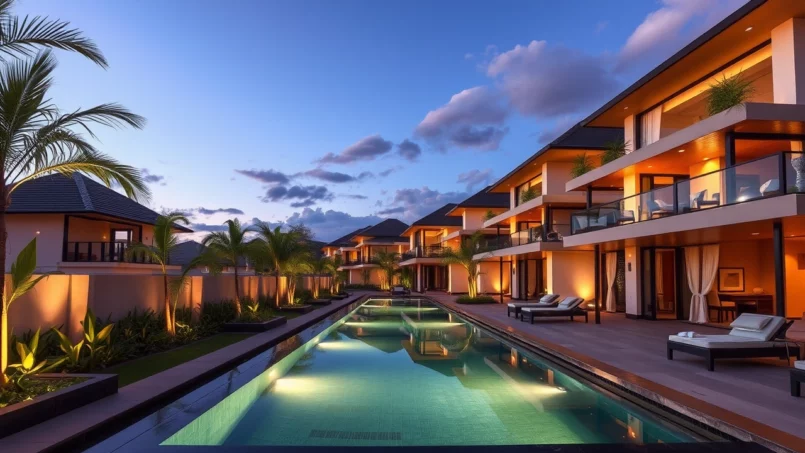
Located at the southern tip of Bali, the town of Nusa Dua is often described as the island’s “most orderly neighborhood”. A gated community managed by the Indonesia Tourism Development Corporation (ITDC), featuring 24/7 security, wide avenues, postcard-perfect beaches, world-class golf courses, and the highest concentration of 5-star hotels in Bali: everything is designed for upscale, family-friendly, and international tourism.
For foreign investors, the real estate market is governed by a specific land law. It is driven by quality tourism and booming infrastructure, offering competitive rental yields compared to the best beach destinations in Asia.
The goal of this article is to break down, in a concrete and factual way, what it means to invest in real estate in Nusa Dua as a foreigner: legal framework, types of properties, prices, yields, taxation, risks, as well as market dynamics and infrastructure projects that could shift the landscape in the years to come.
Nusa Dua: a tourist enclave designed for investment
Nusa Dua is not a Balinese village that developed “naturally” with the rise of tourism. It is a tourism planning project launched in the 1970s, originally financed with the support of the World Bank, based on a master plan completed in 1972 by a French consulting firm (SCETO). At the time, the area was just a patch of barren peninsula with little fresh water and virtually no infrastructure.
Number of classified hotel rooms available in the ITDC tourist enclave of Nusa Dua.
The area regularly hosts major events – UN conferences, APEC, G20, IMF–World Bank meetings, international sports championships – which firmly anchors Nusa Dua in the business tourism and major events segment. For a real estate investor, this means a recurring flow of high-spending visitors who are less sensitive to fads and more interested in safety, quality infrastructure, and stability.
An upscale market centered on families and affluent travelers
Nusa Dua is clearly positioned as the most “premium” seaside resort in Bali. About 70% of the coastline is occupied by luxury hotels and beach clubs, and the area concentrates roughly 20% of all luxury hotels on the island. Brands like The St. Regis, The Ritz‑Carlton, Conrad, and Mulia have a beachfront presence, while branded residences were pioneering in Bali as early as the 1990s, notably with Aman Villas at Nusa Dua.
The target clientele is specific and varied: families with children, couples seeking all-inclusive stays, executives on seminars, conference attendees, senior clients, and high-income individuals. To attract them and justify a high price, it is essential to highlight a secure environment, impeccable cleanliness, a white sand beach considered among the most beautiful in Asia, and prestige amenities like the Bali National Golf Club. This clientele primarily seeks comfort, tranquility, and international standards.
This orientation is reflected in the profile of available properties: primarily luxury villas, branded residences integrated into 5-star hotels, upscale apartments, and wellness or art & lifestyle programs. The surrounding micro-markets (Sawangan, Kampial, Benoa, Taman Giri) broaden the offering with standalone villas, residential houses, and land.
The downside of this positioning: an environment perceived as less “authentic” and more expensive than elsewhere in Bali. Backpackers and budget-conscious digital nomads tend to head to Canggu, Seminyak, or Ubud. For an investor, this means a less “trendy” but more stable market, with reduced volatility and a more predictable clientele.
Underlying trends: Bali growing, Badung at the forefront
To understand Nusa Dua, it must be placed within the broader Balinese market. Over the past five years, real estate prices on the island have increased by an average of about 7% per year, with a rise of roughly 51% in price per square meter over the last three years according to aggregated data for Bali. The average price per square meter across the island is around 3,389 euros, while the median property price is around 257,000 euros.
The Badung Regency accounts for nearly half of Bali’s tourism real estate activity.
In this context, Nusa Dua acts as a “defensive asset”: less speculative than new hotspots like Canggu, but supported by a high-end demand base, strong public governance through ITDC, and excellent connectivity to infrastructure (toll road, immediate proximity to the airport, planned light rail and urban subway link). Experts describe the market as “slower, but very resilient,” with moderate price appreciation but little volatility and a limited risk of demand collapse.
Legal framework: how can a foreigner own property in Nusa Dua?
Indonesian land law is based on the 1960 Basic Agrarian Law (Law No. 5) and several government regulations (notably Regulation No. 103/2015) that precisely govern the ability of foreigners to hold rights to real estate.
The key point is simple: a foreigner cannot directly hold full title (Hak Milik) to land. In practice, three legal avenues are available to invest in Nusa Dua (as elsewhere in Bali).
Leasehold (Hak Sewa): the most flexible solution
Leasehold – or Hak Sewa – is a long-term lease agreement with an Indonesian owner. It is the simplest and most common formula among foreign investors.
Key points to remember:
This is a private contract, not necessarily registered with the national land registry. No residency permit is required; a valid passport and visa suffice. Typical terms are 25 to 30 years, with extensions potentially reaching 80 or 99 years. The law sets no maximum duration; it depends on negotiation and contract drafting. The contract remains valid even if the lessor or lessee dies. There is no legal limit on the number of leasehold contracts a foreigner can sign.
In Nusa Dua, many villas offered for investment are on a leasehold basis, typically 25 or 30 years with pre-negotiated extension options. Price ranges observed for a 2-bedroom villa on a 25-year lease are around 240,000 to 350,000 US dollars, depending on proximity to the beach, quality of construction, whether it carries a hotel brand, and the level of service (rental management, concierge, etc.).
The advantage for the investor is a lower entry ticket than a freehold via a company, and the ability to focus on rental profitability over the lease term. The drawback: the value of the right decreases as the term approaches, unless renegotiated or an extension is planned from the start.
Right of use (Hak Pakai): for personal residence
Hak Pakai, or right of use, allows a foreign individual to hold a real right over a property, registered with the National Land Agency (BPN), subject to meeting certain residency conditions:
Indonesia offers several stay options for foreigners, tailored to different situations and profiles.
Temporary residence permit for foreign residents, usually tied to employment, investment, or family reunification.
Permanent residence permit, the next step after several years with a KITAS, offering long-term residential stability.
Visa specifically designed for foreign retirees over 55 wishing to reside in Indonesia.
Visa for holders of significant assets in Indonesia, allowing an extended stay without local professional activity.
This title has several specific features:
– it is granted only in a personal capacity, and a foreigner can hold only one property under Hak Pakai;
– it must be a built property (not bare land);
– its primary use is residential, not hotel-related: it can be rented long-term if declared, but not for short-term vacation rentals like Airbnb;
– the initial term is 30 years, extendable by 20 years, with the possibility of renewal to reach up to about 80 years in total;
– if resold to an Indonesian, the title can be converted to Hak Milik.
In Bali, Hak Pakai applies to properties meeting certain value and size conditions (minimum value around 5 billion Indonesian rupiah for Bali, area often capped at 2,000 sqm, or up to 5,000 sqm with authorization). It is therefore suitable for a buyer who primarily wants to secure a personal residence in Nusa Dua, without necessarily aiming for intensive rental yield.
PT PMA and Hak Guna Bangunan: for a “business” investment
To operate a property as a commercial asset (vacation rental villa, boutique hotel, serviced residence, condo-hotel, etc.), the most robust structure is the creation of a foreign investment company, or PT PMA (Perseroan Terbatas Penanaman Modal Asing).
Key characteristics:
– at least two shareholders, a director, and a commissioner;
– stated share capital typically around 10 billion rupiah (about 700,000 US dollars), of which 25% is paid up;
– registration with BKPM (Indonesia Investment Coordinating Board) and obtaining operating licenses;
– activities must comply with the list of permitted investments (Negative Investment List).
The PT PMA can hold a building right (Hak Guna Bangunan), which allows it to construct and own buildings on land for an initial term of 30 years, extendable by 20 years, and then renewable again. In practice, this allows economic control of the asset over a horizon that can reach 80 years.
This structure is particularly relevant for:
– short-term rental villas with hotel services;
– branded residences (Ramada, Wyndham, Aman, etc.);
– multi-unit complexes (e.g., development of 10 villas, Art & Wellness resort, etc.);
– a resale strategy through the transfer of shares, rather than direct title transfer.
Using an Indonesian nominee to circumvent the direct freehold ban is illegal and provides no legal protection in case of dispute. Reputable practitioners systematically advise against such arrangements.
Zoning: why the color of your plot matters as much as the sea view
In Bali, urban planning regulations are based on a color-coded zoning system, which determines the permitted use of each plot. For an investor, this is a due diligence element as crucial as the land certificate.
The main colors are:
– green zones: agricultural land, construction strictly prohibited;
– yellow zones: residential with limited commercial activity, more complex for obtaining hotel licenses;
– pink zones: tourist purpose (hotels, resorts, tourist villas);
– orange zones: mixed residential and commercial use;
– red zones: public infrastructure;
– dark brown zones: industry.
Nusa Dua is primarily located in a tourist zone, with a portion in green zone in the hinterland. The area managed by ITDC is dedicated to hospitality and tourism. Short-term rental operations are therefore consistent with the area’s purpose, provided the necessary permits are obtained.
The online tool Batara Map allows checking the zoning of a plot, but it is in Indonesian and reading the symbols remains technical. Hence the importance of a lawyer or a notary/PPAT familiar with transactions in Nusa Dua.
Changing the zoning afterwards is reputedly extremely difficult, lengthy, and uncertain. It is therefore better to ensure that the desired land is in a tourist or mixed zone compatible with the rental project.
Property types, price levels, and market segments in Nusa Dua
The Nusa Dua market is relatively homogeneous in terms of positioning: upscale, oriented toward affluent tourists and families, with a dense supply of professionally managed accommodation.
However, several segments can be distinguished, with different price levels and yields.
Independent villas and villa complexes
Villas remain the preferred format for foreign visitors to Bali (more than 60% of foreign buyers favor this type of property). In Nusa Dua, you’ll find:
– small 1–2 bedroom villas, sometimes in secure complexes;
– family-size 3–4 bedroom villas with pool, garden, sometimes sea view;
– groups of villas managed in hotel style.
The price ranges observed in available studies for Nusa Dua are roughly:
| Villa type | Title / indicative term | Indicative price range |
|---|---|---|
| 2-bedroom villa | Leasehold 25–30 years | 240,000 – 350,000 USD |
| 3–4 bedroom villa | Freehold via PT PMA or long lease | 500,000 – 1,000,000+ USD |
“Packaged” offers also target professional investors. For example, a project named “Villas Nusa Dua by Leon” offers a lot of 10 luxury villas for a total investment of about 2.8 million US dollars on a 1,000 sqm freehold plot, each villa being about 85 sqm plus 35 sqm terrace. The developer highlights a projected return on investment of 13–15% and an immediate “equity gain” of 25–35% upon completion, based on local comparables sold for around 350,000–450,000 dollars per unit.
Real estate developers in Nusa Dua use a specific framework to attract investors. It relies on three main pillars: bulk purchase with a discount compared to unit resale prices, backing by professional rental management, and the promise of double performance through rental yield and property appreciation. These figures, though to be approached with caution, illustrate this marketing strategy.
Branded residences, condo-hotels, and “Art & Wellness” products
Another rapidly growing segment in Nusa Dua is that of branded residences managed by major international chains. An emblematic example is the “Ramada Nusa Dua” project (Ramada by Wyndham) in the Geger sector, which perfectly illustrates the model:
Wyndham Hotels & Resorts, the world’s largest hotel chain, manages over 9,300 hotels in 95 countries.
These branded residences generally command a higher price per square meter than non-branded products, with a premium of around 25–35%. In return, statistics show that hotels under international brands generate on average 20% more revenue compared to independent establishments, and chains like Wyndham benefit from a loyal customer base (115 million members in the Wyndham Rewards program, 43% repeat guests at Ramada, 78% of bookings via internal channels).
For the investor, this translates into a very passive investment scheme: the management company handles all operations (pricing, distribution, operations, maintenance), and the investor receives a contractually defined income, either fixed or indexed to the property’s performance.
Apartments, serviced apartments, and more compact products
Even though villas dominate in Bali, Nusa Dua is beginning to see apartment and serviced apartment products emerge, particularly to attract:
Discover the client profiles that particularly appreciate our hassle-free, upscale accommodation services.
Professionals on extended assignments seeking superior comfort to a hotel and the amenities of an apartment.
Retirees or older couples desiring a comfortable, secure, maintenance-free stay to enjoy the region.
Privileged residents of the region looking for a luxurious pied-à-terre without the hassle of managing a villa.
The order of magnitude observed for Nusa Dua is as follows:
| Property type | Indicative price range |
|---|---|
| Studio | from about 90,000 € |
| 1-bedroom apartment | from about 150,000 € |
| 2-bedroom apartment | from about 150,000 € (depending on size) |
| Condo-hotel unit | 150,000 – 300,000 USD |
| Executive serviced apartment | 100,000 – 200,000 USD |
These formats often come with yield guarantees (up to 10% annually on some programs), in exchange for centralized management. Liquidity may be higher than for very high-end villas, as the entry ticket is lower and the buyer base is broader.
Land and development projects
Freehold land in the greater Nusa Dua area (outside the strictly hotel enclave) trades in an indicative range of 400 to 700 million rupiah per are (100 sqm), which is about 29,600 to 51,800 US dollars, depending on location (proximity to beach, sea view, road access).
This represents an intermediate price level on the Balinese scale: more affordable than saturated hotspots like Canggu or Seminyak, but more expensive than emerging areas in Tabanan or North Bali. The value appreciation potential comes mainly from:
– the growing scarcity of well-located land in tourist zones;
– infrastructure projects (subway, road improvements, airport expansion);
– the continuous upscaling of the destination.
Rental yields and performance: what can an investor expect in Nusa Dua?
Global figures for Bali indicate gross rental yields between 7% and 15% in the most active tourist areas, with an overall ROI (rent + capital gains) of around 10–15% per year on average, potentially reaching 20–25% in optimistic cases (well-positioned off-plan programs, good management).
In Nusa Dua, consolidated data shows:
The market offers a wide spectrum of annual rental yields, ranging from an average of 6–9% to more aggressive scenarios. There are products targeting 10–11% in long-term rentals, yields of 13–15% in seasonal short-term rentals, and branded projects announcing 15–15.8%. Occasionally, offers may promise up to 18% or even 27%, but these latter figures require great caution and an independent profitability analysis.
The key is to distinguish several dimensions.
First, gross yield (before costs) and net yield. In Bali, operating expenses (management fees, staff, maintenance, utilities, platform commissions, taxes) can easily absorb 45–50% of gross rents. For a 2–3 bedroom villa, this typically means:
– rental management: 10–20% of monthly rents;
– maintenance: 100–300 US dollars per month;
– utilities (electricity, water, internet): 150–250 USD per month;
– insurance: 300 to 1,000 USD per year;
– land and building tax (PBB): often around 0.1% of the official assessment value, i.e., a few hundred dollars per year for an asset worth several hundred thousand dollars.
Branded programs target 85–90% occupancy, but the average reality in Bali is around 80%, with peaks of 85–90% in the most sought-after areas. This rate varies according to season, competition, and pricing policy.
Finally, capital appreciation. For projects sold off-plan, experience shows that prices can increase by 10–20% per year during the construction phase, leading to a total rise of 30–50% between pre-sale and delivery. Once the asset is operational, appreciation tends to follow the general market curve (5–10% per year in established areas, sometimes more for very rare products like certain cliffside villas).
In Nusa Dua, the dynamic is more “reasonable”: observers mention an annual value growth of around 9% on average, reflecting a mature market less prone to speculative booms than some trendier neighborhoods.
Taxation: main taxes and fees to anticipate
Investing in Nusa Dua also means dealing with a specific tax environment. Indonesia distinguishes several taxes directly related to real estate, in addition to legal and notary fees.
The main items can be summarized in the following table.
| Item | Rate or order of magnitude | Key observations |
|---|---|---|
| Acquisition tax (BPHTB) | 5% of taxable value | Borne by the buyer, above an exemption threshold (60–80 million IDR depending on regency) |
| Capital gains tax (seller PPh) | 2.5% of sale price (freehold) | Calculated on the higher of price and official tax assessment (NJOP) |
| VAT (PPN) on new | 11–12% on new properties sold by a developer | Does not apply to resale between individuals |
| Luxury tax (PPnBM) | 20% for properties > 30 billion IDR (~2 million USD) | Concerns a minority of very high-end properties |
| Annual land and building tax (PBB) | In practice around 0.1% of NJOP | To be paid within 6 months of receiving the tax notice |
| Tax on rental income – non-resident | 20% of gross rental income | Rate may be reduced to 10% if a tax treaty applies |
| Tax on rental income – resident | Progressive rates up to 35% of net income | Applicable to Indonesian tax residents |
| Tax on rental income via company (PT PMA) | ~22% corporate income tax | Corporate income tax rate |
| Notary / PPAT fees | 0.5–1.5% of transaction value | Negotiable for large amounts |
| BPN registration fee | 50,000–100,000 IDR per certificate | Modest amount, but mandatory formality |
In the case of leasehold, the scheme is different: the lessee is not taxed on the “sale” of the right; it is the Indonesian lessor who bears a tax (10% if they have a tax ID, otherwise 20%) on the lease value. The foreign investor will then be taxed on the rental income derived from the operation.
Nearly all taxes are calculated based on NJOP (official tax assessment value), which is often 30–50% lower than market values in tourist areas, thereby reducing the apparent tax burden. However, the administration is increasingly comparing the declared price with market prices and will reassess if the discrepancy is deemed excessive.
Finally, any owner generating rental income in Indonesia must obtain a tax ID (NPWP) and file an annual tax return. Failure to comply incurs penalties and late payment interest (2% per month of delay for certain taxes).
Permits, licenses, and compliance: an area not to be overlooked
Beyond legal and tax structuring, a successful investment in Nusa Dua hinges on the regulatory compliance of the target property. Three key areas are essential.
Urban planning and construction
Every building must have a PBG (Persetujuan Bangunan Gedung), a building permit that has replaced the former IMB. Obtaining a PBG requires first having a land use certificate (PKKPR) confirming that the project is compatible with the zoning.
Upon completion of construction, a certificate of compliance (SLF, Sertifikat Laik Fungsi) is issued to attest that the building conforms to the approved plans and is fit for use. The absence of this document can result in administrative sanctions and makes any attempt to resell the property considerably more difficult.
Tourism licenses
To operate a property for short-term rentals (stays of less than 30 days), a Pondok Wisata license is required for small structures, or a hotel license for larger establishments. These licenses can only be held by an Indonesian citizen or legal entity; a foreigner on a leasehold must therefore ensure that their lessor or the management company holds the appropriate license.
Since Nusa Dua is an official tourist enclave, the authorities are particularly vigilant about compliance with the rules. This vigilance is explained by the fact that the area hosts major international events and maintaining a reputation for reliability is a strategic issue.
Community engagement
Even in a highly institutionalized area like Nusa Dua, Balinese communal life operates through Banjars (village councils). Integrating into the community, respecting customs, participating in traditional contributions, and working with recognized local service providers are guarantees of long-term stability.
Experts systematically recommend relying on: scientific research, best practices, and professional experience.
– a lawyer specialized in land law, familiar with the specifics of Badung;
– an experienced notary/PPAT in Bali;
– a reputable real estate agent who knows the area and the players.
Purchase process and due diligence: key steps
The acquisition process of a property in Nusa Dua follows the main lines of Indonesian law, with some specifics related to the profile of foreign buyers.
In practice, the following steps are involved:
Acquiring real estate in Indonesia by a foreign investor follows a structured process. It begins with defining the budget and the type of right (such as a lease, Hak Pakai, or via a PT PMA company). Next, the property is selected, often with an agency. After negotiation, a preliminary agreement (CSPA) is signed with a deposit payment. A rigorous legal due diligence then verifies the title deed, permits, and any disputes. The final deed is signed before a notary, followed by payment of the balance and taxes. Finally, the transaction is registered with the land agency (BPN) and the appropriate right is recorded in the buyer’s name.
For off-plan projects, developers frequently offer installment payment plans: 30% upon signing, then 70% spread over 12 to 24 months interest-free, sometimes with a portion due after delivery. This type of arrangement allows entry into the market without immediately mobilizing all capital, but it carries construction risk (delay, cost overrun, quality).
Infrastructure: why transportation projects could be a game-changer
One of Nusa Dua’s major assets is its connectivity. Already located about fifteen to twenty minutes from Ngurah Rai international airport via a toll road, it stands to benefit directly from several ongoing projects:
Investment in billions of Indonesian rupiah for the urban metro project connecting the airport to several tourist areas.
Indonesian experience shows that a major infrastructure project can drive real estate price increases of around 20% per year in the areas directly served. If these plans materialize within the expected timelines (mostly between 2025 and 2028), properties located near future stations and major transport corridors in Nusa Dua could benefit from an additional valuation leverage.
The construction of a new international airport in northern Bali and the improvement of cross-island roads, such as the Gilimanuk-Mengwi toll road, aim to rebalance tourism development toward regions other than the south. However, Nusa Dua, already well-served, should retain its lead in terms of accessibility and infrastructure standards.
Strengths and limitations of Nusa Dua for a foreign investor
Analysis of the available data allows for a nuanced assessment.
Main strengths
First, relative legal security. Since Nusa Dua is an enclave “steered” by a state-owned enterprise (ITDC) and governed by international standards (environmental certifications, safety norms, infrastructure audits), the risk of anarchic construction or use conflicts is significantly lower than in some rapidly developing villages.
Second, quality infrastructure: roads, lighting, waste management, water supply, hospital, international schools accessible nearby, shopping center, golf course, supervised beaches. For expatriate families or affluent retirees, it is an immediately operational environment.
Percentage of Bali’s hotel supply managed by Nusa Dua.
Finally, relative yield stability: average yields of 6–9% in a market less speculative than Canggu or Uluwatu attract an investor profile seeking predictable income rather than a short-term “killing.”
Limitations and points of caution
Nusa Dua is not the best option for those looking for:
Main factors defining the investment environment and dynamics in Bali.
Traditional Balinese living environment, characterized by vibrant village life and numerous independent cafés.
Very active real estate market with double-digit capital gains, often driven by trends.
Attracts mainly a clientele of digital nomads, despite limited co-working spaces, colivings, and nightlife.
Entry costs are significantly higher than in emerging areas: family villas easily exceed 500,000 dollars, and prices per square meter fall within a range of 2,500 to 5,000 dollars on the Bukit Peninsula (which includes Nusa Dua). Double-digit yields touted by some developers often assume optimistic occupancy and pricing scenarios.
Finally, the general risks of the Balinese market also apply here: possible tightening of short-term rental regulations, occasional moratoriums on new tourism projects to protect the environment, rising construction costs, and fluctuations in the rupiah exchange rate.
Possible investment strategies in Nusa Dua
In practice, several strategies emerge for a foreign investor interested in Nusa Dua.
One approach is to aim for stability by purchasing a 2–3 bedroom villa on a 25–30 year leasehold, well-located relative to the beach, managed by a professional agency, targeting a net yield of 7–9% and moderate medium-term capital appreciation. This is a “portfolio fund” rather than a “venture” profile.
A second approach is to enter a branded off-plan project (condo-hotel or villa complex managed by a major chain), betting on:
The main assets contributing to the profitability and security of this real estate investment.
Benefit from an estimated value increase of 30% to 35% between the pre-sale phase and delivery.
Leverage the brand’s marketing power to ensure high occupancy rates and robust rental rates.
A contractually defined passive income model offers predictability and financial security.
The ticket per unit is often more modest (150,000–300,000 dollars for a condo-hotel), but operational control is low, which suits an investor who does not have the time or desire to manage.
An entrepreneurial path involves developing, through an appropriate legal structure (PT PMA), a small villa complex or a targeted product (such as wellness, senior living, or art & culture) on a well-chosen plot on the outskirts of the ITDC enclave. This approach requires relying on local partners for architectural design, permit acquisition, engineering adapted to the tropical climate, and operational management. While potential returns are higher, this strategy also carries increased risks, particularly regarding regulation, commerce, and construction.
In all cases, the key remains rigorous due diligence: verify titles, zoning, permits, seller’s tax compliance, solidity of the rental business plan, and exit scenarios (resale to another investor, hotel operator, end user, or refinancing via a local bank).
In a Bali where certain markets like Canggu or Uluwatu are beginning to show signs of tourist saturation (traffic jams, resource tensions, hotel moratorium projects), Nusa Dua occupies a unique place: that of an upscale, planned, managed destination that capitalizes on a clearly assumed positioning as a secure resort for families and affluent travelers.
For a foreign investor, this translates into a specific risk and return profile: less upside explosiveness than in areas with rampant land speculation, but better clarity of fundamentals (quality tourism, superior infrastructure, public governance, presence of major international brands).
The legal framework, though complex, becomes manageable by using proven structures such as leasehold, Hak Pakai, or a PT PMA, and by surrounding yourself with reputable local professionals (lawyers, notaries). Taxation, stable but dense, allows for realistic cash-flow projections provided all costs (taxes, management, maintenance) are included and assumptions about occupancy rates and rates are conservative.
Investing in real estate in Nusa Dua is neither a speculative gamble nor a simple second home purchase. It is, for the investor who understands the rules of the game, an opportunity to position themselves on a “premium defensive” asset on an island whose fundamentals – tourist appeal, upscaling, massive infrastructure investments – suggest that the demand for high-end, secure, and well-connected stays still has bright years ahead.
Disclaimer: The information provided on this website is for informational purposes only and does not constitute financial, legal, or professional advice. We encourage you to consult qualified experts before making any investment, real estate, or expatriation decisions. Although we strive to maintain up-to-date and accurate information, we do not guarantee the completeness, accuracy, or timeliness of the proposed content. As investment and expatriation involve risks, we disclaim any liability for potential losses or damages arising from the use of this site. Your use of this site confirms your acceptance of these terms and your understanding of the associated risks.

Cyril Jarnias is an independent expert in international wealth management with over 20 years of experience. As an expatriate himself, he is dedicated to helping individuals and business leaders build, protect, and pass on their wealth with complete peace of mind.
On his website, cyriljarnias.com, he shares his expertise on international real estate, offshore company formation, and expatriation.
Thanks to his expertise, he offers sound advice to optimize his clients' wealth management. Cyril Jarnias is also recognized for his appearances in many prestigious media outlets such as BFM Business, les Français de l’étranger, Le Figaro, Les Echos, and Mieux vivre votre argent, where he shares his knowledge and know-how in wealth management.





