
 Published on and written by Cyril Jarnias
Brindisi doesn’t have the fame of Ostuni or Polignano a Mare, but that’s precisely what makes it an interesting playing field for investors today. Between an international airport, a strategic port undergoing major redevelopment, an industrial dynamic focused on green energy, and still-affordable real estate, the city ticks more and more boxes for those seeking returns without paying the stratospheric prices of the Valle d’Itria.
Brindisi is not yet a speculative market, but it represents a rational opportunity. This dynamic is supported by solid rents and a deep economic transformation, as confirmed by recent data and major ongoing projects.
Brindisi in the Italian and Apulian context
Before zooming in on neighborhoods and figures, we need to place Brindisi within the Italian real estate landscape.
The Apulia region shows an average price of about €1,430–1,440/m², well below the national average, which hovers around €1,700–1,950/m² depending on the source. Within this framework, the province of Brindisi is among the most dynamic areas in the region: the average price reaches approximately €1,699/m², with an increase of about 3% year-over-year, while many southern territories remain stagnant.
Average price per square meter exceeding €2,200 in the city of Bari, due to its tourist and economic appeal.
This accessibility is reinforced by another factor: the major tourist hubs in the area, such as Ostuni or the coastal towns of the Bari coast (Monopoli, Polignano a Mare), now come at a premium, sometimes over €2,500/m², with renovated properties easily exceeding €6,000/m². Brindisi thus finds itself in an intermediate position: cheaper than the region’s superstars, but located at the heart of tourist and economic flows.
Still-attractive price fundamentals
For an investor, the first question remains the same: how much does a square meter cost, and what are the corresponding rents.
Prices in the city of Brindisi
Data from July 2025 gives a very precise picture of the residential market within the city walls. The average asking price for sales is €1,163/m², a very slight decline compared to the previous year (-0.17%). The city saw a recent peak at €1,191/m² at the end of 2024 and a low point of €1,120/m² in fall 2023. So we are not in a bubble, but rather in a stabilization phase around a plateau.
The average monthly rent per square meter, indicating the stability of the rental market.
However, differences within the city are significant depending on the neighborhood.
Table 1 – Sales prices and rents by area of Brindisi (July 2025)
| Brindisi Area | Sale Price (€/m²) | Rent (€/m²/month) |
|---|---|---|
| Centro Storico – Cappuccini – Commenda | 1,142 | 7.85 |
| Sant’Elia – La Rosa – Tuturano | 865 | 6.80 |
| Paradiso – Minnuta – Casale – Materdomini – Betlemme | 1,355 | 6.84 |
| Bozzano – Santa Chiara – Sant’Angelo | 1,205 | 6.39 |
| Perrino – San Pietro – San Paolo – Industrial zone | 891 | 6.21 |
| Mitrano – Litoranea – Montenegro | 1,417 | 6.08 |
We can immediately see several things that are useful for an investor :
An analysis of the Brindisi real estate market reveals three distinct dynamics. The seaside sectors (Mitrano, Litoranea, Montenegro) have the highest per‑square‑meter prices but relatively contained monthly rents, which compresses the classic annual rental yield. The historic center and adjacent neighborhoods (Cappuccini, Commenda) show moderate prices and the highest rents in the city, making them a prime area for unfurnished or furnished rentals, including medium‑term stays. Finally, more working‑class areas like Sant’Elia or Perrino remain very affordable, with revaluation potential linked to the realization of urban renewal projects.
Brindisi compared to the rest of its province
At the provincial level, the picture from September 2025 shows a market on the rise, with an average price of €1,699/m² and average rents of €7.67/m²/month. The contrast between municipalities is striking: from €463/m² in San Donaci to €2,587/m² in Ostuni.
Table 2 – Average prices in the main municipalities of the province of Brindisi
| Municipality | Sale (€/m²) | Rent (€/m²/month) |
|---|---|---|
| Brindisi | 1,183 | 7.68 |
| Ostuni | 2,587 | 8.55 |
| Fasano | 2,018 | 6.36 |
| Carovigno | 2,174 | 5.90 |
| Ceglie Messapica | 1,465 | 7.04 |
| Cisternino | 1,668 | 7.80 |
| San Vito dei Normanni | 1,392 | 26.61 |
| Francavilla Fontana | 959 | 6.85 |
| Torchiarolo | 993 | 5.66 |
| Torre Santa Susanna | 789 | 6.27 |
| Villa Castelli | 931 | 4.38 |
Ostuni, the “white city,” clearly sits in a category of its own, with prices approaching €2,600/m² on average and rising much higher for renovated trulli and prestigious masserie. Fasano and Carovigno follow a similar trajectory: rural‑chic destinations, high prices, very international market.
Brindisi, at just over €1,180/m², occupies a median position: more expensive than many inland towns, but well below the star markets, even though it offers a rare combination of airport, port, university, and industrial hubs.
Gross rental yields rarely seen in Western Europe
The big advantage of Brindisi is the relationship between these relatively low prices and the rents being charged. Based on a breakdown by apartment type, gross yields reach levels no longer found in major European capitals.
Table 3 – Average prices and yields by property type (Brindisi city)
| Property Type | Average Price (€) | Average Monthly Rent (€) | Estimated Gross Yield |
|---|---|---|---|
| Studio | 165,000 | n/a | n/a |
| 1 bedroom | 77,500 | 550 | ≈ 8.52% |
| 2 bedrooms | 78,000 | 600 | ≈ 9.23% |
| 3 bedrooms | 108,000 | 700 | ≈ 7.78% |
| 4 bedrooms and up | 147,000 | 750 | ≈ 6.12% |
The core of profitability is clearly on small and medium apartments, especially 1‑2 bedroom units. With an entry ticket starting around €77-78,000 and monthly rents of €550-600, gross yields comfortably exceed 8%, and the best neighborhoods can go up to around 8.6% according to yield calculations by area.
This is the average gross yield offered by 2-room apartments in the province, for a purchase price around €80,000.
To give an idea, many national studies place the average gross yield of Italian residential real estate around 4.7% in large cities, with prime neighborhoods in Milan well below 4%. Brindisi is therefore well above this average, without being an ultra‑risky or illiquid market: this is a port city of over 80,000 inhabitants, a provincial capital, transport hub, and industrial center.
Airbnb and short‑term rentals: real potential, but tightly regulated
The tourist rental market often makes a difference in seaside towns. In Brindisi, it is already well structured and heavily regulated, which limits excesses but requires serious work.
Data gathered for the period February 2025 – January 2026 lists 315 active listings, overwhelmingly dominated by entire homes (more than 77%), mainly apartments or condos. The dominant type is the 1 bedroom, accounting for about half of the stock, followed by 2 bedrooms; together, these two segments concentrate nearly 74% of the supply.
The average capacity is 3.1 guests, with a majority of properties suitable for 2 or 4 people, which perfectly matches the typical clientele: couples, small families, business travelers.
Performance and seasonality
The market shows strong seasonality. Unsurprisingly, August is the absolute peak of the year, with monthly revenues that can reach over $2,400 for top performers, occupancy around 60%, and an average nightly rate of about $128. Conversely, January is the lowest point, with revenues that can drop to around $590 and occupancy falling back to 18–20%.
Over the entire year, average data gives a good idea of the potential of a project or resource. It allows for establishing a global and reliable vision, smoothing out seasonal or occasional variations, to facilitate planning and long‑term performance evaluation.
– a typical annual revenue of around €18,000–19,500 for a well‑managed property, with a median occupancy rate near 60–63% and an average daily rate around €80–85;
– a very marked split between high season (July, August, September), with occupancy above 50% and average revenue of about $1,950 per month, and low season where occupancy often falls below 25%.
The key for an investor is to understand that this is not an explosive market like Ostuni or Cisternino, where average Airbnb rates far exceed €200 per night, but an intermediate environment: competitive rates, real international demand, strong seasonal influence.
Tourist real estate market analysis
Market structure and regulations
The city stands out for strict regulation of short‑term rentals. Data shows that approximately 85% of listings are already licensed or declared, indicating that the municipality closely monitors the sector. In practice, obtaining a permit or registration number is almost mandatory.
A majority of listings offer a moderate or flexible cancellation policy, making it easier for international clientele to book, and many properties remain officially available for more than 270 days per year, even if the days actually rented are concentrated over 3 to 6 months.
For an investor, this means two things:
– they must include the costs and lead times for regulatory compliance in the business plan;
– it is often wise to combine several strategies: high tourist season in short‑term, low season in medium‑ or long‑term to secure a rental income stream.
Short‑term vs. long‑term: choosing according to your strategy
Brindisi offers the possibility of playing on several fronts: traditional yearly rentals, shared housing, furnished apartments for students or workers, short‑term tourist or corporate stays. Each segment has its own logic.
Long‑term rentals: stability and favorable taxation
The classic residential market shows steady demand. The average net salary is around €1,675 per month, and average rents for a 1‑bedroom in the center are around €500, a 3‑bedroom around €700 in the center and €550-600 in the outskirts. Macro indicators (Price to Income Ratio of 3.96; Price to Rent Ratio between 13.5 and 15.8) point to a fairly healthy market: purchasing is still affordable relative to local incomes, and homeownership remains economically rational for households.
The Italian tax system has advantages for landlords: rental demand is stable, and the option for “cedolare secca” (flat tax) allows taxation at 21% on gross rents (or even 10% for certain rent‑controlled leases). Additionally, the property tax (IMU) is moderate compared to other major European countries, with each municipality applying a rate between 0.4% and 1.06% of the cadastral value.
With gross yields reaching 8–9%, a prudent landlord can aim for 5–6% net after expenses and taxes, which is far superior to what one obtains in the northern metropolises of the country on comparable properties.
Short‑term: betting on a multi‑client approach
Short‑term rental, by the night or week, targets several audiences in Brindisi:
The city of Brindisi, Italy, attracts different types of visitors thanks to its multiple assets, ranging from historical heritage to modern economic infrastructure.
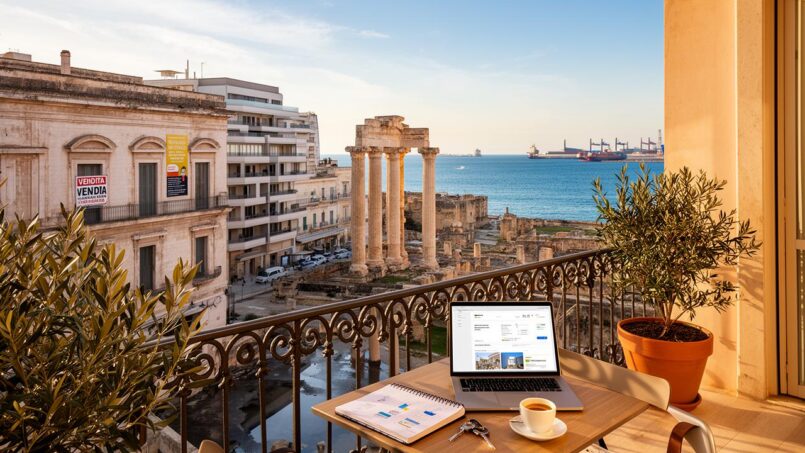
Attracted by the historic center, the Lungomare Regina Margherita promenade, the cathedral, the Roman columns, and excursions into the Valle d’Itria.
Linked to port activities, companies in the industrial zone, shipyards, and the major energy projects in the region.
Attracted by quiet residential neighborhoods like Casale or Perrino, while remaining close to the sea and the airport for mobility.
The strong dominance of 1–2 bedroom apartments in the listings shows that this is a market mainly oriented toward this mixed clientele. The average booking lead time (about 51 days) and the fact that summer is booked much earlier (up to 76 days in advance for an August stay) confirm that international visitors plan their trips, especially in high season.
For an investor, the challenge is to calibrate the product: a small, well‑renovated apartment, ideally in the center or Casale, equipped with good internet connection, a workspace, and a balcony or terrace. This type of property can capture both the summer tourist flow and an off‑season medium‑stay clientele.
Where to invest in Brindisi: a neighborhood‑by‑neighborhood reading
The numerical data is only part of the equation. The perception of a neighborhood, its services, atmosphere, and connection to infrastructure play a central role, especially for furnished rentals.
Casale: the safe bet for digital nomads
Casale is often described as a “hidden gem”: a green, quiet neighborhood close to the coast, well connected to the center by the ferry that crosses the port. It is also an ideal base for digital nomads and families, with easy access to the airport and the ferry terminal to Greece.
Price figures (included in the large area Paradiso–Minnuta–Casale–Materdomini–Betlemme) indicate a market already slightly more expensive than the average, around €1,355/m² for sales, but with rents that remain reasonable. This is typically an area where you pay more for quality of life than for prestige, with good potential for medium‑term furnished rentals, especially for teleworking stays.
Centro Storico, Commenda, Cappuccini: the rental heart
The historic center concentrates most of the tourist attractions, from the waterfront promenade to the main churches, through the shopping streets. The adjacent areas of Commenda and Cappuccini mix residential housing, local shops, and efficient transport routes.
The average rent per square meter per month in this sector, the highest in the city.
Properties such as the independent building with panoramic terrace in the Cappuccini area – cited in local listings – perfectly illustrate the type of product in demand: income‑generating buildings, apartments with outdoor space, close to services (schools, medical facilities) and well served.
Sant’Elia, Perrino: the “value” option boosted by urban renewal
Sant’Elia is perceived as a quiet, affordable residential neighborhood, ideal for budget‑friendly housing. Perrino, described as an authentic area with its local shops, is the subject of a specific urban regeneration strategy.
The administration has launched a strategy for the neighborhood, including renovations with private participation, permits for social housing, and the development of renewable energy communities, the first of which in Sant’Elia.
In Perrino, projects for ARCA Nord public housing, as well as other actions to complete the regeneration, are already underway. These programs have a dual effect: improving the quality of life for residents and creating prospects for medium‑term revaluation. For a patient investor, these are sectors where buying at low prices (often around €891/m² for Perrino and about €865/m² for Sant’Elia) can turn into a nice capital gain over 5–10 years, without sacrificing immediate rental profitability.
Mitrano, Litoranea, Montenegro: the sea and leisure bet
The areas of Mitrano, Litoranea, and Montenegro concentrate some of the most expensive properties in the city in terms of price per square meter, around €1,417/m². This is logical: direct proximity to the sea, villas, residences with a view, appeal for second homes.
Rents, on the other hand, remain relatively moderate on an annual basis (€6.08/m²/month), which somewhat reduces the gross yield on classic rentals. The interest in these sectors lies more in a mixed strategy of second home/seasonal rental or in seeking long‑term capital appreciation, as part of a gradual upscaling of Brindisi’s seafront.
A territory in full transition: the impact of major projects on real estate
One of the most underestimated elements when looking at Brindisi from the outside is the depth of its ongoing economic transformation. The city is emerging from a long period marked by mono‑dependence on coal and heavy chemicals and is undertaking a conversion toward green energy, logistics, shipbuilding, and innovation.
This evolution is not just political talk: it translates into projects, budgets, jobs.
From coal city to green energy hub
The gradual closure of coal‑fired power plants caused a social and economic shock, with job losses and a slowdown in port activities related to fuel flows. But this void is now identified as an opportunity to establish new activities.
The coordination committee received more than 13 proposals, mainly focused on the energy transition. Here is a major structuring project.
Partnership between Eni and Seri Industrial to produce more than 8 GWh/year of stationary LFP batteries in the Brindisi industrial zone.
The plant will produce the active cathode material and assemble energy storage systems, with a plan for an integrated recycling unit.
Coupled with the prospects for developing a hydrogen hub, with investments announced by major Italian groups (Edison, Saipem, Snam, Alboran, etc.), this new sector places Brindisi at the heart of the Italian strategy for renewable energy storage and distribution. This is far from the image of a declining industrial garrison town: a new technological cluster is being born.
The port of Brindisi: from coal to mega‑yachts
The port, historically structured around coal flows and chemical products, is also reinventing itself. The Piloda group’s proposal to transform the former coal‑fired power plant area into a hub for ship repair, refit, and demolition is the most spectacular illustration.
Amount of the planned investment for the construction of a 230‑meter dry dock in Brindisi.
The impact on real estate is not immediate, but it is obvious: more skilled jobs, more rotation of technicians, engineers, sailors, more rental demand, both temporary and permanent. Not to mention the spillover effects on shops, restaurants, and services.
Urban planning, culture, university: the city is reshaping itself
On the urban front, the municipality is not standing by. Several regeneration projects are underway or planned:
The urban transformation includes the requalification of the waterfront via the “Smart City Port” project, the recovery of the Montecatini hangar financed by the Port Authority, the adaptation of the urban plan to the regional landscape plan, and the rehabilitation of multiple public buildings (university centers, student housing, cultural space, university cafeteria, socio‑health center).
Added to this are more diffuse actions, such as the creation of “neighborhood houses” recognized at the European level as a good practice, or Brindisi’s candidacy for the title of Italian Capital of Culture, with substantial budgets to support theater, festivals, and social inclusion.
This reshaping of the urban fabric has a direct impact on the residential attractiveness of the neighborhoods involved. An emblematic example: Palazzo Guerrieri, a former municipal building left abandoned, has become a hub for social innovation and a start‑up incubator. In three years, more than 60 events, a hundred external gatherings, and several young companies have emerged there. This type of place attracts a new profile of residents: entrepreneurs, creative workers, freelancers.
For an investor, this also means a change in demand: more interest in well‑connected homes with good digital services, flexible spaces for teleworking, and proximity to these new urban anchors.
Regional drivers: tourism, Valle d’Itria, and the spillover effect
You cannot understand Brindisi without looking at what is happening a few dozen kilometers away.
The Valle d’Itria, between Bari and Brindisi, has become one of the most competitive second‑home markets in Italy. Ostuni, Cisternino, Carovigno, Fasano, and Ceglie Messapica attract a sophisticated international clientele, willing to pay top dollar for renovated trulli, lamie, and masserie surrounded by olive groves. Airbnb data confirms this: average daily rates that rise to over €270 in Ostuni, nearly €280 in Carovigno, with estimated annual revenues between €45,000 and over €60,000 for some properties with pools.
The average real estate market price exceeds €2,000/m² in municipalities where it is already mature or saturated.
– investors with tighter budgets turn to the city to benefit from higher yields, even if the entry ticket is less “sexy” than a trullo in the countryside;
– part of the tourist flows irrigating the region naturally spills over into Brindisi, particularly via the airport and port, generating growing demand for short‑term accommodations near these infrastructures.
In short, Brindisi benefits from a powerful spillover effect from the regional tourism boom, without (yet) suffering from the extreme price surge.
Tax and legal framework: what a foreign investor needs to anticipate
Investing in Italy requires getting familiar with a fairly sophisticated tax and legal framework, but which, if well managed, can prove rather favorable.
Acquisition costs: taxes and fees
Upon purchase, the main costs are:
– registration tax (imposta di registro): 2% of the cadastral value for a primary residence, 9% for a secondary residence or classic investment rental;
– mortgage tax and cadastral tax: often fixed amounts (€50 each) when buying from a private individual, or €200 each if buying from a developer subject to VAT;
– notary fees, between 1% and 2.5% of the purchase price;
– real estate agency commission, usually 2% to 4% plus VAT, often split between buyer and seller;
– any legal fees if hiring a lawyer, which is highly recommended for a non‑resident investor.
In total, it is reasonable to budget between 7% and 10% of the purchase price to cover all these costs.
Rental taxation: IRPEF or flat tax
Rental income is taxable in Italy, even for a non‑resident. Two regimes exist for individuals:
For renting out a property in Italy, two main tax regimes are available to the owner. The ordinary IRPEF regime includes rental income in overall income, taxed according to brackets (23%, 35%, 43%), but allows deducting certain expenses. The “cedolare secca” option applies a flat rate of 21% on gross rents (10% for certain rent‑controlled leases), with no deduction of expenses, in exchange for great administrative simplicity.
For a foreign investor with no other Italian income, the 21% flat tax on gross yields of 8–9% remains very competitive, especially when compared to other Western European countries where the fiscal and wealth pressure is much higher.
Regulatory risks: urban planning, compliance, and short‑term rentals
As everywhere in Italy, it is crucial to verify the urban planning and cadastral compliance of the targeted property: many buildings have undergone undeclared modifications. Buying an apartment that has been enlarged without a permit or an illegally enclosed terrace can result in costly restoration obligations, or even contract cancellation.
A strengthened national framework allows municipalities to impose constraints on short‑term rentals. Brindisi already applies strict licensing and registration rules for tourist apartments, in accordance with a recent decision by the Constitutional Court.
The consequence for the investor is twofold:
– It is essential to systematically include a technical and legal audit before any preliminary agreement, by hiring a surveyor or engineer to verify the property’s compliance, and a lawyer to analyze the deeds and permits;
– In the case of an Airbnb strategy, it is necessary to inquire precisely about the local conditions for obtaining a license, and, if applicable, to favor properties located in areas where the municipality wants to stimulate supply (e.g., sectors to be revitalized).
Profiles of winning strategies in Brindisi
Based on all this data, several investment models naturally emerge.
The 2‑bedroom in the center or nearby neighborhood: the “workhorse” of yield
With an average purchase price around €78,000 for a 2‑bedroom apartment and rent of about €600/month, the gross yield approaches 9.2%. By targeting areas like Centro Storico, Commenda, or Cappuccini, one can hope for slightly higher rents and better rental liquidity.
This type of property:
– is suitable for long‑term rental to couples, workers, or young families;
– can also be used as a medium‑term furnished rental for transient workers or students, given the ongoing university projects;
– remains easy to resell if needed, as the entry price is accessible for local demand.
The small, well‑located Airbnb portfolio
By targeting 1 or 2 apartments of 1–2 bedrooms:
– in the historic center or on the Lungomare promenade,
– or in Casale for the nomad and business clientele,
Average annual revenue targeted per property after renovation to international standards, according to Airbnb data.
The idea is not to compete with Ostuni on rates of €250–300/night, but to position oneself in an intermediate segment: quality accommodations at a rate of €80–120/night, well‑rated, with professional management.
This strategy works particularly well if:
– you can combine high tourist season with corporate mid‑season (technicians, consultants, sailors, engineers);
– you have a concierge service or local manager familiar with municipal rules and capitalizing on high‑demand periods (August, events, conferences, large‑scale construction sites).
Betting on neighborhoods in transition
Neighborhoods like Perrino or Sant’Elia offer very low entry prices, sometimes below €900/m², with, in the case of Perrino, a clearly outlined trajectory of urban regeneration and public investment.
An effective strategy can be to acquire several units, such as apartments or commercial spaces, within the same building or block. This approach allows pooling management, increasing control over the condominium, and potentially benefiting from economies of scale for renovations or services.
– renovating while incorporating new energy efficiency requirements (double glazing, insulation, efficient heating systems);
– targeting a long‑stay clientele with affordable rents, compatible with local incomes, but higher than current levels in the neighborhood;
– positioning for a resale in 7–10 years, when public interventions and the arrival of new services will have improved the area’s image.
Gross yields can already be attractive from the purchase, but it is mainly the capital appreciation perspective that makes this approach interesting.
Brindisi: a city still under the radar, but not for long
If you piece together all the elements – affordable prices, high yields, provincial growth, massive industrial projects, urban regeneration, strategic position in the Mediterranean – Brindisi stands out as an atypical investment market in Italy: neither a saturated “trophy market” like some corners of Apulia, nor a structurally declining city.
The province shows a price increase of over 3% year‑over‑year, rents are rising slowly but surely, and the city itself remains on a stable price plateau after a catch‑up cycle. In a country where some southern areas struggle to attract capital, Brindisi acts as a pole of resistance, benefiting both from regional tourism dynamics and an ambitious industrial reconversion.
To succeed, the investor must conduct a thorough verification of property titles, perform a building compliance audit, and master the specific regulations for tourist rentals.
– gross rental yields of 8 to 9% on the best segments, while the Italian average hovers around 4 to 5%;
– limited risk of rental vacancy in central and well‑connected areas;
– a credible outlook for revaluation, driven by energy, logistics, and the cultural upscaling of the city.
Brindisi is not a market for the hasty speculator, but a field for patient and structured investors, seeking to combine cash flow, diversification, and exposure to a territory in full transition. It is precisely this type of market, still undervalued but rich in fundamentals, that often creates the best real estate stories over the long term.
A wealth planning project or a question? Contact us now to speak with a wealth management expert.
Disclaimer: The information provided on this website is for informational purposes only and does not constitute financial, legal, or professional advice. We encourage you to consult qualified experts before making any investment, real estate, or expatriation decisions. Although we strive to maintain up-to-date and accurate information, we do not guarantee the completeness, accuracy, or timeliness of the proposed content. As investment and expatriation involve risks, we disclaim any liability for potential losses or damages arising from the use of this site. Your use of this site confirms your acceptance of these terms and your understanding of the associated risks.

Cyril Jarnias is an independent expert in international wealth management with over 20 years of experience. As an expatriate himself, he is dedicated to helping individuals and business leaders build, protect, and pass on their wealth with complete peace of mind.
On his website, cyriljarnias.com, he shares his expertise on international real estate, offshore company formation, and expatriation.
Thanks to his expertise, he offers sound advice to optimize his clients' wealth management. Cyril Jarnias is also recognized for his appearances in many prestigious media outlets such as BFM Business, les Français de l’étranger, Le Figaro, Les Echos, and Mieux vivre votre argent, where he shares his knowledge and know-how in wealth management.





