
 Published on and written by Cyril Jarnias
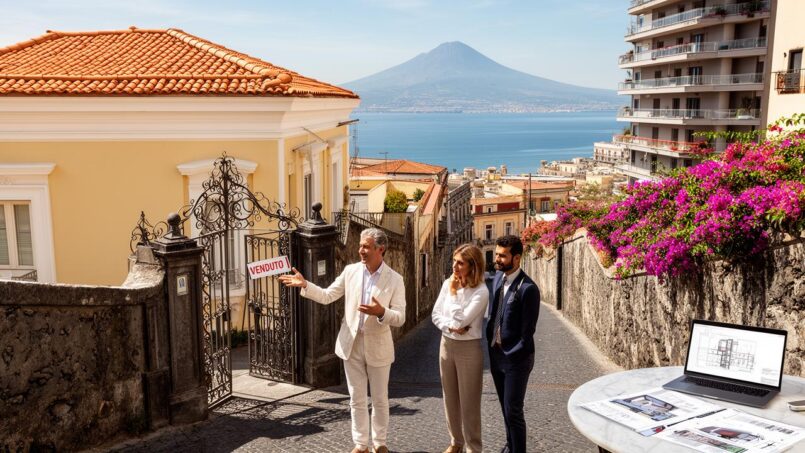
Torre del Greco is not just a city on the Tyrrhenian coast nestled between Mount Vesuvius and the Gulf of Naples. It is also a real estate market undergoing profound transformation, driven by a massive urban renewal policy, a globally recognized artisanal tradition in coral, and a surge in tourism, particularly through short-term rentals.
To invest in Torre del Greco, it is essential to define your strategy (residential, commercial, or tourist) and choose the right neighborhood based on price. The analysis must rely on available market data: key figures, potential yields, and risks to evaluate.
A strategic city in the heart of the Gulf of Naples
Located in Campania, at the foot of Mount Vesuvius and about 14 km from Naples, Torre del Greco occupies a central position in the Gulf of Naples. The islands of Capri, Ischia, and Procida are about fifteen nautical miles away, which reinforces the nautical and tourist appeal of the area.
The city is the fourth largest in its region and has about 80,000 inhabitants.
This context is not anecdotal for the investor: it shapes the city’s image, its future tourist appeal, and therefore the potential demand for housing and accommodations.
A real estate market cheaper than the rest of the province
In terms of prices, Torre del Greco is clearly below the average for the province of Naples and slightly below the regional average, making it a relatively affordable market for a coastal location in Campania.
Price levels and recent trends
In January 2026, the average asking price for residential properties for sale was about €1,831/m². Data from the Real Estate Market Observatory (OMI) confirms a similar level, around €1,838/m² for 2025, with a year-over-year increase of about 4.25% according to this indicator.
Recently observed ranges are wide:
| Period | Average sale price (€/m²) | Min–max range (€/m²) |
|---|---|---|
| June 2025 | 1,801 | 785 – 9,273 |
| January 2026 | 1,831 | 752 – 9,625 |
| OMI 2025 (average) | 1,838 | 1,040 – 2,350 (apartments, by zone) |
Over two years, the recent peak was reached in December 2024 (€1,836/m²) and the low point around March 2024 (€1,777/m²). The overall trend is therefore fairly stable with a slight recent upward pressure, especially in late 2024-early 2026.
The average price of apartments is €1,875/m², which is 1% less than the regional average and 23% below the provincial average.
For the investor, this means that Torre del Greco offers significantly lower entry values than Naples, Ercolano, Pompeii, or the towns of the Sorrento Peninsula, while remaining within a highly sought-after tourist area.
Rental prices: a more dynamic market than sales
On the rental side, the average is around €8.95/m² per month in January 2026, after a peak at €9.29/m² in June 2025. Rents are also below the provincial average (about €11.8/m²), but their trend is more volatile than sale prices.
The average rent per square meter increased by more than 12% between June 2024 and June 2025.
For an investment property landlord, this dynamic is crucial: rents rising faster than purchase prices means, all else being equal, a gradual improvement in gross yields.
Neighborhoods and streets that matter for investment
Behind the municipal average lies a wide disparity between areas. The OMI divides Torre del Greco into eight sectors, each with its own price and rent levels.
OMI zones: from “Pregiata” to the slopes of Vesuvius
Here is an overview of the main residential sectors and their average values:
| OMI Zone | Main characteristics | Sale price (€/m²) | Rent (€/m²/month) |
|---|---|---|---|
| Centro | Via Venezia, Viale Aldo Moro, Corso V. Emanuele… | 1,256 | 4.38 |
| Centro Antico | Around Via XX Settembre, Via De Bettis… | 1,084 | 3.67 |
| Pregiata (C4) | Via De Nicola, upper Via Marconi, Via Cozzolino, Montedoro (1st section) | 1,317 (average), up to 2,350 | 4.44 |
| Via Litoranea | Coastal strip, Via S. Maria La Bruna, Via Cupa Camaldoli | 954 | 3.29 |
| Nuovo Svincolo Autostrada | Viale Campania, Via Sant’Antonio | 998 | 3.42 |
| Area Officine Ferroviarie (D1) | Via Nuova Trecase, Via Leopardi, Via Camaldoli, Via Prota | 867 | 2.92 |
| Pendici Basse del Vesuvio | Maresca hospital sector… | 892 | 2.75 |
| Pendici Alte del Vesuvio (R1) | Higher zones on the volcano slope | 838, min 580 | 2.00 |
In detail, the most sought-after area in terms of values is the C4 “Pregiata” sector, where apartments reach between €1,545 and €2,350/m², and villas up to €2,850/m². Conversely, the high slopes of Vesuvius (R1) show the lowest values, sometimes starting from €580/m² for certain apartments.
For commercial properties in Naples, the most expensive shops are located in the Centro Antico (zone B5) with values reaching €2,350/m². In contrast, shops in the Area Officine Ferroviarie (zone D1) start around €900/m². Warehouses follow a similar price hierarchy, ranging from €280/m² in D1 to €860/m² in zone C4.
The most sought-after sectors by listings
If we look at market activity through the number of listings, Centro Città dominates, with more than 120 listings for sale and rent. Next come the districts of Scappi / Lava Nuova / Montedoro, where asking prices can average around €2,155/m², placing this area among the most expensive in the city.
According to available data, the recommended zones for a real estate investment are those with a residential or tourist vocation.
– the city center (Centro Città, Centro Storico, Santa Teresa);
– areas near the coast and beaches (Via Litoranea, Lungomare, Santa Maria la Bruna);
– major thoroughfares like Via Nazionale, Piazza Santa Croce, or the seafront.
“Prime” streets: Marconi, Vittorio Emanuele, Nazionale
At the micro-local level, certain arteries stand out with prices above the municipal average:
| Street | Average sale price (€/m²) according to sources |
|---|---|
| Via Guglielmo Marconi | 2,598 – 2,626 |
| Corso Vittorio Emanuele | 2,339 – 2,449 |
| Via Alcide De Gasperi | 2,227 |
| Via Cimaglia | 2,273 |
| Via Nazionale | 2,129 – 2,137 |
| Via Circumvallazione | 2,041 – 2,060 |
| Via Torretta Fiorillo | 1,862 – 1,942 |
| Via Litoranea | 1,809 – 1,852 |
These addresses logically concentrate the most liquid and most valuable properties: historic center buildings, apartments with sea views, commercial frontage investment properties, etc.
For an investor, targeting these streets or their immediate surroundings often means paying more per square meter, but also securing higher rental and resale potential.
What budget for which type of property?
Statistics on average prices by property type make it possible to outline typical budgets for different investment profiles.
Apartments: from studio to family apartment
Aggregated data shows the following orders of magnitude for apartments:
| Apartment type | Average sale price (dataset 1) | Average sale price (dataset 2) |
|---|---|---|
| Studio | €57,000 | €82,000 |
| 2-room | €100,000 | €104,000 |
| 3-room | €145,000 | €141,000 |
| 4-room | €194,000 | €193,000 |
| 5-room | €252,000 | €269,000 |
Cross-referencing these figures with the average rent levels by type yields:
| Apartment type | Average monthly rent (dataset 1) | Average monthly rent (dataset 2) |
|---|---|---|
| Studio | €477 | €503 |
| 2-room | €613 | €621 |
| 3-room | €745 | €750 |
| 4-room | €887 | €879 |
| 5-room | €1,044 | €999 |
Even though these data are general, they indicate that a studio or a 2-room can represent a relatively modest entry ticket (between €60,000 and €110,000), for a monthly rent that often exceeds €500–600, before taking into account charges and taxes. Roughly speaking, the theoretical gross yield of a studio at €80,000 rented for €500/month approaches 7.5% (500 × 12 / 80,000), compared to the average Italian national gross yield of around 7.2–7.5% depending on the period.
Houses and villas: a volume game
For houses, we find higher budgets:
| House type | Average price (dataset 1) | Average price (dataset 2) |
|---|---|---|
| 4-room | €212,000 | €194,000 |
| 5-room | €305,000 | €269,000 |
| 6-room | €359,000 | €309,000 |
| 7-room | €414,000 | €360,000 |
| 8-room | €526,000 | €465,000 |
With average rents that, for large houses, can regularly exceed €1,500–2,500/month, these properties are more suited to either family strategies (primary or secondary residence), or setups like co-living or division into multiple rental units, especially in high-demand tourist areas.
The impact of tourism and short-term rentals
As in many Italian coastal towns, the rise of short-term rentals is transforming the Torre del Greco market. Figures from the Airbnb platform allow us to measure this evolution.
Local Airbnb market performance
In January 2026, the city had about 110 active Airbnb listings, with an average annual revenue per property of around €20,500. The average occupancy rate is 58%, with an average daily rate of €98. This translates to about 212 nights rented per year for a “typical” property.
The performance segmentation shows a highly heterogeneous market:
| Performance segment | Occupancy rate | Estimated average annual revenue | Average rate/night |
|---|---|---|---|
| Premium (Top 10%) | 81% | ≈ €31,366 | ≈ €133 |
| High-end (Top 25%) | ≥ 64% | ≥ €20,361 | ≈ €95 |
| Median (50th percentile) | 45% | ≈ €12,613 | ≈ €67 |
| Low-end (Bottom 25%) | 24% | ≈ €5,715 | ≈ €38 |
Over the period June 2024 – May 2025, a short-term rental property was occupied on average 208 nights per year, with an average daily rate of €71, resulting in an annual revenue of about €14,000. Between 2024 and 2025, the average monthly income from short-term rentals increased by about 12.5%, indicating a growing market.
September and July experience the highest demand, while January and February are significantly lower. This profile requires fine-tuning of rates and occupancy to smooth revenue over the year.
Potential gross yields
Cross-referencing these average revenues with typical purchase values in Torre del Greco, the potential gross yield is significant. A simple example:
– purchase of an apartment for €150,000;
– average annual income of €20,000 from seasonal rental (close to the local average level);
The gross yield works out to about 13.3% (20,000 / 150,000), before deducting expenses (management fees, cleaning, maintenance, local taxes, rental taxes). Even after subtracting a significant portion of costs, the yield levels remain higher than those of a traditional long-term rental, which explains investors’ interest in this segment.
This phenomenon is consistent with what is observed in other Italian destinations: in Rome, a well-located apartment can generate 6 to 8% gross yield in seasonal rentals, compared to 3–4% in traditional rentals, and in regions like Puglia, some properties achieve up to 10% gross yield.
Tourist pressure and effects on real estate
The links between tourism and real estate prices are now well documented. A study on Spain shows, for example, that a 10% increase in international tourism causes a short-term increase of about 1.3% in real estate prices. The logic is straightforward: more visitors mean more demand for accommodation, which first boosts rents, then encourages investor purchases, which in turn fuels price increases.
Airbnb data (rising average revenue, increasing number of listings, strong seasonality) suggest that the market is still in a development phase, far from the saturation observed in Florence, Rome, or Venice. The market is described as “emerging,” with supply and demand still balanced and “first-mover advantages” for investors who position themselves early.
Airbnb market study in Torre del Greco
However, the example of highly touristy Spanish cities or Florence shows that unregulated development of tourist rentals can ultimately place heavy pressure on the availability and cost of housing for residents, generate social tensions, and push public authorities to intervene (license caps, bans in certain districts, etc.). Even though such measures are not explicitly mentioned for Torre del Greco, they are now part of the European regulatory landscape and must be considered as a potential medium-term risk.
Major public works that change the game
One of Torre del Greco’s major assets from an investment perspective is the scale of infrastructure and urban renewal projects underway, largely financed by European and national funds (PNRR, PNC, React-EU, “Più Europa” programs, PRIUS, PICS).
The seafront (Litoranea) under construction
The Litoranea redevelopment project represents nearly €9.87 million in investment. It includes widening sidewalks, creating a bike path of about 1.7 km, new street furniture playing on the contrast between red ceramic (recalling coral) and black lava stone, as well as a modern lighting and stormwater management system.
| Litoranea project – key figures | Amount |
|---|---|
| Total investment | €9,870,176.49 |
| PNRR funding | €7,794,454.51 |
| PNC funding | €656,178.58 |
| “Opere indifferibili” funds | €1,419,543.40 |
The executive has already approved the final project, and the start of construction has been announced as imminent. For properties located along Via Litoranea or near the seafront, the prospect of a more qualitative environment, more pedestrian-friendly and better connected, could eventually lead to an increase in prices and greater demand for second homes and tourist accommodations.
A next-generation tourist port
The current port of Torre del Greco suffers from a deteriorated image: outdated shipyards, abandoned banks, lack of mooring spaces, and fragmented concessions often at their expiry. Yet the basin offers water depths of 8 to 9 meters of draft and still hosts a significant fishing fleet and shipbuilding players.
A major project, under discussion for over 20 years, has recently progressed with environmental and archaeological studies, municipal validation, and regional support. It plans to double the operational area, create a large public square with shops and green spaces, add an auditorium, and restructure the southern zone by reclaiming land from the sea through a new breakwater and buried infrastructure.
The stated goal is to transform the port into an engine of the local maritime economy: pleasure boating, fishing, shipyards, but also a service hub and a strategic stopover for nautical tourism in the center of Italy. The new municipal administration describes starting the work as a top priority.
For an investor, the port area represents an opportunity based on the future transformation of the zone. Current brownfields and unattractive buildings could become central points for restaurant activities, tourist services, or residences offering views of a modernized port.
The “Cittadella dello Sport” and other urban projects
In the Viale Europa area, a “Cittadella dello Sport” (Sports Citadel) is under construction. It includes:
– a new sports palace, already launched with an official groundbreaking ceremony;
– a new municipal swimming pool (€2.5 million project, work in progress);
– a future football stadium, while the current “Amerigo Liguori” stadium is to be repurposed for amateur and school sports.
In parallel, several structuring projects are funded by the PNRR and other programs:
Key initiatives for the transformation and modernization of the city, combining heritage, public services, and technology.
Project to enhance the baronial historical heritage.
Rehabilitation of the former mills to house the ‘Colombo’ Nautical Institute and public spaces.
Renovation of the Via Lamaria complexes (budget of €8.6M, work currently suspended).
Remediation and re-use of the former wholesale market on Via Purgatorio.
Creation of a virtual coral museum and deployment of telemedicine services.
Modernization through video surveillance, digitization of services, cloud migration, and improvement of the municipal website.
These projects are part of a comprehensive vision of a “polycentric” city, where key services should be within walking distance (the “15-minute city” concept), with development of limited traffic zones (ZTL) in historic centers, a sustainable mobility plan (PUMS), interchange parking, covering railway tracks to create public spaces, and increasing the number of electric vehicle charging stations (from 5 currently to at least 20).
The combined impact of these investments on the real estate market is twofold:
– improvement in quality of life, and therefore residential attractiveness for families and workers;
– repositioning of the city as a tourist and sports destination, which supports demand for accommodations, shops, and services.
The real costs of a purchase in Torre del Greco
Beyond prices per square meter, it is essential to consider the overall cost of an acquisition in Italy. The rules apply to Torre del Greco as elsewhere.
Purchase costs: between 9% and 15% of the price
For a non-resident, the ancillary costs of a purchase in Italy typically range between 9% and 15% of the sale price, or even higher for luxury properties. They consist of:
The registration tax rate for purchasing a second home or investment property in Italy.
A typical example summarized in studies: for an apartment bought for €150,000 as a second home, the total additional costs can reach €16,000 to €17,000, or about 11–12% of the price, with this indicative breakdown: about €6,000 in registration taxes, €2,000 for the notary, €5,500 in agency commission, €1,200 for a technician/surveyor, and around €400 for utility activation (water, electricity, gas).
Annual taxation and capital gains
Once a property owner, you should budget for:
Main recurring costs to anticipate for owning a secondary residence.
Due on second homes. Its rate is generally between 0.4% and 1.06% of the cadastral value of the property.
Typical annual cost of around €200 to €600 for waste removal service.
Annual costs can range from a few hundred to over €1,000 depending on services and the building.
Recommended annual cost, typically between €180 and €380 to cover the property.
In the event of a resale, a capital gain realized within ten years may be taxed at 26% for a second home, unless alternative arrangements are made through the notary. Rental income may be subject either to the IRPEF progressive rate or to a flat tax regime (cedolare secca) of 21% in most cases.
Specific risks: urban planning, seasonality, compliance
Investing in a coastal market like Torre del Greco, at the foot of an active volcano and in a region with high tourist density, requires mastering certain risks.
Urban planning constraints and “abusi edilizi”
Italy has strict regulations regarding urban planning and landscape protection, especially on the coasts and near sensitive sites (seismic zones, Vesuvius National Park, historical heritage). The “Galasso” law, for example, protects all land strips within 300 meters of the shoreline, making any construction or modification subject to specific landscape authorization.
Many areas are subject to landscape or historical protections, severely limiting building modifications, especially in the city center or along the coast. At the same time, illegal or non-compliant constructions are common and can lead to costly regularization or demolitions ordered by the authorities.
For an investor, technical and legal due diligence is therefore non-negotiable: check the cadastral plans, compliance between the property’s condition and permits, the existence of an occupancy certificate (certificato di abitabilità), and any potential “vincoli” (restrictions) on the land or building. Any irregularity can make the property difficult to resell, non-financeable by banks, or expose the owner to penalties.
Campania is among Italy’s high seismic risk zones. Retrofitting work may be required during major renovations, and structural costs can add 20 to 30% for certain projects. Fiscal measures like “Sismabonus” exist but require careful administrative management.
Annual percentage of the purchase price to budget on average for maintenance of a coastal property, due to accelerated sea-related deterioration.
Tourist season and revenue volatility
Short-term rental occupancy figures in Torre del Greco show a strong dependence on the high season (spring–summer/early autumn). The off-peak months of January and February drag down the annual average, which requires:
– either having cash reserves to absorb low-income periods;
– or combining seasonal rentals with mid-term rentals (outside summer) to smooth revenue.
At the European level, the Spanish or Greek example shows that public authorities are now reacting to the excesses of tourist rentals (bans in certain districts, quotas, licensing requirements, condo votes). Even though Torre del Greco is not at that stage yet, this regulatory risk must be factored into the strategy, especially if the investment relies solely on the Airbnb model.
Who can buy, and how to secure the transaction?
On the legal side, Italian rules allow most foreigners to purchase a property in Torre del Greco, subject to reciprocity conditions for certain non-EU countries. EU and EEA nationals buy under the same conditions as Italians; countries such as the United States, United Kingdom, Canada, Switzerland, and Australia have reciprocity agreements.
Obtaining a codice fiscale (tax identification number) is essential for any transaction. It is also necessary to open an Italian bank account to handle payments, taxes, and charges. An Italian notary must oversee the final deed (rogito). Their role is to verify the parties’ identities, the title deed, the absence of mortgage charges, and to register the sale with the authorities.
In practice, the chain of professionals includes:
– a notary (mandatory);
– a real estate agent duly registered with the Chamber of Commerce, often a key intermediary in the local market;
– a real estate lawyer for foreign buyers, highly recommended;
– a surveyor or engineer for technical checks.
The process generally follows three steps (offer, preliminary contract, final deed), with a deposit of 10–30% paid upon signing the preliminary contract. If the buyer unjustifiably withdraws, the deposit is forfeited; if the seller withdraws, they must return double the amount.
A dense professional ecosystem in Torre del Greco
The network of agencies and local professionals is particularly well developed, which facilitates property searches and remote investment management. Many agencies are directly located in the city:
List of main real estate agencies active in Torre del Greco, with their contact information and specialties.
Located at Via Roma 49.
Via Nazionale 130. Active since 1995, offers about 77 listings.
Corso Vittorio Emanuele 159. Founded in 1997.
Located at Corso Vittorio Emanuele 120.
Via Nazionale 736. Strong presence in the Leopardi district.
Via Mazzini 4. Has about 40 years of experience.
Some of these firms claim several decades of experience and offer services ranging from free valuations to full follow-up through the notary deed, including cadastral checks, financing advice, or even rental management.
For properties sold at auction (judicial auctions), an operator like A.P.I. Srl positions itself as a specialist in forced sale and pre-bid acquisitions. These properties — often listed with significant discounts — can be a source of opportunities for seasoned investors, provided they master the specific legal risks inherent in this type of procedure.
How to position yourself strategically in Torre del Greco?
Combining all this information, several investment avenues emerge.
“Classic residential” long-term strategy
For investors seeking stability rather than maximum yield, the Centro, Centro Antico, Santa Teresa sectors, or the lower slopes of Vesuvius can offer moderate entry prices, steady demand from residents, and limited exposure to tourism-related regulatory risks.
Three- or four-room apartments on streets like Via Nazionale, Corso Vittorio Emanuele, or Via Circumvallazione, well connected to services, lend themselves to long-term rentals to local families, with adequate rents and reasonable vacancy risk.
“Tourist/mixed” strategy on the coast and in the Pregiata area
The districts of Litoranea, Santa Maria la Bruna, Via De Nicola, Via Marconi (upper part), or Montedoro combine several attractive criteria: proximity to the sea, seafront improvements, views of the gulf, access to Ercolano, Pompeii, and the islands. Prices are higher, but Airbnb data shows strong seasonal income potential.
Adopting a mixed approach by combining short-term rentals during the season and mid-term rentals in the off-season allows you to maximize income while capitalizing on seasonality, while ensuring a minimum and stable rental flow. This strategy is particularly suitable for investors willing to manage more actively or outsource management to specialized operators.
“Value-add” strategy via renovation or auctions
The many examples of listings show the existence of properties needing renovation (studios from €25,000–60,000, houses to rehabilitate, apartments to restore in the historic center or outskirts). Rehabilitation, when well supervised technically and legally, allows purchasing well below the average market price (especially in the cheapest areas) and then reselling or renting after work at higher levels.
Judicial auctions, numerous in the region (e.g., lots in Torre del Greco from the Torre Annunziata court), allow purchasing properties at reduced prices. However, they require careful analysis of the files (occupancy, mortgages, zoning compliance) and are more suitable for experienced investors or those assisted by specialized firms.
Conclusion: a still undervalued market in a changing territory
Torre del Greco today offers a rare combination of characteristics for an investor:
Discover the main strengths that make Torre del Greco an attractive real estate opportunity in the heart of the Gulf of Naples.
Prices per square meter significantly lower than those in Naples, the Sorrento Peninsula, or the major nearby tourist islands, while being geographically in the heart of the Gulf.
Growing rental demand, especially in short-term rentals, with average Airbnb revenues (≈ €20,500/year) compatible with high gross yields for well-managed properties.
An unprecedented wave of public investment (seafront, port, sports facilities, digital projects) to improve the city’s image and quality of life.
A dense professional ecosystem of agencies and technicians, facilitating property selection and management, including for foreign investors.
On the other hand, the market is not without risks: Italian urban planning complexity, possible presence of construction irregularities, strong tourist seasonality, medium-term regulatory uncertainty on short-term rentals, seismic and maritime exposure.
A successful investment in Torre del Greco will therefore involve:
For a rental investment in Naples, a methodical approach is essential. It is based on four pillars: a rigorous choice of neighborhood (center, coast, Pregiata, Vesuvius slopes) aligned with your rental strategy; thorough due diligence on the urban planning, cadastral, and legal status of the property; a precise financial projection including all acquisition costs (generally 10 to 15% of the price), ongoing charges, and taxation; and finally, adopting a medium- or long-term vision, aligned with the city’s urban transformation timeline and the evolution of tourism in the Gulf of Naples.
For investors ready to face this Italian reality — both complex and full of opportunities — Torre del Greco today appears as a market still below its potential, at the crossroads of a rich past and ambitious modernization.
Have a wealth planning project or a question? Contact us now to speak with a wealth management expert.
Disclaimer: The information provided on this website is for informational purposes only and does not constitute financial, legal, or professional advice. We encourage you to consult qualified experts before making any investment, real estate, or expatriation decisions. Although we strive to maintain up-to-date and accurate information, we do not guarantee the completeness, accuracy, or timeliness of the proposed content. As investment and expatriation involve risks, we disclaim any liability for potential losses or damages arising from the use of this site. Your use of this site confirms your acceptance of these terms and your understanding of the associated risks.

Cyril Jarnias is an independent expert in international wealth management with over 20 years of experience. As an expatriate himself, he is dedicated to helping individuals and business leaders build, protect, and pass on their wealth with complete peace of mind.
On his website, cyriljarnias.com, he shares his expertise on international real estate, offshore company formation, and expatriation.
Thanks to his expertise, he offers sound advice to optimize his clients' wealth management. Cyril Jarnias is also recognized for his appearances in many prestigious media outlets such as BFM Business, les Français de l’étranger, Le Figaro, Les Echos, and Mieux vivre votre argent, where he shares his knowledge and know-how in wealth management.





