
 Published on and written by Cyril Jarnias
Moving abroad to start a business is a dream for many expats. But Saint Barthélemy is nothing like Dubai, Portugal, or a typical “tax haven”. It’s a small French overseas collectivity in the Caribbean, ultra-luxurious, highly regulated, with a tiny market… but solvable like few places on earth.
This guide provides a realistic overview of the steps to create and develop a business in Saint Barthélemy. It covers the legal framework, taxation, cost of living, available legal structures, banking procedures, business opportunities, and pitfalls to avoid. Its goal is to offer concrete benchmarks to assess whether this territory aligns with your entrepreneurial project and, if so, to guide you through its implementation.
Understanding the playing field: a micro ultra-high-end market
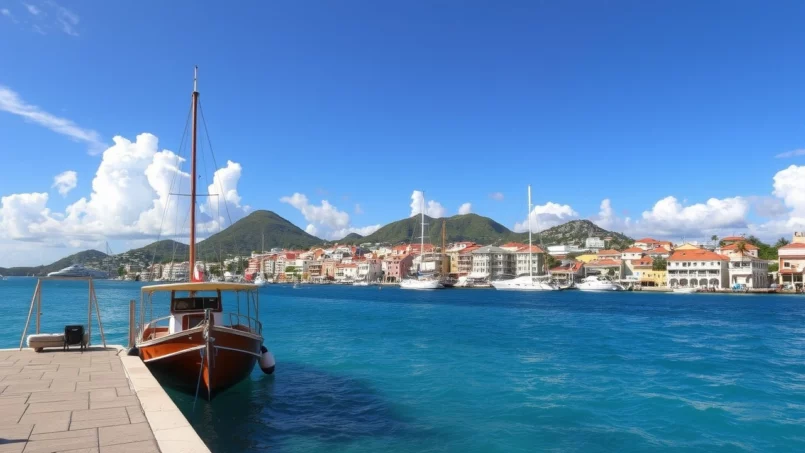
Saint Barthélemy is a small island of 21 to 25 km² depending on the source, nestled in the Lesser Antilles, with Gustavia as its capital and economic heart. The population fluctuates around 9,000 to 11,000 inhabitants, but these figures are misleading: the economy relies primarily on an annual flow of about 200,000 visitors, mostly wealthy.
Number of active businesses in Saint Barthélemy, an exceptional density for a modest population.
The economic landscape is highly concentrated around a few sectors:
| Major Sector | Weight / Role in Local Economy |
|---|---|
| Luxury Tourism & Hospitality | Backbone of the economy, ~€1 billion GDP, 1/3 of jobs |
| Real Estate & Villa Rentals | Ultra-luxury market, high valuation, over 400 rental villas |
| Construction & Building | Activity driven by high-end real estate demand |
| Trade & Commercial Services | Over 4,500 businesses in trade and services |
| Financial Services | About 10% of GDP, presence of major French banks |
| Marine & Yachting | Activity linked to the port, marinas, mega-yachts |
The customer profile is clear: yacht owners, ultra-HNWIs, celebrities, executives, but also a discreet international bourgeoisie, seeking an exclusive, safe, and French-speaking environment, with the euro as the official currency.
For an expat entrepreneur, this means two things:
1. The local residential market is tiny, but
2. The average purchasing power of customers is exceptional, both among tourists and residents.
On the flip side, competition is fierce in all the “obvious” segments (villas, high-end dining, concierge services, boat rentals…) and the expected quality bar is very high.
Legal and political framework: a highly autonomous French collectivity
Saint Barthélemy is an overseas collectivity of the French Republic, endowed with a special status since 2007 (organic law and statutory law of February 2007). Concretely:
– The collectivity has broad autonomy in matters of taxation, urban planning, environment, tourism, and certain economic rules.
– The Territorial Council (19 members) votes on local laws; a President of the Council exercises local executive power.
– Ordinary French law applies in many areas: civil law, criminal law, labor law, structure of commercial companies, procedure, etc.
– The judicial system falls under French civil law, with ties to the Court of Appeal of Guadeloupe.
Legally, setting up a company in Saint Barthélemy means working in a French law environment, but applied to a territory that is neither in the European Union (OCT status), nor in Schengen, with its own tax rules.
For an expat, this has several consequences:
– Legal security is high: protection of private property, contracts, legal recourse, no history of expropriation or capital controls.
– Legal structures and formalities are similar to those in mainland France, with local nuances (especially in taxation).
– Social and labor standards are demanding, as in the rest of France.
Resident status, stay and immigration: what it means for the entrepreneur
All residents are French, but the island has no residence-by-investment program or citizenship-by-investment program. Stay rules depend on the individual’s status:
Stay conditions in France vary by nationality. EU citizens have the right to live and work without time limits. U.S. and Canadian citizens can make tourist stays of up to 90 days without a visa; for a longer stay, they must undergo the French long-stay procedure (long-stay visa then residence permit). Nationals of other non-EU countries must obtain the required visas and residence permits through the French immigration system, starting at the French consulate in their country and then at the prefecture of their place of residence in France.
Owning property in Saint Barthélemy can weigh favorably in a residence application (economic ties, financial means), but does not grant any automatic right of residence.
This resident status is of crucial importance for taxation, as we will see later: it is the key to accessing the island’s ultra-favorable regime.
Overview of business forms: how to structure your activity
The company law applied in Saint Barthélemy is that of France. The most common forms are the same as in mainland France, even if their local use has its particularities.
These include notably:
– EI (Sole proprietorship): majority form (about 53% of structures).
– SARL (Limited liability company): about 15%.
– SAS (Simplified joint-stock company): about 30%.
– SASU (Single-member SAS): about 17%.
– EURL, SA, joint ventures, branches, etc., also exist.
The minimum capital for an SARL is €7,500 according to collected data. In practice, for an SAS or SASU, capital can be set freely, but on a territory where rents and salaries are high, under-capitalization quickly becomes problematic.
For an expat, three families of structures are particularly relevant:
For a micro-business setting up in Saint Barthélemy, choosing the legal status has local specifics. The sole proprietorship or micro-enterprise, while simple, is very limited, and the micro regime adapted to Saint Barth does not exist; the French status can only apply under conditions, without offering the same facilities as in mainland France. The SARL or its single-person equivalent (EURL) remains a classic solution, with a proven legal framework and good banking image, but it is more rigid in terms of governance. On the other hand, the SAS (and its single-person version, SASU) is very popular locally, representing nearly half of all capital companies. This success is explained by its great flexibility (shareholder agreements, preference shares) and its attractiveness to investors.
Important point: it is possible for an entrepreneur already established in mainland France as a sole proprietor to open a secondary establishment in Saint Barthélemy. But this does not magically transform their business into a “Saint Barth” structure. The taxation and obligations must be analyzed on a case-by-case basis.
Creation procedure: from choosing the form to the Kbis
Setting up a business in Saint Barthélemy follows a framework similar to that of mainland France, with a few technical specifics.
Step 1: define the project and legal form
The first step is to clarify:
– The nature of the activity (tourism, services to individuals, B2B, real estate, consulting, tech, crypto…).
– The primary target (tourists, residents, businesses, external market).
– The level of risk (liability, heavy investments, employees).
– The tax strategy (local tax residence or not, coordination with other countries).
On this basis, the choice between EI, SARL/EURL, or SAS/SASU is made according to desired protection, number of partners, potential search for investors or partners.
Step 2: drafting the articles of association and depositing the capital
For companies (SARL, SAS, etc.), you then need to:
– Draft the articles of association (corporate purpose, capital distribution, organization of powers, rules for entry/exit of shareholders, etc.).
– Open a professional account to deposit the share capital.
– Obtain the certificate of deposit of funds.
For questions regarding taxation, tourist accommodation, or multi-activity in Saint Barthélemy, it is recommended to consult a local lawyer or accountant. Although generic templates exist, the specific context of the island often justifies using a professional familiar with its peculiarities.
Step 3: legal publication and registration
As in mainland France, you must:
– Publish a notice of incorporation in an authorized legal announcements newspaper.
– Submit a complete file to the competent office.
Since January 1, 2023, all formalities go through the Single Business Registry on formalites.entreprises.gouv.fr. This portal gradually replaces the former Business Formalities Centers (CFE).
For Saint Barthélemy, a key local player remains the Business Formalities Center (CEM), which:
– Processes over 1,800 requests per year.
– Issues certain professional titles (e.g., property management card).
– Supports project leaders and manages coordination with the Trade and Companies Register (RCS) and the Trade Directory.
Once registration is complete, the company obtains: a K-Bis extract, which is the official document attesting to its legal existence.
List of official documents required for business creation and management formalities in France.
Official document from the Trade and Companies Register (RCS), available online via infogreffe.fr for about €5.
Document providing legal identifiers: SIREN/SIRET numbers, APE code (Main Activity Code), and other classification information.
Set of identifiers needed to carry out all procedures with social (URSSAF) and tax (Tax Authorities) bodies.
The indicative duration of the incorporation procedure is 1 to 2 weeks in simple cases, but can take up to 3 to 6 weeks depending on the structure chosen, completeness of the file, and responsiveness of stakeholders (bank, notary, advisor).
Step 4: post-creation obligations
From the actual launch, the company must notably:
– Keep regular accounts.
– Comply with social obligations (declarations and payment of contributions via the local CPS).
– Pay the annual flat-rate business contribution (CFAE).
– Pay, where applicable, the annual waste disposal tax (set by the treatment center).
– Declare any significant changes (main activity, management, registered office…) to the RCS.
A company can be dormant for up to two years, after which it risks automatic removal if no activity is resumed.
Taxation: a paradise… under strict conditions
The most commented specific feature of Saint Barthélemy is its own tax system, distinct from that of mainland France. But it is often misunderstood.
Tax residence: the key to the privileged regime
The local system is based on a territorial principle and a residency duration criterion.
A distinction is made between:
– “Local tax residents”: individuals who have their home or main economic interests in Saint Barthélemy for at least five years on a regular basis.
– “New arrivals” or non-residents: who do not meet this duration condition.
For local residents meeting the five-year condition, the regime is exceptionally generous:
| Tax for a local tax resident (5 years+) | Situation |
|---|---|
| Income tax | No local tax on personal income |
| Wealth tax | None |
| Inheritance and gift tax | No local taxation (specific allowances and rules) |
| Tax on capital gains from securities | None |
| Recurrent property tax | No annual property tax |
However, specific taxes do exist, notably on real estate capital gains, with a mechanism of rates and allowances linked to holding period.
For individuals who have not yet resided for five years, the standard French tax rules continue to apply, with rates potentially up to 45% for income tax, 30% for capital gains on securities, and significant inheritance taxes. Clearly, one does not “switch” into the Saint Barth regime upon arrival: it requires a long-term commitment.
Saint Barthélemy tax regime
Corporate taxation: between local exemption and French law
Data on corporate income tax reflects two realities that must be clearly distinguished:
– General sources mention a local rate around 25%, aligned with the French rate.
– More targeted analyses explain that “truly local” companies (effective management headquarters on the island for at least five years, controlled by local tax residents) can benefit from an absence of profit tax, in the territorial logic.
In any case, two categories of companies coexist in practice:
Overview of the two main tax statuses applicable to companies, with their implications for taxation and dividend distribution.
Companies considered local under the tax law of the collectivity, potentially eligible for major tax advantages.
Companies remaining under French (or another country’s) tax law, subject to corporate income tax at the standard rate of 25% and a 30% withholding tax on certain dividends.
In addition, there are mandatory contributions for all companies established on the island:
| Tax / Contribution | Amount / Principle |
|---|---|
| Annual flat-rate contribution (CFAE) | €350 fixed + €100 per employee, payable each year |
| Waste disposal tax | Amount set by the treatment center |
| Property registration tax | About 5% of the price, total acquisition costs ~6–7% |
| Vehicle tax (registration) | Rate decided by the territorial council |
| 3% tax on real estate value | Due by certain entities holding properties, unless declared |
The absence of VAT is another key point: there is no local VAT as in mainland France. Instead, the collectivity applies customs duties and import taxes, which contribute to the high cost of consumer goods.
International transparency and image
Contrary to popular belief, Saint Barthélemy is not an opaque fiscal “black hole”:
– The collectivity applies OECD standards (CRS) for automatic exchange of information.
– It is covered by FATCA provisions via the agreement between France and the United States.
– It does not appear on the major blacklists of international organizations.
For an expat entrepreneur, this means it is entirely possible to benefit from a more favorable tax framework, but not to “disappear” from radar screens covertly.
Cost of living: a very, very expensive paradise
Before launching into a business plan in Saint Barthélemy, you must factor in a fundamental parameter: the cost of living is among the highest in the world, well above mainland France or Guadeloupe.
Available comparisons show for example:
| Comparison with mainland France | Estimated differential in Saint Barthélemy |
|---|---|
| Cost of living including rent | +260.5% |
| Cost of living excluding rent | +138.6% |
| Rents | +426.3% |
| Food & Groceries | +143.6% |
| Transport | +20% |
| Health | +201.7% |
| Salaries | +81.8% |
On the ground, the numbers speak for themselves:
– Monthly rent for a primary residence: often between $2,200 and $7,800, even more.
– Small studio apartment (T1): €300,000 to €400,000 to buy.
– T2: €400,000 to €600,000.
– Small 2-bedroom house: €800,000 to €1.5 million.
– Luxury villas: several million, some exceeding €20 or €30 million.
For food, examples of prices (in euros):
| Product | Approximate average price |
|---|---|
| Milk (1 L) | ~€1.50 |
| Bread (500 g) | ~€2.50 |
| Rice (1 kg) | ~€3.00 |
| Eggs (12) | ~€4.00 |
| Chicken (1 kg) | ~€10.00 |
| Fresh fish (1 kg) | €15 to €30 |
Overall monthly budgets for a single person, including rent, are often quoted between $3,800 and over $8,000 depending on comfort level, and can climb to around $14,000 for a very high-end lifestyle. For a couple, the ranges are even higher.
For an entrepreneur, this implies: taking risks, managing a budget, developing a professional network, the ability to innovate, and adaptability to the market.
– A need for very substantial initial cash flow (housing, setup, ramp-up period).
– Salaries must be set much higher than in mainland France, or you won’t attract qualified staff.
– Selling prices are necessarily high, which requires an impeccable offering.
A local expert recommends that a single person has at least €3,000 in monthly income to live “decently,” and a couple at least €4,000. These amounts are rather floors.
Banks, payments and financial services: a strategic link
The banking system in Saint Barthélemy is fully integrated into the French system. Notably, you will find:
– Banque des Antilles Françaises
– Banque Française Commerciale Antilles Guyane
– BNP Paribas
– BRED Banque Populaire
– Crédit Agricole
– Crédit Martiniquais
– Banque Transatlantique, among others.
The services offered are those of a standard French institution:
– Current and savings accounts.
– Visa and Mastercard cards.
– Online banking and SEPA transfers.
– Loans, mortgages, professional financing.
– Wealth management, investment solutions, services for expats.
For an expat entrepreneur, opening a professional account on the island is almost essential, if only to:
– Receive customer payments in euros locally.
– Manage local charges (salaries, rents, suppliers).
– Access bank financing if needed.
Opening an account for a non-resident is possible, a question frequently asked by U.S. citizens. However, this procedure is subject to specific conditions.
– Physical presence is generally required.
– KYC and AML/CFT procedures are strict.
– Account opening times are around 2 to 4 weeks if the file is complete.
EU expats may sometimes benefit from slightly smoother procedures, but in all cases, the documentation (passport, proof of address, economic project, company articles…) must be solid.
The applicable labor law is, broadly speaking, the French Labor Code, with some local adaptations. Key points to keep in mind:
The legal working time is 35 hours per week, with a maximum daily working time of 10 hours. A minimum daily rest period of 11 consecutive hours is mandatory, as well as a break of at least 20 minutes after 6 consecutive hours of work. Employees benefit from approximately 12 public holidays per year and 2.5 working days of paid leave per month worked (i.e., 30 days per year). Maternity, paternity, and family leave are aligned with French law. Protection against unfair dismissal and discrimination is guaranteed.
Social charges follow the French logic, with significant rates for both employer and employee. Indicatively:
| Social contribution (employer) | Indicative rates (order of magnitude) |
|---|---|
| Sickness / Maternity / Disability / Death | 7% to 13% |
| Old-age insurance (employer share) | ~8.55% |
| Family allowances | 3.45% to 5.25% |
| Unemployment insurance | ~4.05% |
| Other (work accidents, AGS, autonomy…) | Variable rates |
| Social contribution (employee) | Indicative rates |
|---|---|
| Old-age insurance (employee share) | ~6.9% |
| CSG (general social contribution) | 9.2% |
| CRDS (debt repayment contribution) | 0.5% |
In a context of high cost of living, these charges add to already substantial gross salaries. Hiring is therefore a major financial commitment that must appear very clearly in the business plan.
Market opportunities: where can an expat position themselves?
Even though the island is saturated with traditional tourism activities, spaces remain open, especially for experienced profiles that bring real added value. Based on economic and sectoral data, several avenues appear.
Tourism and hospitality, but ultra-segmented
Tourism remains the engine, with about 70,000 visitors in luxury hotels and villas per year, plus 130,000 arrivals by boat. Villa rental prices (often $10,000 to $50,000 per week, up to more than $350,000 for some ultra-high-end properties) suggest considerable margins.
Possible niches:
– Tailored experiences for ultra-HNWIs (private chef, wellness, art de vivre).
– Sports and nautical tourism (diving, surfing, kiteboarding, sailing, day trips at sea) with a premium supervision level.
– High-end thematic dining with a real differentiating concept (Caribbean-Mediterranean fusion, signature chef, etc.).
– High-end concierge services combined with property management services for foreign owners.
Real estate and property management
With a highly regulated market and prices in millions of euros, real estate is a sector where entry tickets are high but needs are constant:
A comprehensive range of premium services dedicated to the management, enhancement, and optimization of your real estate assets in the tropics.
Full management: maintenance, rental management, optimization on Airbnb and the luxury market, and detailed reporting for absentee owners.
Custom services for renovation and decoration, specially designed for luxury tropical environments.
Expert advice on asset structuring and tax optimization for very high net worth profiles, in partnership with structures such as SBH Capital Partners.
B2B services and support functions
In a fabric of nearly 6,000 businesses, mostly small in size, a number of cross-cutting needs are hardly visible other than through importing skills:
– Digital strategy consulting, e-reputation, targeted high-end marketing.
– Outsourced HR management services, training, coaching for managers in hospitality.
– Custom IT solutions, cybersecurity, booking or revenue management tools adapted to the local context.
The island imports most of what it consumes and faces strong environmental constraints:
Discover our range of services and projects dedicated to environmental performance and responsible luxury experience.
Development of solar projects and implementation of customized energy efficiency solutions for hotels and villas.
Integrated waste treatment solutions, reduction of plastic use, and optimized water management.
Exclusive and supervised nature experiences, combined with an environmental education program for high-end clientele.
Technology and crypto, with caution
Crypto-financial activity is on the rise, but the island does not position itself as a “crypto hub”. Applicable rules are those of France and the EU (MiCA, PSAN regulations), with all KYC/AML requirements.
For local tax residents, capital gains on crypto-assets can theoretically benefit from the territorial principle (no local taxation), but for new arrivals and non-residents, the French regime remains the reference.
An entrepreneur wanting to set up a crypto structure will therefore have to:
– Register in France as a digital asset service provider if required.
– Carefully coordinate their tax residence, clients, and banking flows.
Commercial real estate: shops and restaurants, a high entry ticket
Data on commercial premises gives an idea of the valuation level of professional real estate. In Gustavia and St Jean, for example:
| Type of commercial property | Approx. surface | Price / leasehold right (examples) |
|---|---|---|
| Boutique in Gustavia (sale of leasehold right) | 60 m² | €590,000 |
| Commercial premises in Gustavia center | 35 m² | €257,600 |
| Commercial premises in Saint Barthélemy center | 80 m² | €328,800 |
| Restaurant (84 m²) | 84 m² | €1,175,000 |
| Beachfront boutique in Gustavia | – | Commercial lease at €3,200,000 |
| Boutique (38.2 m²) | 38.2 m² | €1,296,000 |
| Restaurant (business goodwill) | – | €1,680,000 |
Unsurprisingly, positioning yourself in a prime location requires mobilizing several hundred thousand, or even several million euros, just for the leasehold right or the acquisition of the business goodwill, excluding works, inventory, and cash flow.
This reality leads to two typical strategies:
– Either aim for an “asset-light” model (service provision, consulting, dematerialized management) with little or no commercial space.
– Or accept a very capital-intensive project, but targeting the most profitable segments (exceptional restaurant, luxury concept store, etc.), provided you already have a track record and solid financial partners.
Local networks, support and training
In such a small environment, networking is everything. Besides the informal relationships woven into daily island life, some players structure the entrepreneurial landscape somewhat:
In Saint Barthélemy, new business leaders can benefit from specific resources to develop their company. The Business Formalities Center (CEM) notably offers a three-day “Entreprendre” training course for them. For sector-specific support, professional associations exist, such as the Association of Real Estate Agencies of Saint Barth in the real estate sector. Finally, the ecosystem also includes players specialized in corporate events, such as the establishment Gyp Sea, which focuses on hosting seminars, product launches, and upscale incentive trips.
The CEM can direct towards funded training depending on status (employee, job seeker, entrepreneur), but also towards custom sessions, via its training center.
This networking dimension is all the more crucial since many opportunities (buyout of goodwill, taking over a lease, possible partnerships) are negotiated privately and are not visible on general platforms.
Summary of main advantages and constraints for an expat
To help decide, it is useful to visualize the strengths and weaknesses of the territory from the perspective of a foreign entrepreneur.
| Advantages for the expat entrepreneur | Constraints and risks |
|---|---|
| Potentially very favorable taxation for true residents | 5-year wait to access the full local tax regime |
| Client base with very high purchasing power | Tiny, highly seasonal market |
| Solid French legal environment | Heavy formalities and social charges, “France” level |
| No general restrictions on foreign ownership | Real estate and rents extremely expensive |
| Modern infrastructure (roads, electricity, telecoms) | Cost of living 2 to 4 times higher than mainland France depending on items |
| Banking in euros, SEPA transfers, major French banks | Strict banking procedures, sometimes slow account opening |
| Safety, political stability, very low crime | Strong environmental and regulatory constraints (urban planning) |
| High density of micro-enterprises and SMEs, B2B service needs | Intense competition in all “obvious” tourism segments |
| Possibility to combine local business and external investments | Geographic isolation, dependence on imports and transport |
A few strategic points of attention before launching
For an expat, the main risk is not legal or political, but financial and operational. A few key questions to ask yourself:
Before launching an activity in the overseas territories, it is crucial to ask yourself five key questions. First, assess whether your activity depends on tourism and if your business model can withstand the low season, such as September. Second, ensure you have the financial resources to support a cost of living and working that is much higher than in mainland France for at least 12 to 24 months, while you reach profitability. Third, determine if your project brings real innovation compared to existing offerings or if it merely reproduces what established players are already doing. Fourth, question your time horizon: do you intend to settle permanently (5 years or more) to benefit from the local tax regime, or is your project shorter-term? Finally, be aware that you will operate in an island environment where informal networks are paramount, reputation builds quickly, and information spreads fast. An honest reflection on these points is essential to prepare a successful implantation.
In parallel, the personal dimension must be considered: no university on site, limited healthcare for serious conditions (requires travel to Guadeloupe, Martinique, or the United States), cost of private schooling if applicable, etc. All of this indirectly impacts the entrepreneurial project.
An alternative or complement: structuring a company off the island
Data mention the existence of service providers that help Saint Barthélemy residents set up companies in other jurisdictions (e.g., in the United Kingdom) without traveling, with multi-currency accounts and international payment gateways.
This can be relevant for:
The SAS (Simplified Joint-Stock Company) of Saint Barthélemy is suitable for several types of entrepreneurial projects, particularly those with an international or digital dimension.
Ideal for businesses whose clientele is not located in Saint Barthélemy and whose activity is entirely dematerialized.
For entrepreneurs wishing to legally separate an international activity from their local investments (real estate, services).
Suitable for setups where the operational center is abroad but the director resides in Saint Barthélemy, combining tax optimization and quality of life.
This type of structuring requires, however, a detailed analysis of tax residence, the location of the effective management of the company, and the applicable tax treaties. Here again, recourse to a specialized advisor is almost indispensable.
Conclusion: Saint Barthélemy, a destination for solid projects, not improvisation
Creating your business abroad in Saint Barthélemy is not simply “working in the sun.” It is entering a sophisticated economic microcosm, highly competitive, where customer expectations are high, where the cost of every mistake is immediate, and where barriers to entry – both capital and relational – are strong.
On the other hand, few places combine to this extent:
This French territory in North America attracts an affluent international clientele. Long-term residents can benefit from very favorable taxation. Political and legal stability is ensured by its status as a French overseas collectivity. The quality of life is exceptional, but it comes with a high cost of living and a certain geographic isolation.
For the expat entrepreneur, the right approach is less about “seeking a tax haven” than building a realistic project, profitable in a very expensive environment, aligned with the island’s high-end positioning, and designed for the long term. With this framework in mind, Saint Barthélemy can become a fantastic entrepreneurial playground – provided you arrive prepared, well-supported, and clear-eyed about the constraints.
Disclaimer: The information provided on this website is for informational purposes only and does not constitute financial, legal, or professional advice. We encourage you to consult qualified experts before making any investment, real estate, or expatriation decisions. Although we strive to maintain up-to-date and accurate information, we do not guarantee the completeness, accuracy, or timeliness of the proposed content. As investment and expatriation involve risks, we disclaim any liability for potential losses or damages arising from the use of this site. Your use of this site confirms your acceptance of these terms and your understanding of the associated risks.

Cyril Jarnias is an independent expert in international wealth management with over 20 years of experience. As an expatriate himself, he is dedicated to helping individuals and business leaders build, protect, and pass on their wealth with complete peace of mind.
On his website, cyriljarnias.com, he shares his expertise on international real estate, offshore company formation, and expatriation.
Thanks to his expertise, he offers sound advice to optimize his clients' wealth management. Cyril Jarnias is also recognized for his appearances in many prestigious media outlets such as BFM Business, les Français de l’étranger, Le Figaro, Les Echos, and Mieux vivre votre argent, where he shares his knowledge and know-how in wealth management.





