
 Published on and written by Cyril Jarnias
Moving to Tonga, and particularly to Nuku’alofa, is attracting a growing number of retirees, volunteers, humanitarian workers, and digital nomads in search of a slower pace of life in the heart of the Pacific. But beyond the sandy beaches and humpback whales lies a very practical question: what does it really cost for a foreigner to live in Tonga, and what does an expat’s daily budget look like?
The country is generally cheaper than the global average and much more affordable than major Western cities. However, the cost of living varies greatly depending on whether you consume local or imported products, and whether you adopt a simple lifestyle or a Western-style comfort level. Context must also be considered: limited infrastructure, expensive energy, and geographic isolation make certain expense items more costly, such as electricity, internet access, and healthcare.
General Overview of the Cost of Living for Expats
To get a general idea, estimates converge on a relatively wide range, depending on lifestyle and status (salaried expat, retiree, digital nomad, family).
Several sources estimate that a single expat can live in Nuku’alofa on a budget between 1,000 and 1,500 USD per month for a reasonably comfortable life, including housing, provided they prioritize local products and a simple lifestyle. Other estimates, more geared towards a “standard Western expat”, place this cost at around 1,500 to 1,800 USD per month.
This is the average monthly budget in dollars for a digital nomad, including more meals out, more comfortable accommodation, and better internet.
For a family, estimates vary just as much: some calculations suggest around 2,256 to 2,299 USD per month (housing included) for a family of four living relatively simply, while other sites go up to 3,860 USD per month for an expat family with a higher comfort level.
Nuku’alofa still appears as a city with a “rather low” cost of living in international rankings: it ranks around 5,400th place out of over 9,000 cities listed, with a cost of living index close to 38 to 45 (New York = 100). In practice, the city is considered about 67% cheaper than New York, and about 11% cheaper than Nice for an equivalent standard of living.
Tonga vs. the Rest of the World
On a national scale, Tonga is ranked among moderately expensive countries: it ranks around 90th–93rd place out of nearly 200 countries for cost of living, and about 107th–122nd for quality of life. Overall, the cost of living is about 26.9% lower than in the United States and about 50% lower when including rents.
Direct comparison:
| Indicator | Tonga (USD / month) | United States (USD / month) | Approximate Difference |
|---|---|---|---|
| Cost of living, 1 person | 1,024 | 2,516 | ‑59% |
| Cost of living, family | 2,228 | 5,730 | ‑61% |
| Rent, 1 person | 491 | 1,598 | ‑69 to ‑74% |
| Rent, family | 724 | 2,655 | ‑72 to ‑74% |
| Monthly food (1 person) | 419 | 651 | ‑36% |
| Monthly transport (1 person) | 54 | 101 | ‑46% |
| Average monthly net salary | 344–679 | 4,539 | much lower |
Compared to France or French Polynesia, Tonga remains generally more affordable: prices are about 21.7% lower than in the latter, with cheaper restaurants and groceries, but paradoxically more expensive housing in certain segments when everything is converted to T$ and specific products are considered.
Housing: The Item That Makes (or Breaks) a Budget
For expats, housing is by far the heaviest item in the budget and can cause costs to vary dramatically. Supply is limited, especially in the capital, and the gap between a basic home on the outskirts and a furnished “expat standard” apartment can range from 1 to 10.
Types of Housing and Common Areas
The majority of expats are concentrated in Nuku’alofa and on the island of Tongatapu, with a small community in Vava’u (notably sailors) and some volunteers on ‘Eua or Ha’apai. Options range from simple local-style houses to furnished villas, as well as studios, bungalows, and some coliving and short-term rental options via Airbnb.
Elevated neighborhoods (e.g., Haveluloto) are less exposed to flooding and tsunamis, while low-lying areas (e.g., Sopu, Kolomotu’a, Popua, Kanokupolu) are more vulnerable. This exposure to risks directly influences rental decisions, especially after a cyclone event.
Rental Levels in Nuku’alofa
Figures vary by source but paint a clear trend: the city center and “expat friendly” areas are significantly more expensive than the outskirts.
Some approximate figures in Tongan Pa’anga (TOP/T$) and USD:
| Type of Housing | Average Monthly Rent | Comment |
|---|---|---|
| Studio/1 bedroom center, “expat standard” | ~1,500 T$ (≈ 624 USD) | furnished, well located |
| 1 bedroom center (other source) | 860 USD | approx. 2,000 T$ |
| 1 bedroom center, 40 m² (entry/mid-range) | 558 USD | simpler option |
| 1 bedroom cheap (40 m²) | 183 USD | very basic housing |
| 3 bedrooms center (80 m²) | 2,000–3,000 T$ | ≈ 831–1,245 USD |
| 3 bedrooms cheap (80 m²) | 325 USD | limited amenities |
| Furnished apartment 85 m², expensive area | 3,000 T$ (≈ 1,281 USD) | “expat” comfort |
| Furnished apartment 85 m², “normal” area | 2,000 T$ (≈ 854 USD) | good compromise |
| Furnished studio 45 m², expensive area | 2,000 T$ (≈ 854 USD) | local high-end |
| Furnished studio 45 m², normal area | 1,000 T$ (≈ 427 USD) | mid-range |
| Simple rural housing (4 rooms, 2 baths, outside town) | ~200 USD | very good space/price ratio |
The general rule holds true: central rents can be 20 to 30% higher than those on the outskirts, and “Westernized” options (air conditioning, equipped kitchen, good internet) come at a premium.
For a single expat, some budget calculators average:
– rent + utilities: around 498 USD per month
– other expenses: 939 USD
– total monthly: about 1,562 USD
For a family of four:
– rent + utilities: around 726 USD
– other costs: 1,530 USD
– total monthly: about 2,256 USD
Buying, Property, and Land Particularities
The property market is very specific: foreigners cannot own land outright in Tonga, only obtain leases of up to 99 years. Land belongs to the traditional tenure system, with hereditary titles, and land access is more complicated for women, although they can sign leases.
Regarding prices, here are some benchmarks: it’s important to research common price ranges for the relevant products or services. Compare offers, identify factors influencing costs (quality, timelines, specifics), and establish a projected budget. These benchmarks will help you assess the accuracy of a quote and negotiate knowledgeably.
| Real Estate Indicator | Indicative Value |
|---|---|
| Median house price | ~91,371 USD |
| Price per m² in city center (purchase) | ~414 USD / m² (≈ 421–1,006 T$/m² depending on sources) |
| Price per m² outside center | ~250–597 T$/m² |
The process is complex; using a local agency (Property Tonga, for example) is almost essential for an expat looking to embark on a purchase or long-term lease.
Short-Term Rentals and Solutions for Nomads
For digital nomads and temporary stays, housing quickly becomes the top budget item:
– monthly hotel median: about 2,989 USD (140 USD per night on average)
– monthly Airbnb median: around 4,470 USD (147 USD per night)
– some high-end nightly rentals can range from 100 to 1,200 USD
In practice, a digital nomad staying several months and opting for a furnished studio or coliving can significantly reduce these amounts, but an extended “touristic” style (Airbnb + restaurants + excursions) can easily exceed 3,000–4,000 USD per month.
Food: Cheap if You Eat Local, Expensive if You Eat Imported
The second major expense item is food, with a strong duality between local products (markets, roadside stalls) and imported products (supermarkets, Western specialties, alcohol, snacks).
Monthly Budget and Expense Structure
For an adult, several sources indicate:
– typical monthly food expenses: about 400–420 USD
– reasonable range: 300–500 USD, depending on whether you cook a lot or eat out often
“Recommended minimum” estimates for adequate nutrition (2,200–2,400 kcal/day) are around:
| Indicator | Estimated Amount |
|---|---|
| Minimum daily food budget (1 person) | 16.2–20.9 T$ |
| Minimum monthly food budget (31 days) | 502–649 T$ |
For a family of four, calculations estimate the food budget at about 1,078 USD per month.
Typical Store Prices
The price gap between basic local products and imported products is evident in the detailed prices:
| Product (store / supermarket) | Average Price in T$ |
|---|---|
| Milk (1 gallon) | ~14.3 T$ |
| White bread (1 lb) | ~2.3 T$ |
| Rice (1 lb) | ~2.25 T$ |
| 12 eggs | ~12.3 T$ |
| Local cheese (1 lb) | ~9.8 T$ |
| Chicken fillets (1 lb) | ~6.4 T$ |
| Beef (1 lb, round) | ~8.4 T$ |
| 1.5 L water bottle | ~3.3 T$ |
| Mid-range wine bottle | ~41 T$ |
| Local beer (0.5 L, bottle) | ~7.7 T$ |
| Pack of Marlboro | ~24.5 T$ |
Some imported “comfort” products are significantly more expensive than in many countries: processed cereals (7.5–15 T$ per box), cheese (20 T$ per kilo), instant coffee, or imported snacks.
Markets and Stalls: The Budget Ally
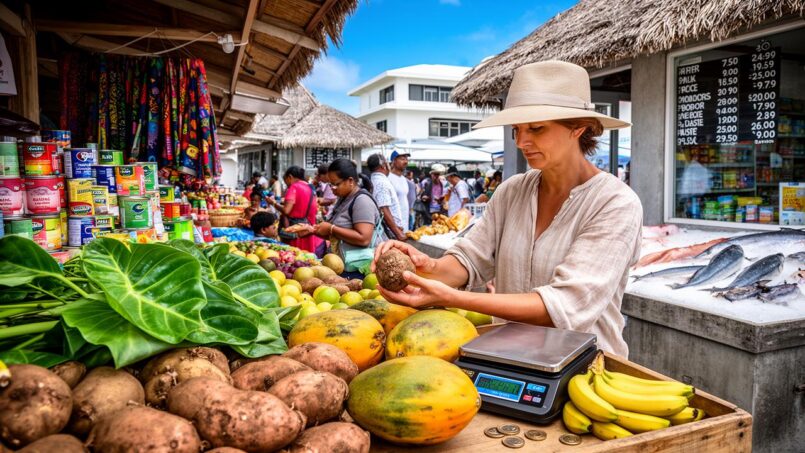
The real lever for savings for an expat remains fruit and vegetable markets and roadside vendors. Prices are often much lower than in supermarkets, even if tourists are sometimes charged a “special visitor” rate.
A few examples:
| Product (markets / stalls) | Price Range (T$) |
|---|---|
| Bunch of bananas | 5–6 T$ (up to 10 T$ for tourists) |
| Watermelon | 1–15 T$ |
| Bag of 6–8 papayas | 10 T$ |
| Bag of tomatoes | 5–10 T$ |
| 3 apples | 5 T$ |
| Basket of coconuts | 10–15 T$ |
| Cabbage | 3–4 T$ |
| Bag of onions | 3 T$ |
For prepared traditional dishes (topai, faikakai, lu with meat, ‘ota ika, BBQ), prices generally range from 5 to 12 T$ per serving, allowing for good eating on a modest local budget.
Eating Out and Having a Drink
For restaurant meals, again, the price spectrum is wide, from a small local eatery to an expat restaurant. Average prices are:
| Type of Meal / Drink | Average Price in T$ |
|---|---|
| Cheap meal (simple restaurant) | ~20 T$ |
| Lunch menu in business district | 28 T$ |
| Fast-food type meal (McDonald’s, etc.) | 25 T$ |
| Meal for two, mid-range restaurant | 150 T$ (3 courses) |
| Simple dinner for two in a neighborhood pub | 60 T$ |
| Dinner for two in an Italian restaurant in expat area | 100 T$ |
| Local draft beer (1 pint) | 6–10 T$ (avg. 8 T$) |
| Imported beer (bottle) | 7–15 T$ (avg. 12 T$) |
| Cappuccino | 5–18 T$ (avg. 7 T$) |
| Soda (small bottle) | 4–11 T$ (avg. 6.8 T$) |
| Cocktail in a club | 10–19 T$ |
| Glass of wine | 15.5–19 T$ |
An expat who mostly cooks at home buying products at the market can keep their monthly food bill in the lower part of the range. One who frequents “Western” restaurants and drinks alcohol will quickly see their budget climb.
Transportation: Cheap Buses, Expensive Cars in the Long Run
Tonga is an archipelago that is a total importer of fuels and vehicles. Transportation costs reflect this dependency.
Public Transport and Taxis
Buses are the main mode of public transport on Tongatapu. They remain affordable but not always reliable in terms of schedules; the service also suffered during the pandemic.
Some benchmarks:
| Service | Typical Price |
|---|---|
| Single bus ticket | 5 T$ (~2.0 USD) |
| Monthly bus pass | 40–100 T$ (17–41 USD) |
| Taxi – pickup | ~5 T$ |
| Taxi – waiting (1 hour) | 100 T$ |
An expat who gets around mainly by bus, walks, and occasionally uses taxis can limit their transport budget to 50–150 USD per month, even including a few outings.
Fuel and Personal Car
Fuel is a heavy expense: the price of a liter of gasoline is around 4 T$ (≈ 1.45–1.7 USD). Tonga spends nearly 20% of its GDP on transport fuel, and 90% of electricity is produced from imported diesel, which increases overall costs.
Discover key statistics presented in a visual and engaging way.
Millions of people use our services every day around the world.
Over 10 years of expertise and innovation in our field.
Thousands of projects successfully completed for our clients.
A customer satisfaction rate over 98% across all our services.
| Indicator | Approximate Value |
|---|---|
| Gasoline (1 liter) | ~4 T$ (~1.45–1.7 USD) |
| Gasoline (1 gallon) | ~13.25 T$ |
| New VW Golf type car | 14,000–30,000 T$ depending on version |
| New Toyota Corolla | ~20,000 T$ |
Owning a car therefore involves:
– a fairly high purchase cost (even for an imported used car)
– a fuel budget sensitive to international fluctuations
– roads sometimes in poor condition, due to insufficient maintenance
The government is considering increasing fuel taxes to fund road maintenance, which would increase the budget for motorists. At the same time, policies to promote electric vehicles are under study, but their initial acquisition cost remains very high.
Impact on an Expat’s Budget
For an expat living in Nuku’alofa, choosing to live without a car, relying on buses and taxis, allows keeping the transport item at a very reasonable level.
On the other hand, an expat living further out, needing to go to the city often, or a household with school-aged children, would benefit from owning a car. In this case, transport quickly becomes a major expense (fuel + maintenance + insurance), especially if combined with an already high electricity bill.
Energy, Internet, and Other Services: The Hidden Costs That Add Up Quickly
One point often underestimated by newcomers concerns energy costs (electricity) and telecommunications, both heavily dependent on imports.
Electricity, Water, Gas
Electricity in Tonga is among the most expensive in the region, as it relies 90% on imported diesel. The standard rate was recently about 0.85 T$/kWh, with a subsidized “lifeline” rate of 0.7 T$/kWh for the first 100 kWh per month to protect low-income households.
For an expat:
| Type of Housing | Typical Monthly Bill |
|---|---|
| 1 person, small housing | ~114–115 USD |
| Family, larger housing | ~175–177 USD |
| 85 m², 2 people (electricity, water, waste, etc.) | ~200–450 T$ (≈ 85–190 USD) |
| 85 m², overall average | ~171 USD (400 T$) |
Water bills remain relatively low (3.5–6.5 USD per month in some examples), but gas or heating costs (for cooking notably) can add 15–50 USD monthly.
Internet and Telephony
The Internet is both expensive and, depending on location, of variable quality. Digital nomads often mention an average speed around 7 Mbps as a reference value, although some recent measurements show higher mobile speeds in the city center.
The monthly cost in Tongan dollars for an unlimited high-speed plan that can reach 50-60 Mbps or more.
Some benchmarks:
| Service | Approximate Monthly Cost |
|---|---|
| Internet 8 Mbps | ~60 T$ (≈ 26 USD) |
| Internet 60+ Mbps unlimited | ~300 T$ (≈ 124–130 USD) |
| Mobile plan + 10 GB of data | ~35–70 T$ (≈ 15–30 USD) |
| Internet + TV + phone bundle (type “triple play”) | 65–135 USD |
For an expat working remotely, the realistic internet bill is rather in the higher part of these ranges, especially if you want a stable connection for video conferences. This item can therefore represent 10% of the monthly budget if aiming for a relatively frugal life.
Cost of Other Services
Also found:
– gym membership: 50–100 T$ (≈ 30–75 USD) per month
– tennis court rental: 100 T$ per hour on weekends
– home cleaning: 5 T$ per hour
These expenses remain optional but can quickly weigh down the budget of an expat accustomed to a certain comfort level.
Health: Cheap Day-to-Day, Very Expensive in an Emergency
For Tongan citizens, the public health system is largely subsidized. Expats, however, must pay for care in full, whether provided at Vaiola Hospital in Nuku’alofa or in the few private facilities.
Basic Costs
The “daily” price level is reasonable:
| Medical Service for a Foreigner | Approximate Cost |
|---|---|
| General practitioner consultation | ~24 T$ (10–15 USD) |
| Hospital consultation | 50–150 T$ (20–60 USD) |
| Consultation or medication in private clinic | 10–30 T$ (4.2–12.5 USD) |
| X-ray (resident, for comparison) | 13–60 USD |
| CT scan (resident, for comparison) | 150–500 USD |
But two elements must be considered:
1. The overall quality of care is considered “basic”: limited technical equipment, reduced choice of medications. 2. For any serious problem, medical evacuation to New Zealand (or another country) is recommended.
However, a medical evacuation represents a colossal cost:
– 20,000 to 50,000 USD in many cases
– can climb to 250,000 USD for some extreme scenarios
Health Insurance: A Mandatory Item
For an expat, living in Tonga without international health insurance, including medical evacuation, objectively constitutes a major financial risk. Authorities have even increased rates for non-residents to fund the system, and the local supply of care outside the capital remains very limited.
This is the monthly price in dollars for some basic health insurance plans for an adult in their thirties.
In a realistic expat budget for Tonga, it is prudent to include: housing, food, transport, health, and education expenses.
– 70 to 400 USD per month for insurance premiums depending on profile
– 15 to 180 USD for pharmacy and minor care expenses
– 7 to 90 USD for medical/dental consultations
The cumulative amounts over the year make health a non-negligible expense item, especially for those who want quality worldwide coverage.
Education and Costs for Expat Families
For families with children, the education item can become decisive in the choice to settle long-term in Tonga or not.
Local and Secondary Schools
Public primary school is free between ages 6 and 14 and almost all children are enrolled at this level. However, local secondary education is fee-paying, even in subsidized institutions.
Annual fees for a local high school are generally between 900 and 1,100 T$ (≈ 400–500 USD) per year, excluding uniforms and books. Relative to the local average salary (about 10,000 T$ per year), this cost is significant for Tongan families, but it remains modest for many expats.
International Schools
For an educational standard closer to Anglo-Saxon systems, many expats turn to international schools. The most well-known in Nuku’alofa is Ocean of Light International School, which follows the Cambridge curriculum (ages 3 to 18). Precise fees are not published in the data; they must be requested directly from the school, but as everywhere in the world, international schools remain expensive on a local scale.
There is also a generic estimate of tuition fees in private and international institutions in the Pacific:
| Type of Institution | Order of Magnitude |
|---|---|
| Private preschool / kindergarten | ~260–500 T$/month |
| International primary school (per year) | ~200–1,000 T$/year |
Precise figures in Tonga may vary, but for an expat wanting a complete international education (and possibly a boarding school in another Pacific country for secondary), the annual education budget can easily exceed a few thousand dollars per child, especially when adding transport, materials, outings, and possible travel costs.
Higher Education
For higher education on-site, institutions like the Atenisi Institute in Nuku’alofa charge semester tuition fees ranging from 3,000 to 6,450 EUR, with a student cost of living around 300 EUR per month. These figures concern foreign students following a university program in the Pacific.
For expats with university-age children, most families continue to direct them to universities in Australia, New Zealand, or the United States, which involves specific costs for those destinations.
Income, Salaries, and Local Economic Reality
To understand the cost of living in Tonga, it is essential to compare it to local incomes. The country remains a lower-middle-income state, with a GDP per capita around 3,700 to 5,800 USD depending on sources and an economy largely supported by remittances from the diaspora.
The median after-tax salary can only finance between 0.3 and 0.7 months of the cost of living for a single person.
For expats paid by an international organization, a foreign government, or a foreign company, salaries are in no way comparable to those of Tongans. But it must be kept in mind that the local job market is limited, there is no officially very protective minimum wage, and many jobs are paid well below Western standards.
Visas, Permits, and Administrative Fees
Beyond daily expenses, settling in Tonga involves a whole series of visa and permit fees, varying by project: extended tourism, work, business, retirement, studies, etc.
Short Stays and Extensions
Many nationalities (Australia, New Zealand, United States, Canada, United Kingdom, EU countries…) receive a free 31-day visitor visa on arrival, sometimes up to 90 days for Schengen area nationals. To stay longer, an extension from the immigration services in Nuku’alofa or Neiafu is required.
Some indicative costs:
| Type of Document / Procedure | Cost in T$ (approx.) |
|---|---|
| Visitor’s Permit (31 days) | 60 T$ per person |
| Extension < 1 month (adult) | 50 T$ |
| Extension per month (adult) | 60 T$ |
| Extension child (< 18 years) < 1 month | 10 T$ |
| Extension child per month | 15 T$ |
| Multiple entry visitor visa (1 year, 1 month/entry) | 300 T$ |
| Visa overstay penalty | 1,150–1,500 T$ |
Possible consular fees in the home country (often between 65 and 115 USD for certain visa types) must also be considered, as well as application costs (photos, certificates, translations).
Work, Business, and Retirement Permits
Expats who wish to work or start a business must obtain a specific permit, generally sponsored by a local employer or validated by the Ministry of Labour and Commerce.
| Type of Permit | Indicative Cost |
|---|---|
| Work Permit (Employment Permit), per year | ~200 T$ |
| Business Permit, per year | ~300 T$ |
| Transfer visitor visa → work permit | 5,000 T$ |
| Transfer visitor visa → business permit | 7,500 T$ |
| Other status transfer | 1,000 T$ |
For retirees, the Assured Income Visa allows residence in Tonga without working, provided you can prove an annual income of at least 10,000 T$. This visa, valid for two years and renewable, involves significant application fees (about 345 USD) and the obligation to provide proof of income, a recent medical certificate, and a police clearance certificate.
Other Common Administrative Fees
There is also a series of additional fees:
– Tongan passport (for eligible persons): 86.25 to 115 T$
– police clearance: 10 T$
– permit duplicate: 100 T$
– ID card: initial issuance free, replacement 50 T$
For an expat, individual administrative fees may seem modest, but their multiplication during long-stay procedures can represent a significant sum in the overall budget.
Budget Summary: How Much to Plan Based on Your Profile?
By combining all this data, we can outline typical budget profiles. The amounts below include rent.
Single Expat in Nuku’alofa
– Mode “local budget + reasonable comfort”
– Rent (studio or small simple 1 bedroom): 300–450 USD
– Food (cooking, markets): 250–350 USD
– Transport (bus + some taxis): 30–70 USD
– Energy and utilities: 80–150 USD
– Internet & phone: 40–90 USD
– Health (insurance + minor care): 80–150 USD
– Leisure and extras: 70–150 USD
– Estimated total monthly: ~850–1,300 USD
– Mode “expat comfort” (furnished central housing + frequent outings)
– Rent (1 bedroom center, furnished): 600–900 USD
– Food (mix of restaurants + cooking): 350–450 USD
– Transport (more frequent taxis, possibly a car): 80–200 USD
– Energy and utilities: 120–200 USD
– High-speed internet & phone: 80–150 USD
– Health (solid international insurance): 150–300 USD
– Leisure, sports, domestic travel: 150–300 USD
– Estimated total monthly: ~1,500–2,500 USD
Maximum monthly budget for a digital nomad in Bali, including accommodation, coworking, and tourist activities.
Family of Four
– Rent (3 bedrooms in a good location): 800–1,300 USD
– Food: 800–1,100 USD
– Transport (bus, possibly one car): 150–300 USD
– Utilities: 150–220 USD
– Internet & telephony: 100–180 USD
– International health insurance for the whole family: 250–600 USD
– Education (depending on local / international choice): from 50–100 USD/month (local) to several hundred for international
– Leisure, clothing, extras: 200–400 USD
Thus, totals consistent with estimates of 2,200–2,800 USD for a relatively simple living standard and up to 3,500–3,800 USD for an expat family using more expensive services (international school, high-end housing, two cars, etc.).
Conclusion: A Moderate Cost of Living, But to Be Handled with Nuance
Living in Tonga as an expat, especially in Nuku’alofa, offers a rather rare combination: a cost of living generally lower than most Western countries, a safe environment and a community atmosphere, but at the cost of limited infrastructure, basic health services, and a heavy dependence on imports for energy, consumer goods, and technology.
For a foreigner with stable income in a strong currency (expat salary, pension, online income), the country can be financially attractive, particularly if you adopt consumption habits close to those of Tongans: local products, simple housing, parsimonious use of electricity, and travel by bus.
Conversely, a “copy-paste” life of an urban Western lifestyle — large air-conditioned housing, high consumption of high-speed internet, many imported products, personal car, international schools, frequent travel out of the country — will quickly push the budget to levels comparable to some moderately expensive major cities in the world.
Description of an urban Western lifestyle
The key for expats wishing to settle in Tonga is therefore to clearly distinguish:
– what is truly important for their quality of life (space, connection, schooling, health),
– what can be adapted to the local context (eating habits, leisure, consumption pace),
– and what they are willing to accept in terms of compromise (slow internet, limited health system, isolation, climatic hazards).
By adjusting these settings, it is possible to build a life project in Tonga that is both financially sustainable and humanly enriching, in a country where the cost of living, while moderate, must always be weighed against the constraints of a small, isolated island state in the middle of the Pacific.
A wealth management project or a question? Contact us now to speak with a wealth management expert.
Disclaimer: The information provided on this website is for informational purposes only and does not constitute financial, legal, or professional advice. We encourage you to consult qualified experts before making any investment, real estate, or expatriation decisions. Although we strive to maintain up-to-date and accurate information, we do not guarantee the completeness, accuracy, or timeliness of the proposed content. As investment and expatriation involve risks, we disclaim any liability for potential losses or damages arising from the use of this site. Your use of this site confirms your acceptance of these terms and your understanding of the associated risks.

Cyril Jarnias is an independent expert in international wealth management with over 20 years of experience. As an expatriate himself, he is dedicated to helping individuals and business leaders build, protect, and pass on their wealth with complete peace of mind.
On his website, cyriljarnias.com, he shares his expertise on international real estate, offshore company formation, and expatriation.
Thanks to his expertise, he offers sound advice to optimize his clients' wealth management. Cyril Jarnias is also recognized for his appearances in many prestigious media outlets such as BFM Business, les Français de l’étranger, Le Figaro, Les Echos, and Mieux vivre votre argent, where he shares his knowledge and know-how in wealth management.





