
 Published on and written by Cyril Jarnias
Moving to Tonga is stepping into a world of light, warm ocean, and an almost constant tropical climate. But behind the postcards lies a demanding meteorological reality: a cyclone season not to be underestimated, high humidity, an especially aggressive sun, and cultural codes that influence even how to dress when it’s 30 °C (86 °F).
Adaptation for an expatriate involves safety reflexes regarding cyclones, daily planning based on the weather, health protection against the sun, humidity, and vector-borne diseases, as well as respect for a culture marked by religion and modesty in dress.
Understanding the Climate in Tonga for Better Adaptation
Tonga enjoys a hot and humid tropical climate year-round. Daytime temperatures typically range between 25 °C and 31 °C (77 °F to 88 °F), while evenings hover around 15 °C to 25 °C (59 °F to 77 °F). Heat is rarely extreme, but the combination of heat and high humidity can surprise newcomers, especially those from temperate climates.
The weather is structured around two main seasons: a relatively cooler dry season and a wet season that concentrates most of the rainfall and, crucially, the cyclone season.
Wet Season, Cyclones, and On-the-Ground Realities
From November to April, it’s the wet season, corresponding to the austral summer. Rainfall can be short but very intense, and humidity rises significantly. Most importantly, this period coincides with the cyclone season in the South Pacific.
Regional meteorological data shows that:
On average, Tonga experiences about 1 to 2 cyclones per season, which runs from November to April.
Tonga has suffered several major cyclones, and four of the five most powerful in its history have occurred in the last twenty years. The human impact has been relatively limited in terms of mortality, but material damage is severe: the cost of post-cyclone reconstruction is estimated at around 15 million US dollars per year.
An important point to consider when preparing for your move: damage is often localized. A cyclone may devastate certain islands or villages while leaving other areas of the kingdom almost untouched. Nevertheless, for an expatriate, it is essential to treat this risk as real, especially if living in Nuku’alofa, Vava’u, or coastal areas.
Extreme UV and Humid Heat: A Daily Challenge to Manage
UV radiation levels in Tonga are particularly high. Indices can climb between 5 and 12, often placing the country in the “very high” to “extreme” category. In practice, this means:
A sunburn can occur in less than 20 minutes on unprotected skin. Common outdoor activities (walking, market trips, beach, snorkeling, gardening) therefore require far greater precautions than those taken in Europe. For long-term residents, the risks of serious consequences, such as skin cancer or cataracts, are very real.
Added to this is pronounced humidity, especially during the rainy season. Even if the thermometer reads “only” 28 °C (82 °F), the heat index can be much higher. Mosquitoes proliferate more under these conditions, bringing a risk of diseases like dengue, chikungunya, or Zika.
Adapting to the local climate for an expatriate therefore means learning to manage simultaneously:
– constant heat,
– high humidity,
– a very aggressive sun,
– an annual cyclone season.
Cyclones: Understanding the Warning System and What to Do
One of the most specific aspects of the Tongan climate is tropical cyclones. The good news is that the country is relatively well organized to anticipate them. The bad news is that they are part of the long-term landscape. It is impossible for an expatriate settling in permanently to ignore this topic.
Who Monitors the Weather and Cyclones in Tonga?
Two main bodies ensure meteorological and cyclone monitoring:
– the Tonga Meteorological Service (TMS), based at Fua’amotu, on the grounds of the domestic airport,
– New Zealand’s MetService, which provides technical support and regional forecasts.
When a depression system forms in the area, the TMS tracks its development and can activate the Fua’amotu Tropical Cyclone Warning Centre (FTCWC) if a direct threat materializes within 48 hours.
Cyclones in the region are predictable. Their formation is monitored from the tropical depression stage. A system is named and its five-day track is published when winds reach between 63 and 120 km/h (tropical storm stage). Although approximate initially, the track gradually becomes more precise with new meteorological bulletins, giving residents time to prepare.
How to Read Local Cyclone Warnings
To adapt to the climate, it is crucial to become familiar with the official terminology used by Tongan authorities.
The TMS can issue several types of advisories:
– Tropical Cyclone Alert – Fakatokanga’osi Saikolone: gale-force winds possible within 24 to 48 hours.
– Tropical Cyclone Warning – Fakatokanga Saikolone: gale-force winds expected within 24 hours.
These advisories are accompanied by Special Weather Bulletins (Fakamatala’ea Makehe), broadcast in Tongan and English, and supplemented by routine weather bulletins.
Warnings are relayed via:
– radio (notably FM90 and FM87.5),
– television channels,
– SMS,
– online news sites,
– the Tonga Meteorological Service website,
– recommended apps such as SMS‑Tsunami‑Warning.com and the Tonga Weather Alerts Response app.
In the event of a serious warning, media outlets are authorized to use an audible siren to signal the broadcast of an alert. The TMS works in collaboration with the National Emergency Management Office (NEMO) and the National Disaster Committee. These bodies coordinate the emergency response and ensure communication with other ministries and local authorities.
Cyclone Categories and What They Mean in Practice
As elsewhere in the Pacific, cyclones are classified from 1 to 5 based on sustained wind intensity:
| Category | Sustained Wind Speed | Typical Impacts on the Ground |
|---|---|---|
| 1 | 63–87 km/h | Negligible damage to houses, some trees and crops affected. |
| 2 | 88–117 km/h | Minor damage to homes, trees and crops heavily damaged, power outages likely. |
| 3 | 118–157 km/h | Significant damage to roofs and structures, widespread power outages. |
| 4 | 159–200 km/h | Major roof loss, heavy structural damage, dangerous airborne debris. |
| 5 | > 200 km/h | Extensive destruction, landscape and buildings severely ravaged. |
For an expatriate renting accommodation, this classification is not just a technical concept: it helps assess the robustness of your dwelling, the need to take shelter in another structure, and the level of preparation required.
The most frequent consequences to anticipate:
– power cuts (sometimes preventive, as during Cyclone Gita when Tonga Power Limited voluntarily cut electricity on Tongatapu and ‘Eua before impact),
– damage to crops and trees,
– damage to simpler dwellings, especially in villages,
– debris thrown by the wind,
– potential contamination of tap water after the event.
The Case of Cyclone Gita: What It Tells Us About the Country’s Preparedness
Cyclone Gita, in 2018, is remembered as the most powerful ever recorded in Tonga. When it crossed Tongatapu, it was classified as Category 3. The winds caused severe structural damage, particularly in Nuku’alofa.
Only two fatalities were recorded in the country despite the scale of the event.
– Activation of the FTCWC as soon as the threat became clear,
– Rapid proclamation of a state of emergency (28 days),
– Imposition of a curfew in Nuku’alofa (8 PM – 8 AM),
– Self-evacuation of approximately 4,000 people to shelters,
– Early shutdown of the power grid on some islands for safety reasons,
– Coordinated monitoring by emergency services and ministries.
For an expatriate, this episode illustrates two simultaneous realities: the potential violence of cyclones, but also the existence of proven procedures. Fitting into this framework (understanding the warning system, preparing your emergency kit, knowing where to go) is a key part of adapting to the local climate.
Practical Preparation for the Cyclone Season
Preparation occurs at two levels: individual and institutional. Tonga has a Tropical Cyclone Emergency Response Plan (TCERP), activated as soon as a threatening system is present in a certain geographic area or within 48 hours of the islands. But this system does not absolve each household – including expatriates – from preparing.
Good Habits Before the Wet Season
From October onward, and more broadly throughout the wet season, a few simple habits should become reflexes:
Regularly consult TMS weather bulletins, especially from November to April. Ask your accommodation about internal procedures and the most solid room in the building. Develop a family plan specifying a meeting point, priority contacts, and a safe route to a shelter. Also identify evacuation routes in case of a tsunami (retreat at least 2 km inland or to high ground).
In terms of supplies, it is recommended to put together an emergency kit designed to last at least three days:
| Key Items for the Kit | Role During and After a Cyclone |
|---|---|
| Drinking water (at least 3 days) | Drinking and minimal cooking when the network is contaminated or cut. |
| Non-perishable food (canned goods, biscuits, rice…) | Sustenance without need for refrigeration or complex cooking. |
| Change of clothes and sturdy shoes | Protection against debris, moisture, and cooling after the event. |
| Flashlight + spare batteries | Lighting during extended power outages. |
| Battery-powered radio or smartphone + power bank | Staying informed via official bulletins. |
| First aid kit | Treating minor injuries, cuts, or infections. |
| Light helmet and closed-toe shoes | Protection for head and feet against falling objects and debris. |
| Fire extinguisher | Managing a fire in a damaged house. |
| List of emergency numbers (including 911) | Contacting emergency services even when stressed or injured. |
Adding personal items (medications, glasses, copies of important documents) is wise, especially for a foreign resident who may need medical evacuation.
Preparing Your Home: A Key Point for Expatriates
Choosing and arranging your home in Tonga must be done with the climate in mind. Before the wet season, authorities recommend:
– trimming tree branches near the house,
– securing or storing anything that could be carried away by the wind (garden furniture, signs, items placed high up),
– reinforcing the roof or at least checking its condition,
– arranging window protection (shutters, panels, sturdy screens).
For an expatriate, it is useful to discuss the diversity of construction types and rents, as well as the importance of the building’s structure and location, especially during cyclone season, when signing the lease.
What to Do During a Cyclone
When a cyclone approaches and a Tropical Cyclone Warning is officially issued, several rules of conduct apply:
– Stay calm, but take the threat seriously.
– Take shelter indoors in a sturdy structure, preferably in the room identified as the safest.
– Stay as far away from windows and glass doors as possible.
– Unplug electrical appliances to limit the risk of surges or fires.
– Do not use the landline phone during a storm due to the risk of electrocution.
– Do not go near the coast or the sea, even if the waves still seem modest: cyclone swell and storm surges can be surprising.
– Know that the passage of the cyclone’s eye often creates a deceptive calm, followed by a sudden return of the winds.
In lightweight houses or those with weak roofs, a local technique recommends slightly opening a small window on the side opposite the prevailing wind. This aims to reduce air pressure under the roof and limit the risk of it being ripped off. If the building structure begins to show signs of failure, it is imperative to take cover under a sturdy table and use thick mattresses or rugs as additional shields against falling debris.
After the Cyclone: Caution and Hygiene
Once the storm has passed, the temptation is great to go out immediately. However, many dangers are actually concentrated in the aftermath:
– Avoid any contact with downed power lines and keep at least 8 meters away.
– Beware of damaged buildings, unstable roofs, broken glass, and weakened trees.
– Consider tap water potentially contaminated for a few days: it is recommended not to drink it without boiling or filtering.
– Wait for official instructions before returning to the worst-hit areas.
Having a water filtration system on hand (filter bottle like Lifestraw, portable filter) is a very reasonable precaution for an expatriate, who cannot rely on a stable water network in the post-cyclone phase.
Heat, Humidity, Mosquitoes: Protecting Your Health Daily
Aside from cyclonic episodes, Tonga’s climate primarily presents long-term challenges: extreme sun, humid heat, vector-borne diseases, and the particularities of the local healthcare system.
Preventing Heatstroke and Sunburn
With temperatures of 25 to 31 °C (77 to 88 °F) and a UV index that can reach 12, lifestyle habits must adapt:
– Drink regularly, even without feeling thirsty, preferably water (filtered or bottled).
– Avoid prolonged sun exposure between late morning and mid-afternoon.
– Use high-SPF sunscreen and reapply frequently, especially at sea or during water activities.
– Wear a wide-brimmed hat or covering cap, UV-protective sunglasses, and lightweight long-sleeved clothing for outdoor activities.
– Schedule physical tasks (sports, gardening, DIY) for early or late in the day when temperatures are more bearable.
Choose breathable, absorbent fabrics like cotton, linen, bamboo, lightweight merino wool, rayon, or Tencel. Opt for light colors that reflect sunlight better and help reduce the feeling of heat.
Mosquitoes and Infectious Risks: Integrating the Climate Dimension
The hot and humid climate favors mosquito proliferation, which are vectors for several diseases present in the region: dengue, chikungunya, Zika, and more broadly, opportunistic infections during a pronounced rainy season.
In this context, adaptation involves:
– daily use of mosquito repellent, especially at dawn and dusk,
– wearing long sleeves and lightweight long pants in the evening,
– installing mosquito nets over beds and on windows,
– paying special attention to standing water around the home (containers, gutters, persistent puddles).
The public health system, centered on Vaiola Hospital in Nuku’alofa, provides free care to Tongan citizens, but foreigners must pay. Infrastructure is decent but limited, with few heavy equipment items (scanners, MRIs) and a limited number of specialists.
In the event of a serious medical issue (major trauma, complex surgery, cardiac or cancer pathology), medical evacuation to New Zealand or Australia is often necessary. The cost of such a repatriation can range from 20,000 to 250,000 US dollars. For an expatriate, having international health insurance including medical evacuation is therefore not a luxury, but a realistic adaptation to the combination of climate and local healthcare offerings.
Hydration, Diet, and Climate: A Long-Term Equation
Studies conducted in Tonga show another underlying challenge: over 70% of annual deaths are linked to non-communicable diseases (diabetes, cardiovascular diseases), heavily influenced by diet. In this kingdom that historically enjoyed strong food self-sufficiency, the dietary transition has accelerated, with heavy reliance on imports: corned beef, mutton flaps, instant noodles, sugary drinks, etc.
For an expatriate, the climate of the host country directly influences their food choices. They must adapt their diet to locally available produce according to seasons, culinary habits related to temperatures (lighter meals in summer or more comforting in winter), and consider the impact of climate on food preservation. This adaptation is essential for well-being and successful integration.
– when it’s hot, the temptation is strong to consume very cold sugary drinks,
– preservation of fresh fruits and vegetables is more difficult,
– some local products are more expensive than imported, ultra-processed foods.
Tongan authorities have launched several policies (taxes on sugary drinks and fatty meats, requirement to sell part of fish catches at subsidized prices, “go local” campaigns, support for local production) to rebalance the supply, but difficulties persist.
Intelligently adapting to the climate therefore also means:
– favoring local fresh produce (roots like taro, yam, cassava, tropical fruits, fish) available at markets like Talamahu in Nuku’alofa,
– limiting sugary sodas, which are very present in shops,
– planning purchases according to heat and preservation capacity,
– taking advantage of local seasonality to diversify your diet despite the climate.
Dressing in Tonga: Balancing Heat, Humidity, and Modesty
One of the biggest surprises for many expatriates: even if the thermometer shows “vacation” temperatures, you don’t dress in Tonga like on a European beach. The culture is deeply conservative when it comes to attire.
Basic Rules for Dressing in Public
In towns, villages, and all public spaces except resorts, a few simple rules apply:
– Shoulders must be covered.
– Skirts, dresses, and shorts must at least cover the knees.
– Very short shorts are considered inappropriate in public.
– Swimwear (bikinis, swim trunks) should only be worn at the beach, pool, or during water activities, never in town or villages.
During religious services, ceremonies, or formal occasions:
– women typically wear dresses or skirts below the knee with sleeves covering the shoulders,
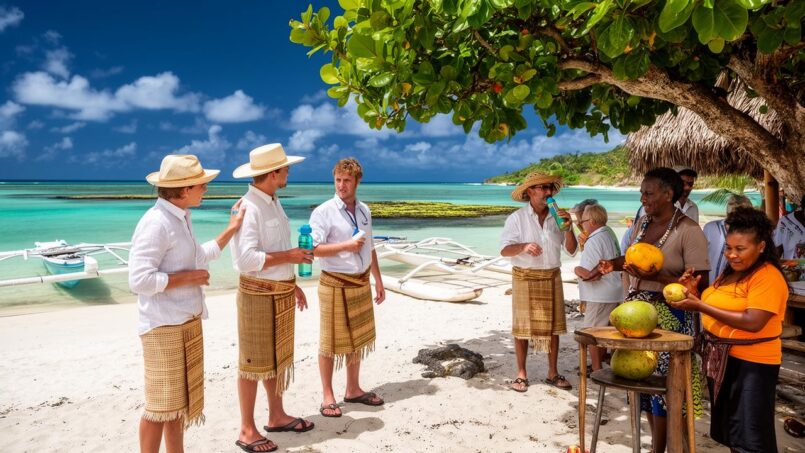
– men wear a collared shirt and long pants or tupenu (traditional wraparound skirt).
On Tonga’s public beaches, it is common for locals to swim in a T-shirt and shorts. As an expatriate, wearing a rash guard or similar covering is seen as a sign of respect for local customs, while also providing effective sun protection.
Whether or Not to Adopt Traditional Attire
Tongans wear a traditional ensemble for formal events:
– for men: collared shirt, tupenu (wraparound), and ta’ovala (woven mat tied at the waist with a kafa cord),
– for women: tunic or puletaha (matching top/skirt set), long tupenu, and sometimes kiekie, a decorative belt made of fibers, shells, or fabric.
Expatriates are not required to wear these outfits regularly, but adopting them at ceremonies (weddings, funerals, major official events) is often appreciated. Conversely, it’s best to avoid wearing them overly folklorically in inappropriate contexts.
The most important thing remains: mutual respect and understanding.
– respect the length (below the knees),
– choose lightweight, breathable fabrics to remain comfortable in the heat,
– avoid low necklines and tight clothing in public spaces.
Managing Your Wardrobe in a Tropical Climate
For an expatriate, the wardrobe should be designed for both daily life and social contexts:
Pack several T-shirts or lightweight shirts covering the shoulders, as well as skirts, dresses, or shorts that go past the knee. Include one or two more formal outfits (collared shirt, dressy dress, possibly a tupenu bought locally) and lightweight sleepwear. Bring a thin warm layer (cardigan, light jacket, fine fleece) for cool evenings, after swimming, or during the cooler season. A rash guard or UV-protective T-shirt is essential for the beach and snorkeling. For footwear, bring comfortable, closed-toe walking shoes, sandals or flip-flops for daily life, and dressier shoes for ceremonies.
Many expatriates opt for a weekly rotation of clothes, relying on laundry services at guesthouses, residences, or local laundries. This allows lighter travel, especially on domestic flights where baggage policies can be strict.
Culture, Pace of Life, and Climate: A Trio to Tame
Tonga’s tropical climate doesn’t just influence clothing or architecture. It intimately interacts with local culture, values, and pace of life. For an expatriate, it is difficult to “live well” in this climate without at least partly aligning with ‘anga fakatonga, “the Tongan way”.
Long Time, Hot Time: Understanding “Tonga Time”
In an environment where heat and humidity impose a certain physical slowdown, the relationship with time is not the same as in a large Western metropolis. Tongans value:
– relationship before scheduling,
– family before agenda,
– flexibility before strict punctuality.
Arriving (slightly) late for an appointment, postponing a meeting because unexpected guests have arrived at home, taking a long break in the shade instead of pushing through tasks in full sun: all of this is seen as normal. This pace, often referred to as “Tonga Time”, can be destabilizing at first, but it is also a form of collective adaptation to the climate.
For an expatriate, the culture shock often comes from the gap between:
– a climate that tires and slows you down,
– a value system that prioritizes family, community, and spirituality,
– professional habits imported from colder, more productivity-driven environments.
Learning to integrate this rhythm – planning buffer time, avoiding overscheduled days, accepting the slowness of certain procedures, especially in high heat – is part of the adaptation.
Religion, Sunday, and the Social Climate
Sunday is a special day. In this deeply Christian kingdom, it is a sacred day of rest:
– most shops are closed,
– sports activities and certain types of work are prohibited by law,
– the day is devoted to church, family, and rest.
Even under a blazing sun, you won’t see joggers on the roads or construction sites active. For an expatriate, this rhythm offers a chance to pause, letting the body recover from the week’s heat, but it also requires planning logistics (shopping, transport) accordingly.
Community Life, Hospitality, and Emotional Adaptation
In a highly community-oriented society, where generosity and sharing are pillars, the climate serves as a backdrop: people gather under trees, chat by the roadside, weave mats together, prepare communal meals. Air-conditioned interiors, when they exist, are not the natural setting for social life.
For the expatriate, the adjustment is twofold:
– physical: accepting spending a lot of time outdoors, even when it’s hot, by equipping yourself properly (light clothing, hat, hydration),
– social: understanding that these moments, where “nothing is happening” on the surface, are actually the heart of integration.
Certain rules of respect strengthen this social bond in a demanding climate:
– not expressing anger publicly (even if the heat and bureaucratic delays annoy you),
– treating elders with particular respect (letting them sit in the shade first, for example),
– avoiding being too directive or rushed.
Adapting to the climate is therefore not just about the thermometer, but also about temperament.
Transport, Travel, and Weather: Organizing Your Mobility
In an archipelago of 169 islands (of which 52 are inhabited), the climate heavily influences mobility. Heat, rainy season, cyclonic episodes, wind strength: all these factors weigh on daily commutes and inter-island travel.
Daily Commutes: Heat, Roads, and Safety
On the main island of Tongatapu, as in Vava’u or Ha’apai, driving is on the left at moderate speeds (low limits between 30 and 70 km/h). Main roads are generally in good condition, but potholes are common, and livestock may wander onto the roadway.
During tropical rain, roads can become slippery and some secondary tracks impassable. During the wet season, plan for:
Due to weather conditions, allow extra travel time, be especially vigilant if using a two-wheeler (scooter or bicycle), and anticipate possible bus or ferry cancellations.
Heat and humidity also make walking more tiring in the middle of the day. Many expatriates organize their errands early in the morning or late afternoon, when the temperature is milder.
Inter-Island Travel: Direct Influence of the Climate
Connections between the kingdom’s different islands are mainly by:
– air (domestic airlines, small aircraft),
– ferries (slower, cheaper, sensitive to sea conditions).
Domestic flights operate every day except Sunday, but can be delayed or cancelled due to bad weather. Ferries are particularly dependent on weather conditions.
– seasonal swells,
– strong winds,
– cyclone warnings.
For an expatriate working on multiple islands or whose family is spread across Tongatapu, Vava’u, and Ha’apai, flexibility is essential. During cyclone season, it is prudent to avoid scheduling critical inter-island travel (important appointments, ceremonies, connecting international flights) just before the arrival of a depression system.
Local accommodations and agencies play a valuable role as information relays: they know company practices, navigation limits, and the actual level of risk based on bulletins.
Toward Sustainable Adaptation: Making the Climate an Ally Rather Than an Enemy
Living in Tonga as an expatriate means entering a kind of pact with the local climate. You don’t tame cyclones, you don’t lower the sun, you don’t make humidity disappear. But you can evolve your lifestyle, your relationship with time, your personal infrastructure, and your reflexes to transform this constraint into a livable, even enjoyable, environment.
In practice, this involves several layers of adaptation:
For a peaceful and secure stay in Tonga, it is essential to prepare in several key areas: physical, material, health, cultural, and logistical.
Hydration, sun protection, wearing appropriate clothing, using mosquito nets, and managing heat in the home.
Assembling emergency kits, choosing a sturdy home, stockpiling water and food before the cyclone season, and acquiring a water filter.
Solid medical insurance including evacuation, knowledge about vector-borne and food-related risks, and familiarity with the local healthcare system.
Respecting dress codes, understanding “Tonga Time,” integrating into community networks, and accepting the importance of Sunday and religion.
Organizing travel with the rainy and cyclone seasons in mind, building margins into schedules, and planning outings for the cooler hours.
Tonga is not just a paradise backdrop; it is a real country, with demanding weather, a structured warning system, a culture of community, and an economy still heavily dependent on nature. For an expatriate, successfully settling in ultimately comes down to doing what Tongans have always done: working with the climate, respecting it, and organizing your life around it rather than against it.
A wealth management project or a question? Contact us now to speak with a wealth management expert.
Disclaimer: The information provided on this website is for informational purposes only and does not constitute financial, legal, or professional advice. We encourage you to consult qualified experts before making any investment, real estate, or expatriation decisions. Although we strive to maintain up-to-date and accurate information, we do not guarantee the completeness, accuracy, or timeliness of the proposed content. As investment and expatriation involve risks, we disclaim any liability for potential losses or damages arising from the use of this site. Your use of this site confirms your acceptance of these terms and your understanding of the associated risks.

Cyril Jarnias is an independent expert in international wealth management with over 20 years of experience. As an expatriate himself, he is dedicated to helping individuals and business leaders build, protect, and pass on their wealth with complete peace of mind.
On his website, cyriljarnias.com, he shares his expertise on international real estate, offshore company formation, and expatriation.
Thanks to his expertise, he offers sound advice to optimize his clients' wealth management. Cyril Jarnias is also recognized for his appearances in many prestigious media outlets such as BFM Business, les Français de l’étranger, Le Figaro, Les Echos, and Mieux vivre votre argent, where he shares his knowledge and know-how in wealth management.





