
 Published on and written by Cyril Jarnias
Settling in Tonga, this small Pacific kingdom often called the “Friendly Islands,” is far more than a simple change of scenery. It means entering a highly structured, deeply Christian, collectivist social universe governed by a multitude of codes that are sometimes invisible to a European eye. For a future expatriate, understanding these cultural differences is not just a nice bonus—it is the key to living peacefully, avoiding missteps, and building genuine relationships with Tongans.
This guide details the essential cultural benchmarks of Tonga and its way of life, drawing on the main academic research dedicated to the country.
Anga fakatonga: The “Tongan Way” of Seeing the World
First and foremost, you need to grasp a key idea: in Tonga, people speak of Anga fakatonga, the “Tongan way” of life. This is not mere folklore; it is a complete system of values, behaviors, beliefs, and implicit rules that govern daily life.
Anga fakatonga, or the “Tongan way of life,” values the collective, hierarchical respect, and traditions. In contrast, Anga fakapālangi, the “Western way of life,” often prioritizes the individual and more formal frameworks. Tongans—especially expatriates or those educated abroad—constantly navigate between these two frameworks. The challenge for them is to discern when to apply traditional codes, when to use Western references, and often, to understand how these two worlds intertwine in daily life.
The Four “Golden Pillars” of Culture
Several researchers summarize Tongan culture around four major pillars, omnipresent in social life:
| Pillar (Tongan) | Main Meaning | What This Means for an Expat |
|---|---|---|
| Faka‘apa‘apa | Respect, deference, courtesy | Always show respect through language, posture, attire—especially toward elders and authorities. |
| Tauhi va / vaha‘a | Maintaining relationships | Invest time in personal connections before discussing business or problems. |
| Lototō / angafakatokilalo | Humility, modesty, generosity | Avoid putting yourself forward, downplay your merits, remain discreet. |
| Mamahi‘i me‘a | Loyalty, commitment, zeal | Be reliable, keep promises, support your family, church, and community. |
These pillars are not abstractions: they regulate how to speak, dress, handle conflict, give gifts, or participate in a meal. Failing to respect them can quickly marginalize you, even if no one tells you to your face.
A Deeply Hierarchical but Highly Inclusive Society
One of the most disconcerting aspects for a newcomer is social stratification. Tongan society is one of the most hierarchical in the Pacific, with a very clear formal structure:
| Level | Main Role / Status |
|---|---|
| Tu‘i (the King) | Monarch, apex of social and political order |
| Hou‘eiki (nobles) | Nobles holding estates and hereditary titles |
| Matapule | “Talking chiefs,” masters of ceremony and orators |
| Kakai tu‘a (commoners) | General population |
In addition to this official hierarchy, there is a family hierarchy that is just as structured.
Extended Family and Status: Who Is “Above” Whom?
In Tonga, the family, or kainga, is the central unit of society. But the notion of family goes far beyond the nuclear parents-children unit: it includes grandparents, cousins, uncles and aunts (on both sides), adopted children, and even members linked by shared projects. Belonging to a kainga defines one’s identity, obligations, and support networks.
Within this structure, several rank rules are decisive:
In the Tongan family structure, gender and birth order determine social rank. Sisters often hold a higher status than their brothers. The eldest child carries particular responsibilities and status. The mehekitanga (paternal aunt) occupies the position of fahu, a very high rank. Authority over the extended family generally falls to the ‘ulumotu’a, the eldest male in the paternal line, whose opinion carries significant weight in decisions.
In practice, this means that a young thirty-something expatriate may be treated with more deference than a more educated Tongan woman, simply because he is male and older… but within a given family, the eldest sister may be socially above all her brothers.
To avoid awkwardness, it is helpful to quickly identify who is who in a family gathering, village, or work team, and observe who is addressed first, who sits where, and who speaks first.
A Collectivist Culture: The “I” Behind the “We”
Tonga is deeply collectivist. The priority is not the individual but the group: kainga, village, church, community. Succeeding means succeeding with and for one’s own people.
Concretely, this translates into:
– a strong expectation of sharing resources (money, food, time);
– a valuing of mutual help (fetokoni‘aki) and generosity (foaki, fe‘ofa‘aki);
– disapproval of individualism: someone who keeps resources to themselves is seen as selfish.
In some cultures, as illustrated by the term **kai po**, eating alone is culturally frowned upon. This word refers both to the act of eating separately and, by extension, to behavior considered sneaky or stingy. Conversely, sharing a meal is a concrete way to demonstrate belonging and solidarity within the group.
For an expatriate, this logic can be destabilizing, especially financially: material success is often seen as a blessing to be shared, and some families expect those who “have more” (including foreigners) to contribute to the costs of ceremonies, funerals, and religious events. Bluntly refusing to participate can be interpreted as a refusal to integrate, or even a lack of respect.
Religion: A Society Shaped by Christianity
It is impossible to understand Tonga without talking about religion. The vast majority of the population identifies as Christian, and several surveys report practice rates around 95%.
Christianity at the Heart of Social Life
Christian faith has become deeply intertwined with traditional values:
– churches play a major role in social cohesion, education, and support for the vulnerable;
– Sunday is a sacred day of rest and worship, enshrined in the Constitution and law;
– many values considered spiritual—‘ofa (love/compassion), mateaki (loyalty), foaki (giving)—are reinforced by religious discourse.
On Sundays, most shops close, sports activities are prohibited by law, and public transport is very limited. The day is reserved for:
– religious services (often several throughout the day),
– large family meals,
– rest and socializing at home.
Even if you are not a believer, you must plan your shopping, travel, and leisure activities around Sunday, and respect its quietness by avoiding loud parties, loud music, or visible sports activities.
Religious Etiquette and Participation
Attending a service is one of the best ways to understand Tongan life. But it requires respecting a number of implicit rules:
To attend a service in Tonga, wear modest and formal attire: shoulders and knees covered, clean clothes. Local men often wear a tupenu (wrap-around skirt) with a ta‘ovala (pandanus mat), and women a puletasi (traditional ensemble). Men should not wear hats indoors. Arrive on time and avoid entering or leaving during prayers or the sermon. If you must leave before the end, do so discreetly. During the a cappella hymns—important markers of local spirituality—observe in silence or sing softly if you know the words to show respect.
For a believing expatriate, integrating into a local church can become one of the main vectors of social integration. For a non-believer, maintaining a respectful attitude and avoiding open criticism of religion are absolutely essential.
Communication: The Art of Indirectness and Harmony
The Tongan communication style can surprise people used to direct frankness. Here, preserving harmony and the other person’s “face” takes precedence over immediate clarity.
A Soft Tone, Avoided Conflict
In general:
– the tone is soft, calm, rarely very loud;
– Tongans avoid direct confrontation, especially toward people of higher rank or elders;
– saying “no” clearly is rare: they resort to vague phrases, silences, and detours.
For an expatriate, this means that: the process of adapting to a new culture, a new work system, and different social dynamics can be both a rewarding personal experience and a significant challenge.
A “we’ll see,” “we’ll talk about it later,” or a prolonged silence can indicate a polite refusal. Direct public criticism is very poorly received because it causes loss of face and can permanently damage a relationship. In case of disagreement, it is better to opt for a one-on-one conversation, a calm tone, and nuanced wording.
Research on conflict styles shows that Tonga is close to an indirect and emotionally restrained style, similar to many Asian collectivist cultures. Conversely, many Western cultures practice a more direct, solution-oriented style. Understanding this gap is crucial to avoid interpreting restraint as indifference or duplicity.
The Weight of Non-Verbal Communication and Silence
Non-verbal language plays a major role:
– a raised eyebrow can mean “yes”;
– silence can indicate thoughtfulness, polite disapproval, or embarrassment, but rarely enthusiastic agreement;
– crossing your arms, pointing a finger, or pointing your feet at someone are seen as signs of disrespect.
Similarly, in the Tongan language, there are several “ways of talking” depending on the status of the person being addressed.
Tongan Language
| Type of Speech (Tongan) | Primary Use |
|---|---|
| Lea fakatu‘i / lea faka‘eiki | Respect register for the king, nobles, chiefs |
| Lea fakatokilalo | Self-deprecating register for addressing someone higher than oneself |
| Lea tavale | Everyday language among equals |
| Lea ‘ita | Abusive speech, used in open conflict |
Even without speaking the language, a foreigner benefits from using modest vocabulary, plenty of “please,” “thank you very much,” and avoiding any sarcastic or aggressive tone.
Knowing How to Listen: A Cardinal Virtue
Patient listening is highly valued. Interrupting, pressuring the speaker to get to the point, or repeatedly insisting on a question is considered rude. When in doubt:
– leave silences,
– rephrase gently,
– show through posture (leaning forward, eye contact) that you are listening.
Theories of face negotiation recommend in this type of context a mindful listening: being attentive to the other’s cultural assumptions, without projecting your own conversational model onto the situation.
Time in Tonga: Between “Tongan Time” and “Palangi Time”
Another major culture shock for expatriates comes from the relationship with time. Two expressions circulate:
– Tongan time: flexible scheduling, priority given to relationships. Being late, rescheduling a meeting, putting off a task until the next day is not seen as dramatic, especially if it is to take care of family or visitors.
– Palangi time: “Western” time (palangi means white person), punctual, timed, with strict adherence to schedules.
Tongan culture is fundamentally polychronic. This means people generally handle several activities simultaneously. It is common to accept multiple invitations for the same time slot and then only attend one. Postponing and deferring tasks that allow it is also a common and accepted practice.
For an expatriate:
– build buffer time into your schedules, especially for administrative procedures, work, or informal appointments;
– avoid getting openly upset if someone is late: this would be judged excessive and not in keeping with the “Tongan Way”;
– clarify when a schedule really must be respected (e.g., for a flight, an important meeting, a medical procedure) and calmly explain why.
Many services (transport, store supplies, mail) can be irregular, with outages, delays, and last-minute changes. Tongans rarely react with anger: they put things in perspective, laugh, and adapt.
Dress Code: Modesty as a Social Language
In Tonga, getting dressed is never neutral. Attire reflects modesty, respect, social rank, and sometimes even the occasion (mourning, celebration, royal ceremony). For an expatriate, aligning with these codes is an immediate sign of respect.
General Rule: Cover Shoulders and Knees
In public spaces (town, village, markets, transport):
– women generally wear skirts or dresses that cover the knees, with shoulders covered;
– long pants for women were long rare, although younger generations are starting to wear them more;
– men wear shirts with sleeves (often short) with trousers or a tupenu (wrap-around skirt down to the knees or calves).
Very tight clothing, low necklines, mini shorts, or deeply cut tank tops are viewed negatively, especially in villages. In a tourist resort, tolerance is greater, but as soon as you leave the resort grounds, it is advisable to cover up.
Wearing all black is traditionally associated with mourning in many cultures. Adopting this attire without a specific reason can be perceived as ignorance of this symbolic dress code or as an inappropriate appropriation of its meaning.
Traditional or Not? Ta‘ovala, Kiekie, Tupenu…
Tongans still widely wear their traditional clothing in formal contexts:
– tupenu: a piece of fabric wrapped around the waist, worn by both men and women;
– ta‘ovala: a pandanus mat tied at the waist with a cord (kafa), a strong symbol of respect, reserved for ceremonies, religious services, and public functions;
– kiekie: a decorative belt worn by women at semi-formal events, made from plant fibers, shells, or ribbons.
An expatriate is generally not expected to wear traditional Tongan attire. However, if you are offered a ta’ovala or a kiekie for an event, it is a great honor. Accepting and wearing it appropriately is a very appreciated and valued gesture.
Swimwear and Modesty
This is one of the classic pitfalls: beachwear. In villages, many Tongans swim fully clothed (shorts, t-shirts), and the law prohibits both men and women from being topless in public outside of resorts. For women, even in a resort, topless sunbathing is not customary.
Some guidelines:
– on public beaches or lagoons near villages, prefer a one-piece swimsuit or shorts with a t-shirt/lycra top;
– save bikinis for hotel beaches or private pools;
– for men, boardshorts are better received than very skimpy swim briefs;
– as soon as you leave the beach, cover up (sarong, light dress, t-shirt).
Respecting this dress modesty also means acknowledging that “what is normal on a European beach” is not necessarily so in a deeply Christian and conservative kingdom.
Gestures, Attitudes, and Everyday Etiquette
Rules of respect in Tonga are conveyed as much through the body as through words.
In Homes: Shoes, Seating, Mats
When you are invited to someone’s home:
– remove your shoes before entering the house, unless you are explicitly told otherwise;
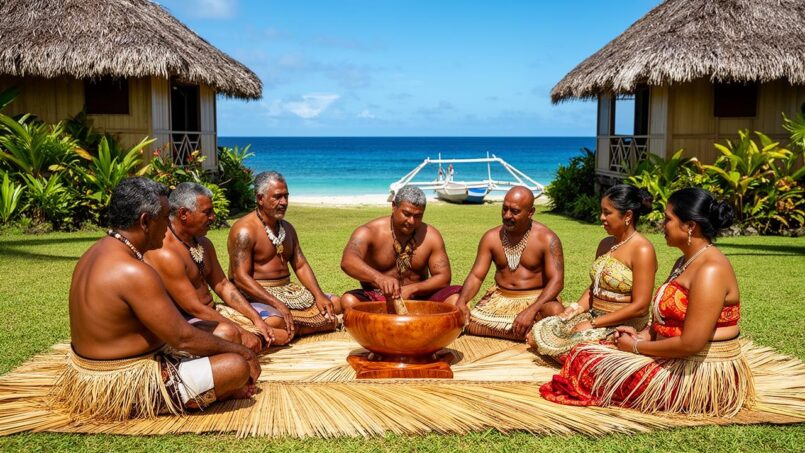
– avoid walking on large woven mats with shoes: these are valuable items, even when used as rugs or “tables”;
– wait to be shown where to sit: sitting in the wrong place, especially during a meal or ceremony, can be a major faux pas.
An important, often overlooked, rule of politeness is not to point the soles of your feet at someone, especially an elder, chief, or religious dignitary. When sitting on the floor, it is better to cross your legs or tuck them to the side, always ensuring your feet are not pointing at anyone.
Face, Head, and Posture
In Tongan symbolism:
– the head is considered sacred, especially that of children: touching it, even affectionately, is taboo;
– you should avoid physically dominating an elder or person of higher rank; for example, standing while a chief is sitting can be poorly perceived.
In a room where several elderly people are sitting on the floor, it is more respectful to sit down yourself rather than stand over them.
Greetings and Physical Contact
Greetings vary according to context:
In a formal setting, the traditional greeting consists of two adults briefly pressing their temples together while inhaling. In daily life, the common greeting is “Mālō e lelei” accompanied by a smile and a slight nod. Handshakes, when they occur, are rather gentle, especially between men. For women, a verbal greeting and a smile suffice, unless they initiate a handshake themselves.
Public displays of affection between men and women (kissing, long embraces) are rare and make people uncomfortable. However, holding hands with a same-sex friend, massaging each other’s shoulders, or walking arm-in-arm is common and carries no romantic connotation.
The Table, Food, and Hospitality: Refusing Is an Insult
In Tonga, the table is one of the main stages of culture. Sharing a meal is about confirming bonds, honoring your host, and fulfilling family obligations.
Dinner Invitations: Key Reflexes
When invited:
– arrive at the agreed time, or slightly after, but never very early;
– bringing a small gift (food, fruit, cake, sometimes a bit of money) is very appreciated, without needing to be lavish;
– let your hosts seat you and serve you.
It is customary for guests to be served first, before the host’s family. Accepting this practice, even if it makes you uncomfortable, is a sign of respect for the family’s desire to honor you.
Refusing a dish abruptly, completely refusing to taste something, or declining a “doggy bag” after a large feast is perceived as an insult to your hosts’ generosity. It is better to take a small portion, calmly explain any dietary restrictions if applicable, and thank them profusely.
Big Celebrations: ‘Umu, Kava, and Gifts
Major events (weddings, funerals, birthdays, religious festivals) involve communal feasts. The heart of these meals is often the ‘umu, a traditional earth oven where whole pigs, root vegetables (taro, yam, cassava), and meat dishes in taro leaves basted with coconut milk cook for hours.
These occasions are marked by a complex system of ceremonial gifts.
– women prepare and offer tapa (decorated bark cloth) and fine mats (koloa);
– men offer pigs, yams, kava, sometimes cash envelopes;
– gifts circulate between families of the bride and groom, maternal and paternal lineages, religious authorities, etc.
Refusing a gift (cloth, mat, food) is particularly serious: it means refusing to participate in the network of reciprocal obligations that structures society. Conversely, as a foreigner, you are not expected to give as much as Tongans themselves, but a small symbolic gesture—a modest contribution to the food, a meaningful present—will always be noticed.
Work, Negotiation, and Professional Life: Relationship First
In the world of work too, the benchmarks differ from those of Western economies. In Tonga, the business is often seen as an extension of the family, and the boss as a quasi-clan chief figure.
Recruitment and Hierarchy
During recruitment or collaboration:
– people look as much for a profile compatible with the culture as for a competent one;
– interviews emphasize your ability to work in a team, maintain good relationships, and contribute to the good of the community, more than your individual achievements;
– seniority and age often weigh more than education or innovation.
For an expatriate, it is best to avoid aggressively touting personal performance, which can be perceived as arrogance. Instead, emphasize collective achievements, service to others, and demonstrate your ability to respect the local hierarchy.
Negotiating in Tonga: Patience and Face
Negotiations, whether commercial or administrative, are generally:
– slow: multiple meetings, informal discussions, meetings expanded to include family or village members;
– focused on trust: they want to get to know you as a person before signing a contract;
– very attentive to the notion of face: avoiding humiliation, public criticism, or ultimatums.
In this context, Western aggressive negotiation techniques, “hardball tactics,” or direct confrontation of viewpoints are very likely to backfire. The key is to:
– stay calm,
– use indirect wording for disagreements,
– allow time for reflection,
– never ridicule or brutally contradict someone in front of others.
Tipping, Money, and Generosity: Knowing Where the Line Is
In the tourism sector, another peculiarity often surprises: tipping is not part of the culture. Neither expected nor systematic.
In hotels, restaurants, and tours, tipping is not expected, though it is appreciated. The culturally appropriate way to thank is through verbal thanks, loyalty, or offering a small gift or meal. An exception exists during cultural performances: it is customary to slip bills into the dancers’ clothing to honor them, a ritual called fakapale.
Within the family and community sphere, however, money flows heavily, especially during funerals, weddings, or religious festivals. There, these are not “tips” but formal contributions, recorded, which contribute to the family’s status within the relationship network. For an expatriate, these contributions should remain proportionate to your means and degree of integration, but completely ignoring them in the long term can leave you on the sidelines.
Managing Conflict: Preserving the Bond at All Costs
Finally, moving to Tonga also means learning another way of handling tensions.
Open Conflict vs. Productive Conflict
In individualistic cultures, it is often believed that “airing dirty laundry” face-to-face clarifies things and strengthens the relationship. In Tonga, open conflict is seen more as destructive to the group. They prefer:
– avoidance,
– using intermediaries (elder, chief, pastor),
– discussions in a safe symbolic framework, like the metaphor of “Fofola e fala kae talanoa e kainga”: “roll out the mat so the family can talk,” meaning to create a space where everyone can express themselves on equal footing despite usual ranks.
For an expatriate, major disagreements may never be expressed clearly. You need to be attentive to indirect signals such as a cooling of relations, repeated lateness, or other small signs, because problems are often not signaled directly.
– seeking a trusted mediator (Tongan colleague, respected community member) can be much more effective than insisting on “putting things on the table” one-on-one;
– apologizing with humility, possibly accompanied by a small gesture (food, concrete help), is often more meaningful than a long justifying speech.
Tongan family violence prevention programs in New Zealand show that by combining these cultural frameworks (Tauhi va, Talanoa, Fofola e fala) with biblical references, spaces can be created where extremely sensitive issues—abuse, paternal authoritarianism—can finally be addressed.
Preparing for Expatriation: Some Inner Adjustments
In summary, living in Tonga requires several inner shifts:
– Moving from “I” to “we”: accepting that your success implies obligations toward those around you.
– Replacing performance with relationship: recognizing that being reliable, generous, and respectful sometimes counts more than being efficient and fast.
– Trading frankness for delicacy: learning to say things differently, to read between the lines, to sacrifice a bit of clarity for a lot of harmony.
– Slowing down: embracing Tongan time, letting human connections take priority over the schedule.
Integrating into Tonga is not about abandoning your own benchmarks, but about expanding your range of behaviors by understanding and respecting local codes, just as Tongans themselves do by alternating between traditional (Anga fakatonga) and Western (Anga fakapālangi) registers. This adaptation allows you to discover genuine hospitality, surprising generosity, and an art of living centered on human connection, living up to the reputation of the Friendly Islands.
A wealth management project or a question? Contact us now to speak with a wealth management expert.
Disclaimer: The information provided on this website is for informational purposes only and does not constitute financial, legal, or professional advice. We encourage you to consult qualified experts before making any investment, real estate, or expatriation decisions. Although we strive to maintain up-to-date and accurate information, we do not guarantee the completeness, accuracy, or timeliness of the proposed content. As investment and expatriation involve risks, we disclaim any liability for potential losses or damages arising from the use of this site. Your use of this site confirms your acceptance of these terms and your understanding of the associated risks.

Cyril Jarnias is an independent expert in international wealth management with over 20 years of experience. As an expatriate himself, he is dedicated to helping individuals and business leaders build, protect, and pass on their wealth with complete peace of mind.
On his website, cyriljarnias.com, he shares his expertise on international real estate, offshore company formation, and expatriation.
Thanks to his expertise, he offers sound advice to optimize his clients' wealth management. Cyril Jarnias is also recognized for his appearances in many prestigious media outlets such as BFM Business, les Français de l’étranger, Le Figaro, Les Echos, and Mieux vivre votre argent, where he shares his knowledge and know-how in wealth management.





