
 Published on and written by Cyril Jarnias
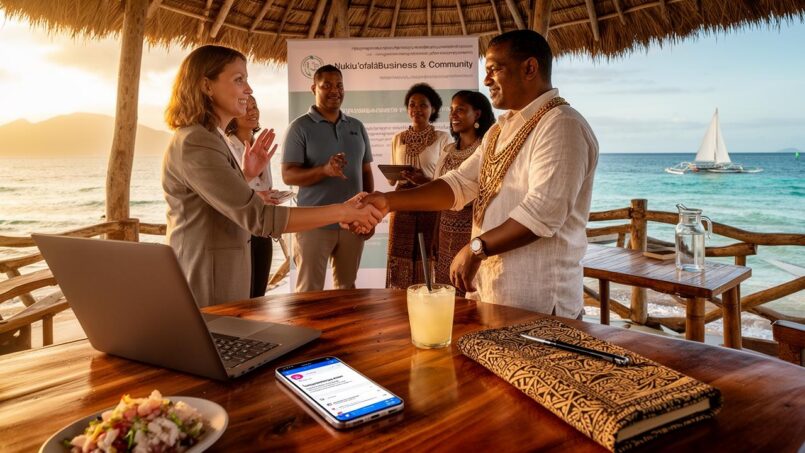
Settling in Tonga to work or start a business means entering a world where human relationships often matter more than contracts, where community comes before the individual, and where trust is earned over time. For an expatriate, professional success in this Pacific kingdom therefore hinges first on the ability to build a solid network, both local and international, while respecting the anga fakatonga – the “Tongan way.”
To grow your professional network in Tonga, it is essential to respect local cultural codes, identify key places and institutions, and use adapted digital tools such as LinkedIn.
Understanding the Tongan ecosystem before networking
Before racking up business cards and LinkedIn connections, it is essential to understand the logic that structures Tongan society. Without this framework, you can attend many meetings… without ever gaining access to the circles where decisions are actually made.
Society is organized around anga fakatonga, a way of life built on several core values: respect (faka’apa’apa), mutual support (fetokoni’aki), loyalty in relationships (tauhi vaha’a), the extended family (kainga), and a deeply rooted Christian faith. Identity is first and foremost collective: people define themselves by their village, their church, their clan, far more than by their resume.
In this context, business is rarely purely transactional. Most entrepreneurs and leaders consider that an agreement rests both on a signed document and on a personal bond. Trust is given to someone who respects the codes, takes time to integrate into the community, participates in events, and shows humility and consistency.
Entrepreneurs and leaders
For an expatriate, this means that simply “networking” in the Western sense is not enough. You must learn to nurture relationships over time by practicing tauhi vā – the art of caring for connections through visits, phone calls, invitations, and social attentions. A follow-up email cannot replace a shared coffee or regular attendance at a local event.
Hierarchy and “face”: two parameters to integrate
Tonga remains a monarchy with a strong social hierarchy, which is reflected in business. Age, family rank, position, and sometimes noble titles carry significant weight in interactions. Publicly questioning a superior, showing anger in a meeting, or embarrassing someone can have lasting relational consequences.
In networking interactions, it is crucial to avoid any pressure for a meeting, insistent follow-ups, or blunt confrontation. In case of disagreement, Tongan practice favors a private, tactful discussion to preserve everyone’s honor. The ability to interpret unspoken cues, silences, and nonverbal signals is often more valuable than demanding a direct answer.
Mapping networking places and structures in Tonga
Once this cultural framework is established, the question becomes very concrete: where, and with whom, to network in Tonga when you arrive as an expatriate?
Geographic hubs: Nuku’alofa, Vava’u, and the outer islands
The main center for professional opportunities and expatriate life is Nuku’alofa on the island of Tongatapu. Here you find most government agencies, the Tonga Chamber of Commerce and Industry (TCCI), many private companies, NGOs, embassies or consulates, and the Ocean of Light international school.
Vava’u is a second important hub, especially for nautical tourism and whale watching. The expatriate community is smaller but very close-knit, with a dense network of sailing clubs, dive operators, and structures tied to the whale season.
On more remote islands, like Nomuka, expatriates are rare and often involved in specific projects (volunteering, research, development). Networking there relies more on deep integration into the local community than on professional cocktail parties. The arrival of new infrastructure, such as a future wharf, may gradually open the area to new flows and thus to more people to meet.
Key institutions for a business network
Beyond geography, certain organizations play a central role in driving economic life and serve as natural crossroads for an expatriate.
The following table provides a quick overview of the different elements or categories mentioned in the article, offering a comparative and immediately understandable view.
| Organization / Place | Primary role for networking |
|---|---|
| Tonga Chamber of Commerce and Industry (TCCI) | National private sector platform, exchanges with government and donors, regular networking events |
| Tonga Business Enterprise Centre (TBEC) | Training and mentoring center for entrepreneurs, with over 4,700 people trained and 1,500 businesses assisted |
| Tonga Development Bank (TDB) | Development bank offering free SME support and internship programs, especially in tech |
| Tonga Tech Hub / Tonga Tech Training Center / TIST | Tech ecosystem (training, bootcamps, workshops) useful for digital profiles |
| Tonga Tourism Association & Tonga Tourism Authority | Key networks for tourism, hospitality, and leisure professionals |
| Pacific Islands Private Sector Organisation (PIPSO) | Regional network, access to business programs and resources throughout the Pacific |
| Tanoa Networking Circle | Specialized circle for tech professionals, heavily focused on jobs and referrals |
| Expat clubs, churches, community associations | Gateways to Tongan society and diaspora, useful for broad relationship building |
The TCCI, in particular, is a reference entry point. A private, non-governmental, non-profit association, it brings together between 50 and over 150 companies from all sectors, from street vendors to large corporations. It organizes bimonthly networking events, offers mentoring services, training, export support, and acts as an intermediary with the government and international donors.
For an expatriate entrepreneur or manager, becoming a TCCI member provides access to this information and contact base, but also helps establish visibility as a legitimate player in the local economic fabric. It also grants access to Business Link Pacific, a business advisory program for SMEs for which the TCCI is the national representative.
More than 4,700 participants have been supported by the TBEC, an incubator and skills center.
Conferences and business missions: accelerators for meetings
In Tonga, several formats structure encounters between local and international players: trade missions, fairs, conferences, sectoral forums. For an expatriate, attending these is not trivial: it is an opportunity to capture in a few days dozens of contacts that would otherwise take a very long time to gather.
An emblematic example: the “Tonga Business Mission” organized with Investment Fiji and the TCCI. One key stage of this mission was a B2B event at the Tanoa International Dateline Hotel in Nuku’alofa, where Fijian and Tongan companies presented their expectations, explored partnerships, and discussed joint projects. This type of B2B session is exactly the kind of setting where an expatriate can introduce themselves, listen, identify influential players, and then request more targeted meetings in the following days.
Similarly, international conferences scheduled in Tonga in the coming years, particularly in tourism, engineering, technology, health, or management, offer fertile ground for combining sector intelligence and networking. They bring together researchers, decision-makers, entrepreneurs, and public officials, and often include workshops, panels, informal time, and field visits, all conducive to networking.
Integrating into the expatriate community without becoming trapped in it
The expatriate community in Tonga remains modest in size, which makes it easier for a newcomer to make contact. It includes retirees attracted by the cost of living and simplicity, missionaries, humanitarian workers, tourism operators, teachers, and a small cohort of digital nomads willing to cope with uneven connectivity.
The main gathering points are the cafés and restaurants along the Nuku’alofa waterfront (like Waterfront Café & Restaurant), hotel bars, sports clubs (rugby, sailing, diving), as well as very active Facebook and WhatsApp groups where practical information and tips are exchanged (housing, healthcare, paperwork, schools).
For an expatriate, coworking spaces and professional meeting places fulfill at least three essential roles in building a network.
These spaces provide an environment conducive to spontaneous meetings and informal exchanges with other professionals, both local and international.
They serve as a hub for understanding the local professional culture, market practices, and discovering opportunities.
Beyond the purely professional network, they facilitate social integration and help create a sense of belonging in a new environment.
They first provide valuable informal support: administrative guidance, feedback, everyday life tips in a very specific island environment (complete shutdown on Sundays, the notion of “Tonga Time”, access to healthcare, etc.).
They then serve as a relay to the local scene. A well-connected expatriate can often introduce a newcomer to trusted Tongan partners, recommend a service provider, or open a door within a ministry or NGO. In a small economy, this kind of referral is worth far more than mass-sending CVs.
Before designing your professional and network strategy in Tonga, it is crucial to consider local realities: a limited job market, strict rules for obtaining work permits, the legal obligation for employers to first recruit a qualified Tongan if available, and the importance of the associative sector and volunteering. These parameters directly influence your trajectory and steps.
The challenge, however, is not to remain confined to this expat bubble. A network composed exclusively of foreigners, however useful, offers little exposure to the heart of Tongan society, where many decisions are made. It is therefore necessary to gradually multiply bridges to local communities: churches, neighborhood committees, women’s associations, mixed sports clubs, etc.
Mastering daily Tongan relational codes
Knowing where to go is not enough: how you interact matters just as much. Building your network in Tonga requires adapting your behavior to a culture where politeness, restraint, and respect for roles are highly valued.
The basic greeting, “Mālō e lelei,” accompanied by a smile, is essential when entering a shop, office, or meeting place. Speaking to elders in a soft voice, avoiding interrupting, standing when an elder or important person enters the room – these are all highly observed signals.
In professional circles, English is widely used, but showing you know a few Tongan expressions creates an immediate bridge. Even a simple phrase like “Mālō ‘aupito” to thank, or “Fakamolemole” to apologize, conveys a welcome image of integration effort.
One must also be attentive to gestures: do not touch someone’s head, avoid pointing with your index finger, remove your shoes before entering a home or sitting on a mat, choose modest attire, especially for women (long skirts, covered shoulders). In a meeting or event context, an expatriate who is well-dressed but respectful of the local dress code will be perceived as more serious than one strictly in Western attire but unsuited to local customs.
Professional exchanges in New Caledonia often include informal moments (meals, breaks) and offering small gifts, a common cultural practice. However, in the public service, a code of ethics prohibits agents from accepting gifts related to their duties. It is therefore recommended to reserve these gestures of generosity for private occasions or entrepreneurial relationships, being careful to avoid any ambiguity.
Finally, accepting invitations – to a birthday, a ceremony, a church celebration – is a powerful lever for strengthening your network. It is in these moments that tauhi vā is fully expressed: by being present, listening, showing availability, the expatriate builds a trust capital that will be decisive when opportunities arise.
Using LinkedIn and digital tools without losing local grounding
Even in a country where face-to-face remains central, digital platforms play a growing role in network development. LinkedIn, in particular, has become the dominant tool for showcasing your profile, spotting recruiters, joining specialized groups, and following online events.
Optimizing your profile for the Tongan context
A well-constructed LinkedIn profile is all the more important because, according to various global studies, a very large proportion of jobs are landed through networks, and 100% remote job offers, a minority in volume, concentrate a massive share of applications. From the start, you need to be more strategic than average.
In Tonga, professionals like Richard Miller, senior software engineer at the Tonga Development Bank, explicitly recommend customizing your profile with local keywords and joining Tongan tech communities to increase your chances of being spotted. Concretely, this means mentioning Tonga, Nuku’alofa, organizations like TCCI, Tonga Tech Hub, Tanoa Networking Circle, or skills related to key sectors (tourism, energy, agriculture, digital, etc.).
For a high-performing LinkedIn profile, follow the basics: use a clear professional photo and a polished banner that reflects your value proposition. Write a headline that goes beyond your job title (e.g., ‘Digital Marketing Specialist | Sustainable Tourism in Tonga’). Structure your summary as a narrative (problem, solution, proof). Detail your experiences with quantifiable results. List targeted skills, request recommendations, and add relevant certifications, such as those from Tonga Technical Institute or other recognized organizations.
Adding multimedia content – presentations, articles, projects – to the “Featured” section also provides a concrete preview of your work, which reassures contacts who do not yet know you in person.
Positioning yourself in the Tongan ecosystem through groups and events
LinkedIn is not limited to the individual profile. Groups play a key role in penetrating a specific ecosystem, and Tonga is no exception. Communities like “Tonga Coders Unite” or “Nuku’alofa Tech Innovators” bring together developers, system administrators, cybersecurity specialists, IT project managers, and recruiters interested in the local market.
To fully benefit from joining an online community, such as a professional network or a specialized forum, active participation is crucial. This includes actions like answering technical questions, sharing a relevant case study, or relaying information about local initiatives, for example a workshop at the Tonga Tech Training Center or a renewable energy project in Tonga. Simple gestures like congratulating a member on a certification also contribute to this dynamic. This regularity of interaction allows you, over several weeks, to identify industry influencers, companies that are hiring, and notable physical events.
LinkedIn also hosts virtual events – webinars, panels, conferences – useful for staying informed about trends, especially in fast-growing sectors (sustainable tourism, digital, climate and green finance). For an expatriate in Tonga, participating in these online gatherings can compensate for geographic insularity, opening doors to regional partners (Fiji, Samoa, New Zealand, Australia) with whom it will then be easier to build projects involving Tonga.
Establishing an online networking routine
Experience shows that a networking strategy only produces results if applied regularly. Organizing to dedicate time each week to network development, setting modest but consistent goals – for example, connecting with three to five new professionals – helps anchor this work in daily life.
Using tools like tracking spreadsheets (Excel, Notion, Trello) allows you to centralize contacts, actions (messages, follow-ups, meetings), and events. For advanced use, software like Breakcold aggregates profiles and posts. For an expatriate, a simple shared spreadsheet may suffice.
Connection messages should be personalized, mentioning a common point (same LinkedIn group, shared event attendance, interest in the same sector) and explaining in a few lines why the contact could be mutually interesting. Once the connection is accepted, it is wise to send a short thank-you message and, if appropriate, propose an informal exchange (video call or coffee in Nuku’alofa).
When targeting highly sought-after profiles – for example, a bank director, a government official, a CEO – it is good to first interact publicly with their content (likes, comments adding real value) before sending an invitation. This gradual approach is more in line with Tongan codes of respect and patience than directly sending a self-interested request.
Betting on tech and training: a powerful lever for expatriates
In a country where the economy is diversifying and digital transformation is accelerating, tech is a particularly dynamic ground for networking, including for expatriates.
Structures like the Tonga Tech Hub, the Tonga Tech Training Center, the Tonga Institute of Science & Technology, and internship programs at the Tonga Development Bank are all gateways to developers, trainers, system administrators, digital entrepreneurs, or public officials involved in IT projects.
Available figures in the tech ecosystem show just how critical networking is.
| Tech-related indicator in Tonga | Value mentioned |
|---|---|
| Share of tech professionals finding a job through the Tanoa Networking Circle | More than 65% within a year |
| Share of IT professionals holding at least one certification | 83% |
| Tech professionals reporting difficulty finding a job due to lack of network | 68% |
| Increase in job prospects for TTTC participants | 92% report better chances within 6 months after workshops |
| Increased probability of finding a job by joining Tonga Tech Hub | 35% additional probability within 6 months |
These data illustrate two points: first, without a network, it is hard to capture good opportunities, as many positions circulate through referrals or specialized groups rather than formal job postings; second, participating in training, bootcamps, meetups, and circles like the Tanoa Networking Circle significantly increases professional visibility.
According to local data, this is the percentage of tech companies that recruit at the Tonga Tech Expo.
Between institutions, NGOs, and associations: diversifying your network
Tonga presents an interesting particularity for expatriates: a relatively high density of associations, women’s councils, community networks, and local or international NGOs. For those who know how to leverage it, this environment constitutes a formidable relationship machine.
Organizations like Friends of Tonga, created by former Peace Corps volunteers, carry out concrete educational projects (pen pal programs, scholarships, video libraries). Getting involved as a volunteer allows you to contribute to the country’s development and meet key players in the sector: educators, NGO leaders, teachers, and community leaders.
On the human rights and health front, entities like the Tonga Leitis’ Association work with vulnerable populations, train their members, and support them toward employment and higher education. Getting involved – with humility and respect for local priorities – provides access to a very well-connected milieu, linked to international bodies and advocacy networks.
Being invited to meetings or projects of women’s associations, such as the Tonga National Women’s Council or village committees, allows you to understand gender issues and concrete needs (access to funding, training, childcare). This participation can lead to co-building projects (workshops, micro-enterprises, cooperatives) and reinforces the perception of the expatriate as a reliable partner.
This associative fabric is not reserved for Tongans. On the contrary, foreigners who show a genuine willingness for co-development, rather than imposing ready-made solutions, are often well received.
Structuring your approach: from contact to partnership
In an environment where time flows more slowly and relationships come first, a risk for the expatriate is to scatter: many meetings, few concrete outcomes. It is therefore useful to think of your network development as a process.
Making yourself known in the Vava’u tourism sector, identifying three potential partners for a digital training project, or joining a local team in the green finance sector. These examples illustrate clear objectives that help guide the choice of events and networks to frequent for an effective development strategy.
The second step is relational prospecting: attending events (TCCI, trade missions, sectoral exhibitions, conferences), meeting at cafés, volunteering initiatives, joining clubs or associations (sports, professional, religious). You then start building a first base of contacts, which you note down and qualify.
After a first meeting, follow-up is crucial to turn a simple acquaintance into a solid relationship. It can take various forms: thank-you messages, lunch invitations, or proposals for a meeting to explore synergies. In the Tongan context, this follow-up also includes visits, phone calls, or participation in local ceremonies. The goal is to reach a level of mutual trust that allows for recommendations or future collaborations.
Finally, once trust is established, you can propose concrete projects: joint pilots, co-organizing a workshop, a business partnership, a consulting assignment, a joint application for regional funding (for example, from the Green Climate Fund or a program like Business Link Pacific). Structures like TCCI or TBEC can here play a facilitating role, by co-signing applications, providing institutional legitimacy, and helping navigate national procedures.
Avoiding classic expat networking pitfalls
Several pitfalls frequently appear in testimonials from expatriates in Tonga.
The first is underestimating the weight of time. Some arrive with a Western calendar: results in three months, business development in six, quick return on investment. In an island context, with decisions based on consultation, consensus, and sometimes waiting for informal signals, this impatience can be poorly perceived. Knowing that a serious project can take a year or two to solidify is essential to avoid interpreting delays as a refusal.
In a country where Sunday is devoted to worship and family, it is essential to show respect for local faith. Avoid proposing meetings on that day or displaying contempt. Adapting your work schedule and accepting invitations to religious services can strengthen the image of a respectful partner and avoid blocking relationships.
The third is confusing openness with interference. Many Tongans are aware of modernization issues (corporate governance, financial management, digital, international compliance), but find it difficult to accept foreigners bluntly criticizing their practices. It is more effective to bring your expertise in the form of advice, mentoring, training, emphasizing co-construction and valuing local assets.
In family businesses, social pressures to finance ceremonies or traditional gifts can affect cash flow and sustainability. An expatriate must be aware of this and avoid imposing strictly Western governance models without considering these local realities.
Cultivating trust: the heart of the network in Tonga
In the background, everything comes back to trust. Studies on entrepreneurship and business relationships show that more than 90% of Tongan interlocutors consider understanding their culture as a key piece of advice for working together, and just as many place honesty and integrity at the heart of the relationship.
For an expatriate, this translates into a few simple but demanding principles.
To build a reliable reputation, it is essential to be consistent in your commitments and respect deadlines. Transparent communication in case of problems is crucial. Investing time in relationships, even outside work (events, calls, favors), nourishes the social bond (tauhi vaha’a). Finally, refusing any questionable practice (corruption, rule-bending, manipulation) aligns your ethics with shared values and strengthens your credibility over the long term.
As this trust takes hold, referrals come: a partner introduces you to another, a manager spontaneously calls you to offer an assignment, a diaspora contact steers you toward an investor, a chamber of commerce associates you with a regional project. That is when the network ceases to be a collection of names and becomes a living relational capital, adapted to the Tongan context.
Success depends on integrating into local values: prioritizing human relationships over contracts, understanding the central role of the extended family in the economy, and respecting the importance of faith. The expatriate must combine digital tools with on-the-ground presence, blend expertise with humility. This approach makes it possible to build a career, launch a business, or co-create projects, while contributing to the development of a kingdom attached to respect, sharing, and community.
An estate project or a question? Contact us now to speak with a wealth management expert.
Disclaimer: The information provided on this website is for informational purposes only and does not constitute financial, legal, or professional advice. We encourage you to consult qualified experts before making any investment, real estate, or expatriation decisions. Although we strive to maintain up-to-date and accurate information, we do not guarantee the completeness, accuracy, or timeliness of the proposed content. As investment and expatriation involve risks, we disclaim any liability for potential losses or damages arising from the use of this site. Your use of this site confirms your acceptance of these terms and your understanding of the associated risks.

Cyril Jarnias is an independent expert in international wealth management with over 20 years of experience. As an expatriate himself, he is dedicated to helping individuals and business leaders build, protect, and pass on their wealth with complete peace of mind.
On his website, cyriljarnias.com, he shares his expertise on international real estate, offshore company formation, and expatriation.
Thanks to his expertise, he offers sound advice to optimize his clients' wealth management. Cyril Jarnias is also recognized for his appearances in many prestigious media outlets such as BFM Business, les Français de l’étranger, Le Figaro, Les Echos, and Mieux vivre votre argent, where he shares his knowledge and know-how in wealth management.





