
 Published on and written by Cyril Jarnias
wp-block-paragraph –>
At the heart of the South Pacific, the kingdom of Tonga offers far more than postcard-perfect beaches. An archipelago of five main island groups – Tongatapu, ‘Eua, Ha’apai, Vava’u, and the Niuas – the country combines spectacular natural sites, remnants of a powerful Oceanic empire, and a still-vibrant Polynesian culture. Far from mass tourism, visitors discover monumental trilithons, royal tombs compared to the pyramids of Egypt, mythical sea caves, and one of the world’s best sanctuaries for observing humpback whales.
This journey through the must-see tourist attractions of Tonga follows a simple thread: from the main island of Tongatapu to ‘Eua, Ha’apai, and Vava’u, stopping at each place that alone justifies the detour to the “Friendly Islands.”
Tongatapu, Historical and Political Heart of the Kingdom
Tongatapu concentrates the country’s political and spiritual power. Here you’ll find the capital Nukuʻalofa, the Royal Palace, bustling markets, and the most important archaeological sites in the South Pacific. It’s often the traveler’s gateway, via Fuaʻamotu International Airport, before radiating out to the other archipelagos.
Nukuʻalofa: Palace, Modern Tombs, and Markets
Nukuʻalofa, a modest but lively capital, is easily explored on foot. The waterfront, the churches, and the markets provide a strong first encounter with the kingdom.
The Royal Palace of Tonga still dominates the Nukuʻalofa waterfront. Built in the 1860s from kauri wood imported from New Zealand, in a Victorian style adapted to Tongan traditions, it remains the official residence of the sovereign. The interior is not open to visitors, but its colonial manor silhouette, decorated verandas, and central tower, facing the ocean, make it an iconic backdrop of the country. The best view is from the corner of Vuna Road and Vaha’akolo Road, along the seaside promenade.
A few streets away, another site embodies the contemporary monarchy: Malaekula, literally the “Red Soil.” These modern royal tombs, surrounded by a fence and ornate gates, have housed the sovereigns of the Tupou dynasty since the late 19th century. The decision to bury King Siaosi Tupou I there upon his death in 1893 marked the transfer of royal burials to the capital, breaking with the tradition of the ancient langi of Mu’a. The site is sacred, generally closed, and can only be viewed from the outside, but it offers a glimpse into the continuity between ancient chieftainship and the current constitutional monarchy.
Right next to the center, other places shape the visitor experience: the Free Church of Tonga, a vast church with a central political and religious role; the Tonga National Museum, which recounts the kingdom’s history; and the Langafonua Handicrafts Centre, where you can discover tapa cloth, woven mats, and traditional objects. Together, they make up an ideal route before tackling the island’s major ancient sites.
Finally, you can’t leave Nukuʻalofa without visiting Talamahu Market, the country’s largest market. Housed in a vast building with a corrugated iron roof, it gathers tropical fruits, root vegetables (taro, cassava, yam, sweet potato), vegetables, peanuts, and handicrafts. You’ll see farmers who came to sell their harvest that very morning, as well as an upper floor dedicated to textiles, t-shirts, and souvenirs. It’s also the place to try ota ika (raw fish marinated in coconut milk) or lu, meat and coconut milk cooked in taro leaves.
A table helps visualize the key sites of Nukuʻalofa:
| Site | Type | Main Features | Public Access |
|---|---|---|---|
| Royal Palace | Royal Residence | Victorian manor in kauri wood, on the waterfront | Exterior only |
| Malaekula Royal Tombs | Modern burial site | Necropolis of the Tupou dynasty kings, sacred space | Exterior view |
| Tonga National Museum | Museum | Tongan history and culture | Yes |
| Talamahu Market | Market | Fruits, vegetables, handicrafts, local dishes | Yes |
| Free Church of Tonga | Church | Monumental architecture, historical role | Yes (worship) |
Haʻamonga ʻa Maui: The “Stonehenge of the Pacific”
In eastern Tongatapu, near the villages of Niutoua and Afa, lies one of the kingdom’s most fascinating symbols: the Haʻamonga ʻa Maui trilithon. Erected in the Haʻamonga ʻa Maui Historical Park, this megalithic monument consists of two coral pillars topped with a lintel, carved and assembled without mortar.
According to oral tradition, this stone structure, attributed to the Tuʻi Tonga Tu’itatui in the 13th century, was a symbol intended for his sons Lafa and Talaihaʻapepe: the two pillars represent the heirs and the lintel the unity the father wished to preserve. Other interpretations see it as the monumental gateway of an ancient palace or a primitive solar calendar device, used to mark key points of the year through sun observation.
The name itself, “Haʻamonga ʻa Maui,” refers to the Polynesian demigod Māui, famous for having “fished up” the islands using his hook. Literally, the expression can be translated as “Maui’s burden,” as if the hero had carried these coral blocks on his back.
The site also includes Maka Faʻakinanga, a large upright slab described as a legendary “throne” where the sovereign might have sat. The historical park, protected since the early 1970s, is located in the Heketā region, which was one of the ancient capitals of the kingdom between the 10th and 13th centuries. In this area, political remains and mythological symbols intertwine, at the heart of the power of the first Tuʻi Tonga.
To measure the importance of this site within Tongan heritage, we can compare it to other major historical sites of Tongatapu:
| Site | Main Period | Historical Role | Visitor Interest |
|---|---|---|---|
| Haʻamonga ʻa Maui | c. 13th century | Royal monument, possible calendar | Unique trilithon, legends of Māui |
| Heketā (former capital) | 10th–13th centuries | Seat of Tuʻi Tonga power | Historical landscape around the trilithon |
| Lapaha – royal langi | 13th–19th centuries | Necropolis and spiritual capital | Monumental tombs, still-living ritual |
| Malaekula (Nukuʻalofa) | Since 19th century | Necropolis of the Tupou dynasty | Modern extension of funerary tradition |
Lapaha and the Langi: The Pyramids of the Pacific
About thirty kilometers east of Nukuʻalofa, the coastal village of Lapaha, in the small town of Mu’a, is home to what many researchers consider the most important archaeological site in the South Pacific: the ancient royal tombs, or langi. It is here, on land reclaimed from an ancient port facing the lagoon, that the former capital of the powerful Tuʻi Tonga empire stands.
Between 22 and 28 monumental tombs dot the landscape of Lapaha. These are earthen, tiered, pyramid-shaped platforms retained by walls of coral slabs cut with remarkable precision. Some slabs measure 2.4 meters wide and fit together so perfectly that no mortar was needed. The blocks, quarried from coastal pits, were transported by boat and then fitted on site.
The earliest constructions on the site date back to the 12th–13th centuries, with recent studies dating some langi to the period 1250–1380. Mu’a served as the empire’s capital from the 12th to the 16th century, then as a major spiritual center until the 19th century. During this time, Lapaha became the permanent residence of the Tuʻi Tonga. At their peak, these sovereigns exerted political and religious influence extending to Samoa, eastern Fiji, and Wallis/‘Uvea, making Tonga the only known Oceanian society to have durably projected its power over other archipelagos.
The most famous of these monuments is Paepae o Teleʻa, built in the 16th century for King ʻUluakimata I, known as Teleʻa. A paradigm of Tongan craftsmanship, it is particularly recognized for its large L-shaped corner blocks. Ironically, this tomb remained empty: King Teleʻa died in Samoa, specifically in Manuʻa, where he was reportedly buried after an expedition to retrieve the body of his Samoan wife Talafiava. Right next to it, the smaller Namoʻala received in 2006 the remains of Prince ʻUluvalu Tuʻipelehake and his wife Kaimana Aleamotuʻa, proof that the langi tradition continues into the contemporary world.
Another emblematic tomb, Langi Tuʻofefafa, holds the last Tuʻi Tonga, Laufiltonga. A cross there marks his Catholic faith, a sign of the meeting between ancient beliefs and Christianity. Further south, the oldest tombs are said to be linked to Fatafehi, daughter of Tuʻi Tuʻitatui, while two langi near the port and princely lands mark the progression of burials northeastward over the centuries.
Even though many structures are now eroded, partially buried, the site remains well-maintained: manicured lawns, informative panels, occasional rituals. The families of Lapaha know exactly who rests under each tumulus and continue to clean the tombs, cut the grass, and perpetuate ancestral ceremonies. This community management makes it a living cultural landscape, where the sacred blends with the everyday life of the village.
Compared to other great necropolises of the world, these tombs illustrate the sophistication of an insular society long underestimated:
| Necropolis | Location | Type of Construction | Cultural Feature |
|---|---|---|---|
| Langi of Lapaha | Tongatapu, Tonga | Pyramidal coral platforms | Continuous use, management by local families |
| Pyramids of Giza | Egypt | Monumental stone pyramids | Pharaonic burials of the Old Kingdom |
| Royal Tombs of Nukuʻalofa | Tongatapu | Tombs of coral blocks in the capital | Mark the modern monarchic era |
The langi and the Haʻamonga ʻa Maui trilithon are at the heart of a project for inscription on the UNESCO World Heritage List, under the title “Ancient Capitals of the Kingdom of Tonga.”
Visitors get there mainly by taxi, rental car, or guided tour from Nukuʻalofa, taking about half an hour. Entry is free, but the rules of respect are strict: no picnicking on the tumuli, decent attire, discretion in the face of the small family ceremonies that sometimes take place there.
Mapuʻa ʻa Vaea: The Giant Blowholes of Houma
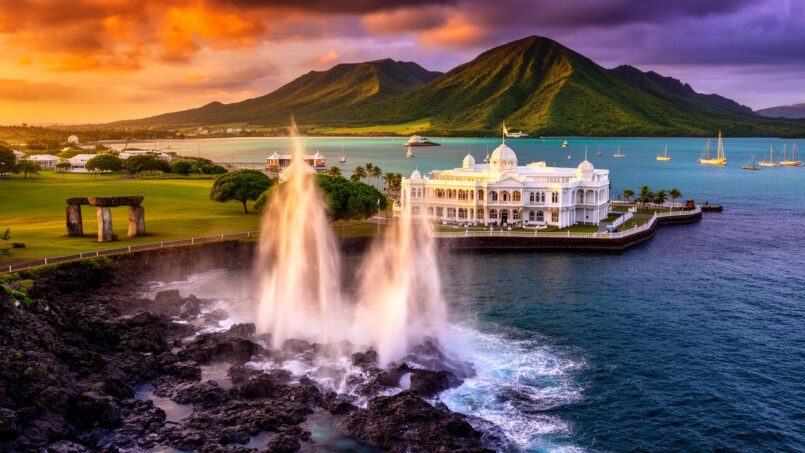
A complete change of scenery on the south coast of Tongatapu, near the village of Houma, with one of the most impressive natural spectacles in the Pacific: the chain of blowholes of Mapuʻa ʻa Vaea, literally “Vaea’s whistle” or “the chief’s whistle.” Over nearly five kilometers of basaltic and limestone coastline, ancient lava flows, hollowed out by the ocean, have become a network of channels and chimneys through which seawater spurts with every wave.
During large southern swells, hundreds of water jets can rise simultaneously, sometimes reaching 30 meters in height. Their sound, a mix of rumbling and whistling, evokes the breath of a whale. On sunny days, rainbows form in the sprays that explode above the black rocks. This phenomenon, often described as a ‘wall’ or ‘procession’ of marine fountains, is visible over long stretches of the coastline.
The phenomenon is particularly spectacular at high tide and during periods of strong swell. After the eruption of the Hunga Tonga-Hunga Haʻapai submarine volcano in 2022, part of Tongatapu’s south coast rose, bringing some blowholes closer to the shoreline and opening new fissures.
Access is easy from Nukuʻalofa: barely fifteen kilometers by car or taxi via Taufaʻahau Road. There’s a small free parking lot and developed platforms with guardrails for safe observation. Infrastructure remains deliberately simple: a few benches, basic toilets, sometimes vendors selling drinks, flower necklaces, and pareos, but no big restaurant or first aid post.
A summary of visiting conditions helps with planning:
| Element | Main Information |
|---|---|
| Location | Houma, south coast of Tongatapu, ~14 km from Nukuʻalofa |
| Phenomenon | Water jets through natural chimneys |
| Height of jets | Up to 30–35 m depending on sources |
| Best time | High tide, strong swell; dry season for clear skies |
| Access | Car, taxi, local bus, bike; small free parking |
| Safety tips | Stay behind barriers, slippery rocks, no swimming |
The site is regularly cited as the number one attraction on Tongatapu by travelers, rewarded with tourism awards and thousands of enthusiastic reviews. Many recommend returning at different times of day to compare the effects of light and tide.
Other Sites on Tongatapu: Caves, Beaches, and Memorials
Beyond the big classics, Tongatapu hides many “small” sites that complete a loop around the island.
On the east coast, Anahulu Cave combines stalactites, stalagmites, and a freshwater pool in a limestone cave accessible on foot. After the visit, you can head to the nearby beach for a swim in the lagoon. Further west, Hufangalupe forms a spectacular natural bridge over the ocean, while Houma Ocean View Cliff offers a plunging view of the Pacific.
The island also preserves traces of the great European explorations: a monument marks the landing site of Abel Tasman on the northwest coast, while a stele commemorates the arrival of James Cook in 1777 near the Fangaʻutu lagoon, close to Mu’a and the village of Pelehake. The coastline is also dotted with curiosities like the “three-headed coconut” or the “two-headed coconut,” trees with surprising shapes, or “Tsunami Rock,” a massive boulder carried far inland by a giant wave, according to local traditions.
In Kolovai, another coastal village, visitors can observe the large fruit bats hanging from the trees. In Navutoka, “fishing pigs” root through the mangroves and shallow waters, a scene that has become a tourist attraction in its own right.
‘Eua, the Wild Island: Cliffs, Forests, and Whales
A few hours by ferry from Tongatapu, ‘Eua offers a rawer face of the kingdom. It’s the oldest island geologically, carved with cliffs, caves, and forests. With little tourist development, it attracts hikers and nature lovers.
The park covers a large part of the island and offers a network of trails leading to viewpoints, natural pools, and immense banyan trees. It is home to remarkable sites such as the Lianga Huo ʻa Maui natural land bridge, the legendary Lakufa’anga area, and the ‘Rock Garden’ where the rare pandanus ‘Hingano’ grows.
The two giant trees nicknamed Big ‘Ovava (spectacular banyans) have become classic stops on guided tours, along with Hafu Pool, a clear water pool where you can cool off after walking. ‘Eua is also one of the few places in the world where you can see humpback whales… from the cliff. Between June and November, the cetaceans glide along the coast, sometimes offering full breaches visible to the naked eye.
A table summarizes the highlights of ‘Eua:
| Site / Area | Type of Site | What Makes It a Must-See |
|---|---|---|
| ‘Eua National Park | Natural park | Hiking, cliffs, forests, ocean views |
| Lianga Huo ʻa Maui | Land bridge | Spectacular natural arch, local legends |
| Lakufa’anga / Rock Garden | Rocky landscape | Geological formations, rare flora (pandanus “Hingano”) |
| Big ‘Ovava Trees | Giant trees | Monumental banyans, primeval forest atmosphere |
| Hafu Pool | Natural pool | Swimming in nature, after a hike |
| Whale watching points | Coastal cliff | Land-based observation of humpback whales |
The ferry crossing from Tongatapu is the shortest and cheapest in the country, making it an easy getaway even for a limited stay.
Ha’apai: Pristine Lagoons, Ancient History, and Silence
Located in the center of the kingdom, the Ha’apai archipelago comprises about sixty islands, of which only about twenty are inhabited. This is Tonga in its most stripped-down version: few facilities, very few cars, nearly deserted beaches, peaceful villages, and reefs in excellent condition. Visitors come to disconnect, dive, kayak, watch whales, and, for the most curious, trace back to the earliest times of Polynesian settlement.
The main town, Pangai, is on the island of Lifuka, connected by a concrete causeway to Foa. This is where the Salote Pilolevu Airport, Taufa’ahau Wharf, a few shops, and the Visitor Information Centre are concentrated. From Lifuka and Foa, boats then depart to even more isolated islands like Uoleva, a hotspot for kitesurfing and diving.
Between Memory and Lagoon: Cultural Sites of Ha’apai
Ha’apai is not just a postcard. On Lifuka, a memorial recalls the tragedy of the Port au Prince in 1806. This ship, a former French vessel captured by the British and converted into a privateer, was caught in a local conflict, and its captain and about half the crew were killed. One of the survivors, the young Briton William Mariner, lived four years among the Tongans before writing a foundational account for Polynesian ethnography.
Shirley Baker was Tonga’s first Prime Minister after serving as a missionary and advisor to King Tupou I.
The subsoil of Ha’apai tells an even older story. At Tongoleleka, a site attributed to the Lapita culture (c. 850 BC), archaeologists have unearthed nearly 50,000 pieces of decorated pottery, traces of one of the earliest settlements in the region. Remains of extinct species have also been found there, such as a large iguana (Brachylophus gibbonsi), testifying to human impact on the island environment. Other sets of petroglyphs, such as Houmaleʻeia and Telekivavaʻu, dated between 1400 and 1600, adorn the rocks along the seashore.
An intriguing vestige is Siaulufotu, a large pigeon-hunting mound built in the 15th century. Perched on these platforms, dignitaries once captured these prized birds, an aristocratic pastime shared throughout the western Pacific.
In summary, Ha’apai thus combines pristine lagoons and long memory:
| Category | Example Site | Main Interest |
|---|---|---|
| Archaeology | Tongoleleka (Lapita) | Ancient pottery, extinct fauna |
| Petroglyphs | Houmaleʻeia, Telekivavaʻu | Rock carvings, pre-Christian art |
| Modern History | Port au Prince Memorial | Key episode of the exploration era |
| Fortifications | Veleta Ancient Fortress | Traditional defensive architecture |
| Local Langi | Uhia | Regional monumental tombs |
Beaches, Reefs, and Whales in Ha’apai
For most travelers, however, the must-see of Ha’apai remains the sea. White sand beaches, almost deserted, stretch across Foa, Lifuka, Uoleva, and Ha’ano. Small lodges like Matafonua Lodge, Sandy Beach Resort, or eco-retreats on Uoleva organize snorkeling trips, kayaking, paddleboarding, as well as day excursions to uninhabited islets.
The humpback whale season, from mid-July to mid-October, transforms the calm waters of Ha’apai into a lively sanctuary. Far from the crowds of Vava’u, the few licensed operators offer more intimate outings, often with very few boats on the sites. Visitors can watch whales from the deck or, during supervised trips, swim with them when conditions permit. On a five-day circuit dedicated to these giants, operators generally estimate that one to three days will offer truly exceptional encounters.
The low population density, the near absence of motorized traffic, and the scarcity of permanent buildings give Ha’apai an end-of-the-world atmosphere, particularly sought after by those wanting to escape everyday life.
Vava’u: Blue Caves, Shipwrecks, and Whale Ballets
North of Ha’apai, the Vava’u archipelago centers around the main island and the port of Neiafu, a vast, deep bay where sailboats and dive boats from around the world moor. The group’s roughly 50 islands form a maze of protected lagoons, perfect for sailing, diving, and snorkeling.
The waters of Vava’u are reputed to be among the clearest in the world, with visibilities of 25 to 40 meters in the dry season. The reefs teem with life, and the underwater terrain offers an astonishing diversity of caves, coral canyons, drop-offs, and shipwrecks.
Swallows Cave, Mariner’s Cave, and Other Mythical Caves
Swallows Cave, also called ‘Ana Pekapeka, is probably the most famous snorkeling site in Vava’u. The cave entrance, about twenty meters wide, opens onto the northwestern tip of Kapa Island, near Port Maurelle anchorage. In the afternoon, the sun enters through the westward-facing opening, turning the interior into an aquatic cathedral: columns of bluish light, schools of small silver fish, and the silhouettes of swimmers outlined against a dark background.
The cave floor descends to about 18 meters, but it is accessible with just fins, mask, and snorkel. Its walls bear 19th-century inscriptions, testifying to its long history. A second, smaller cavity is present inside, and birds nest in the vault.
Mariner’s Cave, on the other hand, cultivates a more adventurous reputation. You enter it by freediving through a submerged opening, either via an upper access for strong swimmers, or via a deeper entrance at about 16.5 meters for equipped divers. Inside, a nearly airtight chamber causes a spectacular phenomenon: with each swell, the air compresses and expands, creating a sudden fog then a mist that dissipates, as if the cave were breathing. This experience, highly supervised by operators, is reserved for experienced individuals.
Around these two flagship sites unfold a multitude of other spots: Mushroom, China Gardens, Shark’s Tooth Cave, Sea Fans, and Coral Canyons, where coral “fingers” suddenly plunge to depths of over 20 meters, offering grandiose perspectives and remarkable visibility.
Discover the diversity of underground and underwater landscapes of the Vava’u archipelago, a paradise for exploration and diving.
Explore caverns carved by the sea, accessible by boat, often harboring luminescent waters and unique marine life.
Dive into spectacular formations beneath the surface, where currents attract an abundance of tropical fish and manta rays.
Venture into caves where daylight filters in, creating light and shadow play ideal for snorkeling.
Navigate through stone arches and tunnels formed by erosion, connecting lagoons and offering picturesque passages.
| Site | Type of Diving/Snorkeling | Typical Depth | Highlights |
|---|---|---|---|
| Swallows Cave | Snorkeling / Diving | Entrance ~15 m, bottom ~18 m | Light, fish schools, inscriptions |
| Mariner’s Cave | Freediving / Diving | Lower entrance ~16.5 m | “Fog” effect in the air chamber |
| Coral Canyons | Diving | > 20 m | Coral fingers, panoramic views |
| Sea Fans | Diving | Variable, accessible | Gorgonians, nudibranchs |
| Shark’s Tooth Cave | Diving | Tunnel ~16.5 m | Interconnected cave system |
Shipwrecks, Coral Gardens, and Pelagic Wildlife
In Neiafu Bay lies another diver’s star: the Clan McWilliam, a large 400-foot ship launched in 1918, sunk over 50 years ago after a fire. The wreck sits upright on the bottom, at just over 30 meters, colonized by hard and soft corals. It is accessible by dinghy from the bay’s anchorages, under the guidance of local dive clubs.
Further offshore, the Lua Tofua’a reef – literally “Whale Reef” – rises to within 2 to 8 meters of the surface before plunging abruptly to 14–25 meters. This seamount attracts large fish like amberjacks, rock cod, and Maori wrasse. Other sites with evocative names, such as China Town, Hunga Magic, Split Rock, No Worries, and The Pagodas, complete a diving offer capable of satisfying both beginners and technical divers.
Discover the specialized operators based in Neiafu and Fangafoa Marina to organize your nautical activities in the archipelago.
Dive with experts like AX Factor Dive or Dive Tonga to explore the seabed.
Set out to discover the reefs with guides such as Riki Tiki Tours or Explore Vava’u.
Enjoy combined activities: diving, whale watching, and sailing trips.
Vava’u, Tonga’s Whale Capital
The waters of Vava’u also constitute one of the main breeding grounds for humpback whales that leave Antarctica between June and July to give birth and mate in the warm waters of Tonga. From July to October, the songs of males resonate underwater, and mothers patrol the surface with their calves.
During these months, Vava’u becomes the most developed center in the kingdom for whale watching, with the highest concentration of operators. Some even claim a success rate close to 100% for snorkeling encounters over more than twenty years of activity, between mid-July and early November. August and September are particularly popular, as they concentrate the largest number of mothers and newborns in the sheltered bays.
This influx requires good preparation: booking early, accepting high prices during the peak season, and especially ensuring you choose respectful outings for the animals. Tonga is considered one of the best places in the world for ethical encounters with these cetaceans, with strict rules on distances, the number of people in the water, and time spent with groups.
Nuku’alofa on the Flavor Side: Markets, Cafés, and Traditional Dishes
If we return momentarily to the capital, it is also for a reason often underestimated: the culinary scene. Nuku’alofa concentrates the most varied offering in the kingdom, from small local cafés to European and Asian restaurants and seafood establishments.
Around Talamahu Market and the Nuku’alofa waterfront, you can taste traditional Tongan cuisine, such as ota ika (raw fish marinated) or lu pulu (meat cooked in taro leaves), as well as international dishes. Informal stalls offer local snacks like topai and fai kakai, and the refreshing drink otai, made from grated fruit, water, and coconut milk. At Faua Wharf, the Tu’i Mata Moana fish market sells fresh seafood (reef fish, crabs, cuttlefish, shellfish, seaweed), and an adjacent food fair offers grilled items and dishes prepared on-site.
The capital’s supermarkets – Molisi, FoodWorld, Sunshine, and other grocery stores run by Chinese families – combine imported products from New Zealand, Australia, or China with local produce. In the evening, some cafés transform into bars, and establishments like Friends Café or other downtown spots serve as meeting points for travelers and locals alike.
This grounding in daily life makes Nuku’alofa a mandatory stop, not only for its political and historical dimension, but also to understand how Tongans eat, trade, and meet.
An Archipelago of Still-Underrated Sites
From Tongatapu to Vava’u, from ‘Eua to Ha’apai, the must-see tourist sites of Tonga outline a paradoxical country: rich in major places, yet still relatively confidential on the international scene. The Haʻamonga ʻa Maui trilithon and the langi of Lapaha rival, archaeologically, with the great monuments of ancient civilizations, while remaining inhabited and managed by local communities. The Mapuʻa ʻa Vaea blowholes have nothing to envy from other world-famous coastal volcanic sites. The blue caves of Vava’u and the protected reefs of Ha’apai rank among the most beautiful marine environments in the Pacific.
Polynesian society is structured around a hierarchy (kings, chiefs, commoners) and has preserved fundamental practices such as respect for tapu, the kava ceremony, dances, crafts, and community celebrations, while integrating external elements. For the traveler, it is necessary to adapt to a different rhythm of life: no frequent public transport, ferries with variable schedules, almost complete inactivity on Sundays, and information often obtained by word of mouth or from local offices.
But it is precisely this slowness that allows you to fully enjoy the places: having a cliff or a blowhole to yourself, approaching a langi in the morning silence, listening to whales sing off Vava’u, swimming alone in a cave on ‘Eua, strolling through Talamahu Market at dawn while the stalls fill up.
Its must-see sites are alive, inhabited, worked by history and the present. They demand time, respect, and curiosity, but offer in exchange the feeling of touching a Polynesia deeply rooted in its own references, far from standardized settings, and ready to tell its story to those who take the trouble to listen.
Tonga, the Last Kingdom of the Pacific
A heritage project or a question? Contact us now to speak with an expert in heritage management.
Disclaimer: The information provided on this website is for informational purposes only and does not constitute financial, legal, or professional advice. We encourage you to consult qualified experts before making any investment, real estate, or expatriation decisions. Although we strive to maintain up-to-date and accurate information, we do not guarantee the completeness, accuracy, or timeliness of the proposed content. As investment and expatriation involve risks, we disclaim any liability for potential losses or damages arising from the use of this site. Your use of this site confirms your acceptance of these terms and your understanding of the associated risks.

Cyril Jarnias is an independent expert in international wealth management with over 20 years of experience. As an expatriate himself, he is dedicated to helping individuals and business leaders build, protect, and pass on their wealth with complete peace of mind.
On his website, cyriljarnias.com, he shares his expertise on international real estate, offshore company formation, and expatriation.
Thanks to his expertise, he offers sound advice to optimize his clients' wealth management. Cyril Jarnias is also recognized for his appearances in many prestigious media outlets such as BFM Business, les Français de l’étranger, Le Figaro, Les Echos, and Mieux vivre votre argent, where he shares his knowledge and know-how in wealth management.





