
 Published on and written by Cyril Jarnias
Moving abroad to Tonga with your dog or cat isn’t just about buying a travel crate and booking a plane ticket. The kingdom is an island nation, air traffic is limited, veterinary capacity is fragile, and animal import rules are strict. Yet, with good preparation, it is entirely possible to start life in Tonga with your four-legged companion without endangering either the animal or the country’s biosecurity.
Importing an animal into Tonga requires rigorous preparation. First, you need to understand the specific legal framework, then put together a file akin to a “pet passport.” Choosing the route and airline is crucial. It’s important to anticipate all costs, which are often underestimated, and to organize life on the ground by planning for limited access to veterinary services and the key role of local NGOs.
Understanding the Animal and Veterinary Context in Tonga
Before even thinking about forms and certificates, you need to grasp the local context. The kingdom has about 100,000 inhabitants… and nearly 17,000 dogs, the vast majority of which are not sterilized. Pets—especially dogs and cats—play an important role in daily life: home protection, hunting, rodent control, but also genuine companionship.
A Very Limited Veterinary System
The point that surprises expats the most: Tonga only has one government animal clinic for the entire country. It is attached to the Ministry of Agriculture, Food and Fisheries (MAFFF) and employs a team of about 14 agents. This facility handles pets as well as cattle, horses, pigs, poultry, etc.
The country does not have a qualified veterinarian permanently stationed. Care relies on veterinary nurses and periodic help from foreign volunteers (New Zealand/Australian teams, U.S. military veterinarians, NGOs like SPAW). The result: while basic care is provided, any specialized procedure becomes complex or even impossible to arrange locally.
For an expat, this implies two things:
– You should get as many preventive treatments and exams done in the departure country (vaccinations, blood work, imaging if needed);
– You must accept that certain major procedures (complex surgeries, sophisticated chronic treatments) may require a return to a better-equipped country or simply not be feasible locally.
Local Initiatives and NGOs: A Safety Net, Not a Substitute
Faced with this lack of resources, NGOs play an essential role. SPAW, for example, regularly runs free clinics on Tongatapu, Vava’u and sometimes other islands, in partnership with MAFFF. These missions provide:
Discover the main activities we carry out to improve animal welfare and raise community awareness.
We organize spay/neuter campaigns for dogs and cats to control populations and prevent suffering.
We vaccinate animals, especially against parvovirus, to protect them from serious and contagious diseases.
We administer treatments against internal and external parasites to ensure animal health and comfort.
We perform urgent surgical interventions, such as amputations or treatment of severe injuries.
We conduct awareness activities in schools and villages to promote respect and protection for animals.
A single mission can represent the equivalent of 50,000 NZD in donated veterinary care, and it’s not uncommon for more than 150 to 170 animals to be treated in a few days on an island like Vava’u. But these clinics are not permanent: they take place a few times a year with limited time slots.
In short, NGOs are a tremendous support, but should not be seen as your “regular” veterinarian. As an expat, you remain responsible for routine care: deworming, tick and flea prevention, booster vaccinations, and reproductive control.
Tongan Legal Framework: What the Law Says (and Doesn’t Say)
The legal regime for animals in Tonga is based on several texts:
– Diseases of Animals Act (CAP 37:01), which governs importation and quarantine;
– Cruelty to Animals Act (CAP 37:2), on animal cruelty;
– Livestock Improvement Act (CAP 36:04), more focused on production animals.
Unlike countries such as Australia, New Zealand, or the United Kingdom, Tonga does not have an official list of prohibited dog breeds. A statement in Parliament clarified that current laws do not empower authorities to ban a specific breed, even for so-called “dangerous” dogs.
However, this does not relieve you of the following: completing the necessary procedures.
– Comply with import rules (vaccinations, documents, inspections);
– Check the policies of airlines, which may refuse certain breeds such as the American Pit Bull Terrier, Dogo Argentino, Fila Brasileiro, or Tosa Inu, even if the destination country does not ban them.
The key authority for imports lies with the Director or Chief Executive Officer of the Ministry of Agriculture, who issues permits and decides on quarantine conditions, inspections and, if necessary, destruction or re-export of animals in violation.
Organizing the Trip: Routes, Airlines, and Constraints
Getting to Tonga with an animal means combining two logics:
1. The routes actually available to Fuaʻamotu International Airport (the country’s main airport);
2. The animal transport policies of each airline involved.
Air Access to Tonga: A Bottleneck
The available texts highlight a crucial point: very few commercial airlines that transport animals serve Fuaʻamotu International Airport. Among those operating flights to Tonga, the main ones are:
– Qantas (from Australia, with extensive regional connections);
– Fiji Airways (connections via Nadi);
– Air New Zealand (connections via Auckland).
These three airlines come from countries with strict animal import regulations (Australia, New Zealand) and apply transport rules that are sometimes even more restrictive than Tonga itself. Qantas, for example, completely bans certain so-called fighting breeds and imposes very strict conditions for brachycephalic breeds (bulldogs, pugs, etc.).
In practice, a trip to Tonga often involves two main stages. This usually means a first long-haul flight to a major hub such as Australia (Sydney, Brisbane) or New Zealand (Auckland), followed by a second leg by plane or boat to reach the Tongan islands.
– A long-haul international flight from your departure country to a major hub (Los Angeles, Doha, Frankfurt, Singapore, Sydney, Auckland…) with an airline that has a good pet-friendly policy;
– A regional flight to Fuaʻamotu with Qantas, Fiji Airways, or Air New Zealand, ensuring they accept your animal in hold or cargo.
Choosing a Pet-Friendly Airline for the Long Haul
For the intercontinental leg, several airlines stand out for the quality and clarity of their animal policies, especially for large dogs traveling in hold/cargo:
| Airline | Main Region | In Cabin | In Hold (Checked) | As Cargo | Key Notes |
|---|---|---|---|---|---|
| Lufthansa | Europe / Worldwide | Yes | Yes | Yes | Animal Lounge in Frankfurt, excellent reputation |
| Turkish Airlines | Europe / MENA / Asia | Yes | Yes | Yes | Accepts dogs, cats, birds |
| Qatar Airways | Middle East / Worldwide | Yes | Yes | Yes | Live Animal Center in Doha, very good tracking |
| Emirates | Middle East / Worldwide | No | No | Yes | Transport only via SkyCargo |
| Singapore Airlines | Asia / Europe / Oceania | Yes | Yes | Yes | Requires strict prior approvals |
| United Airlines | North America / Worldwide | Yes | No | Yes | PetSafe program for large dogs |
| Qantas | Australia / Worldwide | Yes (domestic) | Yes | Yes | Cabin limited to domestic; international via cargo |
For a trip to Tonga, you often prioritize:
– Lufthansa, Turkish, or Qatar to cross the Atlantic or Eurasia with a large dog, thanks to their climate-controlled facilities, priority boarding procedures, and dedicated tracking;
– Singapore Airlines or Qantas for Asia-Oceania routes, provided you fully meet the required veterinary paperwork.
Cabin, Hold, or Cargo?
As of 2026, many airlines still allow animals, but under very strict conditions:
– Cabin: Reserved for small dogs and cats (often < 7–8 kg, crate included).
– Checked baggage (hold): For medium-sized animals, in a rigid crate.
– Cargo: Mandatory for large dogs or certain sensitive breeds.
The article presents one key numerical figure to remember.
| Airline (example) | Cabin accepted | Max weight (cabin, incl. crate) | Comments |
|---|---|---|---|
| Delta (USA) | Yes | ~8 kg | Dogs/cats only, under seat |
| Alaska Airlines | Yes | ~9 kg | 2 small animals per passenger allowed |
| Lufthansa | Yes | ~8 kg | Also accepts small birds |
| Singapore Airlines | Yes (selected routes) | ~7 kg | Route-by-route approval |
| Turkish Airlines | Yes | ~8 kg | Dogs, cats, small birds |
| Qatar Airways | Yes (some flights) | ~8 kg | Rules differ by cabin class |
In practice, for an expatriation to Tonga:
– Animals over 8–10 kg will almost always travel in hold or cargo;
– Small dogs and cats may sometimes stay in the cabin for part of the journey, but the final leg to Fuaʻamotu will often be in the hold, depending on the regional airline’s rules.
Direct Flight or with a Stopover?
Tongan authorities recommend the journey be as direct as possible without contravening animal welfare laws. If a stopover is unavoidable:
– Prefer a hub equipped for animals (Frankfurt for Lufthansa, Doha for Qatar Airways, Singapore for Singapore Airlines);
– If possible, avoid connections where you change airlines, as that often involves new intermediate veterinary rules (e.g., a stopover in the European Union with additional requirements);
– Avoid very long stopovers in extreme climate zones (extreme heat, intense cold).
Import Procedures: The “Pet Passport” Tonga-Style
Texts sometimes refer to a “pet passport” for Tonga, but it is not a single document: it’s a file combining several mandatory elements. The order of steps is important, as some procedures are only valid for a few days.
Overview of Steps
1. International microchip.
2. Vaccinations (including rabies).
3. (Optional) Rabies titer test for future return.
4. Apply for an import permit from the Tongan ministry.
5. Internal and external parasite treatments just before departure.
6. Obtain the health certificate (Certificate of Veterinary Inspection) within the required time window.
7. Notify Tongan veterinary services of arrival.
8. Inspection at Fuaʻamotu Airport.
Microchip: Key to Identification
Even if Tongan texts do not explicitly make microchipping mandatory in all cases, it is highly recommended and practically essential in an international context.
– Recommended type: 15-digit microchip compatible with ISO 11784 or 11785 (Annex A);
– Implanted by: veterinarian, clinic, or trained veterinary nurse;
– Appears on: all documents (vaccinations, health certificate, import permit, etc.);
– If not ISO: provide a compatible reader to the carrier and authorities.
In practice, have the chip inserted before vaccinations so that all procedures are linked to the correct number.
Mandatory Vaccinations
Tonga requires broad vaccination coverage, different for dogs and cats, in addition to rabies.
– Vaccination given between 21 days and 12 months before entering Tonga;
– No shorter or longer booster directive, but respect the validity period stated by the manufacturer and your country;
– Documented by an official rabies certificate, a government record book, or a European pet passport.
Recommended/Required Vaccinations:
– Distemper;
– Hepatitis;
– Parvovirus;
– Leptospirosis.
Recommended/Required Vaccinations:
– Feline viral rhinotracheitis;
– Feline panleukopenia;
– Feline leukemia.
Make sure the international health certificate clearly states the dates of administration, the types of vaccines received, and the corresponding batch numbers. This information is essential for the document to be valid.
Rabies Titer: Not Required for Entry, Useful for Return
Tonga does not require a rabies antibody test (RNATT titer) for entry, regardless of the country of origin. However, prudence recommends doing it if:
– You come from a country that will later classify Tonga as a high-rabies-risk country (as many international regulations do);
– You plan to return to your home country or move to another country that requires this test in the medium term.
Waiting times after a titer test can be long (up to 3 to 6 months depending on legislation), so it’s best to anticipate even before departure.
Import Permit: A Must
All dogs and cats must have an import permit issued by the Tongan Ministry of Agriculture/Food/Forestry before arrival. The application includes at least:
– Owner’s identity and contact details;
– Species, breed, sex, age, color of the animal;
– Origin and planned itinerary;
– Sometimes copies of vaccination certificates.
Texts indicate a processing time of up to two weeks, but it is prudent to start much earlier to handle correspondence, any missing documents, and changes in case of flight schedule modifications.
An administrative fee is provided for by regulation, the exact amount set by order.
Parasite Treatments
Just before departure (usually within 3 to 5 days prior to boarding), the veterinarian must administer:
– A treatment against internal parasites, especially those of the genus Echinococcus;
– A treatment against external parasites (fleas, ticks) appropriate for the country of origin and local risk.
These treatments are recorded:
– Either directly on the international health certificate;
– Or on a separate form attached to the file.
International Health Certificate
This is the central document that accompanies the animal:
The health certificate for importing an animal must be: issued and signed by a veterinarian authorized by the competent authority of the country of origin; in most cases, countersigned or approved by an official government veterinarian (e.g., USDA in the United States); written in English (or officially translated); and issued within 48 hours (sometimes 24 hours) before departure or arrival, depending on regulations.
This certificate confirms, among other things, that:
– The animal is properly identified (microchip);
– The required vaccinations have been given within the timeframes;
– Parasite treatments have been performed;
– The animal shows no signs of contagious disease or rabies on clinical examination;
– The country of origin is not subject to specific rabies restrictions (to be checked at the time of departure).
Prior Notification of Arrival
Tongan authorities must be informed at least 24 hours before boarding, or no later than one working day prior, of flight details:
– Airline and flight number;
– Expected date and time of arrival at Fuaʻamotu;
– Departure point and any stopovers.
This notification ensures that a quarantine/livestock officer will be present for the arrival inspection. Without this step, you risk delays or even extended quarantine placement.
Upon Arrival at Fuaʻamotu: Inspection, Quarantine, and Risks
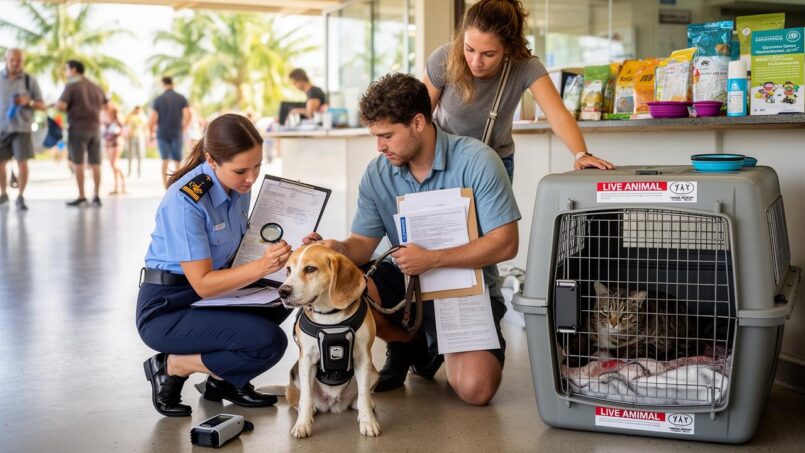
Once the plane lands, your dog or cat is not handed to you at the gate: it is immediately taken over by the Livestock Quarantine Officer, who will check, in coordination with an official veterinarian, the animal and the entire file.
Ideal Scenario: Full Compliance
If the documents are complete and consistent, the animal is in apparent good health, and no contagious signs are observed, the animal is generally:
– Inspected quickly;
– Released to you within hours, after payment of inspection fees.
The regulation provides that, when everything is in order, extended quarantine is not imposed.
Non-Compliance: Scenarios to Avoid
In case of a problem – missing vaccine, incorrectly filled certificate, expired validity period, missing parasite treatment, sick animal – the Director has broad powers. He may decide:
In the event of a health risk related to importing an animal, authorities may require its quarantine at an approved site at your expense, order its re-export, or, as a last resort, order its euthanasia at your expense if the risk is major or no other solution is possible.
All associated costs (additional inspection, quarantine, storage, re-export, destruction, disinfection of the crate, etc.) are borne entirely by the importer. Hence the importance of having the file reviewed by a professional accustomed to international animal exchanges, or by a specialized agency.
Cost of Expatriating with a Pet to Tonga
The financial aspect is often underestimated. For an Oceanian destination (including Tonga), available estimates show very wide ranges, depending on the size of the animal, distance, complexity of rules, and whether or not a professional service provider is used.
Order of Magnitude
For a United States → Oceania trip, estimates give:
– 5,095 to 13,395 USD for a pet relocation, depending on size, type of service chosen, and the profile of the destination country;
– More broadly, most international dog relocations fall between 3,000 and 10,000 USD.
Summary of main expense items to plan for an international move with a dog or cat.
Costs for mandatory consultations, vaccinations (including rabies), parasite treatments, and obtaining the European pet passport or international health certificate.
Cost of the airline ticket in hold or cabin, or specialized ground transport fees. May include rental of an IATA-approved travel crate.
Fees related to procedures with authorities in the country of origin and destination, import duties, and possible quarantine costs.
Taking out or adapting pet health insurance abroad, and checking liability coverage.
Purchase of basic accessories (bowls, bedding) on site, specific pet deposit, and possible setup costs (garden fencing).
Services from a pet relocation company or specialized agent to handle all procedures on your behalf.
| Cost Item | Indicative Range (USD) | Comments |
|---|---|---|
| International health certificate + consultation | 100 – 500 | Depending on country, clinic, and exam complexity |
| Vaccinations + microchip | 100 – 300 | Excluding possible rabies titer test |
| Rabies titer test (if required by a third country) | 100 – 300 | Often optional for Tonga, but useful for future return |
| Endorsement of certificate by authority (USDA, etc.) | 38 – 173 | According to official fee schedule |
| IATA travel crate | 50 – 500 | From small to very large size |
| Custom or reinforced crate | 600 – 2,000 | For certain breeds or very large dogs |
| “Pet” ticket in cabin (international leg) | 200 – 400+ | Per flight, per airline |
| Cargo transport on long-haul | 500 – 1,500+ | Can exceed the price of a human ticket |
| Domestic transport (US, Europe…) by air | 275 – 1,000 | Depending on size and airline |
| Road transport (airport shuttle, etc.) | 50 – 300+ or 0.5 – 2 USD/mile | Depending on distance and provider |
| Possible quarantine in another country | 300 – 2,000+ | If transit through a demanding country (e.g., Australia, NZ) |
| Kennel accommodation during transit or delay | 20 – 60 per night | Can go up to 50 – 150 for specialized boarding |
Add to this, if you use a full relocation service (door-to-door handling, permits, air logistics, customs, etc.):
– Service fee for an international move: often 2,500 USD for the first animal, then about 500 USD for each additional animal;
– Some “full service” companies charge a flat rate ranging from 1,000 to 5,000 USD or more, on top of mandatory costs (transport, vet, taxes, etc.).
Minimum cost in USD to transport a small pet one way when organizing everything yourself.
Anticipating “Hidden Fees”
Three categories frequently come up:
– Customs/inspection fees upon arrival (even if everything is in order);
– Boarding fees if a flight is cancelled or delayed, requiring an overnight stay at a kennel near an air hub;
– Unforeseen quarantine fees in case of a paperwork error or a change in regulations between booking and departure.
For a distant relocation like Tonga, it is prudent to maintain a safety margin of 20 to 30% on the estimated budget.
Should You Use a Relocation Company?
Several international companies (Air Animal, Global Pet Relocation, Relopet, Happy Tails Travel, Continental Pet Relocation, WorldCare Pet, etc.) offer to organize transport, paperwork, and coordination between veterinarians, governments, and airlines for you.
Their typical role:
– Check document compliance with Tongan rules;
– Request the import permit from the ministry;
– Book cargo flights, sometimes through their Known Shipper status;
– Arrange ground transport (home → airport → home);
– Supervise stopovers, plane changes, overnight boarding if needed;
– Assist you with customs formalities upon arrival.
A service surcharge of 2,500 USD or more for an international shipment may seem high, but it is often justified by the specific costs and logistical complexities of this type of shipment.
– The complexity of an island nation with limited service;
– The multiplicity of authorities (veterinarian in the departure country, official veterinarian, airlines, customs, Tongan veterinary services);
– The financial risks of an error (quarantine, re-export, euthanasia, etc.).
If you are traveling with multiple animals, have a tight schedule, or are coming from a country with complex regulations (Australia, New Zealand, EU, UK, etc.), professional support becomes almost a safety investment.
Living with a Pet in Tonga
A successful arrival is only the first step. You then need to organize a sustainable daily life for your animal in a country where culture and infrastructure differ greatly from Europe or North America.
Access to Care: Plan Your Plan B
As we’ve seen: Tonga has only one government veterinary clinic, understaffed and underequipped. So you need to:
– Book appointments well in advance for non-urgent procedures (annual vaccinations, sterilization, check-ups);
– Keep a minimal stock of parasite treatments and basic medications, brought from your home country or ordered during trips;
– Identify the periods of free SPAW clinics or other NGOs on your island, to benefit from quality care when the teams are present.
For serious or chronic conditions (kidney failure, diabetes, heart disease…), discuss in advance with your home veterinarian to know:
Before you leave, check the possibility of remote medical follow-up, including telemedicine consultations and secure sending of your lab results. Also prepare your personal pharmacy by selecting essential medications to bring, making sure they are allowed for import into your destination country.
Parasites, Stray Dogs, and Risk Management
Due to the tropical climate, high density of stray dogs, and limited infrastructure, parasite problems (ticks, fleas, worms) are common. Programs partly funded by Dogs Trust UK have sent treatments like Simparica to Tonga to curb very significant tick infestations.
In practice, this means: implementing concrete actions and decisions.
– Regular external parasite treatment, often monthly;
– Systematic deworming, especially if your animal has outdoor access or interacts with other dogs;
– Caution during walks: limit contact with stray dogs, monitor for injuries.
SPAW and other initiatives also aim for mass sterilization to limit the number of roaming dogs. As an expat, having your pet sterilized (if not already done) is a concrete way to contribute to local animal welfare.
Housing: Finding Pet-Friendly Accommodation
The rental market in Tonga includes houses, cottages, city apartments (Nuku’alofa, Tofoa…) and lodge/guesthouse accommodations. A growing number of properties accept pets, sometimes with a supplement or specific rules (animal size, number, no outdoor access at night, etc.).
On the islands of Tongatapu and Vava’u, several platforms like Airbnb and hotel/lodge websites offer listings explicitly marked as suitable for pets.
Apartments, houses, and bungalows available for rent on online platforms, clearly marked ‘pet-friendly’.
Hotel and lodge establishments whose official websites indicate they accept pets.
– Independent cottages in semi-rural areas, with enclosed gardens, where the sounds of dogs, roosters, and pigs are part of the ambient noise;
– Modern houses in Nuku’alofa with air conditioning, Wi-Fi, secure parking;
– Beach or vacation lodges (Sani Holiday Home, some resorts in Vava’u) that accept pets on request.
Before signing a lease or booking long-term, it is recommended to:
To submit a rental application with a pet, you need to provide a complete file. This should include a written description specifying the type of animal, its size, and its behavior. The tenant may also offer a specific pet deposit and commit in writing to maintain the cleanliness of the property (disinfection, odor control, repair of damage). Finally, the file must include a photo of the animal, proof of up-to-date vaccinations, and, if applicable, proof of sterilization.
This reassures owners who may worry about their property or neighborhood relations.
Local Culture and Cohabitation
Most Tongans consider animals – especially dogs – as an integral part of the domestic landscape, but not always with the same concept of “fur baby” as in Western urban countries. Many dogs live outdoors, roam freely, and primarily serve a guard function.
For an expat who wants to keep their animal indoors, walk it on a leash, and provide regular veterinary care, this may sometimes be surprising, but initiatives being carried out (SPAW clinics, educational interventions, visits from foreign veterinarians) show a growing interest in animal welfare.
You can contribute positively to this dynamic by:
– Respecting your neighbors’ peace (avoid nighttime barking, secure your fence);
– Participating in sterilization campaigns or neighborhood vaccination clinics;
– Calmly educating those around you about bite prevention, parasites, and the value of vaccinations.
Practical Tips for a Smooth Expatriation
To turn this administrative and logistical maze into a manageable path, several good practices emerge.
Start Very Early
For a transcontinental move with a pet, especially to an island destination like Tonga, it is reasonable to start 6 to 9 months in advance:
– 1 to 2 months for updating vaccinations and microchipping;
– 3 months or more if you decide to do a rabies titer test (thinking about a future return);
– 2 to 3 months for permit applications, cargo bookings, and coordination with a relocation company if needed.
Choose a “Travel” Veterinarian
Not all veterinarians are familiar with exports to very specific countries. Look for a practitioner who has already handled export files to Oceania or the Asia-Pacific. They will know:
To organize animal transport, it is crucial to use the correct international certificate templates, anticipate countersignature requirements from competent authorities, and communicate in advance with airlines and, if necessary, relocation companies.
Plan for a Return or Future Move
Even if you are leaving “for a long time”, animals have a limited lifespan, and your professional or family trajectory may cause you to leave Tonga earlier than expected. It is much simpler to:
– Keep digital copies of all documents (certificates, test results, permits);
– Plan a vaccination schedule now that is compatible with a possible return to the EU, UK, Australia, or New Zealand (where requirements are often stricter than Tonga’s).
A rabies titer test (serological test proving immunity) properly done before departure, followed by booster rabies vaccinations without interruption in the protocol’s validity, can sometimes avoid a lengthy quarantine in the future in case of exposure to the virus.
Honestly Assess the Country’s Capacity to Meet Your Pet’s Needs
Some animals travel very well and stay healthy all their lives. Others have serious conditions (cardiac, respiratory, endocrine) that require advanced technical care. With only one under-resourced national clinic and no permanent specialist veterinarian, Tonga is not necessarily the best destination for:
– A very old dog with multiple comorbidities;
– An animal requiring regular complex injectable treatments or intensive care hospitalization;
– Certain fragile brachycephalic breeds, at high risk in cargo and in hot climates.
Sometimes, it may be more humane to entrust the animal to a relative in a well-equipped country rather than bring it at the cost of significant risks.
Conclusion
Expatriating a pet to Tonga means accepting a double challenge: that of sophisticated international logistics and that of long-term settlement in a country with limited veterinary resources. Between import permits, microchips, vaccines, certificates, choosing airlines, and the imperative not to make mistakes under penalty of quarantine or re-export, it’s easy to feel overwhelmed.
For a successful relocation of your dog or cat to Tonga, it is crucial to start procedures early, work with a veterinarian experienced in exports, and possibly a relocation agency. You must also anticipate local specifics: a single government veterinary clinic, periodic NGO interventions, and a high prevalence of parasites and stray dogs.
The key is to approach this project not merely as an extension of your personal move, but as a project in its own right, with its own budget, timeline, and risks to manage. In return, you will have the rare opportunity to share Tonga’s beaches, villages, and unique rhythm with your companion, while contributing through your responsible presence to improving animal welfare in the kingdom, in your own way.
A wealth planning project or a question? Contact us now to speak with a wealth management expert.
Disclaimer: The information provided on this website is for informational purposes only and does not constitute financial, legal, or professional advice. We encourage you to consult qualified experts before making any investment, real estate, or expatriation decisions. Although we strive to maintain up-to-date and accurate information, we do not guarantee the completeness, accuracy, or timeliness of the proposed content. As investment and expatriation involve risks, we disclaim any liability for potential losses or damages arising from the use of this site. Your use of this site confirms your acceptance of these terms and your understanding of the associated risks.

Cyril Jarnias is an independent expert in international wealth management with over 20 years of experience. As an expatriate himself, he is dedicated to helping individuals and business leaders build, protect, and pass on their wealth with complete peace of mind.
On his website, cyriljarnias.com, he shares his expertise on international real estate, offshore company formation, and expatriation.
Thanks to his expertise, he offers sound advice to optimize his clients' wealth management. Cyril Jarnias is also recognized for his appearances in many prestigious media outlets such as BFM Business, les Français de l’étranger, Le Figaro, Les Echos, and Mieux vivre votre argent, where he shares his knowledge and know-how in wealth management.





