
 Published on and written by Cyril Jarnias
The archipelago that today forms the Kingdom of Tonga holds more than three millennia of history, from the arrival of the first Lapita communities to the affirmation of a constitutional monarchy that was never colonized. Tracing the history of the country in Tonga means following both the birth of Polynesian culture, the rise of a genuine regional maritime power, the shocks of encounter with Europe, Christianization, and then political modernization carried out without renouncing traditional royal structures.
The First Human Settlements and the “Birth” of Polynesia
Long before it was a kingdom, the islands of Tonga were one of the very first settlement centers of Polynesia. Archaeological work converges: the ancestors of Polynesians, known as the Lapita, reached the archipelago about 3,000 years ago.
These communities came from the west, from the Bismarck area near Papua New Guinea, and spread rapidly eastward. Their expansion, sometimes described as an Austronesian “express train,” brought navigators to settle first in Melanesia, then to cross a cultural threshold by reaching Tonga and Samoa, where Polynesian identity would be forged.
Excavations at sites like Nukuleka, often called the ‘cradle of Polynesia,’ have revealed Lapita pottery, hearths, shell middens, and burials. Analysis of the pottery provided material evidence of ceramic transport from the Santa Cruz Islands in Melanesia to Tonga, attesting to a highly structured navigation network from the earliest settlements.
Archaeology researchers
In those early centuries, the Lapita lived by lagoon fishing (parrotfish, groupers, turtles, moray eels, shellfish, occasionally tuna), supplemented by cultivation of plants such as taro, yam, banana, and breadfruit, and raising pigs and chickens. Their villages were set up along the beach, facing the lagoon, in houses built from plant materials, with kitchens and earth ovens. Their tools, made from volcanic stone, were used for carving wood, hammering, cooking, or weighting looms.
After centuries, the production of decorated Lapita pottery gave way to simpler ceramics (the so-called “Polynesian Plain Ware” phase), and then to a complete abandonment of pottery. This transition marks a major cultural transformation: the ancestors of Tongans ceased to be a mere Lapita offshoot and developed a distinct Polynesian identity, with their own language, myths, and social structures.
Genetics and Traditions: A Polynesian Homeland in Tonga
Advances in genetics support the idea that Polynesia was first structured in the Tonga‑Samoa area. Analysis of ancient DNA from female skeletons, including those from Tongan sites dated to 2,300 to 3,100 years ago, shows fully Austronesian profiles, close to present-day populations from Taiwan or the Philippines, with no trace of Papuan ancestry. The Melanesian admixture present in the DNA of modern Polynesians therefore seems to result from later marriages and mixing, after the initial settlement in Tonga and neighboring archipelagos.
This scientific confirmation aligns with linguistic reconstructions: the common ancestor of Polynesian languages developed in the area including Tonga, Samoa, Wallis and Futuna. The later migrations eastward – to the Cooks, Tahiti, then Hawaiʻi and Rapa Nui – originated from this western core, of which Tonga is a pillar.
The Emergence of a Hierarchical Society and the First Sacred Kings
As the population grew, especially on Tongatapu where it may have reached between 17,000 and 25,000 inhabitants during the first millennium AD, competition for access to fertile land and marine resources drove the formation of increasingly powerful chiefdoms.
Around the 10th century AD, oral traditions place the appearance of a line of sacred kings, the Tuʻi Tonga. The first of them, ʻAhoʻeitu, is described as the son of the god Tangaloa, the major deity associated with the sea and creation. The ideology that took shape is clear: the sovereign is of divine essence, both political leader and religious officiant, at the top of a hierarchy that includes nobles (houʻeiki), sub-chiefs, servants, and slaves captured in war.
The Polynesian ranking system is determined by patrilineal ties and the mother’s status, giving women, especially the king’s eldest sister (Tamaha), a higher rank. The sacred principle of tapu imposes strict prohibitions on space, food, and people, reflecting the sacredness of dominant lineages.
Tongan society was structured into three broad categories – commoners, nobles, and the royal family – with inheritance rules that in some ways recall European dynasties: the royal title passes from father to eldest son. This patrilineal model, already well established before the arrival of Europeans, survives to modern times in how the royal house manages succession.
A Maritime Power: The Tuʻi Tonga as a Central Pacific Hub
From the 12th to the 15th century, the authority of the Tuʻi Tonga extended far beyond the current boundaries of the kingdom. Traditions from Niue, Samoa, Wallis, and other central Pacific islands tell of the influence of a “Tongan empire,” often described as a thalassocracy rather than a territorial empire. Local chiefs claimed ties to the Tuʻi Tonga, strategic marriages consolidated alliances, and navigators maintained constant circulation between distant islands.
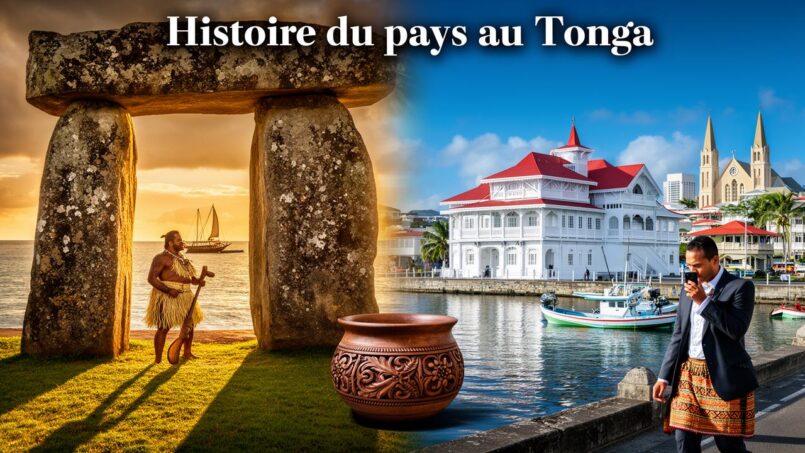
Pottery and tapa designs characteristic of Tonga have been found as far away as Fiji and Micronesia, illustrating the reach of its exchange networks. This archipelago shone through its maritime expertise, distant expeditions, and ritual power. This centralization of power is also marked in the landscape by monuments such as the langi (pyramidal tombs for kings) and the Haʻamonga ʻa Maui trilithon, a gigantic stone portal.
Yet this hegemony was not without tensions. Within the elite itself, rivalries led to civil wars, particularly in the 15th and 17th centuries. To address criticism and coups, the Tuʻi Tonga lineage gradually created two other major titles: the Tuʻi Haʻa Takalaua, who took charge of daily political affairs, and later the Tuʻi Kanokupolu, intended to strengthen the monarchy’s anchor in western Tongatapu and manage relations, especially with Samoa.
Gradually, it was this third pillar, the Tuʻi Kanokupolu, that gained weight at the expense of the Tuʻi Tonga. Marriages with Samoan families, the importation of titles and political practices from Samoa, and involvement in regional conflicts eventually made the Kanokupolu line the heart of temporal power, while the Tuʻi Tonga withdrew more into a religious role.
The First Europeans and the Discovery of the “Friendly Islands”
The first documented encounter between Tonga and Europeans occurred in the early 17th century, when Dutch navigators Willem Schouten and Jacob Le Maire passed by Niuatoputapu and Niuafoʻou. A few decades later, in 1643, Abel Tasman in turn sailed along the archipelago. He visited ʻAta, ʻEua, and Tongatapu, which he renamed respectively. ʻEua became “Middleburg” and Tongatapu “Amsterdam,” after cities in the Dutch Republic. These European names, however, had only limited impact: the Tongan names have endured.
It was not until the 18th century that European presence became more insistent. In 1773, during his second great voyage in the Pacific, James Cook reached the islands of ʻEua and Tongatapu. He was welcomed on the shore by a large, unarmed crowd, curious and apparently happy to see these strangers arriving on strange ships. Cook noted that the inhabitants seemed peaceful and hospitable.
Year of Cook’s third voyage to the archipelago, where he spent several months, reinforcing the impression of cultural coherence among the islands.
1777: Cook, the Haʻapai, and the Birth of the “Friendly Islands”
His final visit is the most documented and most significant for Europe’s image of Tonga. It began with an anchorage at Nomuka, then continued to Lifuka in the Haʻapai islands, where a great chief, Fīnau, invited him ashore. On Lifuka, Cook and his crew attended lavish feasts, dances, and banquets organized in their honor. Impressed by the hosts’ generosity, he coined the term “Friendly Isles” to describe the archipelago.
Ironically, this splendor actually concealed a planned attack. Fīnau and allied chiefs planned to massacre Cook and his men to seize the ships and their cargoes of weapons, metal, and valuables. Disagreements among the chiefs caused the plot to fail, without Cook being aware of it at the time. The image of the “Friendly Islands,” based on a genuine experience of cordiality, became permanently embedded in European cartography and literature, and the archipelago is still commonly known by that nickname today.
After Lifuka, Cook headed south without sighting the Vavaʻu group, then reached Tongatapu again in June. He stayed there with his ships, the Resolution and the Discovery commanded by Charles Clerke, for about a month, waiting for a solar eclipse his astronomers wished to observe. An observatory tent was set up at Hōleva, near an area called Pātangata, and the eclipse was observed in early July.
During his long stay, James Cook adopted an approach similar to that of an ethnographer. He meticulously recorded various aspects of Tongan society, including agricultural practices, rituals, political organization, temples, games, dances, shipbuilding techniques, and gift-exchange customs. To meet the Tuʻi Tonga (the sacred king named Pau), he took a canoe through the Manavanga channel to travel to Muʻa, the former capital of Tongatapu.
Table: Key Stages of Cook’s Voyages to Tonga
| Cook’s Voyage | Main Tongan Stops | Notable Observations |
|---|---|---|
| Second voyage | ʻEua, Tongatapu (1773) | Warm welcome, perception of a peaceful and hospitable people |
| Second voyage | Nomuka (1774) | Inhabitants informed about Cook from other islands, evidence of strong internal communication |
| Third voyage | Nomuka, Lifuka (Haʻapai), Tongatapu (1777) | Stay of several months, feasts offered by Fīnau, observation of the eclipse, detailed description of pre-Christian life |
On Tongatapu, one scene has remained iconic: Cook resting under a huge banyan tree, later named Malumalu ʻo Fulilangi, “the shade under the sky.” A commemorative plaque still marks the spot where he is said to have lain, near a young banyan considered a descendant of the original tree. From this site, he went to Muʻa to attend the ʻInasi ceremony, a solemn offering of first fruits to the sacred king, who embodied the cosmic order and the country’s prosperity.
Cook’s journals, later cross-referenced with the account of William Mariner – a young Englishman who spent several years in the archipelago after the capture of his ship Port au Prince – now form an exceptional body of work for understanding Tongan society just before its mass conversion to Christianity. They reveal a sharply hierarchical society, polytheistic religiosity, an economy based on agriculture, fishing, and ritual gifts, but also political tensions and wars between lineages.
Christianization, Civil Wars, and the Unification of the Kingdom
At the end of the 18th century and the beginning of the 19th, Tonga went through a period often described as a “dark age,” marked by dynastic struggles, the introduction of firearms through European trade, the spread of diseases such as measles, and the establishment of competing Christian missions.
The first Protestant missionaries, sent by the London Missionary Society, encountered these wars and were soon forced to leave Tongatapu. Several were killed; others abandoned their ministry. It was not until the establishment of a more structured Wesleyan (Methodist) mission in the 1820s that conversion really took hold. At the same time, Catholic missionaries also set up, particularly among the Tuʻi Tonga, so that old lineage rivalries soon took on a denominational hue.
The civil wars were fueled by this explosive combination: firearms, succession disputes among the different branches of the Tuʻi Kanokupolu, the return of Tongan chiefs hardened by campaigns in Fiji where ritual violence (cannibalism, widow strangulation) was practiced, and religious competition.
The Rise of Tāufaʻāhau, future George Tupou I
Amid this chaos, a figure emerged who would shape modern Tongan history: Tāufaʻāhau. Chief of the Haʻapai island group, he gradually established himself through arms and diplomacy. Baptized in 1831 into the Methodist Church, he took the name Siaosi (George) in honor of King George III of the United Kingdom. This conversion was not just an act of faith; it became a political tool for legitimation. Presenting himself as a Christian king, he attracted the support of influential missionaries and gave his cause a moral dimension.
Key steps in the consolidation of power and the social and religious reforms carried out by Taufaʻahau (future King George Tupou I) in the Haʻapai and Vavaʻu islands.
Taufaʻahau began by pacifying and taking control of the Haʻapai archipelago, laying the foundations for his future kingdom.
He extended his authority to Vavaʻu after the death of the local chief Fīnau ʻUlukālala III, unifying new territories.
In the Vavaʻu region, he abolished servitude, a major social reform of his reign.
He enacted the Vavaʻu Code, constituting Tonga’s first written laws, foundational to the modern state.
He consecrated the site of Pouono to God, marking his desire to embed Christianity at the heart of power and society.
From there, he turned his attention to Tongatapu, still torn by wars among nobles. The death of a chief, Aleamotuʻa, gave him a pretext to intervene. After a series of campaigns, including the decisive battle of Velata in 1826 as an important milestone, he consolidated his position. On December 4, 1845, a date that would become a national holiday, he was officially installed as Tuʻi Kanokupolu at Kolovai. This proclamation ceremony, organized at Pangai Haʻapai, already incorporated Christian elements: prayers, oaths before God.
Year when George Tupou I became the undisputed leader of the entire Tongan archipelago.
Table: Key Milestones in the Construction of the Kingdom under George Tupou I
| Domain | Measure or Event | Historical Significance |
|---|---|---|
| Religion | Baptism of Tāufaʻāhau and adoption of the name Siaosi (George) | Union of political power and Christian faith |
| Legislation | Vavaʻu Code (1838), then the Code of Laws of 1862 | First written codification, limitation of practices such as human sacrifice |
| Society | Emancipation from servitude in Vavaʻu, Emancipation Day commemorated on June 4 | Break from the popula (serf) system, strengthening of commoner rights |
| Politics | Proclamation as Tuʻi Kanokupolu in 1845, complete unification in 1852 | Effective foundation of the unified kingdom |
| Diplomacy | Travels to Australia and New Zealand, treaties with foreign powers | Positioning of Tonga as a sovereign state, avoidance of colonization |
George Tupou I’s reforms were not limited to the military or religious sphere. He opened a first Parliament in 1862, established a system of land distribution that reserved land ownership for native-born Tongans and prohibited the sale of these lands to foreigners. This clause, inspired by observing the plight of landless peasants in Australia or New Zealand, remains a pillar of Tongan land law today.
In 1875, with the help of the Methodist missionary Shirley Waldemar Baker, he proclaimed a written Constitution. This text officially established a constitutional monarchy in the Tongan style, with a Legislative Assembly, a framework for succession to the throne, a code of rights and duties, and a “royal” stylization of power inspired by European models. The goal was twofold: to modernize the state and, in doing so, to make any attempt at colonial domination more difficult.
British Protectorate Without Colonization: A Unique Case in the Pacific
Despite these efforts, pressure from European powers intensified at the end of the 19th century. Germany, already established in other Pacific territories, showed interest in the archipelago. European settlers and some Tongan chiefs opposed to royal power tried to take advantage of this context to challenge the authority of George Tupou II, successor to George Tupou I.
To protect itself from external threats, Tonga signed a Treaty of Friendship and Commerce with the United Kingdom in 1879, then a protectorate treaty in 1900 (ratified in 1901) under the reign of George Tupou II. This latter agreement gave the United Kingdom control over Tonga’s foreign affairs through a consul in Nukuʻalofa and a say in certain financial and diplomatic decisions. In exchange, the United Kingdom committed to defending Tonga and obtained naval facilities.
Table: Characteristics of Tonga’s Protectorate Status
| Aspect | Situation in Tonga (1900‑1970) | Distinctive Feature |
|---|---|---|
| Internal sovereignty | Maintained, with a Tongan king in place | Unlike a colony, no direct British administration |
| Foreign affairs | Managed by a British consul, veto over certain decisions | Limitation of diplomatic autonomy |
| Legal status | Treaty of Friendship and Protection of 1900, amended in 1905 | Aimed at containing German influence in the Pacific |
| Local government | Monarch and Tongan institutions retained direction of internal affairs | Tonga remained the only indigenous kingdom in the Pacific |
The agreement was modified in 1905 by an additional arrangement that strengthened the British consul’s influence, even encroaching on the principle of non-interference in internal affairs. Tensions arose, with George Tupou II believing that both the Constitution of 1875 and the treaty of 1900 were being violated. Despite these frictions, Tonga never became a colony. It remained an indigenous kingdom, with its own dynasty, language, customs, and land structure intact.
During the coronation of Queen Elizabeth II in London, Queen Sālote Tupou III of Tonga, a very popular sovereign who led her country out of the protectorate, chose to parade in an open carriage despite a drenching rain. This gesture was widely interpreted as a mark of respect for her British host and a display of royal pride, contributing to her international fame.
The negotiations she conducted with London finally led to the dismantling of the protectorate status. On June 4, 1970, designated as the “appointed day” in official documents, Tonga regained full control of its external affairs, while becoming a member of the Commonwealth of Nations. Political independence was thus restored without breaking monarchical continuity, a rare feature in the region.
A Monarchy That Democratizes Without Renouncing Itself
Since its formal independence in 1970, the Kingdom of Tonga has preserved and adapted its monarchical system. Today it is the only functioning indigenous monarchy in the island Pacific, and a special case within the Commonwealth: a state that was never colonized and whose dynasty traces back, without interruption, to George Tupou I.
Nevertheless, the initial concentration of power in the hands of the monarch has gradually been questioned, especially from the end of the 20th century. Major civil service strikes, pro‑democracy movements, and debates over wealth distribution and the economic role of the royal family fueled demands for reform.
The Fale Alea, long dominated by nobility and royal ministers, underwent an evolution toward greater popular representation. This transformation occurred through the entry of elected commoners into the Cabinet, the creation of political reform commissions, popular consultations, and recommendations from local and international experts.
A decisive turning point came in the 2000s. King George Tupou V, who ascended the throne after the death of his father Tāufaʻāhau Tupou IV, announced in 2006 his intention to relinquish a large part of his executive prerogatives. He accepted the principle that a Prime Minister chosen from Parliament would lead the government, with a Cabinet responsible to the Assembly. Constitutional amendments were adopted with this in mind, and the elections of 2010 marked the entry into force of this new balance of power.
Today, Tonga functions as a parliamentary democracy integrated into a constitutional monarchy: the king, currently Tupou VI, reigns but no longer governs day-to-day. He formally appoints the Prime Minister chosen by Parliament, has the right of pardon, a say in the promulgation of laws, and presides over a consultative Privy Council, but leaves the conduct of daily affairs to an executive responsible to the members of Parliament.
King Tupou VI of Tonga
Table: Recent Evolution of the Tongan Political System
| Period | Institutional Characteristics | Democratic Evolution |
|---|---|---|
| Before 2010 | Monarch at the center of the executive, power to directly appoint ministers and influence Parliament | Limited citizen representation, strong weight of nobility |
| Reforms 2005‑2010 | Creation of reform commissions, increased entry of commoners into government, king’s commitment to cede power | Opening toward a responsible Cabinet and a more elected Parliament |
| After 2010 | Prime Minister elected by Parliament, Cabinet responsible to the Assembly, monarch removed from the executive | Tonga becomes a parliamentary democracy within a constitutional monarchy |
This democratization movement does not mean questioning the monarchy. On the contrary, in Tongan culture, respect for the sovereign remains a central value: direct criticism of the king’s person is often seen as contrary to good manners and anga faka‑Tonga, the country’s own ethics. For most pro‑reform activists, the goal is not to overthrow the dynasty, but to find a balance between traditional authority and modern accountability.
National Identity, Living Culture, and Historical Heritage
Across these thirty centuries of transformations, a common thread emerges: the country’s ability to integrate external influences – first Lapita, then Christian missions, European constitutional models, international law – without losing its cultural backbone. The national motto, proclaimed under George Tupou I, sums up this alchemy: “Ko e ʻOtua mo Tonga ko hoku tofiʻa” – God and Tonga are my inheritance.
Tonga has ratified the UNESCO Convention for the Safeguarding of the Intangible Cultural Heritage. The authorities, through the Culture Division of the Ministry of Education, implement actions (inventories, training, projects) to protect traditional practices. An emblematic example is the lakalaka dance, inscribed on the Intangible Cultural Heritage of Humanity. This performance, combining songs, chanted speeches, choreography, and music, can bring together hundreds of participants during major national or religious celebrations.
In villages, the making of ngatu (Tongan tapa made from beaten bark), the weaving of pandanus mats, the art of katoʻalu (basket from the alu vine, now endangered), kava ceremonies in faikava, and exchanges of koloa (symbolic wealth items) at weddings or funerals perpetuate very ancient structures of gift and reciprocity, already visible in the journals of Cook and Mariner.
Respect, loyalty, and harmonious relationships with kin and community are summed up in what Tongans call the “four golden pillars”: fakaʻapaʻapa (respect), tahivā (good relationship), lototō (humility and generosity), and mamahiʻimeʻa (commitment and loyalty). These principles permeate everything from how one addresses the king to how one behaves in a village or within the diaspora.
Tongan culture
Finally, the fact that the country was never officially colonized by a foreign power has become a source of national pride. It does not erase the strong economic dependencies or the wounds left by certain colonial policies in the region, but it fuels the conviction that “Tonga is still Tonga” – ʻOku kei Tonga pē ʻa Tonga – a phrase often cited: a country that opened up to the world while stubbornly keeping its king, its language, its land, and its memory.
Conclusion: An Oceanic Kingdom Between Continuity and Adaptation
The history of the country in Tonga can be read as the trajectory of a small archipelago that held a disproportionate place in the history of the Pacific. A first center of Polynesian settlement, the hub of a vast maritime network, it built complex hierarchical institutions from the Polynesian Middle Ages onward, supported by a royal ideology of divine origin. The encounter with Europeans, the violence of civil wars, and the conversion to Christianity could have shattered this edifice; instead, they transformed it.
Under King George Tupou I, traditional Tongan structures merged with Western tools (legal code, constitution, monarchy on the British model) to strengthen the kingdom’s sovereignty. By opting for a protectorate without direct domination and then skillfully negotiating its independence, Tonga preserved its dynasty in the 20th century, unlike other indigenous monarchies in the Pacific.
The political reforms of the early 21st century extend this logic of adaptation: they introduce parliamentary democracy without abolishing the monarchy, readjust the share of the nobility in representation, without erasing the centrality of the king in the collective imagination. At the same time, the commitment to safeguarding intangible cultural heritage, both on the islands and within the diaspora, shows that Tongan history is not frozen: it continues to be written, between celebrations of lakalaka, lively parliamentary debates, and resistance to contemporary challenges like climate change or emigration.
From Nukuleka, the pioneering Lapita village, to Nukuʻalofa, the capital of a modern kingdom seated at the United Nations, the thread is ultimately continuous: that of a people who turned contact with the outside world not into a dissolution, but into a resource to affirm, again and again, what makes it so that here, “Tonga is Tonga.”
People of navigators and kings
A heritage project or a question? Contact us now to speak with a wealth management expert.
Disclaimer: The information provided on this website is for informational purposes only and does not constitute financial, legal, or professional advice. We encourage you to consult qualified experts before making any investment, real estate, or expatriation decisions. Although we strive to maintain up-to-date and accurate information, we do not guarantee the completeness, accuracy, or timeliness of the proposed content. As investment and expatriation involve risks, we disclaim any liability for potential losses or damages arising from the use of this site. Your use of this site confirms your acceptance of these terms and your understanding of the associated risks.

Cyril Jarnias is an independent expert in international wealth management with over 20 years of experience. As an expatriate himself, he is dedicated to helping individuals and business leaders build, protect, and pass on their wealth with complete peace of mind.
On his website, cyriljarnias.com, he shares his expertise on international real estate, offshore company formation, and expatriation.
Thanks to his expertise, he offers sound advice to optimize his clients' wealth management. Cyril Jarnias is also recognized for his appearances in many prestigious media outlets such as BFM Business, les Français de l’étranger, Le Figaro, Les Echos, and Mieux vivre votre argent, where he shares his knowledge and know-how in wealth management.





