
 Published on and written by Cyril Jarnias
Settling in Tonga is not just about changing your climate or pace of life; it’s also about learning to eat differently. Between taro roots, feasts from the underground oven ‘umu, bustling markets in Nuku’alofa, and the enormous portions served at Sunday gatherings, the cuisine is one of the most direct gateways into the local culture. For an expat, this discovery can be both exhilarating and destabilizing: new ingredients, strong table etiquette, health risks to be aware of, and sometimes difficulty maintaining a balanced diet.
This guide allows you to discover the rich Tongan cuisine, steeped in history and symbolism, while helping you preserve your health and essential eating habits.
Understanding “the Tongan Way” of Eating
Before even talking about recipes or markets, you need to grasp a few cultural keys. Tongan cuisine is not just about taste; it is inseparable from the “Tongan Way,” a set of founding values: respect, humility, collectivism, modesty, and hospitality. Family is central, religion is omnipresent, and the meal is often as much a social act as a nutritional one.
Meals are traditionally taken in common, respecting a strict hierarchy: seating is not free, you do not start before the prayer, and elders or high-ranking people are served first. The tone must remain gentle and calm; outbursts of voice and anger are very poorly perceived. Respect for elders is also shown through posture: when sitting on mats on the floor, avoid pointing your legs towards others and favor sitting cross-legged or with legs folded to the side.
This communal dimension also explains the often impressive size of portions. During large gatherings, you can see up to thirty different dishes lined up on pola, those long serving mats that can reach three meters in length. Saying no to a dish can be seen as rude: it’s better to accept a small portion than to refuse outright. And, good news for expats surprised by the abundance, it is perfectly acceptable—and even common—to leave with a container of leftovers.
Sunday, a Sacred Day… and a Day of Grand Feasting
The Tongan week is structured around Sunday, considered a sacred day. The law strictly regulates this day: no ordinary commercial transactions, no sports, no noisy domestic work, and swimming, fishing, or snorkeling in public is prohibited. Almost everything stops, except for certain essential services and some tourist facilities.
In Tonga, Sunday is a day of complete rest, including in the kitchen. Dishes are prepared the day before, often in a *’umu*, the traditional underground oven. After mass, families gather for a hearty meal between 1 p.m. and 2 p.m. This moment is central to social and spiritual life: it allows expressing gratitude, strengthening family ties, and honoring guests.
For an expat, being invited to a Sunday meal is a real sign of integration. It is customary to bring a small gift—food items, non-alcoholic beverages, hard-to-find local products, or an envelope of about 20 to 40 pa’anga—and hand it discreetly. Don’t be surprised if your gift is not opened in front of you; private opening is often preferred. And be even less surprised if they insist you take leftovers when leaving; refusing would be almost as poorly received as complimenting an object too much, risking the host feeling obliged to give it to you.
Overview of Tongan Cuisine: Roots, Sea, and Coconut
To find your way in Tonga, it’s best to forget grains as the base of a meal and think in terms of roots, fish, and coconut. The foundation of the cuisine rests on massive, very filling tubers: taro (talo), cassava (manioke), yam (‘ufi), sweet potato (kumala), and the ubiquitous breadfruit (mei). These are boiled, steamed, roasted, or slowly braised in a ‘umu. They replace bread, pasta, or rice in most traditional meals.
Yellowfin tuna is particularly abundant for 7 months of the year, from August to February.
Coconut is the other pillar of this cuisine. Its water is drunk fresh, its flesh is grated, and its milk and cream, obtained by pressing the pulp in hot water, serve as the base for the vast majority of dishes. They replace both oil, fresh cream, and part of the spices. Tongans season lightly: onion, ginger, a few chilies, a touch of garlic, and local herbs suffice. The richness already comes from the marriage of roots, coconut, and seafood.
A Few Basic Ingredient References
| Category | Main Ingredients |
|---|---|
| Tubers & starches | Taro (talo), cassava (manioke), yam (‘ufi), sweet potato (kumala), mei |
| Tropical fruits | Papaya (lesi), banana (siaine), mango, pineapple (faina), watermelon (meloni), noni |
| Leafy vegetables | Taro leaves (lu), lau pele (Tongan spinach), cabbage, salads |
| Animal products | Pork (puaka), chicken, lamb (sipi), beef, corned beef (pulu/pisupo), eggs |
| Seafood | Various fish (ika), tuna, swordfish, octopus (feke), crabs, shellfish |
| Fats | Coconut cream and milk, sometimes copra oil |
| Seasonings | Onion, garlic, ginger (sinisa), chili, cilantro, basil, lime (kola) |
For an expat used to Western supermarket aisles, the adjustment is real: few local processed products, an omnipresence of roots and coconut, and few spicy dishes. But this apparent simplicity hides a great variety of preparations.
Iconic Dishes to Know (and Where to Try Them)
Familiarizing yourself with a few key dishes helps a lot in reading menus, understanding invitations, and… better managing your nutritional balance.
The ‘Umu, the Heartbeat of Tongan Cuisine
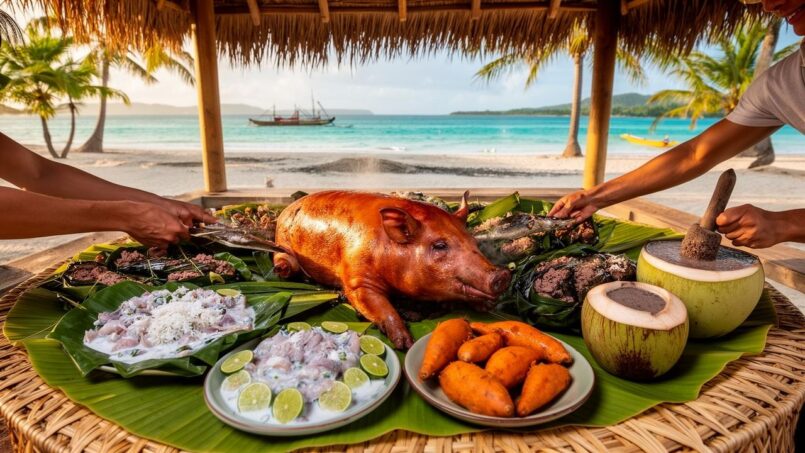
The ‘umu is not a dish, but an ancient cooking technique, dating back about three millennia. First, stones—often coral or lava—are heated over a large fire until they glow red. Then the hot stones are placed at the bottom, baskets of meat, fish, roots, and preparations wrapped in banana leaves are placed on top, and the whole thing is covered with leaves, wet cloths, sometimes dampened cardboard, before being sealed with earth. The oven becomes a kind of giant pressure cooker where the food steams and cooks over radiant heat for several hours, absorbing a earthy, slightly smoky aroma.
In a family or village ‘umu, you often find a whole pig, chickens, pieces of lamb, whole roots (taro, yam, kumala, cassava), mei, and wrapped preparations like lu. The opening of the oven is a powerful collective moment: steam escapes, the smell fills the air, and everyone gathers around the smoking baskets.
Hotels, guesthouses, and cultural tours, especially around Nuku’alofa, in Vava’u, and on islands like Pangaimotu, offer ‘umu evenings. For an expat, witnessing the full assembly of this traditional oven is a condensed lesson in Tongan cuisine and culture.
The Lu: Taro, Meat, and Coconut in a Parcel
Under the term lu, you’ll find a whole family of dishes combining taro leaves, coconut milk or cream, onion, salt, sometimes tomato, and a protein:
– Lu Pulu: the most famous version, made with canned corned beef. The mixture is wrapped in several layers of young taro leaves and then cooked in a ‘umu or oven. It’s the ultimate comfort food, ubiquitous at feasts.
– Lu Sipi: same principle with lamb or mutton, usually served on special occasions or Sunday meals.
– Lu Moa / Lu Siaine: chicken variation.
– Kapisi Pulu: a variant using cabbage leaves instead of taro leaves, handy when lu is unavailable.
These rich dishes, based on coconut and fatty meat, should be enjoyed in moderation. Here’s where to find them.
A small local restaurant in Veitongo for authentic cuisine.
A well-known spot in Vaini for these rich and tasty specialties.
Family version served at church feasts, weddings, or traditional ceremonies.
‘Ota ‘Ika, the Polynesian Ceviche
Considered one of the national dishes, ‘ota ‘ika is a Polynesian ceviche: cubes of raw fish (tuna, snapper, mahi-mahi…) marinated in lemon or lime juice, then mixed with coconut cream, onions, tomatoes, sometimes cucumbers and chilies. The result is fresh, tangy, creamy, perfect for a light lunch or appetizer.
You can try it at Mum’s Cafe in Nuku’alofa, at 12 Seafood Restaurant in Popua, in some seaside restaurants, and also at markets, especially Talamahu, where vendors sell it in containers.
Be careful, however, on more remote islands or when you doubt the water quality: raw fish handled improperly or rinsed with non-potable water increases the risk of digestive infections. In such contexts, health authorities recommend opting for well-cooked dishes.
Feke: Octopus, Tongan Style
Octopus (feke) is a delicacy. Traditionally, it is caught at night by torchlight and with a spear. It is then:
– either grilled, sometimes after a lemon-coconut-soy marinade;
– or stewed in a generous coconut milk sauce with onions and chili, known as Lo’i Feke.
It is served with boiled roots (taro, ‘ufi, kumala) or mei chips. For an expat who loves seafood, it’s a must-try, found in some specialized restaurants like 12 Seafood Restaurant, or by order at large meals.
Sweets and Snacks: Keke, Faikakai, and Company
Tongans also have a sweet tooth, especially when it comes to coconut.
– Keke (or keki) are small fried dough balls, similar to donuts, sometimes flavored with banana or pumpkin. They are very popular for breakfast, at market stalls, and often sold to fund church or school activities.
– Topai are cooked dough balls served in a sweet coconut syrup.
– Faikakai topai add a thicker coconut caramel sauce, turning it into a festive dessert.
– Kulolo combines grated taro, coconut, and sugar, all wrapped in banana leaves and then cooked in the ‘umu, resulting in a dense, melting, very energetic dessert.
– Haupia is a gelatinous dessert made from coconut milk, somewhere between flan and jelly.
You’ll find these sweets at markets, Nuku’alofa’s night markets, or as “homemade” versions at family gatherings.
Where to Shop: Markets, Fishmongers, and Small Shops
One of Tonga’s great strengths for expats is the access to local raw products, often of good quality and at reasonable prices. Conversely, imported products are expensive due to customs duties and transport costs, which encourages rethinking your eating habits.
Talamahu Market: The Pantry of Nuku’alofa
In the heart of the capital, Talamahu Market (or Meketi Talamahu) is where every expat eventually finds their bearings. Over about one and a half hectares, dozens of producers sell fruits, vegetables, roots, peanuts, nuts, sometimes fish, as well as many prepared snacks: keke, grilled corn, containers of lu sipi, ‘ota ‘ika salads, portions of faikakai…
The market is open Monday to Saturday, generally from 8 a.m. to 4–5 p.m., with some stalls staying later. The best time for freshness is between 6 a.m. and 9 a.m. On Sunday, everything is closed.
A few products easy to integrate into an expat routine:
| Product Type | Examples Available at Talamahu |
|---|---|
| Local fruits | Papaya, banana, mango, pineapple, watermelon, guava, noni |
| Tubers | Taro, cassava, ‘ufi, kumala, potatoes (local or imported) |
| Vegetables | Tomatoes, cucumbers, carrots, cabbage, lettuce, squash, eggplants |
| Herbs & spices | Garlic, ginger, chili, basil, cilantro, mint, turmeric |
| Snacks & ready meals | Keke, grilled corn, small containers of lu, ‘ota ‘ika, faikakai |
Around the market, small shops sell clothing, everyday items, and crafts. Right across the street, supermarkets like Molisi allow you to fill in with dry goods, milk, canned goods, or some imported items.
Markets on Other Islands: Vava’u, Ha’apai, Village Markets
In Vava’u, the ‘Utukalongalu market, set up by the water in Neiafu, serves a similar role on a smaller scale: fruits, vegetables, some fish, crafts. The atmosphere is more village-like, but less diverse than Talamahu. In Ha’apai, the Fanga ‘i he Si market (Pangai Market) is busiest on Saturday mornings, when the influx of vendors is greatest.
In villages, the offer is supplemented by micro-markets and roadside stalls. They mainly sell products from family plantations: bananas, tubers, peanuts, limes, sometimes grilled corn or fritters. Prices are often lower than in Nuku’alofa, but the selection is more limited. It’s important to note that none of these markets open on Sundays.
Fishmongers and Fish Markets
For fish, the key spot in Nuku’alofa is the waterfront on Vuna Road and Faua Wharf, with several setups:
Discover the main points of sale for buying fresh, iced, or frozen fish in the Tongan capital.
Tiled stalls by the wharf where vendors often unload their catch directly from boats, especially early in the morning.
Located near the wharf for ‘Eua, this company sells fish kept on ice.
An establishment equipped with refrigerated stainless steel bins, located further along Vuna Road.
Located right next to Waves Cafe, it offers pre-cut fish imported from Fiji.
The advice from health authorities is clear: go as early as possible, because ice storage is sometimes limited. On outer islands, fish is less often kept on ice; prefer morning purchases and quick consumption.
For an expat, it’s essential to quickly learn to assess fish freshness (bright eye, firm flesh, no strong odor). Since the region is prone to ciguatera, an intoxication caused by algal toxins accumulated by certain reef fish, it’s crucial to systematically ask local vendors for advice on which species to avoid. A cautious approach is to stick to pelagic species like tuna, mahi-mahi, or wahoo, which pose a lower risk.
Night Markets and Street Stalls
Tonga doesn’t have a street food culture as dense as some Asian or Latin American capitals, but the informal scene is growing, especially in Nuku’alofa.
– The Ladies Connect Night Market, every Friday evening at Digicel Square, brings together up to 80 stalls: skewers, grilled items, sushi, curries, Tongan-style rice dishes, samosas, fresh fruit, pastries, brownies, cakes. It’s a good place to try “modernized” versions of local cuisine and many international influences.
– The WISE Night Market, focused on women’s businesses, offers BBQ, Indian cuisine, pasta, and elaborate desserts.
– The PTH Night Market, smaller, relies on a few well-known stalls for a signature dish (donuts, butter chicken, etc.).
For the expat, these night markets are an excellent way to sample different dishes in small portions, meet local families, and combine socializing with culinary exploration.
Eating Healthy in Tonga: Adapting Your Diet Without Losing Enjoyment
Radically changing your diet can lead to headaches, digestive issues, fatigue, and even deficiencies if the overall balance deteriorates. Studies on immigrants regularly show the same pattern: initially enjoying novelty, then facing the limited availability of familiar foods, the high cost of “home country” products, and the growing temptation of ultra-processed foods available everywhere.
In Tonga, the temptation comes more from the enormous portions, the combination of animal fat + coconut in many dishes, and sometimes the use of very fatty meats like lamb flaps or canned corned beef. Conversely, the availability of fruits, minimally processed roots, and fresh fish offers a fantastic foundation for healthy eating… provided you make a few trade-offs.
Practical Strategies for Daily Balance
A pragmatic approach involves structuring your meals around three axes: consistency, variety, affordability.
A simple base could look like this:
| Time of Day | Possible Approach for an Expat |
|---|---|
| Breakfast | Fresh fruit (papaya, banana, mango) + toast or lightly sweetened keke + coffee/tea |
| Lunch | Grilled fish or very fresh ‘ota ‘ika + local vegetable salad + tuber |
| Dinner | Richer dish (e.g., lu or meat in coconut sauce) accompanied by vegetables, in small portions |
In practice, a few reflexes are useful:
For a healthier and more economical diet, prioritize markets as your main suppliers. Local roots, fruits, and leaves (like lau pele) are often cheaper and more nutritious than imported processed products. Reserve very fatty meats for special occasions and opt for skinless chicken, fish, or legumes daily. Don’t hesitate to adapt traditional dishes: share a portion of lu, add extra vegetables, and favor local starches like cassava over a double portion of meat. Finally, take advantage of the abundance of fish to reduce red meat consumption, in line with prevention recommendations for metabolic diseases.
Special Diets: Vegetarian, Vegan, Halal, Allergies
The Tongan context is not ideal for all specific diets, but there are margins for adaptation.
For a vegetarian, options rely essentially on: fruits, vegetables, grains, legumes, dairy products, and eggs.
– tubers (taro, cassava, ‘ufi, kumala),
– fruits,
– certain preparations like manioke vai (cassava boiled in salted coconut milk), faikakai topai (dough balls in coconut caramel), simple topai,
– vegetables cooked in coconut or boiled.
It is possible to ask for meatless versions of some dishes, but the presence of coconut is almost systematic. For a strict vegan diet, the offering is very limited, as many dishes use animal products (broth, meat pieces). It is therefore often necessary to cook for yourself using raw ingredients.
The situation is even more complicated for halal or kosher diets: there are no certified restaurants or butcher shops. Those concerned usually turn to fish, eggs, vegetables, legumes, and packaged imported products, carefully checking labels.
Regarding allergies, caution is advised. Potentially problematic products include:
– coconut,
– seafood and shellfish,
– taro leaves,
– corned beef and some soy-based sauces.
The concept of food allergies is not always well understood locally. It is therefore crucial to learn to explain your situation simply, ideally with a few key phrases in Tongan to say “I am allergic to…,” “no fish,” “no coconut,” etc., and to repeat the information when ordering. Again, cooking at home provides a valuable level of control.
Food Hygiene: Enjoy Without Getting Sick
As in any tropical country, there are risks of foodborne illnesses: salmonella, E. coli, giardia, norovirus, parasitic infections and, a regional specificity, ciguatera linked to certain reef fish. About 70% of travelers report having had digestive problems during their vacations, often due to a lack of caution with water or food cooking. Hotel statistics also remind us that 90% of poisonings are linked to poor management of proteins (meats, fish, eggs).
A few simple principles drastically reduce the risks:
To avoid intoxication, never drink tap water if its potability is not guaranteed, and avoid ice cubes of dubious origin. Prefer bottled or filtered water, especially on remote islands. Avoid raw vegetables and raw dishes in risky areas, unless hygiene is certain. Favor dishes served very hot and cooked in front of you, and be wary of buffets where food sits at room temperature, as bacteria proliferate between 5°C and 60°C. Inspect the cleanliness of stalls and wash your hands before eating.
If a problem does occur (diarrhea, stomach ache), it is recommended to rehydrate with water and electrolytes, consult a doctor if symptoms include fever, persistent vomiting, or blood in the stool, and then review your eating practices accordingly.
The Role of Seasons: What Land and Sea Offer Throughout the Year
Dietary balance in Tonga also depends on the climatic calendar. The country has two main seasons: a dry, cooler season from May to October, with temperatures around 19–29°C, and a wet, hot season from November to April, with 23–31°C and nearly double the monthly rainfall. The cyclone season, from November to April, can affect certain crops like banana, papaya, or mei, which is reflected in the stalls.
Tongan tradition is based on a precise thirteen-month lunar agricultural calendar, rhythmically following the growth and harvest cycles of yams and other crops. For an expat, it is not necessary to master this system in detail; knowing a few key markers is enough to adapt.
– Some crops (bananas, papayas, limes, coconuts) are available year-round.
– Other fruits — mangoes, pineapples, guavas, moli vaikeli (a type of mandarin from ‘Eua), local apples — have strong seasonality.
– On the fishing side, pelagic species like tuna, mahi-mahi, or marlin have seasonal peaks, which can affect price and availability.
In practice, following what the markets offer is the best way to eat fresh, in season, and at a reasonable cost.
Cooking at Home: An Expat’s Best Tool
Facing the high cost of imported products, the possible difficulty of finding exactly “the same foods as at home”, and the uncertainties about the nutritional quality of some very rich dishes, cooking for yourself becomes a major asset.
Research on immigrant populations is clear: those who best succeed in maintaining a healthy diet are those who combine traditional products and recipes from their home country with local ingredients from their host country. The idea is not to exactly reproduce your previous menus, but to “translate” them using what the host land offers.
Research on immigrant populations
A few concrete ideas:
For a more balanced diet rooted in local products, several adaptations are possible. Replace imported rice with local tubers like cassava, *‘ufi*, or sweet potato in your stews, curries, or legume accompaniments. Use coconut cream sparingly as a cooking base, compensating with a large amount of leafy greens or root vegetables to limit saturated fats. Reinterpret traditional dishes like *lu* by increasing the proportion of leaves, reducing meat, and using a mix of coconut milk and water, and opt for oven baking if needed. Finally, use fresh herbs (basil, cilantro, mint, ginger) to enhance flavors without relying on salt or added fats.
At first, you may lack some utensils in your accommodation: a good knife, a cutting board, a coconut grater if you want to try the adventure, airtight containers for storage. Investing in these basics reduces both dining-out expenses and the risk of intoxication from poorly stored leftovers.
Discovering Tongan Cuisine Through Classes and Experiences
Beyond daily practice, many expats want to deepen culinary culture by taking cooking classes or participating in more immersive experiences. Even though Tonga does not (yet) have as structured an offering as some gastronomic destinations, the strategies valid elsewhere apply.
Looking for classes taught by cooks rooted in the community — mothers, local hotel chefs, cultural associations — generally provides a more authentic experience than demonstrations formatted for tourists. Often, these classes include a market visit (Talamahu, ‘Utukalongalu…) to choose products, an explanation of uses, and of course, the shared preparation of the meal around a ‘umu or a family kitchen.
To discover authentic culinary experiences, check expat Facebook groups, travel forums, or communities like InterNations. They often share contacts for cooks offering informal workshops or guesthouses organizing “cooking & culture” days. The small size of the country encourages fast and effective word of mouth.
During these sessions, the most enriching part is not solely the final recipe, but the context: why a particular dish is reserved for Sunday, how tasks are divided between men and women for a kaipola (grand feast), what role food plays in mourning ceremonies or weddings, why ceremonial pigs are sometimes pulled on canoe-shaped sleds to symbolize humility before chiefs or royalty. By asking these questions, you truly enter into Tongan culture.
Living in Tonga can be an opportunity to rebuild a more peaceful relationship with food. The abundance of fruits and minimally processed products, the lesser omnipresence of ultra-processed foods, the importance of shared meals can help you adopt or rediscover more regular and structured habits.
At the same time, you should not underestimate the constraints: high prices of imported products, temptation of cheap fatty meats, difficulties communicating certain dietary restrictions, and sometimes dietary isolation for people on very specific diets.
For a sustainable adaptation to Tongan cuisine, plan your first week’s meals, visit markets early to scout products and prices, learn a few local culinary vocabulary words, and introduce new foods gradually, rather than changing everything at once.
Ultimately, Tongan cuisine offers exactly what many expats are looking for: an authentic immersion, a strong collective dimension, quality raw products, and a great capacity for adaptation. Between a bowl of ‘ota ‘ika at the market, a Sunday feast around a steaming ‘umu, and your own experiments in your kitchen, you have all the ingredients to make your stay in Tonga as rich and memorable a gastronomic adventure.
A wealth management project or a question? Contact us now to speak with a wealth management expert.
Disclaimer: The information provided on this website is for informational purposes only and does not constitute financial, legal, or professional advice. We encourage you to consult qualified experts before making any investment, real estate, or expatriation decisions. Although we strive to maintain up-to-date and accurate information, we do not guarantee the completeness, accuracy, or timeliness of the proposed content. As investment and expatriation involve risks, we disclaim any liability for potential losses or damages arising from the use of this site. Your use of this site confirms your acceptance of these terms and your understanding of the associated risks.

Cyril Jarnias is an independent expert in international wealth management with over 20 years of experience. As an expatriate himself, he is dedicated to helping individuals and business leaders build, protect, and pass on their wealth with complete peace of mind.
On his website, cyriljarnias.com, he shares his expertise on international real estate, offshore company formation, and expatriation.
Thanks to his expertise, he offers sound advice to optimize his clients' wealth management. Cyril Jarnias is also recognized for his appearances in many prestigious media outlets such as BFM Business, les Français de l’étranger, Le Figaro, Les Echos, and Mieux vivre votre argent, where he shares his knowledge and know-how in wealth management.





