
 Published on and written by Cyril Jarnias
Moving to Gambia means discovering a tiny country, but one that is immense in flavor. Here, cooking isn’t just a travel backdrop—it structures social life, sets the rhythm of celebrations, shapes the markets, and finds its way into every conversation. For an expatriate, understanding what’s simmering in the pots, how people eat around the communal bowl, or why everyone talks about benachin and domoda is one of the best shortcuts to truly integrating.
This practical guide helps you discover Gambian gastronomy: it presents typical dishes, table manners, local markets, and cooking workshops. It also offers tips on managing dietary restrictions and eating locally and safely, so you can go beyond the usual tourist options.
Understanding the soul of Gambian cuisine
Gambia shares its culinary culture with Senegal within the historical region of Senegambia. The main pillars are the same: rice, peanuts, fish, tomato, chili, cassava, black-eyed peas, complemented by an abundance of tropical fruits and seasonal vegetables.
Gambian cuisine reflects the blend of Mandinka, Wolof, Sérère, Jola, Fula, and other communities. Its recipes, adapted to local resources like Atlantic seafood, the Gambia River, and its tropical climate, give a central role to fish. Caught daily, fish is often more accessible than meat and appears in stews, seafood soups, skewers, and street grills.
Dishes are generally hearty, very fragrant, built around slow-cooked sauces based on tomato, onion, garlic, chili, and oil (peanut or palm), enriched with seasonal vegetables: cabbage, carrot, African eggplant, pumpkin, cassava, sweet potato, okra. Rice is the king of side dishes, but local couscous (thiere), millet, or findi often complete the picture.
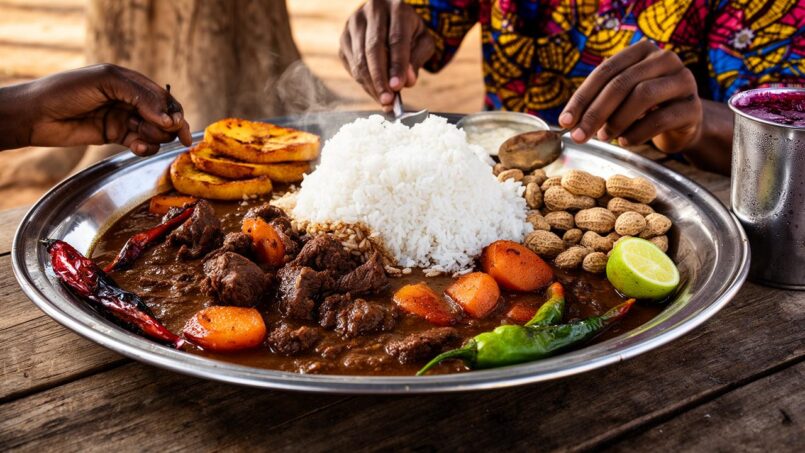
Eating, here, is also a social act. Meals are willingly shared around a large communal bowl, and an expat who agrees to sit on the floor, eat with the right hand, and say a few words in Mandinka or Wolof will do more for their integration than a thousand Zoom meetings.
The must-know classics
Before getting lost in the richness of preparations, a few dishes form the bedrock of Gambian gastronomy. Recognizing them, knowing what they contain, and how to eat them will save you many hesitations at the market or at friends’ homes.
Domoda, the national peanut stew
Domoda is considered the national dish. It’s a thick peanut-based stew served with rice or couscous. Its base is simple: peanut paste or unsweetened peanut butter, tomatoes (fresh and paste), onions, garlic, pepper, mustard, bouillon cubes, plus an assortment of vegetables like pumpkin, sweet potato, cassava, carrot, cabbage, eggplant, or okra. Depending on means, meat (chicken, beef, lamb) or fish is added. Some households favor a variant, domoda faring, where flour replaces peanut paste to thicken a lemon-tomato sauce.
The result is a creamy sauce, both rich and tangy, that perfectly coats the rice. Recipes vary from village to village, but the spirit remains the same: make a lot out of little, leveraging the peanut as a nutritional cornerstone.
Benachin, the one-pot rice
Benachin literally means “one pot” in Wolof. Everything cooks together: rice, tomato sauce, spices, vegetables, meat or fish. It is the Gambian version of jollof rice, famous across West Africa. The local twist: the rice is cooked directly in the cooking liquid from the meat and vegetables, giving it an intense reddish-orange color and a deeply concentrated flavor.
Depending on the household, this dish can be made with different meats (beef, chicken, lamb) or fish (barracuda, bonga, swordfish, butterfish, ladyfish). It is served with various vegetables like cabbage, carrot, eggplant, cassava, sweet potato, whole chili, and sometimes pumpkin. Typical ingredients like baobab powder or cassava that breaks down can add a tangy touch and a slightly sticky texture that’s much appreciated. Also, the crispy rice crust that forms at the bottom of the pot is often considered a real treasure.
Benachin is the ultimate festive dish, inseparable from weddings, religious celebrations, or large family gatherings.
Yassa, mastered acidity
Yassa exemplifies the West African taste for citrus marinades. Chicken or fish (often whole fish or bonga) is marinated for a long time in a mixture of abundant onions, lemon juice, mustard, garlic, chili, and salt. The meat or fish is then grilled or fried, then returned to simmer in the same marinade turned into a sauce. The whole is served on a bed of rice.
The result is an intensely flavorful dish, both tangy and slightly spicy. A street variant, “street yassa,” very popular in Jola neighborhoods, notably uses bonga fish, tamarind, lemon, and plenty of onions.
Mbahal, the smoky-salty Friday dish
Mbahal (or nyankatang) relies on another pillar: smoked and salted fish. It combines dried fish, crushed peanuts, black-eyed peas or néré seeds, okra, sometimes bitter tomatoes, green onion, and fresh chilies. Mixed with rice, the result evokes a powerful risotto, where the smokiness of the fish, the roundness of the peanut, and the vegetal note of okra interplay.
This dish, originating from the Sérère kingdom of Saloum, is traditionally cooked on Fridays in many families. It perfectly illustrates the link between precolonial history and contemporary cuisine.
Superkanja, the discreet power of okra
Superkanja (or supakanja) is an okra stew, often made with fish and palm oil. The okra is cooked until it reaches a slightly mucilaginous texture, bound by the oil and spiced with onion, chili, and seasonings. Sometimes beef, shrimp, or crabs are added. It’s served on rice or fufu (cassava or yam paste).
Beneath its apparent simplicity, superkanja is a concentrated source of fiber, minerals, and protein, very common both in the city and in rural areas.
Ebbeh, the soup that satisfies
Ebbeh is a thick, spicy soup, built on a mix of fish and seafood (bonga, catfish, crabs, shrimp), roots (cassava, sweet potato, taro), chili, palm oil, bouillon cubes, lime, and tamarind. The result is an orange broth, boldly seasoned, with generous chunks of tubers providing a hearty chew.
You’ll find ebbeh in canteens, markets, on the street, and in some restaurants. Many Gambians consider it one of the most iconic dishes in the country.
Nyambeh Nyebeh, the cassava-bean combo
Under this name meaning “cassava and beans,” lies a very common dinner dish. Cassava and beans are cooked separately, then topped with a sauce of white onion, green onion, and chili. It can sometimes be accompanied by fried fish, like snapper. It’s a simple but filling plate, typical of evening meals.
Street food: afra, akara, tapalapa, and more
The boundary between home cooking and street food is porous. However, some dishes are inseparable from the Gambian street.
Afra (or dibi) is the nocturnal star: pieces of meat—lamb, beef, chicken, fish, or even game—rubbed with bouillon cubes, grilled over sidewalk braziers, and served with caramelized onions and mustard. It’s often eaten in a tapalapa sandwich or on a plate. Afra vendors are especially active in the evening, notably around the Abuko animal market, along New Road, or in Kotu.
Akara is another classic: fritters made from ground black-eyed peas, seasoned with onion and chili, deep-fried until they have a golden crust. In the early morning, they’re slipped into half a tapalapa with a spicy onion-chili sauce. Perfect for a breakfast on the go.
Fish cakes, meanwhile, maintain an amusing ambiguity: these small fried discs made only of dough (flour, fat, salt)—no fish despite the name—are served with a very spicy sauce of onion, chili, and jumbo (condiment).
Everyday bread: tapalapa and senfuur
Tapalapa looks like a baguette in shape, but it’s a dense and filling bread made from millet, wheat, corn, and bean flour. Its crust is firm, and its compact crumb is somewhat reminiscent of pretzels. It is traditionally baked in clay ovens fired with wood. It’s eaten at breakfast with butter, jam, chocolate spread, eggs, or beans, and as an accompaniment to stews.
Senfuur is a baguette closer to the French style, often filled with the same ingredients as tapalapa. Both are picked up early in the morning from neighborhood shops.
Desserts and breakfasts: thiakry, porridge, and fruits
Desserts in the Western sense are relatively rare in everyday life, but a few sweet preparations are worth seeking out.
Thiakry (or thiacry, chakery, degue) is a kind of rice pudding revisited: millet or wheat couscous grains are mixed with condensed milk or yogurt, sugar, shredded coconut, raisins, seasoned with nutmeg and cinnamon. It’s enjoyed as a dessert, snack, or for breakfast.
Local porridges, like churra gerte (rice and peanut porridge) or wonjo koko (a thick blend of peanuts, millet, and spices, served with sugar and condensed milk), form the base of many breakfasts. They keep you full for much of the day.
Fresh fruits complete the picture: oranges (green when ripe), mangoes, papayas, very sweet bananas, watermelons, melons, guavas, pineapples, dates, jujubes, cashew apples, and baobab. They are consumed as snacks, in juices, or as jam.
To help you navigate fruit seasonality, this summary table may be useful:
| Fruit | Local name(s) | Main availability period |
|---|---|---|
| Mango | mango / mangoo | May – August (sometimes September) |
| Baobab (pulp) | bouye / buya | October – January |
| Tamarind | tamarind | November – March |
| Watermelon | – | March – July |
| Cantaloupe melon | – | March – July |
| Orange | orange | December – March |
| Cashew apple | cashew apple | April – July |
| Jujube | jujube / ber | June – September |
| Guava | guava | November – April |
| Papaya | pawpaw | Year-round |
Local drinks: teas, juices, and conviviality
No discussion of Gambian gastronomy would be complete without mentioning the beverages that accompany dishes and conversations.
Wonjo is perhaps the most iconic: a ruby red, non-alcoholic drink made from dried hibiscus flowers (sorrel), water, and sugar. Served very cold, often in restaurants, street stalls, or at ceremonies, it is known elsewhere as bissap, zobo, or sorrel juice.
Attaya is more of a true social institution than a drink. It’s a very strong green tea, prepared in three successive infusions, with lots of sugar, and often served in small glasses. The preparation is slow, theatrical: the liquid is frothed by pouring it from glass to glass; people talk, comment on the news. Accepting an attaya means agreeing to enter the circle.
Attaya, a social institution
In some places like Lamin Lodge, a local tea called mbor mbor or attaya is served with Gambian donuts, with a view of the mangrove. Other local juices complete the lineup: baobab juice, tamarind juice, papaya-banana blends, often offered along the beach. Expatriates simply need to remain mindful of hygiene rules for fresh drinks (see below).
Essential Gambian table manners
Sharing a meal Gambian-style means accepting specific codes. They may be surprising at first, but respecting them is a sign of consideration.
Before sitting down, you remove your shoes and wash your hands. In many homes, people eat around a large bowl placed on a mat (basang), sometimes sitting on the floor, sometimes on small stools. A particularly honored guest may receive their own plate.
The right hand is used exclusively for eating; the left is reserved for personal hygiene. Food, like rice, is taken by forming small balls with the right hand. Asking for a spoon is acceptable if needed, but even with utensils, you should avoid touching food with your left hand.
Each diner “owns” the portion of the bowl directly in front of them, within a band of about 10–15 cm. You do not reach into your neighbor’s zone. However, you can reach toward the center to detach a piece of meat or vegetable, as long as you bring it back to your own portion before eating it. Often, the person serving—the hostess, for example—will distribute the best pieces into the guests’ zones. She also pours or adds sauce from a second container.
The meal begins with the word “Bismillah.” It is polite to eat in silence, especially for children, and not to sniff the food. Food that falls to the ground, like rice or bones, should not be put back into the bowl.
Finishing your plate completely can sometimes be interpreted as a sign that you are still hungry. It’s better to signal you are full verbally, for example by learning to say “I’m full” (barrkah). At the end, a discreet burp is accepted as a sign of satisfaction. Then you get up immediately to wash your hands and thank the cook again, often with “Alhamdulilah” (“Praise be to God”) or other expressions of gratitude.
Flatly refusing a meal is very poorly received. If you cannot eat much, take just a few bites and take time to explain tactfully (allergies, health issue, etc.)—ideally in advance if you’ve been invited.
Exploring the markets: the beating heart of gastronomy
For an expatriate, markets are the best culinary learning ground. There you see raw products, preservation techniques, shopping habits, and you talk directly with those who feed the country.
Major food markets
Several markets structure Gambian daily life.
Albert Market, right in the center of Banjul, is the quintessential urban market. A maze of alleys where you can find everything: fruits and vegetables, rice, fresh fish, meat, spices, peanuts, condiments, but also fabrics, jewelry, crafts, tools. The space is generally divided between a wholesale and retail area, a fresh produce section, and a section more geared toward tourists and crafts.
In Serrekunda, one of the country’s largest markets stretches from Sarapond Market to Westfield. The atmosphere is even denser, with sales of fresh produce, cooked dishes, textiles, everyday items. It’s a very good place to spot typical snacks, tapalapa stalls, porridge or juice vendors.
Brikama Market, especially lively on Sunday mornings, perfectly illustrates local economic dynamism. Renowned for its mix of agricultural products, livestock, crafts, and street food, it’s a chance to observe how production from surrounding villages feeds the city. It is a concrete example of the importance of weekly markets in urban supply and rural-urban exchanges.
Bakau Market, on Atlantic Road, concentrates fruits, vegetables, meat, fish, and consumer goods. Right next door, the fishing jetty and community fishing center allow you to see the daily arrival of boats, nets brimming with butterfish, bonga, ladyfish, shrimp, blue crabs… The Bakau Fish Market is ideal for understanding the central role of the sea and river in local food.
Finally, the legendary Tanji Fish Market, on the beach, offers the full spectacle: canoes landing, baskets passed from hand to hand, fish smoked, dried, or sold fresh. A holy site of gastronomy for anyone interested in the food chain.
To help you target your explorations, this table summarizes some major markets:
| Market | Location | Notable culinary features |
|---|---|---|
| Albert Market | Central Banjul | Fish, vegetables, peanuts, condiments, street food |
| Serekunda Market | Serrekunda | Cooked dishes, snacks, fresh produce, great diversity |
| Brikama Market | Brikama | Agricultural products, meat, street food |
| Bakau Market | Bakau / Atlantic Road | Fruits, vegetables, fish, shrimp, crab |
| Tanji Fish Market | Atlantic Coast | Fresh, smoked, dried fish; lively fishing scene |
In all these markets, bargaining is part of the game. Displayed prices barely exist. It’s often advised to start negotiations at about half the announced price, while keeping a smile. The goal is not to “win” against the seller, but to reach a compromise perceived as fair by both sides.
Seasonal fruits and vegetables
Gambia’s climate, hot and marked by a rainy season, strongly dictates the availability of fruits and vegetables. Eating seasonally means enjoying the best taste, lower prices, and reduced environmental impact. The mango trees, ubiquitous, produce abundantly between May and August, turning the countryside into a giant open-air buffet. Oranges, lemons, and grapefruits arrive in force at the end of the year and the start of the dry season. Cashew apples color the markets in spring, while watermelons and melons dominate the hottest period.
Six vegetables can be grown year-round in Senegal, influencing the composition of dishes according to the seasons.
For an expatriate, one of the simplest ways to immerse yourself is to let the local calendar guide your purchases, rather than desperately seeking “European” produce out of season.
Learning to cook local: classes, workshops, and experiences
Rather than remaining a spectator, it is possible—and highly recommended—to get your hands dirty.
Cooking classes in a local home
Initiatives like Cooking Classes Gambia or Ida’s Home Cooking Yabouy offer visitors and residents the chance to learn directly in a Gambian home. At Ida’s, in Tujereng (also connected to the Brufut area), the experience typically starts around 8:45 am and lasts nearly five hours, until early afternoon. Her son picks up participants from their hotel and brings them back afterward.
A typical itinerary includes a visit to Tanji Fish Market to buy the day’s ingredients, with explanations from vendors. The group then cooks in a courtyard over a charcoal fire using traditional utensils, prepares an herbal tea from garden herbs, and can try local games like wuri, while exchanging about local culture.
The preparation is entirely participatory: everyone peels, pounds, stirs, tastes. Ida works with her daughters-in-law Haddy (a trained chef) and Aïcha (who leads cultural and herb workshops). The meal is then shared in the garden, with music, non-alcoholic local drinks, attaya, sometimes a welcome drink and sodas. Prices are around $50 USD per person for this type of format, with discounts for children when booked through platforms like Traveling Spoon.
Another organization, Cooking Classes Gambia, offers full days (9 am–4 pm, hotel shuttle included) around a different dish each day: for example, vegetarian benachin on Mondays, chicken domoda on Tuesdays. The cost is around 1,600 dalasis per person (about €28).
Online experiences and diaspora
For those who want to go deeper or stay connected from abroad, projects like Migrateful invite refugees, asylum seekers, or migrants to teach their cuisine, sometimes Gambian, online via Zoom. Classes generally last one to two hours; the ingredient and equipment list is sent in advance (blender, knives, cutting board, pots, pans, scale…). It’s a different way to understand the adaptability of Gambian cuisine in a migratory context.
Why these classes are valuable for an expat
Beyond the pleasure of the recipe, these experiences offer several very concrete benefits. They allow you to:
To succeed, you need to understand the logic of the dishes (marinades, sauces, leftover management), learn to use specific local ingredients (okra, sweet potato leaves, fish, tamarind, baobab powder), get familiar with markets and local vocabulary for shopping, and build a bond of trust with locals, useful beyond the kitchen.
For an expatriate, mastering a few emblematic preparations—a proper domoda, a tasty benachin, a well-balanced wonjo juice—can quickly become a marker of integration and a bridge to your neighbors.
Managing your diet: hygiene, safety, and specific constraints
Getting used to a new cuisine doesn’t happen without precautions, especially in a tropical climate. The infamous “Banjul Belly,” the local nickname for traveler’s digestive troubles, reminds us that bacteria multiply quickly in the heat, and that farming practices (manure as fertilizer, irrigation water) can expose food to germs unfamiliar to a European system.
Golden rules of food hygiene for expats
A few guidelines are essential, even if you eat local:
To avoid foodborne illness, always wash your hands before meals and after visiting markets, using hand sanitizer if needed. Ensure strict separation between raw and cooked foods during preparation. Favor foods that are well-cooked and served piping hot: meats with no pinkness, opaque fish. Avoid raw dishes like tartare or raw seafood; be cautious with preparations containing raw eggs. Choose small fish and avoid their innards. Finally, do not consume cooked dishes left at room temperature for several hours, and be wary of lukewarm buffets.
For vegetables, the recommendations are equally important: only eat raw fruits and vegetables that you can peel yourself and that have intact skin; rinse thoroughly, and ideally disinfect, raw vegetables if you doubt the quality of the washing water; be especially wary of green salads, whose leaves don’t easily release microbes.
For water, prefer sealed bottles opened in front of you. If in doubt about tap water (even for rinsing your mouth), boil it for at least one minute. Bottled or canned industrial drinks are generally safe. For freshly squeezed juices, check the cleanliness of utensils, ask for the fruit to be peeled in front of you, and avoid ice of uncertain origin.
Allergies and special diets
Diets based on rice, fish, peanuts, and vegetables are a priori rich in options. But for people with allergies or strict dietary requirements, vigilance is still necessary, as peanuts, fish, mustard, gluten, and certain spices are omnipresent.
In Bangkok, some culinary actors know how to handle dietary restrictions. Ida’s Home Cooking Yabouy can adapt its menus (vegetarian, vegan, lactose-free, gluten-free) upon prior request. Traveling Spoon hosts are generally trained to accommodate allergies and intolerances.
A few practical tips, especially during the first months:
– Quickly learn the vocabulary for the main allergens in English and, if possible, in Mandinka or Wolof (peanut, milk, egg, wheat, fish, seafood…);
– Prepare small written cards explaining your allergies or dietary restrictions, to show to restaurant staff or people who invite you;
– Identify a few restaurants and cooks known for their adaptability, then return to them regularly;
– Always keep your emergency medications with you if you are prone to severe reactions.
Where to eat: from the family bowl to cosmopolitan restaurants
Living in Gambia means juggling between meals at locals’ homes, market canteens, improvised street food, and restaurants with international menus. In tourist areas (Kololi, Kotu, Bakau, Fajara, Senegambia Strip), the offerings range from Lebanese rotisseries to Italian pizzerias, including Indian, Chinese, Mexican, Japanese, and African addresses.
Establishments like Scala Restaurant, African Queen Restaurant, Ngala Lodge Restaurant, Calypso Beach Bar & Restaurant (Cape Point), or various spots on the Senegambia Strip often offer international dishes and Gambian specialties like domoda or benachin. Others, more geared toward a local clientele, serve unadapted Gambian cuisine, sometimes described in reviews as “the best Gambian dishes we’ve eaten in the country.”
Restaurants in Gambia
For an expatriate, the most rewarding strategy is not to stick to “toubab” restaurants. Alternating dinners with Gambian colleagues, discoveries of afra stands, regular visits to small neighborhood eateries (including Nigerian or Cameroonian ones, very present on the street food scene), and higher-end restaurants for special occasions allows you to cover the full spectrum of tastes and budgets.
Festivals, events, and cultural dimension
Gambian gastronomy is not limited to the plates served in homes and restaurants. It also expresses itself through a series of festivals and events that inscribe it in a broader narrative: national identity, tourism, creativity.
More than twenty African countries gather each year at the West African Food Festival (WAFFEST).
Meanwhile, festivals like the Perreh-Bi Fest at Palma Rima Beach, supported by European projects, mix music, dance, traditional performances, sports, gastronomy, crafts, and entrepreneurship. The idea is to reconnect youth with Gambian culture and cuisine, stimulate domestic tourism, and generate income for local food vendors. Feedback from the latter underscores how these events are an economic breath of fresh air.
Events like the Banjul Cultural Festival and street food festivals organized by collectives highlight gastronomy as an element of national pride. These festivals offer an open stage with parades, lanterns, traditional wrestling, regattas, and exhibitions. You can taste a diversity of dishes, especially Gambian, Nigerian, and Cameroonian, reflecting the richness of the communities present.
For an expatriate, participating in these events, even simply as a visitor, allows you to grasp another dimension of the dishes: that of symbolism, storytelling, friendly competition (especially around jollof rice), and hospitality.
Practical tips for starting your culinary life in Gambia
To conclude, here are a few concrete pointers, drawn from all this information, to help you take the plunge into local cuisine more easily.
Start with a small number of dishes to identify and taste in several variations: domoda, benachin, yassa, superkanja, ebbeh, afra, akara, tapalapa, thiakry, wonjo juice, attaya. In a few weeks, you’ll be able to spot the good stalls at a glance, signs that the dish is fresh, and the cooking styles that suit you.
Discover local markets with a guide to learn the basics, then test your skills independently.
Go with a resident to explore a major market (Albert, Serekunda, Brikama, or Bakau). Learn how to choose fresh fish, select vegetables suitable for each dish, and the art of respectful negotiation.
Return alone to the market of your choice to practice and consolidate the skills acquired during the guided tour.
Sign up for a cooking class in a local home (Ida’s Home Cooking Yabouy, Cooking Classes Gambia, or equivalent). In one morning, you’ll learn more about gastronomy, rhythms, and codes of the Gambian home than in many books.
Be cautious but not paranoid about health issues. Following the big rules (bottled water, well-cooked dishes, peeled fruits, caution with raw vegetables and sauces containing raw eggs) will significantly reduce risks without depriving you of the essentials.
Finally, accept invitations. Even if meals happen later than you’re used to, even if sitting on the floor seems uncomfortable. A few words of Mandinka or Wolof, a big smile, a “Bismillah” as you start, an “Alhamdulilah” at the end of the meal, and you’ll see the cultural distance melt away quickly.
Gastronomy in Gambia is not just a succession of dishes; it is a language. By learning it, you give your expatriation a human and sensory depth that supermarkets and international restaurants alone can never offer.
Disclaimer: The information provided on this website is for informational purposes only and does not constitute financial, legal, or professional advice. We encourage you to consult qualified experts before making any investment, real estate, or expatriation decisions. Although we strive to maintain up-to-date and accurate information, we do not guarantee the completeness, accuracy, or timeliness of the proposed content. As investment and expatriation involve risks, we disclaim any liability for potential losses or damages arising from the use of this site. Your use of this site confirms your acceptance of these terms and your understanding of the associated risks.

Cyril Jarnias is an independent expert in international wealth management with over 20 years of experience. As an expatriate himself, he is dedicated to helping individuals and business leaders build, protect, and pass on their wealth with complete peace of mind.
On his website, cyriljarnias.com, he shares his expertise on international real estate, offshore company formation, and expatriation.
Thanks to his expertise, he offers sound advice to optimize his clients' wealth management. Cyril Jarnias is also recognized for his appearances in many prestigious media outlets such as BFM Business, les Français de l’étranger, Le Figaro, Les Echos, and Mieux vivre votre argent, where he shares his knowledge and know-how in wealth management.





