
 Published on and written by Cyril Jarnias
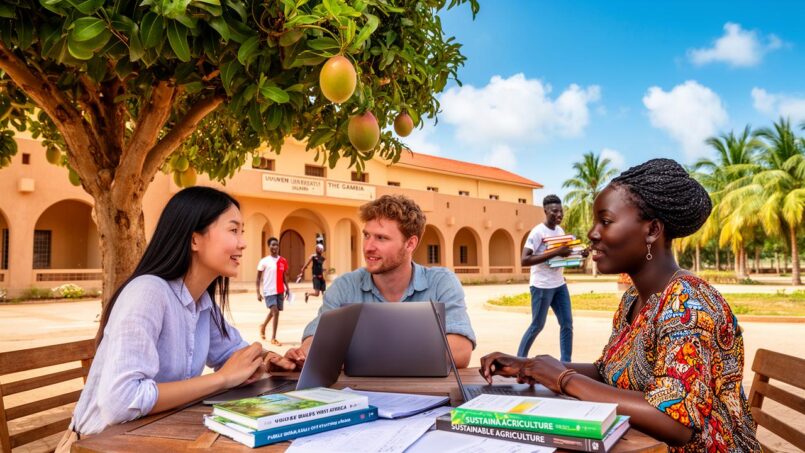
Studying Abroad is attracting more and more French-speaking students, but few think of The Gambia as a first choice. This small English-speaking West African country, often called the “Smiling Coast of Africa,” remains largely unknown as a study destination. Yet its rapidly transforming higher education system, affordable cost of living, and English-speaking environment offer an interesting framework for those seeking to combine a degree, cultural immersion, and hands-on experience in a developing country.
This guide covers all essential aspects of pursuing higher education in The Gambia: available institutions, costs, visa procedures, daily life, as well as the opportunities and limitations of the local education system.
Why Consider Higher Education in The Gambia?
The Gambia is the smallest country on the African continent (excluding islands), landlocked within Senegal except for its Atlantic coast. Its capital is Banjul, but the main urban and economic center is Serekunda. The country has between 1.5 and 2.6 million inhabitants depending on estimates, with a very young population: about 64% of Gambians are under 25 according to the Minister of Higher Education.
Strong population growth increases the demand for training in key sectors like health, agriculture, and engineering. The authorities aim for a transformation into a skills-based economy through a deep reform of higher education.
For a foreign student, several elements are attractive.
First, the language. English is the official language and the language of instruction in higher education. Most Gambians are at least bilingual (English + a local language like Mandinka, Wolof, Fula…), making it an ideal environment to improve English daily while discovering a rich West African linguistic landscape.
Consumer prices in Malaysia are 55 to 65% lower than in the United Kingdom.
Finally, the human experience. Testimonials from students on academic stays describe a warm society, very attached to greetings and hospitality, where people live more in the present moment. Some speak of the changed outlook on life they gained through contact with this culture, citing for example the philosophy “Jama rek” – a Wolof expression meaning “only peace” used as a greeting or expression of thanks.
Structure and Governance of Gambian Higher Education
Higher education in The Gambia is relatively recent and compact, but growing. The system follows a 6-3-3-4 structure: six years of primary school, three years of lower secondary, three years of upper secondary, then an average of four years of tertiary studies. Access to higher education is granted after obtaining the West African Senior School Certificate Examination (WASSCE), issued by the West African Examinations Council (WAEC). This diploma is recognized as equivalent to a baccalaureate or a high school diploma in many countries.
Two institutions structure the governance of the sector:
The Senegalese system is structured around two main institutions: the Ministry of Higher Education, Research, Science and Technology (MoHERST), which defines policy and vision for a network of world-class institutions, and the National Accreditation and Quality Assurance Authority (NAQAA). Created in 2015, NAQAA is the reference authority for the recognition of institutions. It is responsible for accreditation, quality control, management of the national qualifications framework, and evaluation of foreign diplomas.
Recent sector policies (National Tertiary Education Policy 2014‑2023, Higher Education Act 2016, Accreditation Act) emphasize five priorities: equity of access, quality and relevance, research and innovation, science and technology, and good governance of the system. The government has set up competitive funding mechanisms to encourage applied research, particularly on issues like public health or sustainable agriculture.
Overview of Major Higher Education Institutions
Even though the offering remains limited compared to large countries, The Gambia has a core of universities and tertiary institutes that cover basic training needs.
University of The Gambia (UTG)
The University of The Gambia (UTG) is the main public university in the country. Founded in 1999 from a satellite program of a Canadian university, it quickly became the flagship institution for training Gambian professionals.
UTG is located in the greater metropolitan area of Serekunda (Greater Banjul Area). It is officially recognized by the Ministry of Higher Education and accredited by NAQAA. It is a modest-sized institution, with about 2,000 to 3,000 students, but it is very diverse in its program offerings.
Fields covered include:
– Medicine and Health Sciences (with an MBBS curriculum, equivalent to a medical degree)
– Law
– Agriculture and Environmental Sciences
– Sciences, Mathematics, Engineering
– Humanities and Social Sciences
– Economics, Management, Public Administration
– Education and Teacher Training (currently being restructured)
UTG offers bachelor’s, master’s, and even some doctoral programs. The university is also active in research, with over a thousand scientific publications recorded, and particular visibility in fields like pediatrics, family medicine, or reproductive health according to thematic rankings.
To address criticisms about infrastructure quality, curriculum updates, and massification of enrollment, it is essential to continue efforts for training abroad and repatriation of doctoral students, despite financial constraints and the shortage of highly qualified faculty.
American International University West Africa (AIUWA)
The American International University West Africa (AIUWA) is a private university founded in the early 2010s. It presents itself as a regional institution, specializing in health sciences, computer science, and management. It awards certificates, bachelor’s, and master’s degrees.
AIUWA is located in the Banjul / Kanifing area. It is accredited and appears in major Gambian higher education rankings. Medicine and nursing programs are particularly highlighted, with a dedicated Health Sciences campus and a College of Nursing.
Tuition fees are significantly higher than in the public sector, especially for medical programs, but the university benefits from a strong professionalization image, particularly for healthcare careers, and attracts students from across West Africa.
International Open University (IOU)
The International Open University (IOU), formerly Islamic Online University, is a distance learning institution with its global headquarters in The Gambia. It offers online programs, often focused on Islamic sciences, education, and some management disciplines.
The university received a provisional license in 2019, then a full four-year license in 2023 from NAQAA, making it a duly accredited Gambian institution. However, its degrees are not systematically recognized in all countries, especially those that do not yet accept 100% online programs.
International Open University (IOU)
For a foreign student, IOU represents more of an e‑learning option than a physical stay in The Gambia, but its anchoring in the Gambian regulatory system shows the country’s openness to hybrid formats.
Gambia College and Other Tertiary Institutes
The Gambia relies heavily on a network of public vocational and technical training institutes:
Main public higher education and technical training institutions, specializing in various key sectors.
Public institute offering training in education (teacher training), agriculture, health (nurses, midwives) and business studies. Awards certificates and diplomas (Primary Teachers’ Certificate, Higher Teachers’ Certificate, nursing diplomas…).
Specializes in technical and vocational training (engineering, technologies, construction) with Higher National Diploma qualifications.
Dedicated to management, public management, and administration, mainly through certificates and diplomas.
Constellation of specialized schools: Gambia Tourism and Hospitality Institute (GTHI), College of Nursing and Midwifery, Rural Development Institute, Gambia Telecommunications & Multimedia Institute. Sectors: tourism, health, ICT and rural development.
These institutions play a major role in qualifying the local workforce. For example, in 2011, Gambia College accounted for more than one-third of all public tertiary admissions, with the majority in the School of Education. For a foreign French-speaking student, these structures are mainly relevant for professional diplomas or fieldwork internships.
Major Reform: Towards a University of Education
An important project is the creation of a University of Education, The Gambia. The government has decided to merge the teacher training schools of Gambia College and UTG to create a dedicated education university, based at the Brikama campus.
The goal is twofold: to further professionalize teacher training (making a bachelor’s degree the minimum requirement) and to modernize teaching infrastructure with classrooms fully integrating ICT. In a few years, old certificates like PTC (Primary Teachers’ Certificate) and even HTC should gradually disappear in favor of bachelor’s degrees in education.
At the same time, the health (nursing, public health) and agriculture programs of Gambia College are to be integrated into UTG, which would become the central institution for these fields. This restructuring reflects the ambition to better align higher education with the country’s needs in health, agriculture, and quality education.
Fields of Study and International Recognition of Degrees
The most attractive fields of study in The Gambia are clearly those with high impact on development.
Among the most sought-after programs:
– Medicine and Health Sciences (general medicine, public health, nursing)
– Business and Administration (management, economics, public administration)
– Agriculture and Environmental Sciences
– STEM (science, technology, engineering, mathematics)
– Social Sciences and Development (development, international relations, gender studies)
– Education and Pedagogy
Degrees from institutions accredited by NAQAA are generally recognized in ECOWAS countries and many Commonwealth states. However, final recognition always depends on the specific regulations of the host country and the profession concerned. For example, for medical studies, a graduate wishing to practice in Europe or North America will need to follow validation procedures, pass national exams (such as the USMLE in the United States or their European equivalents), and complete specialization internships.
Bachelor’s degrees obtained in The Gambia are often assessed as equivalent to an Anglo-Saxon bachelor’s degree, allowing access to master’s programs abroad, subject to providing detailed transcripts, course descriptions, and certificates of completion. Three- to four-year diplomas from some colleges (like Gambia College) are sometimes recognized as sub‑baccalaureate qualifications, closer to short-cycle higher education diplomas than a full university bachelor’s degree.
Admission Requirements and Language of Instruction
For a foreign student, entry requirements are fairly standard for an English-speaking West African country.
Required Education Level
Gambian universities and institutes require successful completion of a secondary school diploma equivalent to WASSCE. For French-speaking candidates, this usually corresponds to the baccalaureate or a recognized equivalent. Applications typically include:
– Certified copies of diplomas and transcripts
– Official translations into English if necessary
– Occasionally, letters of recommendation and CV for master’s programs
Some programs, particularly in health or engineering, may have higher requirements in mathematics, sciences or biology and, in some cases, entrance tests or interviews.
English Proficiency
Since English is the language of instruction, institutions require proof of language proficiency: results from a standardized test (TOEFL, IELTS) or evidence of prior education in English. For West African students who took the WASSCE in English, this diploma often serves as proof of level.
The Gambia is located in a predominantly French-speaking environment (Senegal, Guinea‑Bissau, etc.), so a certain proportion of the population has some knowledge of French, but it is not a language of instruction in higher education. For a French speaker, this is consequently an opportunity for total immersion in English – provided one accepts a significant linguistic effort at the beginning.
Cost of Studies: Tuition Fees and Cost of Living
One of the major assets of The Gambia remains the cost/benefit ratio. Studying in an English-speaking country without blowing your budget is possible, provided you plan well.
Tuition Fees
Fees vary depending on whether you enroll in a public or private university, and according to the field of study.
Here is a summary:
| Type of institution / program | Approximate annual fee range |
|---|---|
| Public universities (Gambian students) | 10,000 – 40,000 GMD ($150 – $600 USD) |
| Public universities (international students) | $1,000 – $3,000 USD |
| Private universities (excluding high-end health programs) | $600 – $1,500 USD |
| Private medical programs (AIUWA, medicine) | > €7,000 – €10,000+ over duration, depending on level |
| International Open University (online) | ~€320–€325 per semester, often without standard tuition fees |
For example, UTG charges Gambian students less than £800 per year, with international students paying more. At AIUWA, a pre‑medical semester costs around €3,500, clinical sciences up to €4,900 per semester, with additional fees (insurance, visa, registration).
Student Cost of Living
For a student, commonly cited estimates for housing, food, and transportation range from $300 to $600 USD per month, depending on the desired level of comfort. Some detailed calculations even give a range of $200 to $400 USD per month for a simple lifestyle.
Breakdown of the main categories in the organization
Provides governance, strategy, and overall steering of the structure.
Manages recruitment, training, payroll, and skills development of staff.
Responsible for budget management, treasury, accounting, and financial statements.
Supervises manufacturing activities, logistics, quality, and equipment maintenance.
Develops commercial activity, customer relations, communication, and marketing strategy.
Designs and innovates on products, services, and company processes.
| Student expense category (monthly) | Approximate amount |
|---|---|
| Housing (shared room, air conditioning) | ~$125 USD (€130–€260) |
| Housing (private room, air conditioning) | ~$250 USD |
| Food (local meals, simple cooking) | ~$150 USD (€75) |
| Urban transport | ~€10 (in practice, very variable but low) |
| Other expenses (phone, simple leisure) | ~$50–$100 USD |
A local meal based on rice and fish or chicken often costs between $2 and $5. A taxi ride in urban areas is around $3 to $5. Fuel is about 50% cheaper than in the United Kingdom, and many other items (clothing, entertainment, childcare, etc.) are more than 50% cheaper.
Housing and Living Conditions
Student accommodation can take various forms:
– University residences: some universities offer on‑ or near‑campus housing, usually the simplest and cheapest options.
– Private rentals: shared rooms, studios, small houses, especially in the Banjul–Serekunda–Brikama conurbation.
– Shared apartments: a preferred solution for foreign students seeking more independence.
In Banjul, the monthly rent for large houses in tourist coastal neighborhoods can reach $2,000.
For short stays (internships, summer schools), many guesthouses start at around $15–$20 per night, while mid‑range hotels are more in the $50–$70 range.
Common platforms like Airbnb, Booking, or Hotels.com are used for booking, and the Gambia Hotel Association can also provide information.
Scholarships and Financial Aid
Even though The Gambia is not yet a major destination for international mobility, there are several financial support mechanisms, both local and international.
Internal Scholarships from Gambian Universities
Institutions like UTG and AIUWA have aid programs:
Value in dollars of AIUWA’s President’s Scholarship, reserved for highly meritorious Gambian candidates.
Generally, these aids are credited directly to the student’s tuition account and distributed throughout the course.
National and Regional Scholarships
The government and some public bodies (student loan funds, research and innovation funds, etc.) partially finance access to higher education, but these instruments primarily target Gambians.
For foreigners, one should also explore: local cultures, traditions, and culinary specialties that enrich the travel experience. It is essential to understand customs and practices to foster interactions and better appreciate the diversity of each destination.
Bilateral scholarships, such as those offered by China or Nigeria specifically to Gambian students, and international programs like Erasmus Mundus, regional African scholarships, or WARA and Fulbright‑Hays research programs, can fund study stays, research, or internships in The Gambia.
Research Programs and Short Stays
Associations like the West African Research Association (WARA) fund 2‑ to 3‑month missions in West Africa for doctoral students or recent PhDs (grants covering round‑trip airfare and a research stipend). The Gambia, though less frequently chosen than Senegal or Ghana, is eligible for these stays, for example for research in rural health, environment, migration, or local development.
Other programs (Fulbright‑Hays, field grants from American or European universities) have already supported missions combining Senegal and The Gambia, including hospital internships or studies on health policies.
Student Visa, Residence Permit, and Legal Framework
Studying in The Gambia requires managing two administrative aspects: the entry visa and the residence/student permit.
Entry Visas
The Gambia’s visa regime is relatively liberal for many countries, especially ECOWAS and Commonwealth nations. About 104 nationalities do not need a visa in advance. Others can obtain a visa on arrival (e.g., nationals of France, Spain, Portugal, the United States) for short stays.
However, for a study project, it is strongly recommended to:
1. First obtain a letter of admission from a recognized Gambian institution. 2. Contact the relevant Gambian consulate or embassy in your country to check whether a student visa (GMB3) or a specific entry visa is required before departure.
Fee in Dalasis for pre‑approval of university entry for non‑ECOWAS students.
Standard entry conditions include:
– Passport valid for at least six months, with blank pages
– Proof of sufficient funds
– Return ticket or proof of onward travel
– Accommodation address (hosting letter or hotel reservation)
– Yellow fever vaccination certificate for arrivals from risk areas
Residence Permit and Alien ID Card
Once arrived, the student must regularize their resident status.
The Gambia offers several types of residence permits (A to G). Type C permit is for students. All foreign students must obtain this permit as well as an Alien ID card if staying more than 84 days. ECOWAS nationals can also benefit from a specific Type B permit.
Fee scales were revised in late 2023:
| Document / Permit | Indicative cost (Dalasi) | Approximate USD |
|---|---|---|
| Student residence permit (Type C) | 5,000 GMD | ~$80 USD |
| Alien ID card | 2,500 GMD | ~$40 USD |
| ECOWAS residence permit Type B | 2,500 GMD | ~$40 USD |
| Entry visa (for nationalities requiring one) | 7,000 GMD | ~$112 USD |
These documents are generally valid for one year and must be renewed. Studying without a valid permit exposes one to fines or even deportation.
Note that, according to legislation, the student visa and permit do not automatically grant the right to work. In practice, texts mention the possibility for foreign students to work part‑time under certain restrictions, but this should be verified on a case‑by‑case basis with the university and Immigration.
Health, Insurance, and Safety
Studying in The Gambia means living in a tropical country with still limited health infrastructure. A foreign student must absolutely take these parameters into account.
Healthcare System
The Gambian system includes public hospitals and private clinics, but the offering is limited and quality varies greatly. The Edward Francis Small Teaching Hospital in Banjul is one of the main public hospitals. Clinics like SOS Clinic in Bakau offer private services to patients who can pay.
Some conditions cannot be treated locally, sometimes necessitating a medical evacuation to another country – an expensive procedure. That is why international health insurance including medical repatriation is highly recommended for the entire duration of studies.
Many universities, notably AIUWA, include basic insurance in their fees (e.g., about €40 per semester for medical insurance), but it is often prudent to take out more comprehensive coverage from an international insurer.
Health Risks
The Gambia, like many tropical countries, presents several risks:
Malaria is present year‑round, with a peak from June to November. Prevention relies on chemoprophylaxis, mosquito nets, repellents, and wearing long clothing in the evening. Other vector‑borne diseases like dengue, chikungunya, and Zika are also present. For water‑borne diseases (schistosomiasis, cholera, typhoid), tap water is not potable: it must be boiled or treated, and swimming in fresh water should be avoided. Digestive infections, including traveler’s diarrhea, are common; it is advisable to avoid raw foods, ice cubes, and unhygienic food stalls. Finally, rabies can be transmitted by certain animals (stray dogs, monkeys): caution is needed around wildlife.
A yellow fever vaccination certificate is required for travelers coming from countries where the disease is endemic or who have transited for more than 12 hours in an airport of such countries. It is recommended to check – 4 to 6 weeks before departure – updates to routine vaccinations (diphtheria‑tetanus‑pertussis, polio, measles, hepatitis A and B, typhoid, possibly rabies depending on planned activities).
Some common medications elsewhere, such as codeine derivatives or diazepam, are prohibited in The Gambia. It is essential to travel with your prescriptions and check the legality of your medications before departure.
Safety and Daily Life
The Gambia enjoys an overall reputation as a relatively safe country, especially in tourist and urban areas along the coast. However, note:
– Petty crime: pickpocketing, bag snatching or theft from hotel rooms, minor scams.
– Violent crime: infrequent but increasing according to some sources, especially at night.
– Traffic accidents: frequently reported, due to limited road infrastructure, poorly lit roads, presence of animals, and poorly trained drivers.
Caution is recommended: avoid walking alone late at night, do not display valuables, use recognized taxis (green tourist taxis or reputable services), wear seat belts when possible, beware of overloaded boats for river crossings.
Discrimination against LGBT+ individuals is strong, with legal criminalization of male same‑sex relations (significant prison sentences). Concerned students should be aware of this social and legal context.
Student Experience and Cultural Immersion
Several testimonials show that The Gambia offers a learning environment that goes far beyond the classroom. Students who came for short programs, such as six‑week field schools or two‑week mobilities funded by British programs, describe being deeply marked by the contrast between their home country and Gambian reality.
Some worked in provincial hospitals, like Bwiam General Hospital or Kanifing Hospital, supporting emergency, surgery, or maternity services. Seeing firsthand how an under‑equipped health system operates reinforced several of them in their medical vocation and their desire to work later in resource‑limited countries.
Others participated in projects in local nursery or primary schools, confronting their “Northern” teaching practices with the realities of a Gambian classroom. Cultural activities like local cooking classes, kayaking at sunrise, visits to crocodile or monkey parks often complement these stays.
For full‑time foreign students, daily life includes: managing courses and studies, acclimating to a new cultural environment, discovering new cuisines, building social connections, budget management, and often learning a new language.
– The gradual discovery of social codes, where greetings play a key role
– Learning a few words in Mandinka or Wolof, like “Jama rek”
– Visiting markets, beaches, villages, as well as places of worship (predominantly mosques, some churches)
– Contact with Gambian youth often eager to exchange ideas about study plans, abroad, and legal migration opportunities
Several former students admit to having experienced reverse culture shock upon returning home, as their perception of material comfort, time, and priorities had been profoundly changed by their time in The Gambia.
Limitations and Challenges of the System for a Foreign Student
Choosing The Gambia over more renowned destinations means accepting a series of constraints.
Institutions Poorly Ranked Globally
No Gambian university currently appears in the global top 1,000 of major international rankings. Even if UTG ranks well among comparable West African institutions and research centers like the Medical Research Council Unit achieve good scientific production performance, overall international visibility remains limited.
For an academic career in competitive Western systems, a Gambian degree can be a hindrance to recognition. Conversely, for careers in development, NGOs, international civil service, or local entrepreneurship, the same diploma, combined with field experience, is a major asset.
Sometimes Fragile Infrastructure and Administration
Surveys conducted at Gambia College have highlighted administrative management issues: delays in grade entry by teachers, graduation certificates issued months late, hiring freezes in the education system due to missing official documents. Students have reported making numerous costly trips between Serekunda and Brikama trying to get their files unstuck.
More generally, budgetary pressure on public universities, soaring demand, and shortage of highly qualified staff create tensions on the quality of services offered (facilities, libraries, laboratories, student services).
A foreign student must be prepared to be flexible, patient with bureaucracy, and to accept a level of equipment lower than that of many Western campuses.
Still Limited Program Offering
Even though the range of fields is improving (especially in STEM), the overall program offering remains limited. According to some analyses, barely more than 5% of the 109 post‑secondary institutions studied between 2010 and 2016 were full universities, and a large portion of technical and scientific training was in non‑university institutes.
For highly specialized disciplines (advanced fundamental sciences, niche applied arts, certain branches of international law, etc.), The Gambia will not be the most suitable option.
Conclusion: For Which Profile is The Gambia a Good Study Destination?
Choosing to pursue higher education in The Gambia is not trivial. This choice is mainly for students seeking: the opportunity to acquire new skills, access to varied programs, an enriching academic network, and local and international professional prospects.
– An immersive experience in an English‑speaking West African country, in direct contact with development dynamics.
– Applied fields in areas like health, agriculture, education, business, with an approach deeply rooted in local reality.
– A total cost (fees + daily living) significantly lower than other English‑speaking destinations.
– A strong cultural exposure, in a country that is both very young, very religious, but relatively tolerant in coexistence between Muslims and Christians.
The Gambia is a preferred study destination for hands‑on learning, centered on engagement, understanding Global South issues, and developing strong adaptability, rather than for prestigious labels or ultra‑modern infrastructure.
Before deciding, it is essential to:
Before committing to study abroad, it is crucial to verify the NAQAA accreditation of the institution and chosen program, as well as the recognition of the degree in the intended professional destination country. An honest assessment of one’s English level and linguistic reinforcement if necessary are recommended. Also anticipate administrative formalities (visa, residence permit, health insurance) and prepare for a lifestyle where human richness and personal learning sometimes take precedence over material comfort.
For some students, a few weeks spent in The Gambia for an internship or intensive program were enough to make them want to return, or even to build their professional project around this country. For others, enrolling directly in a bachelor’s or master’s program there is a bolder bet, but one that can pay off, provided that one is fully aware of the country’s realities and what one comes to seek: a degree, certainly, but also a profound life lesson.
Disclaimer: The information provided on this website is for informational purposes only and does not constitute financial, legal, or professional advice. We encourage you to consult qualified experts before making any investment, real estate, or expatriation decisions. Although we strive to maintain up-to-date and accurate information, we do not guarantee the completeness, accuracy, or timeliness of the proposed content. As investment and expatriation involve risks, we disclaim any liability for potential losses or damages arising from the use of this site. Your use of this site confirms your acceptance of these terms and your understanding of the associated risks.

Cyril Jarnias is an independent expert in international wealth management with over 20 years of experience. As an expatriate himself, he is dedicated to helping individuals and business leaders build, protect, and pass on their wealth with complete peace of mind.
On his website, cyriljarnias.com, he shares his expertise on international real estate, offshore company formation, and expatriation.
Thanks to his expertise, he offers sound advice to optimize his clients' wealth management. Cyril Jarnias is also recognized for his appearances in many prestigious media outlets such as BFM Business, les Français de l’étranger, Le Figaro, Les Echos, and Mieux vivre votre argent, where he shares his knowledge and know-how in wealth management.





