
 Published on and written by Cyril Jarnias
Nestled between the meanders of the Gambia River and the Atlantic Ocean, this tiny West African country abounds in superlatives: “Smiling Coast,” bird paradise, pioneer of ecotourism… Its small size has nothing to do with the richness of its landscapes, parks, and cultural heritage. In just a few dozen miles, you move from golden, wave‑battered beaches to silent mangroves, from sacred forests filled with baboons to refuge islands for chimpanzees, and then to villages marked by the history of the slave trade.
This guide identifies the must‑see sites in Gambia, based on field data. It takes into account habitat diversity, iconic species, traveler infrastructure, and the historical or cultural significance of each place. It is designed to help any type of visitor – birder, nature lover, history buff, or simply curious traveler – build a complete itinerary.
An exceptional nature destination
Gambia is regularly described as a “birdwatcher’s paradise.” Inventories record more than 540 to 560 bird species, sometimes up to 600 depending on the source – remarkable for such a small country. This richness is explained by its position in a transition zone between semi‑desert and tropical forest, and by the mosaic of environments: Atlantic estuary, vast navigable river, mangroves, savannas, gallery forests, coastal wetlands.
Number of forest parks that contribute to the environmental protection network in Gambia.
Overview of the main protected areas
The table below summarizes some major natural sites that have become tourist must‑sees.
| Site / Park | Approximate area | Main habitat type | Major visitor highlights |
|---|---|---|---|
| Abuko Nature Reserve | 105 ha | Gallery forest, savanna, marshes | First reserve in the country, easy access, dense wildlife |
| Bijilo Forest Park (Monkey Park) | 51 ha | Coastal dune forest | Free‑ranging monkeys, walking trail, close to hotels |
| Kiang West National Park | > 11,000 ha | Mangroves, savannas, dry forests, mudflats | Large wildlife, wild landscapes, river safaris |
| Bao Bolong Wetland Reserve (Ramsar) | 22,000 ha | Wetlands, mangroves, bolongs, dry forests | Ramsar site, birdwatching by pirogue, opposite Kiang West |
| Tanji Bird Reserve | 612 ha | Sandy coasts, dunes, lagoons, mangroves, dry woodland | Coastal and migratory birds, offshore islets |
| Niumi National Park | ~ 4,940 ha | Intact mangroves, lagoons, coastal savannas | Dolphins, manatees, seabirds, Jinack Island |
| River Gambia National Park (Baboon Is.) | 570–580 ha | River islands, forests, savannas and marshes | Chimpanzee sanctuary, hippos, river cruises |
| Makasutu Culture Forest | ~ 1,000 ha | Forest, mangroves, savanna | Model ecotourism, “sacred” forest, culture & nature |
| Tanbi Wetlands National Park | 4,500 ha | Mangroves, marshes, mudflats, coastal lagoons | Boat rides, fishing, birdwatching |
| Bolong Fenyo Community Wildlife Reserve | 320 ha | Savanna, freshwater lagoon, Atlantic coast | Community reserve, around 150 bird species |
Beyond the numbers, it is the contrast between easily accessible sites close to tourist beaches and more remote areas reachable after several hours of driving that really shapes a trip to Gambia. In one week you can string together birdwatching walks at Kotu, swimming at Kololi, a cultural excursion to Kunta Kinteh Island, and a more adventurous getaway to Kiang West or River Gambia National Park.
Abuko Nature Reserve: the “little savanna” at the doorstep of the beaches
Abuko is often the first contact with Gambian nature for travelers staying on the coast. Located about thirty minutes from Banjul or Kotu via the Brikama road, this 105‑hectare reserve packs a surprising wildlife density for such a small area.
A stream, the Lamin Stream, snakes through an evergreen gallery forest that covers about a third of the site. Around it, areas of Guinean savanna, thickets, and marshes create a patchwork of micro‑habitats. More than 50 plant species are recorded here, but it is the animals that mainly catch the eye.
In Comoé National Park, visitors can observe a variety of wildlife on the trails, especially early in the morning or late in the afternoon. Green vervet monkeys, patas monkeys, and the rare red colobus monkeys – endangered in West Africa – are regularly encountered. Near the large central pool, especially at Bamba Pool, it is also possible to spot small antelopes, monitor lizards, crocodiles basking in the sun, and a multitude of birds.
On the bird side, inventories speak of more than 270 species recorded, sometimes up to 300 according to guides: around the walkways and hides, you can hope to see African goshawks, various hornbills, giant or pygmy kingfishers, turacos with green and violet plumage, francolins, owls, and many others. For a beginner birder, Abuko offers an excellent introduction.
The reserve houses an orphanage for confiscated or injured animals and, having been created in the 1960s, is the oldest protected wildlife reserve in West Africa.
On site, official guides are available. Their presence is strongly recommended to spot discreet species – snakes such as cobra, python, or green mamba are present – and to understand the conservation issues.
Bijilo Forest Park: the “Monkey Park” a stone’s throw from the hotels
In Kololi, at the heart of the liveliest area of the coast, a strip of forest miraculously survives between the Atlantic and the resorts: Bijilo Forest Park, nicknamed Monkey Park. Its 51 hectares of coastal dune forest – a habitat that has become rare in Gambia – forms a green bubble just a few minutes’ walk from the Senegambia Strip or major hotels like Kairaba and Senegambia.
Bijilo Park is home to more than 2,000 monkeys spread across four species: vervets, red colobus, patas, and galagos. The endangered red colobus find a crucial refuge here. The vervets, very used to humans, may approach visitors, sometimes very closely.
Officially, it is possible to feed the monkeys and hold them, although some specialists advise against this practice in the long term because it encourages dependence of the animals on humans and can lead to aggressive behavior.
More than 130 bird species are recorded in this area, including remarkable species such as the red‑necked falcon and the gray hornbill.
For tourists staying on the coast, Bijilo is the easiest “nature” excursion to organize: you can walk there from the beach or the main road, the entrance fee is affordable, and a visit can be done in just one or two hours.
The great western corridor: Tanji, Niumi, Bao Bolong, and Kiang West
As soon as you move away from the beach strip, the river‑ocean duo shapes the landscape and tourism offerings. The central part of the country is particularly spectacular thanks to the succession of Kiang West National Park on the south bank and Bao Bolong Wetland Reserve on the north bank, not to mention, toward the mouth, Niumi National Park and Jinack Island.
Kiang West National Park: the great river savanna
On the south bank of the river, about 145 km from Banjul, Kiang West is one of the largest and most important parks in Gambia, with more than 11,000 hectares. It offers a true immersion into landscapes of savannas, dry deciduous forests, mangroves, and mudflats. Three large bolongs cut the park into sections, and the north bank is bordered by the Gambia River itself.
Kiang West is known to host roan antelopes, West African manatees – also threatened –, crocodiles, otters, hyenas, elusive leopards, and a high diversity of reptiles: Nile monitors, puff adders, ball pythons, black‑necked spitting cobras.
For amateur birders, the cliffs and mangroves offer an exceptional natural spectacle, especially in the dry season. During this period, the mangroves concentrate a great diversity of birdlife. You can observe species such as the osprey, the fish eagle, herons, storks, and the African fish eagle coming to hunt in these areas.
Travelers often use the Tendaba camp, located on the riverbank, as a base for exploration: from this rustic lodge, boat trips go up the bolongs, while land safaris or hikes lead into the heart of the laterite plateaus and woodlands.
Bao Bolong Wetland Reserve: a major Ramsar site
Across the river on the north bank, Bao Bolong Wetland Reserve covers 22,000 hectares, i.e., 220 km² of marshes, mangroves, dry forests, and six large bolongs that flow into the river. It is the first Gambian site listed under the Ramsar Convention on wetlands of international importance.
Bao Bolong plays a key role for migratory birds using the East Atlantic flyway. You can see both Palearctic species arriving from Europe in winter and breeding African birds. African spoonbills, woolly‑necked storks, herons, sacred ibises, kingfishers, raptors like the martial eagle or the rare Pel’s fishing owl come here for food and tranquility.
The reserve is explored by motorized pirogue or small boat through the mangroves, and on foot in the adjacent forests and dry savannas. The best time for birdwatching is the dry season, from November to April, but the site is interesting year‑round.
Niumi National Park and Jinack Island: intact mangroves and deserted beaches
Closer to the Atlantic, on the north bank, Niumi National Park extends the protection of coastal ecosystems up to the Senegalese border. Contiguous with the Saloum Delta National Park in Senegal, this park of nearly 5,000 hectares is one of the last large, still undisturbed mangrove complexes in West Africa north of the equator.
The diversity of environments is remarkable: coastal savannas, mangroves, sand dunes, lagoons, salt marshes, dry forests. You can encounter flamingos, many waders, hippos, West African manatees, and also Atlantic humpback dolphins. For seabirds, Niumi’s beaches are critical breeding areas for species like royal and Caspian terns.
A remote island within the park, offering over 11 km of pristine beaches and a rich ecosystem between river and ocean.
Over 11 km of shallow, nearly untouched beaches, creating an end‑of‑the‑world backdrop.
Dolphins regularly frequent the waters, and the tidal creeks and mangroves host abundant birdlife.
A few solar‑powered ecolodges, including one fully self‑sufficient establishment.
Boat trips, kayaking, paddleboarding, and birdwatching to discover the island.
Tanji Bird Reserve: the migrant crossroads
On the south coast of the river mouth, not far from the fishing village of Tanji, Tanji River Bird Reserve (often called Tanji Bird Reserve) protects 612 hectares of sandy beaches, dunes, lagoons, mangroves, and dry woodlands. Created in the 1990s, this reserve lies right on one of the major West African migration routes.
More than 300 bird species are recorded here. In winter, the lagoons and mangroves receive contingents of birds from Europe, while the offshore islets of Bijol serve as roosting sites for gulls, terns, waders, and pelicans. An emblematic species, the Audouin’s gull – rare in West Africa – has been observed here.
For travelers, Tanji is doubly interesting: the reserve itself, ideal for walking and observation, and the neighboring fishing village with its beach black with colorful pirogues, fish‑smoking huts, and lively market. This combination makes the site a key stop for anyone wanting to experience both nature and the daily life of coastal communities.
River Gambia National Park and the Baboon Islands: the chimpanzee sanctuary
Further east, when you travel up the Gambia River about 270 km from the Atlantic, you reach one of the country’s most unique sites: River Gambia National Park, also known as the Baboon Islands. It is not a terrestrial park but an archipelago of five wooded islands, set in the middle of the river near the town of Janjanbureh (formerly Georgetown).
This island complex of 570 to 580 hectares was designated a national park in 1978, mainly to serve as a refuge for rare primates, particularly chimpanzees, as part of the Chimpanzee Rehabilitation Project. Today, this rehabilitation project is one of the most important wildlife sites in Gambia.
Access to the islands is strictly regulated to minimize disturbance to the wildlife. Visitors are not allowed to land. Chimpanzees and other primates (like baboons and red colobus) are observed from boats that cruise along the shores. This safe distance ensures more natural animal behavior and preserves the site’s sanctuary status.
The islands also host one of the country’s last hippopotamus populations, as well as crocodiles, manatees, and typical riverine birdlife: African fish eagles, Goliath herons, waders, and jacanas.
Travelers can reach the area via a long road from the coast, then by boat. Some choose to stay at an eco‑tourist camp upstream or downstream, for example near Kuntaur or on the riverbanks near Janjanbureh, to combine cruises, walks, and visits to other historical sites like the Wassu stone circles.
Makasutu Culture Forest: the rare alliance between ecology and culture
South of Brikama, on a tributary of the river called Mandina Bolon, lies Makasutu Culture Forest – literally “sacred forest” in Mandinka. This vast private forest domain of about 1,000 hectares is presented as a true gem of Gambian ecotourism, so much so that it has received an international award in this field.
The strength of Makasutu lies in its dual character. On the ecological side, the site brings together mangroves, savanna, gallery forests, marshes, and wooded hills, providing support for a great diversity of species: hundreds of bird species, monkeys, baboons – which returned after reforestation efforts –, small deer, monitor lizards, crocodiles.
Makasutu Forest in Gambia was designed as a meeting place between travelers and local communities. It not only offers a wildlife museum but also demonstrations of traditional skills, meetings with a palm wine tapper, discovery of the medicinal uses of plants, as well as music and dance performances.
At the heart of the forest, Mandina Lodges offers accommodation in floating lodges on the canal, jungle bungalows, or stilt houses, without sacrificing modern comfort but with a strong emphasis on sustainability. The estate employs more than a hundred people from neighboring villages, making it an important local economic driver.
For a traveler seeking an immersive stay combining nature and culture, Makasutu is hard to bypass.
Tanbi Wetlands National Park: the mangroves at the gates of Banjul
Just behind Banjul and all around Lamin Lodge stretches Tanbi Wetlands National Park, a vast complex of 4,500 hectares of mangroves, mudflats, lagoons, and coastal marshes. This wetland area directly adjoins the capital, making it an ideal destination for a half‑day excursion from the coastal hotels.
From structures like Lamin Lodge – a large wooden building set on stilts over the bolongs – you board a pirogue or small boat to glide between the mangrove roots, watch women harvesting oysters attached to the trunks, and scan the horizon for pelicans, egrets, herons, spoonbills, ospreys, or terns.
Lamin Lodge, starting point for bolong observation
The possibilities are not limited to birdwatching. The area is also known for sport fishing, relaxing excursions like “lazy day cruises,” or sunset landscape photography. For those short on time, Tanbi offers a concentrated dose of the Gambian mangrove atmosphere without having to travel deep inland.
Other forests and reserves: a constellation of sites for birders
Beyond the big names, Gambia abounds in small forests and community reserves highly prized by naturalists.
Brufut Forest Park, about twenty minutes from Kotu, is a wooded area protected by the community. A small water hole attracts birds in the late afternoon, among them several species of owls, woodpeckers, turacos, long‑tailed nightjars, and other colorful small passerines.
Farasutu Forest, located to the east, has a mixed ecosystem of mangroves, gallery forests, and freshwater pools. It is renowned among specialized guides and birders for harboring discreet species such as the African wood owl, the white‑backed fishing owl, as well as various species of bee‑eaters, eagles, and kites.
Further south, Bolong Fenyo Community Wildlife Reserve, in Gunjur, covers 320 hectares of savanna and freshwater lagoon along the Atlantic. This community reserve, the first of its kind in Gambia, is managed directly by the inhabitants to protect about 150 bird species and coastal habitats. It is a perfect example of tourism that benefits local communities first.
Set on the edge of a flooded former sand quarry, the observatory is a major site for bird ringing and observation along the coast. A permanent ringing station, run by a British team, has been monitoring bird migrations there since the 1990s.
All these forests, often served by trained, passionate guides, are integrated into day trips or longer tours organized by local operators or birding clubs like the African Bird Club.
Kachikally Crocodile Pool: where nature and sacred meet
It’s impossible to mention must‑see sites without talking about Kachikally (or Kachikally) Crocodile Pool, in the heart of Bakau, not far from Cape Point. This natural pool surrounded by vegetation has long been a sacred place for local communities. It is believed that its water has healing powers, especially for fertility. Many childless women come here to perform rituals, bathe symbolically, and pray.
The uniqueness of the place lies in the peaceful coexistence between humans and crocodiles. Dozens of Nile crocodiles live in and around the pool, so accustomed to human presence that some allow themselves to be touched under the supervision of keepers. A crocodile named “Charlie” has even become a kind of mascot.
The site also includes a small museum dedicated to Gambian history, traditional musical instruments, masks and masquerade costumes, as well as ritual objects like jujus (amulets). Around the pool, the trees host a variety of birdlife, making the visit a cultural, religious, and naturalist experience all at once.
Kachikally also illustrates a often‑overlooked face of Gambia: that of local spiritual practices, in which nature – a tree, a spring, an animal – is closely tied to social life and individual hopes.
Kotu Creek, Lamin Lodge, Marakissa: the river in tourists’ daily life
For those staying on the coast, certain river or estuarine sites have become classics.
Kotu Creek, for example, snakes between Kotu Beach and the mangrove hinterland. Kotu Bridge and the adjacent pools are considered one of the best introductory birding spots in the country. Over a few hundred meters, you can observe waders, shorebirds, sacred ibises, various kingfishers, cormorants, herons, jacanas, ducks, and even rarer species. Bird guide offices are located right near the bridge, making it easy to organize trips at dawn or dusk.
Set like a large wooden cabin on stilts, Lamin Lodge is the gateway to the Tanbi Wetland Complex. It allows you to combine a coffee break or lunch with departures by pirogue to explore the channels lined with mangroves and rice fields.
Further south, Marakissa River Camp, on the banks of the Allahein River, offers walks along the banks and canoe trips upstream. The surrounding marshes and forests host a beautiful diversity of birds: kingfishers of various sizes, raptors, weavers, hornbills, owls, as well as crocodiles and small mammals.
These places, easily accessible, show how Gambia puts its network of bolongs, secondary rivers, and marshes at the service of soft tourism: boat rides, traditional fishing, birdwatching, discovering the work of oyster farmers in the mangroves.
Beaches and fishing villages: a coast between relaxation and spectacle
Gambia’s reputation as the “Smiling Coast of Africa” first comes from its 80 kilometers of coastline: long sandy beaches, fishing villages, fish markets, and, still today, moderate crowds.
The main beach areas – Kotu, Kololi, Cape Point, Fajara, Brufut, Bijilo – all offer the same mix: golden sand, a row of beach bars and restaurants, hotels of various sizes, and water sports like jet‑skiing and parasailing. Coastal cruises also allow you to see dolphins and seabirds.
In Tanji, the beach is first and foremost a major fishing center. Dozens of colorful pirogues land to unload and sort the fish right on the sand. Some is sold on the spot, another part is smoked there. This activity offers an intense sensory experience, marked by the smells of fish and smoke, the noise of bargaining, and the bright colors of the boats.
Sanyang Beach, nicknamed Paradise Beach, combines a nearly untouched beach, a few ecolodges, a bar‑restaurant under palm trees, and, on Sundays, traditional wrestling matches on the sand, accompanied by music and a crowd of villagers. Here you find another facet of Gambian culture, where wrestling serves as sport, spectacle, and rite of passage.
To the south, Kartong offers a vast beach, dunes, and an isolated atmosphere, with the Kartong Bird Observatory, the former Falonko crocodile sanctuary, and eco‑friendly accommodations like Sandele Eco Retreat. Gunjur offers a calm beach and a village museum dedicated to nature, thus combining seaside relaxation and naturalist discovery.
Finally, Jinack, already mentioned, represents the ultimate escape: long, nearly deserted beaches, a few villages, access by pirogue from Barra, overnight stays in a solar‑powered lodge, and pirogue trips through the mangroves in search of dolphins.
Kunta Kinteh Island and the slave trade sites: memory and world heritage
Beyond nature, Gambia has two UNESCO World Heritage sites, both linked to its history: the “Kunta Kinteh Island and Associated Sites” complex and the “Stone Circles of Senegambia.”
Kunta Kinteh Island and associated sites
This cultural property, inscribed in 2003, is a series of seven sites spread along the north bank of the river: Kunta Kinteh Island itself (formerly James Island), Fort Bullen and the six‑gun battery at the river mouth, the CFAO building and the Maurel Frères house in Albreda and Juffureh, the remains of a Portuguese chapel, and the site of San Domingo, a former Portuguese trading post. Together, they tell several centuries of Euro‑African interactions around trade and, more tragically, the transatlantic slave trade.
Kunta Kinteh Island, a former departure point for the slave trade, and the neighboring villages of Albreda and Juffureh form a major historical site. You will find the ruins of a fort, a slavery museum, colonial houses, and stories passed down by descendants. The island’s name honors Kunta Kinteh, made famous by Alex Haley’s novel “Roots.”
The so‑called “Roots” excursions – referring to the book – often combine a boat crossing from Banjul, a visit to Fort Bullen and the island, a stop at the museums of Albreda and Juffureh, and sometimes a symbolic meeting with descendants of Kunta Kinteh. All of this inscribes this part of Gambia into a transnational memory of the African diaspora.
Stone Circles of Senegambia and the Wassu site
Second UNESCO inscription, the Stone Circles of Senegambia form a vast ensemble shared with Senegal, covering a band 100 km wide and 350 km long along the river. Four major groups, including Wassu and Kerbatch in Gambia, bring together more than 1,000 megalithic monuments, with a total of 93 circles and numerous tumuli.
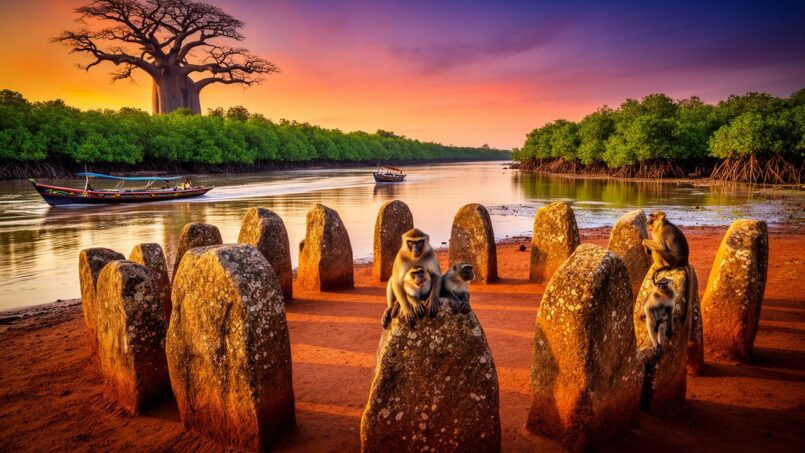
Eleven circles of laterite monoliths surround ancient funerary structures at Wassu, testifying to continuous use of the site from the 3rd century BC to the 16th century.
A small museum, opened with the support of UNESCO, presents the history of these sites, archaeological interpretations, and objects found during excavations. Local guides lead tours of the circles while sharing stories mixing oral traditions and modern archaeology.
For travelers who have time to travel up the river to Janjanbureh and beyond, adding Wassu to visits of River Gambia National Park and Kunta Kinteh Island helps understand how Gambia is crossed by successive layers of history, long predating the colonial period.
Museums, towns, and markets: Gambia beyond the parks
While nature and UNESCO sites top the bill, certain towns and museums remain key stops for grasping the complexity of the country.
Banjul, a small capital located on St. Mary’s Island, is walkable. Arch 22, a great monumental arch 35 to 37 meters high, dominates Independence Avenue and offers a panoramic view of the city, mangroves, and estuary from its top. The National Museum of Gambia, opened in 1985, gathers collections on history, politics, archaeology, local cultures, and arts, with particular sections on the colonial period and the megalithic circles.
This is the minimum number of stalls in the Brikama craft market, specializing in wood carvings and djembes.
In the villages, small museum structures complete this landscape: the Tanji Village Museum, the first private museum in the country, offers a reconstructed traditional village, exhibits on wildlife, flora, history, and the arts. In Gunjur, another small village museum focuses on local nature and culture. In Janjanbureh, a museum highlights Mandinka culture, stories, and traditional costumes, while the town retains colonial buildings and memorial sites related to the slave trade.
These places, less spectacular than the national parks, are essential for contextualizing visits to reserves and villages. They help understand how tourism integrates with the local economy, particularly through the sale of wood carvings and the promotion of artisanal and culinary know‑how.
A laboratory of sustainable and community‑based tourism
Behind the list of “must‑see spots,” Gambia also stands out as a laboratory for responsible tourism in West Africa. The country has received several distinctions in ecotourism and boasts a high percentage of returning visitors (around 40% according to some sources), a sign that the experience offered goes beyond a simple beach holiday.
Projects like the Bolong Fenyo Community Wildlife Reserve and the Tumani Tenda Eco‑Reserve illustrate the direct involvement of rural communities in managing their resources. At Tumani Tenda, this translates into eco‑camps for visitors, participation in village life, and the sale of local products (soap, baskets, batiks), thereby generating income through tourism.
Furthermore, initiatives like the Ninki Nanka Trail focus on community‑based tourism. This circuit, supported by a British social enterprise, works hand in hand with villages, tour operators, and local authorities to offer multi‑day stays centered on culture, traditions, and nature, all while seeking to keep the economic benefits within the villages. The tours sometimes include cooking, batik, and basket‑weaving workshops, homestays, and visits to schools or vegetable gardens.
Gambia trains about 400 tourism graduates per year, feeding a network of qualified local players in the sector.
Finally, the network of light infrastructure – eco‑lodges, bush camps, small guesthouses – spread along the river and coast encourages slow travel and gradual discovery of the country, rather than simply concentrating in a beach resort.
Why are these sites truly unmissable?
Cross‑referencing data on biodiversity, accessibility, historical importance, and tourism offerings reveals a few constants.
First, Gambia excels when it closely combines nature and culture. Kachikally is not just a “crocodile show”: it is a sacred sanctuary where a collective imagination unfolds. Makasutu is not just a lush forest: it is a space where stories, beliefs, and ecological practices come together. Kunta Kinteh Island is not limited to a ruined fort: it is a powerful symbol of the memory of the African diaspora.
Gambia’s most accomplished natural sites, like Abuko or Makasutu, are those where tourism is designed as a lever for conservation. They offer a compromise between habitat protection and visitor reception, with guides and infrastructure. The country has one Ramsar site, two UNESCO sites, intact mangroves, and one of the richest bird faunas in the world, confirming the real commitment behind these efforts.
Finally, the small size of the country works strongly in its favor: in less than two hours’ drive, you can go from a market saturated with colors and sounds to an isolated savanna reserve, from a festive beach to a protected chimpanzee island. Few destinations offer such a density of experiences on such a compact territory.
For a traveler, even a short trip allows combining several unmissable places. A typical itinerary could pair Abuko, Bijilo, and Kachikally for a first wildlife‑culture immersion, then Makasutu and Tanbi for the mangroves and an eco‑tourist dimension, Tanji, Sanyang, or Kartong for fishing village life, and finally a longer trip to Kiang West, Bao Bolong, River Gambia National Park, and Wassu to anchor the journey in the historical depth of the river.
In the end, talking about the “must‑see tourist sites in Gambia” is not just drawing a list of points on a map. It is telling how a small country has managed, despite pressure on its ecosystems and economic challenges, to turn its mangroves, forests, islands, and villages into places that are both welcoming to visitors and meaningful for its inhabitants. And that is what makes it, far beyond the mere beach, one of the most unique destinations in West Africa.
Disclaimer: The information provided on this website is for informational purposes only and does not constitute financial, legal, or professional advice. We encourage you to consult qualified experts before making any investment, real estate, or expatriation decisions. Although we strive to maintain up-to-date and accurate information, we do not guarantee the completeness, accuracy, or timeliness of the proposed content. As investment and expatriation involve risks, we disclaim any liability for potential losses or damages arising from the use of this site. Your use of this site confirms your acceptance of these terms and your understanding of the associated risks.

Cyril Jarnias is an independent expert in international wealth management with over 20 years of experience. As an expatriate himself, he is dedicated to helping individuals and business leaders build, protect, and pass on their wealth with complete peace of mind.
On his website, cyriljarnias.com, he shares his expertise on international real estate, offshore company formation, and expatriation.
Thanks to his expertise, he offers sound advice to optimize his clients' wealth management. Cyril Jarnias is also recognized for his appearances in many prestigious media outlets such as BFM Business, les Français de l’étranger, Le Figaro, Les Echos, and Mieux vivre votre argent, where he shares his knowledge and know-how in wealth management.





