
 Published on and written by Cyril Jarnias
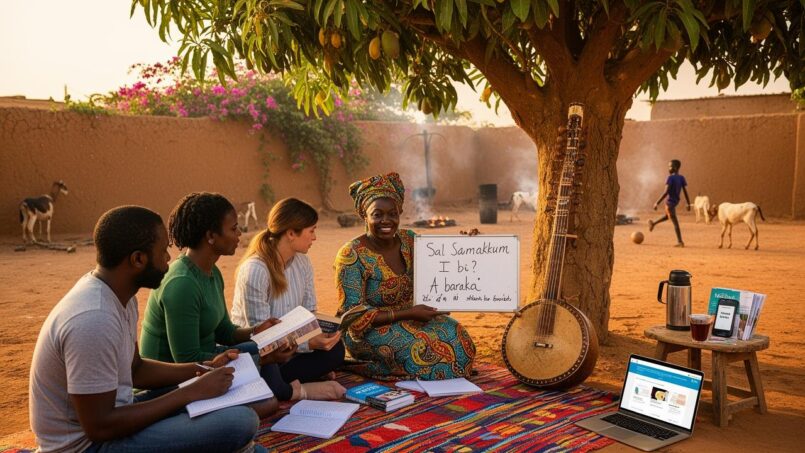
Settling in The Gambia without touching local languages is a bit like watching a movie with the sound off. You see the images, but you miss the essentials: the codes, humor, nuances of respect, everything that makes daily life. For an expatriate, mastering at least the basics of Mandinka or Wolof radically changes social and professional integration.
Good to know:
English is the official language of the country, used in formal institutions. However, in daily life, several local languages predominate depending on the context: Mandinka in rural areas, Wolof as a lingua franca in cities, and Fula (Pulaar), Jola, and Serahuli in their respective communities.
This article offers a real linguistic user manual for expatriates in The Gambia: which languages to target, in what context, how to learn them, with which schools, apps, and programs, and above all, how to use them without cultural blunders.
Understanding the Linguistic Ecosystem in The Gambia
The Gambia is officially English-speaking, but its daily reality is decidedly multilingual. There are about ten languages, mainly from the large Niger-Congo family, supplemented by an English-based Creole (Aku) and specific uses of Arabic in Islamic education.
Major Languages and Distribution
The main ethnic groups—Mandinka, Fula, Wolof, Jola, Serahule—generally correspond to the country’s major languages. Each has its own sociolinguistic territory, but borders remain porous: many Gambians master two, three, sometimes four local languages, in addition to school English.
The situation can be summarized as follows:
| Language | Main Role in The Gambia | Key Areas / Contexts |
|---|---|---|
| English | Official language, education, administration, formal business | Schools, university, administration, large companies |
| Mandinka | Most widely spoken language, rural lingua franca | Provinces and small towns outside Greater Banjul |
| Wolof | Urban lingua franca, street and media language | Banjul, Serrekunda, Kombos, markets, music, advertisements |
| Fula (Pulaar) | Important regional and cross-border language | Fula-majority areas, Fulladu, migrations from Guinea |
| Jola | Regional language in decline in urban areas | Foni, rural areas in the Southwest |
| Serahule | Community language, strong Islamic influence | Upper River Region, migrant trade |
| Aku / Krio | English-based Creoles (Aku, Sierra Leonean Krio) | Banjul, certain migrant networks |
| Arabic | Religious and Islamic school language | Quranic schools, mosques |
For example, data show that in urban areas, a large majority of people claim to understand Wolof (over 90% in some samples), while Mandinka dominates in rural areas (nearly 95% reported proficiency).
Wolofization of Cities, Mandinka Elsewhere
The most striking phenomenon for an expatriate living in the Banjul–Serrekunda area is the “Wolofization”: without people necessarily becoming “Wolof” by identity, they massively adopt this language for daily life. In Banjul, it is estimated that half the population uses Wolof as a first language, and in Serrekunda, nearly 90% of residents speak or understand it, even though ethnic Wolof remain a minority.
Wolof thus dominates in:
– markets and informal commerce
– taxis and local transport
– schoolyards and friend groups
– radio, private television, and popular music (mbalax, rap, etc.)
– some advertising and awareness campaigns
Good to know:
Outside the Greater Banjul area and the Kombos, Mandinka serves as an inter-community vehicular language in rural areas. It is also present in local media and benefits from historical prestige, being associated with the ancient Mandinka kingdoms and its status as the demographic majority in The Gambia.
And English in All This?
English remains essential in schools, universities, administration, and large employers (banks, international NGOs, foreign companies, high-end tourism). It is also the language of justice and official documents.
But on the ground, particularly in practical fields such as:
– construction
– agriculture
– small trade
– domestic services
You should not assume that everyone is fluent in English, especially orally. Many learned it at school but rarely practice it. Hence the major benefit for an expatriate to tackle Mandinka and/or Wolof, even at a basic level.
Which Local Language to Learn First?
The strategic choice depends on your place of residence, your professional environment, and your social circle.
Wolof: Key to Urban Daily Life
For an expatriate based in the Banjul, Serrekunda, Bakau, Fajara, Kotu, or Kololi area, Wolof is the most rewarding language in the short term. It’s the language children play in, drivers negotiate in, and vendors shout in. It saturates the soundscape: radio, music, street conversations.
Research indicates that:
– in Banjul, about 50% of residents use it as a first language
– in Serrekunda, an overwhelming majority understands it, regardless of ethnicity
– in multiethnic environments (schools, markets, popular neighborhoods), it is the spontaneous language of communication
Learning Wolof allows you to:
Tip:
Learning Wolof enables you to understand conversations around you and break the ice very quickly. It also makes it easier to follow local news, like QTV Wolof News bulletins or Wolof radio stations. Finally, it helps you decode the lyrics of *mbalax* songs that set the rhythm for evenings and parties.
Mandinka: Passport to the Interior
Mandinka is numerically the dominant language nationwide and the great rural lingua franca. Approximately 38% of the population uses it as a first language; adding second-language speakers, its weight becomes massive.
It will be particularly useful if:
– you work in rural development, agriculture, or community health
– you frequently travel outside the Greater Banjul area
– you live in a Mandinka or multiethnic village in the interior
– you seek close proximity to traditional structures (chiefdoms, elders, extended families)
Good to know:
The Mandinka language carries strong cultural and historical symbolism. Indeed, the Mandinka were among the first West African peoples to adopt Islam. Their language holds a central place in oral tradition, especially through epics and the transmission of historical memory, such as that linked to the figure of Sundiata Keita.
Fula, Jola, Serahule: Languages of Opportunity
Depending on your field, other languages may become strategic:
– Fula (Pulaar): very present in regional migrations (especially from Guinea), in cattle breeding, but the Fula themselves are often very multilingual, which reduces the need to learn Pulaar just to do business with them. However, for certain livestock projects or cooperation in Fula areas, it is a real plus.
– Jola: strongly rooted in the Foni regions and rural areas of the Southwest, but declining in cities, where young Jola increasingly switch to Wolof or Mandinka as first languages.
– Serahule: important in certain trade basins and cross-border migrations.
For a generalist expatriate, Mandinka + Wolof nevertheless form the most effective duo.
Respecting Social Codes: Language as a Vector of Etiquette
In The Gambia, mastering a few local words goes far beyond a simple “communication tool.” It is a deep marker of respect, a gateway into a value system where language is inseparable from politeness, religion, and social hierarchy.
The Essential Ritual of Greetings
Greetings are everywhere, all the time. You don’t ask for a favor, you don’t ask a question, you don’t enter a shop without a lengthy greeting. Sociocultural studies describe this ritual as mandatory in virtually all interactions: market, street, office, phone call, unannounced visit.
A typical greeting often starts with an Islamic greeting in Arabic:
– “Salaam Alaikum” / “As-Salamu Alaykum” (peace be upon you)
– Response: “Alaikum Salaam” / “Maleikum Salaam”
Then local languages take over. In Wolof, for example:
– “Na nga def?” — How are you?
– Response: “Mang fi rek” — I’m fine
In Mandinka, a common equivalent of “how are you?” would be:
– “Kortanantee?” or “Korri tanan teh?”
– Response: “Tanantee” — I’m fine
Caution:
A greeting must be adapted in length: less than 15 seconds can seem abrupt, while with an elderly person or a dignitary, it often exceeds 30 seconds to include news of family, work, or the day. Omitting a greeting or doing it hastily is considered an affront.
Gestures, Handshakes, and Eye Contact
Language is combined with a set of codified gestures:
– you almost always shake right hands, never the left, considered unclean
– arriving in a group, you greet each person individually if possible
– when hands are full, you extend your forearm to indicate a symbolic handshake
– women are not always required to shake hands; it is safer to let them decide on contact
– some believers avoid physical contact with the opposite sex; a hand gesture or hand over the heart suffices
Good to know:
In some cultures, staring an elder straight in the eyes can be perceived as disrespectful. To show deference, it is advisable to lower your gaze slightly while remaining attentive to the conversation.
Titles and Forms of Respect
Hierarchy deeply marks exchanges, even more in local languages than in English. Depending on the context, you will hear or use:
– “papa”, “baba”, “yeh” for an older man
– “maman”, “naa”, “tante” for an older woman
– “boss”, “mister”, or the surname in professional contexts
– “kambaano” for a boy, “sunkuto” for a girl
Addressing a parent or elder by their first name, especially in a local language, is felt as outright disrespectful, except in very particular relationships.
Meals, Faith, and Key Phrases
At the table, language is omnipresent:
– before eating, the host pronounces “Bisimillah” (in the name of God)
– in Mandinka or Wolof, you will be invited to join the circle around the communal dish
– at the end of the meal, to politely refuse another serving, words like “Barrkah” (I am full) add finesse
You eat with the right hand, after a ritual washing, and stay within your own food “zone” in the large dish. Taking from someone else’s portion, even to be kind, can be misinterpreted.
Local Resources for Learning: Schools, Centers, and Social Immersion
An expatriate in The Gambia has a relatively rich range of language training options, even if the offering remains very unevenly developed depending on the target language.
The Offer Around French: A Useful Paradox
Interesting fact: The Gambia is officially Anglophone, but the university and certain programs require a good level of French. Institutions like the University of The Gambia (UTG) or the American International Women’s Alliance (AIWA) impose or strongly recommend French, to the point of sending students to improve their level at the Alliance Française.
For a French-speaking expatriate, this creates a favorable context: the French language enjoys academic prestige, and many interlocutors (especially among students and teachers) welcome an English–French language exchange, or even French–Mandinka or French–Wolof.
Several French-speaking or bilingual institutions structure this landscape:
| Institution | Type and Teaching Languages | Target Audience |
|---|---|---|
| SBEC International School | First English–French bilingual school in the country | From 8 months to 16 years |
| École Française de Banjul | AEFE-accredited school, French + English curriculum | Children aged 2 to 16 |
| Diana Mariam School | French–English bilingual school, renowned for its results | Nursery–Primary level |
| West Africa International School | IB program, teaching of two languages (including French) | IB students, international orientation |
Expatriates with children can use these schools as levers for linguistic integration: by participating in school life, they come into contact with a network of educated Gambian families, often comfortable in several languages (English, French, local language). From there, conversation tandems easily develop.
Alliance Française de Banjul: A Linguistic Hub… Including for Wolof
The Alliance Française de Banjul primarily offers French courses, but not only. It provides:
45
This represents the total number of training hours per standard 10-week session.
And, very interesting for an expatriate, the Alliance also offers private Wolof lessons with the same basic requirement (at least 5 hours). This makes it a concrete starting point for anyone wanting to learn Wolof in a structured setting with a local teacher, while enjoying a French-speaking cultural atmosphere.
Online Wolof Courses with a Gambian Teacher
Another structured option is a weekly Gambian Wolof course taught online (via Zoom) by a local teacher based in The Gambia. The program features are clear:
Gambian Wolof Course
A program designed for beginners, focused on practicing Wolof as spoken in The Gambia. Interactive and accessible learning.
Schedule and Format
Two live sessions per week, Thursdays and Saturdays, via Zoom for interactive learning.
Affordability
Very affordable rates, around £20 or $25 per month for quality teaching.
Registration and Support
Simple registration by email. Voluntary tipping option to directly support the teacher.
For an expatriate who hasn’t yet set foot in The Gambia, this type of course is ideal for covering the basics before departure. Once on site, it allows you to continue learning with pedagogical continuity, while immediately confronting what is seen in class with street reality.
Peace Corps Resources: Mandinka and Wolof “Field Version”
Peace Corps volunteers in The Gambia have long developed very practical materials for Mandinka and Wolof, specifically designed for rural and community life needs:
– a Mandinka audio script (about 10 pages)
– grammar and vocabulary manuals for Mandinka and Wolof
– Mandinka–English dictionaries (over 160 pages) and Wolof–English (about 76 pages)
– audio recordings accompanying these materials
These documents, though designed for volunteers, are highly useful for any expatriate ready to learn independently. They emphasize:
– long and codified greetings
– useful phrases for village life
– everyday vocabulary (water, market, agriculture, basic health, etc.)
Good to know:
Their main strength lies in a very strong “field” anchorage and the use of authentic language, which sets them apart from the artificial sentences often found in some textbooks.
Village Stays and Community Immersion
Beyond the classroom, some host projects in Gambian villages offer a true linguistic bath, especially around Mandinka. A typical example includes:
– accommodation in a round hut with four rooms, in the middle of a permaculture garden and a banana plantation
– the possibility of lodging in a family compound a few hundred meters away
– shared daily life: cooking, garden work, participation in village activities
– a host who is very locally involved (often also a sports coach, community leader, etc.), seeking language exchanges (e.g., Mandinka for French or Dutch)
For an expatriate ready to step radically out of their comfort zone, this type of short immersion (a few weeks) accelerates the acquisition of basic reflexes, including:
– greetings and polite expressions
– expressions related to meals, agricultural work, household chores
– listening to local prosody (rhythms, intonations, associated gestures)
Apps and Platforms: Learning Mandinka and Wolof with Your Smartphone
Unlike French, absent from major apps like Duolingo, Gambian languages remain poorly covered… but some serious tools exist, especially for Mandinka and Wolof.
Learning Mandinka with Mandinka M(A)L
The Mandinka M(A)L (“Master Any Language“) app offers a playful environment for starting in Mandinka (also called Mandingo):
– interface in English, accessible from iOS 9 (iPhone, iPad, Mac M1 and later)
– uses flashcards, mini-games, quizzes, tests
– choice of vocabulary themes (family, body, food, etc.)
– learn at your own pace, without pressure, with a regular repetition system
This type of app doesn’t replace real oral interaction, but it’s a good supplement for:
– automating numbers, colors, common objects
– memorizing approximate spelling of useful words
– keeping daily contact with the language (5 to 10 minutes of play per day)
Wolof on Mobile: Crepuscule, Easy Wolof, WolofMaster
Several apps are dedicated to Wolof, with varied approaches. Three stand out in particular.
– over 5000 downloads
– interface in English
– path starting with basic lessons, then dialogues
– visual and dialogue-based method to speed up comprehension
– built-in small dictionary to expand vocabulary
Tip:
Its main advantages are its ease of use, technical lightness, and complete absence of personal data collection, making it an ideal tool for a first contact with a new language.
Easy Wolof positions itself as a very comprehensive app, designed for:
– tourists and business travelers
– humanitarian volunteers on assignment
– culture enthusiasts interested in Senegal
– native speakers wanting to improve their written skills
It notably offers:
– 15 illustrated audio dialogues in comic strip format
– vocabulary associated with each scene
– thematic lists (travel, family, city, etc.)
– real Wolof grammar lessons with detailed explanations
– application exercises per lesson
– a Wolof–English dictionary (over 1200 entries) and English–Wolof (over 1300 entries)
– the Wolof alphabet in written and audio form
– cultural content (illustrations about Senegalese life)
– a spaced repetition system for effective memorization
For a serious long-term expatriate, Easy Wolof is an excellent foundation: by combining dialogues, grammar, vocabulary, and culture, it puts in place all the elements needed for real communicative competence.
WolofMaster presents itself as “the most complete app to master Wolof“, targeting mainly Senegalese Wolof, but largely relevant for The Gambia, where the two varieties remain mutually intelligible.
Its features:
– short interactive lessons (5 to 10 minutes), progressive and level-adapted
– experience points, levels, streaks system
– review algorithm based on scientific spaced repetition
– over 500 essential words and phrases
– content calibrated for real-life situations in West Africa
– integration of Senegalese proverbs with cultural explanations
– free mode including 3 full units (about 30 lessons), unlimited reviews, and some daily “hearts”
– Pro version (paid, around $14.99) unlocking over 100 advanced lessons, native Dakar audio, a 24/7 conversational AI tutor, ad-free premium content
For a motivated expatriate, the combination of a gamified system, guided progression, and strong cultural grounding (proverbs, concrete examples) makes WolofMaster particularly effective for maintaining momentum over time.
uTalk: Wolof with Gambian and Senegalese Native Speakers
The uTalk platform offers a Wolof course explicitly designed for Senegalese and Gambian contexts, with a clear goal: enabling participation in everyday conversations in the street, market, and taxi.
How it works in three steps:
Example:
First, the app asks you to choose a theme (greetings, family, travel, dining, etc.). Then you memorize authentic phrases, recorded by native speakers, through interactive mini-games. Finally, you can practice these gains in real conversations with locals, thereby consolidating your learning through immersion.
uTalk’s strengths:
– audio always recorded by Wolof speakers from Senegal and The Gambia, no synthetic voice
– smart review mode, focusing on words you most forget
– content organized by concrete uses (making friends, getting around, ordering food)
– possibility to learn from English, but also from over 140 other interface languages
– use on mobile, tablet, or web browser, with offline download
– method tested with tens of millions of users
– CEFR orientation: progression from A1–A2 level, with some themes at B1–B2 level
Again, the tool doesn’t claim to do everything: it provides ready-to-use communication building blocks. It’s up to you to actively reuse them on site.
An Important Point: No Major App Offers Mandinka or Wolof “Duolingo Style”
Wolof is not offered on Duolingo, and Mandinka even less. Major generalist apps cover African languages very poorly. This means that for these languages, you need to:
– combine several tools (specialized apps, PDFs, manuals, YouTube videos)
– accept a degree of self-structuring (choosing your progression order, priorities)
– heavily rely on in-situ social immersion (neighbors, colleagues, market, etc.)
Learning Methods: Immersion, Exchanges, Courses, and Tutoring
International research on language teaching clearly shows that immersion is one of the most powerful levers for acquiring a second language. The Gambia, with its widespread multilingualism, is a natural immersion laboratory.
Immersion: Why It Works So Well
The work of specialists like Genesee, Swain, or Bialystok converges: the more time you spend exposed to a language, and the more varied that exposure, the more competence progresses, without harming the mother tongue in the long run. Several mechanisms are at play:
– comprehensible input: the learner is constantly exposed to language slightly above their level (i+1), but in concrete contexts (market, greetings, meals), which facilitates understanding
– social interaction: language is built through dialogue, adjustments, reformulations, what Vygotsky calls “co-construction“
– varied repetition: hearing and producing the same structures in different situations strengthens neural connections, a key element in connectionist models
Applied to The Gambia, this means that: the specific issues and challenges of this country must be considered in any analysis or decision-making.
Good to know:
To integrate and progress in local languages, it is advisable to regularly take the same taxi while practicing a few Wolof phrases, to systematically greet your neighbors in Mandinka, and to participate in the preparation of attaya tea while listening to conversations.
constitutes an immersion environment of formidable effectiveness, provided you actively invest in it.
Language Exchanges: Expatriates, Gambians, and Online Communities
Beyond “raw” immersion, structured language exchanges provide a reassuring framework for practice. Several levels can be distinguished.
Platforms like InterNations have a community in Banjul, with regular events (meetings in restaurants or bars, themed evenings). These gatherings:
– bring together expatriates and English- or French-speaking Gambians
– offer an ideal setting for proposing mini-exchanges: 10 minutes in English, 10 minutes in Mandinka or Wolof, for example
– allow you to quickly meet interlocutors motivated by intercultural exchanges
Other apps like Wooh App, focused on “real-life” meetups, facilitate a weekly outing with someone sharing common interests. An expatriate can easily use these meetings to introduce a “local language” time, building on basics learned via apps or courses.
In The Gambia, many people dream of perfecting their English or French. Proposing a tandem where you exchange:
– 30 minutes of English or French for your interlocutor
– 30 minutes of Mandinka or Wolof for yourself
is often greeted with enthusiasm, especially among students, beach vendors, guides, sports coaches, or young entrepreneurs.
Structured Courses, Tutoring, and Cost
Comparative research on language courses and tutoring shows some constants:
– in-person courses at language schools are often structured but rigid (fixed schedules, one-size-fits-all progression)
– private lessons, online or face-to-face, offer very effective personalization (pace, content, immediate corrections), but at a variable cost
– online courses generally cost 10 to 30% less than in-person courses, as teachers have fewer expenses (transport, room rental)
For French in The Gambia, mentioned rates for a tutor average around $30 per hour, with a range of $15 to $150 depending on profile and context. For Mandinka or Wolof, rates are often lower, but poorly documented. The example of the Zoom Wolof course at $25 per month for two weekly sessions shows that very affordable solutions are possible.
Tip:
Platforms like Preply, iTalki, or Lingoda are ideal for finding tutors in French or English. They can therefore be used to learn French (if you are an English speaker, for example) or English (if your mother tongue is French). However, they offer few teachers for languages like Mandinka or Wolof. The recommended approach is to use these platforms to master an international communication language (French or English), then combine that learning with local languages once on site.
Intensive Programs and “Active Immersion” for French
Even though the main focus here is Gambian languages, French plays a strategic role for expatriates coming from non-French-speaking countries: the geographical proximity to French-speaking states (Senegal, Guinea, Mali) makes French a genuine regional asset.
The Get French Classes platform, active in The Gambia, illustrates a so-called “Active Immersion” approach:
– about 20 hours of live lessons per month (2 private lessons + 1 group lesson per week)
– over 7 hours of pre-recorded video content
– around fifty mini-video lessons and over 100 written and oral exercises
– support from a language advisor
– discussion groups with 5 learners from around the world
– CEFR-aligned certificates after exam
If we transpose this model to Gambian languages, the main lines remain relevant: alternating self-study, guided practice with a native tutor, and collective practice.
Building Your Personal Strategy: Combining Tools, Immersion, and Cultural Code
For an expatriate in The Gambia, the key is to build a realistic plan, taking into account both the environment and time constraints.
1. Choose a Language Duo: English + (Wolof or Mandinka)
Even if you are French-speaking, English remains your linguistic hub in The Gambia. Most resources (apps, courses, Peace Corps materials) for Mandinka and Wolof use English as the language of explanation. So it is very wise to:
– stabilize your functional English (if necessary)
– choose Wolof if your life revolves around Banjul–Serrekunda
– choose Mandinka if your activities mainly take you to the provinces
Nothing prevents you from tackling both over time, but it’s better to progress solidly in one local language at the start.
2. Mix Structure and Real Contact
An effective strategy might look like this:
Tip:
To progress effectively in learning a language like Wolof or Mandinka, adopt a routine combining regular practice and targeted immersion. Use a dedicated app (Easy Wolof, WolofMaster, Mandinka M(A)L, uTalk) for short sessions of 10 to 20 minutes each day. Complement this with a structured course once or twice a week, such as private lessons at the Alliance Française for Wolof, online classes via Zoom, or a short stay in a Mandinka village. Finally, actively schedule exposure moments by engaging in conversation with native speakers in your daily life: the guard, the fruit seller, a taxi driver, or colleagues.
This mix of structure (courses, app) and controlled chaos (real life) perfectly matches what research describes as the best learning environments: rich comprehensible input + strong social interaction.
3. Start with Greetings and Politeness
Given the cultural weight of greetings in The Gambia, your absolute priority should be:
– Arabic greetings (Salaam Alaikum and its responses)
– basic formulas in Wolof or Mandinka for “How are you?” and “I’m fine”
– simple words: thank you, please, sorry, yes, no
Some useful examples:
In Wolof:
– “Na nga def?” — How are you?
– “Mang fi rek” — I’m fine
– “Jërëjëf” — Thank you
– “Waaw / Déedet” — Yes / No
In Mandinka:
– “Kortanantee?” — How are you?
– “Tanantee” — I’m fine
– “Abaraka” — Thank you
– “Haa / Haani” — Yes / No
Good to know:
After mastering the basics, you can deepen conversation by touching on frequent themes like family, work, or weather, which are omnipresent in daily exchanges.
4. Respect Hierarchy and Associated Gestures
Alongside words, integrate etiquette rules:
– always greet first, before any request
– use the right hand for giving, receiving, greeting
– avoid the thumbs-up gesture, perceived as insulting
– cover your mouth when yawning
– remove shoes before entering someone’s home, especially a religious or elderly person’s
These gestures, combined with a few local words, radically change how Gambians perceive you: from a passing stranger to a resident who takes the trouble to adapt to local codes.
5. Leverage Schools and Children
If you have children enrolled in one of the international schools (Marina, SBEC, BAES, École Française, etc.), they themselves will very quickly absorb Wolof or Mandinka in the playground. Involve them in your learning:
– ask them to teach you some phrases heard at school
– watch videos in Wolof or Mandinka together
– encourage exchanges with Gambian classmates
Children quickly become excellent linguistic bridges.
In Summary: Learning the Local Language, a High-Yield Investment
The Gambia is a officially English-speaking country, but its heart beats in Mandinka, Wolof, Fula, Jola, Serahule. For an expatriate, ignoring these languages means condemning yourself to remain at the doorstep, a polite but outsider observer. Conversely, embarking, even timidly, on learning a few words and then some phrases, opens unsuspected doors:
– in daily life (fairer prices, spontaneous information, free help in a pinch)
– at work (better understanding of colleagues, access to non-English-speaking networks)
– in community life (real participation in ceremonies, festivities, neighborhood meetings)
Good to know:
Many resources exist for learning a language: bilingual schools, Alliance Française, online courses, specialized apps, Peace Corps manuals, village immersions, and expatriate networks. Research confirms that immersion in a rich, interactive, and social environment is the most effective method for solid and lasting learning.
Two ingredients remain that neither apps nor manuals can provide: regularity and the courage to speak, even poorly. In The Gambia, this effort is almost always rewarded with a smile, a compliment, and often with spontaneous help for the next word. It is in this small loop of kindness that the real learning of the local language begins.

Cyril Jarnias is an independent expert in international wealth management with over 20 years of experience. As an expatriate himself, he is dedicated to helping individuals and business leaders build, protect, and pass on their wealth with complete peace of mind.
On his website, cyriljarnias.com, he shares his expertise on international real estate, offshore company formation, and expatriation.
Thanks to his expertise, he offers sound advice to optimize his clients' wealth management. Cyril Jarnias is also recognized for his appearances in many prestigious media outlets such as BFM Business, les Français de l’étranger, Le Figaro, Les Echos, and Mieux vivre votre argent, where he shares his knowledge and know-how in wealth management.





