
 Published on and written by Cyril Jarnias
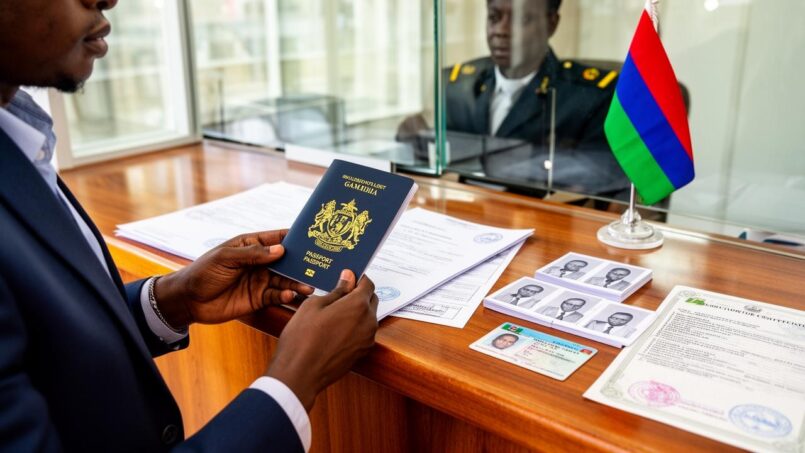
Getting a Passport in The Gambia is not just a simple administrative formality. It is also the final step in a broader legal journey: proving citizenship, understanding which type of passport fits one’s situation, and navigating procedures that sometimes differ for residents and the diaspora. This guide brings together, in English, key information from official texts and field practices to help clarify the process.
Understanding Who Issues the Passport in The Gambia
Before starting any process, it is essential to identify the competent authorities. In The Gambia, the system is highly centralized.
The key player in the entire system is the Gambia Immigration Department (GID), under the authority of the Director General of Immigration. By law, the latter is the only person authorized to issue or replace a valid passport. The reference legal framework is the Immigration Act CAP 3 Volume IV Laws of The Gambia 2009, certain sections of which (notably 4A and 4B) detail the procedures and powers of the Director General.
The Identity and Document Manager (IDM) is responsible for issuing ordinary passports (Machine Readable Passports – MRP and ECOWAS biometric passports) as well as Emergency Travel Certificates. It also handles the majority of public interactions, including receiving applications, biometric capture, interviews, document checks, and producing final printed documents.
Diplomatic and service passports follow a slightly different structure. The decision on eligibility rests with the Presidency and the Ministry of Foreign Affairs and Gambians Abroad. The GID then acts solely as a technical arm: material production, data recording, printing, and handover to the Ministry of Foreign Affairs, which signs and collects the document.
All Gambian passports are issued exclusively in Banjul. The relevant offices, such as the Passport Office and the GID headquarters, are located on ECOWAS Avenue (location CCXG+VP5) or on nearby streets such as OAU Boulevard and Marina Parade.
For contact purposes, several phone lines are associated with the GID (main switchboard, director’s office, fax), along with an official website (gid.gov.gm) and contact email addresses. In addition, embassies and high commissions do not manufacture passports but play an important role for the diaspora, particularly for emergency documents.
The Different Types of Passports in The Gambia
The Gambian system distinguishes between several technical types of passports and several usage categories. It is important to understand both levels, as they carry different rights and procedures.
Technically, there are currently two main formats:
Overview of the two main types of passports in circulation, their characteristics, and technological evolution.
Often called the “ordinary green passport.” Introduced in the early 1990s according to ICAO standards, it includes a machine-readable zone but no electronic chip.
Compliant with ICAO standards, it incorporates an electronic chip containing biometric data (fingerprints, facial recognition) and features the symbols of the Economic Community of West African States.
Both types come in three categories:
The Gambia issues three categories of passports. The ordinary passport, with a dark green cover and gold coat of arms and a two-letter, six-digit number, is intended for citizens’ private or professional travel. The diplomatic passport, with a red cover, is reserved for senior officials and becomes void upon the end of their duties. The service passport, with a blue cover, is for civil servants of a certain grade on official mission and is also invalidated upon termination of duties.
All these passports have a common maximum validity of five years from the date of issue. Documents are, in principle, not renewable: once expired, a new application must be submitted. Some reports mention occasional extensions, particularly in Europe (limited extensions), but these are controlled exceptions, not the rule.
For the ordinary citizen, the passport most often relevant is therefore the ordinary biometric passport, issued by the GID in Banjul, with fingerprinting and photo taken in person.
Who Is Entitled to a Gambian Passport: The Link with Citizenship
One cannot obtain a Gambian passport without first being a citizen of The Gambia. The Nationality and Citizenship Act (The Gambia Nationality and Citizenship Act, supplemented by the Constitution) specifies the distinct modes of acquisition.
One can be Gambian:
Gambian citizenship can be acquired in four main ways. By birth, if born in The Gambia and at least one parent is already a Gambian citizen. By descent, if born abroad to at least one Gambian citizen parent (other than by descent). By marriage, after marriage to a Gambian citizen and at least seven years of ordinary residence in The Gambia from the date of marriage. By naturalization, after at least fifteen years of ordinary and continuous residence in The Gambia, demonstrating good conduct, means of subsistence, and sufficient knowledge of a local language.
These statuses are not equivalent in all respects. For example, dual nationality is permitted for citizens by birth or descent, but not for naturalized and registered citizens, who must renounce their other nationalities.
To verify an applicant’s nationality during a passport application, GID officers examine concrete documents that reflect that right. These supporting documents may include: a naturalization certificate, a citizenship by marriage certificate, a Gambian birth certificate, an attestation issued by a village or district chief (Alkalo, Seyfo), an old Gambian passport, or a biometric voter card. The passport is only issued if the officer is convinced that the applicant is Gambian under the law.
The following table summarizes the main modes of citizenship and the evidence often required for an ordinary passport.
| Mode of Acquiring Citizenship | Main Condition | Example of Common Evidence for Passport |
|---|---|---|
| Birth in The Gambia | Born in The Gambia with at least one Gambian parent | Birth certificate, old passport, ID card, Alkalo/Seyfo attestation + parental documents |
| Descent | Born outside The Gambia with at least one Gambian parent (not by descent) | Foreign birth certificate + parent’s Gambian passport or birth certificate, citizenship certificate if needed |
| Marriage (registration) | Marriage to a Gambian + 7 years of ordinary residence | Marriage certificate, citizenship by marriage certificate, proof of residence |
| Naturalization | 15 years of ordinary residence + good conduct + means of subsistence | Naturalization certificate, police clearance, proof of residence and activity |
Until this foundation is established, the GID may request additional documents, initiate verifications (including with the birth registry of the Ministry of Health), or delay issuance.
Where and How to Submit Your Application in The Gambia
For a resident living in The Gambia, the typical process begins in Banjul, at the GID’s Passport Office on ECOWAS Avenue. Standard working hours, according to sources, are Monday to Thursday from 8:00 AM to 4:00 PM or 6:00 PM, and Friday from 8:00 AM to 12:30 PM. Applications are accepted only during business hours.
The first major distinction is between the Machine Readable Passport (MRP) and the biometric passport. Currently, official policy strongly encourages all citizens residing in the country to switch to biometric, except in cases of impossibility (newborns, hospitalized patients unable to travel, very elderly individuals physically incapacitated).
Applying for an ordinary MRP requires purchasing a form at GID headquarters for 100 dalasis. This form must be completely filled out, then countersigned by a Justice of the Peace and authenticated in section 15 by an authorized person (minister, member of parliament, district chief, doctor, lawyer, etc.) who has known the applicant for at least two years.
Once the form is ready, the applicant must go to one of the approved banks (EcoBank, GTBank, Vista Bank, or AGIB Bank) to pay the MRP passport fees. Depending on the period, these fees vary: 1,000 dalasis, 1,050 dalasis, or 3,100 dalasis are mentioned in successive documents, hence the importance of checking the most recent amounts with the GID. The payment receipt is then stapled to the form, and the entire package is submitted to the GID’s MRP Submission Office. Documents to attach include at least two recent passport photos, a birth certificate, a national ID card or an attestation from an Alkalo or Seyfo, with signature, and, if applicable, proof of residence abroad.
Two major differences distinguish the procedure for an ordinary biometric passport: exclusive payment via EcoBank and the requirement for physical presence for biometric capture.
– Biometric form: 60 dalasis in older sources.
– Biometric booklet: 3,000 dalasis in the early years.
– New schedule: 5,100 dalasis total (100 for the form and 5,000 for the booklet), approved by the government and implemented under a contract addendum with the service provider Africard Gambia Ltd.
Today, the fee structure has clearly increased for biometric passports. The EcoBank receipt and the duly completed, countersigned, and authenticated form are then submitted to the Biometric Passport Processing Centre, after which the applicant reports to the GID enrollment center in Banjul for fingerprint and photo capture.
The table below provides a summary comparison of the main internal procedures for the two types of ordinary passports.
| Step / Element | Ordinary MRP | Ordinary Biometric Passport |
|---|---|---|
| Purchase of form | GID Headquarters (Immigration Head Office) | EcoBank agency |
| Form cost | Approx. 100 GMD | Included in the 5,100 GMD (100 GMD + 5,000 GMD) |
| Payment bank | EcoBank, GTBank, Vista, AGIB | EcoBank only |
| Type of capture | Standard photo | Photo + biometric fingerprints |
| Submission location | MRP Submission Office (Banjul) | Biometric Passport Processing Centre (Banjul) |
| Physical presence | Often required, but sometimes via a relative | Mandatory (except very limited exceptions) |
In all cases, the Director General of Immigration retains discretionary power over the acceptance of applications, may summon the applicant for an interview, or request additional items if the file is deemed incomplete or questionable.
How Much Does a Gambian Passport Cost
Passport fees are set by the government, through the Ministry of Finance, then applied and monitored by the Ministry of Interior and the GID. They have seen several increases, particularly for the biometric passport, under agreements with the service provider Africard.
Several fee schedules have succeeded each other, which explains why different amounts circulate depending on the source. The most structuring figures, drawn from official documents, are as follows:
| Type of Document | Indicated Fees (GMD) | Remarks |
|---|---|---|
| Ordinary Biometric Passport | 5,100 GMD | Includes 100 GMD form fee and 5,000 GMD booklet fee, payment via EcoBank |
| Ordinary MRP Passport | 3,100 GMD (other sources: 1,000–1,050 GMD) | Gradual increase; check with GID |
| MRP Form | 100 GMD | Purchased at GID headquarters |
| Biometric Form | 60 to 100 GMD depending on period | Purchased at EcoBank agency |
| Diplomatic Passport | Free (gratis) | Reserved for holders, controlled by the Presidency and Foreign Affairs |
| Service Passport | Free (gratis) | Same logic as diplomatic |
| Emergency Travel Certificate (ETC) | 1,100 GMD | Emergency travel document, limited validity |
| Biometric Passport (application from abroad) | 120 euros or equivalent USD | Specific fee for the diaspora |
All these fees are non-refundable. An application will not be processed if the payment receipt is not attached. Authorities recommend always checking with the GID for the most up-to-date fee schedule, especially for MRPs, whose amounts have been subject to repeated “updates” in documents.
Diplomatic and service passports are issued free of charge, but under specific conditions. They are automatically invalidated as soon as the beneficiary no longer meets the eligibility criteria (e.g., at the end of a term or contract). Additionally, these documents may be subject to specific checks.
What Documents to Provide to Obtain a Passport
Compiling the application file is the most delicate step for many applicants, especially when they do not have a “standard” birth certificate or have lost old documents. The rules are not exactly the same depending on the citizen’s profile (by birth, by marriage, naturalized, minor, diaspora), but a common core exists.
For a citizen by birth or descent living in The Gambia, a complete file typically includes:
To put together a Gambian passport application file, you must provide the following items: a duly completed and signed application form; the form countersigned by a Justice of the Peace and authenticated in section 15 by an authorized person (minister, MP, chief, doctor, lawyer, notary, civil servant of grade 10, etc.) who has known the applicant for at least two years; two recent passport photos on a white background, meeting format and quality requirements (clear face, neutral expression, clear glasses or removed, no sunglasses); a Gambian birth certificate or, failing that, an attestation signed by the Alkalo or Seyfo of the place of birth, accompanied by the parents’ ID documents; and, if possible, an additional identification document such as an old ID card, biometric voter card, old passport, or driver’s license.
For a citizen by marriage, the following must be added:
– The marriage certificate.
– The citizenship by marriage certificate issued by the authorities, attesting that the citizenship registration procedure is complete.
For a citizen by naturalization or registration, the authorities require:
– The naturalization certificate or citizenship by registration certificate.
– Other documents already provided at the time of naturalization, if necessary, to verify the consistency of information.
For minors, particularly those under 16 or 18 depending on the document, the procedure requires:
– A birth certificate (or Alkalo/Seyfo attestation).
– The parents’ documents (biometric cards, passports, etc.).
– Clear mention on the form of the consent of the legal guardian and their relationship to the child.
In the absence of any civil status document, it is possible to reconstruct a file using a birth certificate issued retroactively by Gambian municipal or health centers, often at the request of relatives, combined with a birth attestation signed by local authorities and parental documents.
A crucial point concerns passport photos. Standards are very close to international standards:
– Often indicated as 2×2 inches (approx. 51 x 51 mm) or 35 x 45 mm.
– Face occupies most of the photo (between 50% and 80% of the height).
– White background, no shadows or patterns.
– Neutral expression, mouth closed, eyes open, head straight facing the camera.
– No headgear except for religious, health, or cultural reasons, provided the face is fully visible from chin to forehead.
– Glasses allowed only if eyes are perfectly visible and without glare. It is generally recommended to remove them.
Incomplete applications or those with non-compliant photos are systematically delayed or even refused.
Processing Times and Passport Validity
Processing times announced vary depending on the source, period, and nature of the application. Indications range from a few days to several weeks, or even longer in cases of heavy verification.
Minimum processing time, in working days, mentioned by authorities for a standard visa application submitted in The Gambia.
For applications involving verification of documents abroad (e.g., for asylum or return cases in certain European states), delays can extend considerably, sometimes up to one year, while Gambian authorities confirm the authenticity of a birth certificate or certificate.
Validity period in years of an ordinary French passport once issued.
A point not to overlook: the law prohibits holding two valid Gambian passports. Therefore, in practice, the old document must be returned (unless declared lost or stolen and a specific procedure has been initiated) when a new passport is issued.
Renewal, Modification, or Replacement of a Passport
Renewal or replacement of a passport follows a similar logic to the initial application, but with some variations depending on the situation.
For a simple renewal of an expired passport, the applicant fills out a new form, attaches the usual documents, and adds the old passport. If the passport has expired but still contains a valid visa (e.g., for a third country), it is recommended to attach a photocopy of the biographical page and visa pages to preserve the record of that visa in the new file.
For a modification of personal data, such as a name change following marriage, divorce, or civil status correction, the procedure involves:
To correct a spelling error in your Mauritian passport, you must: fill out an application form stating the new information; attach strong supporting documents such as the “old” birth certificate with the correct spelling, a deed poll (legal name change), a marriage certificate or divorce decree, and other consistent official documents; submit the old passport to the Immigration Department, which will cancel it. If your appearance has changed significantly, provide new compliant photos according to standards.
For a lost, stolen, or damaged passport, the procedure is stricter:
To reapply, you must provide a sworn statement detailing the circumstances, as well as a police report if the document was still valid. It is recommended to attach a photocopy of the identification pages of the old passport. You will also need to submit new proof of citizenship (such as a birth certificate), fill out a new form, and pay the passport fees again.
The authorities reserve the right to refuse issuance of a new passport for a period of up to 18 months if they believe the previous passport was deliberately damaged, destroyed, or transferred (e.g., sold or lent to a third party). Individuals deported for serious drug-related offenses may be refused a new passport for a period of up to ten years after the conclusion of judicial proceedings.
Special Cases: The Gambian Diaspora and Emergency Documents
For the Gambian diaspora, the situation is a bit more complex, as embassies and high commissions generally do not manufacture passports. Material production remains centralized in Banjul, often requiring Gambians to travel to their home country to obtain a biometric passport.
Intermediate solutions exist, however. For a Machine Readable Passport, a family member remaining in The Gambia can submit an application on behalf of the citizen living abroad, provided they submit strong proof of residence abroad, such as a copy of a residence permit or permanent resident card from the host country. Some procedures also require a member of parliament from the home constituency to complete an identity declaration form and sign the applicant’s photo, especially for first passports.
In the absence of a Gambian embassy or consulate, passport applications may require a complex file: a notarized affidavit proving citizenship, an identity declaration signed by a member of the National Assembly, and copies of old official documents. If the file is deemed credible, the GID may either authorize the issuance of an MRP passport or ask the applicant to travel to The Gambia.
However, the most common issue for the diaspora remains the loss or expiration of a passport abroad. In this case, Gambian embassies can issue an Emergency Travel Document (ETD), also called an Emergency Travel Certificate or sometimes an “Emergency Passport.” This document is not a real passport but a laissez-passer intended solely to allow the citizen to return to The Gambia.
The functioning of the ETD is based on a few simple principles:
This document is exclusively for Gambian nationals. It is issued by the Director General of Immigration or by diplomatic missions (embassies, high commissions). It allows a single entry, usually on a direct route, and is valid for a maximum of six months. Upon arrival in The Gambia, the holder must surrender the document to immigration services, rendering it void.
To apply, the individual must complete a specific form (often downloadable from embassy websites such as Washington DC or London), attach passport photos, proof of nationality (old passport, voter card, birth certificate, consular card, driver’s license, etc.), a police report in case of loss or theft, and pay a fee that varies by country (e.g., $50 or £30).
Embassies often request additional information: contact details for two reference persons in The Gambia, proof of airline ticket for a direct flight to Banjul, parental authorization for minors (with parents’ ID documents), etc. Processing times are generally a few working days, excluding postal time, but may vary depending on demand.
Once in The Gambia with an ETD, the citizen is advised to go promptly to the GID to submit a passport application in due form.
Entry, Stay, and Related Documents
Although this guide focuses on the passport of the country in The Gambia, it is useful to place this document within the broader ecosystem of international mobility, especially for those living abroad or traveling frequently.
For foreigners entering The Gambia: nationals of many states, particularly ECOWAS members, are exempt from visas for short stays (generally up to 90 days). Other visitors can obtain a visa on arrival, often valid for 30 days and extendable through the GID. Beyond a certain threshold (e.g., 56 days), a residence permit, subject to specific fees and conditions, is required.
These visas, exemptions, and permits do not replace the Gambian passport, but they interact with it for dual nationals or those traveling on multiple documents. Moreover, local practice tends to consider a dual national who enters with a Gambian passport primarily as a Gambian citizen, subject to corresponding obligations.
The Gambia does not have a citizenship by investment program: purchasing real estate or assets does not lead to nationality, and therefore not to the right to a passport. To become Gambian, one must go through the avenues provided by law (birth, descent, marriage, naturalization), with long processing times and substantial conditions.
Practical Tips for a Successful Application
At the end of this overview, several concrete recommendations emerge to maximize the chances of success of a passport application in The Gambia:
To obtain a Gambian passport, start by clarifying your citizenship status (birth, descent, marriage, or naturalization), which determines the required documents. Anticipate the total cost with a margin for unforeseen expenses, especially biometric ones. Fill out the form without erasures and ensure that sections reserved for authorities are completed by authorized persons who know you. Provide photos that strictly meet format, background, posture, and lighting requirements. For a first passport, prepare for a possible interview with immigration services. The diaspora should maintain a relationship with a relative in The Gambia to facilitate procedures and register their contact details with the embassy or consulate. Absolutely avoid misusing or transferring your passport, as this may lead to prolonged refusal. In case of loss abroad, quickly contact the Gambian mission to obtain an Emergency Travel Document.
The Gambian passport is both a proof of citizenship and a tool for mobility. Its acquisition relies on a solid legal framework, centralization in Banjul, and increasingly on biometrics. By knowing precisely the rules, costs, timelines, and room for maneuver, the citizen—whether living in Serrekunda, Basse, or on the other side of the world—can approach their application with much more confidence.
Disclaimer: The information provided on this website is for informational purposes only and does not constitute financial, legal, or professional advice. We encourage you to consult qualified experts before making any investment, real estate, or expatriation decisions. Although we strive to maintain up-to-date and accurate information, we do not guarantee the completeness, accuracy, or timeliness of the proposed content. As investment and expatriation involve risks, we disclaim any liability for potential losses or damages arising from the use of this site. Your use of this site confirms your acceptance of these terms and your understanding of the associated risks.

Cyril Jarnias is an independent expert in international wealth management with over 20 years of experience. As an expatriate himself, he is dedicated to helping individuals and business leaders build, protect, and pass on their wealth with complete peace of mind.
On his website, cyriljarnias.com, he shares his expertise on international real estate, offshore company formation, and expatriation.
Thanks to his expertise, he offers sound advice to optimize his clients' wealth management. Cyril Jarnias is also recognized for his appearances in many prestigious media outlets such as BFM Business, les Français de l’étranger, Le Figaro, Les Echos, and Mieux vivre votre argent, where he shares his knowledge and know-how in wealth management.





