
 Published on and written by Cyril Jarnias
Discovering The Gambia using public transportation is a direct plunge into the country’s daily life. Overloaded minibuses speeding from one garage to another, larger green and yellow buses for long distances, cheap yellow taxis or green taxis for tourists, crossing the river by ferry between Banjul and Barra: a whole system, very lively… but far from easy for a visitor to grasp.
This practical guide details the means of transport, how to use them, their costs, advantages, disadvantages, and points of vigilance (safety, accessibility). It helps understand a largely informal system and prepare for road-related risks, the most dangerous element of a trip to this otherwise safe country.
Understanding the public transport landscape
The Gambia has neither a passenger train network, urban subway, nor a structured city bus system with posted schedules and clearly identified lines. The system relies primarily on roads, supported by a few river links.
Three main areas can be distinguished: roads, the river, and the institutional organization that tries, as best it can, to structure the whole.
The Gambia’s classified road network covers nearly 3,920 kilometers.
On the institutional side, several actors share responsibilities: the Ministry of Transport, Works and Infrastructure sets overall policy; the National Roads Authority manages the road network; the Gambia Ports Authority oversees maritime and river links; the Civil Aviation Authority handles air transport. But for urban roads and city transport services, roles are unclear, and there is no dedicated metropolitan authority in the GBA yet, contributing to a very fragmented system largely dominated by the informal sector.
The main types of road public transport
In this context, three families of modes dominate: buses (mainly those of the Gambia Transport Service Corporation, GTSC), minibuses and shared “bush taxis,” and individual or shared taxis.
GTSC buses: the backbone of long distances
The Gambia Transport Service Corporation (GTSC) is the country’s main “formal” bus company. It replaced the former Gambia Public Transport Corporation (GPTC), which many remember as a reliable and affordable service. Today, GTSC focuses mainly on intercity routes and school transport.
Its vehicles are single-decker buses, painted green and yellow for standard services and blue for “Super Express” routes. These buses run daily between the coast and the east of the country, notably from Kanifing bus station (near the coastal area) to Basse Santa Su, with major stops at Brikama, Soma, Janjanbureh, and Bansang. Services also exist in the greater Banjul area (Banjul, Serrekunda, Bakau, Kololi, etc.), but they are not the ones structuring daily urban travel: the informal sector still holds sway.
Schedules are not set in stone, but in general, buses from Kanifing depart between early morning and late morning. There are several departures between roughly 7 a.m. and 10 a.m., with a last departure around 12:30 p.m. All services stop in the evening: in practice, the operational window is roughly from 6 a.m. to 8 p.m. on major lines.
GTSC’s particularity is its good safety record: experienced drivers, regular checks, and ongoing maintenance. For a traveler who is a bit apprehensive about the road in West Africa, this is the most reassuring option.
Super Express vs. standard service
GTSC offers two main categories of long-distance services: standard buses and “Super Express” buses.
The table below compares the main characteristics for a reference trip like Kanifing – Janjanbureh.
| Characteristic | Standard GTSC bus | GTSC “Super Express” bus |
|---|---|---|
| Bus color | Green and yellow | Blue |
| Comfort | Basic, standing passengers possible | Wide seats, air conditioning, no standing |
| Stops | Very frequent, villages and roadside | Only major towns (Brikama, Soma…) |
| Travel time Kanifing–Janjanbureh (favorable day) | Longer, often arrives after dark | About 5 hours |
| Occupancy | Very crowded, especially the last bus | Limited seats, fills up quickly |
| Indicative fares | About 185 GMD | About 385 GMD (~£5) |
On standard services, stops are numerous, not only to pick up or drop off passengers, but also to load or unload all kinds of goods: bags of rice, furniture, construction materials, even livestock. It is not uncommon for the last bus of the day to reach its destination after nightfall, especially if the road is in poor condition.
Super Express buses in Senegal prioritize speed and comfort, with features like air conditioning and comfortable seats. Regulations prohibit standing passengers, and stops are limited to major towns. For instance, a departure around 8 a.m. from Kanifing usually arrives in Janjanbureh in the early afternoon. Although more expensive than standard transport, tickets remain affordable for a foreign traveler.
“Gelly-Gellis” and “bush taxis”: the heart of popular transport
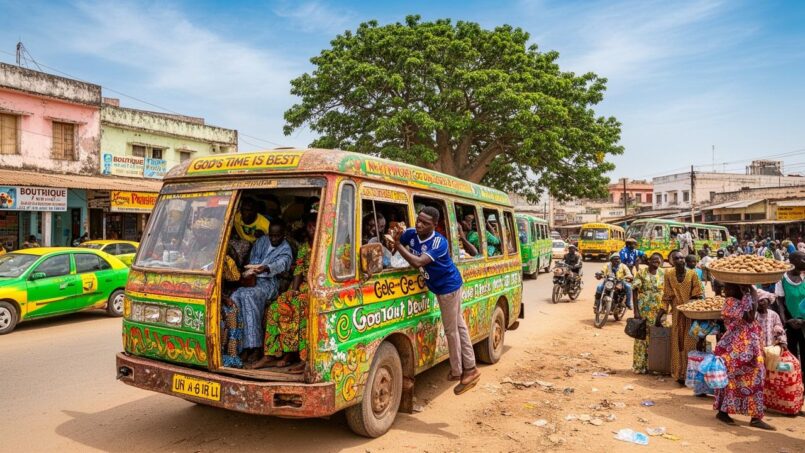
Alongside GTSC buses, the vast majority of the population’s travel is done via an informal network of minibuses, vans, and shared cars. These vehicles are known by different names: “Gelly-Gelli,” “Gele-Gele,” “Sprinter,” “bush taxi,” or “nawettan” for some shared cars.
These minibuses, often refurbished Japanese vehicles, are the most common mode of transport for Gambians without a private car. They handle both daily trips within the Greater Banjul Area and longer intercity connections. They operate on semi-fixed routes but do not follow schedules; a vehicle leaves only when full.
Operation and daily use
In practice, to use a Gelly-Gelli, you go to a “garage” (a large departure lot, like Bundung Garage, Brikama Garage, or other local bus stations), or you wait by the roadside, preferably where other people are waiting. On major roads, vehicles run constantly between terminals, filling and emptying rows as they stop.
Inside, the theoretical configuration allows four passengers per row. In practice, drivers regularly try to fit five people, creating significant crowding. The two front seats, next to the driver, are considered the “best”: more space, better visibility. Culturally, they are often taken by men; women tend to sit farther back.
Prices are very affordable, explaining their popularity: on short urban distances, it’s around 7 to 12 dalasis; a trip from the Senegambia area to Sanyang costs about 18 dalasis. For farther destinations like Janjanbureh from the coast, the fare is higher (around 250 to 300 dalasis), but the trip can take several hours, with an almost mandatory stop at Soma.
At bus stations, collectors or ticket sellers collect payments before departure; if you board en route, the fare is usually collected shortly before arrival. Fares are, in principle, fixed per segment, and attempts to overcharge are limited, especially on very busy local lines.
Safety and comfort: what to expect
The downside is that Gelly-Gellis have several weaknesses: intense heat when the vehicle is full, approximate maintenance, frequent overloading, and dangerous interior layouts. It is common to see simple delivery vans imported without rear windows and designed for carrying goods, converted into minibuses with hastily welded metal benches covered with rudimentary foam. These modifications increase capacity but severely reduce safety (no side protection, benches that could detach during hard braking, etc.).
Gelly-Gelli minibus drivers have a reputation for dangerous driving (speeding, reckless overtaking). The lack of rigorous technical inspections allows many vehicles in poor condition (worn tires, overloading) to remain on the road. These fatal accidents are a major cause of road deaths in The Gambia, as evidenced by the abandoned vehicle carcasses along the roads.
In case of a serious breakdown, the scenario is well-rehearsed: the driver refunds passengers for the uncompleted portion, and everyone figures out how to flag down another vehicle. Local solidarity often kicks in: it is common for drivers or passengers to take initiative to help those stranded.
Alongside Gelly-Gellis, there are shared cars, sometimes Mercedes station wagons or Peugeots, functioning as long-distance collective taxis. These are called bush taxis or “nawettan.” These vehicles leave a starting point (garage or central square) only when all seats are filled. Routes are generally fixed, and stops are made on request along the way.
These cars are in principle a bit faster than Gelly-Gellis, as they stop less often, but they are still shared and often cramped. Fares per seat are higher than minibuses, while still being much cheaper than a private taxi.
Taxis: green for tourists, yellow for locals
Taxis play a central role in travel, especially for visitors. Two main types exist: green tourist taxis and yellow local taxis.
Green tourist taxis
The green taxis, recognizable by their green body and license plates, are registered with the Gambian Tourism Authority. They park mainly near hotels, beaches, and major attractions. Each station has a fare display board by destination, limiting unpleasant surprises. These taxis are more expensive but offer several advantages: most drivers speak English, know tourist sites, and are subject to minimum safety requirements (seat belts, lights, etc.).
For short distances in coastal areas, a trip usually costs between 150 and 250 dalasis. For a day trip to an inland town or visiting multiple sites, budget between 50 and 100 US dollars, or more, depending on distance and driver waiting time. These taxis can travel anywhere in the country.
Yellow local taxis
Yellow taxis (sometimes yellow with green stripes) are primarily intended for residents. They operate in major cities like Banjul or Serrekunda and offer either shared trips on fixed routes or private trips.
For yellow taxis in shared mode, prices are very low: a short urban trip can be around 7 to 10 dalasis, with, for example, a fare of about 7–8 dalasis per segment around some major intersections. A shared Serrekunda–Banjul trip costs about 20 dalasis, while a private trip on the same route is more like 350 dalasis. In other cases, short trips in Banjul or Serrekunda can range from 50 to 100 dalasis.
Yellow taxis often have meters, but they are rarely used. Everything is negotiated in advance, especially when not using the shared option. Negotiation is part of the game: it is advisable to clarify the exact drop-off point and agree on the price before getting in. Having change is important: drivers don’t always have change for larger bills.
In some tourist areas or coastal zones, yellow taxis are not allowed to pick up passengers, to reserve hotel clientele for licensed green taxis. However, a yellow taxi may accept you if it spots you outside the strictly tourist perimeter.
Fare ranges: some benchmarks
Fares change based on fuel prices and authority decisions. The following table shows a series of price increases observed for some typical routes, to give an order of magnitude.
| Route (shared) | Old fare (GMD) | New fare (GMD) |
|---|---|---|
| Banjul – Tabokotoo | 12 | 17 |
| Banjul – Bakau | 10 | 12 |
| Banjul – Serrekunda / Buffer Zone | 10 | 12 |
| Banjul – Soma | 105 | 110 |
| Banjul – Basse | 225 | 235 |
| Banjul – Brikama | 20 | 22 |
| Serrekunda – Gunjur | 20 | 23 |
| Serrekunda – Bakau | 7 | 8 |
| Barra – Farafenni | 80 | 90 |
| Barra – Amdalaye | 25 | 30 |
| Intra-Banjul trips | 7 | 8 |
For trips from Banjul International Airport, there are higher ranges, often charged by green taxis:
| Route from airport (BJL) | Indicative fare (GMD) |
|---|---|
| BJL – Banjul center | 1,000 – 1,400 |
| BJL – Kololi / Kotu / Senegambia | 800 – 1,000 |
| BJL – Serrekunda | ~685 – 765 |
In all cases, the absence of a truly used taximeter and the dual green/yellow taxi system require always agreeing on the price before departure.
The Banjul–Barra ferry: an indispensable link in the network
The Gambia River cuts the country in two, and the crossing between Banjul (south bank) and Barra (north bank) is vital, both for the economy and for daily travel. This stretch of about 5 km connects the capital to the entire northern part of the country and provides access to Dakar in Senegal via Amdallai / Karang.
The link is mainly operated by the Gambia Ferry Service (GFS), a public service, supplemented more recently by a private company authorized to run the same route. Historically, several vessels have operated on this stretch, notably the Kunta Kinteh, the Kanilai, the Johe, and the Barra. Each boat has a different capacity: the Johe and Barra can carry about 400 passengers and 25 vehicles, while the Kanilai can accommodate up to 1,200 passengers. At certain times, only one or two ferries are operational, leading to considerable queues.
Schedules, frequency, and crossing time
Officially, the Banjul–Barra ferries run from morning to evening, with a first departure around 6 a.m. from Banjul and 7 a.m. from Barra, until the last departures late evening (e.g., 11 p.m. from Banjul and midnight from Barra, according to a published schedule). In practice, over certain periods and according to other sources, the daily operating window is more restricted, and modest hours like 7 a.m. – 7 p.m. have also been mentioned for some river services. During major holidays or peak periods, the service may switch to continuous 24-hour operation.
In theory, a ferry departs from each bank every 30 to 45 minutes, with a crossing time of 30 to 40 minutes. In practice, the actual duration can vary from 20 minutes to over an hour, depending on the type of boat, its load of passengers and vehicles, and possible technical issues. A fast ferry can make the crossing in 20 minutes, while another, slower or very loaded, will take much longer.
Delays, cancellations, and breakdowns are frequent, as many vessels suffer from lack of maintenance and recurrent overloading. A recent example saw the Kanilai suffer a major mechanical breakdown while carrying passengers, vehicles, and goods to Barra, before being out of service for over a year. That same ferry later resumed service, and a new vessel provided by Turkey is expected to reinforce the fleet, with the stated goal of eventually providing a reliable 24/7 service.
Fares, ticketing, and on-site conditions
Tickets cannot be booked online: they must be bought at the terminal, often from a cramped booth or a small opening in a wall. Prices have changed in recent years and vary by source, but for pedestrians, amounts range from 25 dalasis to 100, or even 250 dalasis per crossing. For a vehicle, a fare of 250 dalasis is mentioned. These prices may change, so it is important to check with locals at the time of travel.
Practical information for passengers using the maritime link between Banjul and Barra
Over 20,000 people and many vehicles cross the river daily on this link.
The docks, especially in Banjul, are sparsely equipped: limited refreshments, insufficient toilets, and few shaded shelters.
It is advisable to bring water and a snack, and to allow plenty of time, especially during peak hours.
The table below summarizes the main characteristics of this service.
| Element | Detail |
|---|---|
| Distance Banjul–Barra | ~5 km |
| Capacity Johe / Barra | ~400 passengers, 25 vehicles |
| Capacity Kanilai | ~1,200 passengers |
| Daily traffic | >20,000 passengers |
| Theoretical frequency | One departure every 30–45 minutes |
| Announced crossing time | 30–40 minutes |
| Possible actual duration | 20 min to >1 hour |
| Indicative hours | First departures ~6–7 a.m., last ~11 p.m.–midnight |
| Place to buy tickets | Terminal booths only |
On arrival at Barra, there is a telecenter that can be used to make calls, as well as a few accommodation options. If you miss the last ferry to Banjul, lodging options on site are limited; some travelers mention, for example, Ebou’s lodge as an option near the terminal, but it is better to avoid being stuck without a plan.
To reach Senegal from Barra, take a taxi to the Amdallai border post (about 50 dalasis). After crossing the border at Karang, you can continue your journey towards Dakar.
Fares, payment methods, and the TAAMO card
The national currency is the Gambian dalasi (GMD), still largely dominant for everyday payments. International bank cards are very rarely accepted outside major hotels and a few tourist establishments. For transport, cash remains the norm… but innovations are emerging.
Price structure in transport
Prices for buses, taxis, and minibuses vary according to distance, type of vehicle, and mode (shared or private).
For taxis, some data gives an idea of the general level:
– Base fare for a standard taxi ride during the day: about 50 GMD.
– Average price per kilometer: about 50 GMD.
– Waiting time: around 300 GMD per hour.
– A 5 km ride can therefore cost around 300 GMD.
The price of a private taxi for a trip between Serrekunda and Banjul, in The Gambia, is over 300 GMD.
For Gelly-Gellis, urban fares are very low (often around 7–12 GMD) and remain fixed per segment, making them the most economical mode. GTSC, with its standard or Super Express buses, is higher but offers a superior safety/comfort ratio.
Digitalization: mobile money and the TAAMO card
The Gambia is beginning a transition towards electronic payments, although the road is still long. Several mobile money operators are active (Wave, Afrimoney, QMoney, GMoney, etc.), often backed by telecom operators or banks. These services allow deposits and withdrawals through a network of agents, and payment of various bills (phone, fuel, food) via apps like Waychit, which aggregates several payment methods (mobile money, bank transfers, Visa/Mastercard cards).
In Banjul transport, the TAAMO prepaid card allows you to pay for bus trips by tapping it on NFC readers on board. The trip amount is automatically deducted. In case of loss or theft, the balance can be transferred to a new card, offering greater security than cash.
Meanwhile, partnerships have been established between GTSC and operators like Wave or Yonna Wallet, allowing bus tickets to be purchased via a mobile app, even without an internet connection in Wave’s case. These tools help GTSC manage cash flow (less change to handle, less risk of counterfeit notes) and simplify life for regular users. At this stage, however, cash payments are still accepted everywhere, and some fixed-fare lines (e.g., University of Gambia student transport at 10 GMD) still operate only on a cash basis.
The following table summarizes the main payment options for GTSC services.
| Payment method | Where / for what? | Main advantages |
|---|---|---|
| Cash (dalasis) | GTSC tickets, minibuses, taxis, ferry | Accepted everywhere, simplicity |
| TAAMO card | GTSC buses with NFC validators | Speed, security, replacement possible |
| Mobile money (Wave, Yonna, etc.) | GTSC ticket purchase, some urban services | No cash, possible offline for Wave |
| Bank cards (Visa/Mastercard) | Indirect payments via Waychit, hotels, etc. | Useful for tourists, but limited acceptance |
Accessibility and people with reduced mobility
In theory, best international practices recommend thinking of travel as a “chain of trips”: getting to the stop, boarding the vehicle, traveling, getting off, and reaching the final destination. If any single link is inaccessible, the trip is inaccessible for a person with a disability.
Although newer GTSC buses have improvements (wide access, steps, handrails), there is no national standard requiring essential equipment such as lifts, automatic announcements, or designated wheelchair spaces across the entire network.
In the informal sector (Gelly-Gellis, bush taxis, yellow taxis), the reality is even more challenging: no ramps, cramped interiors, overloaded vehicles, unimproved stops, and no systematic announcement of stops. Accessibility relies mostly on the spontaneous solidarity of passengers and the driver. This is real: Gambian culture places great emphasis on respect for the elderly, pregnant women, and people with disabilities, and passengers often mobilize to help someone in difficulty board or alight.
Local solidarity does not compensate for the lack of accessibility in public transport, especially in minibuses and ferries. For travelers in wheelchairs or with significant mobility limitations, the most realistic option is often a private taxi (green or private yellow). It is advisable to negotiate the fare in advance, including a surcharge for the time needed to board and secure the wheelchair.
Practical tips for using public transport
Beyond describing the services, a few basic rules make life easier when relying on public transport in The Gambia.
There is no complete official map of minibus or shared taxi routes. Locals know the routes by their combination of departure and arrival points, as well as a few major intersections or markets. When arriving for the first time, the simplest is to ask your accommodation or trusted residents: they will indicate which garages to use and what fares are charged.
Minibuses do not always operate from designated stops; even if “Bus Stop” signs exist, they don’t necessarily correspond to places actually served. Most often, you just stand by the roadside, on the right side in the direction of traffic, where other people are waiting. You hail the vehicle by raising your hand, sometimes with a specific gesture indicating your destination (certain signs are used locally for Serrekunda, the “Traffic Light” intersection, the “Turntable” roundabout, etc.). These signals may vary by neighborhood, so it’s best to observe or ask people present.
Change, negotiation, and using cash
Having small denominations is essential. Ticket sellers at garages collect payments before departure, and drivers sometimes collect the fare on board; if you pay with a large bill, getting change can be difficult. For private taxis, negotiation is the rule: for a yellow taxi, it’s common to offer an amount in line with local practices, even if it means leaving the vehicle if the driver refuses. Some travelers recommend simply getting in and paying the usual amount when exiting, but this strategy assumes you know the fares in advance.
On highly codified lines like shared taxis at 7–8 GMD per segment, passengers sometimes confirm the price by saying, for example, “seven seven?” to the driver to ensure it’s a shared ride at the usual fare.
Practice of shared taxi passengers in Dakar
Road safety: what to keep in mind
The road is often presented as the most dangerous aspect of a stay in The Gambia. Several factors combine: road conditions (potholes, unpaved roads, almost non-existent lighting at night), poorly maintained vehicles, reckless driving by some drivers, and lack of systematic technical inspections.
A few simple principles help reduce risks:
For long-distance trips, favor GTSC, which is reputed to be safer than private minibuses, especially if you are nervous on the road. Avoid nighttime travel on rural or intercity roads due to poor lighting, poorly lit vehicles, and risk of obstacles. Be selective with minibuses: refuse those that are overloaded or in poor condition (bald tires, excessive smoke). For night outings, use green taxis pre-assigned by your hotel rather than hailing a yellow taxi on the street, as the latter is sometimes associated with assaults. Finally, always fasten your seatbelt when available, especially in taxis and in the front of minibuses, even though many are defective.
In terms of personal safety, ferries, bus stations, and crowded vehicles are places where pickpockets may operate. Keeping valuables close, in a closed pocket or a money belt worn against your body, is strongly advised.
Social etiquette and cultural codes
The Gambia is known for its hospitality, and this is felt in transport. Nevertheless, a few cultural codes are important.
Before any interaction, it is essential to greet and ask about family before moving on to other topics. English phrases are understood, but using local greetings like “Salaam Alaikum” (reply: “Alaikum Salaam”) is very appreciated. For handshakes, always use the right hand between men. With women, wait for them to extend their hand first, or greet by placing your right hand over your heart with a slight bow of the head.
Elders receive particular respect: they are willingly given the best seats, especially in buses and minibuses. Offering to share snacks, complimenting a baby, exchanging a few words with seat neighbors are appreciated behaviors. When giving or receiving money – for a bus ticket or taxi – custom dictates using the right hand, as the left hand is culturally associated with impure tasks.
Finally, in terms of dress, modest attire is appropriate, especially when moving away from coastal areas: covered shoulders, shorts or skirts reaching the knee avoid discomfort in crowded vehicles.
Structural challenges and future developments
Behind these daily practices lie considerable structural challenges. The Gambia is one of the most urbanized countries in the ECOWAS region, behind Cape Verde, with about 65% of its population living in urban areas. The Greater Banjul Area concentrates more than half the population and continues to grow at a rate of about 4% per year, adding nearly 70,000 new urban residents annually.
However, this rapid urbanization has occurred without an integrated transport plan or a true mass transit system. Urban roads are congested, intersections like Westfield, Tabokoto, or Brusubi Turntable suffer from chronic traffic jams, and thousands of people lose long hours each day waiting for a vehicle to travel sometimes less than 5 km.
The policy identifies sector problems and plans several actions: improvement of infrastructure, development of public-private partnerships, creation of a metropolitan transport authority for Banjul, development of a public transport master plan, implementation of vehicle technical inspections, adoption of ECOWAS fuel standards, and strengthening of funding (target: raising public spending to 1–1.5% of GDP).
On the ground, several major road projects are advancing (Lamin Koto–Passimas, rural roads nearing completion, rehabilitation of Banjul roads). A Bus Rapid Transit network is envisioned in the long term, or even a light rail system, although past planning errors – such as the lack of reserved right-of-way on some major corridors – complicate and raise the cost of these solutions.
The Gambia is modernizing its transport infrastructure to improve connectivity. This includes modernizing the ferry fleet and adding a new Turkish vessel on the Banjul–Barra link to secure river transport. Investments are also planned to build a deep-water port in Sanyang and modernize Banjul International Airport through a public-private partnership, to strengthen international connections.
Finally, the transition to digital payments, with the TAAMO card, GTSC partnerships with Wave and Yonna Wallet, or the expansion of the national electronic payment platform (EFT Switch) bringing together banks and mobile money, shows that public transport is also becoming a lever for financial modernization and inclusion.
Conclusion: traveling at the rhythm of Gambian transport
Using public transport in The Gambia means accepting a certain degree of unpredictability: no reliable schedules for minibuses, sometimes bumpy roads, ferries that run late, crowded and often shabby vehicles. But it also offers an immersion into daily life in a country where sociability, hospitality, and mutual aid often trump rigid regulations.
For a visitor, the key is to combine caution and curiosity: prefer GTSC buses for long distances if you are uncomfortable with road risk, try Gelly-Gellis on short stretches to experience the local atmosphere, use green taxis for nighttime travel or sensitive trips, and always allow some margin in your schedule.
Over time, the country is engaged in a deep reflection on its transport model, to respond to demographic pressure, road safety challenges, and climate constraints. While waiting for a true mass transit system to emerge, this patchwork of public buses, informal minibuses, taxis, and ferries will continue to carry millions of trips every day across this small, highly urban country nestled along its great river.
Disclaimer: The information provided on this website is for informational purposes only and does not constitute financial, legal, or professional advice. We encourage you to consult qualified experts before making any investment, real estate, or expatriation decisions. Although we strive to maintain up-to-date and accurate information, we do not guarantee the completeness, accuracy, or timeliness of the proposed content. As investment and expatriation involve risks, we disclaim any liability for potential losses or damages arising from the use of this site. Your use of this site confirms your acceptance of these terms and your understanding of the associated risks.

Cyril Jarnias is an independent expert in international wealth management with over 20 years of experience. As an expatriate himself, he is dedicated to helping individuals and business leaders build, protect, and pass on their wealth with complete peace of mind.
On his website, cyriljarnias.com, he shares his expertise on international real estate, offshore company formation, and expatriation.
Thanks to his expertise, he offers sound advice to optimize his clients' wealth management. Cyril Jarnias is also recognized for his appearances in many prestigious media outlets such as BFM Business, les Français de l’étranger, Le Figaro, Les Echos, and Mieux vivre votre argent, where he shares his knowledge and know-how in wealth management.





