
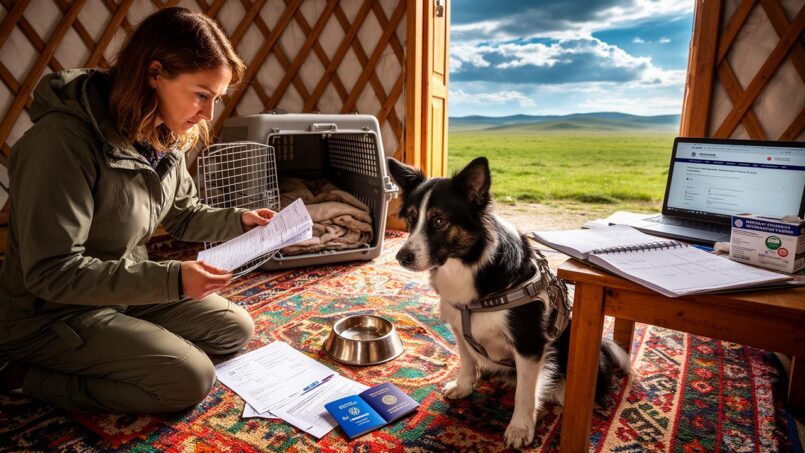
 Published on and written by Cyril Jarnias
Moving to Mongolia with your dog or cat is far from a simple plane ride. Between veterinary paperwork, extreme climate conditions, and the reality of the local animal health system, a poorly prepared expatriation can quickly turn into a disaster – for you and your companion. Conversely, a solid file and good planning can generally help avoid quarantine, being sent back at the airport, or unexpected fees.
Expatriating with a pet to Mongolia requires rigorous preparation. The country is classified as high-risk for rabies, and official information can be fragmented. You need to anticipate extreme weather conditions, with winters that can reach -40°C, and a veterinary services network that is still developing. Thorough planning of entry requirements, airline constraints, and living conditions on the ground is essential.
Understanding the “Passport” for Pets in Mongolia
When we talk about a “pet passport” in Mongolia, it is not the blue European passport, but a set of documents that, together, allow importation. Three items are essential: microchip identification, a valid rabies vaccination, and an international health certificate.
In practice, Mongolian authorities do not publish a clear and complete guide online. Available information is often based on experience reports. It is therefore essential: 1) to complete all procedures in the country of departure before traveling, and 2) to systematically verify requirements with national veterinary authorities and the Mongolian embassy or consulate.
The table below summarizes the components of this Mongolian “passport” for pets.
| Key Element | Primary Role | Where to Obtain |
|---|---|---|
| Microchip (15-digit ISO) | Link the animal to its documents, traceability in case of loss | Veterinarian, clinic, veterinary hospital |
| Proof of Rabies Vaccination | Entry requirement for all dogs and cats | Approved veterinarian |
| International Health Certificate | Certify health status and regulatory compliance | Veterinarian + Official Veterinarian |
| Supplementary Vaccination Record | Cover common diseases (distemper, parvo, etc.) | Treating veterinarian |
| Possible CITES Certificates | For protected species (turtles, parrots, etc.) | National wildlife/fauna authority |
All these documents must be prepared in the country of departure, before the flight, and must bear the animal’s microchip number.
Which Animals Can Follow You to Mongolia?
Import regulations primarily target domestic dogs and cats, whether family pets or properly trained service animals. No official text lists any banned breeds: Mongolia does not publish a “breed ban” like some countries. However, restrictions exist for hybrids closely related to wild species.
Domestic dogs and cats, including service animals, are eligible. Wolf hybrids, Savannahs, and Bengals are only accepted from the 5th generation removed from the wild ancestor, with demonstrable genealogy. Other pets (birds, fish, reptiles, etc.) are not subject to rabies vaccination requirements but need a health certificate and, for protected species (CITES), additional permits.
In the absence of very detailed public rules, owners of animals other than dogs and cats must absolutely consult the veterinary services of their country and the Mongolian authorities before any project.
Microchip: The Foundation of Any Successful Expatriation
Microchip identification is not just a formality: it is the pivot of the entire file. Recommendations for Mongolia clearly point towards a 15-digit microchip, compliant with ISO standards 11784/11785 (Annex A). This compatibility ensures the chip can be read by standard readers used at borders and by most veterinarians.
Microchipping must be performed exclusively by a qualified professional (veterinarian, veterinary hospital, or trained veterinary nurse). It is crucial to obtain the manufacturer’s document and registration instructions, because a chip not registered with your up-to-date contact details in an official database is useless. Furthermore, the chip’s unique number must appear on all documents related to the animal: rabies vaccination certificate, health record, health certificate, serological test results, and export forms.
It is possible to travel with a non-ISO chip, but this requires the owner to provide a compatible reader upon arrival. In practice, this adds an unnecessary layer of complexity in a country where official procedures are already unclear.
Mandatory and Recommended Vaccinations Before Entry
The only vaccination formally required for entry of dogs and cats is rabies. However, bringing an unprotected animal to Mongolia against common diseases would be very risky given the availability of care and the circulation of certain pathogens.
Rabies Vaccine: The Hard Line Never to Cross
All dogs and cats must be vaccinated against rabies within a period between 30 days and 12 months before arrival in Mongolia. The vaccine must not be administered before 3 months of age for puppies and kittens, and a 30-day waiting period after the primary vaccination is necessary before travel. Proof of this vaccination must be signed and stamped by a veterinarian, and may appear on a rabies certificate, an official vaccination booklet, or a European pet passport. In all cases, the date, vaccine type, validity, and microchip number must be clearly indicated.
Although some local sources mention a minimum period of 14 days, the lack of clear official instructions makes the standard of 30 days to 12 months the most cautious approach and consistent with international practice.
Supplementary Vaccinations: Highly Recommended
Beyond rabies, other injections remain “simply” recommended, but they are critical for protecting an animal that will live in an extreme climate environment and potentially come into contact with many vectors (ticks, mosquitoes, wildlife). For dogs, vaccines against distemper, hepatitis, leptospirosis, and parvovirus are recommended. For cats, it is advisable to vaccinate against feline viral rhinotracheitis, panleukopenia, and feline leukemia. These vaccinations must be recorded on the international health certificate or vaccination record.
Summary of the main vaccination requirements, presented clearly and concisely.
Mandatory vaccines vary by age and situation. They generally include diphtheria, tetanus, polio (DTP) and, for residents of French Guiana, yellow fever.
Several vaccines are strongly recommended for optimal protection, such as MMR (measles, mumps, rubella), whooping cough, hepatitis B, and human papillomavirus (HPV) infections.
The vaccination schedule defines ages and intervals for each vaccination, primary series and boosters, to ensure lasting immunity.
Specific requirements (such as yellow fever) or recommendations (hepatitis A, typhoid) apply depending on the destination.
Certain professions (healthcare, laboratory) may be subject to additional vaccination requirements (hepatitis B, flu, etc.).
Temporary (acute illness) or permanent (severe allergy) contraindications must be evaluated by a healthcare professional.
| Species | Vaccine Required for Entry | Time Window | Additional Recommended Vaccines |
|---|---|---|---|
| Dog | Rabies | 30 days to 12 months before arrival | Distemper, hepatitis, leptospirosis, parvovirus |
| Cat | Rabies | 30 days to 12 months before arrival | Viral rhinotracheitis, panleukopenia, feline leukemia |
The veterinarian should also avoid any injection within 24 hours prior to arrival, as some documents mention this precaution to limit post-vaccination reactions during transport.
Rabies Titer Test: Optional for Entry, Often Useful for Return
Mongolia does not require a rabies serological test (antibody titer, such as FAVN or RFFIT) for entry, regardless of the country of origin. In theory, it is therefore possible to go without ever having a titer test. In practice, this approach can become problematic at the time of return or a future move, because Mongolia itself is classified as a high-risk rabies country by the World Organisation for Animal Health.
For a stay in a low-risk rabies country, a titer test performed in an approved laboratory is often required (result ≥ 0.5 IU/ml). The sample must be taken at least 30 days after the most recent vaccination. For an expatriate who does not intend to settle permanently, having this test done in the country of origin before departure is generally simpler and more economical.
It is crucial to understand that the titer test never replaces the vaccination itself. A positive result without proof of a valid vaccine will not satisfy the authorities.
Antiparasitic Treatments: Protection Not to Be Overlooked
Upon entry into Mongolia, no strict requirement for antiparasitic treatment is officially stated, but recommendations emphasize dual protection: internal and external.
Treatment against internal parasites, particularly Echinococcus multilocularis (a tapeworm transmissible to humans), is advised, especially in steppe regions. In parallel, regular protection against fleas and ticks is crucial, as local ticks can transmit various diseases (tick-borne encephalitis, borrelioses, rickettsioses, anaplasmosis) already present in humans and wildlife.
In practice, the best approach is to ask your veterinarian to establish a complete protocol (tablets, spot-ons, collars, as appropriate) and to record the treatment dates on the international health certificate or a separate document.
The International Health Certificate: Central Document of the File
The health certificate – often called the “Certificate of Veterinary Inspection” – is the pivotal document that links all the animal’s health information. It must be completed just before departure by an approved veterinarian, then validated or countersigned by an official veterinarian representing the authority responsible for animal exports in the country of origin (Ministry of Agriculture, State Veterinary Service, APHIS in the US, etc.).
This certificate must necessarily include: the animal’s full identity (species, breed, sex, age, color, chip number), its vaccination history (dates and products), antiparasitic treatments, and a declaration attesting to its good health, fitness for transport, and that it does not originate from a rabies risk area. For certain countries (e.g., South Korea, USA), official forms must be used and validated by the national veterinary authority, sometimes via an electronic system (like VEHCS), but a physically signed paper certificate remains required.
Upon arrival in Mongolia, this document is what the veterinary services will base their check of your companion’s compliance on.
Is an Import Permit Required for a Pet?
The answer is simple for individuals: no, an import permit is not required for a dog or cat traveling with its owner and intended for non-commercial use. However, as soon as it concerns a commercial import (breeding, sales, transport for third parties, etc.), a permit becomes mandatory.
Even without a permit, the owner is responsible for the compliance of the animal’s import file. In case of a deficiency (missing vaccine, incomplete certificate, unreadable chip), Mongolian authorities may impose quarantine, return to the country of origin, or, as a last resort, euthanasia. All costs incurred by these measures remain the owner’s responsibility.
Air Travel: Cabin, Hold, or Cargo to Mongolia?
To enter Mongolia with a pet, you must go through the country’s main international airport: Chinggis Khaan International Airport, in Ulaanbaatar. Pets can theoretically travel in the cabin, as checked baggage, or as cargo, depending on weight, size, species, and the airline’s policy.
Each airline applies its own rules, often very technical: maximum weight for cabin travel (5 kg for MIAT Mongolian Airlines, for example), maximum dimensions for the carrier or bag, additional fees (pets are generally not included in the baggage allowance), and sometimes restrictions on certain breeds or muzzle types (brachycephalic).
The report mentions several airline policies, but no specific numerical order of magnitude is provided to highlight.
| Airline (Examples) | Cabin Mode – Max Weight (Pet + Carrier) | Max Cabin Dimensions (Approx.) | Hold/Baggage – Max Weight (Pet + Carrier) |
|---|---|---|---|
| MIAT Mongolian Airlines | 5 kg | Sum of 3 dimensions ≤ 115 cm | 32 kg / sum of 3 dimensions ≤ 158 cm |
| Uzbekistan Airways | 8 kg (standard) / 15 kg with adjacent seat | 46 × 28 × 24 cm | Per IATA regulations, heavier weights |
| US Low-Cost Airlines (average) | ~8–9 kg (approx. under-seat limit) | 17–19″ long, ~9–11″ high (soft-sided) | Up to 68 kg in cargo depending on carriers |
Weather conditions also play a role: many airlines refuse pets in the hold when the ground temperature exceeds 29–30 °C or drops below 7 °C, unless a specific acclimation certificate is provided, and never below approximately –6 °C. In Mongolia, with winters at –30 °C and summers that can exceed 38 °C in the Gobi, these restrictions can complicate logistics, especially during a transit through other countries.
It is therefore crucial to:
For air travel with your pet, book its transport several days, even weeks, in advance, as some airlines require a minimum notice of 34 to 48 hours to confirm its presence. Always check the pet transport policy of the airline actually operating the flight, not just the airline selling the ticket. Finally, prioritize short layovers and, if possible, avoid changing airlines. This helps avoid having to retrieve the animal, go through intermediate customs, and re-check it during the connection.
For large animals or to simplify procedures, some owners opt for cargo transport via a specialized freight forwarder, who handles the IATA crate, cargo booking, and manifest documents.
Arrival at Chinggis Khaan Airport: Inspections and Quarantine Risks
Upon arrival in Mongolia, all animals must be free of clinical signs of diseases transmissible to humans at the time of inspection. The veterinary services must be notified of the animal’s arrival, especially if the flight lands outside of office hours. An official veterinarian may then travel to examine the animal and verify the documents.
If the microchip is readable, the rabies vaccination proof is up to date, and the health certificate is valid, the animal enters directly without quarantine. In case of an anomaly, the authorities may require medical examinations, temporary isolation, or order return or euthanasia. Any quarantine is organized by the veterinary authorities and local governors, in accordance with Mongolian law on entry control of animals, plants, and derived products.
In a country where official information is not readily accessible, the best assurance remains an impeccable file, prepared well in advance.
Living with a Pet in Mongolia: An Extreme Environment
Mongolia has one of the harshest continental climates in the world: very long, very cold winters, short but sometimes scorching summers, high temperature variation, strong winds, and extreme phenomena like “dzuds,” catastrophic winters that combine polar cold, heavy snow, ice, and wind, regularly decimating livestock. Over 8 million livestock animals died during the winter of 2023–2024, following a previous episode in 2010 when 10 million animals, nearly a quarter of the national herd, were lost.
For a pet in Mongolia, climate challenges are major: winters with temperatures frequently dropping below -30°C (peaks of -40°C at night), summers that can reach 33°C in Ulaanbaatar and 38°C in the Gobi Desert. Add to this dry air, high average altitude (about 1500 m, 1351 m for the capital), and abrupt weather changes, with risks of sandstorms, hail, and blizzards.
Hydrologically, the country is under severe pressure: more than 77% of lands are degraded, a quarter of the lakes on the Mongolian Plateau disappeared between 1987 and 2010, and many rivers are drying up. This indirectly affects wildlife, pastures, disease vectors, and water quality, including in urban outskirts.
Animal Health and Infectious Risks for Expatriate Dogs and Cats
Mongolia is a pastoral country, where livestock – sheep, goats, horses, yaks, cattle, camels – is ubiquitous and far more numerous than humans (approximately 71 million head of livestock in 2022, for a much smaller human population). In this context, dogs, especially those used for herd protection, act as sentinels and potential reservoirs for various vector-borne diseases.
Studies reveal the presence of pathogens in ticks and their hosts, responsible for diseases like tick-borne encephalitis, borrelioses, anaplasmosis, rickettsioses, and bartonelloses. Although some of these infections are known in humans and wildlife, they remain poorly documented in local dogs. The risk of underdiagnosis is increased by the adaptation of ticks to the extreme continental climate and a lack of awareness of these pathologies among some veterinarians.
For an expatriate with a dog, this implies increased vigilance: multiple external antiparasitic treatments, regular coat checks to remove ticks and other parasites, vaccination, and rigorous veterinary follow-up. Outdoor cats may also be exposed to these vectors.
Finding a Veterinarian in Mongolia: Overview and Resources
The veterinary offer in Mongolia is concentrated in Ulaanbaatar and major cities, with a network of private clinics, associative structures, and veterinary drug wholesalers. Examples include several small animal clinics like Enerekh Small Animal Clinic, Sonor Animal Hospital, Ub‑Vet, Amar Mal Emneleg, Animal’s Healthy, Jargal Mal Emneleg, as well as training and coordination structures like Mongolia V.E.T.Net, an NGO stemming from the work of Christian Veterinary Mission.
Over 700 private clinics have benefited from continuing education programs since 2008.
For an expatriate, this means there is a base of competent professionals, especially in the capital. However, the level of awareness of certain emerging diseases (particularly canine vector-borne diseases) remains uneven, which reinforces the value of solid preventive medicine prepared before departure.
The official veterinary services can be contacted in Ulaanbaatar, for example via a contact cited in the report (city veterinary service, Bayangol district, phone, email). They are the preferred contacts for clarifying a regulatory point or for quarantine situations.
Finding Accommodation with a Pet in Mongolia
The pet-friendly accommodation offer exists in Mongolia, especially in Ulaanbaatar and in certain tourist and naturalist sites. Platforms like Airbnb or Trip.com list apartments, houses, hotels, guesthouses, and even yurts (gers) that accept pets, but often with conditions.
In Ulaanbaatar, some accommodations advertised as pet-friendly may change their policy. It is crucial to confirm in writing with the host or hotel that your dog or cat is indeed allowed before any booking.
Outside Ulaanbaatar, accommodations like Three Camel Lodge in the Gobi Desert, Yeruu Lodge in the north, or yurt homestays with nomadic families (Gobi Family Homestay, “Chez Famille Nomade”, etc.) can offer an exceptional setting, but require thinking about interactions between your pet and local wildlife: protective herd dogs, horses, goats, sheep, even wild animals. In these contexts, recall, sociability, and behavioral control of your companion become essential for everyone’s safety.
Prices vary widely, from dormitories under 10 USD to high-end lodges or apartments well exceeding 40–50 USD per night. Discounts are sometimes available for long stays (weekly or monthly rates).
Specialized Organizations for Pet Transport and Relocation
Faced with the complexity of procedures, many expatriates rely on companies specialized in international pet transport. Names cited in the report include AirPets, Freighter Gator, International Petshipping Mongolia, Air Animal Pet Movers, Woof Airlines, or members of the International Pet and Animal Transportation Association (IPATA), a professional association of animal movers.
These providers offer a comprehensive range of services for animal transport, including advice on health and administrative requirements, document preparation, supply of IATA-compliant crates, as well as booking suitable air cargo. They can organize charter flights for sensitive loads, coordinate logistics and customs clearance, and provide real-time tracking. Some have specific expertise in Mongolian regulations and experience transporting exotic animals or research livestock to or from this country.
However, one must remain vigilant against scams: IPATA reminds that it does not directly transport animals and warns against companies that use its name to pose as a transporter. Verifying references and using official contact channels is essential.
Legal Framework: Between Health Protection and Lack of Transparency
Mongolia has a legal arsenal dedicated to managing the flow of live animals, animal health, and biosecurity. A specific law governs the control and inspection at the entry of animals, plants, and derived products; it has been amended several times in recent years. A law on pets, adopted at the end of 2023, aims to organize registration, microchipping, and public health protection related to urban dogs and cats.
In the field of international exchanges, treaties ratified by Mongolia, such as CITES and the standards of the World Organisation for Animal Health (like those on rabies), take precedence in case of conflict with other national laws (Constitution, customs law, livestock health laws, etc.).
For the expatriate, the main issue is not so much the exact content of each law, but rather the practical consequence: the authorities have a solid legal basis to refuse entry, impose quarantines, or prohibit the transit of animals and animal-derived products in case of non-compliance or high health risk.
Planning Your Expatriation with a Pet: A Project Requiring at Least 3 to 4 Months
Assembling a complete file for a pet’s move abroad takes time, and Mongolia is no exception. Between microchipping, rabies vaccination given from 3 months of age, the 30-day minimum wait, other optional injections, scheduling an appointment with the official veterinarian, validating the international health certificate, and coordinating with the airline, you quickly reach a timeline of 60 to 120 days. For a rushed departure, the margin for error is almost nil: you will then have to navigate between the requirements of the departure country, those of Mongolia, and the constraints of each layover.
The following table gives an idea of the minimum timeline for a puppy or kitten that has not received anything yet. It serves as a general reference to initiate the primary vaccination protocol.
| Step | Minimum Recommended Time |
|---|---|
| Microchipping | As soon as possible (before any vaccine) |
| Primary Rabies Vaccination | From 3 months of age |
| Wait after Rabies Vaccine | Minimum 30 days before travel |
| Supplementary Vaccines (distemper, etc.) | According to veterinary protocol, before departure |
| Antiparasitic Treatments | Within the month before travel, renewable |
| International Health Certificate | 1 to 10 days before departure depending on country |
| Endorsement by Official Veterinarian | Immediately after the certificate, before flight |
| Pet Transport Booking | 2–4 weeks before, depending on airline |
Starting preparations 4 or 5 months in advance is therefore reasonable, especially if you also plan to have a rabies titer test done to prepare for a future return.
Practical Tips for Daily Life in Mongolia with a Pet
Once settled, daily life with a pet in Mongolia will require some adjustments.
In winter, walks will need to be short and well-equipped: coat, booties, checking paw pads after each walk to avoid cracks and frostbite. Short-haired dogs or those not well adapted to extreme cold will need particular protection. In summer, sun exposure and dehydration must be monitored, as well as the risk of burns on overheated ground.
Drinkable water should not be taken for granted, especially during trips to the countryside or the Gobi. It is essential to plan sufficient water reserves for the animal, prevent it from drinking from stagnant or potentially contaminated sources, and remain alert to any abnormal digestive signs.
Contacts with local wildlife must be managed: herd dogs can be very protective and aggressive towards foreign dogs; horses and camelids can react sharply to a running dog; and some rodents or marmots can carry specific diseases. In the city, stray dogs, sometimes unvaccinated, represent another potential source of conflict and contamination.
Finally, if planning tourist stays in remote areas (Terelj, Khustai, Gobi, northern lakes), it is wise to ensure beforehand that a veterinarian is reachable in case of emergency, and to bring an appropriate first aid kit (antiseptic, bandages, spare antiparasitic treatment, copies of all the animal’s documents).
In Summary: Administrative Rigor and Health Caution
Expatriating a pet to Mongolia is perfectly feasible, provided you take into account three unavoidable realities: import rules centered on rabies but incompletely documented, an atypical climate and health environment, and a veterinary offering that is improving but still uneven depending on the region and area of expertise.
A complete veterinary file (ISO chip, valid rabies vaccine, international health certificate) and planning over several months are essential. You also need to anticipate local health risks (vector-borne diseases, climate) and plan for a possible return, for example with an early rabies titer test, to avoid unpleasant surprises related to other countries’ requirements.
In this land of steppes, deserts, and brutal winters, the expatriate pet depends more than ever on the preparation, foresight, and sense of responsibility of its owner.
Disclaimer: The information provided on this website is for informational purposes only and does not constitute financial, legal, or professional advice. We encourage you to consult qualified experts before making any investment, real estate, or expatriation decisions. Although we strive to maintain up-to-date and accurate information, we do not guarantee the completeness, accuracy, or timeliness of the proposed content. As investment and expatriation involve risks, we disclaim any liability for potential losses or damages arising from the use of this site. Your use of this site confirms your acceptance of these terms and your understanding of the associated risks.

Cyril Jarnias is an independent expert in international wealth management with over 20 years of experience. As an expatriate himself, he is dedicated to helping individuals and business leaders build, protect, and pass on their wealth with complete peace of mind.
On his website, cyriljarnias.com, he shares his expertise on international real estate, offshore company formation, and expatriation.
Thanks to his expertise, he offers sound advice to optimize his clients' wealth management. Cyril Jarnias is also recognized for his appearances in many prestigious media outlets such as BFM Business, les Français de l’étranger, Le Figaro, Les Echos, and Mieux vivre votre argent, where he shares his knowledge and know-how in wealth management.





