
 Published on and written by Cyril Jarnias
Land of horsemen, endless steppes and biting winters, Mongolia is also a vast playground for sports. Between millennia-old disciplines born from the nomadic way of life and modern sports imported in the 20th century, the country offers a surprisingly wide range of activities that can actually be practiced on-site, whether as a traveler or a resident.
In Mongolia, sports activities—whether traditional like bökh (wrestling), archery, or horseback riding, or more modern like urban marathons, professional basketball, or winter sports—are much more than a simple pastime. They offer a direct gateway to understanding the country’s culture, history, and daily life.
Naadam and the “Three Manly Games”: The Core of Mongolian Sport
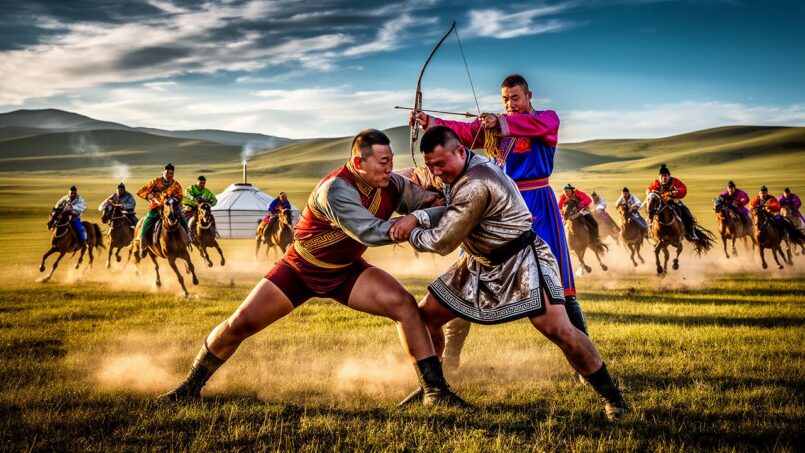
It’s impossible to talk about sports in Mongolia without starting with Naadam, the great summer festival celebrated annually throughout the country. Its full name, eriin gurvan naadam – “the three games of men” – summarizes its sporting core: wrestling, horse racing, and archery. For centuries, these disciplines have served to test the essential qualities of the steppe horseman-warrior: strength, endurance, and precision.
Traditional number of wrestlers participating in the National Naadam of Ulaanbaatar, over nine rounds of competition.
The table below provides a quick overview of the three pillar sports of Naadam.
| Sport | Role in Naadam | Practice Particularities |
|---|---|---|
| Mongolian wrestling | Most prestigious sport, giant tournament | Men only, no weight classes |
| Horse racing | Most popular event for the public | Child jockeys, long distances in open country |
| Archery | Prestigious discipline, mixed | Open to women, shooting with traditional composite bows |
To these three pillars was added a “fourth game” officially recognized at the festival since the late 1990s: anklebone shooting (shagai), a precision discipline using sheep knucklebones. But before coming back to this astonishing sport, we must detail each of the three “manly games,” which visitors can practice more or less directly.
Mongolian Wrestling: The King of Sports
Traditional wrestling, or bökh, is considered the national sport par excellence. The term evokes both solidity, vitality, and the wrestler himself, which speaks to its symbolic importance. Cave paintings from Bayankhongor province, several millennia old, already show figures wrestling. Under the Mongol Empire, Genghis Khan encouraged wrestling to maintain the physical fitness of his armies.
How a Bökh Match Unfolds
The rules are of a deceptive simplicity. There are no weight classes or time limits. Two opponents face each other on grass or packed earth. The first to touch the ground with anything other than the soles of their feet or the palms of their hands is declared defeated. They are said to have “dirtied their knees.”
Mongolian wrestling, though appearing simple, relies on a sophisticated technique favoring balance, hip play, and the ability to shift the opponent’s center of gravity rather than brute strength. It incorporates leg grabs, frequent sweeps, and throws similar to those in judo or Olympic wrestling. This traditional background partly explains the success of Mongolian athletes in these international sports.
Before each match, wrestlers perform the famous “eagle dance,” a ritual with shamanic roots. With arms spread, they mimic the flight of a large raptor around the combat area, greet their coach and referees, and then take their positions.
Attire and Symbols
What immediately strikes a visitor is the unique attire of the wrestlers: a short jacket open at the chest (zodog), tight shorts (shuudag), and leather boots with upturned toes (gutal). Traditionally, everything is in blue and red, colors associated with the “eternal sky” and power, echoing the national flag.
Legend has it that the very open cut of the jacket comes from an ancient episode when a woman supposedly triumphed incognito in a tournament. To avoid such a “surprise,” this garment leaving the chest bare was imposed. Beyond the legend, the costume is also extremely functional for grabbing, pulling, and turning the opponent’s body.
Legend and Functionality of the Wrestler’s Costume
The pointed hats decorated with ribbons reveal the rank. The more victories a wrestler has accumulated at Naadam, the more prestigious his title: “Falcon,” “Elephant,” “Lion,” up to the holy grail of “Grand Champion of the State” for those who have dominated the national Naadam several times.
Can Foreigners Practice Mongolian Wrestling?
Bökh remains a matter for Mongolian men, structured by very strict internal codes. One does not just show up as a participant at Naadam. However, some clubs or culture houses in Ulaanbaatar or major cities offer demonstrations accompanied by supervised initiation sessions, where one learns basic positions, the greeting, and a few simple holds. For a traveler seeking immersion, this is an excellent way to understand what makes the country tick.
For accomplished athletes, attending a training session at the Wrestling Palace in Ulaanbaatar and then exchanging with the wrestlers allows one to gauge the link between this traditional practice and Mongolian success in freestyle wrestling, judo, or even sumo in Japan.
Horse Racing: The Soul of the Steppes
While wrestling holds the top spot in prestige, horse racing is arguably the most emotional spectacle for the population. In a country where it is said that “a Mongol without a horse is like a bird without wings,” this comes as no surprise.
A Format Unique in the World
Naadam races have nothing to do with Western racetracks. Here, horses, often several hundred per category, take off in open country over 10 to nearly 30 km depending on age. The jockeys are children, both boys and girls, from as young as 5 to 7 years old for the youngest categories. They ride bareback or with a very light saddle, without stirrups or boots, wearing a colorful deel (traditional robe).
The typical distances for major Naadam races are summarized as follows:
| Horse Category | Approximate Age | Indicative Race Distance |
|---|---|---|
| Daaga | 2 years | 10–12 km |
| Shudlen | 3 years | 12–14 km |
| Hyazaalan | 4 years | 15–17 km |
| Soyolon | 5 years | 18–20 km |
| Stallions | Adult age | 22–24 km |
| Ikh Nas | 6 years and older | 24–26 km (sometimes ~30 km) |
Spectators don’t pack into grandstands; they spread out along the finish line, sometimes on hills, sometimes in the midst of horses thundering at a gallop. Being “covered in dust” or even splashed by the sweat of the best Soyolon (five-year-old horses) is considered a sign of good luck.
The first five horses in each race receive prizes. They are sprinkled with airag (fermented mare’s milk), the national drink, of which a few drops are sometimes collected on a cloth to be placed on the family altar.
An Endurance Sport… for Horses and Children Alike
To be able to cover such distances at full speed, the horses are prepared for weeks in specialized training camps. An emblematic example is the “Tavanbulgiin Khurd” camp in Arkhangai province, where about fifteen trainers work together with young riders. The preparation takes into account the weather, the horse’s morphology, and its temperament. They monitor how it sweats, its recovery, its movement. One or two weeks before the race, sessions called “white sweat” push endurance to the maximum.
Children, starting from the age of 4, learn to ride and may participate in local races as early as age 6. Although recent rules require helmets and insurance, races take place on rough terrain and in changing weather conditions, presenting significant dangers for these young riders.
How to Participate or Get Close
Horse racing is not a sport a visitor can practice “competitively”: one doesn’t become a Naadam jockey in a few days. However, learning Mongolian horseback riding – whether for half a day or two weeks – is one of the most accessible and rewarding sporting experiences to be had in Mongolia.
Many local operators offer horse riding treks through typical Mongolian landscapes such as the Orkhon Valley, the shores of Lake Khövsgöl, the foothills of the Altai, or the hills of Khan Khentii. These excursions are an opportunity to learn the basics of Mongolian riding: the local tack, very different from Western saddles, specific voice commands (“chuu” to speed up, “baruun” to turn right, and “zuun” to turn left), as well as the technique for rising in the stirrups at a trot or canter.
Mongols generally provide calm horses, accustomed to foreigners, and don’t hesitate to adapt the saddle (wider, more padded) for less experienced riders. For more seasoned athletes, it is possible to join real equestrian raids of over 1000 km, such as the Mongol Derby – although this is an extreme event (entry fee around $14,500, horse change every 40 km, autonomous navigation).
The Horse: Far More Than a Sports Support
Behind the practice lies an entire culture. In many families, a dozen horses are given to newlyweds to start their own herd. Cut manes are kept to make spiritual banners. There are over 500 terms to describe a horse in Mongolian, including 250 for colors and coats. Riding a horse in Mongolia, even for a short ride, is therefore touching on this particularly deep bond between man and animal.
Mongolian Archery: Precision, History, and Honorary Titles
Archery is one of the most significant military heritages of Mongolian history. It allowed Genghis Khan’s horsemen to dominate neighboring empires, thanks to a light, powerful composite bow capable of shooting over very long distances even from the saddle.
From Weapon of War to Popular Sport
Historians place the consolidation of the Mongolian archery tradition during the Xiongnu (Hunnu) empire, well before Genghis Khan. In the Middle Ages, every boy grew up with a bow in hand; in the 13th century, a Franciscan chronicler reported that children started shooting as early as age two.
Now a national sport, this historical martial practice is today a popular competitive leisure activity, open to all.
With the widespread use of firearms in the 19th century, the martial practice declined but was saved by being transformed into a leisure sport.
In the 1920s, archery competitions were integrated into military Naadams and later into the Mongolian national festival.
A national archery federation was created in the 1940s to organize and promote the discipline.
Today, several hundred archers, men and women, from 5 to over 70 years old, compete each summer at the shooting ranges of Ulaanbaatar.
How a Mongolian Archery Competition Works
At Naadam, the most well-known form, called khalkha, is shot at long distance. Men aim at small woven leather cylinders called surs from a distance of about 75 meters; women from 60 to 65 meters. The goal is to knock down these small rolls aligned in a low “wall” or arranged on a long strip of leather.
The general principle is as follows:
| Category | Shooting Distance | Number of Arrows (National Naadam) | Shooting Specifics |
|---|---|---|---|
| Men (Khalkha) | ~75 m | 40 arrows | Shooting at a wall of surs |
| Women (Khalkha) | ~60–65 m | 20 arrows | Shooting at a wall of surs |
| Uriankhai (men) | 30–40 m | 5 arrows per volley | Hide target (sarampai) |
| Buryats | 30–45 m | Variable | Mixed category |
The most spectacular device is that of the “judge-criers,” the uukhaichin, placed near the targets. At each successful hit, they let out a thundering “uuhai,” arms raised, making coded gestures to indicate whether the arrow struck the center or the sides. Archers shoot in teams of ten, each having four arrows per volley, respecting an order based on rank.
Equipment and Technique: “Mongolian” Shooting
The bows used are composite bows in the Asian tradition: a wood or bamboo core, the inner face reinforced with goat or deer horn, the back covered with sinew, all glued with animal glue and protected by leather. Crafting a bow can take six months to a year before it reaches its final form. The strings are made of silk or leather strips, sometimes sheathed in sinew.
Arrows are made of wood or bone, fletched with bird of prey feathers (eagle, vulture, crane). Archers use the “Mongolian draw”: the string is pulled with the thumb, protected by a ring made of leather, horn, or metal, the index finger blocking the arrow. For right-handers, the arrow rests on the right side of the bow, unlike most Western practices.
For archers used to the classic bow, Mongolian practice is a distinct experience. Some clubs, in Ulaanbaatar and in the provinces, welcome beginners and provide the necessary equipment: bow, arrows, and traditional attire (deel).
Titles, Ranks, and Public Access
As with wrestling, archery is structured by a system of titles, conferred exclusively during the State Naadam. Winning the event for the first time gives the title of “champion marksman” (mergen), a second victory makes you a “double champion” (khoshoi mergen), a third consecrates you as “exceptional champion” (gots mergen). Colorful ribbons on hats indicate the level achieved; yellow signals a national laureate.
For visitors, it is possible, at local Naadams, to sign up for small discovery events. Organizers then require the use of bows and arrows made according to tradition to preserve the spirit of the game. It is more of a supervised initiation than a real competition, but the pleasure of shooting an arrow against the backdrop of the steppes, dressed in a deel, remains unforgettable.
Anklebone Shooting (Shagai): The Dexterity Game That Became the “Fourth Sport”
Beyond the three “manly” sports, Mongolia has elevated an astonishing game to the rank of national discipline: anklebone shooting, or shagain kharvaa. This practice, now inscribed on UNESCO’s Intangible Cultural Heritage list, consists of knocking down small knucklebone-shaped targets using wooden or horn projectiles.
A Soldier’s Game Turned Precision Sport
Sheep anklebones, shagai, were originally used as children’s toys. According to tradition, Genghis Khan and his descendants already used this game to develop their warriors’ finger strength and precision. Over time, the practice became codified: from a simple yurt pastime, it evolved into a full-fledged sport, organized in teams, with rules, referees, and even federations in over twenty countries.
Year since which anklebone shooting has been included in the official Naadam program in Mongolia.
How a Game is Played
On a small wooden platform called zurkhai, 15 knucklebones serving as targets are lined up for each team. Players, seated on tiny custom-made stools, position themselves 4.7 meters away – nine “cubits” in the traditional measurement. Their projectile, the sum, is typically a segment of polished wood or deer horn, placed on a wooden guide (khashlaga).
The shooter braces the khashlaga on their knee, rests the projectile at the end, and with a flick of the index or middle finger, sends the sum flying toward the targets. Each successful shot, i.e., one that knocks over a knucklebone, brings the team closer to victory. The first team to knock down all its pieces wins.
Defenders and supporters can use singing, tongue clicking, or loud talking to distract the opposing shooter. However, they are not allowed to use insulting words. At the same time, teammates sing soft songs, called “uukhai,” to encourage the shooter and maintain their concentration.
An Open and Accessible Practice
One of the most interesting aspects of anklebone shooting for a visitor is its inclusive dimension. Some competitions require teams composed of several generations – two children, two young adults, two middle-aged people, and two elderly, both men and women – to maintain team continuity over the long term.
In terms of materials, the game is very accessible: the knucklebones can be bone, plastic, or even amber; the tools are simple to make. For a traveler, it is easy to get initiated during a stay with a nomadic family, or by joining a workshop at a culture house in Ulaanbaatar. There, one discovers not only the shooting technique but also a whole universe of little playful variants – knucklebone races, throwing games, riddles – that are part of the daily life of Mongolian children.
Modern Sports: Football, Basketball, and Running in Full Boom
Long dominated by sports born from the nomadic way of life, the Mongolian sports scene has diversified profoundly during the 20th century. Football, basketball, road running, and trail running have taken root quickly, thanks to expanding cities, schools, and media.
Football: A Sport That Braves the Cold
The Mongolian Football Federation dates back to 1959, but only recently has the country fully integrated into the international scene. Entry into FIFA and support from the FIFA Forward program enabled the creation of synthetic fields, training centers, and, above all, the famous “Air Dome” in Ulaanbaatar.
This giant bubble, inaugurated in 2023 at the national training center, covers an artificial field and allows playing sheltered from wind and temperatures that can drop to –45 °C. Before, all football activity ceased between November and March. Now, youth championships, women’s training sessions, and friendly matches can be held year-round.
On the sporting front, Mongolia has achieved symbolic milestones: participation in World Cup qualifiers since 2002, first qualifying win against Myanmar for the 2014 edition, and qualification to the second round of qualifiers for 2022. The federation has forged a close partnership with Japan, entrusting the national team to a Japanese coach and organizing training camps in the archipelago.
For a foreign resident in Ulaanbaatar, practicing football is relatively easy: semi-professional leagues created in 2016, football schools, and soon a Barça Academy announced for 2026 should further fuel this “new” national sport.
Basketball: From the Steppes to the Courts
Basketball is the other great modern passion. Introduced in the mid-20th century, it has become a marker of urban identity, especially among young people. In the gymnasiums of Ulaanbaatar, Darkhan, or Erdenet, the orange ball bounces late into the night, and tournaments follow one another from elementary school to university.
The professional men’s basketball championship in Mongolia celebrated its thirtieth anniversary during the 2024–25 season.
The progress is not only internal. The champion of “The League” is now qualified for the East Asia Super League (EASL), a competition bringing together the best clubs from Japan, South Korea, the Philippines, and Taiwan. This exposure strengthens the level of play and opens doors for top players to opportunities in Asia or beyond.
For visiting amateurs, playing basketball is probably one of the easiest sports to organize: outdoor courts all over the capital, private gyms, multi-sport clubs. Often, just showing up with your shoes is enough to join an impromptu game.
Running and Marathons: The City Takes Off Running
In a country associated with steppes and horses, running might have remained marginal. The exact opposite is happening. Ulaanbaatar hosts a major international marathon every year, which has become one of the most popular sporting events: over 30,000 participants in recent editions, with runners from more than 40 countries.
The event coincides with a Car-Free Day, resulting in street closures. It offers courses suitable for all levels (from 1.5 km to a full marathon). Registration fees are moderate, and results and certificates are available online.
The evolution of participation over the years shows a constant enthusiasm for running:
| Year | Number of Participants in the Ulaanbaatar Marathon |
|---|---|
| 2014 | 16,839 |
| 2015 | 18,085 |
| 2016 | 25,000 |
| 2017 | 30,000 |
| 2018 | 30,000 |
| 2019 | > 32,000 |
| 2020–21 | Editions canceled (pandemic) |
| 2022 | 23,690 (29 countries) |
| 2023 | > 20,000 (30 countries) |
| 2024 | > 30,000 (41 countries) |
The country also hosts other iconic races: the “Mongolia Sunrise to Sunset” around Lake Khövsgöl (ultra-trail launched in 1999), the Mongolian Steppe Marathon, or trails like the Khadat 50 km. The organization Achilles International Mongolia, supported notably by the European Union, also runs a “Hope and Possibility” marathon mixing able-bodied runners and people with disabilities around the motto “spreading hope, sharing possibilities”.
For a foreign runner, these events perfectly combine sport and discovery. Some agencies even offer “Run+Trip” packages including a bib, accommodation, and excursions into the steppes.
Winter Sports: Sliding, Ice, and Festivals on Lake Khövsgöl
With long, harsh winters, Mongolia logically opens up to winter sports. Ulaanbaatar now has a modern ice palace – the Ice Palace – capable of hosting hockey, figure skating, but also, occasionally, basketball or handball. Resorts like Sky Resort, on the outskirts of the capital, host an annual winter festival with snowboarding, alpine skiing, curling, snow rugby, ice climbing, or even paragliding.
Further north, frozen Lake Khövsgöl hosts a spectacular “Ice Festival,” often called the Blue Pearl Festival. On the icy surface, typical events take place such as ice wrestling (Ice Sumo), horse-drawn sled races, anklebone shooting on ice, skating, and shamanic rituals. For a sporty traveler, participating in a race with crampons on the translucent lake surface or in an improvised snow football match constitutes a unique experience.
The authorities are heavily betting on these events to extend the tourist season beyond summer and encourage an active lifestyle. In Ulaanbaatar, for example, the winter festival brings together over a thousand athletes from all Mongolian provinces and several dozen foreign guests (China, Russia, Kazakhstan, USA, etc.).
Cycling and Mountain Biking: Mongolia on Two Wheels
A land of tracks rather than roads, Mongolia is a dream terrain for mountain biking and bikepacking. Barely 10% of the road network is paved; the rest consists of multiple tracks crisscrossing steppes, mountains, and deserts.
Long-Distance Challenges
Each year, events like the Mongolia Bike Challenge attract mountain bikers from around the world. This stage race, about six days long, takes place in magnificent landscapes, with stages of 60 to 80 km per day and cumulative elevation gain that can exceed 6,000 meters over the entire event.
Many local agencies also offer mountain biking tours of varying difficulty:
Discover a selection of cycling itineraries through Mongolia’s breathtaking landscapes, from the Khangai massif to the Gobi Desert.
Approximately 430 km and nearly 4,800 m of elevation gain over eight days of adventure.
470 km of mountain biking with 6,800 m of elevation gain over a 13-day course.
Total exploration of over 1,700 km through the arid expanses.
Shorter rides in Terelj or Bogd Khan national parks.
In practice, daily distances vary from 22 km to 85 km depending on the profile, with rolling sections in the steppes, more technical mountain passages, river crossings, and sometimes sandy stretches.
What Pedaling in Mongolia Involves
Embarking on a cycling trip in Mongolia requires careful preparation of your gear – tires at least 2.25″ wide, a drivetrain suited for long climbs (e.g., 11–42 or more) – and your self-sufficiency. Most trails are not marked; navigation is done by GPS or with specialized apps. Resupply points can be far apart, especially outside inhabited valleys.
Mongolia offers exceptional terrain for experienced cyclists (lakes, valleys, plains, Gobi). For occasional riders, guided tours with support, a cook, and accommodation in yurts or tents provide a safe experience.
Where and How to Practice These Sports as a Traveler
Beyond the broad categories, the key question remains: what can a visitor actually practice on-site, under realistic conditions and with respect for local culture?
Accessible Traditional Sports
– Horseback riding: arguably the most straightforward activity to take up, from one to fifteen days. Possibility of family rides or sporty raids, in virtually all regions.
– Traditional archery: initiation possible in Ulaanbaatar (archery ranges) and in some tourist camps. One learns the Mongolian draw, posture, shooting at surs on a small scale.
– Shagai games: easy to share with nomadic families, whether formal anklebone shooting or the countless little knucklebone games during evening gatherings.
Modern and Urban Sports
– Running: ideal if visiting Ulaanbaatar during the international marathon or the many races organized in spring and summer. A basic medical certificate and prior registration (often possible online) are all that’s needed.
– Basketball: outdoor courts in neighborhoods, clubs sometimes accepting foreigners. It’s an excellent way to mingle with local youth.
– Football: amateur matches, neighborhood tournaments, football schools; the Air Dome allows playing in winter, though its access is more geared toward clubs and selections.
Outdoor Activities
– Mountain biking / Cycling: turnkey tours via local agencies, with a guide and support vehicle, or self-supported bikepacking for the more experienced.
– Winter sports: alpine skiing, snowboarding, and sledding around Ulaanbaatar (Sky Resort), skating and hockey at the Ice Palace, participation in or simple observation of festivals on Lake Khövsgöl.
For traditional Mongolian practices (horseback riding, wrestling, archery), it is strongly advised to use experienced local operators. They ensure logistics and safety (level assessment, appropriate equipment, supervision) and allow you to respect local codes and etiquette, such as approaching semi-wild horses, behavior in a wrestling changing room, or handling a traditional bow.
What Sport Reveals About Contemporary Mongolia
Looking at which sports are popular to practice in Mongolia is finally reading a society in transformation between the lines.
Traditional disciplines – wrestling, horse racing, archery, knucklebone games – remain central to the national imagination, structure the great festivals, honorary titles, and informal education of children. They recall a nomadic way of life where one learns to ride a horse at age four and to shoot a bow almost as early.
At the same time, the rise of urban sports like basketball, running, or football illustrates the emergence of a young, connected city-dwelling generation, turned toward Asia and the rest of the world. International cooperations, whether with FIFA, FIBA, the EASL, or major clubs like FC Barcelona, provide models, infrastructure, and skill exchanges.
The development of winter sports and events like marathons aims to attract visitors year-round, diversify the local economy, and promote an active and healthy lifestyle.
For those traveling to Mongolia with a desire to move, learn, and share, this is excellent news. Whether you choose to lace up sneakers for a few kilometers in the streets of Ulaanbaatar, gallop on horseback in the Orkhon Valley, shoot an arrow in a deel at a shooting range, or try your hand at anklebone shooting in a yurt, you never just practice a sport: you enter into the living story of a country that, from the steppes to the city, continues to invent its way of combining tradition and modernity through movement.
Disclaimer: The information provided on this website is for informational purposes only and does not constitute financial, legal, or professional advice. We encourage you to consult qualified experts before making any investment, real estate, or expatriation decisions. Although we strive to maintain up-to-date and accurate information, we do not guarantee the completeness, accuracy, or timeliness of the proposed content. As investment and expatriation involve risks, we disclaim any liability for potential losses or damages arising from the use of this site. Your use of this site confirms your acceptance of these terms and your understanding of the associated risks.

Cyril Jarnias is an independent expert in international wealth management with over 20 years of experience. As an expatriate himself, he is dedicated to helping individuals and business leaders build, protect, and pass on their wealth with complete peace of mind.
On his website, cyriljarnias.com, he shares his expertise on international real estate, offshore company formation, and expatriation.
Thanks to his expertise, he offers sound advice to optimize his clients' wealth management. Cyril Jarnias is also recognized for his appearances in many prestigious media outlets such as BFM Business, les Français de l’étranger, Le Figaro, Les Echos, and Mieux vivre votre argent, where he shares his knowledge and know-how in wealth management.





