
 Published on and written by Cyril Jarnias
At the heart of Inner Asia, wedged between Russia and China, Mongolia has long been perceived as a margin, a “void” between great powers. The country’s history in Mongolia, on the contrary, tells a story of nomadic empires, global conquests, foreign occupations, revolutions, and cultural resistance. From the early Xiongnu confederation to the democratic demonstrations of 1990, the Mongolian trajectory sheds as much light on world history as it shapes contemporary national identity.
Origins: Steppe Empires and Early State Formations
Long before the birth of Genghis Khan, the steppes corresponding to present-day Mongolia were the stage for powerful nomadic confederations. Archaeologists and historians see it as one of the great political laboratories of Eurasia.
Up to 300,000 Chinese soldiers were deployed to contain the raids of the Xiongnu confederation, pushing the militarization of the Great Wall.
Over the centuries, other nomadic powers took over: Xianbei, Rouran, Göktürks, Uyghurs, Khitan… Several of these entities are identified by specialists as Mongolian or “para-Mongolic.” The Rouran Khaganate even inaugurated the imperial title of “khagan.” All shared an institutional foundation that foreshadowed the future Mongol organization: the figure of the khan, the kurultai (supreme assembly), right and left wings, the imperial guard (keshig), and a decimal military system.
Discoveries in the Orkhon Valley and the Altai Mountains, including runic stelae, princely tombs, and “deer stones,” attest to the existence of structured warrior elites, sophisticated funerary ideologies, and a shared symbolic art between Mongolia and southern Siberia as early as the Bronze Age.
To grasp the full scope of this pre-imperial foundation, one need only examine the succession of major political entities that successively controlled the Mongolian steppes.
| Approximate Period | Dominant Entity on Mongolian Territory | Main Characteristics |
|---|---|---|
| 3rd century BCE – 1st century CE | Xiongnu Empire | First large-scale confederation, massive pressure on China, triggered the militarization of the Great Wall |
| 1st – 3rd century CE | Xianbei | Empire of probably Mongolic language, partial heir of the Xiongnu |
| 4th – 6th century | Rouran Khaganate | Used the title “khagan,” established nomadic imperial structure |
| 6th – 8th century | First and Second Turkic Khaganates | Turkic dominance, monumental Orkhon inscriptions (Kul Tigin, Bilge Khagan) |
| 8th – 9th century | Uyghur Khaganate | Sedentary-nomadic power, important Buddhist and cultural relay |
| 10th – 12th century | Liao Dynasty (Khitan) then Khamag Mongol Confederation | Dominance of a para-Mongolic people (Khitan), then rise of the Mongols proper |
This long past prepared the ground for a major rupture: the emergence of a Mongol leader capable of durably uniting the tribes and projecting their power far beyond the steppes.
Genghis Khan and the Birth of a World Empire
Temüjin, the future Genghis Khan, was born around the mid-12th century in the Khentii Mountains. Orphaned very early and rejected by his clan, he grew up in a context of fierce rivalries among Mongol tribes. To rise, he mobilized traditional codes—marriage alliances, blood oaths (anda), recruitment of raid companions (nökhör)—while gradually subverting them.
Around 1200, Temüjin led a series of campaigns against his main rivals: the Kereyids of Toghril, Naimans, Merkits, and their allies. A decisive victory over the Naiman-Merkit coalition at the beginning of the 13th century gave him military supremacy over the Mongolian plateau. The defeated tribes were forcibly integrated: those that resisted to the end were broken up and dispersed into new units, while groups that submitted partially retained their identity.
To unify his empire, Genghis Khan (Temüjin) abolished the old tribal divisions and established a common “Mongol” identity. He reorganized society into decimal units called minggan (grouping about a thousand households), which served both as a military structure and a community organization. This reform replaced hereditary leadership with a system based on loyalty and merit, directly recognized by the khan.
At the head of this new edifice stood a restricted aristocracy, the “white bone” (chaghan yasun or altan uruq – “golden family”), dominated by the Borjigin lineage of Temüjin and his brothers. Below them, the “black bone” (qara yasun) gathered survivors of the old nobility and newly promoted families. This hierarchy rose through violence: many hostile traditional chiefs were eliminated, allowing the new power to consolidate without clan counterweights.
In 1206, a great kurultai convened on the banks of the Onon River sealed the transformation. Temüjin was proclaimed Genghis Khan (Chinggis Khaan), “sovereign of the Great Mongol Nation” (*Yeke Mongghol Ulus*). He himself chose the name “Mongol” to designate all the united tribes and the political territory that encompassed them.
Genghis Khan, proclaimed sovereign in 1206
The new khan immediately implemented a program of reforms that some researchers describe as a true social revolution. A legal code, often referred to as the Yassa, codified military discipline, family rules, dietary prescriptions, the status of prisoners, but also religious freedom and protection of merchants. A supreme judge, Shikhikhutug—half-brother of Genghis—was tasked with keeping records and enforcing these decrees.
Culturally, Genghis encouraged literacy. He adopted the Uyghur script, adapted to Mongolian by the scribe Tata-tonga, and had the decisions of power recorded. This openness to writing, law, and social mobility helped durably cement the imperial edifice. A notable consequence: even after the empire’s fragmentation, the fault lines would not follow the tribal divisions of before 1206.
Within a few decades, Mongol armies expanded their empire from Korea to Eastern Europe. At Genghis Khan’s death in 1227, it had become the largest contiguous empire in history, covering approximately 33 million square kilometers at its peak.
Genghis’s successors—Ögedei, Güyük, Möngke, and then Kublai—turned this conquest into an imperial system. The vastness of the territory led to a division into four great khanates: the Yuan in China, the Golden Horde in Western Eurasia, the Ilkhanate in Iran, and the Chagatai Khanate in Central Asia. Together, they established what historians call the Pax Mongolica: secured routes, moderate taxes, protection of caravans. Merchants, artisans, scholars, and missionaries traveled from the Black Sea to the Sea of Japan.
This imperial moment deeply marked the Mongolian national memory. In the eyes of many Mongols today, Genghis Khan remains “the founder of the state, the root of history,” in the words of a contemporary historian. His image is omnipresent—on currency, in public squares, in the names of airports, museums, hotels—and embodies strength, resilience, and leadership capacity.
From the Yuan Dynasty to Manchu Domination
Under Kublai, grandson of Genghis, the Mongol legacy took a new form: the Yuan Dynasty, the first foreign dynasty to rule all of China. Kublai fixed his capital at Khanbaliq, present-day Beijing, and integrated Mongolia into the Chinese administrative framework, notably via the Lingbei Province. He promoted Tibetan Buddhism, entrusted the scholar Drogön Chögyal Phagpa with creating an imperial script, called ‘Phags-pa, and elevated lamas to government partners.
The Yuan Dynasty, weakened by internal tensions and revolts in China, was overthrown by the Ming Dynasty in 1368. The Mongol court then retreated northward, around Karakorum, forming what was called the “Northern Yuan.” Although Mongol khans continued to rule the steppes, their military power declined under growing Chinese pressure. Ming offensives ravaged Karakorum, while new nomadic powers, such as the Dzungars in the west and the Manchus in the northeast, emerged in the region.
From the 17th century onward, it was the Manchus, founders of the Qing Dynasty, who imposed their dominance. The various Mongol branches—Chahars, Khalkhas, Khoshuts, Dzungars, Torguts—gradually entered the Manchu orbit, often after military defeats. The submission of the Khalkha of “Outer Mongolia” was ratified at a great congress in Dolon Nor in 1691, under the auspices of Emperor Kangxi.
Imperial policy of control and division implemented by the Qing Dynasty to manage Mongol populations after their incorporation into the empire.
Implementation of the banner system, entrusted to Mongol chiefs (jasagh) integrated into the imperial aristocracy to ensure delegated local control.
Creation of a specific body in Beijing, the Lifan Yuan, to oversee Mongol, Tibetan, and border affairs of the empire.
Official maintenance of local authorities and Mongol religion, while preventing any reunification under a single khan.
Strict delimitation of banners, control of movements, and regulation of interethnic marriages to fragment and weaken Mongol political identity.
Manchu grip peaked after the annihilation of the Dzungar Khanate in the 1750s—a campaign that some historians describe as genocidal. From then on, the Mongolian plateau was largely caught in a pincer between the Russian Empire to the northwest and the Qing Empire to the south and east. Mongolia became a buffer zone, controlled, partially colonized, but also preserved from total assimilation by the play of imperial rivalries.
Yet the Mongol identity did not disappear. A nobility aware of its distinctiveness maintained itself, distinguished from Chinese and Manchus, while Tibetan Buddhism asserted itself as a cultural cement.
Buddhism and the Construction of a Mongol Identity
Buddhism was not a late import to Mongolia. Sanskrit terms transmitted via Sogdian, and texts translated under the Uyghurs and Khitans, attest to ancient contacts. But it was under the Yuan Dynasty, and especially from the 16th century onward, that Buddhism truly became the structuring religion of Mongol society.
Under Kublai, Tibetan lamas of the Sakya school exerted great influence at court. Links between khans and religious masters were expressed through honorary titles—“Guru of the Empire”—and the spread of monasteries across the Mongol area. After the fall of the Yuan, this tradition continued through intense circulation of monks, teachings, and texts between Tibet and the steppes.
The major turning point, however, came in the 16th century, when Prince Altan Khan, a descendant of Kublai, invited the 3rd Dalai Lama, Sönam Gyatso. In exchange for religious legitimization of his power, he formally recognized the authority of the Dalai Lama and promoted the Gelug school (the “Yellow Hats”) as the religion of his subjects. Other Mongol leaders—Abtai Khan of the Khalkha, Tümen Jasagtu Khan, Sholoi, Oirat dignitaries—followed suit, multiplying edicts in favor of the Buddhist faith and monastery foundations.
Erdene Zuu, built at the end of the 16th century near the ruins of Karakorum, became a major religious and political center. Within a few decades, the landscape was dotted with monasteries, hermitages, and monastic schools. Lamas largely replaced shamans as mediators with invisible forces. Certain shamanic rituals, such as the worship of ovoo (sacred stone piles), were integrated into Buddhist liturgies.
The year the Bogd Khan, from the lineage of the Jebtsundamba Khutuktu, became the spiritual and political leader of independent Mongolia.
For Mongol society, monasticism became central. On the eve of the 20th century, nearly one-third of adult men were monks. Monasteries cumulated functions of worship, education, justice, and economic redistribution. They were places of cultural production—Mongol zurag painting, sculpture, thangka, historical chronicles—and of preservation of traditional language and script.
This rise had a downside: part of the population complained of the economic burden of the monastic institution and the grip of religious and noble elites on resources. These criticisms would be taken up, amplified, and instrumentalized by 20th-century revolutionaries to justify unprecedented policies of destruction.
The Rupture of 1911: End of the Qing Empire and First Independence
At the end of the 19th century, Manchu dominance over Mongolia began to crack. The weakened Qing Empire tried to tighten its grip: gradual opening to Chinese settlers, administrative sinicization, agricultural colonization projects in the steppes. These measures worsened the debt of the Mongol nobility to Chinese trading houses, increased fiscal pressure on nomadic herders, and fueled deep resentment.
Year of the Xinhai Revolution and the declaration of independence of Outer Mongolia from the Qing Dynasty.
This independence, however, remained fragile. In Beijing, the new Republic of China considered Mongolia a mere rebellious province. In St. Petersburg, the Russian Empire saw Mongolia as an excellent buffer vis-à-vis China, but not a state to support at all costs. Complex diplomacy ensued, where Mongolia served as a bargaining chip between great powers.
A 1912 treaty between Russia and the Bogd Khan was interpreted as recognition of independence by the Mongols, but as mere autonomy by the Russians. In 1913, Russia and China specified that Outer Mongolia remained under Chinese suzerainty. In 1915, the Kyakhta Conference confirmed an ambiguous status: internal autonomy for Mongolia, but a ban on independent diplomacy without the joint agreement of Russia and China.
Meanwhile, the internal situation deteriorated. The economy stagnated, debts accumulated, and administration remained largely in the hands of the monastic-noble elite. In 1919, taking advantage of post-revolutionary chaos in Russia, troops of the Republic of China again occupied Outer Mongolia and imposed the abolition of autonomy.
This intrusion triggered a new phase of struggle, which would closely link the Mongol destiny with the Russian Revolution.
1921: Revolution, Soviet Intervention, and Birth of the People’s Republic
Amid the Russian Civil War, an unlikely figure burst into Urga in 1921: Baron Roman von Ungern-Sternberg, a fiercely anti-communist White cavalry commander. With his Russian and Mongol troops, he drove out the Chinese garrisons and formally restored the Bogd Khan. His regime, marked by mysticism and brutality, worried both Mongol nationalists and the Bolsheviks.
In 1920-1921, revolutionaries like Damdin Sükhbaatar and Khorloogiin Choibalsan founded the Mongolian People’s Party in Urga. Under Soviet protection, a provisional government was established in Kyakhta in March 1921. A joint Mongol-Soviet offensive then drove out Chinese troops and defeated Baron Ungern, who was captured and executed in the summer of 1921, marking the birth of communist Mongolia.
On July 11, 1921, the revolutionaries entered Urga. A new government was proclaimed, with Sükhbaatar as Minister of War and Dogsomyn Bodoo as head of government, while the Bogd Khan retained the role of constitutional monarch. In practice, Mongolia gained de facto independence from China but fell under the political and military tutelage of Soviet Russia.
Upon the death of the Bogd Khan in 1924, the revolutionaries took a decisive step: the monarchy was abolished, the search for his reincarnation banned, and the Mongolian People’s Republic was proclaimed. A new constitution, inspired by the Soviet model, transformed the country into the world’s second communist state after the USSR.
The Mongolian People’s Republic: Socialism, Repressions, and Soviet Dependence
Between 1924 and 1992, Mongolia lived under the regime of the People’s Republic. The Mongolian People’s Revolutionary Party declared itself the sole leading force. The capital was renamed Ulaanbaatar, “red hero,” in honor of Sükhbaatar, who died prematurely in 1923.
The early years were marked by a swing between a nationalist line and an “ultra-leftist” line, under the watchful eye of the Comintern. The Mongolian communists aimed to free the arats—small nomadic herders—from the yoke of nobles and lamas, gradually attacking traditional socio-religious foundations.
A first experiment in radical collectivization at the end of the 1920s turned into a disaster. Attempts to abolish private property and impose cooperatives caused massive livestock slaughter and armed uprisings in 1932, suppressed with the help of Soviet advisers. A “new direction” was then proclaimed: temporization and retreat on some measures, but the logic of socialist transformation remained intact.
Between 20,000 and 35,000 people, including at least 17,000 monks, were executed or died in detention during the Stalinist purges in Mongolia at the end of the 1930s.
The highest leaders did not escape the repressive machine: prime ministers like Peljidiin Genden or Anandyn Amar were arrested, deported to the USSR, and executed. In the countryside, fear and denunciation undermined solidarities. This “great decapitation” left a lasting imprint: many families, to this day, carry the memory of a disappeared relative.
Mongolia’s industrial production multiplied more than twentyfold between the 1930s and 1940s thanks to planned industrialization and Soviet aid.
On the social front, the People’s Republic achieved a profound transformation. Illiteracy declined rapidly; by the 1960s, Mongolia was one of the first countries in Asia to achieve near-universal literacy. Women gained access to education, salaried work, and the right to vote. Hospitals, schools, and basic infrastructure were built, often with Soviet technical assistance.
This modernization, however, came at a high ideological and cultural cost. Censorship strictly controlled the press, literature, and arts. Socialist realism became the norm. The figure of Genghis Khan, perceived by Moscow as a symbol of the “Tatar-Mongol yoke” over medieval Russia, was particularly targeted. Any exaltation of his legacy was equated with bourgeois nationalism. Stelae, stamps, and commemorations prepared for his 800th birth anniversary in 1962 were withdrawn under Soviet pressure. For nearly forty years, the founder of the empire was erased from public space and textbooks.
Between USSR and China: The Geopolitics of a Buffer State
Mongolia’s position, landlocked between two giants, shaped the entire history of the country in the 20th century. From the 1920s, the USSR encouraged the autonomy of Outer Mongolia, not out of a love for peoples’ rights, but to have a glacis against China and Japan. It carefully avoided supporting any project to reunite all Mongol populations—those of “Inner” Mongolia remaining under Chinese control, those in Russia integrated into the Tsarist and then Soviet empire.
Percentage of votes in favor of Mongolia’s independence in the 1945 referendum.
The 1950s saw the establishment of a form of “socialist honeymoon” among three parties—USSR, China, Mongolia—based on a common ideology. But the Sino-Soviet split of the 1960s reshuffled the cards. Mongolia resolutely sided with Moscow: it joined Comecon, signed a defense treaty with the USSR in 1966, and authorized the massive stationing of Soviet troops on its territory facing China. Beijing, for its part, stirred the Mongol question by playing up the image of Genghis Khan as emperor of the Yuan Dynasty, which Mongolian leaders perceived as a territorial threat.
By the end of the 1980s, up to 95% of Mongolia’s foreign trade was conducted with the USSR.
This fragile balance broke when Mikhail Gorbachev launched perestroika and the gradual withdrawal of Soviet troops, announced in 1990 and completed in 1992. For Mongolia, this meant the abrupt end of subsidies and military guarantees, but also the opening of an unprecedented political space.
1990: The Peaceful Democratic Revolution
At the end of the 1980s, the economic crisis worsened. The half-hearted reforms of leader Jambyn Batmönkh neither stemmed shortages nor the rise of a thriving black market. With a very low per capita income, Mongolia ranked among the poorest socialist states, while remaining extremely dependent on the USSR.
Among student circles, certain intellectuals and artists, the echoes of the Eastern European revolutions and the slogans of glasnost and perestroika made their way. A small handful of young people, including Tsakhiagiin Elbegdorj, Sanjaasürengiin Zorig, Erdeniin Bat-Üül, and Bat-Erdeniin Batbayar, began meeting clandestinely. Several of them had studied abroad and measured the gap between official discourse and reality.
Year of the founding of the Mongolian Democratic Union, marking the beginning of the movement for political reforms in Mongolia.
In January 1990, gatherings of several thousand, then tens of thousands of people occupied Sükhbaatar Square, despite temperatures around -30 °C. Banners were written in traditional Mongolian script, banned during the socialist era, and some invoked Genghis Khan as a symbol of a suppressed identity. Protesters demanded an end to the Revolutionary Party’s monopoly, free elections, and a new constitution.
“among Mongols, we should not let things come to the point of bloodying noses”
Jambyn Batmönkh, General Secretary of the Party
Pluralistic elections were held in July 1990. The Revolutionary Party retained a large majority but had to coexist with a now legal opposition. A new constitution, adopted in 1992, formally abolished the People’s Republic and established a parliamentary republic. Multi-party politics became the rule: alternations and cohabitations between the former communist party, renamed the Mongolian People’s Party, and various democratic coalitions followed successive elections.
Simultaneously, the country embarked on a radical economic transition. Privatizations, trade liberalization, and the end of Soviet subsidies caused a severe recession in the early 1990s: inflation, unemployment, collapse of public services. But in the longer term, Mongolia recorded significant growth, driven particularly by the mining boom and exports to China.
Imperial Memory, Buddhist Revival, and Contemporary Identities
The collapse of the socialist system freed not only political play but also historical memory. After decades of denigration or silence, Genghis Khan returned to the forefront. Historians like Baatar (Baabar) call him the “compass” and “spiritual force” of the people. In 1991, President Punsalmaagiin Ochirbat officially authorized the return of traditional tribal names. Artists, writers, and musicians reinvested the imperial imaginary; the country’s largest band, Honkh, performed before a huge portrait of the khan, singing regret at having been forced to silence his name.
Mongolia celebrated the 800th anniversary of the 1206 kurultai in 2006, considered the founding date of the nation.
This return of Genghis Khan did not mean blind triumph. Some voices highlight the violence of his conquests. But for the majority, he primarily embodies the people’s ability to overcome divisions, build an effective state, and stand up to great powers. In democratic Mongolia, leaders themselves do not hesitate to refer to his principles of merit, discipline, and religious tolerance to legitimize their projects, whether in administration, foreign policy, or economic reform.
Buddhism is experiencing a spectacular revival in Mongolia, with the restoration and expansion of historic monasteries like Gandan in Ulaanbaatar, Amarbayasgalant, and Erdene Zuu. Thousands of monks have been ordained, some of whom come from lineages of lamas persecuted in the 1930s. Religious freedom is constitutional, and Buddhist ceremonies are regaining a visible place in public life, especially during the festivals of Tsagaan Sar (Lunar New Year) and Naadam.
At the same time, shamanism, long repressed, is manifesting again. In the countryside, families consult shamans for healing, divination, or protection rituals. Some intellectuals insist on the complementarity between shamanic tradition centered on the “eternal blue sky” (Tengri) and Buddhist teachings, and their role together in forming a distinctly Mongolian spiritual identity.
A Nation Between Two Giants: Geopolitical Continuities
Internationally, post-socialist Mongolia retains certain traits inherited from the previous century: a buffer state position between Russia and China, a geopolitics constrained by landlocking, and major economic dependence on its two neighbors. But it tries to turn these constraints into advantages through a so-called “third neighbor” diplomacy—multiplying ties with the United States, the European Union, Japan, South Korea, and India.
With China, relations, once marked by mistrust, have largely normalized. A treaty of friendship and cooperation was signed in 1994. Beijing is now Mongolia’s top trading partner, absorbing a growing share of mining exports. Leaders of both countries publicly insist on their “good neighborliness” and mutual respect for sovereignty, even if sensitive issues persist, such as the Tibet question or the protection of “Inner” Mongols.
Sino-Mongolian Relations
With Russia, ties remain deeply marked by the Soviet era. Moscow retains significant advantages: energy supply, major infrastructure projects like oil and gas pipelines crossing Mongolia, and military cooperation. High-level state visits, including recently in tense diplomatic contexts, testify to this strategic relationship. In Mongolian public opinion, Russia is often still perceived as a historical “lesser evil” compared to fear of a potentially hegemonic Chinese neighbor, although this view is increasingly nuanced by younger generations.
Mongolia maintains a delicate geopolitical position between China and Russia. It must exploit Chinese economic opportunities while preserving its politico-military ties with Russia, and assert its autonomy through its engagement in UN peacekeeping and its nuclear-weapon-free zone status. This posture is inherited from a long history where its territory has often been more coveted than its population by its neighbors.
Nomadic Legacies and Contemporary Challenges
If Mongolia’s political history is marked by empires and regimes, its social history is inseparable from pastoral nomadism. Raising sheep, goats, horses, cattle, yaks, and camels has structured the life of a large part of the population for millennia. Even after collectivization and then privatization, this pastoral economy continues to shape mentalities, sociability, and territorial organization.
Today, about a quarter to a third of Mongolia’s population maintains a nomadic or semi-nomadic lifestyle, moving seasonally with collapsible yurts (ger). This mobility is a pillar of national identity. Major festivals like Naadam (wrestling, archery, horse racing) and Tsagaan Sar (family rituals) celebrate this tradition, while gradually integrating into a growing tourism economy.
But this way of life faces new challenges: rapid urbanization, climate change with the increase of dzud—catastrophic winters killing millions of livestock—and mining pressure on grazing lands. Waves of rural exodus to Ulaanbaatar, especially after deadly winters, are transforming the social landscape: the outskirts of the capital are densifying into neighborhoods of sedentary ger districts, where household appliances, social networks, and rudimentary coal stoves coexist.
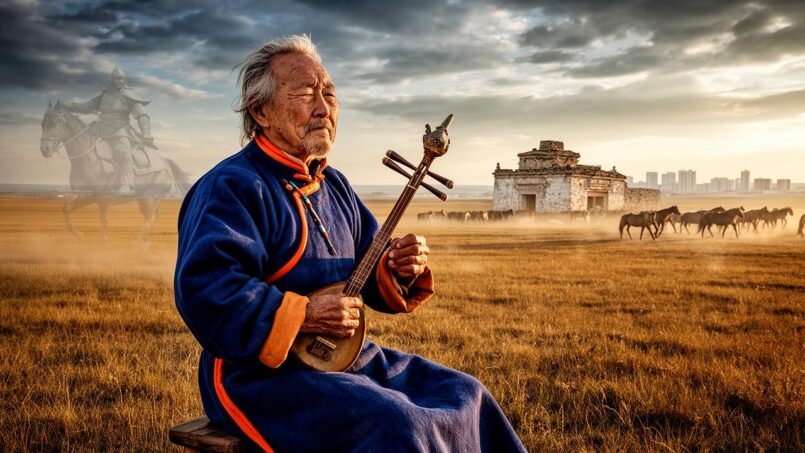
Faced with tensions, national and international institutions work to document and valorize the nomadic heritage. Elements such as morin khuur music, tuuli epics, biyelgee dance, and sacred landscapes are inscribed on UNESCO’s Intangible Cultural Heritage list. Festivals like the World Festival of Nomadic Culture aim to transmit this knowledge to younger generations and integrate it into a globalized cultural economy.
Here again, long history serves as a resource. The evocation of Genghis Khan as “leader of all those living under felt tents,” the reminder of the Xiongnu or Rouran confederations, the insistence on the continuity of pastoral mobility through invasions, revolutions, and collectivization, fuel a distinctive pride: that of being one of the few nations to claim an imperial memory based on a nomadic way of life.
Conclusion: A Past That Structures the Future
The country’s history in Mongolia is not merely a succession of empires and dominations. It is a thread connecting the ancient confederations, the blazing glory of the Mongol Empire, the long Manchu interlude, the socialist revolution, Soviet tutelage, and the construction of a fragile but real democracy. This thread is woven from sometimes contradictory experiences: freedom of movement and colonial enclosure, religious tolerance and destruction of monasteries, imperial pride and the vulnerability of a buffer state.
Mongolia’s historical heritage constitutes a resource for national cohesion and international projection, but also represents a challenge, as a focus on glorifying the past can divert attention from current issues such as economic diversification, social inequalities, environmental fragility, and relations with its two large neighbors.
Between the “eternal blue sky” and mine dust, between steppe riders and connected students, Mongolia continues to write a history where the shadow of Genghis Khan looms but no longer dictates everything. Understanding this long history means grasping how a space long seen as peripheral has shaped, and still shapes, the balances of Eurasia—and how a nomadic people has repeatedly transformed its mode of existence into a state project.
Disclaimer: The information provided on this website is for informational purposes only and does not constitute financial, legal, or professional advice. We encourage you to consult qualified experts before making any investment, real estate, or expatriation decisions. Although we strive to maintain up-to-date and accurate information, we do not guarantee the completeness, accuracy, or timeliness of the proposed content. As investment and expatriation involve risks, we disclaim any liability for potential losses or damages arising from the use of this site. Your use of this site confirms your acceptance of these terms and your understanding of the associated risks.

Cyril Jarnias is an independent expert in international wealth management with over 20 years of experience. As an expatriate himself, he is dedicated to helping individuals and business leaders build, protect, and pass on their wealth with complete peace of mind.
On his website, cyriljarnias.com, he shares his expertise on international real estate, offshore company formation, and expatriation.
Thanks to his expertise, he offers sound advice to optimize his clients' wealth management. Cyril Jarnias is also recognized for his appearances in many prestigious media outlets such as BFM Business, les Français de l’étranger, Le Figaro, Les Echos, and Mieux vivre votre argent, where he shares his knowledge and know-how in wealth management.





