
 Published on and written by Cyril Jarnias
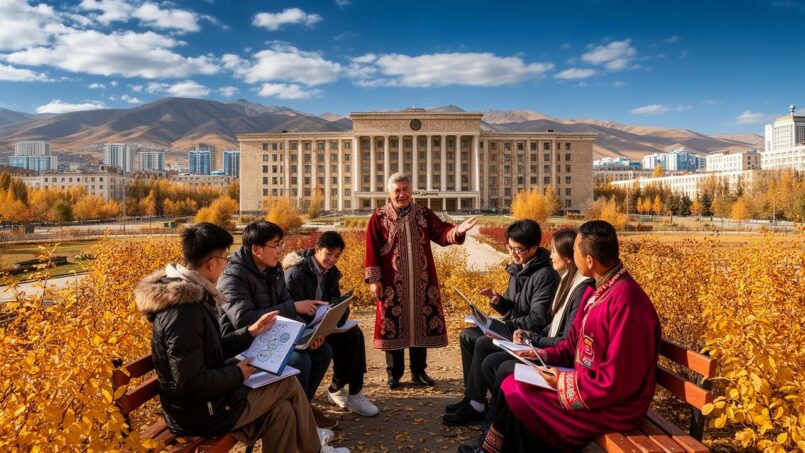
Pursuing higher education abroad in Mongolia is an unconventional bet, far from the “classic” destinations like Western Europe or North America. Yet this country, sandwiched between Russia and China, offers a unique mix: universities in the midst of transformation, affordable cost of living, an academic environment on the path to internationalization, and an exceptional field of study for everything related to natural resources, climate, the steppe, pastoralism, or international relations.
This article details the essential aspects of studying in Mongolia, including the university system, languages of instruction, costs, life in Ulaanbaatar, admission and visa procedures, available scholarships, as well as research and career opportunities.
A higher education system in transition
Studying in Mongolia means entering a university system that is rapidly reforming. The country has several dozen higher education institutions, with a high concentration in the capital, Ulaanbaatar, which alone hosts over fifty institutions.
Two universities, NUM and MUST, together produce nearly all of the country’s graduates.
Master’s programs in Mongolia generally last one to two years, with average tuition fees around 700 to 750 USD for the entire program in many listed programs. In total, there are about 159 master’s programs spread across roughly twenty universities in the country, the vast majority in Ulaanbaatar.
Although no Mongolian university appears in the global top 1000, some institutions are gaining recognition in Asia. For instance, the National University of Mongolia is ranked around 900th in regional rankings like QS Asia, positioning itself as a general research university.
Public vs. private: two complementary logics
Public universities concentrate most of the research and are primarily located in Ulaanbaatar. They cover a broad spectrum of disciplines: natural sciences, engineering, social sciences, medicine, agronomy, education, etc.
Private institutions, more numerous but often smaller, specialize more in business, management, humanities, languages, or information technology. Some of them, like Mongolia International University (MIU) or the International University of Ulaanbaatar, strongly emphasize English as the language of instruction to attract international students and improve the employability of their graduates.
The table below provides a non-exhaustive overview of some key universities for a higher education project.
| University | City | Type | Main academic strengths |
|---|---|---|---|
| National University of Mongolia (NUM) | Ulaanbaatar | Public | Sciences, humanities and social sciences, law, international relations, linguistics, environment |
| Mongolian University of Science and Technology (MUST) | Ulaanbaatar | Public | Engineering, technology, computer science, applied sciences |
| Mongolian National University of Medical Sciences (MNUMS) | Ulaanbaatar | Public | Medicine, public health, medical sciences |
| Mongolian University of Life Sciences | Ulaanbaatar | Public | Agriculture, environment, forestry, agroecology |
| Mongolia International University (MIU) | Ulaanbaatar | Private (English) | Business, public administration, language education, computer science |
| International University of Ulaanbaatar | Ulaanbaatar | Private | English programs, exchanges, business, IT |
| German-Mongolian Institute for Resources and Technology (GMIT) | Ulaanbaatar | Partnership | Resources, engineering, German-Mongolian cooperation |
A structured and accessible master’s offering
For a student considering a master’s in Mongolia, NUM and MUST are often the first reflex. NUM, for example, offers more than 90 master’s programs officially recognized by the Mongolian Ministry of Education and Science. Master’s curricula are governed by a credit system: a “standard” master’s consists of 32 credits, with durations ranging from one and a half to two years.
NUM distinguishes several formats:
Discover the different structures of Master’s programs offered, each tailored to specific academic and professional objectives.
Program focused on research, comprising approximately 30 credits including a thesis and a block of credits dedicated to scientific work.
Structured program around teaching units, totaling 32 academic credits.
Pathway without a thesis where the required credits are validated by completing a long internship in a company or organization.
Students wishing to change fields compared to their bachelor’s degree may be admitted conditionally: they must then complete a two-semester preparatory program (Pre-Master). This bridging system allows, for example, an economics graduate to enter a master’s in international relations, or an engineer to move toward a master’s in environmental policy, provided they accept this additional academic gateway.
To obtain a PhD at NUM, 60 credits and a thesis defense are required. Although the volume of doctoral programs is limited, the country is opening up to research, particularly in natural resources, climate, the steppe, and geology.
An academic calendar close to the international model
The academic calendar, especially at NUM and MUST, is close to the North American semester model.
| Semester | Approximate period | Main remark |
|---|---|---|
| Fall semester | Early August – mid-December | Online applications generally from May to July |
| Spring semester | Early February – mid-June | Online applications from October to early December |
This structure facilitates mobility, especially for exchange students or dual degree programs.
English finds its place on Mongolian campuses
For decades, Russian was the dominant foreign language in Mongolia, a legacy of the socialist period. Everything changed in the 1990s: the country shifted to a market economy, the need for English exploded, and a specialized institute was created to retrain Russian teachers as English instructors with support from the UNDP and British organizations.
Since then, several public policy documents have pushed universities to adopt English as the language of instruction for all or part of their curricula. The government has set the goal of seeing at least four national universities among Asia’s best by 2030, emphasizing English as a tool for training and competitiveness.
Concretely, this translates into:
Higher education institutions are increasingly offering courses in English, particularly in fields like business, computer science, international relations, tourism, medicine, and technology. Some institutions, such as Mongolia International University, have offered fully English-taught programs since their founding. Additionally, dual degree partnerships with foreign universities are developing, like the joint program in public administration between MIU and the University of Missouri.
Studies estimate that about 28 Mongolian universities offer courses in English, totaling close to 400 teaching units. However, the possibility of completing an entire master’s program fully in English remains limited and is often found within joint programs: it is therefore essential to verify when applying whether all courses are taught in English or only a portion.
Language of instruction: a key parameter
In practice, three main configurations emerge for an international student:
– A master’s taught primarily in Mongolian: accessible if you have a good language level (NUM internal test or TOMFL certificate). NUM and other universities offer intensive Mongolian language programs (6 to 10 months, with six levels) to prepare for this type of pathway;
– A master’s in English, often at a private university or through a joint program;
– A research stay or short program (field school, language stay, summer school) with interpretation, such as those offered by the American Center for Mongolian Studies (ACMS) or some scientific NGOs.
The following table illustrates language of instruction logics in some typical cases.
| Type of program | Main language | Typical international student profile |
|---|---|---|
| Standard master’s at NUM or MUST | Mongolian | Student who has completed Mongolian language preparation |
| Joint master’s at MIU (business, SE, etc.) | English | English-speaking or bilingual (English + other language) student |
| Intensive Mongolian language course (NUM, MIU) | Mongolian (beginners possible) | Student starting from scratch, aiming eventually to take a Mongolian-taught program |
| ACMS field school on climate and pastoralism | English (with Mongolian translation) | Student in geography, climate, anthropology, or ecology |
Ulaanbaatar: academic heart and affordable city
For the vast majority of international students, university life will take place in Ulaanbaatar. The capital concentrates most universities, research centers, international NGOs, and cultural infrastructure.
From an economic perspective, Ulaanbaatar offers a significantly lower cost of living than major Western cities. Various international indices rank it among the most affordable 30% of cities worldwide. Without rent, living in Ulaanbaatar costs nearly 50% less than in Austin (Texas), and the gap is even wider compared to cities like Wellington or Helsinki.
For a single student, estimates vary depending on comfort level, but a monthly budget excluding rent of around 600 USD is often cited. Including rent, the total comes to roughly 850 to 900 USD per month for a decent lifestyle. For a family, the figures rise significantly, around 2,000 USD monthly.
Finding housing in Ulaanbaatar: from university dorm to furnished apartment
Ulaanbaatar offers a fairly wide range of student housing: university dormitories, hostels, shared rooms, furnished apartments, and even homestays with families or nomadic herders as part of specific programs.
The National University of Mongolia manages five student residences, one of which is dedicated to international students.
At private universities like the University of Finance and Economics or MIU, student housing is also available, often in double rooms set up near campus, with equipment suitable for long-term stays.
The maximum monthly rent for a three-bedroom apartment in Ulaanbaatar, depending on quality and location.
The following table provides some numerical benchmarks for rents and student housing.
| Type of housing | Location | Indicative price (MNT/month) | Comment |
|---|---|---|---|
| NUM dorm – single international room | NUM campus | ≈ 427,800 | Furnished, shared common areas |
| NUM dorm – double room (per person) | NUM campus | ≈ 213,840 | Furnished, reduced cost |
| 1-bedroom apartment – city center | Ulaanbaatar | ≈ 1.4 to 2.7 million | Highly variable by building |
| 1-bedroom apartment – outside center | Ulaanbaatar | ≈ 1.0 to 2.0 million | Mid-range to affordable |
| 3-bedroom apartment – center | Ulaanbaatar | ≈ 3.5 to 7.0 million | For shared living or family |
| Hostel (dorm bed) | Ulaanbaatar | 7,000 to 12,000 / night | Very economical short-term solution |
For a student looking to optimize their budget, the university dormitory is often the most economical option, especially since some universities offer guaranteed spots for scholarship or exchange students.
Daily cost of living
Beyond rent, everyday expenses in Ulaanbaatar remain reasonable for a student. Public transportation is very cheap: a single ticket costs around 500 MNT, and a monthly pass typically ranges between 20,000 and 60,000 MNT. A lunch at a small local restaurant often runs 12,000–15,000 MNT, while a more complete meal at a mid-range restaurant for two can reach 100,000 MNT or more.
Basic food products (milk, bread, rice, chicken) are affordable, although some imported or luxury goods are heavily taxed and may be significantly more expensive than in Europe. Basic utilities – electricity, water, heating, garbage – for a medium-sized apartment run around 250,000 to 300,000 MNT per month, depending on the season and the insulation of the home, as winters are particularly harsh.
Studying in the heart of an open-air climate laboratory
One of the major academic advantages of Mongolia for an international student, especially at the master’s or doctoral level, lies in its natural environment and the climate challenges the country faces.
Since 1940, the average annual temperature has increased by 2.2 to 2.5 °C, a rate above the global average, with winter warming exceeding 3 °C. More than three-quarters of the territory is affected by desertification, often severe, and extreme events (droughts, dzud, floods, fires, heatwaves, erratic rainfall, strong winds) are multiplying.
For students in climatology, geography, ecology, environmental sciences, or public policy, Mongolia becomes a giant field of study. The country adopted its first National Climate Change Adaptation Plan, covering the period 2024–2030, with 15 objectives and 99 actions spread across 8 priority sectors. This plan, supported by funding from the Green Climate Fund and organizations like UNEP or the Asian Development Bank, provides an exceptional basis for thesis work, dissertations, or field projects.
A program funded by the American Center for Mongolian Studies illustrates the existence of specialized courses. It allows studying climate change by cross-referencing meteorological data with local herder knowledge. Participants travel through various ecosystems (mountain, steppe, desert), stay in ger camps, conduct interviews with herders and environmental officials, and visit ecological monitoring stations.
For a master’s student seeking a research field in climate adaptation, water management, rural community resilience, or conflicts between mining and pastoralism, Mongolia is clearly a scientific hotspot.
Training offerings: from classical disciplines to highly specialized fields
From a disciplinary perspective, the range of master’s programs in Mongolia is widely diversified. At major universities, you find fields close to international standards: management, finance, international relations, law, education, engineering, computer science, natural sciences, social sciences, agriculture, environmental sciences, biology, physics, chemistry, applied mathematics, or statistics.
The country’s specificity emerges in certain niches:
Mongolia offers a unique study setting, combining an economy dominated by the mining sector, specific steppe ecosystems, a rich nomadic culture, and a distinct tourism potential.
Study of geology, geophysics, and mineral resources in a country where this sector accounts for about 30% of GDP and over 85% of exports.
Research in cold-climate agronomy, steppe ecology, and sustainable rangeland management.
Exploration of nomadic culture, Mongolian Buddhism, as well as Mongolian language and literature.
Development of tourism focused on nature, adventure, and exploring Mongolia’s historical heritage.
In the health field, the Mongolian National University of Medical Sciences offers a relatively comprehensive range of master’s and doctorates, both in-person and online, as well as distance learning.
Applying to a Mongolian university: conditions and procedures
Admission requirements vary from one institution to another, but there is a common foundation for international students.
For a master’s, you generally need to: manage a research project, attend lectures and tutorials, complete internships in companies, write a thesis, and pass exams.
To apply for a Master’s in Mongolia, you must hold a Bachelor’s degree in an appropriate field with a good academic level (equivalent to a GPA above 3.0/4.0). You need to provide translated and notarized transcripts and diplomas (Mongolian translation mandatory for final registration). You must also demonstrate good health through a recent medical certificate and HIV test, and have a valid passport (often at least one year beyond the intended entry date). For some selective master’s programs, a research proposal, a motivation letter, and letters of recommendation may be required.
Universities also require proof of financial capacity, showing that the student can cover tuition and living costs, even though these remain relatively low compared to Western standards.
Application timeline
Most Mongolian universities operate with two main annual admission rounds, aligned with the semester calendar.
| Typical university (e.g., NUM) | Entry semester | Online application opens | Indicative deadline |
|---|---|---|---|
| NUM, MUST, large public universities | Fall | Around May 1 | Early July |
| Spring | Early October | Early December |
Admission decisions are generally communicated via email, and the acceptance letter is then used to begin visa procedures.
Required language skills
The language component is crucial. For programs in Mongolian, universities generally require:
To be admitted to a university program in Mongolia, international students must prove their proficiency in the Mongolian language. Accepted methods are: passing an internal Mongolian language test administered by the university; obtaining an external TOMFL (Test of Mongolian as a Foreign Language) certificate with a minimum level, often M3 or higher; or completing a preparatory Mongolian language program at a Mongolian university with a sufficient grade average.
For English-taught master’s programs, most institutions require a minimum score on IELTS or TOEFL iBT, typically around IELTS 5.5 or TOEFL iBT 60. Some universities also accept qualifications like the GCSE English or other proof of schooling in English.
There are also intensive language programs in Mongolia, notably at NUM or MIU, lasting 6 to 10 months and allowing students to acquire the linguistic foundations to then enter a degree program.
Getting a student visa for Mongolia
For a stay of more than 90 days, a specific student visa is mandatory. Mongolia uses a dedicated visa category called type “S”, subdivided into several subcategories depending on the type of institution attended (language course, vocational training, research).
The host university in Mongolia must initiate the process by submitting an official request to local authorities, accompanied by the student’s acceptance letter, copies of their passport, and their HIV test certificate. Only after obtaining approval and notification from the Ministry of Foreign Affairs to the relevant embassy or consulate can the student obtain their visa.
The documents generally required for a student visa include:
– the acceptance letter from a recognized Mongolian university or institute;
– a copy of the passport (valid for at least six months after the arrival date);
– a passport-sized photo;
– a certificate of a negative HIV test and sometimes other medical exams;
– proof of medical insurance;
– notarized translations of documents if necessary.
Visa fees are around 130 USD for a standard application, non-refundable in case of refusal.
Arrival and registration on site
Once in Mongolia, the student must report to immigration authorities within the first few days after arrival. Depending on the length of stay, you need to:
Upon arrival, you must register with the immigration agency within 48 hours or at the latest during the first week. You must then apply for a residence permit, which is generally issued for six months to one year and is renewable. At the same time, inform your university’s international student office and provide them with the required documents: your passport, proof of address, medical certificate, passport photos, and the payment receipt for the permit fee.
A temporary departure during studies often requires applying for an exit visa or a specific round-trip visa, under penalty of problems when leaving the country. Failure to comply with registration rules or overstaying the authorized period can result in fines or even an exit ban.
Scholarships and funding for studying in Mongolia
For an international student, several funding avenues exist depending on nationality and type of program.
Some major international scholarships, such as the US Gilman, Boren, or Freeman Awards for Study in Asia, specifically encourage and fund academic stays in less conventional countries like Mongolia. They can cover a significant portion of program fees, travel, and living expenses for a semester or a year, especially for learning a strategically important language or culture.
Specialized field program organizations, like the School for International Training (SIT), also fund study stays in Mongolia, sometimes through scholarships dedicated to sustainability, development, or participation of students from minority backgrounds (Compton funds, HBCU student scholarships, co-financing mechanisms with Pell Grants, etc.).
The Mongolian government strengthened the framework for financial aid (scholarships, loans, grants) in 2024-2025 through the Education Loan Fund. New co-financing programs with world-class universities (2+2 models or master’s/doctorates) are planned, including for people with disabilities. The goal is to train internationally-educated graduates who will return to contribute to the country’s development.
For the international student coming to Mongolia, the most realistic option is often a mix: home country scholarship (sending state, international program, foundation) + low local tuition fees + moderate cost of living. Some Mongolian universities also offer financial aid or partial scholarships to international students, but on a highly competitive basis.
Student life, work, and career prospects
The quality of life in Ulaanbaatar receives mixed reviews. On one hand, many expatriates highlight relative safety for women, freedom of expression, reasonable cost of living, still sparsely populated spaces, the ability to launch or test entrepreneurial projects, and access to good quality higher education in some fields. On the other hand, the city suffers from recurring problems: significant air pollution in winter, dangerous roads, hospitals that could be improved, very unequal access to English among the population, harsh climate, limited tolerance for certain minorities, and cultural infrastructure less developed than in other Asian capitals.
Working alongside studies is possible under certain conditions. The study visa generally allows limited work, often supervised by the university. Additionally, the government offers the “Student with Income” program to facilitate access to small jobs, in collaboration with employment agencies and institutions like the National University of Teacher Education.
Student employment assistance centers support young people in their search for part-time positions, internships, or jobs after graduation. Figures compiled over several years show an increase in these services: several hundred students per year find paid positions through these services, with modest but significant financial support to cover living costs.
Employability of graduates: challenges and opportunities
Studies on the professional integration of Mongolian graduates paint a nuanced picture. A national survey indicated that more than two-thirds of graduates found a job, but that a majority held positions below their qualification level. In sectors like tourism, employers regularly note gaps in practical experience, foreign languages, knowledge of the country, and communication skills.
Young graduates entering the banking sector have theoretical foundations but require additional in-house training on products, legislation, communication, and financial analysis. To address this, structured partnerships between banks and universities are developing, offering longer, better-paid, and formalized internships.
For an international student, these observations can be seen as an opportunity: demand for profiles with both solid technical skills and genuine international experience is high, especially in the mining, energy, finance, education, or international development sectors.
Why choose Mongolia for a master’s abroad?
When deciding on a study destination, Mongolia does not automatically come to mind. Yet it combines several strengths rarely found together elsewhere.
First, the overall cost is attractive. Between affordable tuition fees, reasonable housing, and a cost of living lower than most Western capitals, a complete master’s in Mongolia remains financially accessible, especially if you benefit from a partial scholarship or support from your home university.
The country provides an exceptional study environment for disciplines related to natural resources, water, climate, the steppe, pastoralism, mining, and international relations, given its geopolitical position between two major powers. It offers unparalleled research terrain for climatology, geography, political science, rural sociology, and anthropology.
The rise of English-taught programs, supported by a long-term national strategy, is gradually opening doors to students who do not speak Mongolian. Institutions like MIU, the International University of Ulaanbaatar, or the English-language departments of NUM and MUST are focusing on this niche.
Mongolia is integrated into several international academic networks, with partnerships with American universities, associations via European programs like Erasmus Mundus, and cooperation with Chinese and Russian institutions. This position serves as an interesting springboard for students wishing to engage in research or expertise projects on a Eurasian scale.
Pursuing higher education abroad in Mongolia is not a mass choice, but that is precisely what gives it value. On a CV, this experience conveys the ability to thrive in a challenging environment, curiosity for little-explored terrains, and direct familiarity with issues – climate, resources, nomadism, mining governance – that will be central in the decades to come.
Disclaimer: The information provided on this website is for informational purposes only and does not constitute financial, legal, or professional advice. We encourage you to consult qualified experts before making any investment, real estate, or expatriation decisions. Although we strive to maintain up-to-date and accurate information, we do not guarantee the completeness, accuracy, or timeliness of the proposed content. As investment and expatriation involve risks, we disclaim any liability for potential losses or damages arising from the use of this site. Your use of this site confirms your acceptance of these terms and your understanding of the associated risks.

Cyril Jarnias is an independent expert in international wealth management with over 20 years of experience. As an expatriate himself, he is dedicated to helping individuals and business leaders build, protect, and pass on their wealth with complete peace of mind.
On his website, cyriljarnias.com, he shares his expertise on international real estate, offshore company formation, and expatriation.
Thanks to his expertise, he offers sound advice to optimize his clients' wealth management. Cyril Jarnias is also recognized for his appearances in many prestigious media outlets such as BFM Business, les Français de l’étranger, Le Figaro, Les Echos, and Mieux vivre votre argent, where he shares his knowledge and know-how in wealth management.





