
 Published on and written by Cyril Jarnias
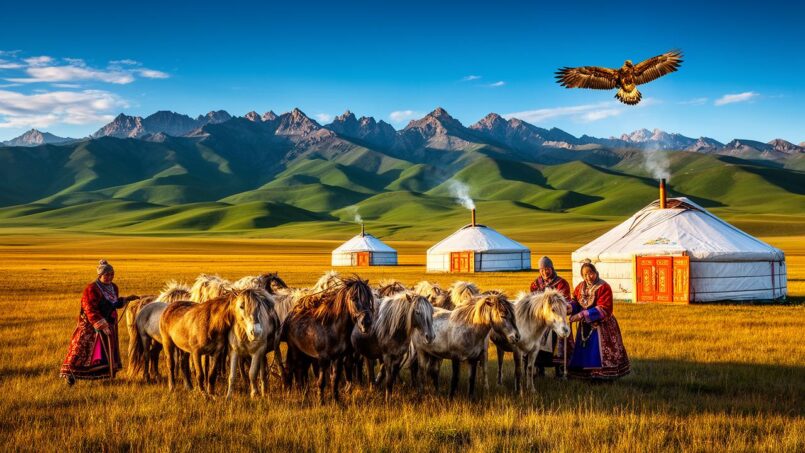
Traveling in Mongolia means accepting to lose your usual bearings and entering a land of endless steppes, silent deserts, sacred mountains, and monasteries lost at the end of dirt tracks. Behind the sometimes caricatured image of the “land of Genghis Khan” lies a mosaic of landscapes and cultures that few destinations can still offer on this scale. Within this immense territory, certain places stand out as true keys to understanding the country: national parks, UNESCO sites, ancient capitals, mythical deserts, and lakes of an unreal blue.
This article provides an overview of the must-see tourist sites in Mongolia, drawing on protected parks, grand landscapes, sites of Mongol Empire memory, and capitals past and present.
Ulaanbaatar and Its Surroundings: Gateway to the Country
Ulaanbaatar concentrates more than a third of Mongolia’s population and serves as a logistical base for all major expeditions across the country. The city itself, long reduced to the image of a gray, polluted capital, nonetheless reveals a surprisingly dense religious, political, and cultural heritage.
At the heart of the city, the vast Sükhbaatar Square—sometimes called Chinggis Khaan Square—sums up a part of national history on its own. On the Parliament forecourt, an imposing sculpted ensemble honors Genghis Khan seated in the center, flanked by his successors Ögödei and Kublai, and surrounded by two of his faithful generals, Bo’orchu and Mukhlai. The square is bordered by the Government Palace, the State Opera and Ballet Theater, the Stock Exchange, museums, and administrative buildings, making it the country’s main political and festive gathering space.
Located a few streets away, this museum covers more than 700,000 years of history, from Paleolithic tools to the democratization of the 1990s. It displays imperial armor, ethnic costumes, Buddhist objects, and archives from the Soviet period. An essential visit to understand the eras of the Huns, Turks, Genghis Khan, and the Soviet era.
Monasteries, Art, and Memory in Ulaanbaatar
The religious face of Ulaanbaatar is revealed especially at the Gandantegchinlen Monastery, better known as Gandan. Founded in the 19th century, this large Buddhist complex was one of the few to survive, at least in part, the communist purges. Today it houses several hundred monks and a massive 26.5-meter Buddha, an interior monumental statue filled with sacred texts, medicinal plants, and precious stones. Outside, the faithful spin prayer wheels in an atmosphere that contrasts sharply with the bustle of the city center.
Not far from the central square, the Choijin Lama Museum-Monastery allows visitors to gauge the finesse of Mongolian religious art. This early-20th-century temple complex, once dedicated to a state oracle, was turned into a museum after its closure under the communist regime. Frescoes, tsam dance masks, statues, and ritual objects testify to the iconographic richness of a Buddhism heavily marked by shamanism.
This museum houses one of the most important collections of works by Zanabazar, a 17th-century religious leader and genius sculptor. It presents a remarkable ensemble of his paintings, bronzes, and thangkas, placed in dialogue with more recent artistic productions. The whole thus offers a complete panorama of Mongolian aesthetics over several centuries, particularly attracting fans of the visual arts.
To get a sense of the capital as a whole, climbing the hill of the Zaisan Memorial is a must. Built in 1971 to glorify the Soviet-Mongolian alliance, the circular monument decorated with frescoes dominates the entire Tuul River valley. The steps to climb are many, but the 360° view over Ulaanbaatar, its ger districts, glass towers, and surrounding reliefs is well worth the effort.
The Genghis Khan Statue Complex: A Modern Symbol of an Empire
About fifty kilometers east of Ulaanbaatar, on the banks of the Tuul River, a stainless steel giant dominates the steppe: the Genghis Khan Equestrian Statue, approximately 40 meters high, the tallest equestrian statue in the world. It stands atop a circular visitor center that houses a museum dedicated to Mongolian history, with collections covering the Empire period and artifacts dating back to the Bronze Age.
According to tradition, it is at this spot that the young Temüjin is said to have found a golden whip, an omen of his destiny to unite the tribes. Visitors go up inside the structure, then emerge onto a platform located in the horse’s head to take in the plains of Khentii, the cradle of the empire.
This complex is one of the gateways to the vast protected area of Khan Khentii, which includes the sacred Burkhan Khaldun Mountain.
Gorkhi-Terelj and Bogd Khan Uul: Nature at the City’s Doorstep
Less than two hours’ drive from the capital, Gorkhi-Terelj National Park offers a landscape of wooded hills, open valleys, astonishing rock formations, and alpine meadows. It is one of the country’s most accessible parks and an ideal introduction to Mongolian landscapes. Travelers can stay in ger camps, go hiking, horseback or bike riding, or kayaking on the Terelj or Tuul rivers.
Among the most photographed natural curiosities is the “Turtle Rock”, a granite outcrop whose shape evokes the animal emblematic of longevity in Asia. Further on, the Aryabal Buddhist Temple, perched on the heights, rewards a steep climb with a sweeping view of the valleys.
Further south of Ulaanbaatar, Bogd Khan Uul Mountain was classified as a protected area as early as the late 18th century, making it one of the oldest nature reserves in the world. Its wooded slopes overlook the capital and lend themselves to hiking, cross-country skiing, or sledding in winter. The partially ruined Manzushir Monastery recalls the region’s dense religious past.
To the west of the capital, another park, Khustain Nuruu, is well worth the detour.
Khustain Nuruu: The Realm of the Przewalski’s Horse
Khustain Nuruu, often called Hustai, was created to host an audacious bet: reintroducing the Przewalski’s horse, or takhi, the last truly wild horse species in the world, back into its natural habitat. Extinct in the wild in the 20th century, the takhi survived only in captivity in Europe before being reintroduced to this area of rolling steppe starting in the 1990s.
The park, inscribed on UNESCO’s “Man and Biosphere” program, hosts the largest wild population of Przewalski’s horses (takhis). To observe them, it is recommended to ride through the valleys in the late afternoon, accompanied by a guide, to spot the harems at a respectful distance. The area is also rich in biodiversity, with deer, gazelles, wolves, ibex, as well as a wide variety of plants and mushrooms.
With its rolling hills, groves, and the course of the Tuul River, Khustain Nuruu illustrates the transition between dry steppe and the forests of the Khentii massif. This park, relatively close to Ulaanbaatar, thus offers a condensed experience of wildlife, landscapes, and conservation history in Mongolia.
Orkhon, Karakorum, and the Cultural Landscapes of the Mongol Empire
To understand the historical dimension of Mongolia, you must leave the capital and head southwest, following the Orkhon Valley. Inscribed as a UNESCO World Heritage Site, this cultural valley stretches for over 300 kilometers along the Orkhon River, in the provinces of Arkhangai and Övörkhangai. It brings together remains covering more than 2,000 years of human presence, from the Paleolithic to the modern era, passing through the Huns, Turks, Uighurs, Khitans, and Mongols.
Karakorum and Erdene Zuu Monastery
At the heart of this valley lay the imperial capital of Karakorum (Kharkhorin), established by Genghis Khan as an administrative center in the early 13th century, then developed by his son Ögödei. Sources describe a cosmopolitan city where Muslim merchants, Chinese artisans, religious figures of multiple faiths, and prisoners of war from all corners of the empire mingled. Palaces, gardens, artificial lakes, and places of worship—Buddhist, Muslim, Taoist, and Christian—were built there.
This is the number of museums, in Kharkhorin, that preserve the archaeological remains of the former Mongol capital Karakorum.
Right next door, the Erdene Zuu Monastery, founded in 1586 by a khan converted to Buddhism, was built largely with stones and bricks from the former capital. Surrounded by a wall pierced with 108 stupas, the complex is considered the oldest Buddhist monastery in the country. Its three main temples—Baruun Zuu, Zuun Zuu, and Buddha Zuu—represent different stages of the Buddha’s life. Despite the massive destruction of the 20th century, part of the site has been restored, and pilgrims still flock there.
Perched Monasteries and Waterfalls
The Orkhon Valley is not limited to Karakorum. Off the beaten path, on a rocky promontory of the Khangai range, stands the Tövkhön Monastery, founded in the 17th century by Zanabazar, a great religious dignitary and artist. This small monastic ensemble clinging to the mountain is also on the World Heritage list. It is accessed on foot or horseback, through larch forests that blaze in autumn.
A spectacular natural site in the heart of Mongolia, marked by water, basalt, and nomadic life.
A 15-meter-high waterfall creating a striking break in the landscape of the region.
Geological formation shaped by ancient volcanic eruptions and continuous erosion.
Site surrounded by meadows, groves, and the traditional gers of nomadic herders.
The outskirts of the valley also contain monumental Turkic monuments, such as the Orkhon runic steles, dedicated to Prince Kul Tigin and his brother Bilge Khagan in the 8th century. These inscriptions in Old Turkic, carved on tall standing stones, recount the deeds of the rulers and constitute major historical documents.
Sites and Monuments of the Ancient Steppe Period
Further north and northwest, other archaeological ensembles complete this picture. The “Deer Stones,” recently inscribed on the UNESCO World Heritage List, stand mainly in the provinces of Khövsgöl and Arkhangai, but can be found in many valleys. These granite monoliths, dated to the Bronze Age and early Iron Age, are carved with stylized deer silhouettes, weapons, belts, and symbols whose exact meaning remains debated. They appear to be associated with funerary and ritual practices of nomadic pastoral societies, much earlier than the Mongols.
In the far west, in the Altai massif, a major cultural site recognized by UNESCO. Thousands of engravings document the evolution of lifestyles, from mammoth hunting to horse breeding, over nearly 13,000 years.
UNESCO – Petroglyph Complexes of the Mongolian Altai
Gobi Gurvansaikhan and the Great Gobi Desert
In the south of the country, the Gobi fascinates as much as it impresses. With over a million square kilometers of deserts and semi-deserts shared between Mongolia and China, this region is not just an ocean of sand, but a complex mosaic of stony plains, dunes, mountains, canyons, and arid steppes. The heart of visits on the Mongolian side lies in Gobi Gurvansaikhan National Park, the largest in the country, stretching over nearly 27,000 km² in Ömnögovi Province.
This park takes its name from the massif of the “Three Beauties” (Baruunsaikhan, Dundsaikhan, and Zuunsaikhan), terminal branches of the Altai range. It gathers some of the most photogenic landscapes in Mongolia.
The Singing Dunes of Khongor
At the foot of these mountains, the Khongoriin Els dunes, often nicknamed “singing dunes,” form a ribbon of sand that can reach up to 300 meters in height and stretch 100 to 180 kilometers in length. Their width varies from a few kilometers to a dozen, for an area that can approach a thousand square kilometers.
The northern part of the dune massif is bordered by a small river, the Khongor, which feeds a string of lush oases. Further south, the sand abruptly ends against rocky slopes. When the wind blows or travelers run down the steepest slopes, the sand produces a characteristic low rumble, the phenomenon behind the nickname “singing” dunes. At sunrise and sunset, the play of light on the golden crests creates a striking spectacle.
Glacial Valleys and Flaming Cliffs
East of Khongor, the Yolyn Am valley—the “Valley of the Vulture”—contrasts with classic images of the desert. This narrow gorge, carved by water into the rock, often retains a tongue of ice tucked in the shadow of the walls until early summer. Seeing this “desert glacier” surrounded by arid steppes gives an idea of the extreme climatic diversity of Mongolia, where one can indeed experience several seasons in a single day. Lammergeiers (bearded vultures) and golden eagles nest in these cliffs, making it a popular site for birdwatchers.
Nicknamed ‘Flaming Cliffs’ for their red color at sunset, these cliffs are a major global paleontological site. In the 1920s, Roy Chapman Andrews’ team discovered the first dinosaur eggs there, as well as skeletons of Protoceratops, Oviraptors, and Tarbosaurs. The Gobi Desert, which contains this site, is considered one of the largest ‘dinosaur graveyards’ in the world.
Further south and west, other paleontological sites such as Nemegt, Tugrugiin Shiree, Ukhaa Tolgod, Algui Ulaan Tsav, and Khermen Tsav continue to attract international scientific missions. Curious travelers can observe, without digging, fossilized bones emerging from eroded strata.
Sacred Rocks and Lost Monasteries
The Gobi is not just dunes and fossils. In Dundgovi Province, granite massifs like Baga Gazriin Chuluu and Ikh Gazriin Chuluu rise from the steppe like mineral fortresses. Gorges, springs, caves, and rock carvings nestle among these blocks, while temple ruins recall the past presence of monastic communities.
Founded in the 18th century on the banks of the Ongi River, this monastery was one of the largest Buddhist centers in the Gobi Desert, housing over a thousand monks. Destroyed during the purges of the 1930s, it is currently being rebuilt. Visitors can explore its ruins, located overlooking a river whose flow has been reduced by mining activities.
Rare Wildlife and Extreme Nomadism
Despite a harsh environment, the Gobi shelters particularly precious wildlife. Iconic species such as the Gobi bear—the very rare mazaalai, Przewalski’s horse (present notably in the southwest), snow leopards, argali sheep, ibex, Pallas’s cat, lynxes, and wild Bactrian camels survive in these spaces. Saxaul trees, characteristic desert shrubs, form sparse groves that stabilize the sand and serve as fuel for nomads.
Camel-herding families, who live off raising Bactrian camels, goats, and sheep, adapt to a daily life marked by water scarcity, lack of wood, and extreme temperature ranges. Sharing salty tea, discovering the techniques of dairy product making, or participating in seasonal transhumance offers a glimpse of nomadism in its most extreme form.
Khövsgöl: The “Blue Pearl” of the North
At the other end of the country, almost on the Russian border, Lake Khövsgöl National Park forms a striking contrast with the Gobi. This glacial lake, over 130 meters deep on average, contains more than 70% of Mongolia’s freshwater reserves and is one of the rare “ancient” lakes on the planet, over two million years old. Its dark blue waters have earned it the nickname “Blue Pearl of Mongolia,” “Khövsgöl Ocean,” or “Mother Ocean.”
Lake Khövsgöl National Park features a Siberian taiga landscape, distinct from the Mongolian steppe. Its shores are densely populated by nomadic families who graze their herds, making this protected area an active pastoral living space.
Activities on site vary by season: hiking along the shores or on the ridges, kayaking, horseback riding, fishing in water rich in fish (lenok, perch, burbot, Khövsgöl grayling), or even diving for the more experienced. In winter, the surface freezes completely and becomes the setting for a spectacular ice festival: translucent sculptures, horse-drawn sleigh races, traditional ice wrestling, anklebone shooting, and reindeer races attract Mongolians and travelers alike.
The Tsaatan, reindeer herders living in the taiga, practice a migratory lifestyle and a shamanic culture. Their situation raises crucial questions about practicing responsible tourism in this fragile environment.
Khorgo–Terkhiin Tsagaan Nuur and the Khangai Mountains
In central Mongolia, in Arkhangai Province, Khorgo–Terkhiin Tsagaan Nuur National Park offers a landscape of extinct volcanoes, lava fields, and lakes. Khorgo volcano, which erupted about 8,000 years ago, left a well-defined crater atop an accessible cinder cone. Ancient lava flows dammed a valley and gave birth to Terkhiin Tsagaan Nuur, literally the “White Lake.”
The lake’s shoreline, bordered by birch and poplar forests, serves as a refuge for many migratory birds such as the black-necked crane. Wildlife also includes wild goats, deer, and sometimes bears in the surrounding massifs. The main human activities are camping, fishing, hiking, and horseback riding. At daybreak, the lake’s surface reflects the peaks of the Khangai massif and the perfect shape of the Khorgo volcano crater.
More broadly, the Khangai range, stretching across several central provinces, is one of the country’s great forested and pasture regions. It contains the sources of major rivers like the Orkhon, Selenga, Ider, and Zavkhan. Among the sacred peaks are Otgontenger Khairkhan and Suvarga Khairkhan, associated with mountain worship traditions that Mongolia officially revived in the 1990s.
Altai Tavan Bogd and the Far West
The end of the Mongolian world lies in Bayan-Ölgii Province, at the junction of the Russian and Chinese borders. That is where Altai Tavan Bogd National Park stands, dominated by the massif of the same name. Its five peaks—Khüiten, Nairamdal, Malchin, Bürged, and Ulgii—form the roof of Mongolia, with Khüiten Peak rising to over 4,300 meters. Thirty-four glaciers, including the Potanin Glacier, the country’s longest ice tongue, and the Alexander Glacier, sculpt these high-altitude landscapes.
The region hosts rich wildlife (argali sheep, ibex, deer, martens, moose, capercaillie, golden eagles). Hiking and mountaineering are recommended for experienced travelers. The site also offers blue-water lakes (Khoton, Khurgan, Dayan) and pastures where camps of Mongolian Kazakhs, a Turkic-speaking Muslim minority, live.
It is in this region that several eagle hunting festivals take place each autumn, where Kazakh berkutchis present their trained raptors on their fists, perpetuating a centuries-old tradition of falconry. The national park also contains part of the Petroglyph Complexes of the Mongolian Altai, a UNESCO site for its thousands of rock carvings tracing the evolution of hunting and herding practices.
Located in the northwest, this endorheic basin, a World Heritage site, is a vast depression composed of salt lakes and wetlands. It exhibits a great diversity of ecosystems, from steppe to mountain tundra, and hosts varied wildlife including the snow leopard and Siberian ibex.
Other Major Parks and Lakes: The Mosaic of Mongolian Landscapes
Beyond the big names, Mongolia counts dozens of more or less well-known protected areas, all contributing to the richness of the tourist offering.
In the north of the country, the Shishged River basin and the surroundings of Tengis-Shishged Nature Park reveal crystalline river valleys surrounded by dense forests. This is an area appreciated for hiking, fishing, and wildlife viewing, in a very sparsely populated setting.
In the Great Lakes Depression, Khyargas Nuur and Khar Us Nuur national parks are major sites for birdwatching. Khyargas Nuur, a salt lake with hot springs on its northern shore, attracts migratory birds to Khetsuu Khad rock. Further south, Khar Us Nuur features a complex of lakes and marshes surrounded by meadows, steppe, desert, and snow-capped mountains, where species such as wild ducks, geese, grouse, and other rare birds thrive.
In the eastern steppe, the Mongol Daguur Strictly Protected Area, part of a transboundary natural site inscribed by UNESCO as “Landscapes of Dauria,” mixes grassy steppes, wetlands, and lakes. This region is a crucial migratory corridor for many bird species, including several threatened crane species such as the white-naped crane and Siberian crane, as well as the great bustard. Vast herds of Mongolian gazelles conduct their seasonal migrations there.
The park contains Ganga Lake, a Ramsar wetland crucial for breeding waterbirds like the white-naped crane and the bearded vulture. The site also includes sacred mountains (Shiliin Bogd, Altan-Ovoo), caves, dunes, and anthropomorphic funerary stelae of great heritage value.
In central Mongolia, Khugnu Tarna National Park illustrates on a small scale the country’s landscape diversity: the sand dunes of Elsen Tasarkhai, the sacred mountain of Khugnu Khan, small lakes, and a monastery nestled among rocks. It is an ideal place to experience the transition between steppe, forest, and desert within a reduced perimeter.
Sacred Mountains and Spiritual Landscapes
The relationship between Mongolians and their environment is deeply tinged with spirituality. Mountains, in particular, are often the object of ancient worship, first shamanic, then imbued with Buddhism. Several peaks are still officially venerated on a national scale, with quadrennial worship ceremonies attended by the country’s president.
This is the area, in square kilometers, of the strictly protected zone encompassing the sacred Burkhan Khaldun Mountain.
Mountain worship rituals are performed especially around ovoo, cairns of stones and wood decorated with blue ribbons, where travelers perform three circumambulations while adding a stone to the pile. After decades of dormancy under the communist regime, these traditions were officially revived in the 1990s by presidential decree.
Other peaks like Otgontenger, Eej Khairkhan, Khanbayanzurkh, Bogd Khan, Altan-Ovoo, and Sutai Khairkhan also figure among the “sacred mountains” candidates for international recognition by UNESCO. Visiting them is not just hiking on wild reliefs, but entering landscapes experienced as inhabited by protective entities.
Summary Table of Selected Major Sites
To better situate the major Mongolian tourist sites, here is a summary table with certain essential characteristics.
| Site / Region | Site Type | Main Features | International Status (if applicable) |
|---|---|---|---|
| Ulaanbaatar (city center) | Urban / cultural | Sükhbaatar Square, national museums, monasteries, Soviet memorials | — |
| Gorkhi-Terelj National Park | National park | Granite rocks, “Turtle Rock,” Aryabal Temple, alpine meadows | National protected area |
| Khustain Nuruu National Park | National park / wildlife | Reintroduction of Przewalski’s horse (takhi), rolling steppes, recognized biosphere | UNESCO Biosphere Reserve |
| Orkhon Valley Cultural Landscape | Cultural landscape | Karakorum, Erdene Zuu, Tövkhön, Turkic monuments, Ulaan Tsutgalan Waterfall | UNESCO World Heritage (cultural) |
| Gobi Gurvansaikhan National Park | National park / desert | Khongor Dunes, Yolyn Am glacier valley, Bayanzag Cliffs, dinosaur fossils | Gobi and fossils candidacy (tentative list) |
| Altai Tavan Bogd National Park | National park / mountain | Highest peaks in Mongolia, glaciers, alpine lakes, Altai petroglyphs | UNESCO World Heritage (petroglyphs) |
| Lake Khövsgöl National Park | National park / lake | Largest freshwater reserve in the country, ancient lake, forests, Tsaatan culture | — (national protected area) |
| Khorgo–Terkhiin Tsagaan Nuur National Park | National park / volcano | Extinct volcano, lake formed by lava flows, migratory birds | National protected area |
| Uvs Nuur Basin | Lake basin | Steppe, forest, tundra ecosystems, great faunal diversity | UNESCO World Heritage (natural) |
| Landscapes of Dauria (Mongol Daguur) | Steppe / wetlands | Habitat for threatened cranes, bustards, gazelles, intact steppes | UNESCO World Heritage (natural, transboundary) |
| Deer Stone Monuments (Khövsgöl, Arkhangai) | Archaeological site | Megaliths carved with deer and symbols, Bronze Age funerary complexes | UNESCO World Heritage (cultural) |
| Great Burkhan Khaldun Mountain | Sacred mountain | Most sacred mountain in the country, linked to Genghis Khan, shamanic-Buddhist worship area | UNESCO World Heritage (cultural) |
When and How to Discover These Must-See Sites
Since Mongolia is subject to an extreme continental climate, the choice of season strongly influences the experience of the major sites. The summer months, from June to August, offer the mildest conditions for accessing most parks and remote regions. The steppes are then covered with green grass, rivers are swollen, and most tourist ger camps are open. This is also the high season, marked by the big national Naadam festival in July, which attracts many visitors to Ulaanbaatar.
Spring and autumn offer the advantage of visiting certain sites with fewer people. However, temperatures are cooler and weather conditions more changeable. In spring, especially in the Gobi Desert, sandstorms can still occur. Autumn, particularly September, is often ideal for forested regions (Khövsgöl, Khangai, Khentii) to admire the autumn colors of larches and birches.
Winter is not the most accessible season, but it reveals unique faces: snow-covered steppes, frozen lakes, ice or camel festivals in the Gobi, and tourism almost exclusively centered on immersion in the life of nomadic families. Ulaanbaatar, however, then combines extreme cold and heightened pollution.
The accessibility of Mongolia’s national parks varies considerably depending on their proximity to the capital. Parks close by like Gorkhi-Terelj, Bogd Khan Uul, and Khustain Nuruu are the easiest to access, with good roads and developed tourist infrastructure. In contrast, remote regions (western Altai, northern Khövsgöl) often require a domestic flight followed by long drives on dirt tracks. Most visits are done through organized tours, which typically include 4×4 transport, accommodation in ger camps, meals, and a guide.
A Land of Parks, Memory, and Nomadism
Throughout this journey, a constant emerges: Mongolia is as much a land of landscapes as it is a land of memory. National parks and protected areas do not only preserve flora and fauna; they often encompass archaeological ensembles, carved rocks, monasteries, and sacred mountains. Conversely, the great historical sites—Karakorum, Orkhon, Burkhan Khaldun—are located in natural environments still used by nomadic herders.
Visiting iconic sites like Lake Khövsgöl, the Gobi Desert, Khustain Nuruu Park, or the Altai Mountains is not limited to the visual aspect. These experiences, such as sleeping in a ger, walking along monastery ruins, observing wild horses, or showing respect to an ovoo, allow one to grasp the millennia-old relationship between Mongolians, their imperial history, their nomadic way of life, and nature.
For those who accept the distances, the relative isolation, and a certain material sparseness, the must-see tourist sites in Mongolia constitute less a checklist than a series of doors opening onto one of the last great wild and pastoral spaces on the planet.
Disclaimer: The information provided on this website is for informational purposes only and does not constitute financial, legal, or professional advice. We encourage you to consult qualified experts before making any investment, real estate, or expatriation decisions. Although we strive to maintain up-to-date and accurate information, we do not guarantee the completeness, accuracy, or timeliness of the proposed content. As investment and expatriation involve risks, we disclaim any liability for potential losses or damages arising from the use of this site. Your use of this site confirms your acceptance of these terms and your understanding of the associated risks.

Cyril Jarnias is an independent expert in international wealth management with over 20 years of experience. As an expatriate himself, he is dedicated to helping individuals and business leaders build, protect, and pass on their wealth with complete peace of mind.
On his website, cyriljarnias.com, he shares his expertise on international real estate, offshore company formation, and expatriation.
Thanks to his expertise, he offers sound advice to optimize his clients' wealth management. Cyril Jarnias is also recognized for his appearances in many prestigious media outlets such as BFM Business, les Français de l’étranger, Le Figaro, Les Echos, and Mieux vivre votre argent, where he shares his knowledge and know-how in wealth management.





