
 Published on and written by Cyril Jarnias
Moving to Mongolia means entering a world where spirituality permeates almost everything: the landscape, the way to say hello, how to eat, travel, celebrate New Year’s, or cross a simple mountain pass. For an expat, understanding these codes is more than cultural curiosity—it is the key to avoiding missteps, gaining the trust of Mongolians, and above all, grasping what structures their worldview.
This practical guide details the behaviors to adopt when encountering the different religions in Mongolia (Buddhism, shamanism, Islam, Christianity). It covers daily rites, major festivals, and specific situations (monastery, ger, ovoo), drawing on field information and recent studies.
A Plural Religious Landscape, Shaped by History
Today’s Mongolia is not monolithic in religious terms. The 2020 census figures show it clearly: Buddhism dominates, but atheism inherited from the communist era remains massive, and Muslim, Christian, and shamanist minorities are well represented.
Here is an overview of the major religious families, according to the national census of 2020:
| Primary Belief | Share of Population | Estimated People |
|---|---|---|
| Buddhism | 51.7% | 1,704,480 |
| No declared religion | 40.6% | 1,338,528 |
| Islam | 3.2% | 105,500 |
| Mongolian shamanism (“Böö Mörgöl”) | 2.5% | 82,422 |
| Christianity (all denominations) | 1.3% | 42,859 |
| Other religions | 0.7% | 23,078 |
In parallel, other sources give slightly different percentages, but all converge on one point: more than half of Mongolians call themselves Buddhist, and a significant minority still claims shamanism.
From Tengri to Tibetan Buddhism: A Long Spiritual Sedimentation
Mongolian spirituality has been built in successive layers. At the origin lies the cult of the Eternal Sky, Tengri or Tenger, at the heart of Tengerism and shamanism. The entire natural world is then inhabited by spirits—mountains, rivers, forests, animals—with which one must deal.
From the 16th century onward, Buddhism became the official religion in Mongolia, with the arrival of Tibetan Buddhism from the Gelug school, a form of Vajrayana linked to Mahayana.
Prince Altan Khan and the 3rd Dalai Lama, Sonam Gyatso
Monasteries (khiid in Mongolian) then became spiritual, intellectual, and medical centers. Figures like Undur Gegeen Zanabazar played a major role in spreading Buddhism and creating a distinctly Mongolian religious art.
More than 20,000 Buddhist monks were killed under the communist regime in the 20th century.
Today, we observe a strong simultaneous revival of Buddhism and shamanism, a rapid development of Christian churches, and the continuity of an Islam well established in the west of the country.
Mongolian Buddhism: Temples, Rituals, and Codes of Conduct
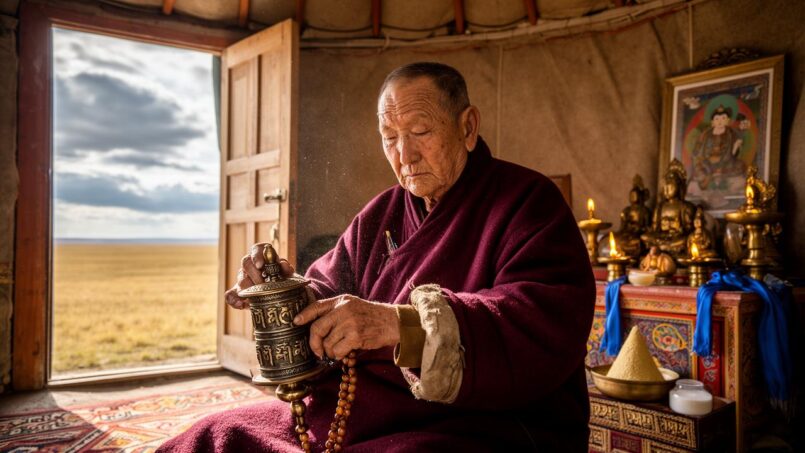
For an expat, Buddhism is arguably the most visible religious facet: city temples, prayer flags, statues, domestic altars, public ceremonies, major festivals like Danshig Naadam.
A Buddhism Tinged with Shamanism and Nature Worship
Buddhism as practiced in Mongolia is not a simple copy of Tibet. It integrates many older beliefs: worship of the Blue Sky, respect for earth spirits (gazryn ezen) and water spirits (lus savdag), veneration of ancestors, rituals around sacred mountains. This hybridization is such that many Mongolians consider themselves both Buddhist and shamanist, turning to the lama for some questions and to the shaman for others.
The great monasteries—Gandan in Ulaanbaatar, Erdene Zuu near the ancient capital, Dashchoilin, Samya Khiid, Geser Sum, Manzushir in ruins in the Bogd Khan massif—concentrate this mix: Tibetan architecture, Buddhist statues and thangkas, but also nearby ovoos, blue hadags, and references to local tutelary spirits.
How to Behave in a Monastery or Temple
Visiting a temple in Mongolia is usually simple, provided you respect a few implicit rules. They are close to the codes in force elsewhere in Asia, with some important local nuances.
From the entrance, proper attire is required: shoulders and legs must be covered, with clothing neither too tight nor too revealing. It is also customary to remove shoes, hats, and sunglasses before entering the main prayer hall.
Inside, several gestures are to be absolutely avoided. Never turn your back on a Buddhist altar or a Buddha statue: instead, withdraw by moving sideways, even slightly bowing. It is also inappropriate to point a finger at a statue or a lama; use the whole hand, palm facing up.
Sacred texts (often stacked as rectangular volumes) and cult objects (such as mani stones, prayer flags, hadags, and offerings) should not be touched disrespectfully. Actions like placing a religious book on the floor, stepping over a monk’s robe, or removing an object from an altar are considered serious breaches of respect for these items.
Circulation is almost always clockwise: around stupas, temples, prayer wheels, and ovoos. This detail, recurrent in Mongolia, is very noticeable to locals: following this direction is a silent way to show respect for the place.
For photos, the principle is simple: ask permission, especially during prayers or meditations. In many monasteries, photography is completely forbidden during services, and flash is prohibited everywhere.
A Concrete Example: Ovoos, Stone Altars for Travelers
Ovoos are those piles of stones, sometimes topped with branches and blue scarves, seen on passes, ridges, and strategic points in the landscape. They are at the heart of the Mongolian belief system, at the crossroads of Buddhism and shamanism.
An ovoo is a pile of stones or a cairn used in Mongolian traditions to honor the spirits of a place and ensure the protection of travelers. The practice consists of stopping in front of it, walking around it three times clockwise, adding a stone or small object each time. It is also common to leave an offering such as a coin, candy, cigarettes, milk, or vodka. Some ovoos, more elaborate, are topped with animal skulls and serve as sites for sky-worship ceremonies at the end of summer.
This sequence—offering, circumambulation, prayer—is deeply ingrained. Not complying, or worse, removing a stone or destroying an ovoo, is perceived as a direct affront, likely to bring bad luck, accidents, or storms. Many stories circulate, sometimes linked to reputedly dangerous mountain passes, about careless travelers who “offended” an ovoo.
If you are traveling by car and in a hurry, honking briefly while passing nearby is considered a minimal way to greet the spirits: better than nothing, but clearly below what a Mongolian would do if they had time to stop.
Living in a Ger: A Highly Symbolic Domestic Space
Anyone staying outside of Ulaanbaatar will sooner or later end up in a ger, the traditional Mongolian yurt. It is both a living space, a cosmological microcosm, and a concentration of unwritten rules. For an expat, mastering ger etiquette is probably the gesture of politeness most appreciated by nomadic families.
Crossing the Doorway: A Few Seconds Where Everything Matters
Before even touching the door, custom says to announce your presence with a call: “Nokhoi khor!” literally “Hold the dogs!” This call, inherited from an era when every camp was guarded by dogs, serves as a request for permission. You do not knock on the door; you signal yourself.
At the moment of entering, several actions are essential. Never step on the threshold: stride over the border, which is equivalent to not “crushing” the household’s luck symbolically. Likewise, pass through the door with your right foot first, lifting the flap or curtain with your right hand.
To respect the symbols and balance of the home, certain postures are forbidden from the threshold onward.
Avoid stopping and lingering in the doorframe.
It is discouraged to lean against the doorposts.
Inside, do not touch or lean on the two central pillars. They symbolize the couple and the stability of the home.
The Interior of the Ger: A Sacred Layout
The ger is organized according to a symbolic axis. The back, opposite the door, is the most respected space: here the Buddhist altar, family photos, and sacred objects are placed. Elders and honored guests sit there. Ordinary visitors are directed to the left upon entering, while the family occupies the right side.
Several things must be avoided: crossing the central axis to go to the back, walking between the two pillars, sitting on the table, or stretching your legs toward the altar or toward people. As in many Central Asian cultures, feet are considered the most unclean part of the body; pointing them at someone or at an altar is especially frowned upon.
Inside, you normally remove your hat, gloves, and coat, especially if a meal is served. Remaining bundled in your outerwear can be interpreted as a signal of imminent departure or a lack of comfort with the family. You also do not whistle in a ger: belief holds that this sound attracts snakes or malevolent forces.
Circulation, again, is clockwise. When sleeping, point your feet toward the door, never toward the altar. As for the fire, at the center of the ger, it is sacred: do not throw garbage, dirty water, or milk into it.
Dialogue, Gifts, and Daily Gestures
Mongolian hospitality is proverbial, but it follows specific codes. When arriving at a ger, placing a small offering on the table—dairy products, candies, tea, a toy for a child—is a thoughtful gesture. Give the gift with your right hand, preferably supported by your left under the elbow: this gesture, very Mongolian, is a visible sign of respect.
To establish meaningful contact, start the conversation around the central topics of local life: the health of the family, the condition of the herds, and the quality of the pastures. Asking a few simple questions on these themes, either directly or through an interpreter, demonstrates an authentic understanding of their daily concerns and what truly matters to them.
Accepting everything offered is crucial. Refusing a cup of milk tea, a bowl of soup, or a piece of meat is one of the few genuine affronts in Mongolian culture. Even if you are not hungry, it is better to taste a little, or at least bring the bowl to your lips. Again, the right hand, possibly held with both hands, is customary for taking food or drink.
If you accidentally touch someone with your foot, or step on their foot, it is expected that you apologize profusely and shake hands with the person to symbolically “repair” the incident.
Shamanism: The Other Spiritual Backbone
Behind the Buddhist facade, Mongolia remains one of the last great centers of living shamanism. For many Mongolians, especially in the north and among certain minorities (Darkhad, Tsaatan, Buryats…), consulting a shaman is a normal recourse for unexplained illness, family problems, or important projects.
What Shamanist Mongolians Believe
Mongolian shamanism, often called Böö Mörgöl or Tengerism, is based on a very structured universe: 99 skies (Tenger) above, 88 levels of earth, and a multitude of spirits: ancestors, masters of places, spirits of water, fire, mountains. The Eternal Sky, Tengri, is the supreme power. Figures like Genghis Khan are seen as incarnations or manifestations of this Sky.
The shaman (böö for a man, udgan for a woman) is an intermediary between humans and spirits. Their rituals, using drum, song, dance, and trance, allow them to make spiritual diagnoses, heal, drive away malevolent forces, interpret dreams, and predict the future. Their drum, often made of horse or deer hide, is considered a symbolic mount for traveling between worlds.
In regions where shamanism is very active, Mongolians readily speak of ongons (family spirits), places to avoid, taboos to respect (not polluting a spring, not pulling grass up by the roots, not offending a sacred mountain…). The central idea is balance: one seeks less salvation in an afterlife than harmony here and now, for oneself, one’s family, one’s herds, and one’s environment.
A Shamanism That Coexists with Buddhism
For centuries, the two systems have interwoven. So-called “yellow shamanism” forms incorporate certain Buddhist elements; conversely, some lamas perform rituals once reserved for shamans. Many Mongolians consult either one indifferently, depending on the nature of their problem.
During a shamanic session, it is imperative to remain in the background as an observer. Filming without permission, touching instruments (drums), costumes, or domestic altars is forbidden. If you offer a gift (food, vodka), strictly follow the shaman’s or their assistant’s instructions.
It is best to refrain from joking or commenting during the ceremony, even among outsiders. In the eyes of the participants, the ritual is a serious operation that may involve the health or protection of a person or family.
Islam in Mongolia: A Well-Established Minority
Less visible in the capital than Buddhism, Islam holds an important place in the west of the country, especially in Bayan-Ölgii province and some areas of Khovd. Most Mongolian Muslims are Kazakhs, with pockets of Khotons and Uyghurs.
Demographics and Settlement
According to the 2020 census, 3.2% of Mongolians identify as Muslim, just over 100,000 people. Other estimates range between 3 and 3.5% of the total population. The Mongolian Muslim Association cites higher figures, distinguishing approximately 130,000 Kazakh Muslims and 20,000 Khotons.
This is the percentage of the Muslim population in Bayan-Ölgii province, the heart of Islam in Mongolia.
Institutionally, the country has several dozen mosques and Islamic centers, with a religious body recognized by the state: the Islamic Muftiate of Mongolia, founded in 2004. Links with Turkey, Kazakhstan, or certain Gulf countries are visible through programs of religious education, Qur’an translation, and funding for Qur’anic schools.
Practices and Etiquette for an Expat
In daily life, Kazakh Islam intertwines with nomadic culture: marriages combining the Islamic contract with a traditional feast, Arabic names given to children but blessing rituals sometimes borrowed from shamanism, celebration of Eid al-Adha (Kurban Ait) with ritual outdoor slaughter.
For an expat, it is important to respect certain cultural practices: avoid alcohol and do not offer pork when visiting a Muslim family, ask before shaking hands with women, and during prayer, avoid walking in front of someone praying or speaking loudly.
Mosques, especially in western towns and Ulaanbaatar, generally remain open to non-Muslim visitors outside prayer times, provided you are modestly dressed and remove your shoes before entering the prayer hall. Again, discretion and asking permission are essential before taking any photos.
Christianities in Mongolia: A Young and Dynamic Landscape
Christianity has an ancient history in Mongolia—the Nestorian Church was present as early as the Middle Ages—but most current churches are very recent. The number of Christians remains low on a national scale, but their visibility is increased in the capital and some towns.
Rapid Growth Since the 1990s
In 1990, at the time of democratization, there were barely four known Mongolian Christians. Thirty years later, there are over 40,000 Christians, more than 400 registered churches, and a predominantly urban demography concentrated in Ulaanbaatar.
The majority of Christians in Mongolia belong to Protestant or evangelical churches, often founded with support from Western or Korean missions. There are also Catholics, Orthodox, and a Mormon presence. The Catholic Church, though very small, gained international visibility with Pope Francis’s visit to Ulaanbaatar and the appointment of the first cardinal serving in the country.
Many local Christian communities are young, led by first-generation pastors, often in their thirties or forties, with theological training still being structured. Institutions like the Union Bible Theological College play an important role in this training work, sometimes supported by Mennonite networks or other missions.
Church Life in Ulaanbaatar from the Inside
For a Christian expat, it is relatively easy to find a community in Ulaanbaatar. Churches like Mongolian Alliance Church, City Vision Church, and various international Protestant groups offer Sunday services with translation, sometimes entirely in English.
The Sunday service lasts about two hours and includes songs, prayers, and sermons by members. Separate classes by age or interest are then offered, including for children from 18 months old. Expats are free to attend without obligation to participate actively in the sacraments, but may join if they wish.
Local churches are also heavily involved in social action: helping poor families, distributing food or clothing in winter, daycare centers, academic support, prison visits, support for people struggling with addiction. For an expat, joining them on this front is often an excellent entry point to understand the country’s social tensions: poverty, alcoholism, isolation in ger districts, etc.
Tsagaan Sar: The Lunar New Year as a Major Religious and Social Event
One cannot understand Mongolian spiritual life without talking about Tsagaan Sar, literally “White Moon,” the Lunar New Year. It is the most important holiday in the calendar, a concentration of Buddhist and shamanic symbolism, but celebrated by almost everyone, regardless of personal beliefs.
A Festival of Purification, Renewal, and Ancestors
Tsagaan Sar marks the end of winter and the beginning of a new cycle. It celebrates purity (the “whiteness” of the name), reconciliation, prosperity, protection from ancestors and spirits. The calendar used is based on a complex lunisolar system, inherited from calculations developed by lamas between the 17th and 18th centuries.
Preparations begin a month in advance: a big cleaning of the house or ger, repairs, settling debts, offering apologies to those with whom you have argued. The message is clear: enter the new year with spirit and home cleared of the dross of the past year.
Impressive quantities of buuz (steamed meat dumplings) are then prepared, often in the hundreds or even thousands, as a family. Some hide a shiny coin in a few buuz, a sign of luck for whoever finds it.
Bituun: The Eve in the Quiet of the Home
The eve of the first day is called Bituun, the night of the black moon. Everything must be ready: no more big cleaning or repairs at this stage. The family gathers around a festive table dominated by two elements: the idee, a pyramid of fried dough cakes (ul boov) in an odd number of levels, decorated exclusively with white foods (dairy products, sugar, light nuts), and the uuts, a whole sheep’s back, including skin and fat tail, a visible symbol of the household’s prosperity.
This evening is governed by strict prohibitions: it is forbidden to leave the house for the night, to throw dirty water outside, to argue, and even to speak the names of infants in the family, who are considered particularly vulnerable to spirits during this liminal moment.
A fascinating detail of Bituun night: three pieces of ice are sometimes placed on the roof of the ger or on a balcony, as drinking water for the supernatural mount of a protective deity, Baldanlkham, who is said to inspect homes three times during the night.
The Morning of the First Day: Greeting the Sun, Greeting the Elders
The first morning begins very early. Men sometimes head to a peak or hill to welcome the first sunrise, renew their vital energy, and walk in the direction deemed favorable by the year’s horoscope. Women prepare milk tea, the first cup of which is symbolically offered to the earth and sky.
Mongolian ritual greetings, called zolgolt, follow a precise protocol. The younger approach elders holding their hands under the elders’ elbows, palms up, in a symbolic gesture of support. The verbal formula also differs from the usual greeting: one says “Amar baina uu?” (“Are you living in peace?”) instead of “Sain baina uu?” The elder responds and then performs the traditional olfactory “kiss” by bringing their nose to each cheek of the younger person.
Some rules often surprise expats: spouses do not greet each other this way, as they are considered a single entity—doing so would be bad luck for the couple. Pregnant women also avoid this supportive ritual, sometimes accompanied by symbolic justifications about the baby’s sex or health.
Each greeting to elders is often accompanied by presenting a khadag, a long ceremonial silk scarf, almost always blue, the color of the Sky. Snuff bottles are also exchanged, following a highly codified gesture: unscrew the stopper three times clockwise, present the bottle with the right hand, return it with the stopper slightly loosened.
Feast, Taboos, and Survival for the Invited Expat
Even without understanding all the nuances, an expat invited to Tsagaan Sar must remember two things: taste everything and avoid certain gestures. On the table, you will find a parade of dishes: tsagaalga (rice with milk, butter, and raisins), buuz, pieces of fat tail, salads, cold cuts, sweets, dairy products, milk tea, sea buckthorn juice, even vodka or airag (fermented mare’s milk). In every home visited, the implicit expectation is to eat at least a few buuz, some mutton fat, and drink several sips of tea or vodka. One quickly understands why many speak of a “gastronomic marathon” lasting several days.
The first day of the lunar year is governed by several prohibitions aimed at preserving luck and purity: do not wear black clothes, cut hair, sew old items, lend or borrow objects. Also avoid napping, crying, arguments, insults, and excessive drinking. It is forbidden to throw ashes or wastewater outside, as well as to hunt or kill an animal.
For the expat, it is best to find out in advance how to dress (a new deel or at least clean, colorful clothes are ideal), what gifts to prepare (chocolates, small useful items, money for elders), and the logistics: travel is massive at this time, roads are congested, and public services run at reduced capacity.
Everyday Gestures and Taboos: What an Expat Must Not Ignore
Beyond the major festivals, Mongolia is full of small symbolic gestures that, although they may seem secondary, structure mutual respect.
The Body: Sacred Head, Unclean Feet
The head is considered the most noble part of the body. Touching someone’s head, especially a child’s, is a gesture to avoid. Conversely, feet are held to be the dirtiest part: avoid pointing them at a person, an altar, or a fire; do not put feet on a chair or table.
Sitting with legs stretched out toward someone, crossing your legs and conspicuously turning the sole of your foot toward a Buddha statue or an elder, is a definite faux pas. It is better to adopt a more contained posture, with legs bent or crossed without exposing the soles of the feet.
Giving, Receiving, Pointing
The right hand is the reference hand. Objects are given and taken with the right, ideally supported under the elbow by the left. This gesture, seen during Tsagaan Sar greetings, is appreciated in all situations: when handing over a passport, business card, money, or a gift.
Pointing at someone with an extended index finger is considered rude. To indicate a person or object appropriately, use the whole hand, palm facing up, with a broad, gentle motion.
Writing someone’s name in red, ostentatiously raising your little finger, stepping over food, utensils, or books are all cultural micro-aggressions that may make your Mongolian acquaintances cringe.
Water, Fire, Earth: Sacralized Elements
In Mongolian cosmology, water is sacred. Urinating in a river, pouring milk or dairy products into it is perceived as an insult to water spirits. Similarly, do not throw trash into a spring, do not pollute watercourses—beyond the obvious environmental reasons, the act has a religious dimension.
Domestic fire, especially in a ger, is sacred: it is forbidden to throw garbage into it or to spill water or milk on it, because it warms, nourishes, and unites the family. Likewise, the earth is inhabited by spirits (masters of places, mountain or steppe spirits): out of respect, avoid asking the name of a mountain while it is still in sight, to avoid risking its anger.
Horses, Lassos, and Other Details That Matter
In a country where the horse holds a central place, certain actions stem as much from common sense as from religious or symbolic respect. Always mount a horse from the left; walking on or stepping over an urgaa (the lasso used to catch horses) is a mark of disrespect.
Many superstitions surround travel: asking how much time remains before arrival is seen as inviting bad luck, as is talking about potential disasters. It is better to let yourself go with the Mongolian rhythm of travel, often loosely structured in time.
Coexisting with Religious Plurality
In practice, Mongolia is a country of great religious tolerance. It is not uncommon for the same person to light a candle before a Buddhist altar, consult a shaman for a family problem, and accompany neighbors to an evangelical church meeting, while having Muslim Kazakh cousins in the west of the country.
For an expat, the key is to observe, ask, and accept learning. The effort to use a few Mongolian words (like ‘Sain uu’ for hello, ‘Bayarlalaa’ for thank you, ‘Bayartai’ for goodbye) and a sincere interest in local beliefs are much appreciated.
Mongolian spirituality is not confined to temples: it is read in the way an ovoo is erected on a mountain pass, in how a bowl of milk tea is served in a ger, in choosing the direction in which one walks on the first morning of Tsagaan Sar, or in planting a tree while thinking of the spirits of the earth. By humbly inscribing yourself within this system of signs, you will discover that Mongolia is not just a vast country between China and Russia, but an immense space of conversation among humans, gods, ancestors, and landscapes.
Disclaimer: The information provided on this website is for informational purposes only and does not constitute financial, legal, or professional advice. We encourage you to consult qualified experts before making any investment, real estate, or expatriation decisions. Although we strive to maintain up-to-date and accurate information, we do not guarantee the completeness, accuracy, or timeliness of the proposed content. As investment and expatriation involve risks, we disclaim any liability for potential losses or damages arising from the use of this site. Your use of this site confirms your acceptance of these terms and your understanding of the associated risks.

Cyril Jarnias is an independent expert in international wealth management with over 20 years of experience. As an expatriate himself, he is dedicated to helping individuals and business leaders build, protect, and pass on their wealth with complete peace of mind.
On his website, cyriljarnias.com, he shares his expertise on international real estate, offshore company formation, and expatriation.
Thanks to his expertise, he offers sound advice to optimize his clients' wealth management. Cyril Jarnias is also recognized for his appearances in many prestigious media outlets such as BFM Business, les Français de l’étranger, Le Figaro, Les Echos, and Mieux vivre votre argent, where he shares his knowledge and know-how in wealth management.





