
 Published on and written by Cyril Jarnias
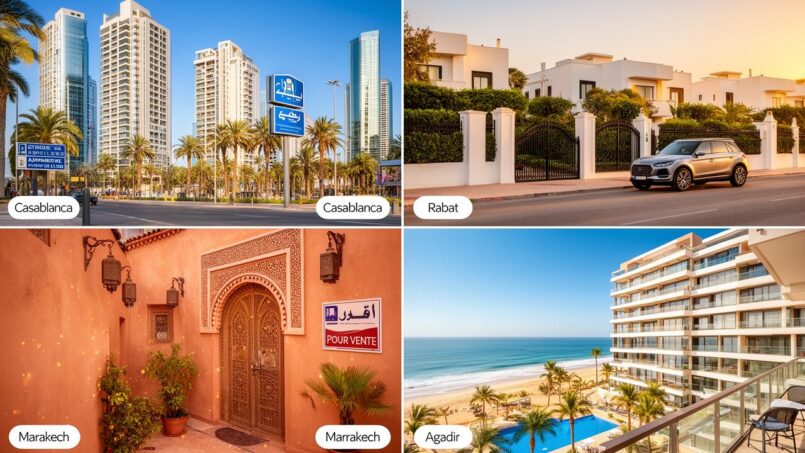
The Moroccan real estate market is entering a new phase. After several years of moderate increases, 2026 is shaping up to be a turning point: prices continue to rise in major cities, rental yields remain attractive on an international scale, and major projects related to the 2030 World Cup, tourism, and infrastructure are redrawing the map of opportunities. In this landscape, four cities are drawing the most attention: Casablanca, Rabat, Marrakech, and Agadir.
This article provides a comparative analysis of price levels, dynamics, and yields across different markets, with summary tables to highlight the gaps.
A measured national market upturn
Before diving into the city-by-city details, we need to set the national context. In 2026, the median price of a home in Morocco is around 1,000,000 MAD, with a higher average price close to 1,450,000 MAD, pushed up by villas in Casablanca and Rabat. In terms of surface area, the median price hovers around 11,000 MAD/m² and the average around 13,500 MAD/m².
For the bulk of residential transactions, the reality lies between 600,000 and 2,200,000 MAD. In this range, approximately 80% of sales are found, whether apartments in buildings, townhouses, or small villas.
The housing deficit, estimated at 340,000 units, is one of the structural factors supporting the annual 3–5% rise in real estate prices nationwide.
In this context, the price hierarchy is clearly confirmed: Casablanca and Rabat are the most expensive, Marrakech sits just behind but often with better yields, while Agadir shows the most accessible values among the major destinations studied.
Comparative overview of the four cities
To visualize the gaps, we can compare the average prices per square meter observed or projected for 2026 for apartments in central areas, as well as the order of magnitude for high-end villas.
Average prices per square meter in central areas
| City | Avg apartment price center (MAD/m²) | Common range (MAD/m²) | Main comment |
|---|---|---|---|
| Casablanca | ≈ 13,500 | 11,300 – 14,900 | Economic capital, most expensive urban market |
| Rabat | ≈ 14,500 | 12,000 – 20,000+ | Political capital, stable and segmented premium |
| Marrakech | ≈ 10,500 – 12,000 | 9,600 – 14,000+ | Tourist city, wide dispersion by district |
| Agadir | ≈ 8,000 – 12,000 | 8,000 – 14,000 (center/marina) | Beach resort, more affordable than Casa/Marrakech |
Behind these averages lie drastic price swings between premium neighborhoods and emerging areas. For an investor or a first-time buyer, this is where it all comes down to.
Casablanca: economic power and high but reasonable prices
Casablanca remains the country’s economic heart and the deepest real estate market. In 2026, the median home price is around 960,000 MAD, with an average price near 1,125,000 MAD. In unit value, most properties fall between 510,000 and 2,400,000 MAD.
Based on various sources, prices per square meter for Casablanca apartments break down as follows: median around 11,300 MAD/m², average near 12,500 MAD/m², with frequent transactions between 13,000 and 15,000 MAD/m² in standard urban areas.
Price range by segment in Casablanca
| Segment / zone | Typical price (MAD/m²) | Indicative range (MAD/m²) | Average gross rental yield |
|---|---|---|---|
| Standard urban | ≈ 10,000 – 11,000 | 11,300 (median) – 13,900 | ≈ 6 – 7% |
| Premium (Anfa, Gauthier…) | 20,000 – 30,000 | 18,000 – 35,000 | ≈ 3.5 – 5% |
| Ain Diab (coastal) | 15,000 – 28,000 | up to 30,000 in high-end | 4 – 6% (8–10% seasonal) |
| Emerging suburbs (Bernoussi…) | 7,000 – 11,000 | 5,000 – 13,000 | 7 – 9% |
Over ten years, Casablanca prices have broadly stagnated in nominal terms, with a decline of about 19% in real terms, which tempers the idea of a bubble. Recent years nonetheless show a recovery: between 2020 and September 2025, apartment prices rose from about 11,500 to 13,900 MAD/m², i.e., approximately +21% over five years. Projections for 2026 place the average between 14,300 and 14,900 MAD/m², with an expected increase of around 4 to 5%.
The average gross rental yield in Casablanca is around 7%, with variations by neighborhood.
From a valuation standpoint, Casablanca appears “rather expensive but not dangerously overvalued.” Official indices show limited annual growth (around 1.5 to 2% recently) and strong transactional activity (+24% in Q3 2025). Analysts consider a deep correction unlikely in the short term, barring a shock to lending rates.
Rabat: political capital and a stable high-end market
Rabat and its Rabat–Salé metropolitan area show, in 2026, one of the highest price levels in the country, but with lower volatility than Casablanca or Marrakech. The median price of a home in the Rabat–Salé area is around 1,100,000 MAD, with an average price near 1,375,000 MAD. In practice, four-fifths of transactions fall between 700,000 and 2,500,000 MAD.
In terms of price per square meter, the median is around 11,500 MAD/m², the average 12,500 MAD/m², but the differences between neighborhoods are extreme: from 4,600 MAD/m² in some parts of Salé to over 23,000 MAD/m² in the most prestigious pockets like Souissi or Haut Agdal.
Rabat–Salé: contrasts between Souissi and Salé
| Neighborhood / type | Apartment price (MAD/m²) | Villa price (MAD/m²) | Neighborhood profile |
|---|---|---|---|
| Souissi | ≈ 21,000 | ≈ 30,000 | Embassy district, luxury villas |
| Hay Riad | ≈ 16,200 | ≈ 25,000 | Business and modern residential district |
| Agdal | 17,000 – 20,000 | ≈ 20,000 | City center, near universities |
| Hassan | ≈ 18,000 | ≈ 20,000 | Historic and administrative heart |
| L’Océan | 15,000 – 16,000 | ≈ 22,000 | Seaside, sought-after residential |
| Salé center | 12,000 – 14,000 | 15,000 – 18,000 | More affordable hub with strong growth |
| Salé entry-level | 4,600 – 9,000 | — | Popular sectors (Tabriquet, Hay Andalous…) |
Apartments clearly dominate the market (about 70% of listings), ahead of houses (8%), villas (7%), and a small segment of duplexes, penthouses, and new upscale residences. Villas, very few in volume, trade on average around 7.5 million dirhams, while standard apartments run around 1.25 million dirhams.
The average gross rental yield in Rabat is about 6.7%, offering a balance between steady appreciation and decent returns.
In 2025, the capital even recorded the largest quarterly increase among major cities (+3.2% at year-end, +7% year-over-year for apartments), driven by diplomatic demand, administrative functions, and limited new supply in the most sought-after neighborhoods. Forecasts for 2026 indicate expected annual increases of 4 to 6%, amplified by preparations for the 2030 World Cup.
Marrakech: tourist market, wide price dispersion, and high yields
Marrakech is a special case. It is both a conventional residential market and a global tourist destination, with a significant share of seasonal rentals, riads, and luxury villas. In 2026, the median price of a home there is around 900,000 MAD, while the average price climbs to about 1.6 million dirhams, reflecting the weight of high-end segments in the ochre city.
The average price per square meter in real estate is about 12,000 MAD, with variations ranging from less than 6,000 MAD to over 35,000 MAD depending on neighborhoods and property types.
Marrakech: price structure by major districts
| District / segment | Observed prices (MAD/m²) | Long-term rental yield (gross) | Comment |
|---|---|---|---|
| Guéliz (city center) | 14,000 – 22,000 | ≈ 5.2% | Business and residential center |
| Hivernage | 18,000 – 26,000 | ≈ 4.5% | Premium hotel district |
| Medina (renovated riads) | 25,000 – 40,000 | ≈ 5.5% | Luxury tourist heritage |
| Medina (riads to renovate) | 8,000 – 14,000 | ≈ 7.5% | Strong value-creation potential |
| Palmeraie (villas) | 22,000 – 38,000 | ≈ 4.0% | Most prestigious residential address |
| Agdal / Issil | 11,000 – 17,000 | ≈ 5.8% | Family residential |
| Semlalia | 10,000 – 14,000 | ≈ 5.5% | Mid-range residential |
| Targa and peripheral roads | 7,000 – 18,000 (apt. + villas) | 5.8 – 6.5% | Strong growth, Atlas views |
| Zohor Targa, Palmeraie extension | 5,800 – 10,200 | > 6.5% often | Entry-level, high potential |
Overall, apartments account for about 70% of transactions, villas 20%, riads 7%, and townhouses a handful of deals. Investment is largely driven by tourism: the city saw a transaction increase of nearly 24% and a rise in luxury investments of 28% in 2025, according to specialized studies.
In 2024, Marrakech experienced a post-pandemic catch-up with a price increase of about 20%.
Rental yields there are among the most attractive in the country. For standard residential properties, figures range around 6 to 8.4% gross (average near 7.1%). But the real engine lies in seasonal rentals: some properties can achieve up to 25% gross yield on very high-end tourist rentals, at the cost of intensive management and higher operating expenses.
Agadir: more affordable beach resort and a catching-up market
Agadir offers a very different profile from the other three cities. An Atlantic beach resort, it attracts tourists, retirees, second-home buyers, and a local audience seeking a milder lifestyle. Compared to Casablanca and Marrakech, purchase prices remain 30 to 40% lower, which is its major asset for budget-conscious investors.
The city offers a diversity of neighborhoods ranging from premium waterfront to family-friendly or budget areas further inland. Since 2023, prices have risen sharply in sought-after sectors, with annual increases of 8 to 12%, but a slight rebalancing is expected in 2025 due to the arrival of thousands of new homes.
Agadir: price overview by neighborhood
| Neighborhood | Apartment price range (MAD) | Average price (MAD/m²) | Positioning |
|---|---|---|---|
| Tourist Sector (Corniche) | 1.5M – 2.3M | 16,700 – 25,100 | Waterfront, very touristy |
| Founti / Sonaba | 1.4M – 1.9M | 15,800 – 21,400 | Expat and second-home neighborhoods |
| Talborjt | 970k – 1.3M | 10,800 – 14,600 | Lively center, mixed |
| Ville Nouvelle | 960k – 1.3M | 10,700 – 14,400 | Urban center |
| Hay Mohammadi / Illigh | 920k – 1.2M | 10,200 – 13,800 | Family-oriented, developing |
| Haut Founty | 870k – 1.2M | 9,600 – 13,000 | Rising residential, near coast |
| Hay Massira | 850k – 1.15M | 9,500 – 12,800 | Family-friendly, good value |
| Haut Anza | 820k – 1.1M | 9,050 – 12,250 | Growing area, rising value |
| Taddart | 810k – 1.1M | 8,950 – 12,100 | Value-oriented residential |
| Hay Najah | 790k – 1.07M | 8,830 – 11,950 | Good-yield residential neighborhood |
| Tilila | 570k – 780k | 6,375 – 8,625 | Budget / family sector |
| Cité Adrar | 520k – 700k | 5,780 – 7,820 | Outlying district, entry-level |
In the city center, the median apartment price is about 13,200 MAD/m², while houses trade around 17,200 MAD/m². For the 2025–2026 period, some studies estimate the average price between 8,000 and 10,000 MAD/m² for most residential properties, with a wider range of 8,000 to 14,000 MAD/m² for the center and Marina.
Average long-term gross residential yield in Agadir, ranging from 5.5 to 7.5% depending on the property.
Studios and small one-bedrooms generally offer the best yields (7.5 to 8.5% gross), ahead of two-bedrooms (6.5 to 7.5%) and three-bedrooms (5.5 to 6.5%). The best neighborhoods for profitability are often inland: Hay Najah, Hay Massira, Hay Mohammadi, Hay Salam, and Cité Adrar can achieve 7.5 to 9% gross. Conversely, very premium areas like Founty or the Tourist Sector, despite high rents, see yields compressed to 4–6% gross due to higher purchase prices.
Agadir: comparison of price and yield levels
| City | Average apartment price center (MAD/m²) | Apartment gross yield range | Summary comment |
|---|---|---|---|
| Casablanca | ≈ 13,500 | ≈ 6 – 7% | Most expensive, decent yield |
| Rabat | ≈ 14,500 | ≈ 6 – 6.7% | Very expensive, moderate and stable yield |
| Marrakech | 10,500 – 12,000 | ≈ 6 – 8.4% (more in seasonal) | High yields, strong tourist component |
| Agadir | 8,000 – 12,000 | ≈ 5.5 – 7.5% (up to 12% spot) | Lower prices, solid yield on certain corridors |
It is clear that Agadir stands out with a lower entry ticket than Casablanca, Rabat, and Marrakech, for yields that remain competitive, especially in non-coastal neighborhoods.
Rental yields: a Moroccan comparative advantage
Broadening the perspective to the entire country, gross rental yields in Morocco appear high compared to many European markets. In 2026, major cities fall within an overall range of 5 to 9% gross depending on the type of rental and city: about 5–7% in Casablanca and Rabat, 7–9% in Marrakech, 4.8–6% in Agadir (with much higher peaks on seasonal rentals), and up to 8–8.3% in Tangier on certain segments.
In 2025, the national average gross yield was about 6.7%, a level significantly higher than the 3–4% seen in France or the 2–3% in Switzerland.
In Agadir more specifically, data from early 2026 converges on an average gross apartment yield of around 7% (6 to 8% in most transactions), with a net of about 5%. Well-located studios and one-bedrooms can even reach 7.5 to 8.5% gross, while three-bedrooms often settle for 5.5 to 6.5%. Some premium locations (Founty waterfront, Marina, luxury residences in Sonaba) can, thanks to seasonal rentals, push gross yield up to 12%, at the cost of heavier management and higher vacancy risk.
Additional costs: what to add to the purchase price
In all four cities studied, listed prices don’t tell the whole story. Ancillary costs represent a significant part of the investment, especially if renovations are needed.
On a property worth 1.8 million dirhams, the transaction bill often approaches 8% of the price, i.e., about 146,000 MAD
In Agadir, detailed estimates show that for an apartment around 1,000,000 MAD, registration fees amount to 30,000 to 40,000 MAD, notary fees 10,000 to 20,000 MAD, land registry 5,000 to 15,000 MAD, and agency commission 20,000 to 30,000 MAD. Then come renovations: a light renovation typically runs between 30,000 and 120,000 MAD, while a major rehabilitation can climb from 150,000 to over 600,000 MAD.
Overall, for an investment with renovations, it is not uncommon for the final bill (fees + renovation) to represent an additional 12 to 25% over the “listed” price of the property, regardless of the city.
Trends and outlook 2026–2030
The 2026–2030 horizon is marked by several common driving forces across the four cities:
First, a price increase deemed very likely but moderate. Nationwide, central projections suggest a cumulative increase of 18 to 30% over five years, and 40 to 70% over ten years, with optimistic scenarios reaching 80–90% over the decade in some metropolises and luxury segments. Casablanca, Rabat, and Marrakech fall at the higher end of this range, while Agadir should continue its catch-up, driven by tourism, infrastructure, and its price attractiveness.
In Casablanca, suburbs like Dar Bouazza or Bouskoura attract budgets of 1.2 to 2.5 million dirhams, while centers become unaffordable. In Rabat, the gaps between Souissi/Hay Riad/Agdal and Yacoub El Mansour or Takkadoum are widening. In Marrakech, Palmeraie/Hivernage contrast with peripheral areas. In Agadir, family neighborhoods like Hay Massira or Hay Salam offer a better risk/return ratio than the waterfronts.
Finally, the role of public policies and financing conditions remains decisive. Sustained mortgage rates around 4.5–5.2%, continued subsidies for homeownership (direct aid of 70,000 to 100,000 MAD for modest households, price caps at 700,000 MAD for eligibility), social housing programs, and infrastructure projects linked to the 2030 World Cup (tramways, high-level infrastructure, ports, airports) are all factors supporting demand and therefore prices.
The main risk scenario combines a sharp rise in lending rates above 7% with an economic slowdown, which could weigh on transactions and lead to corrections of 3 to 5% in certain overvalued segments, although this scenario remains unlikely in the short term.
How does each city stack up for a buyer in 2026?
In summary, Casablanca, Rabat, Marrakech, and Agadir tell different real estate stories, even though they operate within the same macroeconomic framework.
Casablanca plays the card of market depth, liquidity, and structurally strong rental demand, with gross yields around 7% and prices still rising moderately. Ideal for those seeking an asset in the country’s largest urban area, targeting intermediate or emerging neighborhoods to optimize yield.
Rabat stands out as an institutional and high-end market, supported by its diplomatic and administrative presence. Prices per square meter are very high, but growth is steady and volatility low. The investor will seek security and long-term appreciation here, rather than maximum yield.
Marrakech embodies the city of opportunities, with yields often higher than those in Casablanca and Rabat, especially on tourist rentals and riads. The trade-off: greater sensitivity to the tourism cycle, very heterogeneous prices by neighborhood, and a more speculative market in some segments. Selecting the micro-location (Guéliz vs. Medina vs. Palmeraie vs. periphery) is decisive.
Agadir is Morocco’s still-affordable major beach resort, with prices 30 to 40% lower than in Casablanca or Marrakech. The annual rental market is growing, and seasonal potential is interesting. The best price/yield combinations are found in family and inland neighborhoods rather than on the Corniche, but premium waterfront properties offer strong long-term capital appreciation.
For a buyer wondering about the best city to invest in or settle down in 2026, the answer will depend less on an “absolute ranking” than on their profile: wealth preservation or yield, personal use or pure rental, tolerance for tourist risk, holding period, and ability or willingness to manage short-term rentals. Based on these parameters, the four major Moroccan destinations each offer, in their own way, a prime place in the national real estate landscape.
A wealth project or a question? Contact us now to speak with a wealth management expert.
Disclaimer: The information provided on this website is for informational purposes only and does not constitute financial, legal, or professional advice. We encourage you to consult qualified experts before making any investment, real estate, or expatriation decisions. Although we strive to maintain up-to-date and accurate information, we do not guarantee the completeness, accuracy, or timeliness of the proposed content. As investment and expatriation involve risks, we disclaim any liability for potential losses or damages arising from the use of this site. Your use of this site confirms your acceptance of these terms and your understanding of the associated risks.

Cyril Jarnias is an independent expert in international wealth management with over 20 years of experience. As an expatriate himself, he is dedicated to helping individuals and business leaders build, protect, and pass on their wealth with complete peace of mind.
On his website, cyriljarnias.com, he shares his expertise on international real estate, offshore company formation, and expatriation.
Thanks to his expertise, he offers sound advice to optimize his clients' wealth management. Cyril Jarnias is also recognized for his appearances in many prestigious media outlets such as BFM Business, les Français de l’étranger, Le Figaro, Les Echos, and Mieux vivre votre argent, where he shares his knowledge and know-how in wealth management.





