
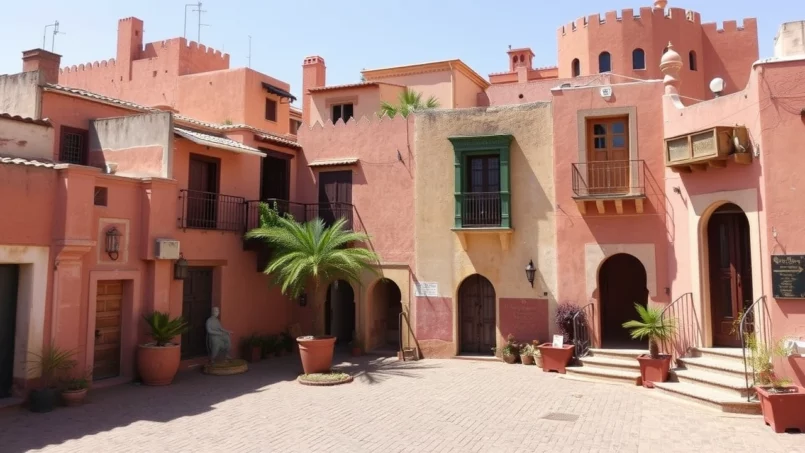
 Published on and written by Cyril Jarnias
Fes has attracted a new generation of real estate investors in recent years. With prices that are still moderate, a UNESCO World Heritage site, and national tourism ambitions, the imperial city is establishing itself as a unique market in Morocco. Far from the frenzy of Casablanca or Marrakech, investing in real estate in Fes allows you to enter the Moroccan market with lower entry tickets, while aiming for solid rental returns and steady price appreciation.
This overview is based exclusively on recent data and studies specific to Fes, including price levels, returns, key neighborhoods, the legal and tax framework, as well as risks, trends, and major urban projects.
A market that is still affordable, but accelerating
With an average price of around $900 per square meter, real estate in Fes remains significantly cheaper than in Morocco’s major metropolises. Studies converge: properties are on average 30 to 40% less expensive than in Marrakech or Casablanca, while the city remains one of the country’s largest by size, cultural weight, and tourism potential.
Price levels and market structure
In 2026, the following benchmarks give a good idea of the residential market:
| Indicator (Fes) | Approximate Value |
|---|---|
| Average price per m² (all properties) | ~$900 |
| Average price per m² apartments | ~6,578 MAD (~$722/m²) |
| Average price per m² villas | ~7,667 MAD (~$841/m²) |
| Median home price | ~658,000 MAD (~$72,000) |
| Average home price | ~900,000 MAD (~$98,800) |
| Share of apartments in supply | ~65% |
| Share of villas/houses | ~20% |
| Share of traditional riads | ~10% |
| 80% price range of properties | 450,000 – 1,500,000 MAD |
In practical terms, a standard 100 m² apartment trades around 658,000 MAD, while a small 60 m² unit is around 395,000 MAD. A family villa of 180 m² is around 1.38 million dirhams.
The entry price for an apartment of about 55 m² in a neighborhood like Oulad Tayeb in Marrakech.
Price dynamics and outlook
Since 2015, Fes has recorded an average annual price increase of around 4 to 6%. The Covid-19 pandemic caused a period of stagnation, but values rebounded strongly in 2023-2024. Projections for 2025-2026 point to moderate but steady growth, around 5 to 8% per year, driven by three main engines:
Number of visitors, in millions, that Morocco aims to welcome by 2030 as part of its tourism revival.
In real terms (adjusted for inflation), the increase over ten years is more modest, from 0 to 10%, but the persistent discount compared to other major cities still leaves room for gradual convergence.
Entry ticket and ancillary costs
One of Fes’s strengths is the diversity of possible budgets. Here are some benchmarks, based on recorded market examples:
| Approximate Budget (in $) | Possible Property Types in Fes |
|---|---|
| $20,000 | Small dar to renovate in the medina, studio on the outskirts, modest 1-bedroom in a growing area |
| $50,000 | 1–2 bedroom apartment in Hay Saada, Bensouda, small partially restored riad |
| $100,000 | Well-renovated 2–3 bedroom apartment, entry-level riad for a guest house, small villa |
| $200,000 | Recent 130 m² apartment in Nouvelle Ville, 170 m² villa in Zouagha, renovated apartment in center |
| $300,000 | Large villa in Agdal (~220 m²), 170 m² apartment in Nouvelle Ville, partially renovated riad |
| $500,000 | Renovated 300 m² villa in Nouvelle Ville, 350 m² villa in Agdal, renovated riad (~220 m²) |
| $1,000,000 | 500 m²+ villa in Agdal, large restored riad in medina, new 450 m² villa in Nouvelle Ville |
| $2,000,000 | 800 m²+ villa estate, riad complex, custom high-end villa |
To these amounts, acquisition fees must be added. According to sources, they range between 6.5 and 12% of the price, with the high end including more complex cases (riads, old titles, large amounts). In practice, for a standard transaction:
| Cost Item | Order of Magnitude |
|---|---|
| Registration / transfer fees | ~4% of price |
| Stamp duty | ~1% of price |
| Land registry (ANCFCC) | ~1–1.5% of price |
| Notary fees | ~1–1.5% of price |
| Agency commission (if buyer’s responsibility) | 2.5–5% (negotiable, sometimes shared) |
| Translations, legal advice, miscellaneous | A few hundred to a few thousand $ |
Negotiation is part of the game: the gap between the listing price and final price is often between 6 and 10%, and aiming for a 10 to 15% discount is common in initial discussions.
Fes neighborhoods: where to invest, for which profile, and at what price?
The city offers a highly contrasting range of neighborhoods, from the ancient medina to the planned suburbs. Each area caters to a different investor profile.
Medina (Fes el-Bali): historic heart and eldorado of riads
Fes el-Bali, the UNESCO-listed medina, is the city’s symbol. It’s also the favorite playground for foreign buyers: about 80% of them are interested, attracted by the traditional architecture and tourism potential.
Riads – houses arranged around a central patio, with zellige tiles, carved plaster, and cedar woodwork – dominate the supply. You’ll find:
– riads to renovate, between $100,000 and $300,000 (around 900,000 to 1.6 million MAD);
– renovated riads or boutique hotels, between $300,000 and over $1 million, some reaching 2.5 to 6 million MAD depending on size and finish level.
The price per square meter ranges overall between $600 and $2,000, with high variability depending on location (proximity to access, views, quietness) and condition of the property.
The major interest of the medina is twofold:
Well-located riads benefit from strong appreciation prospects thanks to heritage rehabilitation programs and tourist flows. Operated as short-term rentals or guest houses, they offer high rental returns, with occupancy rates that can exceed 60% and gross yields typically between 6% and 8%, or even higher for the most optimized operations.
The downsides are known: sometimes complex property titles (old systems like Moulkiya), requiring thorough work with a notary and Adoul; often underestimated renovation costs (it’s prudent to budget 30 to 50% more than the first quote); limited accessibility (pedestrian alleys, more complicated logistics).
Ville Nouvelle and modern center: comfort, offices, and local clientele
Built during the French protectorate, the Ville Nouvelle stands out for its wide avenues, modern buildings, cafes, and services. It’s the favorite sector for wealthy local families, expats, and young professionals seeking comfort and proximity to amenities.
Apartments here have average prices around 6,200 to 7,900 MAD/m², with villas that can go up to nearly 9,400 MAD/m². In the modern city center, apartments often trade between 7,000 and 9,000 MAD/m², which remains competitive nationally.
The Fes City Center program, developed by Prestigia, illustrates the concentration of large residential projects in the area. Located on 32 hectares and including an 8-hectare park, it offers apartments from 90 to 153 m² with sales prices ranging from 850,000 to 1,660,000 MAD.
For an investor, the Ville Nouvelle presents several advantages:
– strong and diversified rental demand (civil servants, executives, expats, students);
– stable gross returns around 5–6% on well-located modern apartments;
– higher market liquidity than very atypical riads.
The flip side is a less “postcard” character for tourism and price increases already well underway, limiting the potential for spectacular appreciation, even though annual growth forecasts remain around 5–8%.
Agdal and Hay Riad: family residential and upscale development
Agdal is often described as the “Fes of tomorrow”. This booming neighborhood offers secure residences, green spaces, pools, and schools, with a clientele of young families, professionals, and executives. Prices per m² are generally between 7,573 MAD for apartments and 8,683 MAD for villas, according to the latest measurements.
Hay Riad, another planned area with wide roads and parks, falls in the range of $800 to $1,200 per m². These sectors combine:
Investing in a property intended for a family rental has several advantages: it offers a good quality of life if you need to live in it yourself, benefits from relatively stable family rental demand, and has potential for appreciation linked to the neighborhood’s continued upscaling (e.g., arrival of new shopping centers, schools, or services).
For medium to high budgets ($200,000 to $500,000), the combination of family villa + long-term rental is particularly relevant.
Affordable neighborhoods and developing areas
For investors on a tighter budget or seeking maximized returns, several peripheral neighborhoods offer very attractive prices per square meter.
Market data identifies notably:
| Neighborhood | Positioning | Price range per m² (MAD) | Typical total price (MAD) |
|---|---|---|---|
| Oulad Tayeb | Value for m²/price | 4,900 – 6,200 | 350,000 – 750,000 |
| Zouagha | Affordable family | 5,400 – 6,800 | 380,000 – 900,000 |
| Hay Massira | Mainstream | ~5,600 – 7,100 | 450,000 – 1,100,000 |
| Hay Al Azhar | Mainstream | ~5,600 – 7,200 | 450,000 – 1,100,000 |
| Oued Fes | Expanding | ~5,700 – 7,300 | 450,000 – 1,200,000 |
| Hay Jdid | Mainstream | ~5,800 – 7,400 | 470,000 – 1,200,000 |
| Saiss | Very affordable | $400 – $700/m² | Entry-level |
| Bensouda | Near university | $500 – $800/m² | Strong student rental potential |
These areas are favored by Moroccan buyers and young professionals, and constitute solid bases for long-term rentals at modest budgets. This is also where studios and small units bought to rent to students or young workers are multiplying.
Premium sectors: Batha, Palace neighborhoods, and view areas
Batha, not far from Bab Boujloud and the eponymous museum, is a sought-after central sector offering a prestigious address, with prices between $1,200 and $1,800 per m². The neighboring Palace districts, quieter and more residential, house homes and apartments for a high-end clientele. Here too, the stock is limited and prices reflect the scarcity of supply.
In these sectors, the investment logic is often hybrid: primary or vacation residence combined with seasonal or occasional event rental, with a higher initial outlay but lower vacancy risk.
Property types: from student studio to luxury riad
The Fes market offers a range of products rarely matched in Morocco, allowing for very different strategies depending on your profile.
Small apartments and studios: the basis for long-term rentals
Small apartments and studios, between $20,000 and $50,000, constitute an excellent entry point. They are found in developing neighborhoods (Hay Saada, Bensouda, Saiss, Oulad Tayeb, etc.). Rents remain affordable for residents, generally between $200 and $400 per month for a “decent” apartment, allowing for returns around 6–7% in many cases.
A frequently cited example is an apartment bought for $50,000 and rented for $300/month, i.e., $3,600 per year, giving a gross yield close to 7%.
Modern apartments: comfort, liquidity, and security
Modern apartments with 1 to 2 bedrooms in Ville Nouvelle, Agdal, or mainstream neighborhoods represent the preferred product for the middle class and families. According to 2025 data:
– a 1-bedroom of 60 m² costs around $54,000;
– a 2-bedroom of 85 m² is around $77,000;
– general ranges for 2-room units go from $50,000 to $100,000.
Gross rental yields in good neighborhoods for this market segment are around 5 to 6%.
Villas: family segment and high-end market
Modern villas, often with gardens and sometimes pools, generally sell between $200,000 and $500,000, both in Agdal and in parts of Nouvelle Ville and planned neighborhoods (Hay Riad, etc.).
They mainly target:
– affluent Moroccan families;
– some long-term expats;
– investors aiming for resale or a combination of primary residence / partial rental.
Rental yields are more variable, but demand remains strong, and medium-term appreciation is driven by the scarcity of quality land in urban areas.
Riads and dars: Fes’s DNA and the tourism lever
The riads of the medina are Fes’s real estate signature. They come in several categories:
Overview of the main categories of traditional properties in Morocco, with indicative starting prices.
Traditional houses, sometimes from $20,000 in very poor condition.
Properties requiring full renovation, from $100,000.
Riads restored with a high level of comfort, from $300,000. Prices can exceed one million dollars for the largest or best located.
Boutique riads and well-managed guest houses frequently achieve returns of 6 to 8% per year, with occupancy rates exceeding 60%, and nightly rates between $50 and $200 depending on standard and season. The appreciation potential is also notable: a careful renovation can double or even triple the value of a well-chosen property.
In return, this segment requires: special attention and adapted strategies.
– expertise in traditional renovation;
– demanding operational management (welcome, cleaning, maintenance, regulatory compliance for guest houses);
– extreme vigilance regarding the legal status of the property.
Commercial premises and land
For more entrepreneurial profiles, Fes also offers:
– commercial premises between $50,000 and $200,000;
– land between $200 and $800 per m² for development projects (residential, mixed-use, or tourist), particularly in expanding areas.
This type of investment generally requires a longer horizon and a higher degree of involvement (project assembly, urban planning, marketing).
Rental returns: what can reasonably be expected
Available figures provide a fairly precise overview of current rental performance in Fes.
Yields by property type
Based on recent data, this can be summarized as:
| Property type / sector | Typical annual gross yield |
|---|---|
| Renovated riads (medina) | 6–8% (or more on very good deals) |
| Modern apartments (Ville Nouvelle, Agdal, near universities) | 5–6% |
| “Mainstream” apartments on the outskirts | ~5–7% depending on purchase price |
| Family villas | Variable, often 4–6% |
| Average gross yield city center | ~5.8% |
| Average gross yield outside center | ~5.79% |
Furnished properties benefit from a premium of around 15 to 20% in rent compared to unfurnished units, which can improve yield, at the cost of higher turnover risk and increased maintenance costs.
Long-term rental market
Rents remain relatively affordable for Fes residents, which partly explains the good depth of the rental market:
Overview of average rental prices for different types of housing in Marrakech, from studio to villa.
From 900 MAD/month.
Average 1,000 MAD/month, up to 1,500–4,500 MAD in city center.
Approx. 1,500 MAD/month, up to 5,000 MAD depending on area.
3,000 to 10,000 MAD in center, 1,500 to 5,000 MAD on outskirts.
Between 10,000 and 20,000 MAD/month.
1-bedroom around 1,200 MAD, 2-bedroom around 2,000 MAD.
Most residential leases are signed for one year, renewable, with a security deposit often between 1,000 and 3,000 MAD, and an agency commission in a similar range (1,000–2,000 MAD). A tax equivalent to about one month’s rent is sometimes due by the tenant.
Tourist rentals and platforms like Airbnb
The combination of low cost of living in Fes, exceptional heritage, and status as a cultural destination favors short-term rentals, especially in the medina. Key elements are:
Key data on average stay duration and accommodation costs for visitors.
Visitors stay about 3 days on average.
Hotel: $39/night | Airbnb: $70/night
Hotel: $842/month | Airbnb: $2,127/month
A well-positioned riad, with an appropriate license if operating as a guest house, can aim for:
– nightly rates between $50 and $200;
– occupancy rates above 60%, even 70% in high season.
This is the segment with the highest profit potential, but also the most sensitive to tourist fluctuations (health crisis, international tensions, changes in short-term rental regulations).
Legal framework: what foreigners can (and cannot) buy
Morocco offers a relatively open framework for foreign investors in urban areas, but it has important specifics to understand.
Property rights for foreigners in Fes
Foreigners can, in principle, buy and own outright:
– apartments (with share of common areas);
– villas, individual houses, duplexes, townhouses;
– riads and dars in the medina;
– most urban land for residential or commercial purposes.
There is no foreign ownership quota, nor a residency requirement to buy property in Fes. The buyer can hold the property in their own name. However, two major limitations apply:
– impossible for a non-Moroccan to acquire agricultural land, except in very specific cases;
– prohibition for an expat to buy a property that is already mortgaged or under a long-term lease, or to buy agricultural land outside urban areas.
Before any purchase on the outskirts, it is therefore essential to check the zoning (urban, agricultural, industrial, etc.) with the urban planning authorities.
Land title, Moulkiya, and the role of ANCFCC
Morocco operates with two property systems:
Morocco operates with two distinct systems: the modern Land Title system (ANCFCC), which is a centralized and secure title guaranteed by the state, and the traditional system (Moulkiya), still common in the medina, which relies on notarized deeds (adoulaires) and chains of possession.
For a foreign investor, the Land Title issued by the ANCFCC is the reference. Before any payment, it is crucial to obtain:
– an up-to-date certificate of ownership, detailing the owner, area, any mortgages or easements;
– a statement of charges and mortgages, to ensure no debts or disputes.
For medina properties without a modern title, the involvement of an Adoul (traditional notary) and a modern notary is advisable. Succession chains, inheritance divisions, and recording of past transactions can complicate the file. Going it alone without professional support in this segment is strongly discouraged.
Purchase process: key steps
The standard timeline for a purchase in Fes goes as follows:
Acquiring a property in Morocco follows a structured process. It begins with identifying the property through agencies or online platforms (Mubawab.ma, Agenz.ma, FesProperties.com) and local networks, followed by price negotiation often aiming for 10-15% reduction. Next, a sales agreement is signed, accompanied by a deposit of 5 to 10% of the price into the notary’s escrow account. Then comes the due diligence phase: verification of the land title at the ANCFCC, search for charges or mortgages, checking building permits, and zoning verification. The buyer then finalizes their financing (equity or local credit) respecting official exchange rules. The signing of the final deed at the notary allows payment of the balance and taxes. Finally, the transaction is registered at the land registry (ANCFCC) for issuance of the updated title deed.
The typical complete timeframe, from accepted offer to final registration, is 6 to 10 weeks for a simple case, longer for medina riads with complex titles.
Exchange control and repatriation of funds
A point often underestimated by foreign investors concerns exchange control. To be able to later repatriate the proceeds from resale, it is imperative that the purchase funds have gone through authorized banking channels, in compliance with the Office des Changes. Cash payments or informal channels compromise this right of repatriation.
It is therefore essential to open a Moroccan bank account, fund it from abroad in a traceable manner, and keep supporting documents.
Taxation at purchase and during ownership
In addition to the fees mentioned at acquisition (around 6.5–8.5% of the price), the investor must factor in annual taxes and taxes on income and capital gains.
On ownership:
– property tax (taxe d’habitation), based on the rental value of the property;
– municipal services tax (taxe de services communaux).
For an apartment, the annual total is typically between 1,500 and 6,000 MAD; for a villa, 4,000 to 15,000 MAD; for a riad, 3,000 to 20,000 MAD depending on value and size.
Rental income and capital gains
Rents received in Morocco are taxed as property income. A 40% allowance is generally applied to long-term rental income before tax calculation. For a foreign landlord, the effective rate is around 10 to 20% of gross rents, depending on the case.
Upon resale, capital gains are taxed, with a degressive system:
– 20% for short-term ownership (less than 5 years, for example);
– progressive reductions beyond, potentially leading to full exemption after 10 years, depending on the property’s status (primary residence, etc.).
For non-residents, a flat rate of 20% on the taxable capital gain is frequently cited, subject to specific exemptions and double taxation treaties.
Financing and ongoing costs: what an investment really costs
While many foreigners pay cash, it is possible to partially finance through Moroccan banks.
Mortgages for non-residents
Institutions like Attijariwafa bank, BMCE Bank of Africa, or Banque Populaire finance foreign buyers, but with stricter conditions than for residents:
– loan-to-value ratio: 50 to 70% of the price (so a down payment of 30 to 50%);
– interest rates: around 5.8 to 7.2% for non-residents, i.e., 1 to 2 points higher than for Moroccan residents;
– heavy documentation requirements: proof of stable income, bank statements, employer letters, sometimes legalized translations.
Most products are fixed rate or initially fixed, then adjustable.
Cost of living and expenses for a property owner
One of Fes’s strong arguments is its cost of living, much lower than in major Western cities. Estimates indicate:
This is the monthly cost in dollars of renting a good apartment.
For a landlord investor, add:
– home insurance, often as multirisque habitation:
– apartment: 1,200 to 3,500 MAD/year;
– villa: 2,500 to 8,000 MAD/year;
– riad: 2,000 to 10,000 MAD/year, or more depending on materials and location;
– homeowners’ association fees, highly variable depending on the residence;
– maintenance and repair budget, particularly important for older properties (plan 1% of the property’s value per year as a baseline).
Investment strategies adapted to Fes
With all these parameters, how to build a coherent strategy for investing in real estate in Fes? Several approaches emerge.
Strategy 1: “Core” long-term rental on modern apartments
Target: investors seeking stable income, fairly simple management, and good liquidity on resale.
Typical product:
– 1 or 2-bedroom apartment in Ville Nouvelle, Agdal, well-served mainstream neighborhoods (Hay Massira, Oued Fes…);
– purchase around $50,000–$100,000, furnished or semi-furnished;
– rental to families, young professionals, expats, or students.
Advantages:
– gross returns of 5–6% realistic;
– relatively low vacancy;
– management can be delegated to a local agency at reasonable cost.
Strategy 2: Riad to renovate and operate as tourist rental
Target: more experienced investors, sensitive to heritage and willing to engage in a renovation and operation project.
Typical product:
Acquiring a riad in the medina can start from $100,000. It is crucial to budget a significant renovation cost, which can exceed the initial estimate by 30 to 50%, especially for a full renovation costing between 2,500 and 4,500 MAD per square meter. These investments then allow for appreciation through conversion into a guest house, boutique hotel, or high-end seasonal rental.
Advantages:
– potential returns of 6–8% (or more on highly optimized operations);
– significant capital gains upon resale after renovation;
– leverage on the rise in tourism and medina rehabilitation programs (over 700 million dirhams invested in restoring sites, parking, etc.).
Points of vigilance:
– legal complexity of some medina titles;
– demanding operational management (marketing, welcome, maintenance, administrative compliance);
– exposure to tourist risk (fluctuations in international demand).
Strategy 3: Bet on expanding neighborhoods
Target: investors with a medium-long term horizon, willing to accept a bit more volatility to aim for capital appreciation.
Typical product:
– apartment or small villa in growing neighborhoods (Oulad Tayeb, Bensouda, Hay Saada, areas near new infrastructure, expanding industrial zones like Ras El Ma);
– entry budget under $50,000–$80,000.
Advantages:
The area has low prices per m² and is located on the edge of developing axes, near industrial zones, technopoles, and new facilities. Additionally, strong public incentives support industrialization and the development of specific zones, like Ain Cheggag, with the creation of industrial parks and industrial acceleration zones.
Risks:
– local infrastructure sometimes still limited;
– dependence on public policies and the success of IAZs and technoparks.
Strategy 4: Primary / semi-residence with partial rental
Target: buyers wishing to spend several months a year in Fes, while making their property profitable the rest of the time.
Typical product:
– comfortable apartment in Ville Nouvelle, Agdal, or Batha/Palace sector depending on taste;
– or small riad in the medina, operated as a short-term rental when not occupied.
Advantages:
– optimization of the very low cost of living in Fes;
– possibility of saving 60–70% compared to an equivalent lifestyle in Europe or North America;
– supplementary income to cover fixed expenses (taxes, HOA fees, maintenance).
Risks, frequent mistakes, and best practices
Investing in real estate in Fes is not a smooth ride. A few risks and pitfalls come up systematically in experience feedback.
Pitfalls to avoid
The main pitfalls pointed out by analyses are:
It is crucial not to neglect due diligence in the medina (poorly recorded titles, inheritances, conflictive co-ownerships), to properly budget riad renovation costs, to anticipate all recurring charges, to formalize agreements by notarized deed, to scrupulously check co-ownership rules for an apartment, and to account for language and cultural barriers to avoid misunderstandings.
In the rental market, classic risks also exist: poorly registered properties, owners not transparent about the property’s condition, imprecise contracts, even scams. It is consistently recommended:
– to work with a reputable agency or intermediary;
– to put everything in writing and have the lease legalized;
– to physically inspect the property before any payment.
Best practices to secure your investment
Several reflexes can greatly reduce risk:
Before any real estate investment in Morocco, it is crucial to demand a recent certificate of ownership from the ANCFCC before any deposit. It is recommended to mandate a notary experienced with foreign clients and, for complex files, an independent local lawyer. Verify the compliance of any work already done (permits, regularization). Simulate the taxation (property income, capital gains) and include these elements in your return calculations. Build a budgetary safety margin, especially for renovation projects (plan for a 30 to 50% increase over initial estimates for a riad). Finally, inform yourself about major urban projects and development plans, which can increase or decrease the value of certain sectors.
Infrastructure, urban projects, and investment environment
The interest of a real estate investment in Fes does not rely solely on prices and rents. The city’s development context plays a key role.
A city in transformation
A vast development plan covers approximately 13,000 hectares and notably includes:
An overview of the main structuring projects aimed at modernizing the city, boosting its economy, and preserving its heritage.
Creation or modernization of major infrastructure such as the Grand Theatre of Fes, the Congress Palace, sports complexes, Fez Arena, and an exhibition park.
Development of economic hubs: Fez Shore (offshoring), Ras El Ma and Ain Cheggag zones, and redevelopment of the former Cotef area, generating thousands of jobs.
Program to restore 118 historic sites, creation of parking lots to ease congestion in the center, and projects like the Lalla Yeddouna complex and the Oued Fes Golf City promenade.
Increase in green spaces and a project to transfer water from the Saiss plain for a more sustainable city.
At the regional level, the program for Fes-Meknes exceeds 12 billion dirhams in investments, explicitly aiming to make the region a major economic, tourist, and cultural hub.
Tourism, economy, and attractiveness
Morocco welcomed about 19.8 million international visitors in 2025, generating 124 billion dirhams in revenue, and aims for 26 million tourists by 2030. Fes, as the spiritual capital and imperial city, is at the heart of this strategy, with:
– over one million annual visitors before Covid;
– a major sacred music festival;
– a pedestrian medina among the largest in the world.
The strong increase in tourism directly translates into a rise in demand for all types of accommodation (hotels, riads, seasonal rentals). This represents positive prospects for owners invested in tourist rentals.
At the same time, industrial development (Fez Shore, industrial zones, AgriTech hub, logistics parks) creates skilled employment and a stable residential base, fueling demand for modern apartments and family villas.
Fes: a compromise between profitability, accessibility, and quality of life
For those looking to invest in Moroccan real estate with a controlled budget, while aiming for honest returns and appreciation potential, Fes ticks many boxes.
The city combines:
Rabat presents several advantages for real estate investors: prices per m² still largely discounted compared to Marrakech or Casablanca; a very diversified supply, from small studios to exceptional riads; gross yields generally between 5 and 8% depending on the segment; an urban environment undergoing transformation, supported by massive public investments; a low cost of living and a growing expat community.
Investing in real estate in Fes is not something to improvise. The success of a project requires detailed knowledge of the neighborhoods, a conservative approach to renovation budgets, mastery of exchange control rules and Moroccan taxation, as well as reliance on professionals (notaries, lawyers, agencies, managers).
In exchange for this rigor, the imperial city offers investors privileged access to one of the most unique markets in the Maghreb, where ancient heritage and new planned neighborhoods coexist at a pivotal stage of development.
Disclaimer: The information provided on this website is for informational purposes only and does not constitute financial, legal, or professional advice. We encourage you to consult qualified experts before making any investment, real estate, or expatriation decisions. Although we strive to maintain up-to-date and accurate information, we do not guarantee the completeness, accuracy, or timeliness of the proposed content. As investment and expatriation involve risks, we disclaim any liability for potential losses or damages arising from the use of this site. Your use of this site confirms your acceptance of these terms and your understanding of the associated risks.

Cyril Jarnias is an independent expert in international wealth management with over 20 years of experience. As an expatriate himself, he is dedicated to helping individuals and business leaders build, protect, and pass on their wealth with complete peace of mind.
On his website, cyriljarnias.com, he shares his expertise on international real estate, offshore company formation, and expatriation.
Thanks to his expertise, he offers sound advice to optimize his clients' wealth management. Cyril Jarnias is also recognized for his appearances in many prestigious media outlets such as BFM Business, les Français de l’étranger, Le Figaro, Les Echos, and Mieux vivre votre argent, where he shares his knowledge and know-how in wealth management.





