
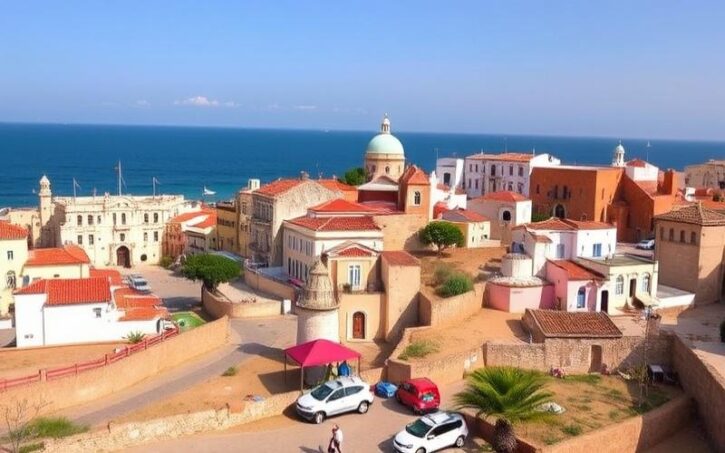
 Published on and written by Cyril Jarnias
Real Estate Investment: A Crucial Decision
Real estate investment is a crucial decision that can significantly influence the financial viability of individuals and businesses.
Considering Buying Real Estate in Morocco
Considering buying real estate in Morocco raises relevant questions compared to the markets of neighboring countries, each offering unique opportunities and challenges.
While Morocco stands out for a booming real estate market and appealing cultural diversity, the economic and legal contexts of neighboring countries also present potential advantages for savvy investors.
A Promising or Risky Investment?
In addressing this comparison, we invite you to explore the key elements that make buying real estate a promising or risky investment in these multifaceted regions.
Introduction to Buying Real Estate in Morocco and Its Neighboring Countries
The Moroccan real estate market is going through a period of transition in 2025, characterized by contrasting dynamics. The country’s real estate economy is experiencing a notable slowdown, particularly in the professional sector where transactions fell by 44.4% in 2024, mainly affecting major cities like Casablanca, Rabat, and Marrakech.
This development is part of a mixed economic context where several factors simultaneously influence the market. On one hand, investors are showing increased caution, significantly extending their decision-making timelines, which now average 6 to 18 months. On the other hand, access to financing has become more complex, with Moroccan banks demanding more guarantees for granting real estate loans.
Price Trends and Market Evolution
| Segment | Price Evolution | 2025 Trend |
| Apartments | Nominal increase of 0.8% (real decrease of 0.1% after inflation) | Expected stabilization |
| Houses | Minimal increase of 0.1% | Expected stabilization |
| Professional Real Estate | Sharp activity decline (-44.4%) | Gradual transition |
In the first quarter of 2025, the real estate asset price index recorded a quarterly decline of 1.8%, with more pronounced decreases of 2.1% in some segments, according to Bank Al-Maghrib. This trend suggests a market adjustment after several years of continuous increases.
Attractiveness and Investment Opportunities
Despite this slowdown, certain segments remain particularly dynamic:
- Foreign investments continue to flow in, especially in the luxury sector in Marrakech
- Renovation of historic neighborhoods and sustainable real estate are gaining popularity
- Second homes, particularly near the Marrakech palm grove, attract investors
- Emerging neighborhoods and eco-friendly projects represent new development opportunities
Challenges for Buyers
Potential buyers face several obstacles in 2025:
- Prices that continue to rise in major cities like Marrakech, Casablanca, and Rabat
- More restrictive financing conditions
- Increasingly complex administrative and legal procedures
- A growing gap between available supply and new buyer expectations
This situation contrasts with that of neighboring North African countries, where real estate markets have distinct characteristics. In Tunisia, the market is more oriented toward residential tourism, while Algeria experiences more state-controlled real estate development. Egypt, for its part, relies on mega urban projects that are radically transforming its real estate landscape.
Regulatory differences are also notable: Morocco has gradually liberalized its market for foreign investors, while some neighboring countries maintain greater restrictions. These variations create a diversified investment landscape at the regional level, with specific opportunities and risks for each market.
Good to Know:
In Morocco, the real estate market is heavily influenced by a growing economy and government policies aimed at stimulating investment, with tax incentives to encourage property purchases. Demand remains high, particularly in urban centers like Casablanca and Marrakech, although supply tries to keep up, sometimes pushing prices upward. The types of properties available range from luxury real estate to more affordable housing, with challenges such as complex administrative procedures for foreign buyers. In comparison, neighboring countries like Algeria or Tunisia show notable differences: Algeria offers sometimes lower prices but with strict regulations, while Tunisia presents interesting investment opportunities, especially in the tourism sector. These aspects, including price variations and regulations, are essential for understanding where and how to deploy your real estate investment in this region.
Analysis of Real Estate Prices in Morocco Compared to Its Neighbors
| Country | Average Price per m² in City (2025) | Recent Price Evolution | 2025 Forecasts |
| Morocco | 13.39 (Numbeo index) | Moderate increase | Stability or slight increase |
| Algeria | €1,196 | Relatively stable | Moderate growth |
| Tunisia | ~2,360 DT/m² in Tunis | Slight increase | Sustained demand |
| Spain | Strong disparity (e.g., Madrid/Barcelona >€4,000/m²); sustained national growth (4.5–5.3%) expected in 2025 | Strong growth since 2021; expected slowdown but still dynamic |
Economic Factors Influencing Prices
- Market Demand:
- Morocco: Demand remains high in major cities like Casablanca and Marrakech, driven by rapid urbanization and growing interest in rental investment.
- Algeria: Sustained demand but hampered by limited purchasing power and supply struggling to renew.
- Tunisia: Stable demand in urban centers, especially for new builds around Tunis.
- Spain: Very dynamic market with strong appeal for foreign investors, second-home residents, and tourism.
- Government Policies:
- Morocco/Tunisia/Algeria: Homeownership access programs vary by country; regulations on foreign investment are often more flexible in Morocco than in Algeria.
- Spain: Favorable taxation on certain rental segments (“flexliving,” senior living), incentive schemes to attract foreign capital.
- Economic Stability:
- Morocco/Tunisia/Spain show relative stability conducive to investments. Algeria is still perceived as less economically stable, which may deter some investors.
Impact of Tourism and Infrastructure
Tourism development strongly stimulates demand for secondary residential real estate as well as the commercial/hotel segment in Morocco, Tunisia (coastal areas), and especially Spain, where “senior living” or flexliving are gaining ground.
Major infrastructure investments drive price increases in well-served areas – for example, Casablanca Finance City or Spanish coastal resorts.
Opportunities & Challenges for Investors
Opportunities:
- Geographic diversification possible thanks to differences in market maturity;
- In Spain and Morocco particularly: attractive returns on seasonal/tourist rentals;
- Easy access to certain innovative niches: “flexliving,” senior living on the Spanish side;
Challenges:
- Local purchasing power sometimes limited outside major Maghreb urban hubs;
- Fluctuating regulations regarding acquisition by foreigners, especially in Algeria;
- Risk of saturation in certain tourist or commercial segments if new projects are not accompanied by equivalent growth in local/international demand.
Specific Segments
Residential:
In Morocco as in Tunisia: affordable housing remains in demand, but there is a shortage of well-located high-end products.
Commercial/Hotel:
Notable expansion in Spain with massive investments planned (+15% expected), certain dynamism in Marrakech/Casablanca on the Moroccan side driven by international tourism. Less pronounced currently on the Algerian side, where this segment remains more niche due to a lack of suitable infrastructure.
In Summary
Price differences between these countries offer a wide range for investors seeking geographic or sectoral diversification. Spain’s dynamism is fueled by its macroeconomic stability and diversified offering, while the Maghreb continues to attract thanks to its lower costs despite some persistent structural fragilities.
Good to Know:
In Morocco, real estate prices are influenced by growing demand and favorable government policies, contrasting with Tunisia and Algeria where economic instability hampers the market. In 2023, the average price per square meter in Morocco is around 11,000 MAD, while in Tunisia it is about 3,500 dinars, and in Algeria, about 180,000 DZD. Spain, although not a land neighbor, stands out with higher costs, averaging 2,500 euros, boosted by tourism and well-developed infrastructure. Forecasts indicate a moderate increase in Morocco and Spain, while economic stability could hold back Algeria. The Moroccan residential market offers growth opportunities, increasingly attracting foreign investors, unlike Algeria where commercial investments remain risky. Tourism development positively influences prices in Spain and Morocco, with these attractive sectors sometimes offsetting more stagnant segments elsewhere.
Comparison of Tax Regulations Between Morocco and Neighboring Countries
Morocco has recently implemented several important tax measures in the real estate sector with the 2025 Finance Law, aimed at simplifying the tax framework, easing certain burdens, and encouraging investments.
Main Real Estate Tax Regulations in Morocco in 2025
The threshold for applying withholding tax on property income has been raised from 30,000 to 40,000 MAD, thus reducing the tax burden on small landlords and encouraging small-scale real estate investments.
A new simplified regime with a final withholding rate of 20% has been introduced for landlords receiving property income, replacing the non-final rates of 10% or 15%. This measure significantly simplifies reporting obligations, offering administrative relief particularly beneficial for employees and retirees.
Tax exemptions have been introduced for investments in the real estate sector, representing a flagship measure of the 2025 Finance Law.
The urban tax on residential properties ranges from 10% to 30% of the rental value.
| Country | Tax Rate on Rental Income | Property Tax | Tax Advantages |
| Morocco | Final rate of 20% (option) | 10-30% of rental value | Exemptions for investments, threshold raised to 40,000 MAD |
| Algeria | 7-15% by bracket | Varies by region | Temporary exemptions for new constructions |
| Tunisia | 15-35% progressive | 2-14% based on value | Benefits for first-time homebuyers |
| Mauritania | Flat rate based on area | Set by zone | Incentives for development zones |
Comparison with Neighboring Countries
In terms of capital gains tax on real estate, Morocco generally offers a more favorable regime than Algeria, but less favorable than Tunisia, which provides more extensive exemptions for primary residences.
Transfer taxes on purchase in Morocco remain competitive compared to its neighbors, notably thanks to recent reforms aimed at stimulating the real estate market.
Mauritania has generally lower property taxes but a less developed legal framework, while Algeria imposes greater restrictions on foreign investors.
Impact on Investment Attractiveness
- Morocco’s 2025 tax measures make the country particularly attractive for small investors and rental property owners
- The administrative simplification with the 20% final rate represents a significant competitive advantage compared to the more complex procedures in Algeria
- Tunisia retains an advantage for primary residences thanks to its capital gains exemptions
- Mauritania attracts more large-scale investments in specific development zones
These tax differences directly influence real estate investment strategies in the region, with Morocco positioning itself as an increasingly accessible market for small and medium investors thanks to its policy of tax simplification and burden reduction for property owners.
Good to Know:
In Morocco, real estate investors benefit from competitive tax rates with capital gains tax on real estate at 20%, while Tunisia applies a rate of 30%, and Algeria 15%. Moroccan residents can take advantage of exemptions on their primary residence, while incentives for foreign investors include reductions on transfer taxes, generally set at 4%. In contrast, in Mauritania, property taxes are significantly lower, making purchases potentially more attractive. Recent Moroccan tax reforms have introduced tax relief to stimulate investment, unlike the more conservative policies in Algeria. Finally, transfer taxes in Tunisia remain around 6%, highlighting a notable difference that can influence real estate investment choices in the region.
Real Estate Investment Prospects in Morocco Compared to Neighboring Countries
The Moroccan real estate market stands out for its sustained growth in recent years, offering interesting prospects for investors. Compared to its North African neighbors, Morocco presents a particular investment profile with its own advantages and challenges.
Comparative Analysis of Real Estate Prices
Morocco shows moderate real estate prices but higher than some of its neighbors. Prices per m² vary considerably by city:
- Casablanca: 10,000 to 25,000 dirhams (900 to 2,300 euros)
- Marrakech: 8,000 to 20,000 dirhams (730 to 1,800 euros)
- Tangier: 7,000 to 18,000 dirhams (640 to 1,650 euros)
- Agadir: 6,000 to 15,000 dirhams (550 to 1,370 euros)
In comparison, according to global real estate price statistics, Egypt ranks as the cheapest country with an average residential apartment price of $31,208, followed by Tunisia ($52,014) and Algeria ($66,318). Morocco does not appear in the top 10 cheapest countries in terms of real estate prices, indicating a relatively more valued market.
Morocco’s Differentiation Factors
| Factor | Morocco | Neighboring Countries (Algeria, Tunisia, Egypt) |
| Political Stability | Recognized strong stability | Varies by country (particularly in Libya) |
| Infrastructure | Modern and constantly improving | Uneven development |
| Legal Framework | Favorable to foreign investors | Often more restrictive |
| Tourism Potential | Highly developed | Variable development |
| Cost of Living | Moderate | Generally lower (Tunisia: 25.5; Algeria: 24.54; Egypt: 19.0; Libya: 18.6) |
Drivers of Moroccan Real Estate Growth
The Moroccan real estate sector is driven by several dynamic factors:
- Rising local demand, particularly in major cities
- The growth of tourism and the development of second homes
- Major government urban development projects
- Attractiveness for foreign retirees
Opportunities and Challenges for Investors
Opportunities:
- Attractive price-quality ratio compared to other Mediterranean destinations
- Medium and long-term capital appreciation prospects
- Exceptional cultural and heritage richness
- Pleasant climate year-round
Challenges:
- Higher prices than in some neighboring countries like Egypt and Tunisia
- Increased competition in certain market segments
- Need to understand local market specifics well
Morocco positions itself as a real estate investment destination offering a good balance between stability, growth potential, and quality of life, despite higher prices than some of its neighbors. This intermediate position, combined with a favorable environment for foreign investors, makes it an attractive option for those seeking a relatively secure investment in the region.
Good to Know:
The real estate market in Morocco stands out for its relatively stable political environment and advantageous tax policy, which attracts many foreign investors compared to its neighbors like Algeria, Tunisia, and Egypt. Local and international demand is sustained, with real estate prices still attractive despite a slight increase in recent years. Urban development initiatives, such as the Casablanca renovation plan and the construction of new cities like Chrafate, strengthen Morocco’s appeal, while Algeria and Tunisia suffer from a lack of comparable projects. Tunisia, despite a favorable tourism environment, faces internal economic challenges, and Egypt, although rich in potential thanks to the development of “New Cairo,” must contend with political instability. Investment opportunities in Morocco are amplified by solid infrastructure, such as modern transport networks, but investors must remain vigilant about the risk of saturation in some popular areas.
Disclaimer: The information provided on this website is for informational purposes only and does not constitute financial, legal, or professional advice. We encourage you to consult qualified experts before making any investment, real estate, or expatriation decisions. Although we strive to maintain up-to-date and accurate information, we do not guarantee the completeness, accuracy, or timeliness of the proposed content. As investment and expatriation involve risks, we disclaim any liability for potential losses or damages arising from the use of this site. Your use of this site confirms your acceptance of these terms and your understanding of the associated risks.

Cyril Jarnias is an independent expert in international wealth management with over 20 years of experience. As an expatriate himself, he is dedicated to helping individuals and business leaders build, protect, and pass on their wealth with complete peace of mind.
On his website, cyriljarnias.com, he shares his expertise on international real estate, offshore company formation, and expatriation.
Thanks to his expertise, he offers sound advice to optimize his clients' wealth management. Cyril Jarnias is also recognized for his appearances in many prestigious media outlets such as BFM Business, les Français de l’étranger, Le Figaro, Les Echos, and Mieux vivre votre argent, where he shares his knowledge and know-how in wealth management.





