
 Published on and written by Cyril Jarnias
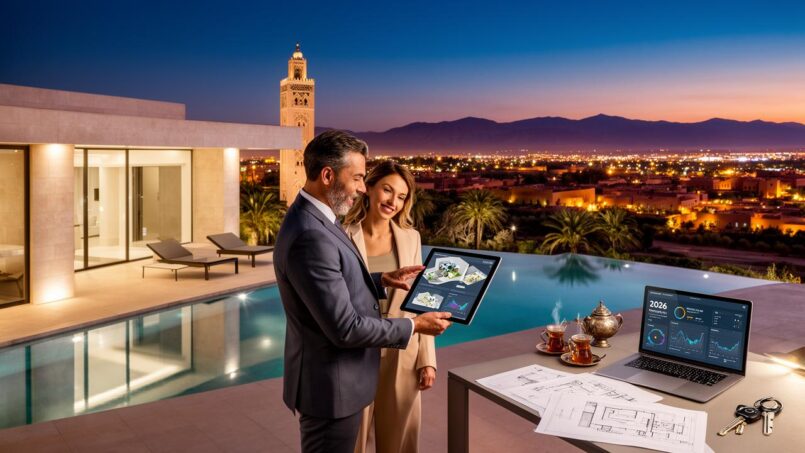
Morocco’s tourism capital, a cultural crossroads and dream destination for discerning international clientele, Marrakech is living through a decisive phase of its real estate cycle. Neither speculative bubble nor sluggish market: the city is in a dynamic of controlled growth, driven by tourism, major infrastructure projects, and growing appetite from foreign investors.
In 2025, real estate values jumped approximately 18% in the city.
A Market in a Soft Landing Phase
The peculiarity of Marrakech’s real estate market is that it combines a robust rise in values in flagship neighborhoods with a more nuanced reality when accounting for inflation. In nominal terms, prices are slightly above their long-term trend; in real terms, they remain about 20% below the peak of the 2010s. In other words, the city is far from systemic overheating.
The official residential price index rose by about 1.4% in the third quarter of 2025. Meanwhile, transaction volumes fell very slightly (–0.5% over the quarter). The market is described as “balanced to slightly seller-biased,” meaning prices continue to rise moderately, but buyers still retain some bargaining power, particularly outside the most sought-after areas.
The core of demand is focused on apartments, which account for about 70% of transactions, with value increases slightly higher than those for villas (approximately +2.7% for apartments versus +2% for villas over twelve months). The average ticket for a standard residential property is between 900,000 and 1,200,000 dirhams, with the median hovering around 900,000 dirhams.
To visualize the market scale, it can be summarized as follows:
| Key Indicator (Marrakech, early 2026) | Indicative Value |
|---|---|
| Average residential price per m² | ≈ 9,600 MAD (≈ $960 / €880) |
| Range covering ~80% of purchases | 600,000 – 3,500,000 MAD |
| Median home price | ≈ 900,000 MAD |
| Average home price | ≈ 1,600,000 MAD |
| Average annual increase (last 12 months) | ≈ +2.5% |
| 2025 increase (all categories) | ≈ +18% |
The consequence for the investor is twofold: the risk of a sharp short-term price drop is considered low, with a plausible variation range between –2% and +5% over one year, but the ability to buy “at the right price” remains crucial because negotiation margins still exist, especially for villas or poorly positioned properties.
Price Mapping: From High-End to Affordable Areas
Marrakech’s mosaic is read neighborhood by neighborhood. Within the city, price gaps per square meter are considerable depending on standing, centrality, available services, and rental potential.
Premium Sectors: Hivernage, Majorelle, Agdal, Palmeraie
The most expensive addresses are concentrated in a few well-identified pockets. Hivernage, Majorelle, and “prime” Agdal form the top trio for apartments, while the Palmeraie dominates the prestige villa segment.
The orders of magnitude can be summarized as follows for apartments in 2026:
| Premium Neighborhood | Indicative Price per m² Apartment (MAD) |
|---|---|
| Hivernage | 18,000 – 25,000 (up to 35,000 for luxury) |
| Majorelle | 18,000 – 35,000 (wide range) |
| Agdal (high-end segment) | 15,000 – 20,000 |
| Palmeraie (apartments) | 10,000 – 15,000 |
In these sectors, prices easily reach the equivalent of 3,000 to 5,000 euros per m² in Hivernage, 4,000 euros and more for villas in the Palmeraie. The differential from the Marrakech average (≈ 9,600 MAD/m²) reflects a scarcity and prestige premium: garden views, proximity to Avenue Mohammed VI, nearby palaces and golf courses, pools, underground parking, security, and hotel-like services.
The Palmeraie of Marrakech spans over 12,000 hectares of estates and palm groves.
Dynamic Central Neighborhoods: Guéliz, Camp Al Ghoul, Greater Majorelle
Guéliz, the modern heart of Marrakech, concentrates offices, cafés, international restaurants, coworking spaces, and a large population of expats, young professionals, and remote workers. Prices range between 14,000 and 20,000 MAD/m², with some references reaching 22,000 to 35,000 MAD/m² for the very high end, and penthouses potentially exceeding 35,000 to 50,000 MAD/m².
Camp Al Ghoul, on the edge of Guéliz, offers a rare combination of centrality, road accessibility, and still reasonable prices, with levels between 9,600 and 14,400 MAD/m² depending on standing. This area benefits from a demand spillover effect as Guéliz prices rise.
The Majorelle neighborhood benefits from its proximity to the famous eponymous garden and quiet, tree-lined streets. Real estate prices generally range between 10,000 and 15,100 MAD/m², with higher values for high-end properties. This attractiveness, driven by an international clientele, is explained by the charm and upscale residential character of the area.
The Medina: Collector Riads and Tourist Yield
The old city, with its alleys, souks, and historic riads, constitutes a market unto itself. Apartments are rare, but riads – to renovate or already restored – are positioned in a wide range:
| Type of Riad (Medina) | Indicative Price per m² (EUR) |
|---|---|
| Riad to renovate | ≈ 2,000 – 3,000 € |
| Standard renovated riad | ≈ 2,500 – 5,000 € |
| Luxury / “collector” riad | 4,500 – 7,000 € (or more) |
The most sought-after micro-sectors – Dar El Bacha, Mouassine, Riad Zitoun, Kasbah, Bab Doukkala – concentrate the famous “collector riads,” whose value can increase by 5 to 9% per year and whose seasonal rental yields can exceed 10% gross.
Emerging Zones and Affordable Peripheries
At the opposite end of the spectrum, several peripheral areas (Saada, Harbil, parts of Tassoultante) still show prices between 8,000 and 14,000 MAD/m², or even around 6,000 MAD/m² in entry-level developments like Zohor Targa. Route de l’Ourika, Route d’Amizmiz, Targa, Route de Fès, or even Tamansourt and Sidi Abdellah Ghiat offer new villas and apartments, often with Atlas views, pools, and gardens, at levels between 7,000 and 15,000 MAD/m² for apartments and 8,000 to 18,000 MAD/m² for villas.
These sectors benefit from a dual engine: improvement of road infrastructure and launch of new residential or tourist programs, often more affordable than central neighborhoods, while remaining within 20 minutes of the center.
A Rental Market Driven by Tourism and Urbanization
One of Marrakech’s structural strengths remains rental profitability. Yields are higher than in Casablanca and many comparable European cities. Aggregated data show an average gross yield around 7% for the city, with significant variations depending on property type and neighborhood.
Yields and Profitability by Property Type
Observed gross yields generally fall within the following ranges:
| Property Type and Location | Estimated Gross Yield |
|---|---|
| Furnished long-term apartments (Guéliz, Hivernage, Agdal) | 6 – 8% |
| Furnished long-term villas (Targa, Palmeraie, Route de l’Ourika) | 5 – 7% |
| Riads in seasonal rental (Medina, Majorelle) | 8 – 12% |
| Seasonal apartments (Guéliz, Hivernage) | 8 – 10% |
| Luxury vacation rental villas | 15 – 22% (overall returns) |
| Modern apartments in prime neighborhoods | 10 – 15% (overall returns) |
Citywide, assessed gross yields range between 6 and just over 8%, with an average yield around 7.08%. After taxes and charges (management, maintenance, condominium fees, property tax), net yields are generally 1.5 to 2 percentage points lower.
For an investor, these levels are particularly attractive in a context of low policy rates (2.25% for the central bank) and modest bond yields. By comparison, many major European city markets now offer 2 to 4% gross on residential, often before taxes.
Long-Term Rentals: The Strength of Central Neighborhoods
In the conventional lease segment, demand is concentrated in Guéliz, Camp Al Ghoul, Agdal, and the Daoudiat corridor. Young professionals, expats, and urban Moroccan families primarily seek proximity to shops, schools, transport, and medical centers.
In Marrakech, the Guéliz neighborhood dominates the rental market with furnished two-bedrooms rented between 7,000 and 13,000 MAD/month and very short vacancy periods (2 to 4 weeks). Camp Al Ghoul attracts a more budget-conscious clientele while remaining central, while Agdal, with its modern buildings equipped (parking, elevator) and proximity to schools, is favored by families.
In these areas, the price-to-rent ratio remains reasonable for investors. It is estimated that 15 to 20 years of rent are needed to cover the purchase price of a well-located apartment in Guéliz or Hivernage, which places Marrakech in a “tight but not crazy” valuation zone, especially given the quality of life offered.
Seasonal Rentals: Marrakech, the Kingdom of Airbnb
On the short-term rental side, Marrakech is the top Moroccan market. Platforms list over 8,000 properties, with an average monthly revenue of around $1,400 per listing, an average daily rate close to $150, and an occupancy rate around 40 to 50% depending on sources (with significantly higher performance for optimized and well-managed properties).
To optimize seasonal rental income, it is crucial to target the most attractive neighborhoods for travelers. These areas are generally characterized by high tourist demand, good accessibility to points of interest, a suitable range of services and shops, and a pleasant environment. Local market analysis and booking platforms can help identify them precisely.
– Mouassine, Riad Laarous, and the Kasbah in the Medina, thanks to the proximity of Jemaa el-Fna and the authenticity sought by travelers.
– Hivernage, which attracts tourists seeking comfort, pools, nightlife, and easy transport.
– Majorelle and Guéliz, appreciated by couples and remote workers for cafés, restaurants, and a more “European” atmosphere.
The average occupancy rates reported for Guéliz and Majorelle are around 52%, with average rates of 1,400 MAD per night. In the Medina, some riads achieve 50 to 70% occupancy with prices ranging between 80 and 400 euros per night, especially during major events like the Film Festival or Marrakech du Rire.
For owners willing to invest in professional management, seasonal rentals can far exceed long-term yields. Provided they master the regulations (permits, taxation, neighbor respect) and handle a significantly higher management intensity.
Growth Drivers: Tourism, Infrastructure, International Investors
If Marrakech outperforms the rest of Morocco, it is because several forces converge in the ochre city.
Tourism at Record Levels
In 2025, Morocco broke a record with 19.8 million tourists, up 14% year-on-year. Marrakech captures nearly 40% of the country’s overnight stays, with a hotel occupancy rate that reached 71% in the first half of 2025. Tourism revenues reached approximately 112 to 124 billion dirhams that year, up 7% from 2024 and more than 40% from 2019.
The country now aims for 26 million visitors by 2030, with a tourism investment plan (“Light in Action”) valued at 6.1 billion dirhams, combining promotion, infrastructure, and upscaling of the offering. Marrakech, with its twenty-odd five-star palaces and new hotel projects backed by international groups (Four Seasons, Mandarin Oriental, Rixos, Kimpton…), is clearly at the center of this strategy.
Major Infrastructure Projects: High-Speed Train, Airport, 2030 World Cup
Another major lever: infrastructure. Several structuring projects are underway or planned, directly linked to Morocco’s co-hosting of the 2030 World Cup with Spain and Portugal. The overall envelope announced for national infrastructure around this event exceeds $41 billion.
Two large-scale projects currently stand out in the ochre city, symbolizing its development and opening.
Project to extend the tram network to improve urban mobility and open up new neighborhoods.
Major rehabilitation and enhancement project for the iconic UNESCO World Heritage site.
– The extension of the high-speed line between Kénitra and Marrakech, which should reduce the journey from Tangier to under three hours and Casablanca–Marrakech to under two hours.
– The expansion of Marrakech-Menara Airport, partly funded by the African Development Bank (approximately $316 million), to significantly increase capacity before 2030.
Market studies estimate that neighborhoods near future high-speed train stations or access routes to the stadium and airport could benefit from value premiums of around 8 to 12%, or even 10 to 15% within a five-kilometer radius of World Cup-related facilities.
Appetite from Foreign Investors and Rising Middle Class
The third force comes from investment demand. In 2025, foreign capital injected into Moroccan real estate reached €2.8 billion, with about 35% directed toward Marrakech. Foreigners account for approximately 35% of luxury property acquisitions in the city, with 60% of buyers from European countries (France, Germany, UK, etc.) and a growing presence of Gulf investors.
Annual growth rate of the urban population in Morocco, illustrating the sustained pace of urbanization.
This dual base – tourists and solvent residents – explains why, unlike other Moroccan cities where activity is slowing, Marrakech continues to show positive momentum, both in prices and volumes.
Forecasts 2026, 5 Years, and 10 Years: What Upside Potential?
Projections from various observatories and analysis firms converge toward a scenario of moderate but sustainable growth, with a premium on the best neighborhoods and rarest products.
2026: A Year of Bullish Consolidation
For 2026, the consensus expects price growth in Marrakech of 4 to 7% on average, with a cautious scenario at 3% and an optimistic scenario potentially reaching 8%. The most dynamic segments should be:
– Prime apartments in Guéliz, Majorelle, Agdal, and Hivernage, expected between +4 and +6%.
– Renovated riads in the Medina’s flagship neighborhoods (Kasbah, Riad Zitoun, Bab Doukkala, Dar El Bacha, Mouassine), projected between +5 and +9%.
– Well-served emerging areas like Route de l’Ourika, around +6 to +8%.
Percentage of potential rental growth in Marrakech sectors where rental demand clearly exceeds supply.
5-Year Horizon: 25 to 35% Cumulative Increase
Over five years (2026–2031), estimates of cumulative residential price growth in Marrakech range between 25 and 35% in central scenarios, with a low end of 18–20% in a less favorable economic climate and a high end around 40–45% if all drivers (tourism, infrastructure, foreign capital) remain fully engaged.
This corresponds to an average annual growth rate of around 4.5 to 6% compounded. The best neighborhoods – Guéliz/Majorelle, Agdal, premium Medina sectors – could show even higher performance, between 30 and 45% over five years.
This is the projected total five-year return, in percentage, for a prime apartment, combining capital appreciation and net rental income.
10-Year Horizon: Potential Doubling in High Scenario
Over a longer horizon (2026–2036), projection models suggest a cumulative price increase between 60 and 90% in a central scenario, with a cautious floor of 45–50% and potential doubling (100–120%) in a very favorable scenario. In annual terms, this represents 4.8 to 6.7% compounded growth per year.
These figures remain obviously sensitive to several unknowns: global economic conditions, changes in financing costs, geopolitical stability, actual pace of infrastructure projects, but also climate and water risks, particularly for villa neighborhoods with gardens and pools.
Which Neighborhoods Offer the Strongest Potential by 2026–2031?
Beyond averages, the key for an investor is knowing where to position themselves on the map. Historical performance data, combined with projections, allow identifying “likely winners.”
Guéliz / Majorelle: The Investor Magnet
Guéliz combines several assets: modern economic center, very strong desire for centrality from locals and expats, good resale liquidity, strong rental demand both long-term and seasonal, and soon enhanced connectivity via high-speed rail.
Historically, the heart of Guéliz has recorded increases of 4 to 6% per year over 5 to 10 years, with recent periods at 7–12%. For the coming years, growth estimates are around 5 to 7% per year for the best locations, with gross rental yields at 6–8%. Camp Al Ghoul, its immediate neighbor, benefits from a catch-up effect, with potential annual growth estimated between 4 and 5% and yields around 5–6.5%.
Majorelle stands out for its scarcity and more residential atmosphere. The lack of available land limits new supply, supporting prices. Expected growth is between 4 and 6% per year, but some highly sought-after segments (quality small units, residences with gardens) could do better.
Hivernage: Luxury, Hotels, and World Cup Effect
Hivernage is the archetype of the prestigious neighborhood associated with a “hotel zone” lifestyle. Proximity to palaces, upscale restaurants, clubs, and convention centers: international demand is very strong, both for purchase and rental.
Annual increase in real estate values over the past decade, with projections of 5 to 7% in the short term.
Agdal, Targa, and the Ourika / Amizmiz Axes: The Play on Booming Areas
Agdal has already seen an increase of about 15% in three years and today shows prices between 12,000 and 20,000 MAD/m² for apartments. Recent buildings, secure, with pools and parking, appeal to families and students, and yields can exceed 8% on certain products targeting these segments. Continued investment in infrastructure and proximity to Avenue Mohammed VI make it a solid bet for the next 5–10 years.
The Targa neighborhood and Route de Fès offer investment opportunities with annual increases already observed of 15 to 20%. Their attractiveness rests on proximity to international schools, a residential setting, and an offering of villas and small gated communities. Their entry price, lower than that of the hyper-centers, suggests additional room for growth.
Finally, the Route de l’Ourika and Route d’Amizmiz axes, dotted with golf courses (Amelkis, Al Maaden, Samanah) and resorts, combine Atlas views, tranquility, and an upscaling of hotel and residential offerings. Prices there are already evolving around +6 to +8% annually according to estimates, with yields on pool villas between 5 and 8%.
Medina: Riads as High-Value Niche Assets
Renovated riads in the Medina, particularly in the most prized historic sectors, constitute a very specific but remarkably effective asset class for those who master the business model. Supply is structurally limited (no new riads are built), tourist demand is strong, and entry tickets are comparable to or lower than those of less iconic European cities.
Recent value increases there are higher than the city average (3 to 5% over one year when Marrakech was at 2.5%, and 5 to 9% projected for 2026), while gross yields from tourist operation can reach 10 to 13%, sometimes more on very well-managed properties with 4 to 6 bedrooms. In return, the model requires professional management and significant renovation budgets.
Why Invest Now Rather Than Wait?
In February 2026, several factors argue in favor of entering the Marrakech market, provided you target well-located assets and aim for a horizon of at least 4 to 5 years.
First, prices, though rising, remain 20% below their 2010 level in real terms, and are very competitive compared to other sunny Southern European destinations: for a comparable standing property, Marrakech is often estimated to cost 50 to 70% less than certain Spanish or Portuguese markets. The cost of living, 30 to 40% lower than in Western Europe, reinforces attractiveness for retirees and remote workers.
Approximate investment threshold to obtain a residence permit, in a context of stable policy rates at 2.25% and inflation below 2%.
Finally, the calendar of major projects (high-speed train, airport, 2030 World Cup, tourism plan) creates a window of opportunity: the first increases are already here, but the full valuation of infrastructure is not yet priced in. At this stage, analyses assess the probability of a true widespread correction as low, while the revaluation potential over 5 to 10 years is substantial.
Regulatory and Tax Framework: What an Investor Should Know
The investment climate in Morocco has been modernized in recent years, with notable efforts on digitalization, transparency, and securing purchases.
The 2026 Finance Law introduces however several new features to consider:
Amount of the direct housing assistance subsidy granted for the purchase of a property worth up to 300,000 MAD.
Law 107-12 governing off-plan sales (VEFA) has also been strengthened: limitation of reservation contract amounts to 5% of the price, mandatory completion guarantee, and the right to a precautionary seizure for the buyer who has paid more than 50% of the price if the developer defaults.
For foreign investors, no ownership cap is imposed. However, acquiring land outside urban boundaries requires a mandatory certificate of non-agricultural use (AVNA), without which the deed may be annulled. Additionally, the Franco-Moroccan tax treaty avoids double taxation, thereby securing the taxation of rental income and capital gains.
Finally, it is crucial to ensure the quality of the land title. A property with a clear title, free of mortgages or disputes, is much easier to resell. Conversely, some riads in the Medina have complex ownership chains, which warrant thorough legal due diligence before signing.
Risks and Limitations: What the Forecasts Don’t Say
The picture is overall positive, but it is not without risks, both short- and long-term.
In the short term, three threats are often cited:
– A normalization of tourism after the records of 2025, which could slow rent and price growth in the most touristy areas.
– A possible tightening of credit conditions or an unexpected rise in rates, which would reduce the borrowing capacity of Moroccan households.
– Delays or downsizing in the implementation of promised major infrastructure (high-speed train, stadiums, airport expansions).
In the long term, climate constraints and water access represent a major structural challenge. Neighborhoods consisting of large villas with lush gardens and pools, which are very water-intensive, could see their maintenance costs skyrocket in the event of resource scarcity, thus impacting the net value of these assets. For an investor, integrating a water resource audit, studying drilling or recycling solutions, and evaluating future operating costs into due diligence has become essential.
There is also noted social pressure on affordability: the rise in real estate prices far exceeds wage growth in many cases, with price-to-income ratios of 10 to 15 years of income for a home in major cities. In Marrakech, this tension is mitigated by the massive presence of foreign capital, but it could eventually lead to corrective fiscal or regulatory measures.
Provisional Conclusion: Marrakech, a Market for Patient Investors
Real estate in Marrakech in 2026 is neither a short-term speculative bargain nor a saturated market without prospects. It is a market for patient investors, who bet on the following combination: a globally attractive city, growing tourism, rental yields significantly above the European average, steady price increases still far from the excesses seen elsewhere, and a vast infrastructure program that should continue to support valuations at least until the 2030–2035 horizon.
For a successful real estate investment in Marrakech, it is advisable to adopt a holding horizon of at least 4 to 5 years, target the most liquid neighborhoods (Guéliz, Majorelle, Hivernage, Agdal, quality Medina, well-chosen Ourika/Amizmiz axes), surround yourself with a competent notary and local advisor, and integrate the new tax framework. This approach offers a risk/return pair that is hard to match in the region.
In this context, reasons to invest are plentiful: average rental yield around 7% with peaks above 10%, prospects of cumulative appreciation of 25 to 35% in five years and up to 90% in ten years, lower entry cost compared to neighboring Mediterranean destinations, and a living environment – sun, culture, gastronomy, proximity to Europe – that gives meaning to an investment that is both patrimonial and pleasurable.
The market is professionalizing, rules are becoming clearer, but the window of opportunity remains open for players capable of selecting their assets with rigor and thinking beyond short-term trends.
Disclaimer: The information provided on this website is for informational purposes only and does not constitute financial, legal, or professional advice. We encourage you to consult qualified experts before making any investment, real estate, or expatriation decisions. Although we strive to maintain up-to-date and accurate information, we do not guarantee the completeness, accuracy, or timeliness of the proposed content. As investment and expatriation involve risks, we disclaim any liability for potential losses or damages arising from the use of this site. Your use of this site confirms your acceptance of these terms and your understanding of the associated risks.

Cyril Jarnias is an independent expert in international wealth management with over 20 years of experience. As an expatriate himself, he is dedicated to helping individuals and business leaders build, protect, and pass on their wealth with complete peace of mind.
On his website, cyriljarnias.com, he shares his expertise on international real estate, offshore company formation, and expatriation.
Thanks to his expertise, he offers sound advice to optimize his clients' wealth management. Cyril Jarnias is also recognized for his appearances in many prestigious media outlets such as BFM Business, les Français de l’étranger, Le Figaro, Les Echos, and Mieux vivre votre argent, where he shares his knowledge and know-how in wealth management.





