
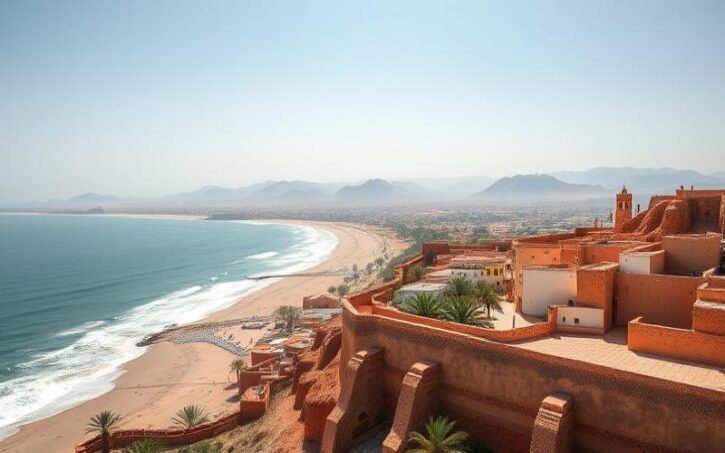
 Published on and written by Cyril Jarnias
Morocco and Green Real Estate: A Commitment to Sustainable Development
Morocco, recognized for its commitment to sustainable development, is resolutely moving toward green real estate, a rapidly expanding sector poised to reshape the country’s urban future.
As environmental issues grow in importance, the Moroccan government is mobilizing by proposing innovative and incentive-based policies.
Horizon 2025: New Standards and Subsidies
By 2025, new ecological standards and targeted subsidies are being implemented to encourage the construction of environmentally friendly buildings.
These measures aim not only to reduce carbon emissions but also to stimulate an attractive and sustainable real estate market, relying on a favorable regulatory framework and enhanced financial support for developers and eco-conscious consumers.
Good to know:
Green real estate in Morocco benefits from an increasingly favorable regulatory framework, with tax incentives and subsidies for eco-friendly projects.
Introduction to the Green Real Estate Market in Morocco
The Moroccan real estate market in 2025 is experiencing strong growth, particularly in the new residential sector. This positive momentum is driven by sustained demand and government incentive measures that have boosted transactions. Major cities like Marrakech, Tangier, Agadir, Casablanca, and Rabat stand out for their appeal, each for specific reasons: Marrakech for its tourist attraction, Tangier for its industrial dynamism, Agadir driven by tourism growth, while Casablanca and Rabat remain major hubs benefiting from housing aid.
Real estate prices in 2025 reflect this upward trend. In Casablanca, the average price of apartments has risen to 13,900 MAD/m², compared to 13,598 MAD/m² in 2024. Villas maintain their value around 20,500 MAD/m², particularly in sought-after neighborhoods like Anfa, Les Princesses, and Gauthier. In Rabat, the average apartment price stands at 14,500 MAD/m².
| City | Average Apartment Price (MAD/m²) | Sought-After Neighborhoods |
|---|---|---|
| Casablanca | 13,900 | Anfa, Les Princesses, Gauthier |
| Rabat | 14,500 | – |
Alongside this growth, the Moroccan real estate sector is beginning a transition toward more sustainable practices. Global environmental concerns are starting to influence construction and investment choices. Moroccan consumers, increasingly aware of ecological issues, are showing growing interest in environmentally friendly housing.
This shift toward greener real estate presents both challenges and opportunities. While the current supply remains largely traditional, upcoming major events like the 2025 Africa Cup of Nations and the 2030 World Cup could accelerate the adoption of stricter environmental standards in new construction.
The sector’s main challenge remains balancing an adapted supply with constantly evolving demand. Professionals emphasize the importance of developing affordable housing while gradually integrating sustainable practices to meet the needs of a growing population without causing excessive price inflation.
Good to know:
In 2025, the Moroccan real estate market is undergoing a notable transformation toward sustainable practices, influenced by global environmental concerns. Consumers are showing growing interest in eco-friendly homes, attracted by the energy efficiency and reduced carbon footprint of these dwellings. Key players like the Société d’Aménagement et de Promotion de la Ligne Verte and Green Building Africa play a crucial role in promoting innovative solutions, although high initial costs and bureaucracy remain challenges to overcome. The transition to green real estate offers significant opportunities for pioneering developers capable of offering sustainable construction at an affordable price, thus stimulating a growing market that could become a model in the region.
Eco-Construction Standards and Their Application in Morocco
Eco-construction is experiencing significant evolution globally in 2025, with increasingly strict standards aimed at reducing the environmental impact of the real estate sector. These regulations primarily focus on energy efficiency, sustainable material management, and the integration of renewable energies.
The main globally recognized eco-construction standards include the European directive on the energy performance of buildings (EPBD), recently revised in 2024, which imposes strict requirements for new buildings. This directive notably requires all new public buildings to be “zero emission” by 2028, with a generalization to all new buildings by 2030.
In Japan, the CASBEE system represents a unique certification that evaluates not only energy performance and the use of low-carbon materials but also attention to landscape and indoor comfort. Starting April 2025, the revised Japanese building standards law strengthens the obligation to comply with energy-saving standards for new homes and non-residential buildings.
| Region | Main 2025 Standards | Key Features |
| Europe | Revised EPBD Directive | “Zero emission” buildings, gradual phase-out of fossil fuels |
| Japan | CASBEE System and Revised Law | Level 4 insulation, level 4 primary energy consumption, transition to ZEH by 2030 |
| International | Life Cycle Assessment | Consideration of global warming potential over the entire building life cycle |
In the Moroccan context, adapting these international standards represents both a challenge and an opportunity. The country is gradually engaging in this ecological transition of the real estate sector, drawing inspiration from global best practices while adapting them to local climatic and economic specificities.
Moroccan initiatives in eco-construction revolve around several axes:
- Gradual adoption of energy efficiency standards
- Promotion of local ecological materials
- Development of certifications adapted to the North African context
- Implementation of tax incentives for projects meeting environmental standards
Challenges faced by Morocco include notably:
- The higher initial cost of ecological construction
- The lack of professionals trained in new techniques
- Adapting international standards to the local climate
- Raising awareness among stakeholders and the public about long-term benefits
Several exemplary projects nonetheless demonstrate the feasibility and relevance of eco-construction in Morocco, such as the eco-districts of Casablanca and Rabat, which integrate innovative solutions in water management, solar energy, and sustainable materials.
Moroccan legislation is also evolving to support this transition, with the introduction of new thermal and energy regulations planned for 2025, drawing on European objectives while adapting them to local realities.
Good to know:
In Morocco, the application of eco-construction standards, such as LEED and BREEAM, is crucial for aligning the real estate sector with international sustainability standards. The country has launched several initiatives, like the National Plan for Energy Efficiency in Buildings, aiming to integrate these standards by 2025. However, challenges such as the high cost of sustainable materials and lack of awareness hinder their adoption. To overcome these obstacles, the Moroccan government has implemented tax incentives and subsidies, while innovative developers use local and recycled materials. A notable example is the Benguerir green city project, which successfully obtained LEED certification through optimized energy and water management.
Subsidies for Renewable Energy in Moroccan Real Estate
Morocco has significantly strengthened its commitment to the green energy transition, particularly in the real estate sector. In 2025, several financial support mechanisms are available to encourage the integration of renewable energies in real estate projects.
Available Funding Programs in 2025
The Green Fund is one of the main financing instruments with an allocation of 2 billion dirhams. This fund specifically supports low-carbon real estate projects by offering preferential interest rates of 3%, compared to 5% on the standard market. This significant 2-point difference represents substantial savings for investors and real estate developers.
Another major tax advantage is the reduction of VAT from 20% to 14% for certified “green” housing. This measure strongly encourages developers to comply with environmental standards in their new projects.
| Type of Financing | Amount/Benefit | Beneficiaries |
| Green Fund | 2 billion MAD (rate 3% vs 5%) | Low-carbon footprint projects |
| Reduced VAT | Reduction from 20% to 14% | Certified “green” housing |
| EU Financing | 500 million euros | Energy efficiency projects (coastal cities) |
| World Bank Loan | 300 million USD | Rehabilitation of slums into eco-districts |
Regulatory Framework and Obligations
The New Urban Planning Code of 2025 now requires the installation of solar panels on 30% of the roofs of new buildings exceeding two stories. This regulatory obligation is accompanied by restrictions on the use of non-recyclable materials, such as expanded polystyrene, in public construction.
These measures are part of the national energy transition strategy, which aims to achieve 52% of energy production from renewable sources by 2030. To support this ambitious goal, the 2025 Finance Bill provides for the mobilization of 18.2 billion dirhams in public investments.
International Partnerships
Morocco has developed significant international partnerships to finance its energy transition:
- Cooperation with the European Union providing 500 million euros for energy efficiency projects in coastal cities like Tangier and Agadir
- A 300 million USD loan from the World Bank for rehabilitating slums into eco-districts, notably through the “Carbon-Free Cities” program in Fez
Challenges and Opportunities for Investors
Despite these incentives, some obstacles persist. Green technologies increase initial construction costs by 10 to 15%, which can be a barrier for small developers. Additionally, only 12% of Moroccan artisans are trained in sustainable construction techniques, creating a skilled labor shortage.
Nevertheless, these challenges come with significant opportunities:
- The development of a circular economy with recycling of construction waste (target of 50% by 2030)
- The rise of green tourism, notably eco-lodges in the Atlas Mountains or the Sahara Desert, which is experiencing annual growth of 8%
These initiatives are part of a broader vision embodied by the Generation Green Plan 2020-2030, successor to the Morocco Green Plan, which provides for massive investments in optimizing energy resources.
The National Office of Electricity and Drinking Water (ONEE) also secured new financing of 300 million euros (3.1 billion dirhams) in May 2025 to strengthen its electrical grid, an essential infrastructure to support the growing integration of renewable energies in buildings.
Good to know:
In 2025, Morocco offers various subsidies to encourage the integration of renewable energies in real estate, notably in solar, wind, and thermal systems. Homeowners and real estate developers can access subsidies covering part of the installation costs, provided these projects meet government energy standards. These incentives, accessible after submitting an application to designated agencies, aim to reduce dependence on fossil fuels and stimulate sustainable construction. Initiatives like the Morocco Green Program include eligibility criteria such as proven energy efficiency and geographic location. This support has not only reduced beneficiaries’ energy bills but also increased the green value of real estate assets, as illustrated by a developer’s testimony who noted a growth in demand for environmentally responsible buildings. Experts estimate that these measures accelerate the shift to a more sustainable real estate model, positively influencing the local economy and reducing the national carbon footprint.
BREEAM Certification and Its Impact on the Real Estate Sector in Morocco
BREEAM (Building Research Establishment Environmental Assessment Method) certification is an international environmental assessment standard for buildings. This multi-criteria certification evaluates the environmental performance of constructions across 10 main categories.
BREEAM assessment criteria include:
- Management: efficiency of management processes
- Health and well-being: impact on occupant health
- Energy: building energy performance
- Transport: accessibility and transport impact
- Water: water resource management
- Materials: environmental impact of materials used
- Waste: waste management and reduction
- Pollution: reduction of pollution caused by the building
- Indoor space quality
- Site selection and planning
BREEAM Rating System
The BREEAM rating system classifies buildings into 5 performance levels:
- Pass
- Good
- Very Good
- Excellent
- Outstanding
In Morocco, BREEAM certification represents an important lever for the sustainable development of the real estate sector. It allows for evaluating and guaranteeing the environmental performance of buildings, including industrial ones, according to recognized international standards. This certification encourages the adoption of environmentally friendly construction practices and contributes to improving occupants’ quality of life.
Process for Obtaining BREEAM Certification in Morocco
- Understanding the certification criteria
- Engaging a qualified team
- Preliminary assessment to identify applicable criteria
- Integrating requirements from the design phase
- Applying sustainable practices during construction
- Final assessment by an accredited BREEAM assessor
| Benefits of BREEAM Certification in Morocco | Impact on the Real Estate Sector |
|---|---|
| Reduction of environmental footprint | Increased property value |
| Improved quality of life | Market differentiation |
| Energy and resource savings | Attraction of international investors |
| Compliance with international standards | Development of local expertise |
Companies like Isover Maroc support real estate projects in obtaining environmental certifications, including BREEAM. Consulting firms like Terao MA also offer their expertise to guide real estate developers through the certification process.
Good to know:
The Moroccan government, as part of its national sustainable development strategy, encourages the adoption of environmental certifications like BREEAM to reduce the environmental impact of the construction sector, one of the most energy-intensive in the country.
For real estate projects seeking BREEAM certification in Morocco, it is recommended to engage qualified professionals from the early design phases. Early integration of BREEAM criteria helps optimize costs and achieve higher certification levels.
- Reduction of long-term operational costs
- Improved brand image for real estate developers
- Creation of healthier work and living environments
- Contribution to national sustainable development goals
By 2025, a significant increase in the number of BREEAM-certified projects in Morocco is expected, driven by growing awareness of environmental issues and the tangible economic benefits this certification offers.
Good to know:
BREEAM certification, one of the most recognized standards for assessing building sustainability, is based on criteria such as energy efficiency, water management, and the use of sustainable materials. In Morocco, it promotes sustainable development by encouraging the construction of environmentally responsible and economically viable buildings. Exemplary projects such as the Anfa Place project and the Tangier City Center Complex have already obtained this certification, illustrating its growing adoption. The economic impact translates into reduced operational costs and increased property value, while the environment benefits from a reduced carbon footprint and residents enjoy an improved living environment. The Moroccan government is actively committed to supporting this initiative through subsidies and tax incentives to promote the adoption of BREEAM certification, thus propelling the real estate sector toward more sustainable practices by 2025.
Disclaimer: The information provided on this website is for informational purposes only and does not constitute financial, legal, or professional advice. We encourage you to consult qualified experts before making any investment, real estate, or expatriation decisions. Although we strive to maintain up-to-date and accurate information, we do not guarantee the completeness, accuracy, or timeliness of the proposed content. As investment and expatriation involve risks, we disclaim any liability for potential losses or damages arising from the use of this site. Your use of this site confirms your acceptance of these terms and your understanding of the associated risks.

Cyril Jarnias is an independent expert in international wealth management with over 20 years of experience. As an expatriate himself, he is dedicated to helping individuals and business leaders build, protect, and pass on their wealth with complete peace of mind.
On his website, cyriljarnias.com, he shares his expertise on international real estate, offshore company formation, and expatriation.
Thanks to his expertise, he offers sound advice to optimize his clients' wealth management. Cyril Jarnias is also recognized for his appearances in many prestigious media outlets such as BFM Business, les Français de l’étranger, Le Figaro, Les Echos, and Mieux vivre votre argent, where he shares his knowledge and know-how in wealth management.





