
 Published on and written by Cyril Jarnias
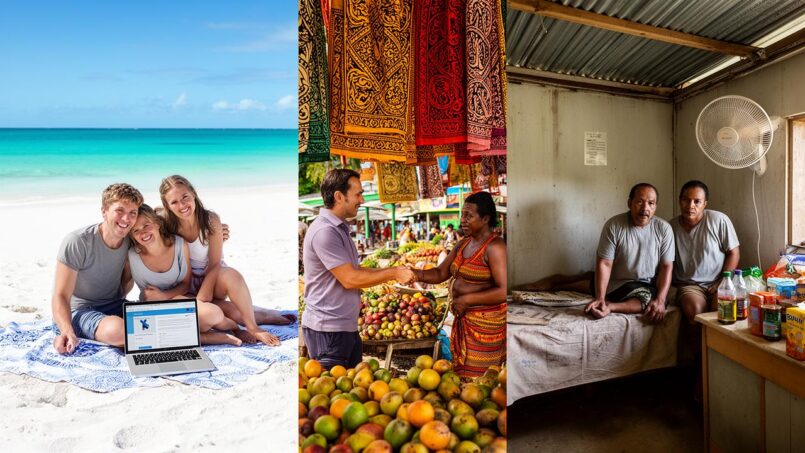
Settling in Tonga sounds like a dream: a Pacific kingdom, coral islands, a warm society nicknamed the “Friendly Islands,” a fairly moderate cost of living, and an everyday pace infinitely calmer than in most Western countries. But behind the postcard image lie extreme climate vulnerability, a limited healthcare system, a narrow job market, and geographic isolation that isn’t for everyone.
This article analyzes the concrete aspects of life in Tonga, reviewing economic, climate, social, health, and educational data. It aims to provide a realistic picture to help separate fantasy from reality before making an expatriation decision.
A Unique Island Kingdom in the Pacific
Before weighing the pros and cons, it’s important to understand Tonga’s particular context. The kingdom consists of about 170 islands, of which only about 36 are inhabited. The largest, Tongatapu, is home to nearly three-quarters of the population and houses the capital, Nuku’alofa, the country’s administrative, economic, and logistics hub.
The demographic structure remains mostly rural, with roughly 85% of residents living in villages, often within 5 km of the coastline. This proximity to the sea shapes the way of life, the economy (agriculture, fishing, tourism), but also exposure to climate risks.
Tonga, the only Pacific monarchy never formally colonized, illustrates the persistence of a traditional social organization known as “anga fakatonga.” This “Tongan way” is marked by respect for elders, a clear social hierarchy, the central role of the extended family, the importance of nobles and titles, and a strong presence of churches in society.
The official languages are Tongan and English. Tongan dominates daily life, while English is widely used in government, business, and education, a significant advantage for English-speaking expats.
Quality of Life: Simplicity, Nature, and Community
Living in Tonga means first embracing a simpler, less consumer-driven lifestyle than in most Western countries. The air is excellent, the islands offer beaches, coral reefs, coconut palms, and lagoons, and daily life revolves around family, church, and community.
The concept of “Tongan Time” illustrates this shift in pace: outside professional settings, strict punctuality isn’t a priority. Social relationships take precedence over an obsession with efficiency. For some expats, this slowdown is a huge relief; for others, it’s a source of frustration.
Markets, at the heart of both urban and rural life, offer an authentic immersion. You’ll find fresh produce sold in bundles (fruits, vegetables, fish at 2, 3, or 5 pa’anga), often locally harvested like bananas, coconuts, or traditional root crops. It’s a chance for direct contact with producers, sometimes picking fruit off the tree, cooking with freshly opened coconuts, and observing free-roaming pigs—a reminder of the still-very-agricultural dimension of the society.
On a social level, expats describe remarkable hospitality: invitations to family meals, participation in ceremonies, and constant greetings on the street. The flip side of this friendliness is that everyone knows everyone, leaving little room for anonymity.
A Culture Deeply Shaped by Religion and Social Codes
One of the most disorienting aspects for newcomers is the enormous importance of religion. Virtually the entire population is Christian, and Sunday is devoted to church and family. This isn’t just a social norm—it’s enshrined in law. On that day, shops, public transport, and professional activities come to a virtual standstill. Jogging on the beach or swimming for leisure can be frowned upon, and in some tourist areas, Sunday walks are even formally discouraged.
Dress codes are conservative, requiring modest clothing, and public displays of affection are limited, generally confined to holding hands.
For an expat, respecting these norms is key to integration. Attending church services, learning a few phrases like “Mālō e lelei” (hello), accepting invitations to ceremonies such as kava parties or funerals (where one often wears the ta’ovala—a mat around the waist) opens doors and builds trust.
This cultural dimension is all the more important because international surveys show that for 65% of expats, cultural adaptation is the number one challenge of moving abroad, ahead of housing or work issues. In Tonga, where local culture is very cohesive and highly codified, this challenge is magnified.
Cost of Living: Generally Affordable, but Highly Contrasted
Financially, Tonga offers real advantages for an expat with a foreign income (pension, remote work, NGO assignment, etc.). According to various indices, the cost of living is about 1.1 times lower than the global average and up to 59% lower than in the United States. Compared to a French city like Nice, living in Tonga would be roughly 11% cheaper for a comparable level of comfort.
Housing: Huge Gaps Between Center and Periphery
The housing market is very uneven. In Nuku’alofa, a furnished 85 m² apartment in an “expensive” neighborhood rents for around 3,000 pa’anga per month, while an equivalent home in a more ordinary area goes for about 2,000 pa’anga. A furnished 45 m² studio can range from 1,000 pa’anga in a normal area to 2,000 pa’anga in a sought-after zone. At the other extreme, in the outskirts or on less-demanded islands, very basic housing can be found for less than 150 pa’anga per month.
The median price of a home in Tonga is estimated at just over $90,000.
This simplified overview gives a general idea:
| Housing Item (approx.) | Typical Amount (TOP/month) |
|---|---|
| Furnished studio 45 m² – outer area | ~1,000 |
| Furnished studio 45 m² – expensive area | ~2,000 |
| 3-room 85 m² – normal area | ~2,000 |
| 3-room 85 m² – expensive area | ~3,000 |
| Utilities (electricity, water, trash) – 85 m² | 200 to 700 (avg ~450) |
| Fixed unlimited internet (high-end plan) | ~300 |
For very short stays, costs shoot up: high-end hotels and Airbnbs can charge between $100 and over $1,000 per night. The median is around $140–$150.
Food: Cheap Local, Costly Imports
The key to keeping your food budget in check is to prioritize markets and local produce. Fruits and vegetables (tomatoes, potatoes, lettuce, apples, bananas, oranges) are generally affordable, with prices that, when converted to pa’anga, remain modest. Fish and seafood are abundant and remain one of the country’s strong points.
The maximum cost of a fancy dinner for two in a mid-range restaurant in Tonga.
A look at some prices illustrates these disparities:
| Food product / service | Indicative price (TOP) |
|---|---|
| Simple restaurant meal | 10–25 (avg ~20) |
| Fast food combo like McDonald’s | ~25 |
| “Business” lunch with drink | ~28 |
| Local draft beer (pint) | 6–10 |
| Imported beer (small bottle) | 7–15 |
| Bread for 2 people/day | ~3.50 |
| 12 eggs | 8–12 |
| Mid-range wine bottle | ~40 |
| Cappuccino in busy expat area | ~6–7 |
For an expat who cooks at home and shops at markets, the monthly food budget stays reasonable; for those who eat Western-style often and dine out frequently, the bill adds up quickly.
Transport and Everyday Expenses
Transport remains affordable: a local bus ticket is around 5 pa’anga, a monthly pass can range from 40 to 100 pa’anga depending on the plan, and gasoline hovers around 4 pa’anga per liter. A taxi ride starts at about 5 pa’anga, with waiting time billed steeply (around 100 pa’anga per hour).
A full day of daycare can cost nearly 380 pa’anga per month in Tonga.
Typical Monthly Budget: Single and Family
Overall estimates give several orders of magnitude for expats:
| Profile | Estimated Monthly Cost (USD) | Includes Rent? |
|---|---|---|
| Single – “standard” lifestyle | 1,000–1,500 | Yes |
| Single – tight budget | ~935 | Yes |
| Single – “comfortable” level | 2,500–3,600 | Yes |
| Couple – comfortable level | ~2,670 | Yes |
| Family of 3 – “nomadic” | ~2,754 | Yes |
| Family of 4 – high estimate | ~3,860 | Yes |
In practice, for an expat with a foreign income, a budget of $2,500 per month allows for comfortable living in Tonga, especially outside the most luxurious housing in Nuku’alofa.
But keep in mind: the average local salary after taxes is around 1,600 pa’anga (about $670) and covers only 70% of the estimated cost of living for a single person. In other words, for an expat tempted to “live like a local” on a local salary, the reality would be much harder. The main cost-of-living advantage only materializes if you arrive with a non-Tongan income.
A Tight and Heavily Protected Job Market
For anyone considering coming to “look for work” on the ground, Tonga is no land of promise. The economy relies mainly on agriculture, fishing, remittances from the diaspora, and tourism. The job market is limited, and the government enforces a strong policy of protecting the local workforce: a position can only be awarded to a foreigner if no qualified Tongan candidate is found, a point formally verified through a labor market test when applying for a work permit.
Employment opportunities in Tonga for foreign nationals are mainly concentrated in high-demand sectors, with a strong presence of jobs in the capital, Nuku‘alofa.
Priority sectors hiring foreign skills to strengthen essential public services.
In-demand trades in construction, electricity, solar energy, and culinary arts.
Management roles and, to a lesser degree, opportunities in information technology.
To obtain a work permit, you need a local employer willing to sponsor the process, provide an employment contract, medical certificates, a police clearance, copies of diplomas, sometimes a letter of support from the relevant ministry, and pay fees that run into a few hundred pa’anga. Permits are generally valid for 12 to 24 months, renewable under certain conditions.
The average gross monthly salary in Tonga is around 1,175 pa’anga, an amount often below the cost of living for most residents.
In short, for a relocation project to Tonga, having an external income (international remote work, pension, annuities, NGO or international agency missions) is an almost indispensable advantage, unless you are coming specifically for a pre-arranged skilled position.
Healthcare: Decent Basic System, but Evacuations Essential for Serious Cases
On paper, Tonga has respectable health indicators in the Pacific context: a network consisting of 1 referral hospital (Vaiola in Nuku’alofa), 3 district hospitals, 14 health centers, and 34 maternal and child clinics; improved water and sanitation coverage of around 99%; life expectancy around 77 years.
The daily reality for an expat, however, is that of a limited system. The majority of care (over 90%) is delivered in hospitals rather than at local clinics. Specialist offerings are very restricted, especially in anesthesia, surgery, advanced imaging, and certain medical specialties. For example, there is no MRI on site, though CT scanners, ultrasounds, and mammograms are available at Vaiola.
For Tongans, care in the public sector is free. Foreigners, on the other hand, must pay for their care, whether in the public or private sector. Rates remain affordable: a general practitioner visit costs about 24 pa’anga, a hospital consultation between 50 and 150 pa’anga, and common medications between 10 and 30 pa’anga. Dental care is mainly provided by the public sector, with few private practices.
The main risk for an expat is not the cost of basic care, but the lack of high-tech medical facilities in case of a serious problem. For a diving accident, there is no decompression chamber; for major surgery, cancer, a complicated heart attack, or severe premature birth, an evacuation to New Zealand or Australia is necessary. A medical evacuation can cost between $20,000 and $50,000, and some estimates even cite bills that can reach $250,000 depending on severity and distance.
For medium- or long-term stays, international health insurance with evacuation coverage to New Zealand or Australia, as well as coverage for high-risk activities like diving, surfing, or snorkeling, is essential.
Infectious risks exist but are relatively well-known: dengue, chikungunya, Zika, hepatitis A, typhoid, leptospirosis, tuberculosis. Water should be boiled, filtered, or bought in bottles. International health organizations recommend being up to date on routine vaccines (measles, polio, varicella), and supplementing with targeted vaccines (hepatitis A and B, typhoid, possibly rabies depending on exposure).
Another longer-term health issue: non-communicable diseases. One study found that 99.9% of Tongan adults had a moderate or high risk of developing diabetes or cardiovascular disease, and these conditions account for 75% of deaths. For an expat, a diet rich in carbohydrates and fatty meats, combined with a more sedentary lifestyle, can increase risks if they don’t monitor their health habits.
Education: A Strong Local System, Limited International Options
For families with children, schooling is a central concern. The Tongan education system follows a 6-3-3 structure (six years of primary, three of lower secondary, three of upper secondary). English and Tongan are both used, but Tongan remains the dominant language in most public schools.
The country boasts a very high enrollment rate (around 98.5% of school-age children) and an adult literacy rate above 98%. Basic education is thus well established, with a network of about 95 primary schools and 22 secondary schools. The vast majority of secondary schools are run by religious or private organizations, with mission schools educating over 80% of students.
The Ocean of Light International School, run by the Baháʼí community, offers a full curriculum from preschool (age 3) to secondary (Year 12) based on the Cambridge program (IGCSE). Instruction is mainly in English, includes Tongan language classes, and emphasizes academic excellence, technology, and values education.
The school has about 250 to 300 students, the majority Tongan, with the rest coming from countries like Australia, Canada, Japan, New Zealand, or the United States. The teaching staff is mixed (Tongans and foreigners). The facilities, built on nearly 6 acres, include classrooms, labs, and a library, all equipped for laptop use.
This is the estimated average annual cost for primary school at an international school, based on cited figures.
Another common solution for expatriate families is to send their children to boarding school in New Zealand or Australia while living in Tonga. This guarantees a path through a broader education system, at the cost of geographic separation and very high fees.
For very young children, paid daycare facilities exist but are few, with costs around 380 pa’anga per month for full-time care.
Safety, Crime, and Daily Life
Tonga has a reputation as a generally safe country. Crime indicators are low: violent crime is very rare, with rates sometimes around 1 to 3 serious incidents per 100,000 inhabitants. Foreign authorities recommend taking “normal precautions” without flagging any specific risk of terrorism, kidnapping, or violence targeting foreigners.
The most common crime in Tonga is opportunistic theft (burglaries, car thefts, pickpocketing). Although rates remain low, some central neighborhoods of Nuku’alofa are more affected. Break-ins into locked houses, sometimes by forcing window bars, have been reported. It’s therefore advisable to take basic precautions: always lock doors and windows, don’t leave valuables in plain sight, and use safes or discreet storage.
Sexual assaults against foreigners are rare but documented, particularly on public beaches. Instances of verbal harassment or inappropriate physical contact have been reported, especially toward women who are alone. It is therefore advised to avoid isolated areas at night, favor group outings, and stay vigilant on less crowded beaches.
Driving with a blood alcohol level above 0.03%, using a phone while driving, not wearing a front seatbelt, public nudity, and homosexuality are prohibited and severely penalized. The importation, cultivation, or distribution of illegal drugs is punishable by extremely heavy penalties, including imprisonment, hard labor, and exorbitant fines.
In daily life, expats report numerous police road checks, roads that are decent but sometimes narrow or deteriorated, and the complete absence of traffic lights, replaced by roundabouts. Driving at night outside urban areas is discouraged due to animals, pedestrians, poor lighting, and uneven road quality.
Internet, Remote Work, and Digital Isolation
For remote workers and digital nomads, internet access is a critical point. Tonga has come a long way since the days when connectivity relied solely on slow, expensive satellites. The opening of the submarine cable to Fiji in 2013, followed by a domestic cable to Ha’apai and Vava’u in 2018, sparked a genuine “digital revolution”: lower prices, a surge in users, the launch of 4G networks, and increased internet penetration (nearly 60% of residents online by early 2025).
This is the percentage of the population with access to at least 4G on the main inhabited islands.
However, Tongan connectivity remains fragile. Submarine cable breaks—in 2019 due to a ship’s anchor, and in 2022 after the eruption of the Hunga Tonga–Hunga Ha’apai volcano—plunged the country into a near-total shutdown of international internet for days or even weeks. Repairs depend on rare cable-laying ships, sometimes mobilized from thousands of kilometers away.
Faced with these vulnerabilities, the country has turned to next-generation satellites. An agreement with Kacific provides a high-speed backup solution, and Starlink was authorized in 2024–2025, distributed through local operators. Many users report “decent and stable” speeds, making it a useful backup option for remote workers, albeit at a significant cost.
Internet subscriptions are expensive in Tonga, potentially reaching $200/month for an unlimited fixed plan. For critical professional use, it’s advisable to plan for a primary connection and a backup, such as two SIM cards from different operators or a Starlink antenna.
Digital isolation isn’t just about outages; it also stems from geographic distance, logistical costs, and the small market size. Digital services are evolving, but some uses remain complicated (heavy streaming, large data transfers, very low-latency cloud services). For many nomads, Tonga is therefore not the first destination but rather a compromise between natural beauty, cost of living, and “sufficient” connectivity for certain professions.
A Country on the Front Line of Climate Change
For any expat considering a long-term move to Tonga, the climate dimension is no small detail. International studies rank the kingdom among the three most climate-change-exposed countries in the world. The combination of low-lying islands, limited resources, and heavy dependence on the sea, agriculture, and coastal infrastructure places the archipelago on the front line.
The sea level around Tonga is rising at an annual rate of 6.4 mm, above the global average.
Added to these long-term trends are extreme events: storm surges, seasonal king tides, and increasingly intense tropical cyclones. Between the 1969–70 season and 2010–11, at least 85 cyclones affected the Tonga region, nearly 20 per decade, with a growing proportion of Category 4 and 5 events. In recent years, major cyclones like Gita (2018) and Harold (2020) caused extensive damage: thousands of homes damaged or destroyed, 80% of households without power, over 4,500 people displaced, and economic losses exceeding $100 million for some events.
For an expat living by the coast, concrete risks include repeated flooding, coastline retreat, temporary submersion of roads and land, salinization of agricultural land and freshwater aquifers, as well as power outages and damaged infrastructure. Long-term projections indicate possible permanent submersion of some currently inhabited or tourist coastal areas.
The government and international partners (Green Climate Fund, UNDP, World Bank, etc.) have launched coastal protection programs: rock revetments, breakwaters, beach replenishment, mangrove reforestation, strengthening 16 km of coastline in Tongatapu, and improving resilience along an additional 12 km, directly benefiting more than 10,000 residents. These projects have a positive impact but remain insufficient given the scale of the risks.
For an expat, this means that planning your move must incorporate this factor: carefully choose the location of your home (elevation, distance from the sea, exposure to prevailing winds), check flood histories, prepare an evacuation plan for cyclones, put together an emergency kit (water, food, lights, batteries), and stay informed through the Tonga Meteorological Service and regional alerts based in Nadi (Fiji).
Drinking water in Tonga comes mainly from rainwater harvesting (domestic cisterns) and shallow groundwater aquifers. Rising sea levels and the gradual salinization of soils and aquifers threaten these resources. In some outer islands that rely almost exclusively on rainfall, drought periods are already causing shortages.
Agriculture, which employs a quarter of the population and contributes 16% of GDP, is heavily affected by climate change. Impacts include flooding in low-lying areas, soil salinization, erosion from extreme rainfall, and cyclone damage to crops. These disruptions lead to lower yields, increased harvest variability, and greater dependence on food imports.
For the expat, these changes have two implications. On one hand, they can affect the availability and price of local products; on the other, they reinforce the need to diversify your supply sources (markets, supermarkets, a stock of dry goods) and get used to more pronounced seasonal variations.
Mobility, Visas, and Residence: A Relatively Clear but Structuring Framework
Access to Tongan territory and the ability to stay long-term are subject to fairly strict rules. A passport valid at least six months beyond the departure date and a onward or return ticket are required. Visitors from many countries receive a visitor visa on arrival, generally for 31 days, sometimes up to 90 days for certain nationals (including Schengen), with the possibility of extension up to 6 months through immigration services in Nuku’alofa or Neiafu.
For a move abroad, several types of visas come into play:
Discover the main visa categories for staying in Tonga, each tailored to a specific situation.
For employment, a mission, or structured volunteering. Requires a local sponsor and a complete set of documents.
For investing in or managing a long-term project in the archipelago.
For individuals over 18 who wish to pursue their studies in Tonga.
For retirement. Reserved for those who can demonstrate at least 10,000 pa’anga of regular foreign income per year.
Accessible notably to people of Tongan descent or married to a Tongan citizen.
Application fees vary by category and are non-refundable if refused. For a resident married to a Tongan, the annual residence permit fee is around 270 pa’anga for an adult and 130 pa’anga for a minor. Applications can be submitted at a Tongan embassy or consulate, with processing times often under a month, except during peak periods or holidays.
Permanent residence and naturalization remain more selective. To become a citizen, you must demonstrate good character, an interest in the Tongan language, and several years of residency. Certain profiles (former citizens, people of Tongan descent, spouses) have preferential pathways, but the procedure remains demanding.
For an expat who simply wants to live in Tonga for a few years without working for a local employer, the combination of a residence visa (through marriage or descent) or a “guaranteed income” visa and a stable foreign income is the most realistic setup.
Bottom Line: Who Is Tonga a Good Expat Choice For?
At the end of this overview, the picture of Tonga appears nuanced. The country offers real assets for certain profiles, but proves unsuitable for others.
The major advantages are clear:
– A generally moderate cost of living for an expat with outside income,
– An exceptional natural environment, with clean air, sea, reefs, and preserved landscapes,
– A warm society structured around values of respect, solidarity, and community life,
– Low insecurity, without major threat of terrorism or organized crime,
– A rich culture with living traditions, festivals, and a strong identity,
– A solid local education system in terms of literacy, complemented by at least one recognized international school in Nuku’alofa,
– A certain modernization dynamic, particularly in digital and connectivity.
But the drawbacks are equally structuring:
Expatriation to the Solomon Islands presents several major challenges: a very restricted job market closed to foreigners, a limited healthcare system requiring costly evacuations, extreme vulnerability to climate change (cyclones, sea level rise), sometimes precarious infrastructure, significant geographic isolation, a very limited range of leisure and services, and a deeply religious culture requiring great adaptability.
In practice, Tonga is especially well-suited for:
This content illustrates the types of people whose lifestyle and priorities align with conditions often encountered in remote islands or isolated regions. Profiles include: retirees with a comfortable pension and good international health insurance; families or couples seeking a simple, nature-focused lifestyle, willing to accept a limited educational offering (local schools and one international school); remote workers whose activity can tolerate sometimes irregular connectivity, provided they can fund redundant internet solutions; individuals involved with NGOs, religious, educational, or medical missions, for whom the service and cultural immersion dimension outweighs comfort; and finally, lovers of maritime activities (diving, sailing, whale watching) who can cope with significant health, transport, and climate constraints.
On the other hand, the Pacific kingdom is probably a poor fit for:
– Young professionals counting on the host country to find work,
– People heavily dependent on specialized medical care or major treatments,
– Families requiring a wide diversity of international school options,
– Those who struggle with isolation, administrative slowness, outages, or climate unpredictability.
Projecting yourself into Tonga therefore requires asking several honest questions: Am I ready to live with fewer product choices, less entertainment, and more climate uncertainty? Do I have a sufficient and stable external income? Am I willing to adapt to a deeply Christian culture, respect conservative dress codes and social norms, accept Sunday closures and community rhythms?
For those who answer yes, Tonga offers a rare experience: living in an oceanic kingdom still largely preserved, within a society where mutual aid, faith, and family remain everyday pillars, with a measured cost of living and a quality of life that many describe as peaceful. For others, it’s probably better to keep Tonga as a destination for extended travel rather than as a permanent expatriation home.
A wealth planning project or a question? Contact us now to speak with a wealth management expert.
Disclaimer: The information provided on this website is for informational purposes only and does not constitute financial, legal, or professional advice. We encourage you to consult qualified experts before making any investment, real estate, or expatriation decisions. Although we strive to maintain up-to-date and accurate information, we do not guarantee the completeness, accuracy, or timeliness of the proposed content. As investment and expatriation involve risks, we disclaim any liability for potential losses or damages arising from the use of this site. Your use of this site confirms your acceptance of these terms and your understanding of the associated risks.

Cyril Jarnias is an independent expert in international wealth management with over 20 years of experience. As an expatriate himself, he is dedicated to helping individuals and business leaders build, protect, and pass on their wealth with complete peace of mind.
On his website, cyriljarnias.com, he shares his expertise on international real estate, offshore company formation, and expatriation.
Thanks to his expertise, he offers sound advice to optimize his clients' wealth management. Cyril Jarnias is also recognized for his appearances in many prestigious media outlets such as BFM Business, les Français de l’étranger, Le Figaro, Les Echos, and Mieux vivre votre argent, where he shares his knowledge and know-how in wealth management.





