
 Published on and written by Cyril Jarnias
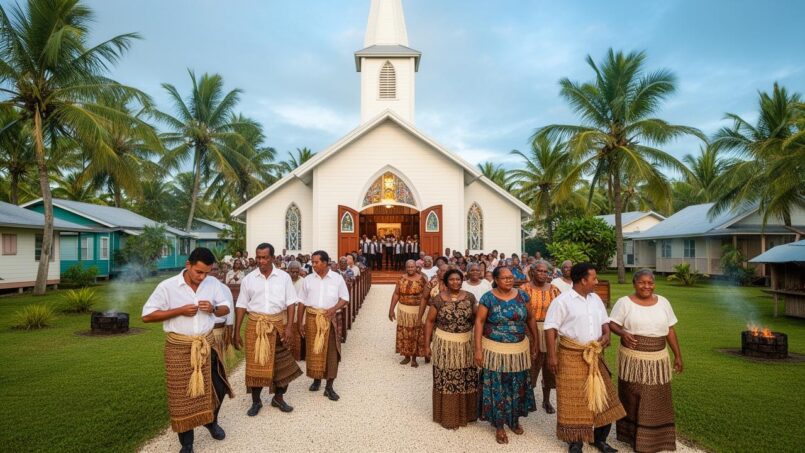
Moving to Tonga means entering a kingdom where Christian faith is not only lived in church but shapes everything—from the calendar to dress codes, social interactions, leisure, and even the silence of Sunday. For an expatriate, religion is not an “optional” topic: it is the key to understanding the country, avoiding missteps, and building genuine relationships with Tongans.
This practical guide helps you understand and respect local religious customs in Tonga, making it easier to integrate with your neighbors, colleagues, and friends while keeping your own identity.
A deeply Christian kingdom
In Tonga, saying that religion is important is an understatement. Almost the entire population belongs to a Christian church: according to the latest censuses, more than 95% of residents identify as Christian, and some figures reach up to 99% when all denominations are included.
The Constitution recognizes freedom of religion, and it is generally respected. Small Baha’i, Hindu, Muslim, and Buddhist communities do exist, often linked to business circles or immigration. But the daily reality remains that of an officially Christian country, whose national motto—””Otua mo Tonga ko hoku tofi’a”, “God and Tonga are my inheritance”—sets the tone.
The religious landscape is dominated by several major churches, each very visible in public life.
Overview of the main churches
The majority of Tongans belong to a Protestant church of Methodist tradition or to evangelical churches, alongside a significant Catholic and LDS (Mormon) presence. Census figures help measure this Christian pluralism.
Here is a simplified overview of the main denominations:
| Christian denomination | Estimated share of population | Approximate number of members |
|---|---|---|
| Free Wesleyan Church of Tonga | 34.2% | 33,953 |
| The Church of Jesus Christ of Latter-day Saints (LDS) | 19.6% | 19,534 |
| Roman Catholic Church | 13.7% | 13,649 |
| Free Church of Tonga | 11.3% | 11,244 |
| Church of Tonga | 6.8% | 6,782 |
| Seventh-day Adventists | 2.48% | 2,461 |
| Assemblies of God | 2.47% | 2,455 |
| Various Pentecostal groups | 1.92% | — |
| Tokaikolo Christian Church | 1.46% | 1,455 |
| Constitutional Church of Tonga | 1.16% | 1,152 |
| Anglican, Salvation Army, others | <1% each | — |
The most influential church remains the Free Wesleyan Church of Tonga. Historically linked to the introduction of Methodism and closely tied to the monarchy, it effectively acts as a “state religion.” Its pastors are powerful social figures, and the institution runs about 30% of the country’s schools, further strengthening its influence.
Percentage of the population that the LDS church claims as registered members in Tonga.
The Catholics, for their part, have large places of worship—Cathedral of the Immaculate Conception in Maʻufanga, St. Anthony of Padua Basilica in Nukuʻalofa, St. Joseph’s Cathedral in Neiafu—and gave the universal Church its first Tongan cardinal in 2015.
Despite this diversity, one characteristic strikes observers: Tongans are particularly devout. Going to church, praying, contributing financially to one’s community, and participating in religious festivals is part of the social norm. Even if everyone is free to choose their denomination, not attending a church remains rare.
Sunday: a sacred day regulated by law
No aspect of religious life affects an expatriate’s daily routine as much as the way the country observes Sunday. In Tonga, Sunday is not just a tradition: it is a constitutional principle, backed by specific laws.
A “Sabbath” enshrined in the Constitution
Since 1875, the Constitution has included a very clear clause: the “Sabbath” must be observed, and it is forbidden to carry out any trade, business, or professional activity on that day, except as provided by law. The “Lord’s Day” officially begins at midnight on Saturday and ends at midnight on Sunday.
On this basis, detailed legislation has specified what one may—or may not—do on Sunday. It is prohibited to:
– operate a business or sell goods or services
– carry out construction, gardening, or agricultural work
– organize or engage in games, sports, dancing, or recreational fishing
– produce significant noise in public spaces
Exemptions exist for essential services such as hospitals, police, ports, and certain public and security services. Specific permits may be issued by the Minister of Police, with government approval, to authorize these activities.
For an expatriate, this means the country is practically at a standstill on Sunday. Most shops, markets, and public transport are closed. Private businesses cease operations. Only some tourist facilities—especially resorts—and a few restaurants (including some Chinese restaurants) remain open. Even the once-tolerated practice of bakeries operating on Sunday has been restricted by a recent government decision.
Spending a Sunday in Tonga as an expatriate
A typical Sunday revolves around three pillars: worship, family, and rest. Streets are quiet. You will see entire families, often in traditional attire, heading to the various churches in their village or neighborhood. Afternoons are reserved for family meals, visits, naps, and sometimes a second church service or church meetings.
In some cultural or religious contexts, common behaviors elsewhere may be frowned upon or prohibited. In particular, avoid swimming in a swimsuit on a public beach, running for sport, washing your car or laundry in public, or playing loud music. Some tourist activities, such as boat trips or organized excursions, may also be banned, especially on Sundays on certain islands. Always research local laws and norms to avoid any incidents.
To avoid tensions, it is strongly recommended to:
– plan your grocery shopping and trips on Saturday
– keep a low profile on Sunday if you do not wish to go to church: read, take a quiet walk, spend time with family
– prioritize discreet activities within your own home, avoiding noise and behavior perceived as “loud leisure activities”
Many newcomers choose to attend at least one church service, if only for the cultural experience. The a cappella choral singing, the fervor, and the community dimension of Methodist or Catholic services leave a lasting impression. If you decide to go, it is crucial to respect the dress code and the order of service, and especially to stay until the end: leaving before the conclusion is seen as an offense.
Clothing, modesty, and respect: reading the codes of the body
In Tonga, dress norms are strict and largely shaped by Christian culture. Even if resorts allow a bit more freedom, the general rule in villages, towns, and public places is modesty.
Basic principles
Outside tourist areas, both men and women are expected to cover more than the current minimum in Western countries. Shoulders and chest must be covered, and legs covered at least to the knee. Very tight, transparent, or overly short clothing is considered disrespectful, especially near churches or on village lands.
It is illegal for both men and women to be topless in public spaces. This rule does not apply inside resorts, but female toplessness there remains culturally frowned upon. On public beaches, locals often swim fully dressed (T-shirt and shorts). Choose a one-piece swimsuit under a T-shirt or long shorts—better accepted than a skimpy bikini.
Another key point, often overlooked by expatriates: wearing an all-black outfit is, for Tongans, an explicit sign of current mourning. Dressing entirely in black when not in mourning can raise questions or even be interpreted as inappropriate appropriation of another’s grief. It’s best to avoid this choice unless you are actually participating in funeral ceremonies.
Finally, public displays of affection are generally frowned upon. Holding hands is usually tolerated, especially for married couples, but hugging, kissing, or persistent displays of tenderness in the street or village may shock.
Church attire: a formal style
Going to church in Tonga is somewhat like attending a solemn ceremony. People dress carefully, sometimes in their best clothes.
For men, the norm includes:
Appropriate attire for attending a church service in Tonga generally includes a short- or long-sleeved shirt, well buttoned, paired with long trousers or, more typically, a tupenu (a piece of fabric worn like a sarong) covering the knees. For Tongans, wearing a ta’ovala (a woven mat tied around the waist) is common in the more traditional churches, especially the Free Wesleyan Church. In some contexts, a blazer or jacket may be added, particularly for men of a certain rank.
For women:
– dress or skirt below the knee, with a top covering the shoulders
– in some churches, a matching blouse and skirt set (pule taha or puletaha) in very bright colors
– a shawl over the shoulders is possible
– women’s trousers remain rare at worship, though this is slowly evolving
The wearing of hats, inherited from Western tradition, is codified in some Methodist communities: only women considered “full” members of the congregation may wear one. Young girls or women seen as “seekers” come bareheaded. Out of respect for these codes, a foreign visitor should avoid wearing a hat in church.
Understanding traditional clothing
For anyone settling in Tonga, it is useful to distinguish the main elements of traditional attire, which you will see everywhere on Sundays, at weddings, funerals, as well as in government offices and some businesses.
They can be summarized as follows:
| Item | Description | Main use |
|---|---|---|
| Tupenu | A piece of fabric worn like a sarong by both men and women, at least knee-length | Daily or worship attire |
| Ta’ovala | A woven mat or mat tied around the waist, often over the tupenu | Symbol of respect, worn in church, official work, ceremonies |
| Kafa | Cord (coconut fiber, sometimes human hair) used to tie the ta’ovala | Indispensable accessory for the ta’ovala |
| Kiekie | Decorative women’s belt worn at the waist, often lighter than a ta’ovala | Semi-formal, parties, church |
| Puletaha / Pule taha | Matching blouse and skirt set with Polynesian patterns | Women’s festive or worship outfit |
| Ngatu (tapa) | Bark cloth decorated with traditional motifs | Ceremonial gifts, decoration, sometimes costume elements |
| Sulu | Cotton or rayon garment for everyday wear | Casual |
The ta’ovala holds a special place: worn around the waist, it signals that you are presenting yourself in a formal context with respect. You will see it at church, weddings and funerals, during royal ceremonies, or in government offices. Large families often own finely woven ta’ovala, passed down through generations and worn smooth with age: the older and more delicate it is, the more valuable. Conversely, very coarse and even damaged mats are worn during mourning by some close relatives to signify the depth of their grief.
An expatriate is not expected to spontaneously wear a ta’ovala or specific mourning attire. However, accepting to wear one when offered for a wedding, service, or ceremony is seen as a very respectful gesture. The important thing then is to let the Tongans around you guide you.
Daily religious life: prayer, meals, and community
Beyond Sunday service, Tongan religiosity appears in countless everyday details. One of the most visible for a foreigner is the ritual of prayer before meals.
At home as at restaurants, it is common for someone to say a blessing before starting to eat. Even children are accustomed to this. As a guest, you are not expected to lead the prayer, but it is important to wait quietly, head bowed, until the blessing is finished before touching your plate. Eating before the prayer would be seen as bad manners.
Prayer is a common practice to open and close most public meetings, ceremonies, and major events, including village meetings. It is customary to invite a pastor or church elder for this. As an expatriate, you are expected to stand, remain calm, sometimes remove your hat, and stay silent during these moments.
The boundary between social and religious is therefore very porous: the church serves as a place of worship, a social center, a sports club, a meeting hall, and sometimes even a relay for social services. Abroad, in Tongan communities in Auckland or the U.S. West Coast, this function of a “reconstructed village” is even more pronounced: the pastor plays a role close to that of a customary chief.
“Faka’apa’apa”: respect as a cardinal principle
To understand expected behaviors in a religious context in Tonga, you need to grasp the concept of faka’apa’apa, often translated as “respect,” but which also encompasses modesty, restraint, discretion, and a way of positioning oneself relative to others.
Faka’apa’apa is a Polynesian principle of respect that demands deference toward elders, chiefs, the royal family, and ministers of worship. It comes with strict postural rules: avoid physically towering over an important person (by remaining standing if they are sitting), do not point your feet at someone, and do not step over mats that are already occupied.
In a house or meeting room, you will generally be expected to wait to be invited to sit, rather than taking a seat spontaneously. Often everyone sits on mats on the floor—women with legs folded to the side, men cross-legged. Lounging, stretching your legs toward someone, or walking through a seated group without bending slightly and apologizing (saying “tulou”) are signs of disrespect.
The head is considered sacred: avoid touching a child’s head, even with affectionate intent. Also, do not use your feet to point at an object, and do not pass an object over another person’s head.
In the religious domain, this requirement for respect is combined with a strong emphasis on self-control. Raising your voice, being aggressive or losing your temper, especially during church meetings or ceremonies, is very poorly regarded. Good reputation is largely built on the ability to “save face.”
Between village, capital, and diaspora: variations in practice
While religious fervor is a common trait, how it is experienced varies depending on whether you are in a remote village, in the capital Nukuʻalofa, or within a Tongan community abroad.
In villages, the church is a pillar of social status. Building a beautiful building, maintaining a large hall, and forging alliances between families and congregations are sources of prestige. Each family or segment of a large clan is often associated with a specific church, but many lineages are “multiconfessional”: cousins may be Catholic, Methodist, LDS, etc. Aggressive proselytizing toward other churches in the village is generally avoided; the norm is peaceful coexistence, where everyone respects each other’s feast days and may even participate.
In the city, marriages between people of different denominations are more common. Social and geographic mobility softens strict community affiliations. It is not uncommon for some Tongans to change religious denomination based on their relationships—a practice that can sometimes create tensions but is generally accepted.
In the diaspora (New Zealand, United States, Australia), Tongan churches replay both the village solidarity and the rivalries imported from home. Pastors become major authority figures, and communities find not only spiritual life but also help with housing, employment, navigating the education system, or receiving psychological support. For an expatriate living in Tonga, understanding this role of the church also helps interpret the very strong ties your colleagues or friends maintain with their cousins or relatives abroad, often through religious networks.
Money and faith: understanding the “Misinale”
For a foreigner invited to participate in church life, one of the most bewildering moments is the Misinale, the annual fundraising campaign in some denominations.
During these special services, often held around October or November, the sermon gives way to an almost uninterrupted series of collections. Women, dressed for the occasion, walk down the central aisle with collection boxes, and everyone—men, women, children—slips in bills, ostentatiously. There is no anonymity: giving is part of a social performance.
Minimum amount, in dollars, that many Tongan families spend or aim for at financially significant celebrations, at the risk of shame.
For a non-Tongan expatriate, you will not be asked to match these amounts, and people generally understand that your financial benchmarks are different. A useful strategy if you wish to contribute is to prepare many small bills in advance, so you can give at each passing of the box without donating sums disproportionate to your budget.
In compensation, it is not uncommon for the community to give back a hundredfold in the form of food. After a Misinale, many go home loaded with dishes offered by other members, sometimes enough to eat for several days.
Funerals and mourning: Christianity intertwined with ancient customs
For a well-integrated expatriate, it is likely that one day you will be invited to a putu, a wake or funeral. This is one of the areas where the connection between Christianity and pre-Christian culture is most evident.
Funerals are major community events, costly in time, gifts, and food. The grieving family must feed a steady stream of relatives, neighbors, co-religionists, sometimes hundreds of people, for several days—which can lead to “fakamasiva” (impoverishment due to social obligations). In exchange, visitors bring fabrics, mats, envelopes, baskets of food, following a very precise code.
The example illustrates the successive phases of a traditional funeral rite in Madagascar. It begins with a sung wake under a large tent, followed by the return of the body, kept cold, to the home for the vigil. The body is then perfumed with lotions and oils from a special basket called *kato teu*, allowing loved ones to touch or kiss it one last time. The ceremony continues with various moments of prayer, speeches, and gifts, before ending with burial.
In religious terms, the services are marked by Christian prayers, hymns, and sermons. But the act of placing large mats on the grave, later covering it with oiled stones in a ceremony a hundred days later, or wearing torn ta’ovala for weeks, stems from older symbolic logics, reinterpreted in light of the Christian faith.
For an expatriate at a Tongan funeral, it is best to let the host family guide you. As a sign of respect, wear sober, dark clothing (not necessarily all black), avoid bright colors, cover shoulders and knees, and accept the mourning ta’ovala (traditional cloth) if offered. It is better to observe and be discreetly present than to improvise unmastered gestures.
Weddings, celebrations, and liturgical colors
Weddings, another major life event, also combine strong Christian references with the display of Tongan culture. The religious ceremony, almost always Christian, is followed by parades, dances, and large gift exchanges: mats, tapa, roast pigs, yams, and other prized goods.
A color rule to know: mourning and funerals favor dark tones—red, purple, dark brown, black—while weddings, baptisms, and joyful celebrations are adorned with white, yellow, green, or blue. Additionally, the newlywed couple is expected to attend church the first Sunday after the wedding, dressed in their traditional wedding clothes.
For an expatriate invited to a wedding, light, modest attire, perhaps with a floral pattern or a flower crown if offered, works well. Again, covering shoulders and knees remains the implicit rule.
How can an expatriate participate without making a faux pas?
Faced with such a structuring religious universe, many expatriates fear “doing something wrong.” Yet Tongans are generally very tolerant of foreigners, as long as they perceive a willingness to respect their values.
A few pointers can help navigate:
When arriving in a village or new neighborhood, it is essential to greet first (“Mālō e lelei”) before any practical request. Always ask permission before taking photos, especially during a service, ceremony, or with children. Avoid direct criticism of churches, pastors, or the monarchy; these debates are generally reserved for Tongans among themselves. If invited to a religious ceremony (baptism, wedding, putu), choose sober attire, arrive on time, and stay until the end of formal moments. Never interrupt a prayer or speech by speaking loudly or moving noisily.
If in doubt about what to wear, asking a Tongan colleague or neighbor is often the best way to avoid a misunderstanding. Many will be delighted to advise you, or even lend you a ta’ovala or a kiekie for the occasion.
Modernity, television, and debates around faith
Even though Tonga appears as a bastion of traditional Christianity, the country is not immune to the changes of the modern world. The massive arrival of television, the internet, and globalized values introduces what some religious leaders call “secularization”: a relative autonomy of culture from religion.
Practices that were once strict, such as certain taboos on vocabulary or dress, are gradually loosening, especially among young people. The number of small new churches is growing, while major denominations sometimes report a decline in attendance. Tongan theologians have attempted to rethink the relationship between the Gospel and local culture—speaking, for example, of a ‘coconut theology’ from a Methodist pastor, or an ‘incarnation theology’ from a Catholic bishop—to take ordinary people’s reality more seriously.
Tongan theologians
For an expatriate, these internal debates are often imperceptible in daily life, but they explain why you might encounter, alongside very conservative believers on the Sabbath, more open Christians who make practical compromises. Nevertheless, as a foreigner, you are expected to align with the dominant norms rather than engage directly in these discussions.
Religion, power, and the monarchy: what to know without getting involved
Historically, Christianity was a tool for consolidating the power of the Tongan monarchy. The first great modern king, Taufa’ahau (George Tupou I), converted to Christianity, dedicated the kingdom to God, and relied on the Methodist mission for political and religious legitimacy. The Constitution enshrines the “sacredness” of the king’s person, an inheritance from both ancient cosmologies (the king as a figure endowed with mana) and Christian theology.
The Free Wesleyan Church maintains an official link with the Tongan crown: its president is confirmed by the monarch and also serves as royal chaplain. State ceremonies incorporate religious symbols, and major national events (such as Constitution Day) are marked by solemn church services.
For an expatriate, it is not necessary to delve into the subtleties of these connections between religion and politics. But it is helpful to be aware that publicly criticizing the monarchy, the church, or the ties between them can be perceived as not only a political but also a spiritual offense. Caution and restraint are therefore advisable, especially since these are sensitive debates already lively among Tongans themselves.
Feeling at home while respecting others’ faith
Settling in Tonga means accepting that religion shapes very concrete aspects of your life: what you wear on the beach, what you can do on Sunday, how you enter a house, the time taken for prayer before a meal, your children’s school life, or the rhythm of celebrations and mourning.
This does not mean you have to convert or give up your own worldview. Many expatriates of various faiths—or atheists—live in Tonga without major difficulty, as long as they play along with respect. In practice, it means:
In these communities, religious and family values take precedence over work and leisure. Plan for reduced services, especially on Sunday, respect strict dress codes, particularly in villages, and know that church remains the heart of social life, even for observers.
In return, you will discover a world where hospitality is not an empty word, where a polite and curious foreigner is often welcomed like a distant relative, and where you will be included in meals, celebrations, and sometimes very intimate ceremonies. Faith, in Tonga, is also a language of generosity and connection. Knowing how to decode its signs is probably the best way, for an expatriate, to truly feel at home in this Pacific kingdom.
A heritage project or a question? Contact us now to speak with a wealth management expert.
Disclaimer: The information provided on this website is for informational purposes only and does not constitute financial, legal, or professional advice. We encourage you to consult qualified experts before making any investment, real estate, or expatriation decisions. Although we strive to maintain up-to-date and accurate information, we do not guarantee the completeness, accuracy, or timeliness of the proposed content. As investment and expatriation involve risks, we disclaim any liability for potential losses or damages arising from the use of this site. Your use of this site confirms your acceptance of these terms and your understanding of the associated risks.

Cyril Jarnias is an independent expert in international wealth management with over 20 years of experience. As an expatriate himself, he is dedicated to helping individuals and business leaders build, protect, and pass on their wealth with complete peace of mind.
On his website, cyriljarnias.com, he shares his expertise on international real estate, offshore company formation, and expatriation.
Thanks to his expertise, he offers sound advice to optimize his clients' wealth management. Cyril Jarnias is also recognized for his appearances in many prestigious media outlets such as BFM Business, les Français de l’étranger, Le Figaro, Les Echos, and Mieux vivre votre argent, where he shares his knowledge and know-how in wealth management.





