
 Published on and written by Cyril Jarnias
Discovering local cuisine is one of the fastest ways to understand a country. In Mongolia, food tells both the story of a nomadic people, the constraints of an extreme climate, and the rapid changes of a capital city becoming globalized. For an expatriate, the experience can be fascinating… and sometimes confusing, especially if you come from a country where vegetables, spices, and light dishes dominate.
This guide provides cultural reference points and health tips for approaching local cuisine. It includes good addresses in Ulaanbaatar and specific tips for vegetarians, vegans, or those looking to moderate their consumption of fats and offal.
Understanding the culinary DNA of Mongolia
Traditional Mongolian cuisine is based on a simple equation: a brutal continental climate, a pastoral nomadic lifestyle, very little arable land. Result: a diet built almost entirely around livestock.
Mongols distinguish two main categories of food: “red foods,” i.e., meat, and “white foods,” i.e., dairy products. The former dominate in winter, the latter in summer. For centuries, this diet rich in fats and proteins made it possible to survive winters at -40°C and fuel days spent on horseback, moving herds, or building empires.
The traditional diet of steppe peoples relies mainly on mutton (often aged mutton), goat, beef, and sometimes yak, horse, or camel depending on the region. It is supplemented by dairy products such as milk, yogurt, cheese, cream, butter, and their many derivatives. Vegetables and fruits have historically been rare, sometimes considered animal fodder. Seasoning is minimal, often limited to salt, with very little use of spices; strong flavors like chili or soy sauce are not part of it.
For an expatriate, this means two things. First, local dishes will seem very simple, rustic, sometimes monotonous. Second, Mongolian cuisine does not resemble the “Mongolian beef” or “Mongolian barbecue” of Western restaurants: those dishes are Chinese or international inventions, not steppe recipes.
A diet designed for the climate, not for health recommendations
Viewed through modern Western lenses, the classic Mongolian diet is striking: massively excessive consumption of red meat, very low intake of fiber, fruits, and vegetables, an abundance of animal fats. Studies show that red meat intake can exceed recommendations from certain models like the “Planetary Health Diet” by more than 17 times, while vegetable and fruit intake represents only a fraction of what is considered desirable.
Historically, the Mongolian carnivorous diet offered nutritional and adaptive advantages. However, with sedentary lifestyles, decreased physical activity, and the addition of industrial foods and imported vegetable oils to this dietary base, we now see an explosion of cardiovascular diseases, type 2 diabetes, obesity, and certain cancers.
As an expatriate, you are not forced to adopt this diet daily. But understanding it allows you to taste it with a different perspective and adjust your choices between cultural immersion, pleasure, and health.
The pillars of the Mongolian table: meat, flour, dairy
If we were to sum up a typical meal: fatty meat, starches made from wheat or barley flour, sometimes a few root vegetables, all boiled, fried, or steamed. Nothing is wasted: head, tail, bones, offal, marrow, sheep tail fat—everything ends up on the plate or in the pot.
Here is an overview of the major food groups you will encounter everywhere, both in the city and in the steppe.
“Red foods”: the reign of meat
Meat is omnipresent, often served on the bone, to be gnawed with the fingers. The pieces are generous, the portions as well. In many urban families, buying a whole cow before winter is not unusual: they butcher it and store it for the entire cold season.
Mutton and beef are the most common meats, followed by goat. Depending on the region, you might also find yak (in the north and mountains), camel (in the Gobi Desert), and sometimes horse. The latter is more commonly consumed by Kazakh communities in the west than by ethnic Mongols, but it occasionally appears in urban restaurants, especially in hot pot.
Fat is as appreciated as lean meat. Sheep tail fat, very rich, is considered a delicacy. Offal (liver, heart, kidneys, intestines) is incorporated into dishes; sheep’s head is a dish of honor, and being offered an eye by your host is, culturally, a sign of respect.
“White foods”: an impressive dairy world
On the dairy side, the range is equally wide. There are dozens, or even over a hundred, dairy derivatives: yogurts, fresh or dried cheeses, thick creams, butter, clarified butter, as well as fermented drinks with varying alcohol content.
Milk in Mongolia comes from various animals such as cows, goats, sheep, yaks, camels, and mares, the latter being specifically used to produce airag, an iconic fermented milk. In summer, nomadic families continuously process milk to create reserves in the form of cheeses and dried curds, like aaruul, as well as fermented drinks. Milk also has an important cultural dimension: it symbolizes purity and prosperity, and is especially highlighted during major traditional festivals such as Tsagaan Sar, the Lunar New Year.
Flour, noodles, and fritters: the other energy pillar
With grain crops limited to cold-resistant grains like wheat and barley, Mongols developed a wide repertoire of pasta and fried breads. Handmade noodles, dumplings (stuffed dumplings), flatbreads, and fritters supplement the caloric intake in the absence of locally produced rice or corn.
Most of these preparations have only a few ingredients: flour, water, sometimes salt or sugar, a little animal fat for cooking. Some serve as a base for meat (dumplings, stir-fried noodles, noodle soups), others act as snacks, like the famous boortsog, those small fritters often served with tea or cream.
Must-try dishes: what you absolutely need to taste
Even if Mongolian cuisine can seem monotonous, it contains a series of iconic dishes to discover. Some are very accessible to a European palate, others a bit more extreme. Here are the main stars, which you’ll encounter everywhere, from a nomadic family’s ger to the restaurant chains of Ulaanbaatar.
Buuz: steamed dumplings, “national dish”
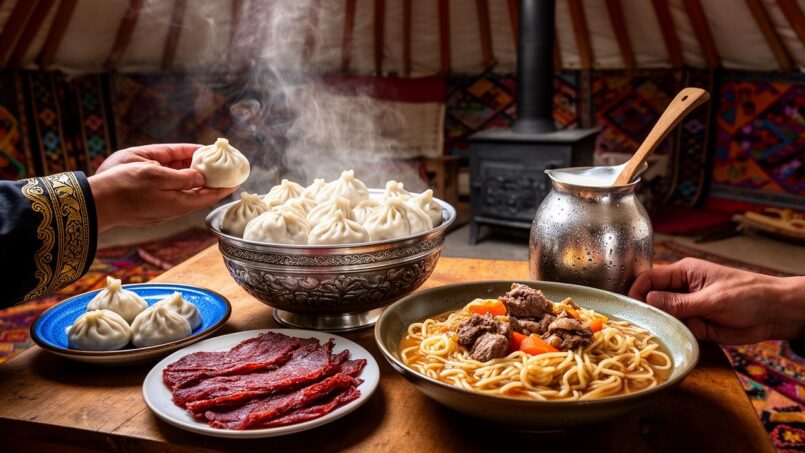
Buuz are arguably the most iconic dish of Mongolia. These large steamed dumplings, originating from the Sino-Tibetan region but adapted to local tastes, are made with a simple wheat dough (flour + water) and a filling of minced meat, most often mutton or beef, sometimes with onion, garlic, a few herbs, or a little vegetables (cabbage, potato).
They are shaped with a small opening on top, then steamed for about twenty minutes. They are eaten piping hot, by hand, being careful of the fatty juice that can squirt out with the first bite.
During Tsagaan Sar, urban and rural families shape hundreds, sometimes thousands, in anticipation of visits. Each way of pinching the dough has its own style—”flower buuz,” “sheep buuz,” “lazy buuz,” etc. For an expatriate, it’s an ideal entry point into local cuisine: simple flavor, comforting texture, easy to love.
Khuushuur: the Mongolian “hot pocket”
If you attend the Naadam festival or take a bus to the countryside, you will inevitably come across khuushuur stalls. Imagine a large flattened dumpling, filled with minced meat (mutton or beef), onion, and garlic, sometimes mashed potato, then deep-fried until golden, greasy, crispy on the edges, and juicy inside.
Khuushuur is the quintessential street food: easy to hold in your hand, sometimes compared to a “turnover” or a Russian “cheburek.” Its famous variant, Naadam khuushuur, is mass-produced for the summer festival. Calorie-wise, it’s a bomb, but to understand festive Mongolia, it’s hard to pass up.
The khuushuur, Mongolian culinary specialty
Tsuivan: everyday stir-fried noodles
Another pillar, another style: tsuivan. This stir-fried noodle dish holds a special place in daily meals. First, handmade noodles are prepared with flour, water, and salt, then cut into strips. Next, meat (often mutton), tail fat, onions, carrots, and potatoes are stir-fried, then the noodles and a little water are added to cook and soften them in steam before mixing everything together.
The result is a one-dish meal, very filling, slightly greasy, with the dominant flavor of mutton. It’s one of the dishes that best illustrates the Chinese influence (stir-fried noodles) reinterpreted in steppe style.
Noodle soup, bantan, and other comforting bowls
Mongols consume a huge amount of soups, in all seasons. The range goes from a simple meat and bone broth with a few handmade noodles (guriltai shöl or lapsha) to richer preparations where potatoes, carrots, cabbage are added.
Bantan is a meat broth into which flour is gradually added to form small dumplings or lumps, creating a kind of savory porridge. Considered a “neutral” dish, it is traditionally given to babies, served to the elderly, and recommended for hangovers, illustrating its role as comforting, easy-to-digest food.
Another very Mongolian variant: banshtai tsai, a bowl of salted milk tea (süütei tsai) in which tiny dumplings (bansh) stuffed with meat float.
Khorkhog and boodog: barbecues with hot stones
When Mongols want to mark an occasion—wedding, important guests, a child’s first haircut ceremony—they bring out the heavy artillery: khorkhog or boodog.
Khorkhog involves cooking pieces of mutton (often with bones) in a large sealed metal container, with stones heated red-hot over a wood fire. Layers of meat, possibly some vegetables (potatoes, carrots), and hot stones are alternated. Everything cooks in its own steam for over an hour. No salt or spices are added: the flavor comes from the meat and concentrated juices. Once the container is opened, you eat with your hands from a large platter, and sometimes pass the hot stones from hand to hand, said to improve blood circulation.
Boodog is a nomadic cooking method that uses an animal’s skin (traditionally goat or marmot) as a unique cooking vessel. After singeing the fur, meat, hot stones, and sometimes vegetables are placed inside, then the skin is sealed and cooked over a fire. This technique eliminates the need for a pot; the animal provides both food and container.
The case of marmot deserves a word: highly appreciated in some rural areas, it is historically associated with bubonic plague transmitted by fleas. Offering marmot to a guest is an honor, but for an expatriate, it’s better to assess the health risk.
Snacks, breads, and steppe sweets
Beyond main dishes, the Mongolian table includes small items that often surprise foreigners.
Aaruul, those sun- and wind-dried milk curds, are found on practically every ger table. Very hard, with a tangy, milky taste, they are offered to guests with tea. They are nibbled like (very) hard candies. They also serve as a reserve of calories and calcium for facing winter.
Another classic, boortsog: small sweet or slightly sweet fritters, shaped into thick sticks, traditionally fried in sheep fat. They are eaten at breakfast or with tea, sometimes accompanied by thick cream (urum) or jam.
Gambir, a thin fried pancake, can be served plain, sweet, or topped with butter. And for big occasions like Tsagaan Sar, ul boov, sole-shaped cookies stacked in odd-numbered layers on the table, symbolize abundance and happiness.
Drinks: from salty tea to fermented airag
If there is one confusing experience for many expatriates, it is that of salted milk tea.
Süütei tsai: the tea that replaces water
Süütei tsai—milk tea with salt—is the everyday drink. Tea (often brick tea) is steeped in water, milk and salt are added, sometimes a little barley flour or a few pieces of meat or bansh to make it a soup. In nomadic families, bowls of it are drunk from morning to night, often more than water, which is considered a precious and almost sacred resource.
For an unaccustomed palate, the contrast can be strong, but you get used to it quickly. It is also almost systematically the first thing you will be offered when entering a ger.
Airag: fermented mare’s milk
Another must-try: airag (or kumis), fermented mare’s milk. It is prepared in summer and autumn in a leather bag suspended in the ger (khukhuur), beaten regularly. The result is a milky white liquid, slightly effervescent, sour, with a variable alcohol content (about 2 to 7%). Locally, it is believed to have digestive and purifying properties, especially in summer.
For an expatriate, tasting airag, fermented mare’s milk, is often a test: its texture, sourness, and smell are surprising. Also, it has a laxative effect on the uninitiated. This drink holds a strong symbolic place, associated with hospitality and celebrations like Naadam. Refusing it can be seen as a lack of respect. It is possible to just wet your lips, or to touch the bowl with your ring finger and then your forehead, according to traditional ritual, to honor this custom.
Vodka and milk vodka: the other festive pillar
The dominant modern alcoholic drink is vodka, a legacy of Russian proximity. National brands like Chinggis dominate the market, and traditions similar to Russia’s are found: refusing a glass is frowned upon, toasts are often made with small silver bowls, and drinks are downed in one go. Mongols also have a milk spirit (shimiin arkhi), distilled from fermented milks (cow, goat, horse).
For an expatriate invited for a toast, an accepted dodge is to dip your finger in your glass, flick a few drops toward the sky and the ground in homage to Tengri (the sky) and the Earth, then touch your forehead with that finger. Finally, simply set the glass down without emptying it. This ritual gesture is generally understood and accepted, especially if done during the first toast.
Eating at a local’s home: codes, gestures, and pitfalls to avoid
Mongolian gastronomy is not limited to what is on the plate. The setting—the ger, the way of sitting, taking a bowl, or returning a snuff bottle—is an integral part of the culinary experience. In the countryside, hospitality is a cardinal virtue, reinforced by the history of a country where doors were opened to travelers lost on the steppe. Being invited is a privilege, but it requires respecting a few rules.
Entering a ger: what your host notices
From the moment you approach, an unspoken code kicks in. Sometimes you announce your presence with the phrase “Nokhoigoo khorioroi” (“Hold the dog”), even if no dog is visible. You do not knock on the door; you enter after a brief call.
It is important to step over the threshold, not on it. The door should be opened from the right side with the right hand. Inside, movement generally goes clockwise. Guests sit on the left (west side), hosts on the right, and the back (north), facing the door, is the place of honor, often reserved for the head of the household, an altar, family portraits, or religious objects.
Avoid touching or leaning against the two central poles, considered sacred, as well as standing in front of the door. Do not whistle, and do not throw anything into the stove, the true symbolic heart of the home.
At the table (or on the mat): how to hold your bowl and meat
Meals are often eaten sitting on the floor, sometimes around a small table. Keep your feet tucked under you, pointing backward rather than toward the food, people, or stove. Eating with your hands is not only accepted but logical: it avoids accumulating dishes that are hard to wash when water is scarce.
Some essential rules:
In Mongolia, it is customary to accept what the host offers by taking it with the right hand (or both hands), palm facing up, optionally supporting your right elbow with your left hand. Do not reject a dish with a hand gesture and avoid flat-out refusal; if you do not wish to eat something (especially for medical reasons), it is better to explain in advance. Finally, try your best to finish what is in your bowl or plate, but note that finishing completely can sometimes be interpreted as a request to be served again; if you are full, leave a small amount.
Meat is almost always served on the bone, in large pieces. You grab a bone, gnaw the meat and fat, and leave practically nothing, out of respect for the slaughtered animal. Ribs must be cleaned to the last shred. If the host hands you a piece, it is often the “best part” in their eyes (fatty tail, piece of head, eye): refusing it outright would be seen as an insult.
Symbolic gestures around the bowl and glass
Around drinks, the ritual is combined with gestures of blessing. When receiving a bowl of milk tea or airag, it is common to:
During a ritual, first take the bowl with your right hand holding the bottom. Then, dip your right ring finger into the liquid and touch your forehead with the drop. Sometimes, it is also customary to flick a few drops toward the sky and the ground, as a tribute to the spirits.
With vodka, you can do the same. For someone who drinks little or not at all, this ritual allows participation without consuming too much.
Hats, gloves, coats: details that matter
Mongols place great importance on headwear. Do not touch another person’s hat. Inside a ger, you generally do not keep your cap or “city” hat on, but some ceremonial situations reverse the rules (for example, during airag toasts where you sometimes show your full outfit). On the other hand, keeping your coat and gloves on while eating or drinking can be interpreted as an implicit criticism: “it’s too cold in your home.” Better to remove them if possible.
Ulaanbaatar: between traditional buuz and Italian brunch
For an expatriate living in Ulaanbaatar, the culinary reality is more nuanced than this very meaty image: the capital concentrates most restaurants, cafes, and supermarkets, and you can find everything from reinvented khorkhog to Mexican tapas to “American-style” brunches.
Overview of the capital’s food scene
Ulaanbaatar today offers a mix of local and international cuisines: traditional Mongolian restaurants, modern chains, Sino-Mongolian hot pots, Indian, Italian, French, Japanese, Korean, Mexican, Turkish, Vietnamese eateries, and even 100% vegan places.
The central districts around Sukhbaatar Square, Central Tower, Shangri-La Center, Seoul Street, and Zaisan concentrate the majority of restaurants, from local cafes to rooftop views. Tipping is not mandatory but it is customary to leave about 10% of the bill in establishments frequented by expats.
Some reference Mongolian restaurants in Ulaanbaatar
The list of addresses is long; here are some usful anchor points for a newcomer.
| Type of experience | Restaurant / Chain | What they serve | Location / Main feature |
|---|---|---|---|
| “Modernized” Mongolian cuisine | Modern Nomads | Khuushuur, buuz, khorkhog, bone marrow soup, veg options | Several locations (downtown, airport, Darkhan, Erdenet) |
| Mongolian fine dining | Mongolians Restaurant | Goat head, ceremonial dishes, terroir cuisine | Top floor of Shangri-La Mall, museum-like decor |
| Mongolian-style hot pot | The Bull Hotpot, Little Sheep | Rich broths, fresh mutton, sometimes horse | Various downtown locations |
| Workers’ restaurant | The Moriton, Mongol Zoog | Cheap daily specials, very local cuisine | Office areas, near State Department Store |
| Traditional cuisine + show | Altan Gadas | Large meat platters, music, dance, contortionists | Two locations, shows around 7 p.m. |
These places allow you to gently taste the great classics in a more “urban” setting than the ger, while staying close to local flavor: lightly spiced meats, discreet salt, generous portions.
Being vegetarian or vegan in Mongolia: mission impossible?
For a long time, adopting a meat- and dairy-free diet in Mongolia was a feat. Outside of Ulaanbaatar, it still largely is. But in the capital, the situation has radically changed.
Ulaanbaatar: a mini vegan capital in the heart of the carnivorous steppe
In Ulaanbaatar, several restaurants are completely vegetarian or vegan, often run by Mongols converted to these dietary practices, sometimes inspired by Buddhism or new health movements.
Some key addresses for expats:
| Restaurant / Cafe | Type of cuisine | Features for vegetarians / vegans |
|---|---|---|
| Loving Hut | 100% vegan, international chain | Plant-based versions of Mongolian dishes (buuz, khuushuur), vegan product shop |
| Luna Blanca | Vegetarian | “Vegetized” Mongolian classics, moderate prices |
| Bosco Verde | 100% vegan, European / Italian | Pizzas, pasta, falafel, vegan Mongolian dishes, plant-based milks |
| Foody / Lohas Cafe | 100% vegan | Vegan khuushuur, “green buuz,” burgers, veggie skewers |
| Oneness-Fountain-Heart | Vegetarian | Soups, noodles, simple cuisine, calm atmosphere |
| Vegan House, Greeno | 100% or mostly vegan | Bowls, curries, burgers, juices, plant-based desserts |
| Hazara, Namaste (Indian) | Non-vegetarian but with ample veggie options | Vegetable curries, dal, biryanis, meat-free breads |
In these places, you often find adaptations of traditional recipes: buuz stuffed with mushrooms or tofu, lentil khuushuur, bantan or noodle soups in vegetable broth, “niislel” salads with plant-based mayo, etc.
In the countryside: preparation, useful phrases, and plan B
As soon as you leave Ulaanbaatar, the situation becomes more complicated. “Guanz”, those small roadside restaurants often set up in gers, almost always serve soups and dishes based on meat and animal fat. Even vegetables soak in mutton broth.
For vegetarian or vegan expats, the key is anticipation. It is essential to inquire about the availability of suitable products, local eating habits, and dining options before departure, to ease adaptation and ensure a balanced diet.
– Inform travel agencies or guides several days before departure;
– Preferably choose tours with a private cook, who will have time to plan alternatives (more expensive, but much more comfortable);
– Stock up in supermarkets in the capital: tofu, textured soy, canned beans, pasta, instant noodles, dried fruit, nuts, energy bars.
Two Mongolian phrases can save a dinner.
Practical Mongolian tip
– “Bi makh iddeggüi”: I don’t eat meat;
– “Bi süü, tsagaan idee iddeggüi”: I don’t consume milk / dairy products.
Writing them on a piece of paper in Cyrillic and showing them to hosts often helps. Still, in a nomad’s ger, not tasting anything offered can be experienced as rejection. Sometimes you can negotiate a bowl of rice, fried bread, or boiled potatoes, but it will happen that you must choose between a bit of meat or nothing at all. Better to know this before committing to a “very authentic” immersion.
Health, hygiene, and food safety: what expats should know
Mongolian gastronomy raises not only questions of taste. It also involves health issues, related both to the composition of meals (too rich in animal fats, too low in fiber) and to hygiene conditions, which vary greatly between the capital and remote areas.
Water, raw vegetables, meat: reflexes to adopt
Some rules emerge from medical recommendations for travelers:
To avoid digestive troubles while traveling, never drink tap water without boiling or filtering it, and opt for bottled water, even for brushing your teeth. Beware of ice cubes, often made with untreated water. In small restaurants, prefer dishes served piping hot and freshly prepared, and avoid buffets where food stays lukewarm for a long time. Strongly limit raw vegetables if you cannot wash them yourself with safe water; for fruits, choose those you can peel. Be cautious with fish and seafood, unless recommended by a trusted local, especially far from large lakes. For dairy products, choose pasteurized products in the city; in the countryside, boil raw milk before consumption.
Wild berries, highly appreciated, can carry parasites difficult to eliminate with simple rinsing. Caution is therefore advised, especially outside controlled circuits.
Digestive issues: when your stomach meets the steppe
Even with precautions, digestive problems are common among newcomers: sudden dietary change, excess animal fats, presence of unfamiliar bacteria. Having basic medications on hand (anti-diarrheals, rehydration salts, intestinal antiseptic) is highly recommended, especially since access to quality healthcare can be difficult outside Ulaanbaatar.
Number of food poisoning cases linked to a KFC-type fast food in the capital in 2019
Hand and utensil hygiene
The steppe is dusty, water is scarce, yet hand hygiene remains your best protection. Washing hands before every meal, using gel or wipes if water is lacking, cleaning utensils or cups with an alcohol wipe if needed… These simple gestures prevent many troubles.
In gers, one might be tempted to judge sanitary conditions by Western standards. No need to moralize: it’s better to focus on what you can control (your own hands, your filtering water bottle, your food choices) and accept the rest as part of the experience.
Between steppe traditions and trendy restaurants: how to compose your own diet
As an expatriate, you are neither a 13th-century nomad nor an urban Mongol accustomed since childhood to a very meat-based diet. The challenge is therefore to find a balance between cultural immersion, gustatory pleasure, health, and digestive comfort.
Get inspired without copying: enjoy local cuisine smartly
A reasonable approach consists of:
For a balanced culinary experience in Mongolia, it is advisable to taste the great classics like buuz, khuushuur, tsuivan, noodle soup, aaruul, airag, and salty milk tea, as well as khorkhog if possible. It is better to limit the frequency of consumption of the fattiest dishes (sheep tail, offal, fried items like khuushuur). Take advantage of lighter versions offered by some modern restaurants (salads, dishes with more vegetables, reduced portions). Finally, regularly incorporate fruits, safe raw vegetables, and whole grains, available in supermarkets and international restaurants in Ulaanbaatar.
Major chains like Nomin, Emart, Orgil, or Mercury Market offer a range of imported products (fruits, vegetables, legumes, grains, sometimes plant-based milks) that allow you to “rebalance” your diet, especially if you cook at home.
Use the diversity of the capital
The strength of Ulaanbaatar for an expat is the diversity of cuisines:
Discover a selection of international cuisines and establishments for varied and balanced meals in Ulaanbaatar.
Salads, fish, and pasta dishes at restaurants like Veranda, DeQuattro’s Italian, and Choijin Temple Restaurant.
Rich in vegetable and legume dishes, offered by Hazara, Namaste, and Delhi Darbar.
Rice, vegetable stir-fries, and spicy soups from Japanese, Korean, Vietnamese, and Thai restaurants.
For Western breakfasts, soups, and balanced meals at Millie’s, Paul, or Fromagerie MACU.
For a long-term resident, establishing a sort of weekly routine alternating between Mongolian cuisine and foreign cuisines helps maintain a good level of enjoyment while limiting excesses.
Markets, local products, and gourmet souvenirs
Discovering gastronomy also means exploring markets, smelling the aromas of dried meat, tasting dairy snacks, spotting stalls selling wild berries, airag in recycled bottles, and traditional snacks.
Where to shop: from Narantuul to supermarkets
In the capital, Narantuul Market (the famous “Black Market“) is the big meeting place, where you can find everything: clothes, saddles, food products, kitchen utensils. For food, many expats prefer slightly more structured places like the State Department Store (and its Empire food court on the top floor), Emart Khan Uul, or Saruul Market.
In the provinces, each town has its market: Erdenet Market, Olgii Bazaar in the west, Kharkhorin Market near the ancient capital, or the small shops in Hatgal near Lake Khovsgol. There you will find:
– fresh meat and borts (dried meat);
– dairy products (milk, airag, aaruul, butter, cream);
– traditional snacks;
– sometimes, imported or seasonal fruits and vegetables.
For quality meat lovers, some urban butchers like BB Butchery or Butchery by Rosewood on Seoul Street offer cuts closer to Western standards.
Typical products to taste or bring back
Beyond prepared dishes, a few local products are worth trying:
Discover a selection of Mongolian milk-based specialties, from energy snacks to traditional spirits.
Ideal as a hiking snack, very light and energetic.
Dried meat that can be added to soups or eaten as is.
Milk tea in bags, local tea blends.
Made from sour milk, butter, or dried milk.
Milk vodka for fans of original spirits.
In some lounges and shops, you can also find local medicinal herbal teas, Dr. Baatar blends for the liver, kidneys, sleep, etc. Consume with curiosity but discernment.
Mongolian culinary year: festivals and seasonal specialties
Living in Mongolia also means aligning your calendar with the major festivals, each associated with specific dishes. Expatriates find opportunities to taste dishes rarely served outside these periods.
The main Mongolian festivals are marked by specific traditional dishes. During Tsagaan Sar (Lunar New Year), buuz (dumplings) are prepared in large quantities, along with uuts (boiled sheep rump), ul boov (stacked pastries), dairy products like aaruul, and salads like niislel salad. During Naadam (in July), khuushuur (fried meat pies) is ubiquitous, and airag (fermented mare’s milk) is offered to winners. Regional festivals (Eagle Festival, camel, yak, ice festivals) are opportunities to taste local specialties like horse sausages, camel dishes, or smoked fish from Lake Khovsgol.
These moments offer a privileged window into food culture: you observe stacked cookies, the ways of carving an entire sheep, bowls of airag circulating, children nibbling boortsog.
Practical tips for new expats: survive and enjoy
To conclude this overview, a few guidelines can help approach Mongolian gastronomy with serenity.
For successful integration, occasionally step out of your comfort zone by tasting local specialties like buuz, salty tea, aaruul, or airag. Set your own limits in case of health issues (cholesterol, allergies) by politely refusing certain foods after a calm explanation. In Ulaanbaatar, take advantage of food diversity to balance your diet by alternating “Mongolian days” with “Mediterranean” or “Asian” days, and by visiting vegetarian restaurants. Prepare for trips to the provinces with a medical kit, safe snacks, water, an offline translator, and a note in Mongolian explaining your restrictions. Finally, keep in mind that food is a gesture of hospitality: in a ger, accepting a bowl of tea or a piece of fried bread is often a symbol of respect more important than the food itself.
In Mongolia, eating is not just about nourishment. It’s sharing a wind-beaten tent with a family of herders, it’s gnawing a mutton bone under a sky of almost unreal blue, it’s discussing with a waiter in Ulaanbaatar about the best way to cook khorkhog or reinvent buuz in a vegan version. For an expatriate, gastronomy then becomes one of the best drivers of mutual understanding: a language without grammar, but rich in broths, dumplings, and steaming bowls of tea.
Disclaimer: The information provided on this website is for informational purposes only and does not constitute financial, legal, or professional advice. We encourage you to consult qualified experts before making any investment, real estate, or expatriation decisions. Although we strive to maintain up-to-date and accurate information, we do not guarantee the completeness, accuracy, or timeliness of the proposed content. As investment and expatriation involve risks, we disclaim any liability for potential losses or damages arising from the use of this site. Your use of this site confirms your acceptance of these terms and your understanding of the associated risks.

Cyril Jarnias is an independent expert in international wealth management with over 20 years of experience. As an expatriate himself, he is dedicated to helping individuals and business leaders build, protect, and pass on their wealth with complete peace of mind.
On his website, cyriljarnias.com, he shares his expertise on international real estate, offshore company formation, and expatriation.
Thanks to his expertise, he offers sound advice to optimize his clients' wealth management. Cyril Jarnias is also recognized for his appearances in many prestigious media outlets such as BFM Business, les Français de l’étranger, Le Figaro, Les Echos, and Mieux vivre votre argent, where he shares his knowledge and know-how in wealth management.





