
 Published on and written by Cyril Jarnias
Investing in real estate in Matera means betting on a city that combines several rare assets: a historic center classified as a UNESCO World Heritage site, a status as a former European Capital of Culture, strong tourist demand, and a price dynamic that is still far from the major Italian hotspots. But it also means accepting significant constraints, very strict heritage regulations, and an increasingly selective market where asset quality and positioning matter more than just a “good deal” on price.
This guide details the Matera real estate market, including key figures, different neighborhoods, rental profitability (traditional and short-term), as well as legal and tax constraints, and outlook within the Italian market context.
Matera: A Niche Market That Became a Reference in Basilicata
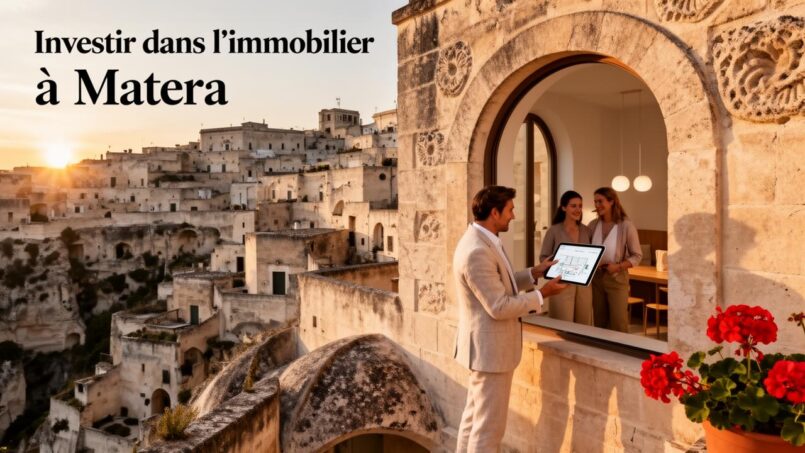
Matera is a medium-sized city in southern Italy (about 60,000 inhabitants), capital of the province of the same name, located in Basilicata. Its identity is intimately linked to the Sassi, those rupestrian districts carved into the rock, which earned it UNESCO recognition and global fame.
The city now positions itself as the most expensive real estate market in the region: prices hover around €1,600 to €2,000/m² on average, compared to about €1,330/m² for Basilicata as a whole, with some rural areas at €300–800/m². In other words: Matera is to Basilicata what major heritage cities are to their respective regions—a “magnet” for capital and tourism projects.
An Upswing Accelerated by Cultural Tourism
Matera’s designation as European Capital of Culture in 2019 played a decisive role. In a few years, the city went from an “alternative destination” profile to an international cultural destination. The data speaks for itself:
Tourist check-ins surged 115% in 2019 compared to the reference level.
This dynamic fueled a very visible cycle of real estate investments, especially in the Sassi: between 2014 and 2019, real estate projects linked to tourism in Matera represented about €30 million in private investments, with a total economic impact estimated at €55.5 million. Every euro injected into tourism real estate thus generated €1.50 in economic impact.
Direct consequence: prices appreciated, particularly in the historic center. Estimates indicate:
– housing prices in the old center rose by about 43%,
– commercial property prices there increased by 30%,
– the number of transactions grew by about 77%.
This increase was not uniform: ordinary properties outside central areas saw more moderate growth, while well-located heritage assets captured most of the appreciation.
Prices, Yields, and Market Structure in Matera
To invest wisely, you need to understand the price and rent structure as well as the realistic profitability levels.
Price Levels and Recent Trends
Recent market data show solid and gradually rising price levels:
– average housing price in Matera: approximately €1,980–2,036/m² depending on sources and periods,
– 12-month increase: +2.1% for houses, +0.4% for apartments in one series, with other series showing increases up to +8.1% for houses,
– four-year progression: +18–19% for both houses and apartments, depending on the periods analyzed.
In absolute terms, average prices by property type give a good order of magnitude:
| Property Type (City of Matera) | Indicative Average Price |
|---|---|
| Studio | €90,000–147,000 |
| 1-bedroom (T2) | €136,000–159,000 |
| 2-bedroom (T3) | €171,000–181,000 |
| 3-bedroom (T4) | €203,000–207,000 |
| 4-bedroom+ (apartments) | €229,000–237,000 |
| 3-bedroom house | €235,000–257,000 |
| 4-bedroom house | €279,000–309,000 |
| 5-bedroom house | €320,000–363,000 |
There is also significant dispersion by area (OMI data – Real Estate Market Observatory):
| OMI Zone in Matera | Sale Price Range (€/m²) | Rents (€/m²/month) |
|---|---|---|
| B2 (Center, Via Lucana, Casalnuovo, etc.) | €1,950–2,850 | €2.6–9.0 |
| D1 (Outskirts, C.da Le Piane, etc.) | from €1,200 | €2.6–4.7 |
Zone B2, which includes part of the city center and the most sought-after surroundings, concentrates the highest prices. The outskirts and rural areas remain significantly cheaper.
Rents and “Traditional” Rental Yield
On the rent side, the level is consistent with Matera’s regional high-end positioning:
Overview of average monthly rents for a rental property in France, including price per square meter and by property type.
About €8.4/m²/month in the city, compared to a provincial average between €8.2 and €8.4/m²/month.
About €700 per month for a considered ‘standard’ rental property.
Indicative rent values by apartment type (studio, 1-bedroom, 2-bedroom…).
| Apartment Type | Average Monthly Rent (City of Matera) |
|---|---|
| Studio | ~€428–550 |
| 1-bedroom (T2) | ~€538 |
| 2-bedroom (T3) | ~€589–650 |
| 3-bedroom (T4) | ~€625–700 |
| 4+ bedrooms | ~€657–750 |
On this basis, the average gross yield in Matera is around 5.24%, which is respectable but lower than the Italian average (7.56%) or the best markets in southern Italy (often >8%). The estimated payback period is about 24.1 years for the city, compared to 16.9 years at the provincial level.
By property type, yield differences are marked:
| Property Type (City of Matera) | Average Sale Price | Rent or Annual Income | Estimated Gross Yield |
|---|---|---|---|
| Studio | €90,000 | €6,600/year | ~7.3% |
| 1-bedroom | €120,000 | €8,640/year | ~7.2% |
| 2-bedroom | €150,000 | €650/month (~€7,800/year) | ~6.1% |
| 3-bedroom | €180,000 | €700/month (~€8,400/year) | ~4.7% |
| 4+ bedrooms | €235,000 | €750/month (~€9,000/year) | ~3.8% |
Smaller properties (studios and 1-bedrooms) offer better gross profitability, while larger apartments and houses stand out more for their heritage or tourism potential than for long-term rental yield.
Comparison with the Province of Matera
At the provincial level, average prices are lower and yields are often better, especially on smaller units:
| Type (Province of Matera) | Average Price | Average Rent | Gross Yield |
|---|---|---|---|
| Studio | €34,000 | €430/month | 15.0% |
| 1-bedroom | €80,000 | €530/month | 8.0% |
| 2-bedroom | €88,500 | €550/month | ~7.5% |
| 3-bedroom | €118,000 | €500/month | ~5.1% |
| 4+ bedrooms | €158,000 | €700/month | ~5.3% |
Some towns show spectacular theoretical yields on paper: in Pisticci, the average yield climbs to 18.15%, in Nova Siri to over 21%, in Montalbano Jonico to 13%. But these rates must be put into perspective: narrow markets, risk of prolonged vacancy, complexity of resale. Conversely, some rural municipalities (Accettura, Aliano, Craco, etc.) are indicated with 0% yield and €0 average annual income, a sign of a near-total absence of a structured rental market.
Investing in the province can maximize gross yield but involves lower liquidity and higher rental risk. Conversely, a market like Matera offers more depth and diversified demand (residential, tourism, professional).
Sassi, Piano, Outskirts: Where to Invest in Matera?
One of the major challenges of investing in Matera is choosing the sector. The city can be read in three main entities: the Sassi (Sasso Barisano, Sasso Caveoso, Civita), the “Piano” (modern city), and the outlying or rural neighborhoods.
The Sassi: UNESCO Heart and Engine of the Tourist Market
The Sassi constitute the rupestrian historic center, formed by a natural amphitheater carved into the Murgia plateau. They are divided into:
– Sasso Barisano: the part most connected to the modern city, slightly better accessibility, higher density of already renovated properties, strong concentration of high-end tourist accommodations (boutique hotels, cave suites).
– Sasso Caveoso: a steeper side, spectacular views, narrower alleys, steep staircases, more complex access conditions, which impacts renovation logistics and daily life.
– La Civita: the central ridge separating the two Sassi, a true balcony overlooking the ravines, high intensity of tourist flows, rare real estate supply, prices among the highest in the city.
Homes, often rupestrian houses or partially excavated, constitute the tourist attraction but present technical and regulatory constraints: humidity problems, sometimes limited ventilation, variable natural light, difficult vehicle access, UNESCO restrictions on materials and renovation methods, and mandatory authorization from the Soprintendenza for any structural intervention.
In economic terms, the Sassi are the main driver of short-term rental activity: the majority of the best accommodations on Airbnb or Booking are concentrated here, with examples like “Giulietta nei Sassi,” “Maison des Vents,” “CASA SANTOSTEFANO-SASSI DI MATERA,” or “Panoramic suite in the heart of the Sassi di Matera.” It is in this sector that you also find the most successful multi-property hosts, such as the “VICOLO FIORE Affittacamere” structure or host “Annamaria” (over $170,000 in estimated annual revenue across four properties).
Investing in the Sassi primarily aims to generate profitability through seasonal (or short-term) rentals with a high-end positioning. This strategy is preferred over long-term rental to permanent residents.
The “Piano”: The Modern City for a Residential Strategy
The Piano corresponds to the city built above the Sassi, mainly from the 17th to the 20th century, and the modern extension. This is where the majority of permanent residents live: more practical buildings, easier access, parking, shops, services, and schools.
Prices there are on average lower than in the Sassi, offering a more affordable entry ticket for a long-term residential strategy (families, local workers, retirees) or for furnished yearly rentals to expats or teleworkers attracted by the lifestyle.
Certain areas stand out for their attractiveness:
– Centro Città / Expanded Centro Storico: proximity to the Sassi, shops, main arteries (Via Lucana, Via Nazionale, Via San Pardo), high prices (Via Lucana can exceed €3,000/m²).
– Serra Venerdì: quiet residential neighborhood, more affordable housing, popular with families and retirees.
– Borgo La Martella: family-friendly suburb with large spaces, parks, and playgrounds, a short drive from the center.
For steady profitability and simplified management, investors typically target quality properties with good energy ratings, or properties to renovate while taking advantage of available tax bonuses for renovation, energy efficiency, and seismic upgrading.
Outskirts, Rural Areas, and Provincial Towns
On the outskirts of Matera and in the surrounding countryside, you find village houses, traditional farms (masserie), or large properties to renovate, with a significantly lower price per square meter. The downside: dependence on a car, relative isolation, less liquid resale market.
The province is full of small towns where prices are very attractive, but the rental market is thin or non-existent: some municipalities show high theoretical yields for small units, others are listed with no yield because no significant rentals are recorded. For an investor, these localities are more about personal residence, a rural lifestyle project, or subsidized renovation than a pure rental investment.
The Short-Term Rental Market: A Powerful but Highly Regulated Lever
Matera has established itself as a stronghold for tourist rentals in Italy, particularly through platforms like Airbnb. However, the market is very seasonal and subject to increasing regulation.
A Dense and Highly Competitive Market
A recent analysis lists approximately 532 active Airbnb-style listings in Matera, nearly 70% of which are “entire home” rentals. The rest is split between private rooms and a few hotel/boutique type properties. The majority of listings are apartments or condos (45.5%), followed by houses (30.1%) and para-hotel units (19.4%).
The profile of the most common listings is also fairly homogeneous:
– 51.3% of listings offer a one-bedroom property,
– one- or two-bedroom properties account for nearly 74% of the market,
– average capacity is 3.3 people,
– properties for 4 people (couples with children, small groups) constitute the strongest segment (27.8% of listings).
To succeed with a 1-bedroom rental, offering a standard property is not enough. This market segment is already very dense and dominated by experienced operators.
Seasonality, Prices, and Performance
The market is highly seasonal, with two well-defined periods:
– low season (January–March): average revenue around $887/month, occupancy rate close to 25–26%, ADR (average daily rate) around $120,
– high season (May–August, with a peak in August): average monthly revenue around $2,092, average occupancy rate of nearly 49%, ADR around $135, with a possible peak at $140.
At extremes, there are notable variations:
| Monthly STR Indicator in Matera | High Level | Low Level |
|---|---|---|
| Monthly Revenue | ~$2,159 | ~$781 |
| ADR (nightly price) | ~$140 | ~$118 |
| Occupancy Rate | ~51% | ~22.5% |
Performance is highly segmented by quality of the offering:
| Market Segment | Monthly Revenue | Occupancy | Approximate ADR |
|---|---|---|---|
| Top 10% | >$3,108 | >73% | >$204 |
| Top 25% | >$2,117 | >56% | >$147 |
| Median | ~$1,245 | ~35% | ~$111 |
| Bottom 25% | ~$633 | ~17% | ~$86 |
Only the best-positioned properties (premium location, strong concept, thoughtful design, professional management) manage to exceed $3,000 in average monthly revenue with very high occupancy. Standardized offerings suffer from low occupancy rates and constrained pricing.
Regulatory Constraints and Risks
The tourist rental market in Matera is highly regulated: it is very likely that registration, a license number, or specific obligations apply, especially in the Sassi. The Italian context is moving toward tightening rules in many tourist cities (day caps, reporting obligations, increased tax audits).
For an investor, this means :
– researching locally before defining a business plan based on short-term rentals;
– planning a fallback strategy for medium- or long-term rentals if regulations change;
– considering that the future value of a tourist asset will depend on its compliance with standards (safety, accessibility, energy, urban planning conformity).
Add that online reputation plays a crucial role: a visible negative review can lead to a wave of cancellations and a sharp drop in revenue. Operational management (maintenance, cleanliness, quality of service) thus becomes a central element of the business model.
Purchase Process and Costs: What an Investor Should Anticipate
Investing in Matera, especially as a non-resident, requires a good understanding of the Italian legal framework. Although there is no legal obstacle to purchase by a foreigner (subject to reciprocity for certain countries), the procedure is demanding and ancillary costs are far from negligible.
Key Steps in the Acquisition
The classic scheme follows several phases:
Buying a property in Italy, for example in Matera in the Sassi, follows a specific procedure. It begins with the mandatory obtainment of the codice fiscale. It is then highly recommended to open an Italian bank account. The negotiation phase leads to a proposta d’acquisto, often with a deposit. A preliminary contract (compromesso) then binds the parties with a payment of 10–20% and penalty clauses. A rigorous due diligence (cadastral, urban planning, technical checks) is essential before signing the final deed (rogito notarile) before a notary, which transfers ownership.
The notary plays a central role: he verifies the chain of ownership, the absence of mortgages, pre-emption rights of the State or local authorities in protected areas, and calculates and collects the taxes due.
Acquisition Costs and Purchase Taxes
The listed price is only part of the equation. You generally need to budget 8 to 15% extra (or even more in some cases) to cover:
Registration tax rate for a second home or investment property in Italy, calculated on the cadastral value.
For a non-resident who does not establish their primary residence in Matera, the 9% rate on the cadastral value (usually lower than the market price) will generally apply. Access to the prima casa regime requires transferring one’s residence to the municipality within a specified timeframe and meeting several conditions.
Recurring Costs: Taxes and Annual Charges
Once you are a property owner, several taxes apply:
IMU rate, the main property tax for non-residents in Italy, set by the municipality based on the cadastral value.
For properties generating rental income, Italy offers the cedolare secca regime, a flat-rate withholding of 21% (or 10% for certain agreed rent leases) on gross rents, replacing progressive income tax on this income and exempting from stamp duty on the contract.
Upon resale, a capital gain realized within 5–10 years may be subject to a 26% tax, unless the property was a primary residence or held long enough.
Renovation, Heritage, and Energy Transition: Central Issues
One of the classic pitfalls in Matera concerns renovation costs and constraints, especially in the historic center and the Sassi.
Renovation in the Sassi: Tourist Potential, Maximum Complexity
Rupestrian homes combine several challenges:
– frequent humidity from walls in contact with rock (saltpeter, infiltration),
– variable natural ventilation,
– sometimes limited lighting in excavated spaces,
– pedestrian access only via staircases in some cases, with no possibility of a construction truck nearby,
– very strict prohibition or control over modifications to facades, volumes, and materials.Any serious renovation project must be approved by the Soprintendenza, the heritage protection authority, which extends timelines and increases costs. Specialist contractors for this type of architecture are not numerous, which can create a bottleneck.
It is recommended to include a 20% contingency budget margin for work from the outset, to absorb technical surprises and administrative adjustment requests.
Tax Bonuses for Renovation and Energy Efficiency
Despite its complexity, the Italian framework remains very favorable for renovation investments through a series of tax credits renewed in the budget law:
Main tax benefits available for property renovation work, with their rates and key conditions.
50% deduction of eligible expenses (cap of €96,000 per property) for a primary residence in 2026, 36% for second homes and investment properties. The deduction is spread over 10 years.
Tax credit for energy efficiency work (insulation, windows, heating systems) with rates of 50% for a primary residence, 36% for other uses.
Deduction for seismic reinforcement interventions, up to 36% of expenses (cap of €96,000, over 5 years), with differentiated rates for residents and non-residents.
50% deduction on the purchase of furniture and large appliances for a renovated property, up to a cap of €5,000.
Aids for high-efficiency appliances, bonus for removal of architectural barriers, etc. Some are in a phase of reduction or non-renewal.
These schemes do not turn a bad project into a good investment, but they can significantly improve the net profitability of a rehabilitation operation designed with an architect and a tax advisor.
European Directive on Energy Performance: A Turning Point to Anticipate
The future transposition of the European directive on the energy performance of buildings is expected to weigh heavily on the market. It is estimated that over 70% of the Italian housing stock may need upgrading work to reach the energy classes required in the medium term.
The orders of magnitude are significant and allow you to appreciate the scale or dimension of a value relative to another, offering essential understanding for comparing and evaluating data.
– energy renovation costs can exceed €2,000/m² in some cases,
– for a 300 m² building, a minimum budget of €600,000 is not exceptional,
– construction timelines can range from 18 to 24 months.
Poorly rated properties (F, G) risk a “brown discount,” i.e., a markdown on sale and increasing difficulty in renting or financing them, while high-performing properties (A, B) already benefit from a “green premium” (better valuation, access to “green mortgages” at preferential rates).
A buyer in Matera, especially in old buildings, should therefore:
– request an up-to-date Energy Performance Certificate (APE);
– if necessary, have a credible energy engineering study carried out;
– include the cost of potential “energy catch-up” in their 10–15 year business plan.
Financing, Investor Profiles, and Strategy
Matera attracts both Italians and foreigners seeking an alternative to saturated tourist megacities. The typical profile ranges from second homes, boutique hotels, and rental investments.
Access to Credit for Foreigners
Foreigners can obtain mortgage loans in Italy, without specific legal restrictions, but with more demanding criteria. The main points:
– non-residents: loan-to-value (LTV) often limited to 50–60% of the estimated property value, sometimes 70% for very strong profiles, requirement of stable income, translated and legalized documents.
– Italian residents: standard LTV of 70–80%, even higher for Italian first-time buyers.
– average Italian mortgage rates recently around 3.5%, with a downward trend expected due to the ECB’s more accommodative monetary policy.
– a debt-to-income ratio generally capped at 30–35% of net monthly income.Italian banks often set a minimum loan amount, typically around €150,000 to €200,000. This can make it difficult to obtain financing for a low-value property, such as a studio at €80,000, especially for a non-resident buyer.
Possible Investment Strategies in Matera
Based on the data and constraints, several strategies naturally emerge:
Four distinct approaches are identifiable for investing in Matera. The “Sassi + High-End Short-Term” specialization involves acquiring properties in the Sassi for professional tourist operation with a strong concept, offering attractive gross yields but sensitive to seasonality and management. The “Piano + Long-Term Rental” strategy consists of buying a modern apartment in the new city to rent to residents or teleworkers, with a gross profitability of about 4.5–6.5%, simpler to manage. The “Renovation + Capital Gain” approach seeks a property to rehabilitate below market price to resell after work or use for high-end rental, requiring expertise and a long horizon. Finally, “Province + Cash Flow” diversification targets villages in the province to buy at low prices and rent long-term, a niche strategy with high yield but limited liquidity and demographic risk.
In all cases, the central axis is selectivity. The Italian market as a whole is moving toward a logic where the intrinsic quality of the asset (location, energy efficiency, compliance, real rental potential) outweighs macro-economic generalities.
What You Absolutely Must Check Before Buying in Matera
The experience of many buyers in Italian historic centers converges on a few key points of vigilance, particularly relevant in Matera:
Before acquisition, a thorough check is essential. It must cover urban planning and cadastral compliance, the possible existence of pre-emption rights (State, Region, Municipality), as well as easements and rights of use such as right of way. The structural condition of the building (cracks, humidity, drainage) requires expertise from an independent professional. You also need to ensure the absence of charges (mortgages, debts) and assess accessibility issues, particularly for tourist use.
The buyer must also account for the potential slowness of the Italian justice system in case of a real estate dispute: it is better to invest in good due diligence upfront than to rely on the possibility of later recourse.
Matera in the Context of the Italian Market: Asset or Gamble?
Nationally, Italy recorded nearly €12.5 billion in real estate investments in 2025, with a significant share of foreign capital and a strong appetite for the retail, logistics, and hospitality segments. Forecasts for 2026 point to a certain stabilization of yields, a decline in mortgage rates, and increased selectivity by investors, particularly around ESG criteria and energy efficiency.
In this landscape, Matera checks several interesting boxes:
Real estate prices there are about 40% lower than in comparable-sized seaside towns like Viareggio.
But the city also has its limitations:
– imperfect infrastructure (no main railway station directly in the center, less fluid accessibility than regional capitals),
– high exposure to tourism, hence vulnerability to shocks (as seen with the pandemic),
– gentrification trends in the Sassi, with a risk of tensions between residents, tourism players, and local policies.For an investor, Matera is thus neither a “zero-risk” investment nor a speculative bubble. It is a solid niche market, where value rests on the uniqueness of the heritage and the ability to adapt the asset to tomorrow’s standards (energy, comfort, tourism regulation).
Conclusion: How to Approach a Real Estate Project in Matera?
Investing in real estate in Matera requires combining passion for heritage with investor discipline. The city offers a rare combination of favorable factors: steady price increases, sustained tourist demand, opportunities for decent yields, and even very high profitability in certain narrow segments (provincial studios, high-end STR in the Sassi).
On the flip side, regulatory complexity, renovation costs in old buildings, the upcoming energy transition, and fierce competition in short-term rentals demand a professional approach:
For a successful real estate investment in Matera, it is crucial to: clearly define the target use (residential, tourist, or mixed) before any commitment; choose the neighborhood accordingly (the Sassi for image and short-term rental, the Piano for year-round living, the province for gross yield); have the property audited by independent professionals (notary, lawyer, technician) before a significant payment; include all ancillary costs (8 to 15% of the purchase price, plus renovation) in the profitability calculation; and leverage Italian tax bonuses judiciously, without making them the sole pillar of the project.
Matera is no longer a well-kept secret, but it remains far from having reached the overheating levels of other Italian destinations. For a patient, well-advised investor capable of embracing heritage and energy complexity, the city can provide an interesting foundation in a real estate diversification strategy in Southern Europe.
Have a wealth project or a question? Contact us now to speak with a wealth management expert.
Disclaimer: The information provided on this website is for informational purposes only and does not constitute financial, legal, or professional advice. We encourage you to consult qualified experts before making any investment, real estate, or expatriation decisions. Although we strive to maintain up-to-date and accurate information, we do not guarantee the completeness, accuracy, or timeliness of the proposed content. As investment and expatriation involve risks, we disclaim any liability for potential losses or damages arising from the use of this site. Your use of this site confirms your acceptance of these terms and your understanding of the associated risks.

Cyril Jarnias is an independent expert in international wealth management with over 20 years of experience. As an expatriate himself, he is dedicated to helping individuals and business leaders build, protect, and pass on their wealth with complete peace of mind.
On his website, cyriljarnias.com, he shares his expertise on international real estate, offshore company formation, and expatriation.
Thanks to his expertise, he offers sound advice to optimize his clients' wealth management. Cyril Jarnias is also recognized for his appearances in many prestigious media outlets such as BFM Business, les Français de l’étranger, Le Figaro, Les Echos, and Mieux vivre votre argent, where he shares his knowledge and know-how in wealth management.





