
 Published on and written by Cyril Jarnias
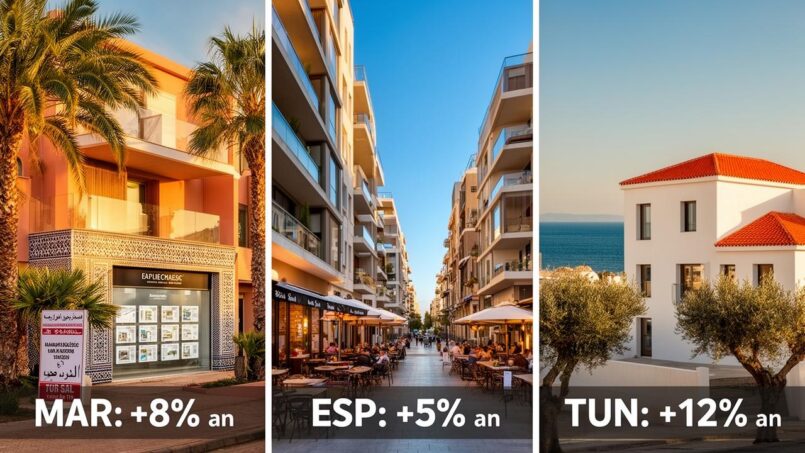
Between the rise of Tangier, the booming Spanish coasts, and the “renaissance” of the Tunisian market, choosing where to invest your money in 2026 is far from obvious. Behind the postcards lie very different economic, tax, and regulatory dynamics. For an investor, the real question is not “where the sun shines brightest,” but where you get the best combination of yield, security, and appreciation potential.
Morocco (especially Tangier) offers the best rental yields for a moderate entry price. Spain combines legal security and growth, but prices have risen sharply. Tunisia is a niche market undergoing structuring, with targeted opportunities but a more complex environment.
Morocco: Tangier, New Real Estate El Dorado
Morocco is engaged in a cycle of massive investments, fueled by preparations for the 2030 World Cup, the rising prominence of the Tanger Med port – Africa’s largest port complex – and the development of industrial and logistics zones along the entire Casablanca–Rabat–Tangier corridor. In this context, real estate remains one of the major beneficiaries.
A National Market in “Positive Turbulence,” Yet Still Undervalued
On a national scale, the residential real estate market in 2026 is described as “sluggish” in terms of transaction volume, with official prices rising only about 1.5% to 1.7% year-over-year. In reality, in real terms (adjusted for inflation), homes are still worth roughly 21% less than their 2010 levels. In other words, the Moroccan market is not a bubble; it is just emerging from a long post-2010 digestion phase.
However, major Moroccan banks (Attijariwafa, BMCE) and Bank Al-Maghrib converge on a scenario of moderate but steady increases: 3% to 5% per year on average, 4% to 6% in major cities, and up to 6% to 8% for high-end segments. In a context of economic growth expected around 3.7% to 5% and controlled inflation (around 1.9% in 2026), the trajectory of real estate remains upward.
The average home price is around 950,000 dirhams, or about 10,500 MAD per m² nationally. In 80% of cases, transactions fall between 600,000 and 1.4 million dirhams, making it still an affordable market for foreign investors, especially those from Europe.
Tangier: Record Yields and Appreciation Potential
However, it is Tangier that draws most of the analysts’ attention. The city is often described as the “new El Dorado” of residential investment, and the numbers illustrate the scale of the phenomenon.
Tangier’s dynamic rests on three engines:
– The Tanger Med port complex, number one in Africa by volume,
– A rapidly expanding industrial fabric (Renault, Stellantis, free zones),
– A very active Moroccan diaspora in Europe (MRE), which transfers over 95 billion dirhams annually, a large portion of which goes directly into real estate.
Between 2020 and 2025, prices have already risen by 25% to 35% depending on the neighborhood, with premium areas occasionally seeing annual increases of 15% to 20%. Yet, the average price of around 10,800 to 11,500 MAD/m² remains lower than in Casablanca, Rabat, or Marrakech. For a 100 m² apartment, we are generally talking about 900,000 to 1.3 million dirhams, whereas a comparable property easily exceeds 2 million dirhams in Casablanca or Rabat.
Projections for the next five years are explicit: a cumulative increase of 25% to 35%, roughly 4.5% to 7% per year, with certain high-end locations potentially doubling in value over ten years. For 2026 alone, estimates range from +4% to +7%, with conservative scenarios at +3–4% and optimistic ones at +7–8%.
Above all, Tangier offers the highest rental yields of Morocco’s major cities: around 8% on average, with a typical range of 6.8% to 9% and peaks of 10–12% for well-calibrated studios in short-term rental. Casablanca hovers around 5.8%, Rabat barely above 5%, Marrakech more like 6–9% depending on the neighborhood; Tangier clearly dominates the national competition.
Neighborhoods Under the Microscope: Prices, Uses, Yield
Tangier is not a homogeneous block: each area has its own positioning, target clientele, and price dynamics. For an investor, the choice of neighborhood determines the strategy to adopt.
Summary of Tangier’s main neighborhoods and their strengths
Historic neighborhood offering a dense supply of older homes, shops, and local services. Ideal for those who enjoy vibrant urban life.
A booming modern residential zone with recent developments, shopping centers, and green spaces. Prized for its tranquility and connection to major thoroughfares.
Upscale coastal area offering high-end villas and apartments with sea views. A sought-after destination for quality of life and exceptional natural surroundings.
| Neighborhood / Area | Average Prices (MAD/m²) | Estimated Annual Growth | Main Positioning |
|---|---|---|---|
| Malabata / Beachfront | 14,000 – 18,500 | ~16% | Luxury sea view, short-term tourist rental |
| Iberia / City Center | 10,000 – 14,200 | ~12% | High-end residential, offices, mixed-use |
| Moujahidine | 7,500 – 10,500 | ~18% | Families, first-time buyers |
| Bir Chifa / Achakar | 6,000 – 9,000 | ~14% | Long-term rental, sustained rental yield |
| Industrial Periphery / Free Zone | 5,500 – 8,000 | ~20% | Worker housing, high yields |
| Gzenaya (new development) | From 8,000 | >15% expected | VEFA (off-plan), long-term appreciation (2030) |
In premium areas (Malabata, Iberia, city center), prices are around 13,500 to 14,200 MAD/m², comparable to the best neighborhoods in Agadir or Marrakech, but lower than the hearts of Casablanca and Rabat. Intermediate neighborhoods range from 9,000 to 13,000 MAD/m², and several peripheral areas remain below 10,000 MAD/m², leaving significant room for catch-up.
Gross yields typically range from 6% to 9% on standard apartments, with 8% to 10% on well-located studios and small one-bedroom units (25 to 50 m²). Short-term rentals near the medina and Malabata beach achieve occupancy rates of over 75% in summer, pushing gross yields above 11%. On the commercial and logistics side, warehouses near Tanger Med deliver returns of 8% to 12%.
Five Typical Investment Strategies in Tangier
Recent studies identify five main Tangier investment profiles, each suited to a specific budget and objective:
| Strategy | Budget (MAD) | Target Product | Main Objective | Expected Yield / Appreciation |
|---|---|---|---|---|
| 1. Industrial Periphery | 350,000 – 500,000 | 60–80 m² at 4,000–5,500 MAD/m² | Rental to executives (Renault/Stellantis) | 7–9% gross (best performance 2026) |
| 2. Primary Residence Iberia | 800,000 – 1,200,000 | 80–100 m² city center | Personal use / executive status | Wealth building |
| 3. MRE – Marshan sea view | 1,500,000 – 3,000,000 | 100–150 m² sea view | Retirement home / prestige | Long-term appreciation, quality of life |
| 4. Second Home Asilah / Cap Spartel | 1,000,000 – 2,500,000 | 80–120 m² waterfront or villa | Personal use + Airbnb summer | Seasonal income + capital appreciation |
| 5. VEFA Gzenaya / Mediouna | 400,000 – 700,000 | New in secure development (4,500–6,500 MAD/m²) | 2030 bet (Tanger Tech, expansions) | Strong appreciation upon delivery (2027–2028) |
For a purely yield-oriented investor, the first strategy (industrial periphery) is the most attractive: rents of 2,500 to 3,500 MAD/month for a contained acquisition cost, yielding 7% to 9% gross in a sector with structural demand. For a “wealth + enjoyment” approach, the Marshan, Asilah, or Cap Spartel options combine long-term appreciation with personal use.
Tax Advantages and Pro-Investor Framework
Morocco has adopted a clearly capital-friendly policy – domestic or foreign – with a gradual reform of corporate tax through 2026 and a range of incentives for new projects.
At the general level:
| Tax Parameter (Morocco 2026) | Indicative Level |
|---|---|
| Standard corporate tax (up to 100 M MAD profit) | Target 20% |
| Corporate tax above 100 M MAD (outside special zones) | 35% |
| Maximum income tax | 38% |
| Standard VAT | 20% |
| Tax on dividends for non-residents | 15% (often reduced by treaty) |
For individual residential real estate, the key issue is less the corporate tax than the total acquisition cost and ease of repatriation:
– Acquisition costs (registration, notary, land registry) represent about 15% to 20% on top of the price, if ancillary investment costs are also included,
– Registration fees are around 5% to 6%, notary fees 1% to 2%,
– Foreigners enjoy nearly total freedom to repatriate net rents and resale proceeds, provided they follow the procedures of the Exchange Office.
The industrial acceleration zones and free zones – including Tangier Free Zone – also offer five-year corporate tax exemptions, followed by reduced taxation, which enhances the appeal of investments in business real estate (logistics, warehouses, offices linked to export activities).
Comparative Advantage of Morocco vs. Spain and Tunisia
One data point sums up the situation fairly well: in Tangier, the average price per square meter remains around $642, which is half that of Tunis and three to four times less than Malaga, Spain. At the same time, Tangier’s gross yields are often between 7% and 9%, whereas many Spanish coastal markets have fallen back to between 4% and 6%, and Tunisia averages around 5.4% for long-term rentals.
For an investor seeking above all a leverage effect between entry cost and rental flow, Morocco – and especially Tangier – comes out on top.
Spain: An Expensive but Solid Market, Driven by the Coasts
Spain is entering a post-boom maturity phase: the excesses of the 2000s bubble have been purged, banks have cleaned up their balance sheets, foreign demand has returned with a vengeance, and real estate has once again become one of the country’s flagship investments.
Price Increases Continue in 2026
In 2025, finished home prices rose by another 13.1% year-over-year in the fourth quarter, with a jump of 3.5% in the final quarter alone. Madrid saw prices surge nearly 21% year-over-year to nearly €4,900/m², Barcelona surpassed €4,270/m² with over 8% annual growth. In cities like Valencia or Malaga, the increase was even more spectacular (up to +17.5% for Valencia, +11.3% for Malaga).
For 2026, no major player is forecasting a correction. BBVA Research anticipates an increase of about 5.3%, CaixaBank speaks of 6.3%, other analysts mention a range of 5% to 7% nationally, with “hot” regions (Costa Blanca, Costa del Sol, Balearic Islands) potentially rising 7% to 10%. In short: the post-Covid surge is calming slightly, but prices continue to advance, driven by a structural housing shortage (over 700,000 units missing, against an annual need of 150,000 to 200,000 new homes).
At the national level, the average price per square meter is around €2,100 to €2,300, but the contrasts are extreme: from less than €800/m² in inland provinces like Jaén or Ciudad Real, to over €4,000–6,000/m² on certain stretches of the Costa del Sol.
Spanish Coasts: Guaranteed Appreciation, Yields Under Pressure
The core of foreign investment remains concentrated on the coasts. In 2025, the valuation firm Tinsa measured a 7.2% annual increase for all coastal areas, and 12.1% for second homes, with an average price near €2,970/m². Northern Costa Blanca (Alicante province) recorded +17% year-over-year, Valencia province +15.5%, Balearic Islands +13.4%.
Price benchmarks illustrate the diversity of markets.
| Region / City (Spain) | Average Price (€/m², Q4 2025) | Estimated Annual Increase |
|---|---|---|
| Valencia City | 2,639 | +17.5% |
| Málaga City | 2,819 | +11.3% |
| Alicante (province) | 1,858 | +17% (Northern Costa Blanca) |
| Valencia (province) | 1,735 | +15.5% |
| Costa Cálida (Murcia) | 1,298 | strong growth |
| Balearic Islands | 2,697 | +13.4% |
| Costa Brava (Girona) | 2,058 | sustained increase |
Yields on the coast remain decent but are tightening with rising prices. Across all coastal areas, apartments offer an average of 5% to 7% gross yield, villas 4% to 6%. In highly touristy resorts like Benidorm, you can still target 6% to 8% gross thanks to near-constant demand, but in other premium zones (Marbella, parts of the Costa del Sol), the gross yield can drop to around 4.5–5% due to expensive land.
A dedicated study of new-build on the “costas” indicates:
– An average price of €687,140 for new developments,
– An average gross rental yield of about 3.7%,
– Properties under €200,000 are significantly more profitable (5.8% average gross yield) than luxury properties over €500,000 (3.1%).
The message is clear: in Spain, performance is increasingly about targeting specific price ranges and micro-markets, rather than broad regional “brands.”
Inland Spain: Higher Yields, Slower Appreciation
The rise in coastal prices is gradually pushing some buyers – especially those who telecommute or seek stable rental income – inland. In provinces like Ciudad Real, Jaén, or Cuenca, you can find properties around €750 to €850/m², three to four times less than Marbella or Barcelona, with higher gross yields.
Overall, the data shows:
– Gross yields of 5% to 8% for long-term rentals in inland Spain,
– Low seasonality and more regular demand,
– More moderate price appreciation but accelerating in some university cities or regional capitals.
Yield statistics confirm the potential of these “secondary” markets:
| City / Region (Spain) | Estimated Gross Rental Yield |
|---|---|
| Spain (national average, residential) | ~6.3–6.7% |
| Murcia (city) | ~7.4–7.5% |
| Lleida | 7.5% |
| Segovia, Lleida (other source) | 7.3% |
| Huelva, Jaén, Castellón | around 7.2% |
| Alicante (city) | ~5.6% |
| Valencia (city) | ~6% or more |
| Madrid (peripheral neighborhoods) | >7% |
| Barcelona (working-class neighborhoods) | 6–7.5% |
On the other hand, prime neighborhoods in Madrid or Barcelona often cap out at 3–4% gross, making them more akin to wealth preservation assets than pure yield products.
A Favorable Macro and Financial Framework, Despite the End of the Golden Visa
Despite rising prices, Spain remains attractive on several fronts:
– Credit rates are easing: the 12-month Euribor has fallen from over 4.2% in 2023 to about 2.236% in January 2026, with a trend toward 2%,
– Fixed rates offered to residents are between 2% and 2.5%, with non-residents generally paying 0.5 to 1 point more,
– Total return (appreciation + rents) approached 16% in 2025 according to the Bank of Spain, far ahead of 10-year government bonds (3.3%) and bank deposits (1.5%).
One of the major changes in recent years is the gradual elimination of the real estate component of the Golden Visa. The program, which allowed obtaining residency through a real estate investment of at least €500,000, was dismantled starting in April 2025 with the enactment of an organic law that removed the articles governing this scheme. In 2026, a real estate purchase – even a large one – no longer provides privileged access to residency.
In practice:
Investors who already had a permit before the reform retain their rights and can renew it. However, new applications based on real estate are no longer accepted. Alternatives exist: public bonds from €2M, shares or funds from €1M, but with no connection to real estate.
For a purely wealth-focused investor, this change is more political than practical: buying a property to rent it out remains perfectly possible, with no nationality restrictions, but the “purchase = automatic residency” argument has disappeared.
Rent Control and Tourist Rentals: A Risk to Monitor
Another point to consider: regulation. Spain has introduced a national index to limit rent increases in certain stressed areas, replacing the inflation-based indexation (CPI). Several cities, notably Barcelona, have toughened their stance on tourist rentals, multiplying registration requirements and inspections. Some supply has shifted toward seasonal or long-term rentals.
The country has also strengthened control over Airbnb-type rentals: mandatory digital registers, the ability to remove illegal listings, and penalties for platforms that allow non-compliant listings. For an investor operating in short-term rentals, this implies a higher level of management and a need for ongoing regulatory vigilance.
Nevertheless, Spain’s yield/risk ratio remains competitive on a European scale, with residential yields of 5% to 7% considered among the highest in Western Europe, and prospects of moderate but robust price increases (5–7% per year in many forecasts for 2026).
Tunisia: A Market in Transition, Between Reforms and Targeted Opportunities
Tunisia is currently in a deep transitional phase for its real estate sector. Long marked by informality, underinvestment, and regional imbalances, the market is experiencing a dual dynamic: on one hand, a “renaissance” driven by tourism and domestic demand; on the other, a tightening and modernization of the fiscal and regulatory framework.
Price and Rent Growth Against a Backdrop of Social Tensions
In terms of prices, recent years have been marked by strong increases, especially in urban areas:
– Nationally, apartment prices rose by about 7% in 2025,
– In the third quarter of 2025, apartments in Tunis surged up to +16% year-over-year, houses up to +19%,
– In Sousse, apartments saw +12% annually, houses +6%,
– Nabeul and Ariana showed more mixed dynamics, with increases in some segments and decreases in others.
In 2024, the national average price of an apartment was around 3,345 TND/m², up 6.4% year-over-year. Rents also rose, with an increase of about 7.27% over the same period. As a result, the average gross rental yield settled at around 5.43% in the second quarter of 2025, a slight rise from previous years.
A Tunisian peculiarity is that, despite these increases, real estate remains the main savings vehicle for households: over 75% of households own their home, and the housing stock reaches about 4.2 million units for 3.4 million households.
Tax Reforms and New Rules of the Game
Beginning in 2023–2024, and especially with the 2026 Finance Law, Tunisia has started to extensively overhaul its fiscal and legal framework related to property:
Net wealth threshold in dinars above which a real estate wealth tax of 0.5% to 1% is introduced, with exemption for primary residence and business assets.
These measures aim both to broaden the tax base, combat the informal economy, and clarify sometimes vague rules, particularly concerning properties owned by foreigners or the private domain of the state.
At the same time, foundational work has been launched to revise the Land Use Planning Code, laws on co-ownership and real estate development, and to strengthen the supply of social housing through public actors like SNIT and SPROLS, now equipped with new marketing tools (rent-to-own, installment payments, etc.).
Tourist Rentals: Gradual Structuring of a Booming Market
In the short-term rental segment, Tunisia is trying to find a balance between encouraging tourism and fighting market disorder. Regulations now require:
Owners must register with the National Tourist Office (ONTT) to obtain a unique registration number, to be displayed on all listings (Airbnb, Booking, etc.) and contracts. Platforms can remove listings without this number; owners collect and remit tourism taxes to municipalities; and minimum standards for safety, equipment, and insurance apply.
Income from seasonal rentals is taxable, either as industrial and commercial profits (BIC) for professional renters or as property income for occasional renters, with a progressive scale and deductions.
In practice, enforcement of these rules remains uneven, and a significant portion of supply still escapes control. However, available data gives an idea of the potential:
– The national gross yield for long-term rentals is around 5.4%,
– In Tunis, yields range from 5.8% to just over 8% depending on the property type,
– On Airbnb, a host in Tunis can generate average monthly income of about $1,305 in high season (August–September), with an average daily rate of $84 and occupancy around 49%.
Gross yields on the tourist segment generally vary between 4% and 6% for upscale waterfront apartments, 5% to 8% for “standard” vacation rentals, 6% to 9% for villas, and up to 7% to 10% for renovated traditional homes in sought-after areas.
A 2026–2030 Plan Focused on Social Housing and Regulation
The 2026–2030 development plan places housing at the heart of the “social justice through economic instruments” strategy. Concretely, this translates into:
Construction of approximately 5,000 rent-to-own homes at an estimated cost of 750 million dinars, with a target to deliver 1,213 homes in 2026 across 11 governorates for 212 million dinars. Nearly 2,926 units already under construction, supplemented by new projects to eradicate substandard housing. Allocation of state land to SNIT and SPROLS for a symbolic one dinar to reduce land costs, and implementation of credit guarantee mechanisms for households with irregular incomes.
Deliver 1,213 homes in 2026 across 11 governorates for an investment of 212 million dinars, with roughly 1,000 units delivered per year.
2,926 units already under construction, reinforced by new projects aimed at eradicating substandard housing.
State land allocated to SNIT and SPROLS for a symbolic one dinar, reducing land costs.
Credit guarantee mechanisms to support households with irregular incomes.
For a foreign investor, this plan signals a more structured environment, but also potentially more regulated, especially if rent caps or price grids come to apply to certain segments.
Specific Constraints for Foreigners
Tunisia does not prohibit non-residents from buying an apartment or villa in urban or tourist zones, but the process is significantly more regulated than in Morocco or Spain:
– Impossible to acquire agricultural land,
– Double authorization required: from the regional governor and the Central Bank for foreign exchange matters,
– Procedures can take up to 12 months,
– Mandatory use of bank transfers to justify the source of funds.
There is no Tunisian “Golden Visa” linked to real estate, although property ownership can favor obtaining a long-stay visa or residence card. Meanwhile, a draft law filed by deputies aims to more strictly regulate furnished rentals, imposing registers, rent caps, heavy penalties for violations, and even possible permanent closure for serious breaches.
In summary, Tunisia offers:
– Still competitive prices, though some segments (coastal luxury) flirt with $1,000–1,500/m²,
– Decent gross yields (5–8%) with added administrative complexity,
– A changing tax environment, with both incentives (targeted exemptions, simplifications) and new taxes (wealth tax on real estate).
Comparing Morocco, Spain, and Tunisia: Yield, Risk, Outlook
To inform an investment decision, it is useful to summarize the key comparative parameters.
Entry Ticket and Price Level
| Country / Typical City | Indicative Average Price (Residential) |
|---|---|
| Tangier (Morocco) | ~11,000 MAD/m² (~€1,000/m²) |
| Casablanca / Rabat | 12,000 – 15,000 MAD/m² (€1,100–1,400/m²) |
| Tunisia (avg. apartment) | ~3,345 TND/m² (approx. $1,000/m²) |
| Spain (national) | €2,100 – €2,300/m² |
| Costa del Sol (prime) | €4,000 – €6,000/m² |
| Malaga / Valencia city | €2,600 – €2,800/m² |
In terms of pure prices, Tangier remains one of the cheapest markets, while offering international-level infrastructure. Tunisia offers comparable prices in some segments, but with lower market depth and liquidity. Spain is clearly more expensive, especially on the Mediterranean coast, but offers in return very high liquidity and international market recognition.
Gross Rental Yields
| Country / Region | Typical Gross Yield |
|---|---|
| Tangier (Morocco) | 6.8 – 9% (peaks at 10–12% for short-term) |
| Casablanca / Rabat | ~5–6% |
| Marrakech (tourist areas) | 6–12% depending on type (riads, Hivernage) |
| Tunisia (national, long-term) | ~5.4% |
| Tunis | 5.8 – 8% |
| Tunisia (short-term coastal) | 4–9% depending on product |
| Spain (national residential) | ~6.3–6.7% |
| Coastal Spain (apartments) | 5–7% |
| Inland Spain (long-term rental) | 5–8% |
In this table, Morocco and Spain are roughly tied on average, but Morocco offers more room to achieve very high yields with a moderate budget. Spain offers comparable or even superior yields in some inland segments, but at a significantly higher cost per square meter.
Appreciation Prospects
All three countries are in a rising cycle, but at different stages:
In Tangier, a catch-up phase is underway with still-low prices and a projection of +25% to +35% over 5 years, driven by Tanger Med and the 2030 World Cup. In Spain, after a strong 2023-2025 rise, growth is slowing to 5–7% per year in 2026, particularly on the coasts and in Valencia. In Tunisia, nominal price increases are held back by inflation, but tourism and the 2026-2030 plans support moderate demand without a comparable boom.
Risks and Regulatory Complexity
On this front, the order reverses:
Spain offers a stable framework with strong property rights, a liquid market, and accessible financing, but strict regulation of tourist rentals and heavy taxation for non-residents. Morocco offers growing legal security with a favorable exchange code, tax treaties to avoid double taxation (notably with Spain), and flexible rental regulation, but requires local management. Tunisia, in normalization, imposes heavier procedures for foreigners, changing taxation (new wealth tax), and unstable regulation of furnished rentals.
Where to Invest Based on Your Profile in 2026?
At the end of this comparison, an informed investor will not seek a single answer, but an arbitrage based on their constraints and priorities.
For a “maximum yield with limited budget” profile, Morocco, and more specifically Tangier, clearly stands out: a ticket of 400,000 to 700,000 MAD already allows entry into VEFA properties on the industrial periphery or in developing neighborhoods like Gzenaya, with targeted gross yields of 7% to 9% and a high probability of medium-term appreciation.
For a profile seeking legal security, euros, and high liquidity, Spain remains advantageous despite a higher entry ticket and tighter net yields on prime locations. The best deals are in the hinterland, in Murcia, on the outskirts of Valencia, or in non-central neighborhoods of major cities.
For a “niche diversification and bet on a structuring market” profile, Tunisia can serve as a complement, provided you accept higher regulatory complexity and work with strong local partners. Opportunities exist, particularly in vacation rentals or certain high-end projects, but they are not suitable for all investors.
In 2026, the real challenge is therefore not to definitively decide between “Morocco vs. Spain vs. Tunisia,” but to build a smart portfolio that benefits from:
Regional development expert
– Tangier’s rise as a high-yield real estate hub,
– The solidity and depth of the Spanish market for euro-based anchoring,
– And, for the bolder, Tunisia’s transition for tactical arbitrage opportunities.
Those who can play these three chords while managing their risks will have a head start in the great Mediterranean real estate game of the coming years.
A wealth project or a question? Contact us now to speak with a wealth management expert.
Disclaimer: The information provided on this website is for informational purposes only and does not constitute financial, legal, or professional advice. We encourage you to consult qualified experts before making any investment, real estate, or expatriation decisions. Although we strive to maintain up-to-date and accurate information, we do not guarantee the completeness, accuracy, or timeliness of the proposed content. As investment and expatriation involve risks, we disclaim any liability for potential losses or damages arising from the use of this site. Your use of this site confirms your acceptance of these terms and your understanding of the associated risks.

Cyril Jarnias is an independent expert in international wealth management with over 20 years of experience. As an expatriate himself, he is dedicated to helping individuals and business leaders build, protect, and pass on their wealth with complete peace of mind.
On his website, cyriljarnias.com, he shares his expertise on international real estate, offshore company formation, and expatriation.
Thanks to his expertise, he offers sound advice to optimize his clients' wealth management. Cyril Jarnias is also recognized for his appearances in many prestigious media outlets such as BFM Business, les Français de l’étranger, Le Figaro, Les Echos, and Mieux vivre votre argent, where he shares his knowledge and know-how in wealth management.





