
 Published on and written by Cyril Jarnias
Between islands lost in the Pacific, roads without traffic lights, and ferries that move at the pace of the weather, getting around Tonga is anything but “standardized” transportation. Public transportation in Tonga is limited, heavily reliant on private enterprise, and deeply marked by local culture, especially the famous “Tonga Time,” that very relaxed way of looking at schedules.
This guide details transportation options (bus, taxi, ferry, plane) in the country, noting that elderly people or those with disabilities must anticipate challenging conditions, making it one of the most difficult destinations in the Pacific in this regard.
Understanding the Transportation Context in Tonga
The Kingdom of Tonga is an archipelago of 169 islands spread across several groups, the main ones being Tongatapu, Vava’u, Ha’apai, ‘Eua, and the Niuas. The capital, Nuku’alofa, is on the main island of Tongatapu, which concentrates most transportation services: buses, most taxis, as well as ferries and domestic flights depart from here.
Tonga’s road network exceeds 600 km of public roads, with quality varying significantly outside urban areas.
This context is essential to keep in mind: in Tonga, don’t expect an integrated public transportation network. Almost everything relies on private operators — buses, taxis, ferries, domestic flights — with flexible schedules, often changed at the last minute, and services completely stopped on Sundays for religious reasons.
The “Tonga Time” Culture and Its Impact on Travel
Tongan society is very conservative, with strong values of modesty, respect, humility, and hospitality. In this context, showing anger or frustration in public, for example, over a late bus or a canceled ferry, is frowned upon. “Tonga Time” means that schedules are more indicative than binding, whether for buses, ferries, or domestic flights.
When using public transportation, it’s advisable to accept that delays, last-minute changes, and cancellations are part of it. Approaching these situations with patience and courtesy, while keeping a calm tone, helps you blend in with local customs and get assistance more easily.
Buses on Tongatapu: The Heart of Public Land Transport
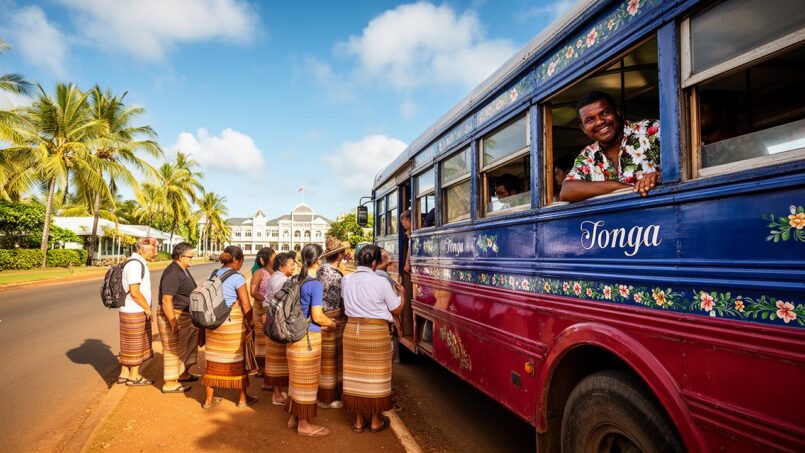
Buses are the only real local public transport in Tonga, and they only operate on the island of Tongatapu. There are no longer public buses on Vava’u, and the other island groups never developed a comparable network.
Buses, often old vehicles imported from China, offer the cheapest fares in the country. They connect Nuku’alofa to the eastern villages (Hahake), western villages (Hihifo), and the outskirts of the capital (the Vaiola line). However, their operation is far from Western standards: no real schedule, limited frequency, and no service to the airport.
Network Organization and Landmarks in Nuku’alofa
The capital has two main bus stations, both located along the waterfront near Vuna Wharf. Their names and functions are simple to remember:
| Bus Station | Approximate Location | Main Destinations Served |
|---|---|---|
| Bus Station Central | Opposite the Tonga Visitors Bureau / downtown area | Hospital, city center, urban routes |
| Bus Station East West | Facing the Ministry of Education / near the courthouse | Eastern villages (Hahake) and western villages (Hihifo) |
In town, some stops are marked with a “Pasi” or “Bus Stop” sign, but in most villages, you just stand by the roadside and wave at the driver. To get off, passengers commonly use the phrase “Tu’u atu heno!” to request a stop.
Buses indicate their main destinations on a sign at the front of the vehicle.
| Windshield Sign | Area Served |
|---|---|
| VAIOLA | Nuku’alofa, hospital, city center |
| HAHAKE / LAPAHA | Villages on the east coast of Tongatapu |
| HIHIFO / HOUMA | Villages on the west coast, especially toward Ha’atafu |
This basic signage is enough to find your way, as long as you know at least the name of the area (east / west / center) where you want to go.
Schedules, Frequency, and Service Limitations
Buses on Tongatapu follow a very consistent but imprecise overall pattern. There is no official timetable; drivers organize their day around the flow of schoolchildren, workers, and villagers.
In practice, the service looks like this:
| Day of the Week | Approximate Time Range | Frequency per Line | Particularities |
|---|---|---|---|
| Monday – Friday | About 7 a.m. – 5 p.m. | Generally 3 round trips | Peak during school hours |
| Saturday | Early morning – mid-afternoon | Reduced frequency | Service ends earlier |
| Sunday | No service | — | General prohibition on work |
Each route is operated only a few times a day, often once in the morning, once in the mid-afternoon, and once at the end of the day, aligned with school commutes. This means that a round trip from Nuku’alofa to a distant village requires careful planning for the return: it’s advisable to aim for a return bus before 3 p.m. to avoid the risk of getting stranded.
The announced travel times for crossing the island of Tongatapu, from east to west for instance, are about an hour. However, in practice, these trips can be much longer. Indeed, the bus makes many stops in each village to let passengers on or off. Adding the waiting time at the stop, a route that seems short can end up taking between 30 minutes and an hour longer than expected.
A crucial point for travelers: no bus serves Fua’amotu International Airport. All airport transfers are done by taxi, private shuttle, or rental vehicle.
Fares, Payment, and Discounts
Bus fares are regulated and calculated based on distance traveled. They are particularly low, making the bus the most economical option for getting around Tongatapu.
Some rough estimates:
| Typical Trip | Approximate Fare (TOP) |
|---|---|
| Short trip in town (VAIOLA) | ~ 1.00 |
| Villages near Nuku’alofa | 0.80 – 1.70 |
| Distant eastern villages | Up to 3.50 |
| Distant western villages | About 2.20 – 2.50 |
Payment is made in cash, directly to the driver, not when boarding but when getting off. The passenger states their starting point, and the driver announces the amount due. Given the low fares, it’s recommended to travel with plenty of small change and low-denomination bills.
Discount rules are very strict: there is no specific child fare, but student fares are granted to pupils (elementary, secondary, technical, etc.) provided they wear a uniform or present a school ID… and only on school days. These discounts do not apply to visitors.
To gauge the overall low cost of the bus, some indicators mention an average price around 5 TOP for a single ticket and about 100 TOP for a monthly pass, which remains very affordable by travel budget standards.
Onboard Experience: Local Immersion More Than Comfort
Traveling by bus in Tonga means taking part in a daily life scene: families, schoolchildren in uniform, bags of groceries, sometimes even somewhat bulky loads. The vehicles are often old, without air conditioning, and can be very crowded during peak hours.
So it’s not the ideal solution for hopping between sights or managing a tight schedule, but rather a way to observe Tongan life from the inside, provided you accept a good dose of unpredictability. The bus then becomes an experience in itself rather than just a means of transport.
Taxis: The Flexible Solution but Needs Good Negotiation
On Tongatapu and Vava’u, taxis supplement the buses, especially for airport trips, nighttime travel (outside of Sunday), or customized excursions. There are no Uber-type services, and no taxis operate on ‘Eua, Ha’apai, or the Niuas.
Taxis are easy to spot thanks to the letter “T” at the beginning of their license plate; most also have a “taxi” sign on the roof. They are mainly found in city centers (around Talamahu Market in Nuku’alofa, on the main streets of Neiafu in Vava’u) and in front of Fua’amotu (Tongatapu) and Lupepau’u (Vava’u) airports.
The vast majority of taxis do not use meters. Fares are based on official rates — first distance then price per kilometer — but in practice, each driver gives an estimated price based on the route. It is therefore essential to agree on the fare before getting in.
On Sundays, taxis are officially reserved for trips to church. In practice, most companies do not accept rides that day, unless a specific prior arrangement is made. It is therefore advisable to assume no taxi is available and plan your travel accordingly.
Booking is usually done by phone. Hotels and guesthouses are happy to act as intermediaries, and some tourist offices (for example in Vava’u) can also help contact a driver.
Price Levels: From Short Trips to Private Day Hire
Fares can seem contradictory from one source to another, reflecting the diversity of practices and the lack of meters. Nevertheless, some ranges can be identified for Tongatapu and Vava’u.
On Tongatapu, economic authorities recommend prices around:
| Pricing Elements (Tongatapu) | Indicative Amount (TOP) |
|---|---|
| First kilometer | 3.50 – 4.10 |
| Additional kilometer | 1.20 – 1.40 |
| Short trip in town | 5 – 15 |
| Fua’amotu Airport – Nuku’alofa | 30 – 70 depending on source, often ~50–60 |
| Transfer between terminals at the airport | 5 – 7 |
| Nuku’alofa – Ha’amonga ‘a Maui | 75 – 80 |
| Nuku’alofa – ‘Anahulu Cave | 50 – 60 |
| Nuku’alofa – Ha’atafu Beach | 150 – 160 |
| Taxi + driver rental for the day | About 300 |
In Vava’u, where distances are shorter but competition is less, prices are higher, especially for daily rentals:
| Trip or Service (Vava’u) | Indicative Range (TOP) |
|---|---|
| Lupepau’u Airport – Neiafu | 40 – 50 |
| Neiafu – Ene’io Botanical Gardens | 40 – 50 |
| Neiafu – Mt Talau | 7 – 10 |
| Airport – more distant villages | 50 – 75 |
| Privatized taxi per hour | About 80 |
| Taxi for the day | 400 – 600 |
Sometimes night surcharges of about 10% after 7 p.m. are added to these base rates. Payments are in cash, and tipping remains at the customer’s discretion, not a strong cultural obligation.
Estimated cost in TOP per kilometer for the initial pickup, according to some sources.
Taxis, Accessibility, and Support
For wheelchair users, Tongan taxis pose a challenge: no vehicles equipped with ramps or tail lifts are available for hire, and taxis are rarely ” accessible” in the strict sense. Most drivers, however, will accept a folding wheelchair in the trunk, especially if the customer informs them at the time of booking.
In practice, travelers with disabilities are strongly encouraged to come with a companion capable of handling the wheelchair, helping to get in or out of the few steps at building entrances, and acting as an intermediary with the drivers.
Ferries: The Backbone of Inter-Island Connections
To travel between island groups, the ferry is the cheapest option, far ahead of the plane. But it is also by far the slowest, especially since crossings combine passengers, vehicles, and cargo in sometimes complex logistics.
Ferries are operated by several companies, including Friendly Island Shipping Agency (FISA), Tofa Ramsay Shipping, Malau Shipping, and Eua Sea Transport Co. These operators manage various vessels — fast barges, mixed cargo ships, large ferries — and serve the main ports: Nuku’alofa (Taufa’ahau Tupou IV Wharf), Pangai (Ha’apai), Neiafu (Vava’u), Nafanua (’Eua), and the two Niuas.
Main Routes, Durations, and Costs
Inter-island trips are long; it’s not uncommon to spend a whole night on board to reach another island group. The average durations provided by the companies are as follows:
| Main Route | Approximate Duration |
|---|---|
| Tongatapu – ’Eua | 2 to 2.5 hours (up to 5–6 hours in bad weather) |
| Tongatapu – Ha’apai | 13 to 14 hours |
| Ha’apai – Vava’u | 7 to 10 hours |
| Tongatapu – Vava’u | 16 to 23 hours (up to 24 h) |
| Vava’u – Niuatoputapu | 16 hours |
| Niuatoputapu – Niuafo’ou | 12 hours |
| Niuafo’ou – Vava’u | 24 hours |
Fares are very competitive compared to flying:
| Trip (Adult Passenger) | Indicative Fare (TOP) |
|---|---|
| Tongatapu – ’Eua (one way) | ~ 30 |
| Tongatapu – Ha’apai | 70 – 80 |
| Ha’apai – Vava’u | 80 – 90 |
| Tongatapu – Vava’u | 90 – 100 |
| Tongatapu or Vava’u – Niuas | ~ 150 |
Some ferries, like the MV ‘Otuanga’ofa or the MV Taka I Pomana, offer cabins (often two single beds or four berths) for significantly higher amounts, sometimes around 250 TOP, including boarding priority. Cabin spaces are limited and recommended for travelers less comfortable sleeping on a simple bench or deck mattress.
Many car rental companies formally prohibit transporting their vehicles on ferries. For travelers bringing their own vehicle, costs are very high, potentially reaching several hundred or even thousands of Pa’anga depending on the destination.
Ticketing, Reservations, and Unexpected Events
The philosophy of Tongan ferries is in line with the rest of transport: maximum flexibility. Schedules and departure days can change at the last minute due to weather, demand, technical issues on the ships, or administrative decisions.
Passenger tickets are generally purchased at the companies’ offices, located at the wharf or in town, often the day before or on the day of departure. Outside very busy periods (November–January), it is rarely necessary to book long in advance for a single passenger. However, for a vehicle, a cabin, or a large group, advance booking is essential.
A few practical points:
| Aspect | Usual Practice |
|---|---|
| Ticket purchase | Company offices at the wharf or in town, payment in cash, check, or bank transfer |
| Ticket check | Ticket must be kept until the end: it may be rescanned upon arrival |
| Refund policy | Tickets sometimes refundable, with a deduction of about 20% |
| Schedule information | Posted at the wharf, tourist offices, company Facebook pages |
| Days without service | No ferries on Sundays, in accordance with Tongan law |
Specialized agencies offer to manage ferry reservations departing from Tongatapu, sometimes with high fees but saving you from going to the counter yourself. They can deliver tickets to your hotel, book returns from the outer islands, and coordinate transfers to the port.
Onboard Conditions, Safety, and Comfort
Ferries vary greatly from one ship to another. On short routes like Tongatapu–’Eua, you’ll generally find barges with benches, toilets, a small covered area, and a snack counter selling snacks and drinks. On the long routes to Ha’apai, Vava’u, or the Niuas, some boats offer showers, common rooms, cabins, outdoor decks, and luggage storage areas.
Despite improvements since the sinking of the Princess Ashika in 2009, caution is still advised. Check the condition and loading of the boat, ensure there are enough life jackets on board, and bring a suitable one for children if necessary.
Another important point: these crossings can be physically demanding, especially at night, in rough seas, or for people prone to seasickness. Bringing something to drink, eat, cover up, and lie down can make the difference between a miserable trip and a bearable experience.
Domestic Flights: Speed vs. Unpredictability
Faced with long ferry hours, domestic flights represent the fast solution for connecting Tongatapu to other island groups. Several companies have come and gone, such as Real Tonga or Chathams Pacific, but the pattern remains broadly similar: frequent connections to Ha’apai, Vava’u, and ‘Eua, fewer to the Niuas.
This is the approximate price, in Tongan pa’anga, of a round trip between Tongatapu and Ha’apai for some travelers.
Schedule Constraints, Cancellations, and “Blank” Sundays
Domestic flights face several major constraints:
– no operations on Sundays, neither for domestic nor international flights at Fua’amotu;
– many cancellations or delays, often due to weather;
– schedule changes that can occur just a few hours before departure.
Authorities explicitly recommend not planning a tight connection between a domestic flight and an international return flight. In a country where a cyclone, fuel shortage, or technical issue can ground the plane for several days, it’s better to allow a buffer of at least one night on Tongatapu before leaving the country.
Airports and Transfers
Fua’amotu International Airport is about a thirty-minute drive from Nuku’alofa. The airport has basic services: currency exchange, bars, shops, car rental, tourist information. With no bus service, transfers are by taxi, hotel shuttle, or minibus from private companies (e.g., Teta Tours & Travel). Some accommodations offer a fixed-price transfer, often better value than a single taxi.
Taxis wait for every flight arrival. The trip to central Nuku’alofa costs about 50 Pa’anga, but fares can vary. It is essential to clarify and negotiate the price before getting into the vehicle.
Getting Between Islands: Choosing Between Plane, Ferry, and Local Boats
To plan an itinerary between several islands, everything comes down to the trade-off between budget, available time, and tolerance for the unexpected.
In a nutshell, the equation looks like this:
| Mode of Transport | Main Advantages | Major Disadvantages |
|---|---|---|
| Inter-island ferry | Very economical, carries cargo and vehicles | Very slow, unstable schedules, basic comfort |
| Domestic flight | Fast, more comfortable | Expensive, frequent cancellations, no flights on Sunday |
| Local boat / water taxi | Access to islands not served by ferries | Variable costs, uneven safety, weather-dependent |
Many travelers adopt a combination: ferry for part of the itinerary, then a flight to avoid a too-long return to the capital. In any case, it is recommended to carefully check schedules and availability several times: during planning, a few days before departure, and on the day itself.
Accessibility and Disability: A Country Still Far Behind
For travelers with disabilities or reduced mobility, Tonga is ranked among the most difficult destinations in the Pacific. Several factors combine: rugged terrain, sandy beaches, incomplete road adaptations, rarely accessible buildings, an almost complete lack of specialized equipment, and little to no adapted public transport.
Institutional Framework Still Lacking
At the national level, there is no dedicated government agency specifically for protecting the rights of persons with disabilities, nor a systematic program to guarantee access to information or communications. The Tonga Red Cross does run a school for children with disabilities and conducts home visits, but coverage remains limited.
Some sectoral policies do mention persons with disabilities: the Tonga Strategic Development Framework includes the issue of social protection and institutional support for vulnerable populations; the Inclusive Education Policy aims to provide them with adapted education; the Tonga National Health Strategic Plan plans to improve access to health and rehabilitation services. On the ground, however, the concrete impact on transport and accessibility remains weak.
Available data show that people with limitations — whether physical, sensory, intellectual, or mental — face greater difficulties than others in participating in social life, accessing employment, healthcare, education, community activities… and obviously transport. Women with disabilities even report slightly more difficulty using transport than men with disabilities.
Urban Infrastructure and Pedestrian Pathways
The towns of Nuku’alofa (Tongatapu), Pangai (Ha’apai), and Neiafu (Vava’u) are the only ones with sidewalks featuring “dips” (curb cuts) relatively compatible with wheelchairs, and even then: coverage is neither continuous nor uniformly good. Pedestrian crossings are rare, and parking spaces reserved for persons with disabilities are found only in a few spots in Nuku’alofa and in some hospitals.
No specific figure was provided to illustrate the mentioned lag.
| Indicator | “Case” Households* | Control Households |
|---|---|---|
| Average household size | 6.2 people | 5.3 people |
| Households with concrete sidewalks passable by wheelchair | 9.9% | 6.7% |
“Case” households: households including one or more persons with disabilities.
In practice, many shops and restaurants are ground-level or have only one or two steps, which may allow access with an assisted manual wheelchair, but greatly limits the use of heavier motorized wheelchairs.
Transport and Disability: Multiple Obstacles
Several surveys conducted around 2018 examined the ability of persons with disabilities to use both private transport and public transport. They highlight a significant proportion of adults aged 15 and over reporting difficulty using private transport (cars, motorcycles) and a substantial percentage having trouble with public transport for various reasons: stairs, lack of information, staff behavior, cost, etc.
Even though detailed figures by sex or type of limitation are not all published, the trend is clear: all else being equal, persons with disabilities use public transport less and face more obstacles than people without limitations, and this applies to buses, taxis, ferries, and planes.
Specifically affected modes of transport are:
Public transportation presents access difficulties for people with reduced mobility: buses are not equipped with ramps, taxis lack adapted vehicles (only a folding wheelchair can fit in the trunk), ferries have boarding via gangways or steep stairs with few adaptations, and domestic planes offer limited assistance with basic boarding wheelchairs.
Accommodation and Adapted Services: Rare Exceptions
A few establishments are beginning to incorporate the notion of accessibility, but in a very partial way and without conforming to Australian or New Zealand standards. These initiatives are more a matter of individual goodwill than regulatory obligation.
Among the examples cited:
– Tanoa International Dateline Hotel in Nuku’alofa: elevator, rooms with raised toilets, grab bars, smooth surfaces for wheelchair circulation, large pools, and full hotel services. It is one of the most ” accessible” hotels in the country, though gaps persist (adapted toilets not always available in all areas, standards not aligned with Australia/New Zealand).
– Sandy Beach Resort on Foa Island (Ha’apai): a bungalow equipped with a ramp, large bathrooms with some grab bars, immediate proximity to the beach (but sand difficult for a non-all-terrain wheelchair).
– Port Wine Guest House in Vava’u: presence of a ramp allowing at least basic access to the building.
These examples remain extremely rare in the Tongan hotel landscape. Furthermore, the availability of specialized equipment (portable ramps, extra bars, all-terrain wheelchairs, etc.) depends entirely on the establishment’s willingness, with no guarantee. Hence the strong recommendation to contact each accommodation directly, explain your specific needs (door width, bed height, shower type, etc.), and confirm possible modifications in writing.
On a national scale, Braille equipment is almost non-existent: only a few signs in the toilets of some ferries have it.
Airports, Planes, and Assistance
Tongan airports — primarily Fua’amotu — offer the best accessibility services in the country, but the level remains far below what is found at major international hubs. A wheelchair can be provided for boarding and disembarkation, subject to prior request to the airline.
Accessible restrooms are not standard in airport terminals. A person in a wheelchair will often need to be accompanied to move around, manage luggage, and handle transfers. It is imperative to reserve specific equipment (such as boarding wheelchairs or ramps) directly with the airline, either when purchasing the ticket or at check-in.
Getting Around in a Wheelchair: Specific Recommendations
For travelers using a wheelchair, several recommendations clearly emerge:
– bring your own all-terrain wheelchair, as there is no rental service for this type of equipment;
– favor manual wheelchairs, which are easier to transport in taxis, ferries, or tour boats;
– always travel with a companion able to help navigate steps, push the wheelchair on uneven terrain, and negotiate with operators;
– choose Tongatapu as your main base, as many sites (like the Ha’amonga ‘a Maui trilithon) are within a short distance from parking areas or on relatively compact terrain (packed grass, stabilized paths) accessible with assistance;
– plan ahead and always inform service providers (taxis, hotels, tour or ferry operators) of your specific needs.
Generally, the country’s major natural attractions — beaches, dive spots, natural pools, caves — remain difficult to access for people with reduced mobility, whether due to sand, rocks, or steep stairs.
Practical Tips for Using Transport in Tonga
Beyond the characteristics of each mode of transport, a few cross-cutting recommendations can help you navigate the Tongan system more effectively.
Plan with a Buffer, Especially for Long Connections
For any trip involving a ferry or domestic flight, it is wise to:
– check schedules directly with the companies (at the counter, by phone, via their Facebook pages or the Ministry of Infrastructure website);
– re-check the day before, and call on the day itself;
– allow a buffer of at least one day between a domestic flight and an international flight;
– absolutely avoid scheduling a critical transfer on a Sunday, when almost everything stops.
Weather conditions, especially during the cyclone season, can lead to canceled crossings or flights, and sometimes the temporary closure of ports or airports.
Dress, Attitude, and Cultural Codes
When using buses, ferries, or taxis, you are immersed in Tongan public life. Adopting local codes avoids misunderstandings:
For a respectful stay, wear modest clothing (covered shoulders, skirts or shorts below the knee) on buses and in public spaces, and avoid very revealing attire. It is illegal to be shirtless. If delays occur, remain calm and polite, as displays of anger are frowned upon. Using basic Tongan words like “Mālō e lelei” (hello) or “Fakamolemole” (excuse me) is highly appreciated.
On Sundays, respect for customs is even more important: especially modest clothing, discreet behavior, no noisy leisure activities, no obvious swimming in inhabited areas.
Road Safety and General Precautions
Even though serious crime remains relatively low, travelers should remain vigilant, especially in town:
– avoid walking alone at night in isolated or poorly lit areas;
– do not display valuables on buses or in taxis;
– keep your documents in a safe place (hotel safe, inner pocket);
– lock doors and windows of your accommodation.
Caution is necessary on the road.
– do not drive at night on unlit secondary roads, where animals, pedestrians, and obstacles can appear at any time;
– obey speed limits (50 km/h most of the time) and the very low legal blood alcohol limit (0.03%);
– know that there is no structured roadside assistance: in case of a breakdown, you must rely on locals, your rental company, or a passing taxi.
Choosing Between Public Transport and Rental Vehicle
To explore Tongatapu, buses and taxis are sufficient for those who accept a very flexible pace, but a rental vehicle offers far greater freedom, especially for reaching remote beaches, poorly served villages, or natural sites off the main roads.
The following comparison table summarizes the main trade-offs:
| Aspect | Bus | Taxi | Rental Car |
|---|---|---|---|
| Cost per person | Very low | Average for short distances / high for the day | Variable depending on duration and fuel |
| Schedule flexibility | Very limited (few rotations) | Good, except Sunday | Excellent |
| Access to remote sites | Restricted (many beaches not served) | Variable, but expensive for long distances | Very good (except rough tracks) |
| Comfort | Basic, often crowded | Fair to good depending on vehicle | Depends on rental model |
| Exposure to unexpected events | High (delays, early last buses) | Medium (negotiation needed, variable price) | Mainly related to weather and road conditions |
| Interaction with locals | High | Good with drivers | More limited |
For the other islands, especially Vava’u and Ha’apai, walking, boats (tours, transfers to small islets), and occasional taxis remain the core of the system, as public buses have disappeared or were never established.
Conclusion: Traveling at Tonga’s Pace
Public transportation in Tonga is a reflection of the country: simple, often rudimentary, deeply influenced by culture and religion, and not very standardized. Navigating it requires more patience than technical skill, but also a genuine ability to adapt.
On the bus, you pay little but accept not being in control of time. By taxi, you gain flexibility provided you negotiate each ride. By ferry, you travel “slow” and economically, but remain attentive to safety and the whims of the weather. By plane, you go fast, but with no absolute guarantee of being on time.
For travelers with disabilities or the elderly, Tonga presents significant challenges. Accessible infrastructure is very limited, assistance relies primarily on accompanying relatives, and transport is rarely adapted for people with reduced mobility. A successful trip requires careful preparation, the presence of a companion, and very precise communication with all service providers.
For everyone, the key is to embrace “Tonga Time,” plan generously, keep smiling, and soak in this way of traveling where the journey counts almost as much as the destination. In an archipelago where you still see horses on the roads and passengers sleeping in the middle of a ferry, taking the bus or boat is not just a way to get from point A to point B: it’s an integral part of the Tongan experience.
A heritage project or a question? Contact us now to speak with a wealth management expert.
Disclaimer: The information provided on this website is for informational purposes only and does not constitute financial, legal, or professional advice. We encourage you to consult qualified experts before making any investment, real estate, or expatriation decisions. Although we strive to maintain up-to-date and accurate information, we do not guarantee the completeness, accuracy, or timeliness of the proposed content. As investment and expatriation involve risks, we disclaim any liability for potential losses or damages arising from the use of this site. Your use of this site confirms your acceptance of these terms and your understanding of the associated risks.

Cyril Jarnias is an independent expert in international wealth management with over 20 years of experience. As an expatriate himself, he is dedicated to helping individuals and business leaders build, protect, and pass on their wealth with complete peace of mind.
On his website, cyriljarnias.com, he shares his expertise on international real estate, offshore company formation, and expatriation.
Thanks to his expertise, he offers sound advice to optimize his clients' wealth management. Cyril Jarnias is also recognized for his appearances in many prestigious media outlets such as BFM Business, les Français de l’étranger, Le Figaro, Les Echos, and Mieux vivre votre argent, where he shares his knowledge and know-how in wealth management.





