
 Published on and written by Cyril Jarnias
Long associated with the silent vastness of the steppe, Mongolia surprises those who discover it after nightfall. Between Ulaanbaatar’s trendy bars, electronic clubs, packed Irish pubs, intimate jazz concerts, traditional music performances, and nights under the stars in national parks, nightlife in Mongolia is far richer than imagined. It is also deeply tied to a culture of celebration where alcohol, songs, hospitality, and nomadic traditions play a central role.
Nightlife in Ulaanbaatar offers a diversity of experiences, from city outings to nights in the Mongolian wilderness. For a successful cultural immersion, it is essential to stay vigilant about safety and to moderate alcohol consumption, as excess is common.
Ulaanbaatar After Dark
Ulaanbaatar is the beating heart of nightlife in Mongolia. The capital has undergone a true transformation in just a few years: what was once a modest scene has become a dense, varied nocturnal landscape where cocktail bars, electronic clubs, pubs, rooftops, jazz clubs, concert halls, and arty cafes coexist.
Although the city is not a ‘city that never sleeps’, the evening entertainment options are now vast. The city center is relatively compact, allowing you to reach most venues within 20 minutes of each other by car. Young professionals typically hop between several places in one evening, choosing their stops mainly based on music, atmosphere, and cocktail quality, rather than on the food menu.
Rooftops and lounges perched atop modern towers offer unexpected panoramas: the lights of Sükhbaatar Square, Soviet-era blocks, recent skyscrapers, and in the distance the ger districts encircling the city. These terraces have become symbols of urban Mongolia, ambitious, forward-looking yet always tied to its roots.
Cocktail Bars, Lounges, and Pubs: A Scene for Discerning Drinkers
To understand Ulaanbaatar’s nightlife, you must first look at the bars. Here you’ll discover a generation of passionate mixologists and restaurateurs, who play as much on the decor as on the contents of the glasses.
Iconic Cocktail Bars
Several spots have become landmarks for lovers of crafted cocktails and refined atmospheres. These places don’t just serve drinks—they shape an aesthetic and an identity unique to the new Ulaanbaatar night.
A comparative overview makes it easier to navigate:
| Bar / Venue | Atmosphere Type | Main Highlights |
|---|---|---|
| LaRosa Tapas & Tequila Bar | Festive, 90s-2000s, pool table | Strong cocktails, Mexican cuisine, nostalgic music |
| Bitsy & CO | Intimate, very lively in summer | Very refined cocktails, small size, cozy atmosphere |
| Cante Bar & Garden | Night street vibe, multi-space | Sports bar, creative cocktails, integrated club |
| Alfie Restaurant & Living Room Cocktail Bar | Cozy, dim lighting, DJ in the evening | Signature cocktails (including “Baby”), Heineken on tap |
| Sip Ulaanbaatar | Intimate, attentive service | Signature cocktails (Sarana Blossom, Armonia, Espresso Martini) |
| 976 Restaurant | Chic brasserie, professional crowd | 76 beers from 18 countries, smoked cocktails, warm wood decor |
| Num Sum Speakeasy Bar | Vintage speakeasy, low lighting | Retro decor, smoked Old Fashioned |
| Grazie Ulaanbaatar | Romantic Italian, floral | Floral decor, gentle ambiance |
| La Fontana Ulaanbaatar / 707 Bar | Mediterranean, terrace & fountain | House cucumber G&T, summer terrace, upstairs bar |
| 17 SKY BAR (Central Tower) | Panoramic rooftop | Skyline view, new cocktail weekly, open 12pm–2am |
| WallStreet Restaurant & Lounge (Blue Sky) | Business chic | Modern design, business clientele |
| Diosa Del Cafe Restaurant | Intimate, romantic, candlelight | Ideal for dates, located atop a residential building |
Bitsy & CO, for example, has established itself as a “small” bar with outsized character: central, bursting with personality, ideal for kicking off the evening. In contrast, Num Sum Speakeasy plays the retro card, with its leather banquettes, vintage photos, and smoked cocktails arriving under glass cloches.
LaRosa Tapas & Tequila Bar stands out by combining a 90s-2000s musical atmosphere, a selection of tequilas, and tapas, with a very busy pool table. Conversely, Sip Ulaanbaatar focuses on an intimate atmosphere with dim yellow lighting and personalized service, renowned for its house creations like Sarana Blossom, Armonia, or a refined Espresso Martini.
976 Restaurant, often frequented by office workers after work, illustrates another phenomenon of local nightlife: the upgrading of beer and cocktail culture. The house boasts 76 beers from 18 countries (Germany, Belgium, France, Australia, Netherlands…) and also offers smoked cocktails, in a warm wood setting.
Pubs and “International” Bars
Ulaanbaatar also hosts Western-style pubs, which have become gathering points for the expat community, diplomats, and travelers.
The Grand Khaan Irish Pub, on Seoul Street, functions as an international salon. Classic Irish pub atmosphere, a large selection of draft beers, a live music stage several nights a week, and a menu that blends Western dishes with Mongolian specialties.
The Dublin Irish Pub, located two blocks from Sükhbaatar Square, offers a compact setting with a modest entrance fee in tugriks. It is appreciated as much for its beer as for its ‘neighborhood pub’ atmosphere in the heart of the capital.
MB Beer Plus, both modern and accessible, shows that beer bars are no longer simple vodka rooms: sleek design, street view, reasonable prices, and long hours (11am–1am) making it convenient for extending a dinner or starting the night.
Private Lounges and More Discreet Venues
The scene also includes more exclusive spaces. VLVT Lounge, designed as a club for entrepreneurs and businesspeople, is also open to the public as a bar-restaurant-club, with late hours (6pm–3am). Il Punto, long members-only, built its reputation on its main hall with a red curtain stage and its ability to host, sometimes at the last minute, top local artists.
Another atypical address: D.d/H.z, located opposite the Bank of Mongolia, presents itself as the city’s only explicitly LGBT-dedicated and “straight friendly” bar, open until 4am. In a still conservative landscape on these issues, this type of venue says something about the evolution of mentalities in urban areas.
Jazz, Live Concerts, and World Music
Mongolian nightlife is not limited to club decibels. It also rests on a strong tradition of live music, driven as much by the jazz scene as by large traditional music ensembles.
Fat Cat Jazz Club and the Jazz Scene
Fat Cat Jazz Club has become an institution in Ulaanbaatar. Located in the basement (B1) of the Veranda restaurant, in the center, the venue is often described as the country’s first real jazz bar. The space is intimate, almost confidential, with limited capacity making it ideal for a couple or small group, but less so for very large parties.
The entrance fee to the club, in Mongolian tugriks, to attend quality concerts late into the night.
Local artists such as Sanchir, Jojo, Ariu, Namone, or the group Uuye and the Boiss perform there regularly, and the venue also hosts international guests. Fat Cat was created through crowdfunding, which speaks volumes about the local public’s attachment to quality live music.
Live Music and Rock Clubs
For a rockier or variety atmosphere, River Sounds Live Music Club is another key address. Located on Chodoi Street, this club open 7pm–2am (Monday to Saturday) offers local bands, hot food, a dance floor, and comfortable banquettes. It mainly attracts a millennial clientele.
Other venues, like UB Jazz Club or Gandan Live House, also focus on live music: UB Jazz Club in an intimate setting with good acoustics, Gandan Live House by marrying contemporary design with nods to tradition, while serving craft beers.
A unique establishment that merges gastronomy and nightlife, offering a complete experience from dinner until the early morning.
Combines Western and Mongolian fare for a varied gastronomic offering.
Offers a selection of beers and cocktails to accompany your evening.
Hosts concerts by local bands on Friday nights until 4am.
Illustrates how some restaurants turn into concert venues after dark.
Major Traditional Evening Shows
The Ulaanbaatar night also offers an immersion in Mongolian arts, in settings more akin to “performance halls” than bars.
Several ensembles have gained an international reputation for the quality of their performances:
| Ensemble / Show | Main Venue | Major Artistic Content | Typical Duration |
|---|---|---|---|
| Mongolian National Folk Song and Dance Ensemble | Ulaanbaatar | Throat singing, traditional instruments, dance, contortion | ~90 minutes |
| Tumen Ekh Ensemble | Ulaanbaatar | Khoomii, dances, morin khuur, yatga, contortion | ~1 hour |
| Tsagaan Lavai – “Nomadic Legend” | Ulaanbaatar | Dances, songs, tsam, ankle bone games, instruments, contortion | ~1 hour |
| “Mongol Nomadic” Show (cultural center) | Mongol Nomadic Center (Töv) | Reenactment of nomadic life, music, tastings, games, songs | ~2 hours |
The performances highlight the morin khuur (horsehead fiddle), throat singing (khöömii), long songs, the Biyelgee dance, tsam masks, as well as contortion acts. In winter, some of these shows are only scheduled on certain days (e.g., Thursday and Sunday for a 90-minute show), so it’s advisable to check schedules in advance.
These evenings are an excellent complement to a more “Western” night at the bars: you discover the deep connection between music, spirituality, and daily Mongolian life, without giving up a drink in town afterward.
Clubs and Nightclubs: Where to Dance Until Morning
For dancefloor enthusiasts, Ulaanbaatar offers a range of clubs with varied profiles, from techno temples to hip-hop clubs, including chic bottle-service venues.
Major Generalist Clubs
Several names come up when talking about nightclubs in Ulaanbaatar:
| Club | Main Music Style | Notable Features |
|---|---|---|
| ZU Club | Hip-hop & techno, 2 rooms | Over 7 years old, known for spotless restrooms |
| Choco Metropolis Club | Hip-hop & techno, 2 rooms | Decor with synchronized moving light balls |
| MINT Club | Varied mix, 4 spaces (Club, Lounge, VVIP, Garden) | Over 10 years experience, seasonal garden |
| EON (Zaisan) | Electro / high-energy | Spectacular visuals, large dance floor, themed parties |
| Lux Club | Mixed clubbing | Busy after 12:30–1am, somewhat hidden |
| Flux | Trance, house, hip-hop, R&B | Dress code, open until 4am, different entrance fees M/F |
| Silence | Trance, electro, house | Small size, no dress code, moderate entrance fee |
| Palace night club | Hip-hop, techno, rock | Large room, very affordable entrance |
| Face nightclub | Disco, varied | No dress code, variable prices |
ZU Club and Choco Club each offer two distinct rooms: one oriented towards hip-hop, the other towards techno. ZU boasts over seven years of activity, giving it veteran status on a fast-moving scene. MINT Club, on the other hand, caters to a crowd seeking something more “refined” than the typical Gen Z haunts, with its four different zones, including a garden open in season.
Flux and Silence, both located in shopping centers (Saint Petersburg Center for Flux, Berlin Center for Silence), offer a predominantly electronic program. Flux enforces a dress code (no sportswear) and different entrance fees for men and women, while Silence is more casual.
Premium Clubs and Original Concepts
In the upper range, some clubs focus on concept rather than just a dance floor. This is the case with VAULT, in the basement of the Shangri-La Hotel: you pay with “tokens” bought at the entrance, the decor resembles a safe, and the atmosphere is very selective, with a design bar and cigar lounge.
ILOFT FUNCTION HOUSE is a hybrid venue, halfway between an event hall and a trendy club. It hosts various types of events, such as conferences, weddings, and parties. Its main asset is its extended opening hours, from 6pm until 4am, allowing for late-night parties.
Finally, Lux Club and some more discreet establishments have earned a reputation among those who like to arrive late: many locals advise not to show up before 12:30 am, to let the dance floor fill up.
Rooftops, Night Views, and Panoramic Bars
Ulaanbaatar’s topography and the rapid rise of office towers have given rise to a new category of nightlife spots: high-rise bars. They appeal to both locals and travelers with breathtaking views over the capital’s lights.
17 SKY BAR, on the 17th floor of the Central Tower, overlooks the city center. A cafe-lounge by day, a bar in the evening, it stays open until 2am and offers a new “special” cocktail each week. It is regularly cited as one of the best places to gaze at the illuminated city while sipping a drink.
Perched on the top floors of the Blue Sky Hotel & Tower, it offers great height, a panoramic view, live concerts on Fridays, and a drink menu targeting both international hotel guests and young urban Mongolians.
The Blue Sky Lounge
WallStreet Restaurant & Lounge, on the ground floor of the same building, offers a more “business” alternative while staying in this skyscraper environment.
These bars also play a special role during major occasions, especially New Year’s Eve. At midnight, they become prime observation points for watching fireworks over Sükhbaatar Square, when the city celebrates the new year around a huge tree (called the “New Year tree”) and concerts organized on the central square.
Alternative Evening Outings: Cafés, Cinema, Bowling, Indoor Activities
Nightlife in Mongolia is not just about drinking and dancing. In Ulaanbaatar, several options allow you to enjoy the evening without necessarily turning to alcohol.
Several bowling centers (M Bowling, Bowling Center, Big Bowling) are open in the evening and serve as social meeting spots, especially in winter. Cinemas offer tickets for about 4 USD and popcorn for around 2 USD, an economical outing.
Bars like Basement have specialized in a “cultural” atmosphere: quality sound system, screenings of art-house films with English subtitles, occasional DJ nights, board games. Dund Gol Vinyl Café, meanwhile, attracts lovers of vinyl and analog music.
Finally, some nighttime art workshops occasionally offer painting on canvas with a glass of wine in hand, a calmer way to end the day in the city.
Mongolian Nights Outside the City: Black Skies and Nomadic Life
Leaving Ulaanbaatar at nightfall is entering another universe. Mongolia, with its vast, sparsely populated territory, high average altitude, and almost total absence of light pollution outside major cities, offers some of the most spectacular nights on the planet for stargazers.
Astro-tourism, night photography, nights in ger camps, winter ice festivals, homestay evenings… Mongolian nightlife also plays out far from the neon lights.
The Sky as the Main Show
From June to September, conditions are particularly favorable: pleasant temperatures, the Milky Way high in the sky, nights long enough. During the new moon, the Milky Way band appears as an incredibly clear pale river, very different from what you can observe in a large European city. Conversely, under the full moon, the faintest stars disappear in a gray glow, but the landscape takes on an almost unreal light.
Several regions are especially well-suited for nighttime observation:
| Region / Site | Type of Night Scenery | Nighttime Highlights |
|---|---|---|
| Gorkhi-Terelj National Park | Rocks, forests, valley near the capital | Very clear skies, easy access from Ulaanbaatar |
| Hustai (Khustai) National Park | Rolling steppes, Przewalski’s horses | UNESCO Biosphere Reserve, little artificial light |
| Gobi Desert (Khongoryn Els, etc.) | Dunes, cliffs, desert vastness | Deep sky, dune silhouettes, very dark nights |
| Orkhon Valley | Waterfalls, monasteries, cultural steppe | UNESCO World Heritage landscape, low light pollution |
| Lake Khövsgöl | Large lake, mountains, forest | Possible reflection of the Milky Way on the water |
| Steppe Lakes (Ugii, Ulaagchiin Khar) | Lakes, dunes, hills | Interesting compositions with reflections and dunes |
In these regions, some operators offer tours dedicated to night photography or simply the pleasure of sleeping under a star-filled sky. Local companies specializing in photo travel build itineraries that combine spectacular landscapes, isolated monasteries, and nights far from any light source.
Ger Camps and “Full-Service” Campsites
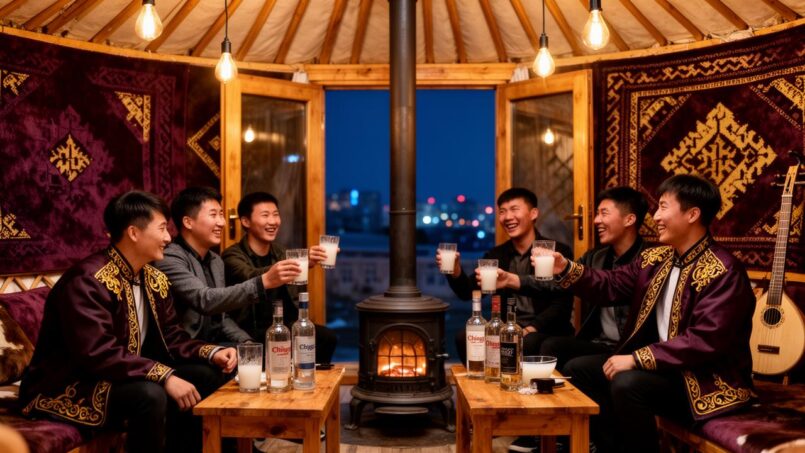
Ger (traditional yurt) camps are the base for many nighttime experiences. Unlike wild bivouacking, they often offer real bedding, a stove in the center of the tent, sometimes shared showers, and hot meals.
Operated by the guesthouse FOUR SEASON, this camp located about 40 km west of a major city focuses on the night as a highlight. Often the last stop on a long circuit, it offers in the evening: sauna, beer, basketball and volleyball courts, mini-golf, and stargazing and moon observation through a telescope (weather permitting). It also organizes one-night/two-day excursions including horse riding and hiking.
On the food side, the experience is very Mongolian: this camp offers to prepare classic dishes on request such as khorkhog (stewed mutton with hot stones), boodog (whole goat or marmot cooked), buuz (steamed dumplings), khuushuur (fried pastries), tsuivan (stir-fried noodles), boiled sheep’s head and intestines. Dinner easily extends into a starlit vigil, especially when the host offers local airag or vodka.
In some rustic nomadic camps or during homestays, there is no shower or electricity, and toilets are outdoor and basic. These conditions allow you to fully experience the night on the steppe: after the herd returns and the shared meal, the yurt becomes a lively place animated by conversations, songs, and sometimes vodka, while outside, an almost pitch-black sky covers the hills.
Nighttime Festivals and Events in the Regions
Several festivals also come alive at night, even if they are not always explicitly “nighttime.”
Example of the Lake Khövsgöl Ice Festival, held in early March. On the frozen surface of the lake, the event features skating marathons, illuminated ice sculptures, shamanic ceremonies, dog sled demonstrations, ice wrestling competitions, and construction of ice *gers* (yurts). At nightfall, the sculptures and installations sparkle, creating an almost unreal atmosphere.
In the Gobi, the Thousand Camel Festival, organized since the late 1990s in the Dalanzadgad region, is centered on daytime activities (camel parades, polo, camel beauty contests, cultural shows). But it naturally extends into the evening in the surrounding camps, with music, songs, salty milk tea, and vodka, under a night sky of exceptional darkness.
Further northwest, in the Bayan-Ulgii province, the eagle hunter festivals (Golden Eagle Festival) take place in autumn and spring. Again, the main events are during the day, but the night at camp, surrounded by Kazakhs telling their eagle hunting stories around a stove, is an integral part of the experience.
Drinking in Mongolia: Between Hospitality, Traditions, and Excess
It’s impossible to talk about nightlife in Mongolia without addressing the place of alcohol in society. Drinking is an integral part of local culture, both in cities and the countryside. This reality has two sides: very generous hospitality and a series of very real social problems.
Airag, Vodka, and Other Alcoholic Drinks
The emblematic drink of traditional Mongolia is airag, fermented mare’s milk, also called koumiss. White, slightly fizzy, with a sour and slightly bitter taste, it contains little alcohol (generally between 0.5% and 3%, sometimes more). It is mainly drunk in summer and autumn while the mares are lactating.
Airag, the traditional Mongolian drink, goes beyond its alcoholic dimension. It is a symbol of hospitality offered to guests, used in libations to honor the sky and earth, and poured over winning horses during Naadam. Its role is central in various rituals and festivities. Its traditional method of preparation in a leather bag (khokhuur) is inscribed on UNESCO’s Intangible Cultural Heritage list, underscoring its cultural importance.
A distilled version of airag, called arkhi or shimni, reaches about 12% alcohol. Alongside this, vodka—Russian or Mongolian—is ubiquitous in the country. It is served during official home visits, religious holidays, major national holidays, graduations, weddings, corporate parties. Toasts follow one after another in small shot glasses, sometimes at a fast pace.
Drinking Rituals and Etiquette
Refusing food or drink in a Mongolian home is considered very rude. When a bowl of airag is passed around the yurt, everyone is expected to take at least one sip. Custom even holds that it is bad luck to empty a bowl of airag by yourself: this would symbolize that the mares will no longer give milk. So you take a few sips, then return the bowl to the host, who fills it again to pass to another guest.
For vodka, a ritual involves dipping a finger in the glass and flicking a little liquid three times: towards the sky, the earth, and your forehead, to honor the spirits. This gesture also allows you not to refuse an offering, even if you don’t drink. Furthermore, objects should be given and received with two hands, or with the right hand supported by the left, as a sign of respect.
Travelers who don’t drink or drink little can use these codes to limit their consumption without offending their hosts, by taking a tiny sip of airag or vodka, performing the ritual gesture, then setting the glass down. Calmly explaining that you don’t drink much for health reasons is often better received than a blunt refusal.
The Downsides of a Strong Drinking Culture
While the conviviality around alcohol is very real, it has a downside. Mongolia has a reputation for being a country where people drink a lot, and the World Health Organization has already pointed to alcohol abuse as a major obstacle to social and economic development. Problems of alcoholism, violence, and domestic violence are documented.
On the streets, especially near bars and nightclubs, it is common to encounter drunk people, particularly in the evening, which can lead to fights. Additionally, some workers consume alcohol during working hours, and in some circles, men who don’t drink may be looked down upon.
Popular culture is not blind to these excesses: a local hip-hop group, Tatar, satirized them in a parody song, “Reverse Day”, which mocks certain alcohol-related societal flaws.
Finally, a fairly famous hangover remedy, though unappealing to sensitive stomachs, involves swallowing sheep eyes marinated in brine. It’s often mentioned with a smile, but it reminds us how deeply alcohol is ingrained in habits.
Staying Safe at Night: Realities and Precautions to Know
Mongolia is generally considered a safe country, with one of the lowest crime rates in Asia. However, the increase in tourist traffic, rapid urbanization, and the concentration of bars and clubs in certain districts have led to a rise in petty crime—and sometimes more serious incidents—especially in large cities like Ulaanbaatar.
Where and When to Be Cautious
Pickpockets and thieves mainly target busy areas: markets (like the Narantuul – “Black Market”), large department stores (State Department Store), shopping malls, bus stops, crowded transport, train stations, airports, areas around certain tourist sites (Gandan, Sükhbaatar Square, central post offices…).
But when it comes to nighttime, the highest risks are concentrated around bars and nightclubs, especially in their immediate vicinity and on the way back. Most incidents—fights, assaults, thefts—occur at very late hours, at the exits of establishments, sometimes in a context of general intoxication.
During major holidays (Naadam in July, Tsagaan Sar in winter, Women’s Day, year-end holidays), there is an increase in opportunistic crime, price gouging, and scams.
Types of Reported Incidents
Expatriates and travelers report cases of: violence, scams, abuse, and discrimination in various countries.
– snatch thefts of bags or wallets,
– assaults following nights of heavy drinking,
– thefts in tourist camps (including from occupied gers),
– street harassment, especially around bars on certain streets,
– people posing as police officers, demanding money or trying to take papers,
– “spiked” drinks to facilitate theft,
– price scams at the entrance to certain sites or during highly sought-after festive events.
Serious assaults against foreigners remain rare but do occur, including cases of sexual assault, sometimes involving people known to the victim (guides, drivers…). Some crimes may have a nationalist dimension, targeting foreign men, especially when accompanied by Mongolian or Asian women.
Best Practices for Enjoying the Night
Without falling into paranoia, several reflexes can help reduce risks in the evening:
To ensure your safety during nighttime outings, avoid walking home alone late at night, especially in unfamiliar neighborhoods. Stick to well-lit areas and reputable establishments. Keep your valuables on you, in a closed bag worn in front or a hidden travel belt. If you’re going out for a boozy evening, leave your passport and expensive items in the hotel safe. Do not accept drinks offered by strangers on the street or in shady bars without seeing them prepared. Limit your alcohol consumption, especially if you don’t speak the local language or know the area. Use reliable taxis (apps like UBCab or known services) and avoid sharing a taxi with a stranger met outside a club. If the taxi doesn’t have a meter, agree on the price before getting in. Finally, avoid flaunting large wads of cash or high-end electronic equipment.
Generally speaking, maintaining basic vigilance, as you would in any large city, allows you to experience Mongolian nightlife without incident.
Night Tours, Local Guides, and Organized Experiences
For those who prefer to explore the city at night in a structured way, private guide services offer customized tours in Ulaanbaatar and its surroundings, often on time slots ranging from 2 to 8 hours, with hotel pickup and return.
These tours can combine elements of daily life (markets, residential areas, nightlife spots) with more heritage or cultural aspects: illuminated Sükhbaatar Square, Zaisan Memorial and its night view of the city, opera house, throat singers, folklore shows, typical restaurants, etc.
Some agencies or freelancers even design “day + night” programs including, for example:
A complete program to explore the historical, gastronomic, and artistic riches of the capital, from day to night.
Visit monasteries (Gandantengchinlin, Choijin Lama) and museums (National Museum, Chinggis Khaan Museum) during the day.
Dinner at a traditional Mongolian restaurant to discover the country’s cuisine.
Evening dedicated to a song and dance performance (Tumen Ekh, Mongolian National Folk Song and Dance Ensemble…).
Tour of iconic bars with a guide to discover the modern facet of the city.
Outside the city, multi-day circuits mix nomadic life (stay with a family, milking animals, dairy tasting, horse riding, camel riding) with nights under the stars, sometimes with specific nighttime activities (stargazing through a telescope, tales, songs around the stove). Again, the presence of a guide helps overcome language barriers and decode what happens in the evening: vodka toasts, airag rituals, improvised songs, traditional ankle bone games (shagai), etc.
Festive Nightlife: Festivals, Concerts, and Major Events
In addition to daily parties, the Mongolian calendar is dotted with major events that change the face of the night.
The Playtime Music Festival is presented as the largest music and culture festival in Mongolia. Born in the early 2000s as a small day of rock and indie concerts in Ulaanbaatar, it has become a major multi-day event about thirty kilometers from the capital. It now features several stages hosting dozens of Mongolian and international bands, covering diverse genres such as rock, indie, pop, hip-hop, metal, electronic, and world music. The festival experience is complemented by camping, food areas, art stalls, and parties that stretch late into the night.
The ARA Music Festival, in Arkhangai province, spreads its program over a month, with concerts, cultural performances, exhibitions, workshops, children’s activities, sports (horse racing, motocross), and food markets. At night, the site transforms into a profusion of concerts and shows, sometimes with international collaborations (for example, a Mongolia–Korea dance show or a live festival bringing together Mongolian, Korean, Chinese, and Russian artists).
In Mongolia, some festivals transform nightlife into an immersive multi-day experience. They are not limited to a simple outing but create a continuous bubble mixing concerts, parties, late-night discussions, and encounters.
Finally, some local artists, like musician Batzorig Vaanchig – a virtuoso of the morin khuur and throat singing – organize international tours, extending the Mongolian night far beyond the country’s borders, through concerts and workshops that bring a bit of this night culture of songs, bowed strings, and poetry to European or other performance halls.
Conclusion: A Mongolian Night, Between Neon Lights, Steppes, and Bowls of Airag
Mongolian nightlife cannot be confined to a single image. It is both that series of sleek bars where young professionals sip smoked cocktails after work, those techno clubs where the crowd dances until dawn, those Irish pubs packed with diplomats, those small jazz clubs where Mongolian musicians play American standards under dimmed lights, and those ger camps where, after dinner, bowls of airag are raised under a star-filled sky.
It is also a cultural nightlife, made up of throat singing performances, masked dances, contortion, festival concerts, fireworks over Sükhbaatar Square on December 31, Naadam where wrestling finals can end late in the evening amid the cheers of the crowd.
In all this, alcohol is both a vector of conviviality and a source of problems, and one must be aware of this to fully enjoy the Mongolian night. Crime, even if relatively contained, requires the same kind of vigilance you would adopt in any capital city after dark.
For those who can navigate these realities, Mongolia offers a unique night experience: a place where, in the same week, you can listen to jazz in a chic basement, dance to electro in a futuristic club, attend a traditional music performance, then sleep in a yurt in the middle of the steppe, stepping out to gaze at the Milky Way. In short, a Mongolian night is the meeting point between the neon lights of Ulaanbaatar and the total darkness of the great outdoors, between shots of vodka and bowls of airag, between electronic beats and ancient long songs.
Disclaimer: The information provided on this website is for informational purposes only and does not constitute financial, legal, or professional advice. We encourage you to consult qualified experts before making any investment, real estate, or expatriation decisions. Although we strive to maintain up-to-date and accurate information, we do not guarantee the completeness, accuracy, or timeliness of the proposed content. As investment and expatriation involve risks, we disclaim any liability for potential losses or damages arising from the use of this site. Your use of this site confirms your acceptance of these terms and your understanding of the associated risks.

Cyril Jarnias is an independent expert in international wealth management with over 20 years of experience. As an expatriate himself, he is dedicated to helping individuals and business leaders build, protect, and pass on their wealth with complete peace of mind.
On his website, cyriljarnias.com, he shares his expertise on international real estate, offshore company formation, and expatriation.
Thanks to his expertise, he offers sound advice to optimize his clients' wealth management. Cyril Jarnias is also recognized for his appearances in many prestigious media outlets such as BFM Business, les Français de l’étranger, Le Figaro, Les Echos, and Mieux vivre votre argent, where he shares his knowledge and know-how in wealth management.





