
 Published on and written by Cyril Jarnias
Moving to Mongolia isn’t just about changing countries; it’s about entering a structured social universe shaped by centuries of nomadism, Tibetan Buddhism, and shamanic traditions. Many foreigners describe Mongolians as warm, direct, incredibly hospitable… but also baffling when it comes to time, unwritten rules, and etiquette in gers, offices, or over a bottle of vodka.
Understanding cultural differences in advance is essential. It’s not just about politeness—it determines your ability to build trust, advance a professional project, and avoid offending a host who welcomes you, for instance in the middle of the steppe.
In this article, we dive into the main gaps to anticipate before settling in Mongolia, drawing on surveys, expat testimonies, and cultural studies.
A Culture of Hospitality, More Codified Than It Seems
One of the major culture shocks for an expat is the intensity of Mongolian hospitality. It goes beyond simple kindness: it’s a moral obligation inherited from a nomadic lifestyle where, in a harsh environment, a traveler could be key to survival.
Historically, roads were long, winters extreme, and distances immense. In this context, closing your door to a stranger potentially meant condemning them to death from cold or hunger. From this came a rule: those with a home have a duty to welcome.
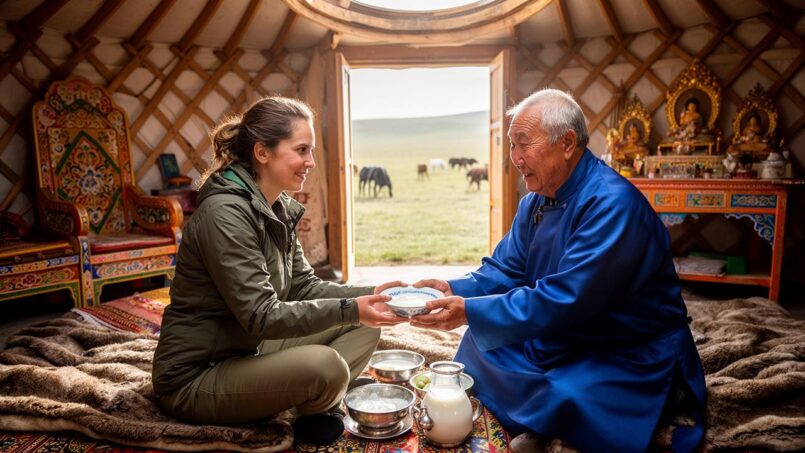
Today, in the Mongolian countryside, a host might spontaneously invite a traveler to spend the night in their ger. They then share a hot meal, salty milk tea (süütei tsai), and sometimes airag, fermented mare’s milk considered the national drink. The host often also offers milk, dairy products, or meat, and sends the guest off with blessings for a safe journey.
The home—the ger—is both a living space, a symbol of openness, and a sacred area. But what seems like informal conviviality to a Westerner actually rests on a tight set of rules: you don’t enter just any way, you don’t stand anywhere, and you never refuse just anything.
The Central Role of Sharing
In this culture, wealth is measured less by what you accumulate than by what you share. So it’s no surprise that key moments of Mongolian sociability are structured around food, drinks, and reciprocal gifts.
Accepting an offering of food like airag or aaruul is a sign of respect and integration into a network of reciprocal obligations. A refusal without explanation or without respecting the ritual is seen as a personal and family insult.
The expats who adapt best are those who play along: taste, even a little, compliment, pay homage to the host’s effort, and in turn bring a small gift suited to the local context.
Time, Punctuality, and the Famous “Mongolian Time”
Another difference that often surprises newcomers is the relationship with time. Mongolia comes from a culture where daily organization relied mainly on the sun and weather: “before noon,” “afternoon” sufficed. This view has modernized in cities, but flexibility remains strong.
Local surveys show that more than half of Mongolians admit they are not always punctual. In a survey of 50 people, only a minority say they arrive consistently on time, with the majority admitting occasional or frequent lateness, averaging between 4 and 15 minutes off for scheduled appointments. In practice, it’s not uncommon for a social gathering to start 30 minutes or even an hour after the planned time.
Time to get ready, traffic jams, but also the implicit certainty that “the other will be late anyway.” Some even admit to giving false departure or arrival times to compensate.
Justifications for Lateness
This time flexibility has a name: “Mongolian time.” For many Mongolians, it’s simply normal. Expats from cultures highly focused on efficiency, like Hong Kong or Singapore, report frustration with repeated meeting postponements or deadlines taken lightly even in some government services.
Conversely, other foreigners highlight the positive side of this relationship with time: Mongolians tend to focus on the person present, carrying the conversation through to the end without being tyrannized by the clock.
For an expat, the key is twofold: stay punctual yourself—seen as a sign of seriousness and respect—while understanding it won’t necessarily be reciprocated, especially in public or administrative settings. In business, it’s often advised to arrive 5 to 10 minutes early, without being too early to avoid pressuring the host.
Punctuality: Perception and Hard Numbers
To visualize this gap, it’s useful to look at some figures from local surveys on punctuality.
| Self-Reported Punctuality Behavior | Share of Respondents |
|---|---|
| Generally punctual but sometimes late | 42% |
| Often late | 5% |
| Always late | 4% |
| Not punctual “all the time” (overall) | 51% |
In the same type of surveys, average lateness observed ranges from 4 minutes 30 seconds to nearly 15 minutes. So adjust your expectations and, above all, build buffers into planning for professional projects or delivery and payment deadlines.
A Hierarchical Society, but More Nuanced Than It Appears
Another crucial point to grasp before moving is the central place of hierarchy and age. Mongolian society remains largely vertically structured, even if recent history, urbanization, and international openness have introduced nuances.
In daily life and business, special respect is given to older people, supervisors, and authority figures. This shows in how people greet, sit, speak, and even handle disagreement.
In top-down companies, the final word typically rests with a small circle of leaders or the owner.
For an expat, the trap is trying to convince “everyone” when, in practice, only one or two people truly have the power to decide. Identifying who holds real authority early on saves time and helps calibrate your efforts.
Respect for Elders: A Reflex to Adopt Quickly
In social life, this attachment to hierarchy shows from the first interaction. Greet the oldest or most important person first, stand when an elder enters a room, avoid walking in front of an elder without permission, and naturally give up your seat on public transport.
Important social conventions to observe during meals, especially regarding elders and language.
Wait for the oldest person to start eating before serving yourself, and serve them first.
Using formal language, especially the respectful pronoun (you), is expected with older people.
For a foreigner, adopting these reflexes early—standing up, giving up your seat, greeting elders first—immediately eases integration and reduces the symbolic distance between “foreign guest” and “community member.”
Managing Meetings, Negotiation, and Professional Communication
In the workplace, Mongolia combines relational tradition, strong hierarchy, and gradual openness to more “international” standards. Navigating this requires flexibility, especially if you come from an environment where everything goes by email and shared calendars to the quarter-hour.
Appointments are ideally made one to two weeks in advance, by phone or email. With administrations, it’s recommended to send an official paper letter several weeks before the visit, verify receipt, then confirm closer to the date. Providing an agenda and simple materials in Mongolian in advance greatly facilitates exchanges.
Meetings rarely start “on the dot” and almost always open with informal conversation: health, family, weather, country news, sometimes mentions of the steppe or regional geopolitics. Jumping straight into figures or contracts can come across as cold, even disrespectful.
Once the core topic is addressed, discussions can be long, winding, punctuated by silences. These pauses aren’t necessarily awkward moments; they’re times for reflection. Interpreting every silence as a gap to fill is a common expat mistake.
In negotiations, the tone is generally direct on substance—people say what they want clearly—but wrapped in polite forms to avoid direct confrontation. Saying “no” outright remains delicate; people often prefer phrases that imply a difficulty rather than a flat refusal. A “yes” can sometimes mean “I heard you” more than “I agree.”
For an expat, this means verifying agreements in writing and rephrasing key points, without aggression, to ensure everyone is on the same page.
Decisions and Deadlines: Why Everything (Often) Takes Longer
Decisions aren’t necessarily made around the meeting table. It’s common for the Mongolian side to discuss later internally, sometimes informally, before getting back to you. Forcing an immediate conclusion can be seen as a form of disrespect or mistrust.
In public or family organizations, delays can be particularly long. Some attribute this to a lack of time management culture, including at the government level, while others point to structural factors like unpredictable urban traffic, harsh winters, and the weight of certain social habits.
Here again, patience is your best ally. It’s better to build in safety margins from the start for your projects, both in terms of timelines and payment schedules.
Business Cards, Attire, and External Signs of Seriousness
In business settings, the business card remains a must, especially on first contact. It’s generally exchanged with both hands; take time to read it and show interest. A bilingual card, in Mongolian and English, boosts credibility and makes life easier for your interlocutors.
As for attire, appearance matters. A sloppy look is quickly associated with a lack of seriousness. A sober suit for men, a neat professional outfit for women are the norm in formal meetings. In some circumstances, wearing a traditional deel is appreciated as a sign of respect for local culture, provided it’s worn correctly, especially with the belt fastened.
Social Codes and Body Language: What You’re Never Told Explicitly
A large part of communication in Mongolia goes through gestures, postures, and how you give or receive an object. For an expat, this is often where the most awkward misunderstandings arise, as few of these rules are explicitly stated to foreigners.
The common thread to remember: the body is symbolically hierarchical. The head is sacred; the feet are “low” and associated with impurity. Between these two extremes, every movement can be read as a mark of respect or, conversely, an offense.
Avoid showing the soles of your feet, sitting with your legs pointed at someone, an altar, or the central stove of a ger. Putting your feet on a chair or table is shocking. If you accidentally touch someone’s foot, a verbal apology alone isn’t enough: you must take their hand, a coded gesture of reconciliation.
It’s important not to touch someone’s head, especially a child’s, without their invitation. Also, a hat, an object with strong symbolic weight, should never be taken, moved, or worn by another person.
Similarly, pointing a finger at someone or something is considered impolite. Instead, use a gesture with the whole hand, palm facing up, or a slight chin movement. A simple little finger extended can be interpreted as an insult.
Right, Left, Two Hands: A Grammar of Gesture
How you give or receive an object is equally codified. Use your right hand, possibly supported by your left at the wrist, or both hands together. Handing something over with only the left hand is considered rude.
In some cultures, offering money, gifts, or drinks like tea or vodka involves precise gestures expressing respect. For instance, it’s common for the giver to offer with the right hand while the left hand supports the right elbow as a sign of deference. Some hosts go so far as to orient banknotes in a specific way, presenting the portrait on the bill facing the recipient before handing it over.
In this regard, it’s better to do too much than too little: accept a cup with both hands, slightly bow your head, place a bowl or object with care rather than setting it down abruptly—these send the signal that you take the relationship seriously.
Silence, Volume of Voice, and Foreign Languages
In exchanges, silence has a positive value: it often means someone is thinking, weighing their words, not that they don’t know what to say. Constantly filling it, especially with quick comments or jokes in your own language, can come across as tactless.
Speaking very loudly, interrupting, raising your voice are seen as aggressive. Conversely, a calm tone, slower pace, and attentive listening are appreciated. Speaking at length in a language unknown to those present—among expats, for example—can also be poorly received, especially in intimate settings.
Understanding the Ger Universe: Sacred Space, Strict Codes
For anyone settling long-term in Mongolia, invitations to gers—in the city or countryside—will quickly become part of daily life. But life under the traditional tent follows complex symbolism that it’s best to understand before entering.
To enter a Mongolian yurt (ger), don’t knock on the door. Announce yourself as you approach, possibly by saying “Nokhoi khor!” (“Hold the dog!”). Always enter with your right foot first, carefully avoiding stepping on the threshold, considered a sacred boundary. Once inside, don’t linger in the doorway; move quickly and wait for the host or hostess to indicate where to sit.
Inside, the space layout is meaningful. The back, opposite the door, is the place of honor, often occupied by a small Buddhist altar, family photos, and the most important guests. Don’t sit there spontaneously. Men typically sit on the right side, women on the left, though practice varies by region and the family’s traditionalism.
The two central pillars symbolize the stability of the home; it is forbidden to lean against them, walk between them, or rest on them. The stove in the center is considered the living heart of the family; do not throw anything into it, pour water on it, step over it, or point your feet toward it.
Behaviors that are casual for a Westerner—whistling while talking, rolling up sleeves in an overheated interior, rocking on a chair, stepping over someone’s legs—can be interpreted as provocations or a total lack of upbringing.
For an expat, adopting these rules shows that you respect not just habits, but a family cosmology where every gesture carries symbolic weight.
Eating and Drinking: The Real Ground for Integration
Culinary shock is part of the strong experiences of expatriation in Mongolia. A country of extreme climates, low population density, and a long pastoral tradition, cuisine revolves around meat and dairy products rather than vegetables and spices.
The Mongolian table often contrasts “white foods” (milk, yogurts, cheeses, creams, aaruul) with “red foods” (mutton, goat, beef, horse meat). In the countryside, a diet rich in animal fats and protein is considered necessary to endure winters at –40°C and outdoor work.
A Few Reference Points on Food
Here’s a very simplified overview of the main types of food and drinks that structure daily life:
| Category | Typical Examples | Cultural Particularities |
|---|---|---|
| Meats | Mutton, goat, beef, horse | All parts of the animal are consumed, including heads and offal |
| Dairy Products | Yogurt, cheese (byaslag), cream (öröm), aaruul | More abundant in summer and autumn |
| Staple Dishes | Buuz, khuushuur, tsuivan, noodle soups | Served at festivals like Tsagaan Sar or Naadam |
| Hot Drinks | Süütei tsai (salty milk tea), black tea | Milk tea is drunk like water |
| Alcoholic Drinks | Vodka, airag, shimiin arkhi | Vodka ubiquitous, airag an identity drink |
Chinese and Russian influences can be found in some noodle, dumpling, and soup dishes, but overall, the cuisine remains lightly spiced and not very salty compared to other Asian countries. Chili peppers aren’t part of the culinary tradition.
For an expat, being willing to taste a bit of everything offered, even unusual dishes like offal or fatty foods, is an important way to open up and integrate into the local culture.
Drinking Rituals
Salty milk tea is offered throughout the day. Refusing a cup, especially upon arrival, is almost unthinkable. If you don’t want much, drink a few sips, then set the bowl down with thanks. Leaving liquid at the bottom every time can be misinterpreted.
With airag and vodka, things get more complex. Alcohol is part of hospitality, but there are socially acceptable ways to limit consumption. One is to lightly dip your right ring finger into the drink, symbolically flick a few drops toward the sky and the earth, then touch your forehead, before bringing the bowl or glass to your lips for a symbolic contact rather than an actual sip. If you don’t drink alcohol, you can perform the ritual then return the glass with a smile and a word of thanks.
In a ritual context, simulating consumption without actually participating may be perceived as a sign of disinterest or even contempt toward the spirits honored during the ceremony.
Meal Etiquette in a Family or Ger
Meals aren’t always taken together around a table. But when a guest is present, a kind of collective staging takes place. Let elders start, let the host serve you, avoid helping yourself directly from shared dishes without being invited.
Eating with your hands is common inside a family ger, especially for large pieces of meat on the bone. It’s not a lack of manners, but a practice suited to the dishes served. The important thing is to go with the flow: accept what the host hands you, don’t refuse the pieces offered, don’t waste food.
Finishing your plate entirely may prompt a second serving; leaving a tiny bit can signal you’re full while showing you enjoyed the meal. In any case, thanking at the end—with a “Bayarlalaa” and a compliment—is welcome.
Giving, Receiving, Offering: The Mongolian Art of Gift-Giving
Gifts are everywhere in Mongolia: in family, business, to thank a host, at festivals or ceremonies. It’s not just about material things; it’s a social language in its own right.
When invited to a home, arriving completely empty-handed is rarely a good idea. A small something—food, tea, sweets, toys for the children—helps break the ice and shows you recognize the effort of hospitality. It’s customary to leave some gifts when you depart, as a sign of gratitude.
Gifts should be appropriate: useful and of decent quality, without being ostentatious enough to suggest a bribe. To show respect, present the gift with both hands. When offering something to a religious figure or a highly respected elder, protocol dictates placing it on a silk scarf (khadag).
In business, small souvenirs from your country, books, products from your company, or sweets are appreciated. Sharp objects—knives, scissors—are discouraged, as they symbolize cutting the relationship.
When to Give What?
An important subtlety often surprises expats: offering the main gift at departure, not upon arrival, avoids it being seen as an attempt to buy the relationship. On arrival, a small gesture suffices; it’s once the relationship is cemented through a meal, a night, or a shared project that you can give a more significant present.
For nomadic families, items hard to come by in the countryside—like batteries, headlamps, various spices, good-quality tea, fruit, or biscuits—are often more appreciated than an imported luxury item that wouldn’t fit into their daily life.
Religion, Beliefs, and Superstitions: A Constant Backdrop
Even if a large part of the population claims attachment to Tibetan Buddhism, the religious reality is more complex: it combines Buddhist practices, shamanic heritage (Böö Mörgöl or Tengerism), ancestor worship, and belief in spirits tied to mountains, springs, and fire.
In many Mongolian families, it’s common to practice religious syncretism, such as lighting incense sticks before a Buddhist altar while periodically honoring an ovoo—a stone cairn dedicated to mountain or sky spirits—with offerings of milk, vodka, or dairy products. An important ritual gesture when passing near an ovoo is to circle it three times clockwise, adding a stone, as a sign of respect for the protective spirits of the place.
Water, like fire, is perceived as sacred. Washing directly in a spring, throwing trash into it, urinating, or washing dirty dishes in a natural water source are major taboos. Even without sharing these beliefs, an expat must respect them, or risk being seen as someone deliberately insulting the “master of the place.”
Superstitions extend into daily life: avoid starting important activities on a Tuesday, don’t joke loudly about the possibility of a car or plane accident, don’t ask the name of a mountain while it’s still visible on the horizon. These rules reflect a worldview where words have weight on reality.
Understanding this belief substrate doesn’t require adherence, but helps decipher certain reactions—reluctance to go somewhere on a particular day, the need to make a detour to an ovoo before hitting the road, or discomfort caused by a joke deemed “ill-omened.”
City Life vs. Country Life: One Country, Different Practices
For an expat settled in Ulaanbaatar, it would be misleading to think all these norms apply everywhere with the same rigidity. The capital is a fast-changing large city, marked by a strong presence of young graduates, international companies, and global influences.
Dress codes are very varied, ranging from classic suits to fashionable or revealing outfits. Young couples often show more affection in public than in smaller towns. English is relatively common in some circles, and practices like using messaging apps to set appointments are close to international standards.
Yet as soon as you leave the center or interact with families from the steppe, traditional rules resurface. Many city dwellers even “go back to their roots” during Tsagaan Sar or Naadam, donning the traditional deel and reactivating the intact etiquette of their home regions.
For an expat, the safest strategy is simple: adopt the most respectful rules everywhere, then adjust where hosts themselves are more flexible. Better to appear a bit too ceremonious than a bit too casual.
How to Turn These Differences into Resources Rather Than Obstacles
Living in Mongolia isn’t about passively bending to a foreign protocol. It’s about learning to play with a different reference system, where:
– hospitality isn’t a service, but a duty;
– time is more elastic, but presence in the moment and for the other is stronger;
– hierarchy is marked, but human warmth is real;
– spirituality infuses the most everyday gestures.
For a successful expatriation, it’s advisable to prioritize building personal relationships before discussing business, accept and return invitations, learn a few words of the local language to show commitment, and adopt an observational stance before passing judgment.
Their punctuality, rigorous follow-through, and clear writing are seen positively, provided they come with patience for inevitable delays and detours. Their scrupulous respect for ger and dining rules opens doors that more “Western-centric” approaches leave closed.
Ultimately, moving to Mongolia forces you to step out of a logic of control—tight schedules, fixed procedures—and into an economy of relationship and symbol. It’s not always comfortable, but it’s precisely this shift that makes a fully embraced Mongolian experience so rich.
Disclaimer: The information provided on this website is for informational purposes only and does not constitute financial, legal, or professional advice. We encourage you to consult qualified experts before making any investment, real estate, or expatriation decisions. Although we strive to maintain up-to-date and accurate information, we do not guarantee the completeness, accuracy, or timeliness of the proposed content. As investment and expatriation involve risks, we disclaim any liability for potential losses or damages arising from the use of this site. Your use of this site confirms your acceptance of these terms and your understanding of the associated risks.

Cyril Jarnias is an independent expert in international wealth management with over 20 years of experience. As an expatriate himself, he is dedicated to helping individuals and business leaders build, protect, and pass on their wealth with complete peace of mind.
On his website, cyriljarnias.com, he shares his expertise on international real estate, offshore company formation, and expatriation.
Thanks to his expertise, he offers sound advice to optimize his clients' wealth management. Cyril Jarnias is also recognized for his appearances in many prestigious media outlets such as BFM Business, les Français de l’étranger, Le Figaro, Les Echos, and Mieux vivre votre argent, where he shares his knowledge and know-how in wealth management.





