
 Published on and written by Cyril Jarnias
Moving to Madeira is a dream for many retirees, remote workers, and families seeking a gentler lifestyle. But behind the photos of volcanic cliffs, natural pools, and hiking trails, one question always comes up: how much do you really need to live there on a daily basis?
Madeira is generally more affordable than most major cities in Western Europe or North America. However, prices, especially for real estate, are rising quickly. So it’s essential to understand the cost structure before settling on the island.
Realistic Budget Ranges for Living in Madeira
For an expat, the monthly budget depends mostly on housing, transportation, and lifestyle. Data compiled from Numbeo, Expatistan, and various accounts from expats living there converge on the following ballpark figures.
Typical Budgets by Profile
For a single person, couple, or family, the ranges become fairly clear once rent is included.
| Profile | Realistic Monthly Budget (Funchal, rent included) | Key Remarks |
|---|---|---|
| Single, “minimalist” mode | €1,100 – €1,450 | Shared flat or 1BR outside center, few outings |
| Single, average budget | €1,400 – €2,100 | What most actually end up spending |
| Single, comfortable lifestyle | €1,930 – €2,500 | 1BR in center, car, regular leisure and dining out |
| Couple, comfortable | €2,500 – €3,600 | 2BR, car, restaurants, leisure, private insurance |
| Couple, average observed level | ~€3,500 | Budget seen for many retirees |
| Family of four | €3,400 – €4,700 | Heavily dependent on rent and schooling |
| Digital nomad (solo) | €1,800 – €2,600 | Coworking, active social life, travel |
These amounts include rent and utilities. Without housing, the baseline spending is around €616 per month for a single person and about €2,231 for a family of four.
Another way to read these figures: most expats report a total cost between €1,200 and €1,800 per month for a single person, and €2,500 to €3,000 for a family, including housing, aiming for a comfortable standard of living without ostentatious luxury.
Comparison with Other Cities and Countries
International comparisons confirm Madeira’s advantage:
In Funchal, daily expenses excluding rent are about 58% lower than in New York.
In other words, to achieve the same standard of living as with $9,200 in New York, you’d need about $3,328 in Madeira. But this theoretical purchasing power needs to be put in perspective: the local average salary is around €836 net per month, so it’s mainly external income (pensions, foreign salaries, international freelancing) that allows expats to fully benefit from this cost difference.
Housing: The Biggest Expense
Housing is by far the largest portion of an expat’s budget. It’s also the item rising fastest, especially in the capital, Funchal.
Rent Levels: Funchal vs. the Rest of the Island
Funchal is home to more than half of the island’s international residents (52.6% of foreigners) and remains the tightest and most expensive rental market. Compiled data show a wide spread, with ranges reflecting lease age, standard, and views.
| Type of Property (long-term) | Location | Observed Monthly Rent Range |
|---|---|---|
| Studio / 1BR | Funchal center | €900 – €1,500 (often €1,200 – €1,300) |
| Studio / 1BR | Funchal outskirts | €600 – €1,200 |
| 2BR | Funchal center | €1,600 – €1,800 (typical starting point) |
| 3BR | Funchal center | €1,500 – €3,200 |
| 3BR | Funchal outskirts | €1,200 – €2,000 |
| 1BR (approx. 50 m²) | Estreito da Calheta | ~€400 |
| 1BR (approx. 50 m²) | Ponta do Sol | ~€300 |
| 1BR (approx. 50 m²) | Porto Moniz | ~€260 |
| 1BR (approx. 50 m²) | Câmara de Lobos | ~€310 |
Funchal shows average rents around €15 to €18.75 per square meter depending on sources. For a 2BR of 80 to 85 m², you easily hit around €1,200 to €1,300 per month, and much more for a modern apartment with sea views.
Secondary municipalities like Santa Cruz, Machico, Ribeira Brava, Ponta do Sol, or Câmara de Lobos remain more affordable, with rents observed between €650 and €900 for small units, but owning a car becomes almost essential.
Rapid Increase and Tight Market
Madeira was long considered a cheap alternative to the mainland. That is no longer really the case for real estate: in 2025, the archipelago recorded the highest rent increase in the country, with +7.4% year on year, and values continue to climb.
Notable trends:
– A modern 1BR in central Funchal that rented for around €700 in 2020/21 now goes for around €1,500;
– Average rents on the island have reached about €1,725 per month;
– Funchal is now the fastest city in the country to find a tenant, pushing landlords to regularly raise prices;
– In practice, many landlords apply an increase of €100 to €200 per year on existing leases.
On top of that, entry requirements are often demanding: a deposit of one to two months’ rent is typically required, plus the first month in advance. For a rent of €1,200, you’ll need a “landing fund” of €3,600 just to get the keys.
Most long-term rentals on the expat market are offered furnished, often with a balcony and sometimes sea or mountain views. This reduces move-in costs but is reflected in the rent level.
Sharing a 2BR apartment at €1,800 in a good neighborhood of Funchal brings the cost down to €900 per person. This strategy offsets the price hike and represents substantial savings compared to renting two individual studios.
On the other hand, short-term stays – under six months – are hit by seasonal rates: a tourist rental apartment can easily exceed €3,000 per month in high season, with nightly rates over €100 for a decent place and up to €300 for high-end properties in December.
Buying in Madeira: Prices Rising Sharply
For expats considering buying, Madeira is no longer a “secret bargain.” The average price in the autonomous region is now around €3,814 per square meter, with Funchal around €3,993 according to recent data.
Some key figures:
| Area / City | Average Purchase Price per m² (recent periods) |
|---|---|
| Madeira Region | ~€3,355 – €3,814 |
| Funchal (overall) | ~€3,230 – €3,993 |
| Funchal – Sé district | ~€3,846 |
| Calheta (2023) | ~€2,494 |
| Ponta do Sol (2023) | ~€1,821 |
| Ribeira Brava (2023) | ~€1,807 |
The south of the island, sunnier and more touristic, now sees its prices rising at the same pace as major mainland cities. As of January 2025, average bank appraisals had already reached €2,000 per square meter, and some new developments in Funchal sell well above those levels.
Owning your home doesn’t eliminate costs: one example cited €51 in condo fees, €31 in property taxes, and €33 in insurance per month, totaling about €115 in fixed costs, excluding any mortgage.
Utilities and Bills: Generally Moderate Costs
While rents grab attention, basic bills – electricity, water, internet, mobile – remain reasonably priced, especially compared to other European countries.
Electricity, Water, Waste: How Much to Budget?
For an 80 to 90 m² apartment, cost studies converge on a ballpark of €90 to €130 per month for the “electricity + water + waste” block, with variations due to air conditioning, heating, and number of occupants.
A frequently cited breakdown gives: the division of research into three distinct phases.
– €80 to €120 for an 85 m² unit, averaging around €94 to €103;
– €90 to €130 for a single person in a small apartment;
– €110 to €160 for a couple;
– €150 to €220 for a family of four.
Despite generally high electricity prices, Madeira’s subtropical climate limits heating needs, and many households use little or no air conditioning. For a well-equipped couple (with electric water heater, air conditioning, and many appliances), the average bill is about €91 per month.
Water, on the other hand, remains particularly cheap: monthly bills of €3 or €17 are not uncommon, averaging around €20 to €30 depending on household size. Even on a national scale in Portugal, a two-person household often pays €25 to €30 per month.
Internet, Mobile, and TV
Madeira benefits from excellent digital infrastructure, with fiber at 200 Mbps and higher widely available. For remote workers, this is a key point.
Typical costs are as follows:
Overview of average monthly prices for main internet and mobile plans, based on market rates.
Plans from 60 Mbps: €22 to €59 per month, with an average between €41 and €43.
Bundle Fiber Internet + TV + Landline. Plans start at €25-45 and can reach €60-70 for the most complete packages.
Plans with unlimited calls and 10 GB data or more: €10 to €25 per month, averaging €15 to €18.
One couple, for example, cites a MEO subscription at about €65 to €67 per month for high-speed internet, over 200 TV channels, and unlimited mobile data for two phones.
For an average expat, adding fixed internet (€40) and a comfortable mobile plan (€15 to €20) comes to €55 to €60 monthly.
Overview of Typical Monthly Bills
For a couple in a standard 2BR, you often get a bills structure like this:
| Expense Type | Indicative Monthly Range |
|---|---|
| Electricity + water + waste | €100 – €150 |
| Fixed internet | €30 – €45 |
| Mobile plans (2 lines) | €20 – €40 |
| Streaming / misc. subscriptions | €20 – €50 |
In practice, many couples spend around €150 to €220 per month for all “technical” bills, which remains moderate relative to the total cost of living.
Food and Groceries: Local vs. Imported – The Real Savings Lever
Food spending is another major item, but it’s also the one you can adjust the most by changing your habits.
Grocery Budget: What the Numbers Say
Reliable estimates give the following ballpark figures for supermarket shopping:
– For a single person: €200 to €300 per month, some minimalist budgets capping at €250 to €275;
– For a couple: €300 to €500 per month, or even €400 to €600 depending on comfort level;
– For a family of four: €600 to €800, with wider ranges of €700 – €1,000 if you rely heavily on branded and imported products.
A concrete example shows recent trends: a couple who spent €319 in January 2022 on monthly groceries found themselves at €623 in January 2025, then €724 a year later. Food inflation is hitting Madeira too, even though local products remain relatively cheap.
Overall, grocery prices in Funchal are:
– about 8% lower than in Lisbon,
– 29 to 34% less than in London,
– nearly 49% lower than in Washington D.C.
Local Products vs. Imported Products: Two Worlds of Prices
The island produces a large portion of its fruits and vegetables – thanks to fertile volcanic soil – but imports many processed foods. This gap is clearly reflected in your bill:
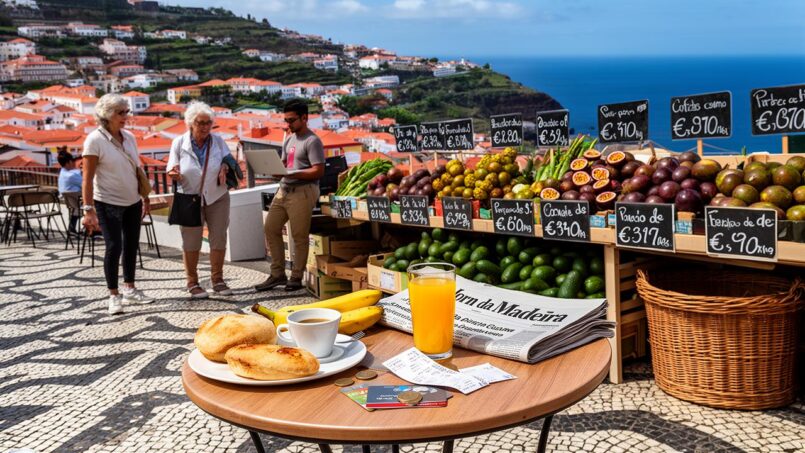
Local products like vegetables (tomatoes, potatoes, cabbages), tropical fruits, and bananas are very affordable (often under €2/kg). Local fish (black scabbardfish, sea bream, sardines) and Portuguese meats are competitively priced. On the other hand, imported products (international brands, cereals, peanut butter, snacks) are significantly more expensive due to island transport costs.
Some indicative prices give you an idea:
| Product | Current Observed Price |
|---|---|
| Milk (1 L) | €0.94 – €1.15 |
| Bread (500 g) | €1.00 – €2.39 depending on type |
| Eggs (12) | €2.50 – €3.50 |
| Chicken fillets (1 kg) | ~€6.58 |
| Local cheese (1 kg) | ~€9.10 |
| Madeira bananas (1 kg) | <€1.00 – €1.50 |
| Apples (1 kg) | €1.68 – €1.85 |
| Tomatoes (1 kg) | €2.17 – €2.60 |
| Mineral water (1.5 L) | ~€0.50 |
| Local wine bottle (0.75 L) | €4 – €6 (more for aged wines) |
| Local beer (0.33 – 0.5 L) | €1 – €2.5 |
Shopping at major local chains (Pingo Doce, Continente) and supplementing with municipal markets keeps you at the low end of the range. The markets in central Funchal offer very fresh produce, but some tourist-oriented stalls may charge high prices for exotic fruits.
Eating Out: An Often Affordable Pleasure
Madeira is a place where you can still enjoy regular meals out without blowing your budget, as long as you choose the right spots.
Price benchmarks are fairly consistent:
– Inexpensive restaurant meal: €7 to €12 per person;
– Lunch special (prato do dia, with drink and sometimes coffee/dessert): often between €8 and €12;
– Meal at a mid-range restaurant: €10 to €15 for the main course, €15 to €25 for dinner with drink;
– Three-course dinner for two at a mid-range place: €40 to €50, excluding high-end wines;
– Dinner for two at a good restaurant with wine: often €35 to €60 per person, much more in fine dining.
A coffee shop visit remains very affordable: an espresso (bica) typically costs between €0.80 and €1.20, a cappuccino around €1.70, a draft beer about €2.50 to €3.
In practice, many expat couples who eat out two to three times a week spend €80 to €140 per week on inexpensive to mid-range restaurants, or €300 to €500 per month for two.
Getting Around the Island: Bus, Car, Taxi, and Flights
Madeira’s topography – steep mountains, deep valleys, villages clinging to slopes – strongly influences transportation choices and costs.
Public Transit: Affordable but Limited
Funchal has a well-structured urban bus network, complemented by several intercity companies (Horários do Funchal, Rodoeste, SAM, EACL) serving the rest of the island. It’s the most economical option but not always the most practical.
Typical fares are as follows:
– Urban bus ticket bought from the driver: about €1.95;
– Same ticket bought at a ticket office or machine: about €1.35;
– Monthly pass in the capital: €30 to €40 depending on the plan;
– Multi‑day pass (Funchal): 3 days for €11.50, 5 days for €16.50, 7 days for €21.50;
– Intercity connections: €1.30 to €6 depending on distance.
Budget-wise, many expats without a car get by on €40 to €50 per month for transport, while those combining bus, occasional taxis, and airport shuttles may reach €80 or €100.
Car: Comfort and Added Cost
For many expats living outside Funchal, a car is nearly essential, if only for easy access to hiking trails, beaches, and large supermarkets.
The main car-related expenses are: vehicle purchase, insurance, maintenance and repairs, fuel, parking, and taxes.
– Fuel: around €1.69 per liter of gasoline, range €1.54 – €1.74;
– Basic car insurance: from about €15 per month, but more for better coverage;
– Occasional paid parking in the city: €5 to €6 for a covered parking lot;
– Rental car: between €30 and €50 per day for a small compact, more in high season.
Transport budget estimates for a motorized household typically run around €200 to €350 per month, including fuel, parking, maintenance, and insurance. One couple reports a monthly spending of €75 to €127 for the fuel‑parking‑insurance trio, which remains low for non-intensive use.
Taxis are very common in Funchal and at the airport. Prices are regulated, though long trips can be negotiated in advance. Typically you’ll find:
The average fare for a taxi ride from the airport to central Funchal in Madeira.
Platforms like Bolt and Uber also operate on the island, often at slightly lower rates than regular taxis, with the advantage of price transparency. However, their availability is more spotty outside major urban areas.
Finally, the Aerobus shuttle connects the airport to Funchal for about €5 per ride (€2.50 for children), and some regular buses cost barely €3.35 on the same route.
Overall Transport Budget by Profile
Here’s a summary of what expats typically spend on monthly transportation:
| Mobility Situation | Estimated Monthly Transport Budget |
|---|---|
| Funchal resident without car (bus + walking) | €30 – €60 |
| Resident with car used lightly | €100 – €150 |
| Family or highly mobile couple (car + bus) | €200 – €350 |
| Short-term digital nomad (rental + taxis) | Highly variable, €300+ in high season |
For a single person living in the city, walking and local buses often suffice, with a pass at €30 or €40 covering most needs.
Healthcare: Excellent Level, Managed Cost
For expats settling long-term, healthcare is crucial. Madeira has a good healthcare system, combining public and private services.
Public System: Nearly Free for Residents
Madeira has its own regional health service, separate but aligned with the Portuguese Serviço Nacional de Saúde (SNS). For legal residents who have registered, coverage is broad:
– Primary care, public hospital, emergencies: covered, with small co-payments (taxas moderadoras) of a few euros;
– Free for children under 18 and people over 65 who contribute to social security;
– Typical co-payments between €4 and €10 for some consultations or exams.
To access the Portuguese healthcare system, an expat must first obtain a residence permit. They must then register with a local health center to receive a user number and health card (Cartão de Utente). After registration, they have access to care under the same conditions as Portuguese residents.
Madeira is regularly cited as one of the safest regions in Europe with an excellent standard of care for a population of about 250,000. The Portuguese public system ranks well in European quality indices, at 13th place on a health quality index at the European level.
Private Insurance: Comfort and Speed
Even with public access, many expats supplement their coverage with private health insurance, mainly for:
Taking out private health insurance reduces wait times to see certain specialists, provides faster access to private clinics, and gives you access to networks of English-speaking doctors.
Rates remain modest by international standards: an individual plan typically falls between €25 and €70 per month, with most estimates converging on a range of €50 to €100 depending on age, coverage breadth, and whether deductibles are included.
A concrete example cites a plan at just over €40 per person per month, covering up to €75,000 in annual hospitalization, certain advanced therapies (chemo, radiation), as well as international coverage up to €1 million.
For a couple, it’s realistic to budget €70 to €150 in monthly premiums for comfortable private insurance, in addition to public system access.
Leisure, Dining, Coworking: Daily Life Without Deprivation
The cost of living in Madeira isn’t just about necessities. Once rent, utilities, food, and transport are covered, there’s still quality of life: outings, sports, culture, and coworking for remote workers.
Restaurants, Cafés, and Bars
As seen, dining out remains relatively affordable. On a monthly basis, observed budgets for a couple often break down like this:
– €100 to €150 per month for two to three meals a week in small eateries or simple restaurants;
– €200 to €400 per month for more frequent outings, including some higher-end restaurants.
The minimum price of a beer in standard bars, illustrating the affordability of drinks.
The presence of daily specials and inexpensive snacks (bolo do caco, soups, sandwiches) also helps keep the bill low while enjoying local social life.
Sports, Culture, and Activities
Good news for your budget: most of Madeira’s major attractions are free or low-cost: hiking on the levadas, swimming in natural pools, sightseeing, and city walks.
Paid expenses center on:
This is the average monthly cost, in euros, of a gym membership for one adult.
A reasonable leisure budget for a single expat often falls between €80 and €150 per month, more for heavy users of paid activities.
Coworking and Digital Nomad Life
Madeira actively courts remote workers, especially in Funchal and villages like Ponta do Sol, which positioned itself as a “Digital Nomad Village.”
Coworking costs remain moderate:
– €130 to €150 per month for a shared desk in a Funchal coworking space;
– Free coworking at the Ponta do Sol digital village, as part of a nomad attraction program.
For a remote worker, the combination “rent + internet + coworking” becomes the professional budget base, rarely exceeding €200 to €250 per month excluding housing.
Where to Live in Madeira: Funchal or Outlying Towns?
Beyond overall figures, the cost of living can vary significantly from one municipality to another. Expats don’t choose their neighborhood solely based on price, but it certainly plays a role.
Funchal: Economic and Cultural Hub, but More Expensive
Funchal concentrates the best infrastructure: hospitals, shopping centers, restaurants, schools, coworking spaces, and the best internet connection. It’s also where most newcomers first settle.
Living in the center or modern neighborhoods like São Martinho or Lido guarantees:
– easy access to services and buses,
– a lively social life,
– higher rents than anywhere else on the island.
For singles and couples without children, the ability to go without a car or significantly reduce motorized trips can financially offset a higher rent.
Outlying Towns: More Space, Lower Rent, Car Needed
The farther you get from the capital, the lower the rents… up to a point. Some villages that have become very popular with foreigners (Calheta, Ponta do Sol) have also seen prices rise, but they remain on average more affordable than Funchal.
Key characteristics by area:
Discover the main locations on the island of Madeira, their advantages and atmosphere, to help you choose your future place of residence.
Picturesque fishing village 9 km from Funchal. Authentic atmosphere and lower rents, but need to travel for some services.
Good compromise east of Funchal: coastal life, proximity to the airport. Santa Cruz is often cited as the cheapest municipality for renting.
Quiet town with a sandy beach, calm atmosphere, and reasonable prices.
Sunny south coast. Ponta do Sol attracts a nomad community with free coworking. Moderate rents but rising.
Arco da Calheta, Estreito, Paul do Mar… Very popular with expats. Mild climate, artificial beaches. Competitive prices compared to Funchal.
Very affordable with spectacular nature, but more isolated. Rents can go as low as €260-400 for small apartments.
In practice, many expats start in Funchal for convenience, then move to the west or east once familiar with the island, to gain more space and quiet for a similar or lower rent – accepting the cost of a car.
Budget Summary: What “Living Well” Means in Madeira
Combining all categories, several typical scenarios emerge for expats.
Single in the City, “Realistic” Mode
Imagine a 1BR on the immediate outskirts of Funchal, heavy use of public transit, groceries mostly from supermarkets and markets, a few weekly outings.
A typical budget structure might look like this:
– Rent: €800 – €1,000;
– Utilities and internet/mobile: €120 – €150;
– Food (groceries + some meals out): €250 – €350;
– Transport (bus, occasional taxi): €40 – €80;
– Health (basic private insurance): €50 – €70;
– Leisure, sports, miscellaneous: €80 – €150.
Total: between €1,340 and €1,800 per month, which aligns with the €1,400 to €2,100 range mentioned for a single in Funchal.
Retired Couple, Comfortable Life in a 2BR
With a good quality 2BR in Funchal or a nearby town, a car, regular dining out, and private health insurance, the typical structure becomes:
– Rent: €1,200 – €1,800 depending on location and standard;
– Utilities + internet + mobiles: €150 – €220;
– Food: €400 – €600;
– Transport (car + bus): €200 – €300;
– Private health insurance for two: €80 – €150;
– Leisure / restaurants / internal trips: €200 – €300.
This is the monthly budget considered comfortable for a couple, according to the study.
Family of Four, with School and Car
For a family, rent dominates the budget. With a 3BR in a good area, a car, groceries for four, and possibly an international school, the numbers climb quickly:
– Rent 3BR: €1,500 – €2,200;
– Utilities and communications: €200 – €250;
– Food: €700 – €1,000;
– Transport (main car, possibly second): €250 – €350;
– Private health insurance for four (at least for parents): €100 – €200;
– Leisure, sports activities, kids’ extras: €200 – €400.
Without private school fees, you’re already looking at around €3,000 to €4,000. With an international school, the budget can easily swing to €4,500 – €5,000, which matches the €3,400 to €4,700 range identified for families in Funchal.
Conclusion: An Attractive Cost of Living, but No Longer “Cheap”
Madeira remains, overall, cheaper than Lisbon, Porto, or most major European capitals. Daily expenses (food, transport, simple leisure) are particularly favorable, and the quality of life is high: mild year-round climate, omnipresent nature, low crime, solid healthcare, good digital infrastructure.
But several trends paint a more nuanced picture:
In Madeira, rents – especially in Funchal and the highly sought-after south coast – are rising quickly and are now comparable to those in medium-sized Portuguese cities. Imported products are expensive, requiring you to adapt your consumption habits to keep food costs in check. For families seeking international schooling and high standards, monthly expenses can reach the level of many Western metropolises.
In the end, an expat with a stable foreign income can expect a very good value for money with, depending on their profile, a monthly budget of:
– €1,400 – €2,100 for a single person,
– €2,500 – €3,600 for a couple,
– €3,400 – €4,700 for a family of four.
By accepting some compromises – living outside the center, favoring local products, using buses instead of a car daily – these amounts can be significantly reduced, while still fully enjoying what Madeira offers: a safe, sunny, outdoor-oriented life at a cost that is still very competitive on a European scale.
A wealth planning project or question? Contact us now to speak with a wealth management expert.
Disclaimer: The information provided on this website is for informational purposes only and does not constitute financial, legal, or professional advice. We encourage you to consult qualified experts before making any investment, real estate, or expatriation decisions. Although we strive to maintain up-to-date and accurate information, we do not guarantee the completeness, accuracy, or timeliness of the proposed content. As investment and expatriation involve risks, we disclaim any liability for potential losses or damages arising from the use of this site. Your use of this site confirms your acceptance of these terms and your understanding of the associated risks.

Cyril Jarnias is an independent expert in international wealth management with over 20 years of experience. As an expatriate himself, he is dedicated to helping individuals and business leaders build, protect, and pass on their wealth with complete peace of mind.
On his website, cyriljarnias.com, he shares his expertise on international real estate, offshore company formation, and expatriation.
Thanks to his expertise, he offers sound advice to optimize his clients' wealth management. Cyril Jarnias is also recognized for his appearances in many prestigious media outlets such as BFM Business, les Français de l’étranger, Le Figaro, Les Echos, and Mieux vivre votre argent, where he shares his knowledge and know-how in wealth management.





