
 Published on and written by Cyril Jarnias
Between volcanic cliffs, primary forests, and tropical gardens, the must-see tourist attractions in Madeira offer a concentrated array of spectacular experiences on a tiny territory. The Portuguese island, often nicknamed the “Garden of the Atlantic” or the “Island of Eternal Spring,” combines natural assets, historical heritage, and outdoor activities. From Funchal to the western cliffs, from hidden levadas in the Laurissilva to natural pools sculpted by lava, every corner offers a different backdrop.
This article lists the island’s must-see attractions for planning a complete stay: hiking trails, gardens, traditional villages, Funchal monuments, beaches, volcanic pools, cable cars, viewpoints, and maritime experiences like whale watching. It is based on recent data to help you miss nothing.
Overall Impressions: The Island of Eternal Spring
Madeira enjoys a mild climate year-round, of the subtropical Mediterranean type, with temperatures generally between 18 and 25°C in spring, 21 to 28°C in summer, and rarely below 15–16°C in winter. This thermal stability explains the luxuriance of the vegetation and the island’s international reputation for its gardens, flowers, and crops.
The island’s microclimates are very pronounced: the north is wetter and windier, the south is sheltered and drier, plateaus like Paul da Serra are cooler, and the southern coast remains the sunniest. To make the most of hikes and landscapes, prioritize the periods from April to June and September to October. They offer an excellent compromise between favorable weather, moderate crowds, and reasonable prices.
Funchal, Historical and Cultural Heart
Capital of the archipelago, Funchal concentrates a large part of the architectural heritage and museums, as well as several of the most renowned gardens. It is also the starting point for many cable cars, sea excursions, and guided tours.
Iconic Monuments and Neighborhoods
Funchal’s historic center stretches around the Old Town (Zona Velha), the Cathedral (Sé), and the Praça do Município. The architecture blends Gothic, Manueline, Baroque, and military influences.
Among the major sites, the Funchal Cathedral, built at the turn of the 15th and 16th centuries, stands out for its local cedar ceiling and a mix of Gothic, Manueline, and Mudéjar styles. The stones in its walls come from the cliffs of Cabo Girão, and it houses a silver cross offered by King Manuel I.
Around the main square, the city hall occupies the former palace of the Count of Carvalhal (18th century), while the Church of the Jesuit College features remarkable 17th-century carved wood interior decoration. The São Lourenço Palace, both a fortress and the official residence of the Republic’s representative, embodies the city’s military history and has been classified as a national monument.
Funchal’s fortifications, such as the Fortress of São Tiago (built from 1614 against pirates) and the Fortress of Pico, illustrate the reuse of military heritage. São Tiago, a refuge during floods in the 19th century, now houses a contemporary art collection. Pico, a former powder magazine overlooking the city, has become a cultural venue with a cafeteria offering panoramic views of the bay.
The Old Town, meanwhile, features merchant mansions and fishermen’s houses dating from the 19th century, with the small Corpo Santo chapel built in the 15th century by sailors. Santa Maria Street is famous for its painted doors, transforming the neighborhood into an open-air gallery.
Museums: From Sacred Art to CR7
Funchal boasts a rare density of museums for a city of this size. Some are essential for understanding the island’s history, others, more playful, usefully complement a stay.
The Sacred Art Museum, housed in a former 16th-century bishop’s palace, contains an impressive collection of Flemish works commissioned in Bruges and Antwerp during the sugar golden age, as well as Portuguese paintings and a treasure of religious goldsmith pieces. Nearby, the Sugar Museum traces the history of this crop that shaped Madeira’s wealth in the 15th and 16th centuries, located in the house of João Esmeraldo, a merchant and friend of Christopher Columbus.
The Electricity Museum, housed in Funchal’s former power station (1897-1989), traces the electrification of the island. The Madeira Story Centre offers an interactive tour of the archipelago’s history, from its volcanic origins to the development of its wine, with a panoramic terrace featuring sugar cane and vines.
Nature enthusiasts won’t want to miss the Natural History Museum, the oldest on the island, which houses 41,000 faunal specimens as well as an aquarium with 15 tanks and a garden of aromatic and medicinal plants. The Quinta das Cruzes, the last home of João Gonçalves Zarco, one of Madeira’s discoverers, displays porcelain, drawings, and engravings by artists who immortalized the island, all set in a shady garden.
For a more unusual approach, the Photography Museum, housed in a 19th-century studio, reveals Madeira’s visual history, while the Toy Museum brings together over 20,000 toys. The CR7 Museum, dedicated to Cristiano Ronaldo, a native of Funchal, displays trophies and objects tracing the footballer’s career.
Markets: Immersion in Local Life
The Mercado dos Lavradores, or farmers’ market, is one of Funchal’s symbols. Inaugurated in 1940 in a yellow building decorated with azulejos by João Rodrigues, it features exotic fruits, vegetables, flowers, spices, and a large fish section. It is the ideal place to discover the richness of the island’s produce: bananas, passion fruit, mangoes, guavas, chayotes, monstera, white sweet potatoes, peppers, as well as herbs, flowers, and dried goods.
Discover the lively atmosphere and typical products on offer at the market, from fresh catch to local specialties.
Observation of fresh Atlantic catches, such as tuna and black scabbardfish.
Vendors in traditional costume offer flowers, bulbs, honey, biscuits, liqueurs, and souvenirs.
Not far from Funchal, the Sunday market at Santo da Serra, in the highlands, offers a more rural and very local atmosphere. Products are exclusively from the island: fruits, vegetables, meat, Camacha wood crafts and wickerwork, hats, street food. Stalls serve typical dishes such as Madeira-style macaroni, sopa de trigo, carne de vinha d’alhos sandwiches, milho frito, or espetada skewers to grill yourself around an ember fire. Groups sometimes improvise accordion parades, and families and friends gather there every Sunday.
Urban Gardens and Parks of Funchal
Even without leaving the city, the must-see tourist attractions in Madeira include several remarkable gardens. Santa Catarina Park, facing the bay, spans 36,000 m² of lawns and flowerbeds, with a pond, playground, café, and statues of historical figures like Christopher Columbus. The Municipal Garden (Dona Amélia), in the city center, gathers exotic species and large trees with a view of the bay, easily accessible for people with reduced mobility.
Around, a constellation of small public gardens (Ajuda, Campo da Barca, São Martinho gardens, Quinta Palmeira, Santa Luzia, Jardin do Miradouro Vila Guida…) allows you to punctuate visits with green breaks, often free and open all day or nearly so.
Iconic Gardens and Parks of the Island
Beyond the city center, the gardens are a travel motive in themselves. Several rank among the most beautiful in Europe, even in the world.
Monte Palace Tropical Garden: A Spectacular Park-Museum
Perched above Funchal, accessible via the waterfront cable car, Monte Palace Tropical Garden spans 17 acres on terraces. Formerly a sugar estate and later a grand hotel, the site was transformed in the 1980s into a vast tropical garden by the José Berardo Foundation.
The botanical garden lists over 100,000 plant species from almost every continent.
The paths wind between waterfalls, lakes populated with swans, free-roaming peacocks, and panoramic viewpoints overlooking Funchal Bay. A trail even passes behind a waterfall. A complete visit easily takes three hours. The adult entry fee (around €11–13 depending on sources) typically includes a Madeira wine tasting; children under 15 enter free.
Madeira Botanical Garden: An Open-Air Plant Encyclopedia
On the former Bom Sucesso estate, just a few kilometers from the city center, the Madeira Botanical Garden gathers over 2,000 exotic species across 7 to 8 hectares, with terraces overlooking the bay. Created in 1960, it realizes a project envisioned as early as the 17th century and now welcomes about 350,000 visitors per year.
The collections cover plants from around the world, including species threatened in their native environment. Geometric flowerbeds form a colorful plant carpet, especially photogenic with Funchal in the background. You’ll find a succulent garden, a section dedicated to economically important plants (bananas, coffee, sugar cane…), and a natural history museum with an herbarium.
A cable car connects Monte to the botanical garden, offering a flight over the valley and making it easy to combine with a visit to Monte Palace Tropical Garden.
Other Remarkable Quintas and Gardens
Botany and refined landscape enthusiasts can supplement with: visits to botanical gardens, walks in landscaped parks, and excursions to discover rare plants.
| Garden / Park | Location | Notable Features |
|---|---|---|
| Palheiro Gardens | Palheiro Ferreiro | Camellias, azaleas, themed gardens, sea/mountain views |
| Quinta Vigia | Funchal | Regional president’s residence, historic gardens, bay view |
| Quinta das Cruzes (garden) | Funchal | Former Zarco home, exotic trees, museum |
| Quinta da Boa Vista (Orchid Garden) | Funchal | Orchid collection, over 50,000 tropical plants |
| Quinta do Arco Rose Garden | Arco de São Jorge | +1,500 rose varieties (approx. 17,000 rose bushes) |
| Santa Luzia Gardens | Funchal | Modern garden on former sugar mill, 5 distinct zones |
These gardens offer a complementary reading of the island: aristocratic gardens inherited from the great wine-producing families, public parks in the heart of the city, or specialized gardens like the rose or orchid gardens.
Laurissilva and Hikes: The Kingdom of the Levadas
The Laurissilva, a vast relict laurel forest dating back about 20 million years, is one of the island’s absolute treasures. A UNESCO World Heritage site, it is the largest existing forest of its kind, whereas it once covered a large part of Southern Europe.
The network of levadas – irrigation channels – provides privileged access to this forest. With over 3,000 kilometers of channels and more than 450 recorded trails, hiking has become the island’s flagship activity for visitors.
Legendary Levadas
Some walks along the levadas have become classics, combining accessibility and spectacular scenery.
The Levada do Caldeirão Verde (PR9), starting from the Queimadas forest park near Santana, follows a relatively flat route along mountainsides, through lush jungle-like vegetation, dotted with waterfalls and five tunnels. It leads to a green amphitheater dominated by an impressive waterfall. Even in rainy weather, the scenery remains magical, making it a good option when mountain peaks are in the clouds.
This easy route in the Rabaçal valley leads to a basin fed by numerous springs and an impressive waterfall. A paid shuttle between the parking lot and the trailhead allows you to avoid a long descent on foot.
For a more intimate experience, the Levada do Rei leads into a peaceful forest valley, almost flat, while the Levada dos Cedros offers one of the simplest walks, ending at a multi-tiered waterfall. The Levada dos Balcões (PR11), very short, takes about thirty minutes to a viewpoint overlooking the central massif and the summit of Pico Ruivo.
Some Madeira levadas present a more challenging route, such as the Caminho do Pináculo e Folhadal, 18 km long with over 700 m of elevation gain, featuring tunnels, stone walls, and narrow ridges. The Levada do Plaino Velho is also known for its particularly steep return. Other itineraries combine several channels, like the famous Levada do Moinho – Levada Nova duo, which notably offers a passage behind a waterfall.
Summits and Ridges: Pico Ruivo and Pico do Arieiro
Mountain enthusiasts will find in the must-see tourist attractions in Madeira the PR1 route, which connects Pico do Arieiro (1,818 m) to Pico Ruivo (1,862 m), the island’s highest point. This airy trail alternates between sharp ridges, tunnels carved into the rock, and steps sculpted into the volcanic slopes. On clear days, the view extends over a sea of clouds and a succession of jagged peaks. Coffee and restrooms are available at Pico do Arieiro and near the final ascent of Pico Ruivo, making logistics more comfortable.
A shorter alternative to reach the island’s roof is the PR1.2, Vereda do Pico Ruivo trail, which ascends directly from Achada do Teixeira.
Ponta de São Lourenço and Fanal: Other Faces of Madeiran Nature
In the east, the Vereda da Ponta de São Lourenço (PR8) follows a wind-swept volcanic peninsula, offering a striking contrast to the Laurissilva: ocher and red cliffs, sparse vegetation, rock formations sculpted by erosion. At the end of the path, a cove at Cais do Sardinha allows swimming in clear waters, sometimes rich in marine life.
In the west of the island, the Paul da Serra plateau is home to the Fanal forest, an iconic part of the Laurissilva primary forest. This dreamlike landscape is famous for its oddly shaped trees, often shrouded in mist. The PR13 hiking trail (Vereda do Fanal) allows you to traverse this forest where some trees are over 600 years old.
Practical Organization of Hikes
Some of the busiest trails now require online reservation via the SIMplifica platform for 42 official routes starting in 2026. Early morning departures are strongly advised to avoid crowds, find parking, and enjoy sunrise light, especially at Pico do Arieiro.
The tunnels present on several levadas require bringing a headlamp, especially on routes like Caldeirão Verde or certain sections of Plaino Velho. A waterproof jacket is recommended for sheltered areas like the Levada da Ribeira da Janela, where waterfalls intensify after rain.
To find out about distances, elevation gains, and trail conditions, many hikers rely on the AllTrails app, in addition to local maps.
Cable Cars and Viewpoints: Seeing the Island from Above
The very steep terrain led to the development of several cable cars, initially designed for farmers and then becoming attractions in their own right. Today they are gateways to isolated sites – fajãs, beaches at the foot of cliffs – and to certain gardens.
The Main Cable Cars of the Island
| Cable Car | Area / Access | Approximate Height | Main Interest |
|---|---|---|---|
| Monte Cable Car (Funchal) | Waterfront → Monte | ~560 m elevation gain | View of Funchal, access to Monte & gardens |
| Rocha do Navio | North, near Santana | ~330 m | Coastal view, access to nature reserve |
| Achadas da Cruz | West, near Porto Moniz | 451 m over 600 m length | Extreme slope, agricultural village at cliff base |
| Cabo Girão (Teleférico do Rancho) | Near the viewpoint | Few hundred meters | Isolated beach, agricultural fajãs |
| Garajau (Cristo Rei) | Caniço, southeast | 150 m | Diving beach, Christ statue |
| Fajã dos Padres | West of Funchal | 300 m | Agricultural estate, restaurant, beach |
| Botanical (Jardim Botânico) | Monte → Botanical Garden | Valley flight | Convenient link between two major gardens |
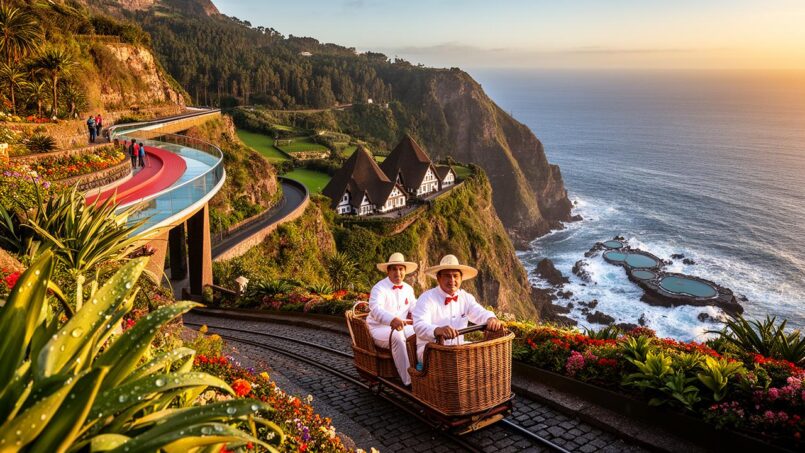
The Monte cable car is the longest (3.2 km, 15 to 20 minutes travel time) and the most iconic. It connects the waterfront (near Almirante Reis Park) to the Monte district, steps from the Nossa Senhora do Monte church, the Monte Palace Tropical Garden, and the starting point of the famous wicker toboggan ride (Carreiros do Monte), a century-old tradition where two men in white costumes guide these sleds on foot down the asphalt.
The Rocha do Navio cable car provides access to the foot of a cliff, within a nature reserve. There you’ll find gardens, traditional Santana houses, and waterfalls. The site offers a panorama of the north coast, considered one of the most beautiful on the island.
In the west, the Achadas da Cruz cable car, known for its slope that can reach 98%, leads to the Fajã de Quebrada Nova: ancient stone houses, terraced fields, and a coastal trail at the foot of the cliffs. Further south, the Cabo Girão cable car gives access to the beach and agricultural plots at the foot of this 580 m promontory, the highest cape in Europe, famous for its glass skywalk suspended over the void.
Fajã dos Padres, accessible only by cable car or boat, offers a unique experience: gardens, orchards, restaurant with your feet in the water, and small beach, all in an isolated microcosm at the foot of a basalt wall.
Viewpoints: An Island Studded with Lookout Points
The island is packed with developed miradouros, often signposted along roads. Some have become unmissable stops:
Discover the most spectacular viewpoints of Madeira Island, offering breathtaking panoramas over coastal landscapes, mountains, and the Atlantic Ocean.
Glass platform offering a plunging view of Câmara de Lobos, Funchal, and the ocean.
At 355 m altitude, ideal at sunset for admiring Funchal Bay and, on clear days, the Desertas Islands.
Overlooking the Curral das Freiras valley, a village nestled in the heart of an ancient crater.
Above Machico, offering views of the north coast and the Penha d’Águia rock.
On the central plateau, overlooks the São Vicente valley and a sea of clouds above the Laurissilva.
Near Seixal, where you can see a waterfall falling almost directly into the sea.
Guindaste, São Cristóvão, Lombo dos Palheiros, etc., offering nonstop panoramas of cliffs, terraced villages, and the Atlantic.
Villages, Traditions, and Themed Parks
Beyond Funchal, several localities have become iconic stops, each for a different reason.
Santana and Its Traditional Houses
On the north coast, Santana is famous for its “palheiros”, small triangular houses with colorful facades and thatched roofs. Some have been turned into shops selling homemade ice cream, souvenirs, or local products, but a few retain a more educational purpose, allowing visitors to understand traditional rural dwellings.
The Madeira Theme Park presents the history and traditions of the archipelago through gardens, pavilions, and multimedia spaces, including a simulator called “Fantastic Voyage to Madeira.” The site also features replicas of typical Santana houses, a windmill, and a lake with rowboats, offering a family-friendly visit.
Curral das Freiras, Câmara de Lobos, Porto Moniz…
Curral das Freiras, literally “Valley of the Nuns,” nestles at the bottom of a mountain cirque. Long isolated, the village is known for its chestnut-based recipes and its chestnut festival in autumn. The viewpoints of Eira do Serrado and Boca dos Namorados allow you to appreciate the site’s dramatic enclosure.
Câmara de Lobos, a former fishing village backed by high cliffs, was often immortalized by Winston Churchill, who stayed at the famous Reid’s Palace in Funchal and painted there.
Winston Churchill
Porto Moniz, at the northwestern tip, is world-famous for its natural lava pools, but also for its aquarium (12 tanks including a large 500,000-liter saltwater tank where you can dive) and interactive science center. It’s an excellent base for exploring the north coast and the Fanal forest.
Natural Pools, Beaches, and Seaside Complexes
The coasts of Madeira are largely rocky and steep, but erosion and volcanism have created many natural basins, complemented by developed seaside complexes. These places are fully part of the must-see sites.
Porto Moniz, Seixal, Doca do Cavacas: The Trilogy of Volcanic Pools
At Porto Moniz, two main complexes share the spotlight. The modernized Porto Moniz Natural Pools offer 3,800 m² of swimming area and 3,210 m² of solarium, with interconnected pools, stairs, concrete platforms, a children’s pool, playground, lifeguard station, showers, changing rooms, bar, and sunbed rental. Entry is paid, with a modest fee. These pools are constantly fed by seawater, renewed with the tides.
Nearby, the so-called “old” pools (Cachalote Natural Pools) form a wilder ensemble: deep basins, rocky labyrinths, sometimes sharp edges, and few amenities, except an outdoor shower. During high season, a lifeguard may be present. The setting is particularly photogenic but requires caution and appropriate footwear.
On Madeira’s north coast, Seixal combines a black sand beach (Praia do Porto do Seixal) and natural lava pools (Poças das Lesmas / Piscinas Naturais do Seixal) at the foot of lush green cliffs. These still-preserved pools are freely accessible via a steep stairway. On site, you’ll find a bar, restrooms, and a lifeguard station. The nearby Clube Naval offers kayak and diving equipment rentals, and has showers and a bar.
On the south coast, between the Lido area and Praia Formosa in Funchal, Doca do Cavacas (also called Poças do Gomes) offers a set of developed lava pools with an unbeatable view of Cabo Girão. Access is paid, and the complex includes a bar-restaurant, sunbeds, showers, restrooms, and lifeguards. An adjacent pedestrian tunnel, with windows overlooking a sea cave, leads to the large pebble beach of Praia Formosa.
Seaside Complexes and Developed Beaches
Funchal has several public seaside complexes incorporating pools and sea access: the Lido Bathing Complex, with pools integrated into the rock, children’s play areas, and direct ocean access; and Ponta Gorda, more family-friendly, with shallow pools, floating platforms in summer, and a launching device for people with reduced mobility.
On the south coast, Calheta Beach is artificial with imported golden sand and breakwaters for calm water, ideal for swimming and water sports. Machico also has a golden sand beach imported from the Sahara, protected from waves. Ponta do Sol offers a pebble beach in a sunny cove, known for its very mild microclimate.
In the northeast, the Porto da Cruz seaside complex features a seawater pool and views of the São Lourenço point, while the Faial complex combines a pebble beach, wading pool, playgrounds, sports fields, and picnic areas, all free of charge.
More Secret Spots
Some places, harder to reach, appeal to visitors seeking tranquility. Calhau da Lapa, near Ribeira Brava, unfolds a pebbly cove dominated by a cliff and graced with a waterfall. You descend via a steep path or a small cable car from Quinta Grande, or even by boat from Funchal.
Prainha, at the foot of the São Lourenço peninsula, is a cove of brown-black sand framed by cliffs, accessible on foot from a parking lot near the start of the PR8 trail. In summer, a café, showers, and sunbed rental are available.
The Sea as a Stage: Whale Watching and Excursions
The waters surrounding Madeira quickly plunge to over 3,000 meters in depth, allowing large cetaceans to approach the coasts. The archipelago has thus become one of the best destinations in the world for dolphin and whale watching.
Exceptional Marine Biodiversity
Over 20 species of cetaceans have been recorded around the island. Among the most frequently observed are common dolphins, spotted dolphins, bottlenose dolphins, as well as pilot whales, sperm whales, Bryde’s whales. Depending on the season, especially in spring and through the end of the year, fin whales, blue whales, or even orcas may appear during migration. Loggerhead sea turtles, flying fish, pelagic birds, rays, or even hammerhead sharks and monk seals can be spotted more rarely.
Some companies report success rates of over 98 to 99% for their trips. They also offer a second free excursion in case of complete absence of sightings, a very rare situation.
Sea Trips and Operators
Most excursions depart from the Funchal marina, but departures also take place at Calheta, Machico, or Quinta do Lorde (near Caniçal). Durations vary from 2 hours to 3.5 hours, sometimes more for full-day trips, with prices starting around €40 per adult. Large motor launches or catamarans can carry up to a hundred passengers, while rigid inflatables or traditional boats often limit the number of participants to 18–30 people for a more intimate experience.
Several operators adopt a responsible approach to cetacean watching. Their practices include having marine biologists on board, using spotters on land to locate animals, and using hybrid or electric engines near groups. They maintain minimum distances and strictly limit time spent with a group, often to 10 minutes maximum, in line with local recommendations. It is forbidden to feed, touch, or chase animals, ensuring reduced impact on their behavior and environment.
Combining Sea and Coast
Beyond wildlife observation, these trips allow you to see the coast from another angle: Cabo Girão cliffs, fishing villages like Câmara de Lobos, headlands like Ponta de São Lourenço, and even the Desertas Islands, a nature reserve that hosts a small colony of Mediterranean monk seals.
In summer, many tours include a swimming and snorkeling stop in sheltered waters. Equipment is often provided, and a snack or drink is sometimes included on the return trip. Passengers are advised to bring swimwear, towel, sunscreen, warm clothing for the wind, and perhaps a book for quieter moments.
Funchal Seen from Above: Monte, Toboggans, and Gardens
The Monte district, visible from most points in the bay, concentrates several iconic attractions.
At the top of the cable car is the Baroque Church of Nossa Senhora do Monte, a pilgrimage site housing the tomb of Emperor Charles I of Austria. The municipal park offers a shady walk with a view of the city. The site is also a major tourist hub, immediately adjacent to the famous Monte Palace Gardens and the Botanical Garden, the latter accessible by a second cable car.
Right next door, the wicker toboggan ride (Monte Toboggan Ride) remains a unique curiosity: two “carreiros,” in white attire and straw hats, guide these braided sleds on foot for several kilometers of paved streets down to the outskirts of the city center. The experience, costing around €50 per sled, is halfway between living heritage and tourist attraction.
Volcanic Caves and the Volcanology Center
On the north coast, the São Vicente caves offer a rare incursion into the volcanic bowels of the island. This network of lava tubes, formed nearly a million years ago during an eruption, can be visited on an underground route of about 700 to 1,000 meters, for a total duration of about one hour.
The Volcanism Center offers a multimedia explanation of Madeira’s geological formation and how its volcanic cavities work. This visit is ideal for rainy days and suitable for introducing children to earth sciences.
Porto Santo and the Desertas Islands: The Archipelago’s Satellites
While the article focuses mainly on the main island, the must-see tourist attractions in Madeira extend to two nearby island groups.
Porto Santo Island is accessible by boat or plane. It is famous for its long golden sand beach that borders almost its entire south coast. Its clear waters are ideal for snorkeling and diving. Sites like Porto das Salemas or Zimbralinhos, located in sheltered coves, offer natural pools and unique geological landscapes.
The Desertas Islands, on the other hand, are a small uninhabited archipelago classified as a strict nature reserve. Catamarans or excursion boats take visitors there for the day, with possible sightings of monk seals, seabirds, and austere cliffs.
How to Build a Balanced Itinerary?
Given the island’s richness, a balanced approach consists of combining at minimum:
A typical program for discovering Madeira could include: a big mountain hike like PR1 (Pico do Arieiro – Pico Ruivo) for its volcanic terrain; a walk along an iconic levada in the heart of the Laurissilva, such as PR6 (25 Fontes) or the Levada do Rei; a coastal hike on a barren volcanic landscape like PR8 (Ponta de São Lourenço); a day in Funchal for its museums, markets, cable cars, and gardens; a detour to the north coast (Seixal, Porto Moniz) for its natural pools and the Fanal forest; and finally, a sea trip for dolphin and whale watching, with a possible extension to Porto Santo or the Desertas Islands.
The table below summarizes some key sites by theme:
| Theme | Key Sites in Madeira |
|---|---|
| Nature and Hikes | Pico do Arieiro, Pico Ruivo, PR1, PR8, PR9, Fanal, Paul da Serra |
| Primary Forest | Laurissilva, Queimadas, Rabaçal, Levada do Rei, Levada dos Cedros |
| Gardens & Parks | Monte Palace Tropical Garden, Botanical Garden, Palheiro Gardens, Santa Catarina |
| Sea & Swimming | Porto Moniz Pools, Seixal, Doca do Cavacas, Calheta, Prainha |
| Culture & History | Funchal Old Town, Cathedral, forts, Sugar Museum & Sacred Art Museum |
| Villages & Traditions | Santana, Curral das Freiras, Câmara de Lobos, Santo da Serra |
| Panoramic Views | Cabo Girão Skywalk, Pico dos Barcelos, Eira do Serrado, Portela |
| Maritime Experiences | Cetacean watching, Desertas excursions, Porto Santo beach |
In a few days, it is impossible to embrace the entire diversity of the island; the essential thing is to choose a combination of sites that allows you to touch both mountain, forest, ocean, culture, and gardens. It is this mosaic of atmospheres that makes the must-see tourist attractions in Madeira such a unique ensemble in Europe: a destination where, in a few kilometers, you go from a balcony above the clouds to a lava pool at the foot of a cliff, then to a tropical garden suspended over the city.
A heritage project or a question? Contact us now to speak with a wealth management expert.
Disclaimer: The information provided on this website is for informational purposes only and does not constitute financial, legal, or professional advice. We encourage you to consult qualified experts before making any investment, real estate, or expatriation decisions. Although we strive to maintain up-to-date and accurate information, we do not guarantee the completeness, accuracy, or timeliness of the proposed content. As investment and expatriation involve risks, we disclaim any liability for potential losses or damages arising from the use of this site. Your use of this site confirms your acceptance of these terms and your understanding of the associated risks.

Cyril Jarnias is an independent expert in international wealth management with over 20 years of experience. As an expatriate himself, he is dedicated to helping individuals and business leaders build, protect, and pass on their wealth with complete peace of mind.
On his website, cyriljarnias.com, he shares his expertise on international real estate, offshore company formation, and expatriation.
Thanks to his expertise, he offers sound advice to optimize his clients' wealth management. Cyril Jarnias is also recognized for his appearances in many prestigious media outlets such as BFM Business, les Français de l’étranger, Le Figaro, Les Echos, and Mieux vivre votre argent, where he shares his knowledge and know-how in wealth management.





