
 Published on and written by Cyril Jarnias
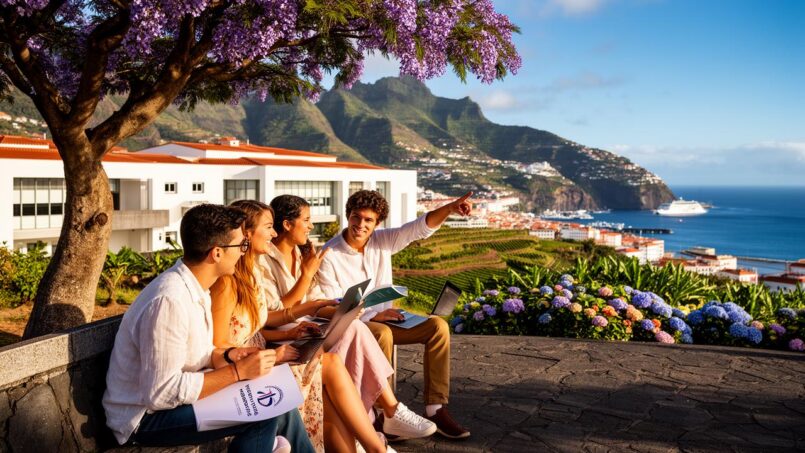
Pursuing higher education abroad is no longer just about major capitals or ultra-connected metropolises. More and more students are choosing human-scale destinations with an attractive living environment, without sacrificing academic quality. That’s exactly the promise of student life in Madeira: a Portuguese island in the Atlantic, with a mild climate, spectacular nature, and a recognized public university, the Universidade da Madeira.
Far from being just a vacation island, Madeira offers a developing academic environment, controlled cost of living, and high safety. It hosts a growing international community and has a surprising research network for an island region, making it a serious option worth considering for French-speaking students.
Understanding the framework: a gateway island within the European area
Madeira is a Portuguese archipelago in the Atlantic, about 1,000 km from the European mainland and 500 to 600 km from the Moroccan coast. The main island, where higher education is concentrated, is Madeira; Porto Santo with its nine kilometers of golden sand beaches completes the picture, while the Desertas and Selvagens islands are classified as nature reserves.
Politically, Madeira is an autonomous region of Portugal. A degree obtained from its university is therefore a degree from a Portuguese public university, fully integrated into the European Higher Education Area (LMD system, ECTS credits, degree recognition). For an international student, this is an opportunity to enter the European university system while benefiting from an island environment very different from that of large continental cities.
The climate itself is one of the first selling points: the archipelago is often presented as the “island of eternal spring”. Summer temperatures hover around 25 °C and rarely exceed 30 °C; in winter, they generally stabilize between 16 and 20 °C. Extremes are rare, seasonal variations limited, and rainfall moderate. The sea ranges from 19 °C to 24 °C, making swimming possible almost all year round.
Percentage of Madeira Island covered by the Laurissilva forest, a UNESCO World Heritage Site.
The Universidade da Madeira: a small institution with big ambitions
At the heart of the higher education system is the Universidade da Madeira (UMa), a public university founded in 1988 and primarily located on the Campus da Penteada in Funchal, the regional capital. It enrolls about 2,900 students, supervised by over 200 teaching and research staff, offering around fifty degrees across all cycles (bachelor’s, master’s, doctorate, plus short professional courses).
The institution is organized into four faculties (Arts and Humanities, Exact Sciences and Engineering, Social Sciences, Life Sciences) and two schools (Health; Technology and Management). Its programs are aligned with the Bologna Process, with bachelor’s, master’s, and doctoral cycles. Most master’s degrees require 120 ECTS, corresponding to two years of full-time study.
Contrary to the image one might have of small island universities, UMa is strongly research-oriented, with a dense network of accredited units and centers: a chemistry center, a research center in education, the Atlantic Center for Applied Economic Studies, research groups in mathematics, human genetics, botany, sports, interactive technologies, and a center for marine and environmental sciences. The regional context—biodiversity, vast maritime area, importance of tourism, climate challenges—fuels highly current research themes (blue economy, island sustainability, renewable energies, climate change adaptation, island agronomy).
The university serves as a platform between its region and the world, with partnerships in Europe (Spain, France, Germany, Italy) and beyond, such as in Brazil or with Carnegie Mellon University in the United States for double degrees in human-computer interaction. It also participates in Erasmus+ and Erasmus Mundus programs, notably the co-diploma program “Climate Change and Diversity: Sustainable Territorial Development” with a specialization in regional and local studies, in collaboration with the universities of Padua and Madeira.
For an international student, this means a human-scale setting, but connected to broadly international scientific and mobility networks.
Study programs: mostly Portuguese, but windows in English
The vast majority of bachelor’s programs and most master’s degrees at UMa are taught in Portuguese. For a French speaker, this is both a challenge and an opportunity, as mastering European Portuguese opens up a vast professional space (Portugal, Brazil, Portuguese-speaking Africa…). The university is well aware of this issue and offers a specific program for non-Portuguese-speaking international students.
Nevertheless, Madeira is not a closed destination for those who prefer to study in English. Several master’s programs are taught entirely in English, particularly in the fields of design, interactive media, or environmental studies in European partnership.
Discover a selection of master’s programs available at the University of Madeira, offering diverse specializations in a unique study setting.
Program focused on the study of marine ecosystems and Atlantic biodiversity, leveraging the archipelago’s privileged location.
Training dedicated to responsible tourism management and the valorization of natural and cultural heritage in island regions.
Program covering advanced areas of computer science, including artificial intelligence and software development.
Specialization for teacher training and pedagogical innovation, adapted to contemporary educational contexts.
| Field | Example master’s | Main language | Duration / Credits | Special features |
|---|---|---|---|---|
| Design & media | Master’s in Interactive Media Design (MDMI) | English | 2 years – 120 ECTS | In collaboration with the Madeira-ITI research center |
| Design | Master’s in Design | English | 2 years – 120 ECTS | Project studios, Erasmus+ exchange possibilities |
| Life sciences | Master’s in Applied Biochemistry | Portuguese | 2 years | Strong experimental focus |
| Tourism & environment | Master’s in Ecotourism | Portuguese | 2 years – 120 ECTS | Located in São Martinho, ideal island setting |
| Engineering | Master’s in Electrical Engineering – Telecommunications | Portuguese | 2 years – 120 ECTS | Focus on telecommunications |
| Architecture & spaces | Master’s in Spatial Design | Portuguese | 2 years – 120 ECTS | Architecture/interior design approach |
| Territorial studies | “Regional and Local Studies” track of the Erasmus Mundus master’s CCD-STeDe | English & Portuguese | 2 years – 120 ECTS | Double degree Padua – Madeira |
In addition, there are master’s programs in management (with courses in data analysis, digital marketing, strategy, innovation, internationalization), civil engineering, computer science, educational sciences, psychology, sports, linguistics, literature, cultural management, teaching, and an Integrated Master’s in Medicine in partnership with the University of Lisbon.
Studying in Portuguese as a French speaker
The language barrier is real, but Madeira offers several entry points. The university’s language center offers Portuguese as a Foreign Language (PLNM) courses at several levels (A1 to B2), in extensive (3 hours per week) or intensive (30-hour modules) formats. These courses are designed for international students, with evening sessions (6:00 pm–8:00 pm) to fit around main studies.
The university offers a Foundation Year (40 ECTS) for non-Portuguese-speaking international candidates wishing to enter a bachelor’s in engineering. This program combines Portuguese learning, transversal skills, and introductory modules (management, web technologies, nature sports). Options (math, physics, chemistry, etc.) allow for pathway customization. The goal is to acquire the necessary Portuguese level to follow the university curriculum while integrating into Madeira’s academic and natural environment from the first year.
Admission requirements: a special competition for international students
For international students who are not Portuguese nationals or nationals of another EU country, UMa has set up a “special competition” for admission. It is intended for those who cannot go through the standard channels reserved for nationals or long-term residents.
To be eligible, you must:
– not be a Portuguese citizen or a citizen of another EU member state,
– not be a close family member of a Portuguese or EU citizen under Portuguese law,
– not legally reside in Portugal for more than two consecutive years (legacy of the rights equalization regime),
– not already be enrolled at UMa under an exchange or mobility program,
– not be covered by other special access regimes.
A dual national with one nationality being Portuguese or from an EU country cannot apply through the international competition. They must use the ordinary application channels.
The documents usually required are standard for the European system: online application form, valid passport, high school diploma (or proof that it grants access to higher education in the home country), transcripts, sometimes national exam results (ENEM for Brazil, for example), certified translation if documents are not in Portuguese, English, French, or Spanish, language certificate, statement of purpose, recommendation letters for 2nd or 3rd cycle. For master’s programs, a corresponding bachelor’s degree is obviously required.
The university has an overall acceptance rate of around 65% for all its applications.
Cost of studies: reasonable fees for an EU country
Tuition fees remain one of the major advantages of Portugal compared to other European countries, and Madeira follows this trend. Portuguese public universities charge on average between 2,500 and 8,000 € per year for international students, but UMa generally falls in the lower range.
For non-European students, a rough order of magnitude can be summarized as follows:
| Level of study | Status | Indicative annual range in Madeira |
|---|---|---|
| Bachelor’s (1st cycle) | EU student | ~900 to 1,350 € |
| Bachelor’s (1st cycle) | Non-EU student | ~1,500 to 2,500 € |
| Master’s (2nd cycle) | EU student | ~1,200 to 2,000 € |
| Master’s (2nd cycle) | Non-EU student | ~2,000 to 3,500 € |
| Special international competition – example | Non-EU | 2,000 € per year (payable in 10 monthly installments) |
More precise amounts are sometimes published per program, with minima at the Universidade da Madeira between 910 and 2,280 € for some courses. Science or technology fields are generally slightly more expensive than humanities.
Additional fees apply, but are modest: 30 € application fee, 20 € administrative registration fee, 50 € appeal fee. The first tuition payment is due at the time of enrollment.
Scholarships and financial support: a multi-level game (regional, national, international)
UMa and the Autonomous Region of Madeira have gradually developed a range of targeted scholarships. The idea is not to fully finance all foreign students, but to make certain programs particularly attractive for specific audiences.
The university offers scholarships for certain bachelor’s and master’s programs, mainly aimed at students from Portuguese-speaking countries (CPLP: Angola, Mozambique, Cape Verde…) or Venezuela. This aid aligns their tuition fees with those of non-international students, allowing for a reduction of up to several thousand euros per year.
Examples from a recruitment session:
| Program (examples) | Number of spots | Associated scholarships |
|---|---|---|
| Bachelor’s in Visual Arts | 4 spots | 2 scholarships |
| Bachelor’s in Communication, Culture and Organizations | 9 spots | 5 scholarships |
| Bachelor’s in Biochemistry | 5 spots | 3 scholarships |
| Bachelor’s in Electronic Engineering and Telecommunications | 20 spots | 10 scholarships |
| Bachelor’s in Economics | 18 spots | 9 scholarships |
| Bachelor’s in Nursing | 2 spots | 2 scholarships |
| Master’s in Design | 5 spots | 3 scholarships |
| Master’s in Applied Biochemistry | 7 spots | 4 scholarships |
| Master’s in Civil Engineering | 14 spots | 4+4 scholarships |
| Master’s in Hospitality | 10 spots | 3+3 scholarships |
The Autonomous Region also offers regional scholarships covering bachelor’s, master’s, and short courses, with particular interest in students from Madeira, but also targeted measures to strengthen strategic fields, such as the integrated master’s in medicine (over 500 students affected, with public investments of several hundred thousand euros to extend the program to a third year locally).
Maximum amount in dollars that some private scholarships for a doctorate can reach, according to recorded international programs.
For a French-speaking student, the challenge is to intelligently combine these different sources: local scholarship (if eligible), international aid, possibly support from the home country, to limit reliance on self-financing, especially if a master’s or doctorate is targeted.
Visa, stay, and work on site: the Portuguese rules of the game
Madeira being part of Portugal, the visa and stay rules are those of the Portuguese state.
For EU / EEA / Swiss citizens, no visa application is needed to come study in Madeira; only registration with local authorities is required if the stay exceeds 90 days (obtaining a registration certificate).
For non-EU students, the rule is more standard: a long-stay visa (type D) to be applied for before departure, then converted into a residence permit on site.
In summary:
– the application begins once you obtain an acceptance letter from a recognized institution (e.g., UMa),
– the file is submitted at the Portuguese consulate in the country of residence, possibly through a provider like VFS Global,
– the usual documents are required: application form, valid passport, photos, admission letter, proof of sufficient funds, health insurance covering the stay, proof of accommodation (university residence, lease, hosting declaration), recent criminal record extract, sometimes a statement of purpose or proof of tuition payment,
– the residence visa is generally valid for four months, giving the student time to arrive in Portugal and then apply for a residence permit from the AIMA agency (which succeeded the former SEF),
– the first residence permit is valid for one year, renewable for periods of two years (with recent temporary adjustments from 2 to 3 years for renewals in some cases).
The long-stay visa (type D) for studies in Portugal allows you to work, as long as it remains reasonable and does not hinder academic success. The country does not always impose a strict hour quota, but it is essential to maintain a satisfactory academic status. However, a short-stay visa (type C) for a program under 90 days, such as a summer school, does not authorize work.
Financial requirements vary by consulate, but a base of about 760 to 870 € per month is often used as a threshold to demonstrate sufficient means of subsistence, close to the Portuguese minimum wage. Visa fees are around 90 to 110 €, plus possible service fees (e.g., 40 € for some centers).
Cost of living in Madeira: a realistic student budget
One of the major arguments for Madeira compared to other European destinations remains the cost of living. Compared to London, Washington, or New York, Funchal consistently appears significantly more affordable, both in terms of housing and dining or leisure.
International comparisons place Funchal at approximately:
– 38 to 50% cheaper than London depending on whether rent is included or not,
– 45% cheaper than Washington D.C. on everyday expenses,
– about 58% cheaper than New York overall.
For a student, the budgets mentioned in the sources converge quite clearly.
Basic student budget
Local estimates often mention a range of 600 to 650 € per month for a student sharing accommodation and covering food and leisure. This figure seems quite low if you account for rent in Funchal, but becomes credible for someone in tight shared accommodation or a subsidized university residence.
Other, more general estimates for an adult in Madeira give:
– about 616 € per month excluding rent for a single person,
– a total around 1,000 to 1,100 € per month excluding housing for a more comfortable lifestyle.
To make things more concrete, some price markers in Funchal:
| Expense item | Range / Example |
|---|---|
| Simple meal at an inexpensive restaurant | 6 to 25 € (average ~12 €) |
| Three-course meal for two at a mid-range restaurant | 36 to 90 € (average ~45 €) |
| Cappuccino | ~1.70 € |
| Draft beer (pint) | from 2 € |
| Movie ticket | 7 to 10 € (average ~7.75 €) |
| Monthly public transport pass | 30 to 40 € (about 35 € in Funchal) |
| Gasoline | 1.60 to 1.74 € per liter |
| High-speed internet subscription | 22 to 59 € (average around 30–40 €) |
| Monthly gym membership | 30 to 50 € |
For groceries, supermarket prices remain reasonable: tomatoes at just over 2 €/kg, potatoes around 1.80 €/kg, bread at 1.45 €, milk just under 1 €/L, chicken around 6.50 €/kg, local cheeses around 9 €/kg. A single student can get by with about forty euros of groceries per week; a family of four reaches rather 600 to 800 € per month.
Student housing in Madeira: from very affordable to very touristy
Housing is the most variable expense. In Funchal, demand is tight, as the city concentrates not only students, but also foreign retirees, digital nomads, and tourism.
Available data paint a multi-speed landscape:
| Type of housing | Typical monthly rent in Funchal | Remarks |
|---|---|---|
| Room in student shared apartment | 200 to 240 € (sometimes up to 450–650 € depending on city or standard) | Often utilities included |
| Studio or one-bedroom on the outskirts | 650 to 800 € | Minimalist option for a single student |
| Furnished studio in city center | from 650 €, average around 900–1,300 € | High tourist variability |
| One-bedroom (1 bedroom) in center | 1,000 to 1,600 € | Rents can rise to 1,300–2,200 € at peak demand |
| One-bedroom outside center | 800 to 1,200 € | Cost/distance compromise |
| Two- or three-bedroom | 1,100 to 1,500 € (even 1,700–2,200 € for sought-after properties) | Ideal for shared living with several people |
Alongside the traditional rental market, students can look into different formats: university residence (about 450 to 700 € per month), coliving for young professionals (650 to 1,000 € all inclusive), long-term on Airbnb or specialized platforms (900 to 1,500 € per month for stays over 28 days).
Monthly price for a room in shared accommodation in some Funchal neighborhoods, such as São Gonçalo or São Roque.
Platforms to watch include Idealista, Erasmus Play, Casita, Flatio, Spotahome, as well as Facebook groups (“Expats in Madeira”, “Living in Madeira”) and the university’s internal services (residences SASUMa, ISAL Academic Residence, etc.). Some services, like Flatio, claim to eliminate the security deposit, which can simplify moving in.
Daily life and community: a very safe, very slow, very natural island
Beyond the numbers, the crucial question for a student is what life is really like on the ground.
Madeira cultivates an image of the good life: slow pace, low stress, appreciation of family life, simple friendliness. Funchal concentrates services, with a lively historic center, a developed waterfront, bars, restaurants, and pubs that provide a real nightlife without turning the island into a permanent party destination.
The local population is known for its warm welcome, especially towards foreigners. English is widely spoken in tourist areas and services. In recent years, a large international community (retirees, teleworkers, students) has settled, making linguistic and cultural mixing completely natural in some neighborhoods.
In terms of safety, Madeira is regularly cited as one of the safest regions in Portugal, with crime rates significantly lower than those of large mainland cities. The tranquility, day and night, is one of the points highlighted by residents.
The city has an efficient and relatively uncongested bus network for getting around, complemented by good roads. Communications are ensured by high-speed internet and expanding fiber optics. The healthcare system is accessible through hospitals and health centers connected to the Portuguese public network. Cultural life is rich with a theater, an orchestra, and university events. For a student, daily trips are mainly on foot and by bus, taking into account the city’s hilly topography.
Finally, nature plays a central role in life off campus: hiking along the levadas, canyoning, mountain biking, paragliding, surfing on the north coast (São Vicente, Porto da Cruz, Jardim do Mar), diving, snorkeling, sailing, dolphin and whale watching, not to mention simply swimming in volcanic pools or at Porto Santo. Many activities are accessible year-round thanks to the climate.
Strengths and limitations of an island university
Settling in Madeira for studies means accepting a very different compromise from that of a European capital.
Among the most often cited advantages:
Madeira offers a mild climate year-round, spectacular and varied nature in close proximity to cities, and a cost of living lower than many regions of Western Europe and North America. The archipelago also stands out for its safety, calmness, and solid infrastructure, including a high-performing healthcare system. Academically and professionally, it has a dynamic university environment in niches like marine sciences or interactive design, and attracts a growing international community, notably through initiatives such as the “Digital Nomad Village” in Ponta do Sol.
The disadvantages are not negligible, especially for a student considering a career path heavily focused on large companies or certain specialties.
Geographic isolation, first: to reach the mainland, flying is almost the only option, with transportation costs that can weigh on a student budget and make frequent round trips difficult. However, connections remain regular to Lisbon, Porto, and several European cities.
The local job market is limited, especially without Portuguese proficiency. The growing sectors are tourism, hospitality and food service, technology, health, agriculture, and construction. For many international graduates, Madeira is often a study and experience step before moving to mainland Portugal or another European country, rather than a permanent settlement destination.
Finally, the very relaxed pace of life can, for some, give an impression of slowness, or even lack of economic dynamism, especially compared to large metropolises. The “island effect” also translates into slightly longer delivery times for some goods and a smaller selection in certain consumer segments.
Concretely preparing for a study project in Madeira
For a French-speaking student seriously considering Madeira as a higher education destination, a few key steps emerge.
The first is to clarify the desired language of study. If the goal is a program in English, priority should be given to master’s programs in design, interactive media, certain Erasmus Mundus programs, and any joint programs with an international focus. A good level of English (IELTS ≥ 6.0 or TOEFL iBT ≥ 80) will be necessary.
If you are willing to invest in learning Portuguese, the field expands considerably. Taking an intensive Portuguese course (PLNM) or the preparatory year (Ano Zero) can be a good strategy to give yourself a year of linguistic transition while immersing yourself in the island environment.
The second step is budgetary. It is prudent to build a realistic monthly budget, combining:
Estimate of the main expense items for an international (non-EU) student living in France, in euros.
Annual fees, often between 1,500 and 2,500 € for a non-EU student.
Shared accommodation: 200–350 € for a room. Modest studio: 650–800 €.
Often included in shared accommodation. Otherwise, budget 50–120 € per month.
About 160–200 € per month cooking for yourself.
Monthly public transport pass: 30–40 €.
Mobile plan and internet: 20–40 € per month.
With careful management, it is possible to aim for a total student budget of around 900–1,100 € per month in shared accommodation, plus tuition fees, which remains competitive for a European destination.
The third step concerns scholarship research. Between UMa scholarships for certain programs, regional aid, European schemes (Erasmus+, Erasmus Mundus), and private international scholarships, a financial package is often possible, especially at the master’s or doctoral level.
After a degree in Madeira, realistically consider career prospects. This experience can serve as a springboard towards a doctorate, a career in research, sustainable tourism management, marine sciences, design, or technology. For a lasting settlement in the EU, the Portuguese experience and language proficiency are assets, but it is often better to target the mainland job market rather than the island’s.
Ultimately, Madeira is not a standardized destination in the study abroad market. It is aimed at students looking for a human-scale environment, high quality of life, exceptional landscapes, and who are willing to accept a certain distance from major urban centers. For those, the combination of a public university committed to research, affordable costs, and a living environment rare in Europe makes Madeira a singular but serious option for building a higher education path abroad.
A patrimonial project or a question? Contact us now to speak with a wealth management expert.
Disclaimer: The information provided on this website is for informational purposes only and does not constitute financial, legal, or professional advice. We encourage you to consult qualified experts before making any investment, real estate, or expatriation decisions. Although we strive to maintain up-to-date and accurate information, we do not guarantee the completeness, accuracy, or timeliness of the proposed content. As investment and expatriation involve risks, we disclaim any liability for potential losses or damages arising from the use of this site. Your use of this site confirms your acceptance of these terms and your understanding of the associated risks.

Cyril Jarnias is an independent expert in international wealth management with over 20 years of experience. As an expatriate himself, he is dedicated to helping individuals and business leaders build, protect, and pass on their wealth with complete peace of mind.
On his website, cyriljarnias.com, he shares his expertise on international real estate, offshore company formation, and expatriation.
Thanks to his expertise, he offers sound advice to optimize his clients' wealth management. Cyril Jarnias is also recognized for his appearances in many prestigious media outlets such as BFM Business, les Français de l’étranger, Le Figaro, Les Echos, and Mieux vivre votre argent, where he shares his knowledge and know-how in wealth management.





