
 Published on and written by Cyril Jarnias
Settling in Madeira without speaking Portuguese is possible. But to truly feel at home, build connections with locals, and navigate daily life without stress, almost always requires the language. In Madeira, Portuguese is everywhere: at the neighborhood bakery, at the health center, in government offices, and also in the jokes shared over coffee and the songs of the bailinho da Madeira.
This expat guide details the choice between European and Brazilian Portuguese, the importance of understanding the local dialect (Madeirense), and the resources available on the island: language schools, apps, online courses, private tutors, and expat groups to accelerate learning.
Understanding the Local Language: European Portuguese, Madeira Accent, and Challenges for Expats
The Portuguese spoken in Madeira is not a separate language, but a regional variant of European Portuguese. Portuguese is a Romance language originating from the Iberian Peninsula, and Madeira, an autonomous region of Portugal, shares the same linguistic foundation as Lisbon or Porto.
The Madeirense dialect, however, has a very distinct character. It stems from the archaic Portuguese brought by the first settlers in the 15th century, mainly from the Minho, Algarve, and Lisbon areas. Insular isolation, trade, and successive waves of population (English, Spanish, Flemish, slaves from the Canary Islands and Morocco) shaped an insular speech with its own melody, while remaining perfectly mutually intelligible with mainland Portuguese.
Standard European Portuguese allows you to communicate without issues in Madeira, provided you adapt to a more sing-song intonation, a few local words, and sometimes fast-paced speech. Conversely, a Madeiran can be understood without much difficulty in Lisbon.
European Portuguese vs. Brazilian Portuguese: A Strategic Choice
For expats in Madeira, the question is far from trivial: should you learn Portuguese from Portugal or Brazil? Many mainstream apps (Duolingo, Babbel, part of Memrise, etc.) focus on Brazilian Portuguese because Brazil represents a massive market.
However, on the ground, people speak European Portuguese, with more closed vowels, more swallowed syllables, and vocabulary that differs on many points. For example:
– Bus: autocarro in Portugal vs. ônibus in Brazil
– “I love you”: Gosto muito de ti commonly used in Portugal vs. Te amo in Brazil
– The pronoun você is rare or felt as somewhat distant in many Portuguese regions, whereas it is common in Brazil.
For an expat living, working, or schooling children in Madeira, it is clearly more relevant to focus on learning European Portuguese rather than Brazilian Portuguese. Although Brazilian content can be useful, it will require corrections in accent, vocabulary adaptation, and sometimes grammar. It is recommended to always specify looking for a “European Portuguese” teacher, a point emphasized by most local teachers and specialized platforms like Practice Portuguese or Portuguese Lab Academy.
The Madeirense Accent: Musical, Engaging… and a Bit Confusing at First
The Madeira accent is often described as melodic, with a “sing-song” intonation: the pitch drops in the middle of the sentence and rises again at the end. The r’s can be slightly rolled, some l’s softened, and the overall rhythm can seem fast to a beginner’s ear.
On the ground, many expats share the same experience: after a few months in Lisbon or on standard Portuguese apps, they arrive in Madeira and feel like they’ve taken a step back in listening comprehension. This is not back to square one, simply an adaptation to a different music.
The upside is that this accent, considered pleasant and warm, provides fantastic training ground. Once you understand a Madeirense in a noisy café, following a TV newscast in Lisbon or understanding someone from Angola or Mozambique will often seem easier.
Learning Portuguese on the Ground: Language Schools and Structured Courses in Madeira
Madeira may be an island, but the offering of Portuguese courses is far from limited. Funchal concentrates several recognized centers, with formats adapted to the lifestyles of expats and nomads: evening classes, intensive, semi-intensive, small groups, one-on-one lessons.
University of Madeira (UMa) – Language Center
The Language Center of the University of Madeira, in Funchal, offers courses in Portuguese for Foreigners, structured from beginner to advanced levels. Classes meet twice a week, either morning or evening, over approximately 12 weeks, with a cost around €280 per term.
For an expat seeking a clear academic framework with consistent progression and trained teachers, this is a very good entry point. The audience is generally mixed: Erasmus students, foreign workers, retirees settled on the island. The university atmosphere also facilitates international networking.
DUAL – Formação Profissional
DUAL – Formação Profissional is a local training organization that offers, in Madeira, courses in Portuguese for Foreigners, beginner and intermediate levels. Groups are usually small, sessions tend to be in the evening, lasting 10 to 12 weeks. The cost ranges between €250 and €300.
A language training focused on everyday life dialogues, administrative procedures, and professional interactions. It is particularly suitable for an expat wanting to become quickly operational in concrete situations like grocery shopping, scheduling medical appointments, or interacting with public services.
Academia de Línguas da Madeira (Madeira Language Academy)
The Academia de Línguas da Madeira, often presented as the oldest and largest language school on the island (founded in 1976), operates as a non-profit association. Its headquarters, in the heart of Funchal, includes 17 classrooms, and the school has small branches in Machico, Santa Cruz, Estreito de Câmara de Lobos, Ponta do Sol, and Calheta.
It offers:
Discover the different learning options designed to fit your needs and schedule.
Three hours per week from late September to early July.
30 hours, at 2 hours per day, available in summer.
Open year-round once a minimum of four students is reached.
Private lesson or mixed format (group + private lesson).
Teachers are qualified native speakers, and the school is happy to help find accommodation (rental apartment, hotel, guesthouse). This is an interesting solution for those who want to combine language learning with integration into a well-established local structure.
Quick Comparison of Main Options on the Island
To visualize at a glance the options available in Funchal and surrounding areas, here is a summary table of the main schools mentioned in the resources:
| Institution | City / Area | Main Format | Typical Duration | Indicative Price Range | Main Strengths |
|---|---|---|---|---|---|
| Language Center – Univ. of Madeira | Funchal | Group classes A1–C… | 12 weeks | ≈ €280/term | University setting, international mix, clear progression |
| DUAL – Formação Profissional | Funchal | Small groups evenings | 10–12 weeks | €250–€300 | Very practical language, work-friendly hours |
| Academia de Línguas da Madeira | Funchal + branches | General, intensive, individual | 30h modules / school year | €12–€18/h (group), €30–€40/h (indiv.) | Regional network, non-profit, wide range of formats |
For an expat, a good compromise often involves starting with a structured term (UMa or Academia) to lay the foundation, then continuing with a rhythm combining small group classes, individual tutoring, and daily practice out on the street.
Apps and Online Platforms: Selecting Those That Really Help in Madeira
Alongside in-person classes – or if your schedule is tricky – digital resources are essential. But you need to filter: many apps focus on Brazilian Portuguese or offer a “neutral” Portuguese that doesn’t really exist on the ground.
Generalist Apps: Useful, But with Caution
Duolingo or Babbel, for example, are attractive for their gamified approach, but their offering mainly covers Portuguese from Brazil. Duolingo does not offer a European version. The basic vocabulary and grammar remain useful, but pronunciation and certain turns of phrase will need adjustment.
Memrise, on the other hand, has content specifically geared toward European Portuguese, especially through community-created courses. Its spaced repetition algorithm, memorization via images and sounds make it a good tool to consolidate your lexicon.
Overview of Some Mentioned Apps and Platforms
| Resource | Portuguese Variety | Main Function | Recommended Level | Notes for Madeira |
|---|---|---|---|---|
| Duolingo | Brazilian only | Vocabulary, basic grammar | A0–A1 | Good as a supplementary game, accent needs correction |
| Babbel | Mostly Brazilian | Conversation, grammar | A0–A2 | Poorly suited if goal = integration in Madeira |
| Memrise | EU + BR (depending on course) | Vocabulary through spaced repetition | A0–B1 | Search specifically for “European Portuguese” |
| Anki / flashcards | Customizable | Vocabulary review | All levels | Very effective for Madeirense words and local lexicon |
Specialists in European Portuguese: Your Best Allies
For an expat in Madeira, it is much more rewarding to invest time (and possibly a little money) in platforms targeting European Portuguese.
The platform ‘Practice Portuguese’, created by a Luso-Canadian duo, offers a comprehensive library of authentic European Portuguese resources, including dialogues, audio lessons, videos, transcribed podcasts, grammar and conjugation, with a variety of regional accents.
Interesting for you: some content is explicitly “friendly” toward the Madeira accent, and the speaking pace allows you to gradually get used to the natural deformations of spoken language. The business model is freemium: some free content, then a subscription of about €15/month for full access (Learning Studio, progress tracking, grammar sheets, etc.).
Portuguese Lab Academy is another platform dedicated to European Portuguese, with structured courses, dialogues, audio files, and detailed grammar explanations. The subscription is around €25/month, with a community of learners to support you.
Practice Portuguese, Portuguese Lab, Italki, etc. complement each other well: the first two provide structure and massive exposure to the language, while tutoring platforms (Italki, Preply, Superprof) offer targeted practice with a native teacher.
Private Tutors Online or on the Island: Accelerators of Progress
To go beyond a simple “survival” level and reach fluent conversation, face-to-face interaction with a native speaker is extremely effective. Major online tutoring platforms – Italki, Preply, LanguaTalk, Superprof – host hundreds of Portuguese teachers, both European and Brazilian, with widely varying prices.
Italki offers more than 400 Portuguese tutors for individual lessons.
The process is similar: you filter teachers by:
– dialect (imperative: select “European Portuguese” for Madeira),
– price,
– available hours,
– specialization (conversation, business, CAPLE exam preparation, etc.).
A trial lesson at a reduced rate (or even free) lets you test the chemistry. The video conference format (Zoom, integrated tool, etc.) facilitates regular practice, even if you move around the island or travel frequently.
In parallel, several platforms like NiceTutor.pt or Superprof list teachers based in Portugal, sometimes in Funchal itself, offering in-person or online classes. Typical rates for Madeira fall in the range of €25 to €40 per hour, with discounts for packages (e.g., 10 lessons for €200–€350).
Practicing in Madeira: Cafés, Markets, Expat Groups, and Online Communities
Apps and textbooks aren’t enough: in Madeira, the real classroom is the street. The island is known for the friendliness of its people, and the density of English drops off quickly as you move away from the most touristy areas. This is an advantage for anyone who really wants to practice.
Cafés, Markets, Small Errands: Conversation Labs
Starting your day with a simple Olá, bom dia at the corner café changes everything. The waiter will eventually recognize you, offer you a galão or chino before you even open your mouth, and you’ll have a daily opportunity to practice a handful of key expressions:
– Um galão, por favor.
– A conta, se faz favor.
– Está muito calor hoje, não é?
At markets like Mercado dos Lavradores, you can practice by asking the price (“Quanto custa?”), the origin of products, or striking up a conversation about seasonal fruits. Locals love to explain local nuances, like the difference between “batata” (sweet potato) and “semente” (regular potato), or share anecdotes about preparing “bolo do caco”.
Expat Groups: Practice Without Pressure
Madeira has a dense network of expat and nomad groups, especially in Funchal. Communities like “Madeira Friends” or “Madeira Foodies, Expats & Digital Nomads Meet Ups” organize hikes (levadas, viewpoints), dinners, afterworks, and regular gatherings.
These spaces serve primarily to build a social circle, but they are also good places to meet other Portuguese learners or locals open to language exchange. Some events are explicitly centered on language practice, such as “Portuguese for Everyday Life” workshops offered online or meetups organized by language schools.
Language events and learning communities
Online Communities and Nomad Slack
The digital nomad Slack for Madeira, as well as Facebook groups like “Expats in Madeira” or “Living in Madeira”, are excellent places to:
– ask for recommendations for local private teachers,
– find language tandems (Portuguese ↔ English, French, German, etc.),
– spot events where language is highlighted (workshops, conferences, cultural evenings).
The app “Portugal Social” adds a more informal layer: it allows you to meet people, make friends or more, and provides another opportunity to practice Portuguese in a real social context.
The Madeirense Dialect: From Integration Tool to Cultural Key
Once you have the basics of European Portuguese down (A1–A2), engaging with the local dialect is not only useful for comprehension, but also greatly appreciated by locals. Using a few typically Madeirense expressions often brings a smile, breaks the ice, and lifts you from mere tourist status.
A Rich and Surprising Insular Lexicon
Madeira has a true linguistic treasure: a dictionary of regionalisms lists dozens of words unique to the island, with their usage in context. For example:
The text presents several terms typical of Madeiran Portuguese, illustrating the lexical richness of the archipelago. For instance, *bizalho* means a small chicken, *poncha* is the famous drink made from aguardente, honey, and lemon, and *poio* refers to small cultivated terraces. Other words describe states or objects: *fornicoque* for a nervous breakdown, *cagaço* for a big scare, *palheiro* for a barn or shed, *poia* for feces, *vinhosca* for very ordinary wine, and *zangarilha* for a person who walks strangely.
Other, more informal terms are cited in guides: bilhardeiro (nosy, snoopy), carolassos (to get beaten up), escarpio (something disgusting), tromba (the face, especially when sulking), etc.
For an expat, the goal is not to master the patois perfectly, but to use a few familiar or slang expressions, like ‘Não sejas bilhardeiro’, ‘Que escarpio!’ or ‘Vou-te dar carolassos!’, at the right moment and preferably in a friendly context.
How to Gradually Integrate This Vocabulary
A simple method is to create your own Anki or Memrise lists dedicated to the Madeirense lexicon, with, for each entry:
– the dialect word
– its translation into standard Portuguese
– an example sentence (from the dictionary or heard on the ground).
Markets, neighborhood bars, and family gatherings are ideal places to pick up these words in context. Once noted, check them in a regionalism dictionary or with your teachers – some Madeirense teachers love sharing this linguistic heritage with curious foreigners.
Work Methods: Combining Courses, Tools, and Immersion to Progress Fast
The difficulty of European Portuguese is easily underestimated: even experienced Spanish speakers admit struggling with pronunciation and especially with understanding everyday spoken language, which is often fast and “swallowed.” For an expat in Madeira, where many locals continue speaking among themselves in a very slurred Portuguese, this can be discouraging.
A realistic approach involves combining several dimensions:
1. a structured course, 2. regular practice with a tutor, 3. targeted online resources for European Portuguese, 4. real-life Portuguese every day.
Building a “Game Plan” over 6 to 12 Months
Realistic estimates for a motivated expat are as follows:
– A1–A2 (solid basics): 3 to 6 months,
– B1–B2 (comfortable conversation): 6 to 12 more months with immersion,
– without practice outside class, these timelines easily stretch over several years.
In Madeira, a typical scenario might look like this:
– 1. Months 1–3
– Enrollment in an intensive or semi-intensive course (UMa, DUAL, or Academia de Línguas).
– 2–3 hours of class per week + 15 min/day of app practice (Practice Portuguese / Portuguese Lab) + 2 café visits per week “100% Portuguese”.
During months 4 to 6, continue your learning by adding 1 hour of individual tutoring per week (online or in person). Practice speaking daily by recording an audio journal in Portuguese on your phone, then have your tutor correct it. To cement your skills, regularly attend at least one local event or meetup where you commit to speaking Portuguese from the start.
– 3. Months 7–12
– Gradual transition to more unsimplified native content: RTP Madeira, podcasts, local radio stations.
– Targeted work on the Madeirense dialect (vocabulary, intonation) with the help of a native teacher from the island.
– Personal project in Portuguese: blog, hiking journal, food column, etc.
Leveraging Audio and Video Resources
For listening comprehension, recurring recommendations are:
To progress in European Portuguese, start by listening to RTP Madeira and local radio stations as early as level A2, accepting that you won’t understand everything. Use podcasts for learners (Practice Portuguese, Portuguese Lab) at first, then move on to shows for native speakers, like “Portugueses no Mundo”. Supplement with educational YouTube channels such as Talk the Streets, Portuguese With Carla, and Portuguese With Leo.
The idea is not to catch everything, but to get used to the prosody, contractions, natural pace, while gradually spotting words and structures already seen in class.
Using Local Culture as a Language Playground
Gastronomy, music, and traditional festivals are powerful vectors for “anchoring” vocabulary.
– Cuisine: learning to order espada com banana, espetada, bolo do caco, or to comment on a poncha gives you concrete vocabulary. Shopping at markets and cooking with Portuguese recipes reinforces this.
– Music: learning the lyrics of the bailinho da Madeira or discovering fado works on pronunciation and the rhythm of the language.
– Festivals: Flower Festival, Carnival, music festivals – each event offers posters, audio announcements, interviews, all opportunities to pick up recurring expressions.
A simple notebook where you jot down vocabulary and phrases encountered at a festival or on a museum visit (Madeira Story Centre, sacred art or contemporary museums) quickly becomes a valuable resource.
Special Cases: Families, Children, and School Integration
For expat families, the question is not just about learning the language oneself, but helping children navigate between the home language and the Portuguese of school and friends.
Local, Bilingual, or International Schooling
Madeira has several international or bilingual schools that offer instruction in English with a strong Portuguese component, or vice versa. In the public system, the language of instruction remains Portuguese, which promotes rapid immersion.
A strategy often recommended by educators is the “one language per environment” model:
– home mostly in the mother tongue (French, English, etc.),
– school, sports activities, friends in the country’s language (Portuguese).
Children, especially younger ones, can acquire fluent Portuguese in a few months with active parental support. This learning is facilitated by exposure to Portuguese media (like cartoons on RTP Play), the use of bilingual books, and participation in local social and sports activities, such as birthday parties.
Specific Support and Tutoring
Parents should inform the school that the child is starting from scratch in Portuguese. Teachers are accustomed to welcoming non-Lusophone students and can adapt their teaching. Individual language support (private tutor) during the first few months significantly accelerates classroom comprehension.
For parents, learning at least the basics of European Portuguese also helps with following parent-teacher meetings, understanding school documents, and avoiding signing papers without understanding them.
Frequent Mistakes and Pitfalls to Avoid for Expats
Even with motivation, certain pitfalls recur often in expat accounts from Madeira.
Sticking with English… and Regretting It Later
Many expats report having lived several years in Madeira without ever going beyond a few polite phrases in Portuguese, because their interlocutors would systematically switch to English. Result: difficulty understanding administrative procedures, feeling always “on the sidelines” in group conversations, obligatory dependence on a Portuguese-speaking friend or spouse for complex situations.
To practice, inform your interlocutors from the start that you are learning Portuguese and wish to continue in that language, even if they speak English. A phrase like ‘Estou a aprender português, podemos falar devagar, por favor?’ can encourage them to play along gladly.
Getting Lost in the Wrong Resources
Spending months on Duolingo in Brazilian Portuguese and then landing in Madeira is possible, but you’ll have to relearn a significant part of pronunciation and vocabulary. Similarly, multiplying apps without ever touching real European content risks giving you false confidence.
Better to have a few well-chosen resources truly aligned with your context (Madeira, European Portuguese, local accent) than ten generalist apps used sporadically.
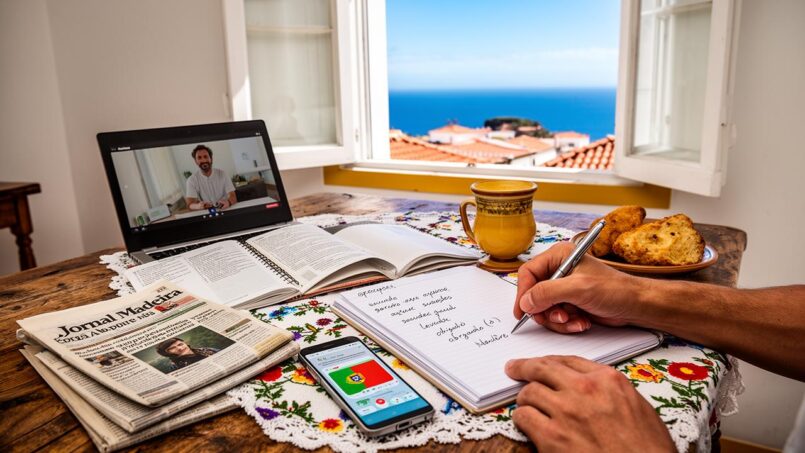
Advice for learning Portuguese in Madeira
Waiting to Be “Ready” to Speak
One piece of advice comes up repeatedly from teachers and seasoned learners: don’t wait until you have a good level to start speaking. If you wait until you know “all” the rules, you’ll never speak.
In Madeira, where social life revolves heavily around cafés, village festivals, and group hikes, every hello, every order at the counter is a chance to try. A simple but correct phrase, repeated daily, is worth more than ten perfectly understood but never spoken grammar rules.
Summary: An Ideal Ecosystem for Learning… Provided You Dive In
Madeira is often described as a “subtropical paradise“; from a linguistic perspective, the archipelago is also an ideal playground for European Portuguese. English is present enough to help you out, but not so much as to trap you in an English-speaking bubble. The Madeirense dialect, musical and expressive, opens a privileged window into local culture.
By combining:
Several complementary approaches to progress effectively in learning European Portuguese during a stay in Madeira.
Follow structured training at one of the schools in Funchal or nearby to build a solid foundation.
Use dedicated platforms like Practice Portuguese or Portuguese Lab Academy for self-study.
Get help from a private tutor to correct your pronunciation and linguistic reflexes.
Immerse yourself in the language through local life: cafés, markets, expat groups, cultural events, and hikes.
you can reasonably aim for conversational Portuguese in 6 to 12 months, and thus access a deeper, richer, more independent Madeirense life.
The key is neither special talent nor a miracle tool, but regularity and diversity of contact with the language. In Madeira, everything is set up for that regularity to take the form of very concrete pleasures: a coffee shared overlooking the ocean, a joke exchanged on a levada, a compliment on a particularly good bolo do caco.
Every bom dia is a micro-lesson. Yours to multiply.
A heritage project or a question? Contact us now to speak with a wealth management expert.
Disclaimer: The information provided on this website is for informational purposes only and does not constitute financial, legal, or professional advice. We encourage you to consult qualified experts before making any investment, real estate, or expatriation decisions. Although we strive to maintain up-to-date and accurate information, we do not guarantee the completeness, accuracy, or timeliness of the proposed content. As investment and expatriation involve risks, we disclaim any liability for potential losses or damages arising from the use of this site. Your use of this site confirms your acceptance of these terms and your understanding of the associated risks.

Cyril Jarnias is an independent expert in international wealth management with over 20 years of experience. As an expatriate himself, he is dedicated to helping individuals and business leaders build, protect, and pass on their wealth with complete peace of mind.
On his website, cyriljarnias.com, he shares his expertise on international real estate, offshore company formation, and expatriation.
Thanks to his expertise, he offers sound advice to optimize his clients' wealth management. Cyril Jarnias is also recognized for his appearances in many prestigious media outlets such as BFM Business, les Français de l’étranger, Le Figaro, Les Echos, and Mieux vivre votre argent, where he shares his knowledge and know-how in wealth management.





