
 Published on and written by Cyril Jarnias
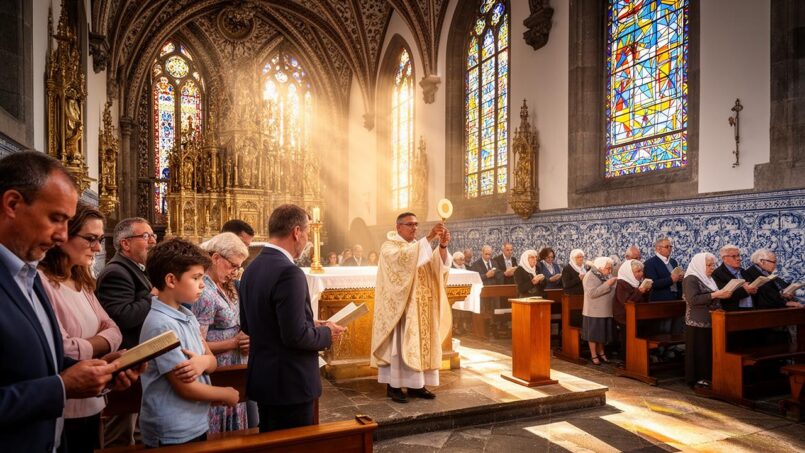
Settling in Madeira is not just about changing your climate and landscape. It’s about entering a world where the Catholic faith still structures the calendar, village festivals, much of social life, and even store opening hours. For expats, understanding these religious codes helps avoid missteps and integrate into local life much faster.
Good to know:
This article offers a cultural overview of Madeira’s religious traditions. It explains how parishes work, describes the major festivals, details proper conduct in churches, and indicates where to find services in English. It also gives tips on how to behave with neighbors during arraiais (popular festivals) and pilgrimages.
A very Catholic island… but open and tolerant
Across Portugal, Catholicism is overwhelmingly dominant. About 80% of the Portuguese population declares itself Catholic. But in Madeira, this weight is even stronger: nearly 90.9% of residents say they are Catholic, and 93.3% belong to some Christian church. Barely 6.3% claim no religion.
In practice, however, strict Sunday attendance has declined as elsewhere in Europe. The majority remain culturally Catholic: baptisms, funerals, major festivals, pilgrimages, and processions mark the lives of most families even when Sunday Mass is not a regular habit.
Example:
Portugal, including the Madeira region, provides a secular framework that guarantees religious freedom. This principle is reflected in the presence of a Muslim community with its mosque, a Jewish heritage, as well as Protestant, Evangelical, Mormon groups, and an international English-speaking church.
For an expat, the challenge is not about “conforming to an orthodoxy,” but understanding that the Catholic religion still plays a strong social role, especially in rural areas, and that it coexists with other faiths in a generally peaceful climate.
Funchal and its churches: essential landmarks for newcomers
To understand religious life in Madeira, you must start with Funchal, the archipelago’s capital and the historical heart of the diocese.
The Sé, mother of all churches on the island
The Cathedral of Our Lady of the Assumption, better known as the Sé do Funchal, is the “mother church” of the entire island. Built from the late 15th century, it concentrates several centuries of religious history: Gothic and Manueline styles, a mudéjar-style wooden ceiling, altarpieces, and ivory-inlaid woodwork.
Beyond the architecture, the Sé remains a very active place of worship, with a dense schedule of Masses, confessions, and prayers. For a Catholic expat, it is often the first point of contact with local practice. For a non-believer, it is a major heritage site, best approached with some knowledge of respect and protocol.
Mass times at the cathedral follow a brisk schedule:
| Day | Main Mass times at Funchal Cathedral* |
|---|---|
| Monday – Friday | 8:00 AM – 8:30 AM – 11:00 AM – 5:30 PM |
| Saturday | 11:00 AM – 6:00 PM |
| Sunday | 8:00 AM – 9:00 AM – 11:00 AM – 5:00 PM – 6:00 PM |
| Public holidays | 11:00 AM (only one Mass) |
| Religious solemnities | Sunday schedule |
The 11:00 AM service on Sunday includes a second reading in English.
Note:
The cathedral doors open early in the morning and close in the late afternoon, with more restricted hours on Sundays and public holidays. Tourist visits are mostly possible in the morning and mid-afternoon; some time slots are reserved for groups.
The sacrament of reconciliation (confession) is offered on weekdays, usually between 9:00 AM and 10:00 AM, except during the Octave of Christmas and Easter. Every evening before vespers, the rosary is recited, and eucharistic adoration takes place on certain Friday slots.
Expatriates wishing to arrange a baptism, a Mass for a deceased loved one, or simply ask practical questions can contact the parish office by email ([email protected]) or stop by the office during opening hours, which are widely available Monday through Saturday.
Penha de França: the gathering place for English-speaking Catholics
A few minutes’ walk from the main avenue, the chapel of Nossa Senhora da Penha de França is a discreet but crucial landmark for English-speaking expats. Located near the Savoy Palace and opposite the Prince Albert Pub, this small church offers the only regularly celebrated Catholic Mass in English on the entire island.
Tip:
Unlike the Sé, this chapel offers a more intimate setting and a very international atmosphere, frequented by long-term expats and tourists. It plays a key role in facilitating linguistic and community integration for those who do not yet speak Portuguese.
| Location | Language | Day | Time (check locally) |
|---|---|---|---|
| Capela Penha de França | English | Sunday | 10:00 AM or 10:30 AM |
| Capela Penha de França | Portuguese | Sunday | 12:30 PM |
| Capela Penha de França | Portuguese | Saturday | 6:30 PM – 7:00 PM |
Sources differ slightly on the exact time of the English Mass (10:00 AM or 10:30 AM), hence the importance of checking the chapel’s official website, by phone, or with your hotel. This “unique English Mass” makes it a very popular rallying point for foreign communities.
A mosaic of other churches and communities
Funchal is not limited to the Sé and Penha de França. Expats living in other neighborhoods or wishing to explore the island’s religious heritage can discover a dense network of churches and chapels: Igreja de São Pedro, Igreja do Carmo, Igreja do Monte, Igreja de São Martinho, Capela da Ajuda, Capela do Amparo, Igreja da Nazaré, Capela do Pilar, Capela da Fundação Zino, not to mention the Jesuit church of São João Evangelista, a remarkable example of 17th-century religious architecture.
Good to know:
Religious services are held almost exclusively in Portuguese. However, the welcome is generally warm. To follow the liturgy, simply observe and mimic the gestures of the faithful present.
Alongside the Catholic network, the Madeira International Church (affiliated with the Assemblies of God) offers a Sunday service in English at 4:00 PM. This is an important option for English-speaking Protestants or Evangelicals accustomed to a more informal liturgy. Here you often find expats of various nationalities, for whom this gathering is both a spiritual moment and a social space.
Good conduct in churches: codes, dress, and behavior
In a region so marked by Catholicism, entering a church is not quite like entering a museum or a café. For an expat, a few simple reflexes help avoid misunderstandings.
The question of dress code
The basic principle is clear: dress modestly as soon as you step through the door of a church or chapel. There is no strict dress code, but a fairly stable cultural norm: shoulders and knees covered, clean and non-transparent clothing.
For women, dresses or skirts at knee length or longer, light trousers, blouses, or simple T‑shirts work perfectly. For men, long pants, a polo shirt or button-down, even a simple T‑shirt without aggressive slogans are fine. Cotton or linen fabrics are recommended, especially in summer.
Avoid: very short shorts, miniskirts, halter tops, sleeveless shirts without a wrap, swimsuits or beachwear, extremely tight, torn, or clothing with provocative messages. Flip-flops are frowned upon in a liturgical context; proper sandals or closed shoes are better.
Tip:
To balance beach time and visits to spiritual sites, the simplest solution is to carry a light scarf or shawl in your bag and put it over your shoulders before entering. If you forget, some sanctuaries sometimes lend one at the entrance.
Gestures of respect and discreet attitudes
In Madeira as elsewhere in Portugal, a few gestures are expected when entering a church:
– men remove their hats or caps inside;
– everyone takes off their sunglasses;
– lower your voice immediately, even during a tourist visit.
Pews are often occupied by faithful at prayer, even outside Mass times. It is therefore poorly regarded to walk around talking loudly, phone, or laugh noisily. During a Mass or rite (baptism, wedding, funeral), it is best to stay discreet, sit at the back if you are not participating, and follow the assembly’s movement without drawing attention.
The areas near the altar are considered particularly sacred. Avoid entering them unless invited, stepping onto the dais, or going behind the choir balustrade. Walking directly in front of the altar during a celebration is considered very disrespectful; it is better to go around via the side aisles or wait until a ritual ends.
Note:
It is forbidden to touch works of art (statues, altarpieces, paintings, reliquaries). Also avoid sitting on monument edges, climbing on steps, or leaning against an altar to take a selfie, as these behaviors are inappropriate.
Photography without turning faith into a spectacle
Most major churches in Madeira allow photography without flash outside of services. Nevertheless, rules can vary: some spaces (side chapels, sanctuaries, altarpieces) forbid photos, and signs indicate this.
For an expat, a few simple principles apply:
– check for a pictogram (camera crossed out) before pulling out your smartphone;
– ask a sacristan, volunteer, or guide if unsure;
– never photograph worshippers at prayer up close, especially people in tears during funerals or (particularly intense moments);
– during Masses and sacraments, avoid filming as if covering a show: here, you either participate or observe in silence.
Outdoors, during processions, photography is more tolerated, but the approach remains the same: stay at the edge of the crowd, do not obstruct the march of the confraternities, do not run ahead of the statue to “steal” a shot, and avoid intrusive close-ups of worshippers’ faces.
Festivals, processions, and arraiais: the beating heart of popular piety
To understand religion in Madeira, attending a Sunday Mass is not enough. It is especially in the great patron saint festivals and arraiais that the Madeiran way of living the faith reveals itself: a mix of fervor, conviviality, folklore, and gastronomy.
Between sacred and profane: how an arraial works
Almost every parish on the island organizes at least one major religious festival per year, often linked to the patron saint of the church or a particular Marian devotion. The structure is fairly constant:
– a sacred dimension: novenas (nine consecutive Masses before the feast), confessions, solemn Mass with sermon, procession with the saint’s image or relic;
– a profane dimension, the famous arraial: food stalls (espetada, bolo do caco, grilled limpets, poncha), live music, brass bands, folk groups, impromptu dances, fireworks.
The church surroundings are transformed. Garlands of colorful flags are strung from pole to pole, often decorated at the base with laurel, boxwood, or myrtle. The streets are illuminated, light arches frame the entrances, and sometimes flower carpets cover the ground for the procession’s passage.
Orchestras and philharmonic bands alternate with traditional music groups. You hear typical instruments: rajão, braguinha (ancestor of the ukulele), guitar, accordion, castanets, brinquinho, even reco‑reco. Singers sometimes perform the despique, an improvised verbal joust full of innuendo and social satire.
Good to know:
For an expat, this is an excellent opportunity to meet neighbors, taste local specialties, and understand the community dimension of local religion. It is important to note that this popular festival is above all an act of devotion, always beginning with a Mass and a procession.
Maritime processions and vows fulfilled
Some Madeiran festivals are inseparable from the sea. This is especially true of Nossa Senhora da Piedade in Caniçal, a fishing village in the municipality of Machico. The festival, celebrated on the third weekend of September, is based on a legend: sailors caught in a storm allegedly promised to build a chapel if they survived. The chapel, perched on “Monte da Piedade,” became the highlight of a pilgrimage by land and sea.
On Saturday afternoon, the statue of the Virgin is carried from the parish church to the dock, accompanied by the priest, confraternities, the brass band, and the people. She then boards a boat, escorted by a flotilla of decorated fishing vessels. Ship owners lend their boats free of charge to allow everyone to participate, and many families save all year, through vows or donations, to fund the festival.
Upon arrival near the chapel, the procession continues on foot along a steep path to the sanctuary. The statue, often adorned with jewelry offered as thanks for graces received, is placed on a resting altar; hymns are sung, the band plays the hymn of Our Lady. Some faithful perform penances: ascending on their knees, carrying wax candles, acts of reparation.
Example:
Back in the village after a procession, the statue is first placed in the mother church. The faithful queue to “kiss” it (to kiss it), a deep gesture of devotion that signifies acceptance of its protective power. The next day, a new procession, both on land and at sea, accompanies the image back to its chapel. For the blessing of the village of Caniçal, the statue is this time turned to face it.
For an expat attending, a few informal rules apply: appropriate attire, discreet observation of acts of piety (penances, tears, kissing the image), no mockery or loud comments, and, if you simply wish to watch, stand to the side of the procession without cutting through the confraternities’ line.
Pentecost and the cult of the Holy Spirit: visits, bread, and sharing
Another highlight: the cycle from Easter to Pentecost, marked by the cult of the Holy Spirit. In Madeira, as in some regions of mainland Portugal, this cult involves home visits organized by the confraternity of the Holy Sacrament.
From Easter Sunday until Pentecost, members of the confraternity, wearing a sleeveless red silk garment, go from house to house carrying a standard, the banner of the Holy Spirit, and a tray to collect offerings. Families welcome them, decorate their homes, sometimes kiss the insignia, and give monetary or in-kind donations, seen as a way to give thanks for the protection received throughout the year.
At the end of this cycle, a large arraial is organized: food stalls, music, a gathering of the whole village. On Sunday afternoon, the bread procession takes place: oversized baskets overflowing with bread, fruits, vegetables, sometimes topped with a red flag bearing a white dove, parade through the streets to the church. These goods, arising from vows, are then displayed and later redistributed to the poor.
For an expat, this cult, far removed from the more “institutional” Catholic practice sometimes known elsewhere, is a lesson in solidarity and symbolism: bread as a guarantee of shared abundance, the visit as a moment of family cohesion, the festival as an annual reaffirmation of a link between the sacred and daily life.
An expat
Christmas, missas do parto, and lapinhas
The Christmas period is another pillar of Madeiran religiosity. Fifteen days before December 25, the missas do parto begin, literally “Masses of childbirth.” Celebrated at dawn, often around 6:00 AM, they commemorate the nine months of the Virgin Mary’s pregnancy and exist only in the archipelago.
These well-attended Masses blend Catholic liturgy with popular culture: traditional instruments (rajão, castanets, bass drum), specific songs, an atmosphere both fervent and joyful. After Mass, parishioners often gather for a breakfast of specialties: bolo do caco, broas, hot drinks.
In homes and churches, nativity scenes – here called lapinhas – take on typical forms. Two main types exist: the lapinha em escadinha, shaped like a staircase, and the Rochinha, larger, a miniature mountain with caves, streams, and multiple figurines. Some families compete in creativity, and residents sometimes invite visitors to admire their home nativity.
The midnight Mass, from December 24 to 25, remains a central event, often preceded by the Christmas Eve dinner. The period then continues with cantar os Reis (singing of the Kings) on January 5, where groups go (or used to go) door to door singing Epiphany hymns. In many towns, this tradition now takes the form of public concerts.
For expats, these weeks deeply change the island’s rhythm: increased Masses, illumination of Funchal’s streets, Christmas markets, longer and noisier nights around December 23 (Noite do Mercado), then grand New Year’s festivities with a renowned fireworks display.
When the civil calendar aligns with the religious calendar
Settling in Madeira also means getting used to a calendar heavily marked by religious, national, and municipal festivals. On these days, administrations and shops may close, transport schedules change, and villages fill with pilgrims.
Major national and regional holidays
Among the public holidays with a direct link to the Catholic religion, we can mention:
| Holiday (Portugal / Madeira) | Primary Nature |
|---|---|
| Good Friday | Commemoration of Christ’s Passion |
| Easter (Sunday) | Resurrection |
| Corpus Christi | Feast of the Holy Sacrament |
| Assumption of Mary | Marian feast |
| All Saints’ Day | Feast of all saints |
| Immaculate Conception | Marian feast |
| Christmas | Birth of Christ |
To this are added more specifically regional dates, such as Madeira Day, and local public holidays linked to the patron saints of municipalities (e.g., Saint Peter in Ribeira Brava or São João in Porto Santo). These festivals almost always include a solemn Mass and a procession, followed by an arraial.
Good to know:
To better plan administrative procedures, professional appointments, and travel, it is advisable to check national, regional, and municipal holidays in advance. Also note that major festivals attract large crowds, complicate parking, and can lead to temporary price hikes for accommodations.
A network of festivals where the religious surfaces
Many of Madeira’s flagship events have a religious root, even if today the cultural and tourist aspect often takes over.
Example:
Carnival, for example, traditionally marks the entry into Lent, a period of penance in the Christian calendar. In Funchal, it translates into large costumed parades, including a highly structured “allegorical” corso and a more spontaneous *Trapalhão*, where residents parade in humorous costumes. Even if the religious dimension is no longer at the forefront, the logic of the liturgical calendar remains.
The Flower Festival, with its flower-adorned floats, petal carpets on the squares, and a “Wall of Hope” built by children, retains the imprint of religious processions where the saints’ route was once decorated.
Wine and harvest festivals also echo themes of gratitude for the harvests, traditionally addressed to God or protective saints: processions, blessing of the grapes, reenactment of grape treading.
For expats, the boundary between religious and cultural is sometimes blurred. The best approach is to consider these festivals as overall expressions of Madeiran identity: you can participate for the festive aspect while respecting explicitly devotional moments (prayers, blessings, processions).
Coexisting with others’ faith: attitudes and daily life
Beyond churches and big events, religion permeates details of daily life in Madeira. Knowing how to adapt eases neighborly and professional relationships.
In the neighborhood, at home, in shared spaces
If you do not live in a hotel but in an apartment or rental house, you share the soundscape and culture of your neighbors. A few principles matter especially in a context where family and religious festivals are central:
Tip:
For harmonious integration, it is important to respect nighttime quiet, especially after 10:00 PM, except during big arraial nights. Accept that some summer weekends, villages live to the rhythm of patron saint festivals, with music until late, comings and goings, and more frequent bells. It is forbidden to use streets, ditches, or levadas as toilets; use public or establishment bathrooms instead. Finally, respect queues and give priority to the elderly, pregnant women, and people with reduced mobility, a reflex consistent with a culture that values seniors and family.
In rural areas, processions may cross roads or streets in front of your home. It is good form to slow down in your car, even stop to let them pass, and avoid making noise (music, work) when the statue approaches.
At the table, in town, at work
In Madeira, politeness and cordiality are highly valued. Saying “Bom dia,” “Boa tarde,” “Por favor,” “Obrigado/Obrigada” is always appreciated. Using “Senhor” or “Senhora” followed by the surname remains the norm with older interlocutors or in formal contexts.
Sunday lunches, especially after Mass, are often long family moments. For an expat invited to a Madeiran home, arriving on time, staying long enough for coffee, and not criticizing religion or local practices at the table, even jokingly, are good reflexes.
Good to know:
In restaurants, the ‘couvert’ (bread, olives, cheese brought without ordering) can be refused or paid only if consumed; it is better to discuss this calmly. Tipping is not mandatory but is appreciated for good service.
Observing without judging: a key principle
For an expat from a more secularized country, certain gestures – kissing a statue, procession on knees, mass pilgrimage to a reportedly miraculous crucifix – can be surprising, even disconcerting. The key is to see them as sincere expressions of popular faith, rooted in the island’s and its families’ history.
Rather than constantly comparing with “back home,” one can choose to ask open questions, listen to residents’ stories about the origin of a legend or a procession, discover the social side of a festival (collections for the poor, fulfilled vows, role of confraternities).
This attitude of cultural humility applies to all faiths present on the island: whether the small Muslim community gathering in its mosque, the international evangelical church, remnants of Jewish heritage, or more discreet religious minorities.
For believing expats: practicing your faith in Madeira
Not all expats are believers, but those who are often seek to find religious landmarks in their place of residence. In Madeira, several options exist depending on your tradition.
Practicing Catholics
For a Catholic, integration is particularly simple: almost all parishes belong to the Diocese of Funchal, and Mass is celebrated very regularly in every town and most villages.
The main options:
– attend Masses in Portuguese at your local parish: the responses and structure of the liturgy remain the same as anywhere else in the world; with a bilingual missal, the language barrier is reduced;
– occasionally join the English Mass at Penha de França to better follow the readings and homily;
– take advantage of confessions, adoration, and various devotions offered at the Sé or in neighborhood churches.
Apps to find a Mass
International mobile apps to find schedules of Catholic celebrations and sacraments near you or while traveling.
Worldwide schedules
Check Mass, adoration, and confession schedules worldwide, with filtering by language.
Verification and geolocation
Useful for confirming a time or locating the nearest church to your position.
Protestants, Evangelicals, and other Christians
The Protestant history of Madeira goes back to the 1830s, with the arrival of Scottish missionaries like Robert Reid Kalley, whose activities sparked severe persecution at the time and a mass exodus of converts. Today, the context has radically changed: the island is legally secular and non-Catholic communities practice freely.
Protestant or Evangelical expats can turn to:
– Madeira International Church, which holds a Sunday service in English in Funchal;
– Portuguese evangelical communities already established, sometimes accustomed to welcoming foreign members.
Good to know:
For Anglican or Presbyterian traditions, the offering on Madeira Island is limited. However, large cities on mainland Portugal offer more possibilities.
Muslims, Jews, and other faiths
The Muslim community in Madeira, composed mostly of immigrants from South Asia and the Middle East, has a mosque open thanks to the combined support of the local community, other Muslims in Portugal, and the island’s authorities. For Muslim expats, it is an important landmark for prayer and community life.
The Jewish heritage of Madeira is mainly historical (former synagogue and cemetery in Funchal, sheltering refugees during World War II). Regular services are mostly concentrated in Lisbon or a few large cities on the mainland, but Jewish visitors often enjoy discovering these traces of an ancient presence.
Other religious minorities (Hindus, Buddhists, Baháʼís, etc.) exist mainly at the national level; in Madeira, their presence is very small, but the Portuguese legal framework guarantees them the same freedom of worship.
In practice: some tips for expats
Rather than enumerating a long list of rules, we can summarize the essentials as follows.
In churches and religious festivals:
– dress simply, with shoulders and knees covered, avoiding beachwear;
– remove hats and sunglasses inside places of worship;
– speak softly, turn off your phone’s ringer, stay discreet during Masses and processions;
– respect areas near the altar as spaces reserved for clergy and servers;
– ask permission or follow guidelines before photographing, especially during ceremonies;
– during processions, stay to the side, avoid blocking the way or turning the ritual into a spectacle.
In daily life:
Note:
In Portugal, it is important to greet shopkeepers, neighbors, and colleagues with the usual formulas. Also keep in mind that some Sundays and religious holidays are reserved for family, making administrative or professional appointments rare on those dates. Finally, during big events like Carnival or processions, it is essential to follow local recommendations: beware of crowds, respect safety instructions, and consume alcohol in moderation.
Lastly, remember that religious festivals, even very lively ones, are not just “attractions” but moments of deep identity for the locals. Participating with curiosity, respect, and a desire to understand is the best way for an expat not to remain a spectator but to gradually become a full member of this island where faith, music, food, and the street are closely intertwined.
Have a heritage project or a question? Contact us now to speak with a wealth management expert.

Cyril Jarnias is an independent expert in international wealth management with over 20 years of experience. As an expatriate himself, he is dedicated to helping individuals and business leaders build, protect, and pass on their wealth with complete peace of mind.
On his website, cyriljarnias.com, he shares his expertise on international real estate, offshore company formation, and expatriation.
Thanks to his expertise, he offers sound advice to optimize his clients' wealth management. Cyril Jarnias is also recognized for his appearances in many prestigious media outlets such as BFM Business, les Français de l’étranger, Le Figaro, Les Echos, and Mieux vivre votre argent, where he shares his knowledge and know-how in wealth management.





