
 Published on and written by Cyril Jarnias
wp:paragraph
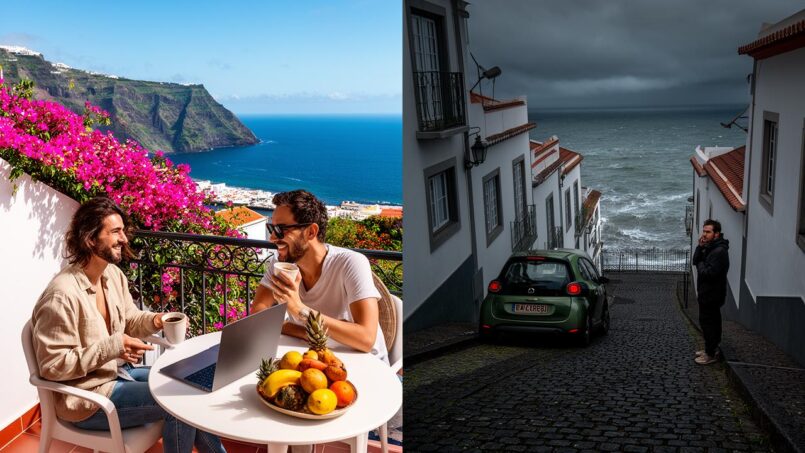
Nearly Constant Sun, Ocean at Your Doorstep, Favorable Taxes, and an Ultra-Safe Island: on paper, expatriating to Madeira looks like a winning bet. But behind the images of dizzying cliffs and lush levadas, the reality is more nuanced. Soaring Housing Costs, a limited job market, Portuguese bureaucracy, island isolation, and social tensions around immigration also factor into the balance.
This article draws on recent data on climate, cost of living, taxes, healthcare, the job market, and the social context to present the pros and cons of expatriating to Madeira, tailored to digital nomads, retirees, families, and investors.
An “Eternal Spring” Climate… but with Nuances
Madeira has built a reputation as “the island of eternal spring,” and that’s not just empty marketing.
The archipelago enjoys a humid subtropical climate, often compared to a Mediterranean climate with summer drought. Temperatures are remarkably stable: averaging around 20 °C (68 °F) throughout the year, with winter days on the south coast ranging from 18 to 21 °C (64 to 70 °F) from December to April, and summer days typically between 24 and 26 °C (75 and 79 °F) from July to September. In Funchal, the coldest month (February) averages around 17 °C (63 °F), and the warmest month (August) just under 24 °C (75 °F).
The maximum sea temperature reached in September, offering a pleasant swimming period from August through October.
Microclimates: An Asset… That Can Surprise You Daily
The picture-perfect climate postcard masks one reality: the volcanic terrain creates a mosaic of microclimates. Within just a few miles, you can go from a perfectly clear sky to a low cloud ceiling, even pouring rain.
Generally speaking, the north of the island is more humid, windy, and lush, while the south is drier, sunnier, and more sheltered. The mountains, peaking at Pico Ruivo at 1,862 meters (6,109 ft), act as a barrier that blocks clouds and prevailing northeast winds: they generously water the central laurel forest and spare the south coast from many rainy episodes. The result: the southwestern coast enjoys the most hours of sunshine, which explains its popularity among expats.
Funchal gets 2,100 to 2,400 hours of sunshine per year, with 5 to 6 hours of sun per day in winter and 7 to 8 hours in summer. However, neighborhoods located between 600 and 800 meters (2,000–2,600 ft) in altitude are noticeably cooler and cloudier than the waterfront. Living at that altitude offers coolness in summer but comes with more frequent cloud cover.
Rain, Humidity, and the “Cap” Cloud
Another reality, often downplayed in brochures: the humidity. The air is very humid, with average relative humidity exceeding 70% (around 69% in Funchal annually). The most humid months, like June, can average 72% relative humidity, compared to “only” 63% in September.
Rainfall is concentrated between October and April, peaking between November and February. Funchal receives an average of 500 to 640 mm (20–25 in) of rain per year, but this figure soars in the central mountains, which can see up to 2,800–3,000 mm (110–118 in) annually. Conversely, the south coast and the eastern tip (Ponta de São Lourenço) average between 600 and 1,000 mm (24–39 in), reinforcing the contrasts between lush valleys and more arid areas.
For an expat in Madeira, it’s essential not to rely solely on general climate statistics. In winter, several consecutive days of bad weather or strong gusts from Atlantic depressions can catch you off guard, even though constant sunshine is often expected. Also, some local phenomena can be confusing: for example, in June, a thick cloud cover (called the “capacete” or helmet) often forms over the island in the morning before dissipating during the day. So be prepared for this variability and check short-term local forecasts.
Decisive Advantage: A “Livable” Climate 12 Months a Year
Despite these nuances, the overall picture remains very favorable: Madeira genuinely allows for outdoor living year-round. Hiking, surfing, cycling, swimming (at least from late summer onward), terraces—the island ticks all the boxes for anyone wanting to escape harsh continental winters or scorching summers.
This is one of the strong objective arguments for expatriating to Madeira: not only is the climate mild, but it is especially remarkably stable, with a narrow temperature range between seasons. It is also a powerful driver of well-being for retirees or professionals sensitive to seasonal affective disorder.
Cost of Living: Cheaper Than Paris or London, but Far from a “Low-Cost Paradise”
Madeira enjoys a reputation as an affordable destination. Compared to London, Washington, Paris, or even Lisbon, that reputation is broadly justified. But on the ground, many expats get a rude awakening, especially when it comes to housing.
Housing: The Real Time Bomb
Housing is by far the number one expense in Madeira, for both renters and buyers. The island has experienced one of the biggest real estate surges in the country in recent years.
In a few numbers, the trend becomes very clear.
Real Estate Prices (Purchase)
| Indicator | Approximate Value | Comment |
|---|---|---|
| Average price per sqm – Madeira Region | ~€3,825 | +17.3% year-over-year (Feb to Feb) |
| Average price per sqm – Funchal | ~€3,993–€4,000 | New construction exceeds €4,000/sqm |
| Average property price – Madeira | ~€300,000–€580,000 | Depending on source, with an “anchor” around €600,000 reported |
| Average price per sqm – Portugal (national) | ~€3,076 | Madeira is more expensive than most regions outside Lisbon |
| Price increase in 2024 (Madeira) | +12.6% | In a single year |
The region is simply the second most expensive in the country after the Lisbon district. In some segments, Funchal already exceeds the suburbs of Lisbon.
Pressure is so intense that the market has begun to slow: transactions fell by about 23% in Q3 2025 compared to the previous year, and the total value of sales dropped by roughly 9.6%. But due to lack of supply, prices themselves continue to rise or remain at high levels.
Rental Market: The Explosion
The rental market has seen a similar shock, driven by tourism growth, short-term rentals, and the arrival of digital nomads with incomes higher than the local average.
| Type of Rental | Range / Average (approx.) | Remarks |
|---|---|---|
| Average rent – Madeira Region | ~€1,400–€1,700/month | Steep recent increases; second most expensive region in the country |
| 1-bedroom – Funchal center | ~€900–€1,500/month | Most listings around €1,000–€1,300 |
| 1-bedroom – outside Funchal center | ~€600–€1,200/month | €650–€800 possible in suburbs or neighboring towns |
| 2-bedroom – Funchal center | From ~€1,600/month | Higher rates for newer properties or sea views |
| 3-bedroom “high-end” – Funchal | ~€1,700–€3,200/month | Villas or large apartments with amenities |
| Ponta do Sol / Ribeira Brava | ~€650–€900/month | More affordable, but limited supply |
| Other towns (Câmara de Lobos, etc.) | ~€400–€600/month (simple 1-bed/2-bed) | Outside the most sought-after areas; growing scarcity |
In a digital nomad’s monthly budget, rent often accounts for 40% to 50% of expenses. For a couple or family, this item dominates all others.
Despite a generally lower cost of living, the local population of Madeira, earning a minimum wage of around €980/month, can no longer afford to buy or rent decently, generating growing resentment due to the price surge driven by foreign demand.
Other Everyday Expenses: Mostly Favorable
Alongside housing, other spending categories remain fairly attractive for an expat coming from a high-income country.
Comparisons with London and Washington, D.C. are telling.
| Expense Category | Difference: Funchal vs. Washington, D.C. | Difference: Funchal vs. London |
|---|---|---|
| Cost of living (excl. rent) | -45.3% | – (not specified) |
| Rent | -47.7% | – (total cost -46.1%) |
| Restaurants | -47.9% | -44.3% |
| Groceries | -48.6% | -34.1% |
| Local purchasing power | -58.2% | -48.6% |
Groceries, in particular, remain a good deal if you adopt a “local” lifestyle: fruits and vegetables from volcanic soil, fresh fish, wine, and Portuguese products are reasonably priced. However, as soon as you fill your cart with imported Northern European brands, the bill jumps by 10–15% compared to the mainland, penalized by shipping costs.
This is the minimum monthly budget in euros for groceries for a single adult at the supermarket.
As for services, a fast fiber internet subscription costs around €40–€50/month, utilities (water, electricity, waste) for a standard apartment run about €80–€140/month, with an average bill around €109 in Funchal compared to over €150 in Lisbon for a similar sized property.
Public transportation, though limited outside Funchal, remains cheap: a monthly pass costs €30–€40. In practice, many households need a car, which adds significantly to the cost (€200–€350/month on average including gas at around €1.69/L, insurance, and maintenance).
Realistic Budgets for Different Profiles
Available data allows us to outline ballpark figures for various expat profiles, including rent.
| Profile | Comfortable Monthly Budget (approx.) | Comment |
|---|---|---|
| Minimalist digital nomad | €1,190–€1,450 | Outside center, shared apartment or small studio, public transit |
| Mid-range digital nomad | €1,500–€1,900 | Better housing, some extras |
| Comfortable single nomad | €1,930–€2,500 | 1-bed or 2-bed near Funchal, car, regular dining out, leisure |
| Couple (renting) | €2,700–€3,600 | 2-bed/3-bed, car, outings, private insurance |
| Retiree alone, comfortable | €2,000–€2,500 | Outside the hyper-center, good safety margin |
| Retired couple (renting) | €2,800–€3,600 | High quality of life “per euro spent” |
| Family of four (renting) | €3,800–€5,000 | Upper end rises with private/international schools |
Excluding rent gives an interesting perspective: a single person spends between €1,000 and €1,100 per month without housing, a retired couple €1,650–€1,800, a family of four €2,400–€2,600. This shows how housing is the key factor that will decide whether Madeira is “affordable”… or not.
Healthcare and Safety: Two Major Strengths for Expatriation
Two dimensions consistently appear in testimonials and international indicators: the quality of the healthcare system and the feeling of safety.
A Solid Healthcare System, Public and Private
The Portuguese public healthcare system, implemented in Madeira through SESARAM, is universal and largely tax-funded. Access is based on legal resident status: once residency is obtained, expats can request a user number (número de utente), register at a health center, and benefit from the network of public clinics and hospitals.
Basic care (family doctor consultations, hospital visits, emergency care, maternity follow-up, etc.) is largely covered, with small co-payments – typically €4 to €10 per consultation. Children under 18 and adults over 65 are essentially exempt from these fees.
The island has the public hospital Dr. Nélio Mendonça in Funchal, open 24/7, and specialized facilities like the hospitals dos Marmeleiros or Dr. João de Almada. Private clinics (Hospital Particular da Madeira, Hospital da Luz Funchal, polyclinics, and private practices) offer faster care, often preferred by expats. A private consultation costs around €40–€50.
Private health insurance, fairly widespread (20–25% of the Portuguese population has it), is relatively affordable: €50 to €100/month for a standard policy, which allows quicker access to some specialists, covers dental or optical care, and limits out-of-pocket expenses.
Not everything is perfect: waiting lists for certain consultations or surgeries have surged since the pandemic, and even though Madeira shows better results than the national average (88% of scheduled surgeries within target times recently), there can still be delays of several months for non-urgent procedures. For very rare diseases or ultra-specialized care, patients are sent to the mainland, with travel costs covered and a small daily allowance.
Madeira Healthcare System
Overall, international assessments rank the Portuguese healthcare system above the United Kingdom, Ireland, or Spain on some criteria. For an expat coming from a country without universal social security, this is a major advantage.
A Safe Island with Very Low Crime
Madeira is regularly described as one of the safest places in Portugal, itself ranked among the safest countries in the world. Violent crime, theft, and burglary rates are low, and many residents say they feel comfortable at any hour on the streets of Funchal.
This sense of safety extends to minorities: reports indicate that LGBTQ+ individuals generally feel comfortable living openly, in a climate of quiet acceptance rather than visible activism.
This point weighs heavily in favor of expatriation, especially for families with children, retirees, or people who have lived in larger, more tense metropolises.
Work, Income, and Taxes: An Opportunity for Nomads, Much Less for Local Employees
Settling in Madeira means very different things depending on whether you come with a well-paid remote job or hope to find local employment.
A Narrow, Low-Paying Local Job Market
The regional economy relies heavily on tourism and related services. Job opportunities are concentrated in hospitality and food service, retail, a few administrative services, and some agriculture (viticulture, floriculture, tropical fruits).
For an expat who doesn’t speak Portuguese, the local job market is extremely limited. There are some niches in tourism (jobs where English or other language skills are an asset, even without direct customer contact), IT, or multilingual customer support, but they are far from sufficient.
Wages remain low: the minimum wage in Madeira is about €980/month, and even skilled positions rarely exceed €1,800–€2,000 gross per month. These amounts clash directly with housing costs, partly explaining the social tension on the issue.
To find paid employment, knowledge of Portuguese is almost always required, except for a few highly specialized positions or jobs that are entirely remote.
A Highly Consistent Paradise for Digital Nomads and Remote Workers
Conversely, for freelancers and remote employees working for foreign companies, Madeira ticks many boxes.
The island positioned itself early on as a hub for digital nomads: a dedicated “village” in Ponta do Sol, coworking spaces in Funchal, Santa Cruz, or Machico, internet among the fastest in the country (fiber at 100–200 Mbps or more), and an active community organizing hikes, parties, workshops, Slack groups, and WhatsApp chats.
Minimum monthly income required to obtain the D8 remote worker visa for Portugal in 2026, equivalent to four times the minimum wage.
For a nomad earning €4,000–€5,000 or more per month, Madeira offers a rare combo: mild climate, high safety, reliable infrastructure, attractive taxes, a lower cost of living than major cities, and the chance to join an already structured international community.
Taxation: Madeira, the Most Competitive Region in the Country
On the tax front, Madeira benefits from regional autonomy that allows it to apply lower personal income tax (IRS) rates than the mainland, within a 30% differential limit. In 2026, the top marginal rate on high incomes will cap at around 33.6% in the region – compared to nearly 48% on the mainland scale.
Autonomous rate applied in Madeira to certain dividends and interest, compared to around 28% on the mainland.
At the same time, the former Non-Habitual Resident (NHR) regime, which offered broad exemptions on foreign income for ten years, has been replaced by a much more targeted system focused on research and innovation (IFICI, sometimes called “NHR 2.0”). This regime, available to highly qualified professionals in scientific, technological, or innovative fields, can allow a flat 20% tax on Portuguese professional income and significant exemptions on certain foreign income. But it is much more selective, centered on actual activity and value creation in Portugal, and only concerns a minority of new arrivals.
For most expats, Madeira’s main tax advantage is therefore the general reduction in IRS rates compared to the mainland, and, for investors or entrepreneurs, the possibility of enrolling in the very advantageous Madeira International Business Center (MIBC) framework, which offers a 5% corporate tax rate on certain income, under strict substance requirements (local jobs, actual on-site activity).
Integration, Language, and Social Life: Easy for Expats… Slower with Madeirans
Another key dimension of expatriation in Madeira involves social life, language, and the degree of integration possible into local society.
English as a Crutch… Portuguese as a Long-Term Key
In Funchal and tourist areas, many Madeirans – especially young people and those working in tourism – speak very good English. Translated menus, bilingual restaurant staff, English-speaking doctors and nurses, and partially accessible administration in English: for an expat who stays within the tourist or nomad “bubble,” the language barrier may seem low at first.
But as soon as it comes to dealing with bureaucracy (immigration services, tax office, social security, vehicle registration, etc.), reality quickly catches up: forms only in Portuguese, staff not comfortable in other languages, opaque procedures. Without at least some Portuguese, the experience quickly becomes frustrating.
In daily life outside the most touristy spots – local grocery store, artisans, elderly neighbors, public schools – Portuguese becomes the norm again. To access the local job market, keep up with island news via local media, understand political debates, or participate in associations, mastering the language is a must.
The upside is that Madeira offers a conducive environment for learning: relatively low cost of living (except housing), slower pace of life, and a population that is generally patient and encouraging with those who make the effort. Many resources exist: language schools, university courses, associations, private tutors, online platforms dedicated to European Portuguese. With regular work (even 10–15 minutes a day) and a minimum of immersion, reaching an intermediate level in 6 to 12 months is realistic.
Expat and Nomad Communities: Easy to Join, Often Ephemeral
Socially, Madeira is now heavily geared toward the international crowd. Roughly 6% of the population is foreign, with large communities from Venezuela, Brazil, the United Kingdom, Germany, and a more recent influx of Americans, Canadians, and Northern Europeans. The nomad scene is especially visible in Funchal, Ponta do Sol, Santa Cruz, and Machico.
Thanks to Facebook groups, associations like “Madeira Friends,” hiking clubs, language exchanges, and coworking spaces offering activities (yoga, workshops, happy hours), it is very easy for a newly arrived English speaker to make friends within the foreign community. This active social life makes expatriation to Madeira smooth and avoids the isolation often felt on other islands.
The flip side is the very transient nature of this community: many nomads only stay a few weeks or months, making it difficult to build deep, stable friendships. Those planning to settle long-term must therefore, at some point, make the effort to go beyond the expat circle and build ties with Madeirans.
Racism, Social Tensions, and “Island Mentality”
On a more sensitive subject, testimonials document significant discrimination against certain immigrant groups, especially those from poorer countries or perceived as “competitors” in an already tight job and housing market.
Despite overall low violent crime, targeted assaults, insults, and discrimination are reported. Local social media amplifies these tensions with hostile comments, a phenomenon fueled by the rise of far-right parties that scapegoat immigrants.
In practice, this hostility mainly manifests online or within closed circles, much less in daily individual interactions, especially when the expat is perceived as a “wealthy Western tourist”. But for certain groups – particularly non-European immigrants with limited economic means or poor Portuguese skills – the climate can be more difficult.
This points to an often underestimated reality: Madeira is a small island where people know each other, and family and friendship networks play a big role in accessing jobs, services, and “inside tips.” Entering these circles requires time, patience, a respectful attitude, and a genuine desire to understand the local culture rather than just treat it as a backdrop.
Infrastructure, Mobility, and Island Isolation: Strengths… and Limits
Expatriating to an island, especially one as small as Madeira (roughly 57 km long and 22 km wide), involves a particular relationship with mobility and infrastructure.
An Island More Connected Than It Seems
In terms of infrastructure, Madeira has caught up on decades of delay: construction of a modern road network winding through the mountains, a dramatic improvement of the airport – long considered dangerous because it is squeezed between the sea and the mountains –, consolidated water and energy networks, widespread high-speed internet, a structured healthcare system, and plenty of schools.
More than 5 million passengers passed through Funchal Airport in some years, an increase of about 50% compared to pre-pandemic levels.
Within the island, Funchal and its surroundings are well served, and ride-hailing services (Uber, Bolt) have made a strong comeback, even doubling their presence compared to earlier periods. But in more rural areas, buses are infrequent, and it is hard to do without a car if you want to live comfortably.
Isolation, “Island Fever,” and Limited Cultural Offerings
Then there is the question of isolation. For some, it is an advantage: a feeling of cocooning, a small community, omnipresent nature, far from the hustle and bustle of big cities. For others, it is a source of frustration: every trip abroad requires a flight (often via Lisbon), and the selection of concerts, major museums, international exhibitions, or large-scale festivals is inevitably limited by the size of the local market.
Some expats experience “island fever” after 2-3 years, marked by a feeling of routine, lack of stimulation, and repetitive encounters. To remedy this, it is advisable to regularly plan trips to the mainland (e.g., Lisbon, Porto, Barcelona), taking advantage of the subsidy available on flights.
For those who enjoy a slower pace of life, a human-scale social life, and near-immediate access to nature, this same insularity is, on the contrary, a strong argument in favor of Madeira.
Real Estate Investment: Opportunity or Trap for Expats and Foreign Buyers?
The high prices and market tension discussed above do not prevent Madeira from being considered a “hot spot” for investment, particularly in the luxury segment.
A Strong Market, but Very Imbalanced
In recent years, the region has seen the highest price increases in the entire country over five years. The luxury segment even saw its sales volume increase by 75% in 2025 for some specialized agencies, with a mixed clientele: about 56% Portuguese buyers and 44% foreigners, mostly from the United States, the United Kingdom, and Brazil.
Demand is driven by several factors: the search for primary residences with sea views, purchases of villas combining personal use with seasonal rentals, remote work in the sun, wealth diversification strategies, and interest in local tax regimes.
The imbalance between limited supply and strong international housing demand generates heavy social consequences and growing political mobilization, while structural responses from public authorities remain limited for now.
For an Expat Buying a Residence: Choose Your Location Wisely
For an expat who wants to buy rather than rent, the challenge is twofold: secure your budget and choose a location consistent with your life project.
A few major trends emerge:
An overview of the main areas on the island to help you select the environment that best matches your expatriation project.
Concentrates shops, services, international schools, coworking spaces, and cultural life. Prices are higher, but resale is easier.
Ponta do Sol, Ribeira Brava, and Calheta offer abundant sunshine, a calm atmosphere, and quick access to Funchal (30-40 minutes by car).
São Vicente, Santana, and Porto Moniz offer a more natural and affordable setting, though rainier and farther from main services.
Caniço, Câmara de Lobos, and Santa Cruz are more economical alternatives, popular with local young families and budget-conscious expats.
Prestige properties with sea views easily sell in the range €400,000–€1,300,000 and beyond. For more modest budgets, it is still possible to find small village houses to renovate for around €50,000–€150,000, but often far from the most dynamic areas.
The appeal of buying in Madeira therefore lies less in the idea of a short-term speculative “good deal” than in overall coherence: living there yourself, securing housing against a tight rental market, and possibly partially renting in season to offset costs – keeping in mind potential regulatory changes.
Verdict: For Whom Is Madeira a Good Expatriation Choice?
By cross-referencing all these factors – climate, cost of living, housing, healthcare, safety, work, taxes, integration, isolation – we can begin to outline the profiles of expats for whom Madeira is a relevant choice… and those for whom the bet is riskier.
Profiles Where Advantages Clearly Outweigh
– Remote workers and digital nomads with comfortable incomes: with €3,500–€5,000 or more in net monthly income, Madeira offers a quality-of-life-to-price ratio hard to beat, especially if you favor Funchal or the south coast. The combination of climate, safety, healthcare, internet, taxes, and international community works particularly well.
– Retirees with medium to high pensions: for a retired couple with a monthly budget of €2,800–€3,600, quality of life is excellent: mild climate for joints and mood, solid healthcare system, very low crime, easy access to nature, cost of living lower than many European cities.
– Savvy investors in the luxury segment: despite already high prices, the market remains supported by significant international and local demand, and by the structural scarcity of supply. Provided you don’t overestimate future “automatic” increases and carefully analyze location, investment can be worthwhile.
Profiles Where Disadvantages Can Weigh Heavily
– Young professionals seeking local employment: without remote work or outside income, the equation is tough: low salaries, expensive rents, few opportunities outside tourism and services, a narrow job market. In that case, Lisbon, Porto, or other European cities will often offer better prospects.
– Families with school-age children and a limited budget: between housing costs, possible international schools, the almost necessary car, and island constraints, the bill adds up quickly. For a total budget below €3,500–€4,000 for four people, the margin for maneuver shrinks significantly.
– People highly sensitive to cultural diversity and urban abundance: if you seek world-class museums, alternative music scenes, large universities, daily arts events, life on a small island can quickly feel cramped.
– Expats unwilling to learn Portuguese: in the medium to long term, staying locked in an English-speaking bubble leads to frustration, dependence on others for any administrative task, and limited integration into local society.
A Successful Expatriation to Madeira Requires Preparation
In the end, expatriating to Madeira is neither a fairy tale nor a mirage. It is a demanding choice that requires looking beyond the visuals of sunlit cliffs: accepting real insularity, acknowledging social tensions around housing and immigration, dealing with Portuguese bureaucracy, and a sometimes challenging language.
For a successful move to Portugal, it is essential to approach the project with a realistic budget, a clear professional plan (ideally compatible with remote work), a willingness to learn Portuguese, and a clear-eyed view of the local real estate market’s specifics. In return, the benefits are considerable: a mild climate year-round, a high level of safety, easy access to spectacular nature, a robust healthcare system, attractive taxes, and a slower, more humane way of life that attracts many Europeans and North Americans.
The key, before packing your bags, is probably to spend time on the island, in different seasons, testing several areas – Funchal, the southwest coast, the wilder north – to see if the postcard dream holds up to everyday life. That is often where the difference lies between a traveler’s crush… and a durably successful expatriation.
A wealth management project or a question? Contact us now to speak with a wealth management expert.
Disclaimer: The information provided on this website is for informational purposes only and does not constitute financial, legal, or professional advice. We encourage you to consult qualified experts before making any investment, real estate, or expatriation decisions. Although we strive to maintain up-to-date and accurate information, we do not guarantee the completeness, accuracy, or timeliness of the proposed content. As investment and expatriation involve risks, we disclaim any liability for potential losses or damages arising from the use of this site. Your use of this site confirms your acceptance of these terms and your understanding of the associated risks.

Cyril Jarnias is an independent expert in international wealth management with over 20 years of experience. As an expatriate himself, he is dedicated to helping individuals and business leaders build, protect, and pass on their wealth with complete peace of mind.
On his website, cyriljarnias.com, he shares his expertise on international real estate, offshore company formation, and expatriation.
Thanks to his expertise, he offers sound advice to optimize his clients' wealth management. Cyril Jarnias is also recognized for his appearances in many prestigious media outlets such as BFM Business, les Français de l’étranger, Le Figaro, Les Echos, and Mieux vivre votre argent, where he shares his knowledge and know-how in wealth management.





