
 Published on and written by Cyril Jarnias
Madeira is often presented as a paradise for hikers and fans of spectacular viewpoints, but the idea of having to rent a car still discourages many travelers. In reality, the island has deeply modernized its public transportation in recent years. A unified bus network, services adapted for people with reduced mobility, simplified transit cards, and specific airport connections now allow visitors to explore a large part of the archipelago without getting behind the wheel.
This guide gathers the essential information to understand and use public transportation in Madeira. It helps plan your trips, optimize your budget, and consider accessibility issues.
Understanding the Public Transport System in Madeira
The core of Madeira’s public transport system is the bus. There is no train, subway, or tram on the island. For a long time, the network was fragmented among several private companies, each with its own fares, tickets, and schedules. Since July 2024, a major change has simplified things: the creation of the unified SIGA network.
SIGA now brings together all regional lines under a single brand and a common ticketing system. However, bus operations are still handled behind the scenes by three historic operators: Companhia de Autocarros da Madeira (CAM), Siga Rodoeste, and Horários do Funchal (HF), along with some specific urban services in Funchal.
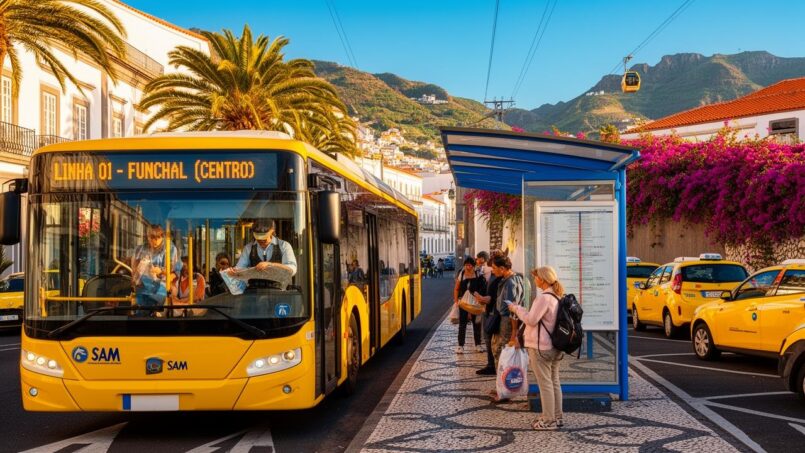
In practice, travelers mostly see white buses with the SIGA logo for intercity routes, and yellow Horários do Funchal buses in the city. Some colors inherited from the old system remain (green buses from former SAM, red-striped buses from Rodoeste), but the fare logic is now common.
The stated goal is clear: reduce road congestion, make travel easier to understand, and offer a credible alternative to the car, including for tourists.
Different Types of Buses and Services
In daily use, it is helpful to distinguish three main categories: urban buses in Funchal, intercity lines that crisscross the island, and a few special services like the Aerobus from the airport or shuttles to certain tourist sites.
Urban Buses in Funchal
Horários do Funchal is the main operator for travel within the capital and its immediate surroundings. Its low-floor yellow buses run frequently in central neighborhoods, to the waterfront, Monte, the botanical gardens, and Praia Formosa.
One line deserves special mention: the Eco Cidade line, operated by electric minibuses. It serves the waterfront promenade and the historic center, under two numbers: 05 and 05B (often also referred to as 05A on some materials for the promenade circuit). These minibuses are wheelchair accessible, with a dedicated space on board. There are no marked stops: just wave to the driver to get on or off, as long as you choose a safe and clear spot (not under a bridge, not on a crosswalk, not on a curve or right in front of a traffic light).
The service runs Monday to Friday from 8:30 am to 6:30 pm, and on weekends and public holidays from 8:30 am to 4:30 pm. For information or ticket purchases, a “Marina” counter is available on Avenida do Mar, open during weekday daytime hours.
Intercity Lines Across the Island
Beyond Funchal, the SIGA network covers the entire main island and Porto Santo. There are more than sixty different lines, connecting the major towns (Machico, Ribeira Brava, Santana, Porto Moniz) as well as many villages and trailheads for hikes.
Historically, each area had its dominant operator: SAM for the east, Rodoeste for the west, EACL and HF for some areas near Funchal. With SIGA, these brands still coexist visually, but fare rules and transit cards are now standardized.
Intercity buses are an economical option for visiting sites like Cabo Girão, Porto Moniz, Santana, Ponta de São Lourenço, or Curral das Freiras. However, frequencies are limited, especially in the evening, on weekends, and on public holidays. So it is essential to plan your schedules in advance, particularly to ensure a return trip after an activity like a hike.
Aerobus and Airport Services
To connect Cristiano Ronaldo Madeira International Airport to Funchal, several options exist, but the most emblematic service is the Aerobus, integrated into the SIGA network and operated by CAM (formerly part of SAM).
The Aerobus, often referred to as line 1, directly serves the main hotels and the center of Funchal: waterfront (Avenida do Mar), casino area, Lido, and on to Praia Formosa. Travel time ranges from about thirty to fifty minutes depending on the stop. You board the bus right outside arrivals, where a large blue sign marks the stop.
This service runs daily with a frequency of about 60 minutes during working hours, less frequent in the evening. The ticket is paid in cash to the driver and costs €6.50 per trip (flat fare, no discount with the GIRO card). Reduced return fares existed in the past but are no longer offered in the latest available information.
Minimum price for a regular bus trip to Madeira Airport from Funchal or Machico.
Shuttles and Special Buses to Tourist Sites
In addition to the regular network, several services target high-demand locations for visitors.
One notable example is the shuttle to Pico do Arieiro, one of the iconic peaks on the island. A dedicated bus leaves from Praça da Autonomia in Funchal twice a day, with a fare around €3 one way. Travel time is about an hour uphill, depending on conditions. This service avoids renting a car just for a high-altitude excursion, though the schedules mean you must plan your hike within the available time window.
Some regular lines have also become true tourist classics. Line 113, for example, reaches the Ponta de São Lourenço area and the start of the PR8 trail at the eastern tip of the island. Line 103 connects Funchal to Santana, crossing the mountainous interior and passing near the start of several levadas. Line 80 (or 139, depending on configuration) takes you to Porto Moniz and its natural pools, offering a long scenic ride.
Fares, Cards, and Passes: How to Pay for the Bus in Madeira
One of the major improvements of the SIGA network is the simplification of fares. Gone are the completely separate systems by company and city: today, a single smart card – the GIRO card – allows you to load tickets valid across the entire public bus network (with a few exceptions, like certain private tourist services).
The GIRO Card: The Key to Madeira Transport
The GIRO is a contactless card onto which you load trips or passes. It is validated when you board the bus. There are two main versions: a rechargeable paper card, ideal for travelers, and a personalized plastic card, intended mainly for residents and those staying on the island for several months.
The paper card costs €0.50 and can be topped up at ticket counters or from retailers. The plastic card costs €5, requires a photo and registration, and allows access to monthly subscriptions or free travel for certain groups (seniors, students).
What to remember for a tourist stay: buying a GIRO card upon arrival (in town or at the airport) is cost-effective as soon as you plan more than a few trips, because per-ride fares are significantly lower than paying cash to the driver.
Zones and Fare Types
The SIGA system distinguishes several categories of trips:
Madeira’s public transport fare system offers several ticket categories tailored to different types of journeys. For example, a ‘Municipal’ ticket is valid only within a single municipality, such as Funchal. An ‘Intermunicipal’ ticket allows travel between two different municipalities on the islands of Madeira or Porto Santo. For longer distances across the archipelago, there is a ‘Regional’ fare. Finally, the ‘Aerobus’ is a specific airport shuttle with its own dedicated fare, but it is not eligible for certain usual discounts.
For an adult, paying cash to the driver costs around €2 for municipal, €2.60 for intermunicipal. With the GIRO card, the same trips cost about €1.45 and €1.95 respectively, a saving of roughly one quarter.
Children aged 6 to 12 get a reduced fare, starting at about €0.75 per prepaid trip for municipal (€1 cash). Children under 6 travel for free.
An important point: municipal tickets allow free bus transfers within 45 minutes; intermunicipal tickets allow transfers within 90 minutes. This means you can connect without paying again, as long as you stay within the same zone category.
The table below summarizes the approximate fares:
| Type of Trip | Cash Payment | With GIRO Card (Adult) | Child Discounts (6–12) |
|---|---|---|---|
| Municipal | ≈ €2.00 | ≈ €1.45 | €0.75 (prepaid) / €1.00 cash |
| Intermunicipal | ≈ €2.60 | ≈ €1.95 | similar discount |
| Regional (long trip) | Up to €7.00 | Slight reduction | partial discount |
| Aerobus (airport) | €6.50 | No GIRO discount | approx. –50% depending on age |
These figures may vary slightly with SIGA updates, but they give a good idea of the price ranges.
Daily Passes and Tourist Tickets
For travelers planning multiple trips in a single day, passes are often better value than buying individual tickets. On the GIRO card, you can load 1, 3, 5, or 7-day passes for unlimited travel on a large part of the network.
Discover our fare options designed to meet your specific needs.
Ideal for small projects or a first approach. Includes a basic consultation and a simplified quote.
Our most popular offer for businesses. Includes personalized follow-up, detailed reports, and priority support.
Complete and tailor-made solution for large accounts, with dedicated project management and premium services.
| Validity Period | Adult Total Price | Average Cost per Day (≈) |
|---|---|---|
| 1 day | €4.50 | €4.50 |
| 3 days | €11.50 | €3.83 |
| 5 days | €16.50 | €3.30 |
| 7 days | €21.50 | €3.07 |
Beyond simple passes, there are also more comprehensive tourist tickets. Two formats stand out:
– The “Giro 24” or 24-hour premium ticket, starting at €12.50, gives access for 24 hours to all SIGA lines, including expresses.
– The “Regional Tourist Tickets”, valid for 2, 5, or 7 days, allow unlimited use of SIGA buses across the entire archipelago, including the Aerobus.
The table below summarizes these regional tourist tickets:
| Duration | Adult | Child | Features |
|---|---|---|---|
| 2 days | €17.90 | €9.10 | Unlimited trips on SIGA + Aerobus |
| 5 days | €28.70 | €14.80 | Ideal for a bus-and-hike focused stay |
| 7 days | €35.00 | €18.00 | Covers the full vacation week |
Compare these amounts to the cost of a single long trip (up to €7) to gauge whether a pass is worthwhile when making multiple journeys.
Subscriptions and Free Travel for Residents
For Madeira residents, a special effort has been made: since 2024, seniors and young people can, under certain conditions, travel for free with a “Social Pass” after registration and purchase of a personalized GIRO card (fee of €5).
Standard monthly subscriptions cost about €40 for municipal use and €50 for intermunicipal, with specific discounts for residents (€30 and €40 respectively).
Where to Buy Cards and Bus Tickets
The good news is you don’t need to hunt for a single hard-to-find central ticket office: several types of sales points are spread across the territory.
In Funchal, you can buy and top up a GIRO card at the main SIGA offices, for example on Avenida do Mar near the cable car station, in shopping centers like Anadia Shopping or near La Vie shopping center (the “Edifício 2000” building), as well as at kiosks along the waterfront.
GIRO public transport cards are available for purchase or top-up at many newsagents and kiosks displaying the logo, including in some shopping centers and bus stations (e.g., Machico, Ribeira Brava, Porto Santo). At Madeira Airport, the information counter can provide transport information and, depending on the period, may also sell or top up these cards.
In any case, keep in mind that you cannot buy a GIRO card directly from the driver: on board, only cash payment for the trip (and some special tickets like the Aerobus) is possible. So it is wise to get your card at the start of your stay.
Accessibility: Getting Around Madeira with Reduced Mobility
Madeira’s very mountainous terrain makes accessibility complex, but the archipelago has undertaken real groundwork to improve the situation. Portuguese laws impose accessibility standards in public spaces, and a specific program, “Madeira for All,” launched in 2017, aims to make more places accessible to people with disabilities or reduced mobility.
Bus Adaptations and Dedicated Services
Urban buses and many intercity lines now have low-floor vehicles, equipped with wheelchair ramps and spaces reserved for strollers. Horários do Funchal, in particular, has invested in recent models with retractable ramps and marked areas for wheelchairs and strollers.
In Funchal, certain lines (notably lines 1, 2, and 4) are specifically announced as wheelchair accessible thanks to a folding ramp. The Eco Cidade line, with its electric minibuses, includes a dedicated wheelchair space.
Since 2019, a specialized bus for people with reduced mobility (PRM Bus) has been in service. This new vehicle can accommodate up to nine independently positioned wheelchairs and is equipped with an electro-hydraulic lift platform at the rear. It operates as a special service for Funchal residents and as a shuttle at the city’s port.
This bus is especially useful for cruise passengers: Funchal port receives about 500,000 tourists per year, an increasing share of whom are elderly or have reduced mobility. Without this shuttle, many wheelchair users would either have to manage on their own on sometimes steep terrain or resort to a specialized taxi. The total project cost was around €277,500, co-financed by the CIVITAS DESTINATIONS program, focused on sustainable mobility.
Airport, Adapted Taxis, and Mobility Aids
At Cristiano Ronaldo airport, airlines and ground services provide standardized European assistance: help boarding, disembarking, and moving through the terminal, provided you have notified them of your needs at least 48 hours before your flight. Accessible restrooms are available, as well as taxis equipped with ramps or lift platforms for non-folding wheelchairs.
For vehicles adapted for rigid or electric wheelchairs, it is essential to book in advance through specialized companies (such as local dispatch centers or AITRAM association). Standard taxis can generally accommodate folding wheelchairs in the trunk, but not rigid or electric models.
In the city and across the island, private companies also rent out mobility scooters (light electric wheelchairs), designed for people with motor disabilities, allowing greater independence for daily travel.
Accessibility of Tourist Sites
Accessibility is not just about the journey: you also need to be able to enjoy the sites once you arrive. Several efforts have been made:
Many newer hotels offer accessible rooms with wide doors and adapted bathrooms. Several restaurants have accessible restrooms. Gardens like the Monte Palace Tropical Garden and attractions like the Monte cable car and the CR7 museum are accessible. Some levadas, such as the Maroços levada in Machico, are adapted for wheelchairs, although most natural trails remain rugged. Beach wheelchairs are available on some beaches like Praia Formosa or Garajau.
Nevertheless, the terrain of Funchal and smaller towns, with very steep streets, remains a challenge. The information available on the “Madeira for All” website gives an initial indication but should always be verified directly with providers, as it is not always up to date.
From the Airport to Funchal: Comparing Bus, Taxi, Bolt, and Transfers
Upon landing, several options are available to reach Funchal, about twenty kilometers away.
The SIGA Aerobus
As mentioned earlier, the Aerobus is the bus solution simplest for many travelers. You find the stop just outside the arrivals area, on the right. Blue signs mark the line.
Strengths: moderate price (€6.50), many stops in the hotel zone, luggage space on the bus, decent frequency during the day. It’s a good value-for-money compromise that works well if you are staying at one of the hotels served.
Its limits: no service very late at night, cash payment recommended (card payments are not always available), and you may need to walk a few minutes to your accommodation if the nearest stop is a bit far.
Regular Lines
Regular buses (formerly SAM, now under CAM/SIGA) leave from a stop on the main road, about 100 meters from the terminal. They are slower (40 to 60 minutes), make more stops, but cost significantly less (€2.60 to €3.40 depending on zone and time).
This transport option is relevant for a very tight budget or for reaching towns on the east coast like Machico, Santa Cruz, or Caniço. It is essential to check schedules in advance, as frequencies can be several hours apart.
Taxi or Ride-Hailing (Bolt / Uber)
The taxi rank is directly at the arrivals exit. The trip to central Funchal takes 20 to 30 minutes and usually costs between €23 and €35, with a surcharge of about 20% at night or on public holidays. The meter starts around €4, plus a small extra for luggage.
The typical fare for a ride-hailing trip between the airport and central Funchal in Madeira.
Bolt has the advantage of also allowing you to call a traditional taxi via the app with an estimated price in advance. However, in remote villages or on the north coast, the availability of drivers becomes very uncertain.
Private Transfers
For those who want a guaranteed door-to-door service, especially for late arrivals or bulky luggage, several companies offer private transfers that can be booked in advance. Prices for a private vehicle range around €25 to €35, similar to a taxi, but with a named welcome and guaranteed pickup even if your flight is slightly delayed.
Getting Around the Island Without a Car: Strengths, Limitations, and Strategies
It is entirely possible to explore Madeira without renting a car, by combining buses, transfers, a few taxi or ride-hailing trips, and possibly organized excursions. However, you must accept certain constraints.
Advantages of Using Public Transport
The first advantage is financial: buses remain very cheap, especially with a GIRO card or pass. A long trip costs a few euros, whereas a taxi over the same distance can approach €80 to €100 (for example Funchal–Porto Moniz).
Choosing the bus avoids parking problems, which are common at hiking trailheads and coastal areas. Parking lots are often full by late morning, forcing drivers to park several kilometers away.
Third benefit: you enjoy the scenery better. Madeira’s roads are often spectacular but demanding, narrow, winding, with significant elevation changes. Letting a local driver handle the driving lets you take in the panorama calmly.
Limitations to Keep in Mind
The drawbacks are mainly about flexibility. Bus frequencies can be limited, especially in the evening (many intercity lines have no departures after 7 pm) and on Sundays or public holidays. Some villages or plateaus, like Paul da Serra or Rabaçal, are barely served. Iconic hikes (like Pico do Arieiro–Pico Ruivo) are not accessible by regular bus; you need a shuttle or a car.
Bus stop timetables can be imprecise for new users, as they often only show the departure time from the terminal, not the time at each specific stop. Therefore, it is recommended to use dedicated transport apps for accurate, real-time information.
A strategy often recommended is to combine approaches: base yourself in Funchal (very well connected), use buses for well-served sites (Cabo Girão, Santana, Ponta de São Lourenço, Curral das Freiras, Porto Moniz…), and rent a car for one or two days for remote areas or to hit multiple stops in one day.
Digital Tools for Planning Your Trips
To navigate the web of 60-something SIGA lines, several tools are useful.
The “Madeira Bus” App
This free app was designed specifically for the Madeiran network. It integrates schedules for all SIGA lines, takes into account the 2024 revamp, and allows you to view timetables by line, day (weekday, Saturday, Sunday), and direction. One major advantage: data can be downloaded locally for offline use, very handy in valleys or tunnels where mobile reception is unreliable.
The app displays stops and travel times per line, allows searching by line or destination, and locates nearby stops to see which buses serve them. It is multilingual and integrates with Apple Maps or Google Maps to provide walking routes to stops.
Websites and Other Apps
The official website siga.madeira.gov.pt provides maps, fare information, and gradually a route planner. In addition, the old Rodoeste website or Horários do Funchal pages have long served as practical resources, though their information is being absorbed into the SIGA portal.
General apps like Google Maps or Moovit show some bus lines and schedules, but their reliability can vary by area. To be safe, cross-check this information with official timetables at stops, or ask a hotelier or local tourist office for confirmation.
Finally, excursion booking platforms like GetYourGuide or Ceetiz offer bus or minibus tours for classic circuits (west coast, east coast, famous levadas, Cabo Girão, Santana, Porto Moniz…). For some travelers, this represents a good compromise between independence and comfort, especially where public buses are scarce.
A Few Concrete Examples of Bus Trips
To better visualize what public transport in Madeira actually allows, it is useful to mention a few examples of typical connections.
From Funchal to Ponta de São Lourenço, line 113 (now operated by CAM under SIGA) leaves the capital, partially follows the southeast coast, passes through Caniço, Santa Cruz, the airport, and Machico, then continues to the parking area near the start of the PR8 trail. The trip takes about 1 hour 15 minutes. It is an excellent option for hiking without worrying about parking in this narrow and popular area.
To Santana, line 103 crosses the mountainous heart of the island from Funchal. It passes near several levada trailheads and connects the city to the traditional thatched-roof houses. Again, taking the bus avoids driving on the winding northern roads.
For Cabo Girão, several lines serve the viewpoint and the glass skywalk overlooking the ocean from nearly 600 meters high. From the Funchal promenade, some Rodoeste lines (like the former line 7) head toward Câmara de Lobos and continue to the belvedere.
For Porto Moniz, you can take a long line (like 80 or 139 depending on the schedule) from Funchal, with a crossing of about 2 to 3 hours through the valleys and the northwest coast. It is a classic day trip by bus, provided you carefully check the time of the last return bus, which is sometimes the only one on weekdays.
Transport and Hiking: What You Need to Know
The question that often comes up is: can you really go hiking in Madeira using only public transport? The answer is nuanced.
Many trailheads are accessible by bus, especially certain PR (Recommended Paths) near Funchal, levadas toward Santana, or the PR8 at Ponta de São Lourenço. In some cases, taking the bus is even preferable to driving due to a lack of parking spaces. Travelers report taking a morning bus from Funchal for a hike and arriving around 10:30 am to find the access road and parking already jammed.
Some popular trailheads, like Pico do Arieiro–Pico Ruivo, the Paul da Serra plateau, or Rabaçal, are difficult to reach by standard bus. Although specific shuttles exist for some sections, coverage is not complete. It is sometimes possible to combine bus and walking by reaching a point via public transport, then hiking to another village to catch a bus back, but this requires careful planning of timetables and available lines.
An important detail for the coming years: access to official trails is being regulated via an online reservation platform (SIMplifica), with time slots. So you will need not only to plan your bus approach but also to respect your departure slot.
Practical Tips for Using Public Transport in Madeira
Several simple habits help avoid unpleasant surprises.
First, always check schedules the night before or several hours ahead: frequencies can vary by day of the week, school holidays, or certain special days when the network runs on a “Saturday” or “Sunday” schedule. On December 25, for example, no buses run.
Second, arrive a bit early at the stop, especially for intercity buses that only pass a handful of times a day. Terrain and weather can cause slight delays, but drivers generally stick fairly well to the planned schedules.
It is essential to carry cash, as most buses do not accept credit card payments. The GIRO card is also recharged with cash. While ATMs are common in town, many cafés or restaurants offer free Wi-Fi to download maps and schedules before traveling.
Finally, keep in mind that not all bulky items are allowed on board: surfboards, for example, are often prohibited due to lack of suitable storage. Conversely, strollers and wheelchairs are increasingly well accommodated, with designated spaces on newer buses.
Conclusion: An Imperfect but Already Very Useful Network
Public transport in Madeira is not perfect: lack of frequency to some villages, challenging terrain, information sometimes scattered. Yet the momentum is clearly toward improvement: a unified network under the SIGA banner, a GIRO card usable everywhere, affordable tourist passes, strong initiatives in accessibility, a specialized bus for people with reduced mobility, and more comprehensive mobile apps.
It is entirely possible to discover Madeira without a car, by combining buses, the Aerobus, shuttles, taxis, and ride-hailing services like Bolt and Uber. Some minimal preparation is recommended to organize your stay efficiently.
The key is to choose your base carefully (Funchal is the best-connected city), think ahead about the hikes and excursions you want to do, and make use of available resources: tourist offices, the SIGA website, the Madeira Bus app, paper maps, and advice from locals. With these elements in hand, public transport becomes a real asset for exploring Madeira more economically, more sustainably, and often more serenely.
A heritage project or a question? Contact us now to speak with a wealth management expert.
Disclaimer: The information provided on this website is for informational purposes only and does not constitute financial, legal, or professional advice. We encourage you to consult qualified experts before making any investment, real estate, or expatriation decisions. Although we strive to maintain up-to-date and accurate information, we do not guarantee the completeness, accuracy, or timeliness of the proposed content. As investment and expatriation involve risks, we disclaim any liability for potential losses or damages arising from the use of this site. Your use of this site confirms your acceptance of these terms and your understanding of the associated risks.

Cyril Jarnias is an independent expert in international wealth management with over 20 years of experience. As an expatriate himself, he is dedicated to helping individuals and business leaders build, protect, and pass on their wealth with complete peace of mind.
On his website, cyriljarnias.com, he shares his expertise on international real estate, offshore company formation, and expatriation.
Thanks to his expertise, he offers sound advice to optimize his clients' wealth management. Cyril Jarnias is also recognized for his appearances in many prestigious media outlets such as BFM Business, les Français de l’étranger, Le Figaro, Les Echos, and Mieux vivre votre argent, where he shares his knowledge and know-how in wealth management.





