
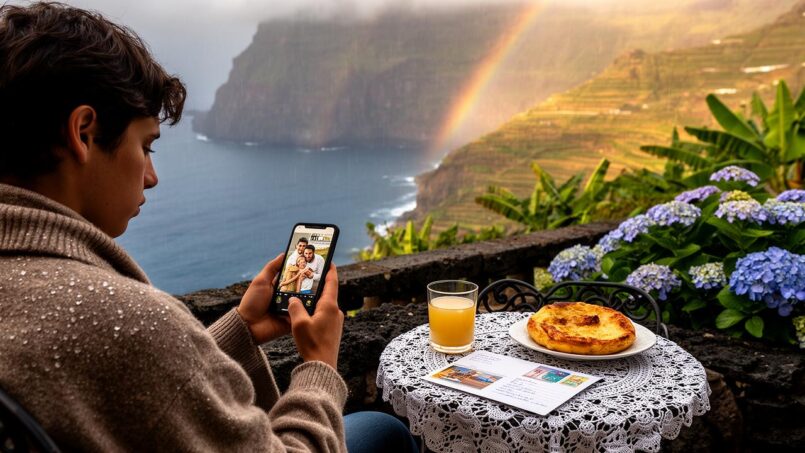
 Published on and written by Cyril Jarnias
Moving to Madeira, whether for a few months of remote work, several years of expatriation, or a retirement project, is often a dream. The island offers a mild subtropical climate, spectacular nature, low crime, a reasonable cost of living, and a welcoming local community. Yet, even in this postcard-perfect setting, homesickness can hit hard.
Good to know:
Homesickness is neither a whim nor a failure, but a normal psychological reaction to the loss of one’s familiar environment. To turn this difficult period into a true step toward integration, it’s advisable to rely on Madeira’s strengths: its landscapes, culture, expat communities, and local mental health resources.
Understanding homesickness when living in Madeira
Homesickness is that dull ache from missing what was “home”: the people, places, routines, language, unspoken codes. Researchers describe it as a form of grieving the life left behind. It can affect exchange students, passing digital nomads, relocated employees, newly settled retirees, or parents following a spouse.
In Madeira, newcomers often find themselves in a dynamic well known in expatriation psychology. The first few days or weeks resemble a honeymoon: marveling at the levadas, Cabo Girão cliffs, Porto Moniz natural pools, Funchal’s Zona Velha streets, the UNESCO-listed Laurissilva forest. Then comes a harsher phase.
Attention:
Between the 2nd and 6th week abroad, homesickness peaks. Irritations with language, paperwork, cultural misunderstandings, and family distance pile up. This frustrating phase, which can last up to three months, usually precedes a period of adjustment and adaptation where new habits and bearings start to form.
Studies show that around 70% of international students experience significant homesickness in the first semester. Among expats, the phenomenon isn’t limited to the early days: people who have been settled for 6 to 8 years can still go through strong waves of nostalgia, especially around holidays, birthdays, or during tough times.
What you really feel: from mood to physical symptoms
Madeira doesn’t cancel the reactions of body and mind to uprooting. Homesickness often manifests on several levels at once.
On a mental level, you constantly ruminate about your home country, idealize “back there,” convince yourself that “everything was better before.” Your brain loops: “I made a mistake,” “I won’t make it,” “I don’t belong here.” Focusing on work or studies becomes hard, and you count the days until your next return.
Description of a psychological state related to expatriation
On an emotional level, the range is wide: persistent sadness, irritability, anxiety, feeling lonely even when surrounded, shame at being “the one who can’t handle it”, jealousy of those who seem to integrate faster. Motivation drops, so does self-confidence.
The body follows: fatigue, headaches, muscle tension, digestive issues, lowered immune defenses. Many sleep too much or too little, eat more (or much less), seek refuge in snacking, alcohol, compulsive shopping. The reflex to withdraw—staying in your Funchal apartment or your house with a view in Ponta do Sol—is common but often worsens isolation.
It’s important to understand that these reactions are normal, common, and that they subside in most cases within a few months if you implement appropriate strategies. Conversely, ignoring them or numbing them with alcohol or constant escape can lead to real depression or abandoning the expatriation project.
Making Madeira a “home”: taming the island to ease nostalgia
Homesickness largely comes from the loss of bearings. However, Madeira has the advantage of offering an environment particularly conducive to creating new routines and attachments.
The main island is home to about a quarter of a million people, mostly in Funchal, a lively but human-sized capital. The north, wilder, features cliffs, laurel forests, and villages like São Vicente or Seixal. To the east, Machico and Caniçal keep a more local feel, with the sea breeze and trails like the Vereda da Ponta de São Lourenço. The west, around Ponta do Sol or Calheta, attracts digital nomads and families seeking sun and quiet.
Establishing routines in a stable setting
Madeira is nicknamed “the island of eternal spring.” Temperatures mostly range between 17°C in winter and 25°C in summer, with no extremes. This climatic stability is a major asset against seasonal blues and makes it easier to establish daily routines that structure your days.
Good to know:
Establishing a daily ritual—like having coffee, working from a coworking space, and taking a walk in the late afternoon—helps anchor both body and mind. Research indicates that a predictable routine helps reduce anxiety, especially during uncertain times.
The same goes for home: cooking at set times, planning a weekly meal list mixing local products (fresh fish, exotic fruits, market vegetables) and recipes from home, setting up reading or movie nights, tidying your place to make it a cozy haven—these are all little lifelines that give you a sense of regaining control.
Using the island’s nature as an antidote
One of Madeira‘s strong points for fighting homesickness is its immediately accessible nature. The levadas, those former irrigation canals turned into trails, let you hike for hours in the Laurissilva forest, discover hidden waterfalls at Lagoa do Vento or along the Levada das 25 Fontes, take in views from Vereda dos Balcões or Bica da Cana, or lose yourself in the mists of Fanal Forest.
Tip:
Spending time outdoors, especially during the day, combines physiological benefits (exposure to natural light and physical activity) and psychological ones (a sense of discovery, wonder, and camaraderie with other hikers). This practice is a proven remedy for anxiety and gloominess.
Even without aiming for major peaks like Pico do Arieiro or Pico Ruivo, walking through Zona Velha streets, taking the cable car up to Monte, strolling through gardens (Jardim Botânico, Monte Palace Tropical Garden, Santa Catarina Park), watching the bustle at Mercado dos Lavradores, or sitting facing the ocean at Ribeira da Janela helps you recenter.
Building a local network: the best protection against isolation
Psychology research is clear: the feeling of belonging to a community is one of the best shields against expatriation distress. In Madeira, the ground is favorable: society greatly values family, neighborly help, shared meals, and face-to-face conversations.
The Madeirans are known to be warm, talkative, quick to strike up a conversation, especially if you make an effort with a few words of Portuguese. Even a “bom dia,” “obrigada,” “até logo” often changes the dynamic and opens doors to deeper exchanges.
Relying on the international community already in place
Madeira has become, in a few years, a hub for digital nomads, active retirees, and expats from all walks of life. It is estimated that people from over 120 nationalities cross paths on the island. A multitude of formal and informal groups structure this community and can play a central role when homesickness strikes.
Active Networks
Overview of the main social networks and digital platforms where presence and engagement are most significant.
The quintessential visual platform, ideal for sharing photos, ephemeral stories, and short videos. It attracts a young and creative audience.
A professional social network dedicated to networking, recruiting, and sharing content related to the business world and careers.
TikTok
A platform for short, viral videos, dominant among Gen Z and Alpha. It favors creative, dynamic, and trendy content.
X (formerly Twitter)
A microblogging network focused on real-time news, discussions, and sharing concise opinions.
| Community / Group | Main Location | Type of Network | Number / Reach (indication) |
|---|---|---|---|
| Madeira Friends | Funchal | Non-profit association, hub, WhatsApp | 424 members in public group, >25 subgroups |
| Madeira Foodies, Expats & Digital Nomads Meet Ups | Funchal | Meetups, large WhatsApp community | 129 Meetup members, >800 on WhatsApp |
| Digital Nomads Madeira (official Slack) | Ponta do Sol & entire island | Official community, Slack, events | Initiative supported by the regional government |
| Deutschsprachige Community Madeira | Primarily Funchal | German-speaking community, events | Largest German-speaking group on the island |
| Madeira Business Network | Funchal | Professional network, consultants & entrepreneurs | Focused on business and local opportunities |
| InterNations Madeira | Funchal | Expat meetups, regular events | Established international community |
| Association M3A | Entire island | Social network for international residents | Physical activities, social events, classes |
These communities organize group hikes (e.g., on PR13 Vereda do Fanal or Levada dos Cedros), dinners, yoga classes, afterworks, professional workshops, and sometimes even volunteer activities like tree planting or school interventions. In 2024, one organization specializing in international life in Madeira coordinated over 440 events bringing together more than 12,000 participants.
Participating in these activities, especially during moments when you tend to withdraw, is often decisive. Many expat testimonials in Madeira share a common thread: the positive turning point began the day they stopped declining invitations and said “yes” to a hike, a community dinner, a Portuguese class, or a networking coffee at a coworking space.
Balancing ties with expats and ties with locals
Expat and nomad groups are valuable, especially at the start: you find practical advice on housing, procedures, daily life, and an ear that immediately understands the nostalgia for another country. But staying solely in an international bubble can also sustain, in the long run, a feeling of being “suspended” between two worlds.
Example:
Building relationships with Madeiran locals—neighbors, shopkeepers, colleagues, language teachers, or other parents—helps you anchor yourself in daily life. Simple gestures, like a regular smile at the café, jokes with the market vendor, or exchanges with the pharmacist or parents at a sports club, gradually create a social safety net. This network can replace the support of extended family left behind.
Again, the key is often language. Many doctors, lawyers, or civil servants speak English, but signing up for Portuguese classes in Funchal, joining conversation groups, or using language apps isn’t just about “getting by”: it sends a signal to locals and is a powerful factor for inclusion.
Anchoring yourself in Madeiran culture to put the loss in perspective
Homesickness rarely fades by cutting yourself off from your new environment. In Madeira, culture is both deeply rooted and very accessible in daily life. Experiencing it from within helps you feel less like a “long-term tourist” and more like a full-fledged resident.
Madeiran life revolves around several pillars: village festivals, gastronomy, music, crafts, and popular religion. The arraiais—neighborhood or parish festivals—mix concerts, food stalls, poncha, dancing, processions, and fireworks on major religious days. You see people of all ages, tables filling and emptying with conversations and dishes.
Other traditions are visible in the villages: the triangular houses of Santana (palheiros), wickerwork in Camacha, the religious architecture of Santa Clara Convent, Funchal Cathedral, and small chapels like Capela do Corpo Santo.
Example:
Madeira’s cuisine, a vehicle for cultural connection, relies on local products. Specialties include: espetada (beef skewers on bay leaves), bolo do caco (bread with garlic butter), black scabbardfish with banana, and bolo de mel (honey cake from sugarcane). Mercado dos Lavradores offers a variety of fruits and vegetables. Discovery pairs with Madeira wines tasted at places like Blandy’s Wine Lodge, Porto de Abrigo in São Vicente, or family-run tascas.
Joining an espetada dinner with folk show, taking a traditional cooking class, attending a bailinho or a fado concert, visiting embroidery or ceramics workshops, hanging out at independent art galleries or exhibitions like “African Passion”—these are all opportunities to step outside yourself, get surprised, and create memories anchored here rather than “back there.”
Staying connected with loved ones without getting trapped in nostalgia
The connection with family and friends back home is an essential tool for limiting homesickness… provided it’s used as support, not a crutch that prevents you from putting down roots on Madeiran soil.
Today, the possibilities are endless: free video calls via WhatsApp, FaceTime, Skype, or Zoom, voice messages, family groups on WhatsApp or Telegram, photo sharing on Instagram, private blogs, family newsletters. Used wisely, these tools allow you to show your daily life in Madeira—a levada, Mercado dos Lavradores, a sunset over Ponta do Sol—and stay updated on the lives of those you love.
Good to know:
Finding a balanced frequency of contact is important. Too-frequent, impulsive calls can reignite the pain of separation, especially if they end in tears or constant comparisons between the two places. Conversely, prolonged silence of several weeks can fuel guilt and a sense of distance.
Many expats find it helpful to establish a “connection plan” from the start with their closest loved ones: parents, siblings, best friends. The idea is simple: together decide on the frequency of calls (once a week, twice a month, etc.), the channels used (video, audio, messages), the times that work with time zones, and stick to it as much as possible.
| Primary Relationship | Preferred Tool | Indicative Frequency | Psychological Goal |
|---|---|---|---|
| Parents / close family | Video call (WhatsApp, Zoom) | Weekly or bi-monthly | Reassurance, maintaining strong emotional bond |
| Best friend | Audio call + messages | Every 1–2 months (call), regular messages | Deep sharing, mutual support |
| Wider circle (cousins, colleagues) | WhatsApp group / email | Monthly or as it comes | Stay “in the loop” without pressure |
| More distant contacts | Social media | Occasional | Keep an overview, no obligation |
This type of framework avoids misunderstandings (“You never call me anymore,” “You talk to me too much, I can’t live my life here”), allows you to plan anticipated moments instead of dealing with surprise calls, and provides stable anchors that support emotional balance.
Tip:
To maintain the connection at a distance, diversify shared activities: cook together via video conference following the same recipe each at your own place, watch a movie or series synchronized, or organize events like a birthday or Christmas in “hybrid” mode, where you appear on screen at certain moments rather than duplicating everything.
Using technology to bring you closer—not to compare—is another crucial point. Social media can be an ally or an enemy: only following perfect vacation photos from other expats, or friends’ nights out back home, can sometimes fuel a feeling of exclusion. Conversely, sharing unfiltered slices of reality, joining local groups in Madeira, limiting scroll time to set periods, reduces the negative impact.
Recognizing when homesickness spills over into mental health
Even with good strategies, some people feel homesickness so intense that it begins to resemble depression: loss of interest in everything, massive isolation, dark thoughts, inability to function at work or in the family. The lines between nostalgia, passing blues, major depression, or adjustment disorder are thin, but some signals should alert you.
A nearly constant sadness lasting at least two weeks, combined with loss of pleasure in things you used to enjoy, significant sleep disturbances (insomnia or hypersomnia), marked appetite changes, overwhelming fatigue, feelings of guilt or worthlessness, concentration difficulties, and especially recurrent thoughts of death or suicide, warrant seeking professional help quickly.
Good to know:
In Madeira, the public health system (Serviço de Saúde da RAM) is part of the Portuguese national system (SNS). Registered residents with a user number can see a general practitioner. With a referral from the GP, access to a psychiatrist or psychologist in the public system is possible. Mental health consultations prescribed by an SNS doctor are generally exempt from co-payments.
The flip side, as elsewhere in Portugal, is wait times: seeing a psychiatrist or psychologist in the public system can take months. Many then turn to the private sector, where appointments are quicker but cost on average between 40 and 100 euros for 50 to 60 minutes. Some private insurance plans cover part of these costs; it’s wise to contact your insurer to know exactly what is covered.
Tip:
To find a professional, several avenues exist: the Portuguese Order of Psychologists maintains a directory of certified practitioners, and international platforms like “It’s Complicated,” “Therapy Route,” “International Therapist Directory,” or “BetterHelp” list psychologists and psychotherapists who work online, often in English and sometimes in other languages. It’s common to have a first free exchange to check compatibility (therapeutic approach, language, experience with expats).
Alongside psychologists, psychiatrists—specialist doctors—can prescribe medication if needed, particularly antidepressants. Again, it’s crucial to inform these professionals of your expatriation journey, your adaptation difficulties, and the nature of homesickness, so that the treatment takes context into account.
In case of acute crisis or suicidal thoughts, the reflex should be to call 112 (European emergency number) or go to the nearest emergency room. National helplines also exist in Portugal, as well as associations like APAV (victim support), youth support structures (Casa Qui, CADin), or LGBT+ organizations (ILGA Portugal), even if they are mostly based on the mainland.
Dealing with the island’s limitations: “island fever,” housing costs, and local tensions
Madeira is not a paradise detached from reality: the island has its own tensions, which can subtly fuel homesickness. Rents have risen sharply in recent years, with property prices up more than 12% in 2024 according to local press, and rents up nearly 8%. The growing presence of digital nomads and expats, combined with limited housing supply, contributes to the pressure.
A one-bedroom apartment in Funchal can rent for between 900 and 1,500 euros per month, with even higher rates on Airbnb, often between 1,800 and 2,500 euros for monthly rentals. In Machico, prices are a bit more reasonable (800 to 1,500 euros per month for a room), but remain high relative to local wages, in a context of unemployment around 14.7%.
Attention:
The rising cost of living, remote workers’ practices in cafés, and short-term rentals create tensions with local residents. For a newcomer, perceiving these frictions can reinforce a feeling of being an ‘intruder,’ especially if burdened by guilt about leaving or discomfort in the role of a privileged expat.
Acknowledging these dynamics, being humble, consuming locally as much as possible, avoiding contributing to speculation (e.g., by favoring medium- or long-term rentals negotiated directly with owners when possible), getting involved in volunteer or mutual aid activities—these are concrete ways to turn diffuse discomfort into positive engagement. And again, social integration—knowing Madeirans, understanding local issues—helps overcome the anxiety of never feeling legitimate.
Tip:
The feeling of confinement or ‘going in circles’ on an island, known as ‘island fever,’ can set in after a few months in Madeira. Rather than seeing it as a rejection of the island, interpret it as a simple need for contrast. To remedy this, plan, when possible, small getaways to the European mainland (accessible by plane) or to the neighboring island of Porto Santo (accessible by ferry). These breaks let you breathe and return to Madeira with a fresh perspective.
Weaving your identity between two shores
Behind homesickness lies a deeper question: that of identity. Who am I, if I am no longer entirely “from there” but not yet truly “from here“? The stories of successive waves of Madeiran migrants—who went to British Guiana, Venezuela, South Africa, Hawaii, or the American Midwest—remind us that there is nothing new about living between two worlds. These diasporas brought their cuisine, faith, and family values, blending them with those of their host countries.
Example:
An expat living in Madeira develops a mixed cultural identity, combining elements from their home country and the island. This shows up as adapting traditional dishes with local products from Mercado dos Lavradores, celebrating Christmas according to both traditions, and following their favorite football team’s matches while sipping a poncha, a typical Madeiran drink, in a bar in Câmara de Lobos.
Seeing your heritage as something alive, evolving with experience, rather than as a fixed block to be preserved intact, can ease a lot of guilt. You are not betraying your country by loving Madeira; you are simply adding another layer to your personal story.
In practice: turning nostalgia into a driver for integration
In daily life, managing homesickness in Madeira comes down to working on three levers simultaneously: strengthening your inner resources, investing in your local ties, maintaining your distant connections.
Good to know:
To overcome homesickness, it’s advisable to accept your emotions without judgment, keep a journal to identify triggers (dates, places, news), and allow yourself to cry. It’s also important to remind yourself of the reasons for leaving (quality of life, climate, safety, opportunities, desire for change). Activities like meditation, yoga, prayer, music, walking, or drawing can bring comfort.
On the local front, every small step counts: signing up for a class, going to a meetup, joining an organized hike, trying a coworking space, visiting a museum (CR7 for football fans, electricity museum, press museum, Santa Clara, Quinta das Cruzes), accepting a coffee offered by a neighbor, asking a colleague to lunch. Many expats settled in Madeira report a richer social network here than in their home country, precisely because they had to take the initiative to build a social life at some point.
Tip:
To maintain the bond with distant loved ones, it’s beneficial to set up regular check-ins. Occasionally send a package with local specialties (like cane honey, biscuits from Fábrica Santo António, or artisanal chocolate from UAUCACAO) and create new traditions, such as a synchronized movie night or a “Madeira” dinner prepared simultaneously on both sides of the screen. This turns distance into two connected poles rather than two competing worlds.
Conclusion: making homesickness a passage, not a dead end
Experiencing homesickness in Madeira is not an anomaly. It is often the paradoxical proof of the depth of the bonds you once formed, and of how seriously you take your life project. On this island of mountains and ocean, of laurel forests and villages clinging to cliffs, the tools are plentiful for transforming this pain into a journey toward a new form of home.
Good to know:
The stable climate, the gentleness of daily life, the richness of the landscapes, the importance of community, the presence of organized expat networks, and access to mental health professionals form a rare combination. This environment does not eliminate nostalgia but offers fertile ground to tame it.
With time, kindness toward yourself, a bit of method to keep in touch with those who matter, and the willingness to open up to this culture between tradition and innovation, many eventually find themselves saying a phrase they never thought they would utter: “Madeira, it’s my home now… without taking anything away from the other home.”
A wealth management project or a question? Contact us now to speak with a wealth management expert.

Cyril Jarnias is an independent expert in international wealth management with over 20 years of experience. As an expatriate himself, he is dedicated to helping individuals and business leaders build, protect, and pass on their wealth with complete peace of mind.
On his website, cyriljarnias.com, he shares his expertise on international real estate, offshore company formation, and expatriation.
Thanks to his expertise, he offers sound advice to optimize his clients' wealth management. Cyril Jarnias is also recognized for his appearances in many prestigious media outlets such as BFM Business, les Français de l’étranger, Le Figaro, Les Echos, and Mieux vivre votre argent, where he shares his knowledge and know-how in wealth management.





