
 Published on and written by Cyril Jarnias
The Madeira archipelago is often seen as just a postcard off the coast of Portugal. But behind the steep cliffs, the laurisilva forest, and the natural swimming pools lies one of the densest historical narratives in the Atlantic. The first great laboratory of Portuguese expansion, the birthplace of colonial sugar, the homeland of a wine that traveled to the four corners of the world, a refuge for exiles and a battleground between European empires, Madeira is both an open-air museum and a concentrated dose of global history.
Islands Imagined Before They Were Conquered
Even before the official arrival of the Portuguese, the islands of the archipelago seem to float in the gray zone between myth and geography. Ancient authors like Pliny the Elder or Plutarch mention “Fortunate Islands” off the coast of Africa, which some historians associate with Madeira. Medieval manuscripts – the Libro del Conocimiento in the 14th century or the Laurentian-Medici Atlas of 1351 – already locate Atlantic islands bearing names that strikingly resemble Madeira and Porto Santo.
14th-century portolan charts mention forms like *Legname*, *Lolegname* or *Lecmane*, all referring to the idea of “wood,” much like the Portuguese word *Madeira*. A Genoese map from 1351 thus designates the large island as “Isola di Legname,” literally “island of wood,” long before its official claim by the Portuguese.
In addition to these cartographic clues, there are accounts from Arab navigators, such as those of Muhammad al-Idrisi, speaking of islands visited by sailors from Lisbon before the Canaries, or even an intriguing archaeological hypothesis: mouse bones dated to the 10th-11th centuries suggest a possible Viking presence, though not colonization.
Madeira was thus known, drawn, fantasized long before it became Portuguese territory. But it was the adventure of Lusitanian navigation that would truly bring it into history.
The “official” history begins when captains João Gonçalves Zarco and Tristão Vaz Teixeira, in the service of Prince Henry the Navigator, are blown off course by a storm and land on a small island they name Porto Santo. From there, a new expedition spots, to the southwest, a dark mass covered in clouds. Approaching it, the sailors discover a completely forested island: this would be Madeira, the “wood.”
The Madeira archipelago, then uninhabited and without large terrestrial mammals, was the first major Portuguese conquest of the Age of Discovery. In 1425, King John I placed it under the administration of Prince Henry the Navigator, who turned it into a feudal province. Land ownership was granted to the Order of Christ, a military order presided over by Prince Henry the Navigator.
To populate and exploit the new space, the monarchy established a system of hereditary captaincies. The archipelago was divided into three major districts:
| Captaincy | Initial Governor | Main Area |
|---|---|---|
| Funchal | João Gonçalves Zarco | Southern Madeira |
| Machico | Tristão Vaz Teixeira | Eastern and northern Madeira |
| Porto Santo | Bartolomeu Perestrelo | Island of Porto Santo |
This model of donatary captaincies would later serve as a template for Portuguese occupation in Brazil.
The first settlers arrived in several waves: families of the captains, minor nobility, poor peasants, fishermen, sometimes former prisoners pardoned in exchange for departure to the Atlantic. Many fled a Portugal ravaged by the Black Death and a nobility that monopolized the best lands.
In Funchal, Zarco settled in a bay shaped like an amphitheater, sheltered from the winds, where an aromatic plant grew abundantly: fennel, funcho in Portuguese. That is the origin of the name of the future capital, Funchal, which would be raised to city status at the beginning of the 16th century.
Burning the Forest, Inventing a Landscape
The main island was then covered by a dense laurisilva forest, a relict subtropical vegetation that still blankets the northern slopes today. To cultivate, the colonists chose a radical solution: they set it on fire. Chronicles speak of a huge blaze that is said to have smoldered for years and devoured two-thirds of the forest cover.
To irrigate the arid southern slopes of Madeira, the colonists built a vast network of narrow, masonry canals called *levadas*. These channels, dug into the cliffsides, capture water from the humid northern zones and transport it over many kilometers, crossing ravines and steep inclines. This historic hydraulic project transformed the island into a cultivated garden and today forms a network of highly popular hiking trails.
The slopes were also carved into dry-stone terraces, the socalcos, where wheat was first planted. Initially, cereal production barely sufficed for subsistence, then generated a surplus exported to the mainland. The colonists’ diet then consisted of fish, vegetables, fruits, and this precious wheat.
But this first economy quickly reached its limits. The decline in cereal yields in the 1450s, combined with the commercial ambitions of Prince Henry the Navigator, would push Madeira toward another destiny: becoming the first great sugar “factory” in the Atlantic.
The White Gold of the Atlantic: The Sugar Era
To escape the wheat crisis, the prince ordered the introduction of sugar cane, a plant still rare and expensive in Europe. Seedlings were imported, likely from Sicily, along with the technical know-how related to mills and crystallization.
The gamble was quickly successful. The subtropical climate, volcanic soils, and abundance of irrigation water combined ideally. By the mid-15th century, hydraulic mills were installed along the rivers, including what tradition holds as the first water-powered sugar mill on Madeira.
The figures show the speed of this takeoff:
| Approximate Year | Estimated Sugar Production | Key Comment |
|---|---|---|
| 1455 | > 6,000 arrobas | Approximately 66–72 tons |
| 1472 | ~ 280 tons | Beginning of direct exports to Flanders |
| 1506 | ~ 2,500 tons | Peak of production |
| Around 1500‑1520 | – | Madeira, world’s top sugar exporter |
Sugar, nicknamed “white gold,” became the pillar of the island economy. The port of Antwerp, a major European hub, had dozens of ships dedicated to the Madeiran trade. It is estimated that around 1480, sixty to seventy ships from Antwerp participated in the Madeira sugar trade.
Merchants from various origins (Genoese, Flemish, Italian, Basque, Catalan, French) settled in Funchal. The sugar trade allowed exchanges for works of art, such as the Flemish altarpieces in the cathedral. Genoese capital financed the mills, and Sicilian experts improved refining techniques.
This success had a human cost: the large-scale implementation of slavery in a colonial plantation economy.
Slavery: A Laboratory for a Colonial Model
Madeira is one of the first territories where a model of colonial exploitation combining large plantations and African slavery was systematically established. From the 1450s onward, slaves were brought to the archipelago.
The first came mostly from North Africa or the Canaries: captured Berbers, deported Guanches. Soon, West Africans supplemented these contingents. They worked in the cane fields, at the mills, or on levada and terrace construction sites.
Number of slaves held by João Esmeraldo, the largest recorded owner on the island.
This enslaved workforce remained numerically smaller than the European population, and many historians note that a large part of Madeiran slavery took a domestic form: valets, cooks, laborers in towns rather than masses of anonymous slaves in gigantic fields, as would later be the case in the West Indies or Brazil. Nevertheless, the structures of the slave plantation were firmly in place, and this model would be exported to São Tomé, Brazil, and then the Caribbean.
The sugar crisis led owners to resell slaves to the Americas. The enslaved population was also affected by low birth rates and difficult living conditions. The official abolition of slavery in Madeira occurred in the 18th century, shortly after that of mainland Portugal.
When Sugar Collapses: Pirates, Competition, and Reconversion
The golden age of sugar was brief. From the second half of the 16th century onward, several factors combined to cause a production decline: cane diseases, soil erosion, growing competition from new Atlantic sugar-producing areas, notably Brazil and São Tomé, not to mention the Canaries.
Within a few decades, Madeiran production collapsed, to the point of no longer meeting local consumption. Many mills were abandoned. Some colonists and entrepreneurs redeployed to new productions; others left the island, taking with them the technical experience of plantation farming.
Due to its strategic position on Atlantic routes, Madeira was a target for pirate raids. In 1566, a French expedition led by Bertrand de Montluc attacked Funchal, landed at Formosa Beach, and pillaged the city for fifteen days. Subsequently, North African Barbary pirates captured hundreds of inhabitants from Madeira and Porto Santo, enslaving them.
To defend itself, the island bristled with bastions. The palace-fortress of São Lourenço dominates Funchal, forts watch over the coves of Machico, Santa Cruz, Ribeira Brava, and Porto Moniz. The population developed an alert system using fires and signals to warn of incursions.
This era of instability did not, however, doom Madeira. It accelerated a spectacular reconversion: from white gold to wine.
The Age of Wine: Madeira, the Atlantic’s Cellar
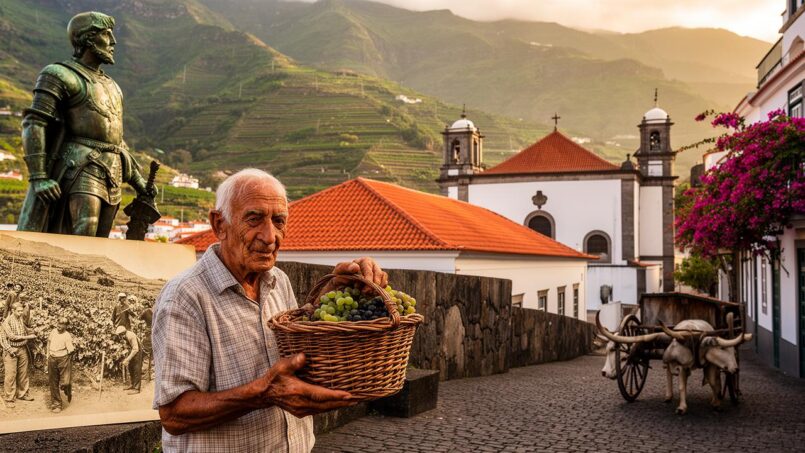
Vines were present on Madeira from the earliest days of colonization, with the introduction of grape varieties like Malvasia (Malmsey) from Crete. But it was only after the decline of sugar that wine became the major export product.
From the 17th century onward, nearly all the sugar lands on the south coast were covered with vines. The wine was fortified with brandy – sometimes aguardente from sugar cane – and a remarkable peculiarity was gradually discovered: long voyages in ships’ holds, subjected to tropical heat and constant motion, improved the wine, stabilized it, and gave it a unique bouquet.
Merchants deliberately heated Madeira wine in warehouses called *estufas*, where it was kept at a moderate temperature for several months. This technique, named *estufagem*, gives the wine exceptional durability, making it particularly resistant to long sea voyages to colonies such as India, the Americas, or Africa.
The relationship with England was decisive. Trade treaties granted customs advantages to Portuguese wines, while the marriage of King Charles II to Catherine of Braganza strengthened Luso-British ties. English merchants settled in Funchal, established trading houses, and took over a large part of exports to England, North America, and the West Indies.
In the North American colonies, it was so prized that it was served at major political events; tradition holds that a toast with Madeira wine accompanied the signing of the United States Declaration of Independence.
Historical tradition
The success was such that it drove some producers to blend the best wines with inferior vintages, particularly those from the north of the island, to meet demand. The 19th-century crises – powdery mildew, phylloxera – subsequently dealt heavy blows to viticulture, leading to the abandonment of many vineyards and a partial shift toward other crops, including… sugar cane again, this time for alcohol used in fortifying wines and rum production.
Funchal, Atlantic Capital: From Mills to Luxury Hotels
Administrative and economic capital, Funchal condenses the history of the country in Madeira within its urban fabric. From the end of the 15th century, the future King Manuel – then Duke of Beja – had a complete set of public buildings erected there: town hall (Paços do Concelho), notary’s office (Paços dos Tabeliães), hospital, customs house, and above all a large church that would become the cathedral.
Cathedral completed in the 16th century, blending Late Gothic and Manueline styles. It features a Mudéjar cedar ceiling, Flemish choir stalls, and a Manueline high altar unique in Portugal. Its bishopric, with a vast diocese, symbolized the global ambition of the Portuguese monarchy.
Around the cathedral unfold civil and religious palaces: the Santa Clara convent founded to house the daughters of the local nobility, Baroque churches decorated with azulejos, traditional-style manor houses. Later, the British presence left its mark in the form of quintas with English gardens, especially in the heights of the city.
Funchal’s heritage can be read as a chronicle of six centuries of history:
| Building / Site | Main Period | Historical or Symbolic Role |
|---|---|---|
| Sé Cathedral | Late 15th – early 16th c. | Religious center, Manueline and Mudéjar masterpiece |
| São Lourenço Palace-Fortress | From the 16th c. | Heart of civil and military power, today regional seat |
| Santa Clara Convent | Late 15th c. | Reflects power of local families and religious orders |
| São Tiago Fortress | 16th–17th c. | Defense of Funchal against privateers |
| Mercado dos Lavradores | 20th c. (1940s) | Testament to agricultural economy and Estado Novo architecture |
| Baltazar Dias Theater | Late 19th c. | Symbol of bourgeois cultural life |
Each era has left its layer: the city of sugar mills, the city of wine merchants, the strategic port occupied by the British, the “Belle Époque” climate resort, the capital of an autonomous region focused on tourism.
Madeira: Crossroads of Empires and Diplomatic Battleground
Though initially an advanced base of Portuguese power, the archipelago quickly became a stake in European rivalries. In the 16th century, the Treaty of Alcáçovas-Toledo confirmed Portuguese sovereignty over Madeira, the Azores, and Cape Verde, while Spain kept the Canaries. But the Portuguese dynastic crisis of 1580 led to a union of the Iberian crowns: for sixty years, Madeira was administered within the Spanish monarchy.
Number of Porto Santo inhabitants captured and enslaved during a Barbary raid in 1617.
At the turn of the 19th century, it was the Napoleonic Wars that thrust Madeira into the heart of maritime strategies. To prevent the archipelago from falling under French control, the United Kingdom negotiated a “friendly” occupation: first in 1801, then from 1807 to 1814. British troops, including the 85th Regiment of Foot, were stationed there; an English governor administered the island, while maintaining nominal Portuguese sovereignty. This presence brought infrastructure improvements, strengthened trade links, and helped build Madeira’s image as a safe haven for the British navy.
During World War I, in 1916 and 1917, German submarines torpedoed ships and bombarded Funchal, causing dozens of deaths and material damage. In response, residents built the sanctuary of Nossa Senhora da Paz in Monte, incorporating the anchor chains of the sunken ships as a symbol of a peace vow.
During World War II, even though Portugal remained officially neutral, Madeira hosted about 2,000 evacuees from Gibraltar, including a Jewish community that discovered an old cemetery belonging to the Abudarham family in Funchal. The German plan to occupy Madeira and the Azores remained a theoretical directive, never executed.
A Land of Exile, Legends, and Illustrious Visitors
Madeira’s history is interwoven with individual destinies that speak volumes about the archipelago’s role in European geopolitics. Emperor Charles I of Austria, deposed after World War I, was exiled to Madeira by the Allies; he died there and still rests in the Church of Our Lady of Monte. Legends claim that a Polish king who disappeared in battle survived and lived under an assumed name on the island, where he had a church built.
On Porto Santo, the figure of Christopher Columbus is deeply rooted in local memory. The Genoese navigator stayed there as a sugar merchant, married Filipa Moniz, daughter of Captain Perestrelo, and is said to have studied Atlantic winds and currents from the archipelago before his voyage to the New World. Today, a statue of Cristóvão Colombo stands on the island, and the *Padrão dos Descobrimentos* commemorates Porto Santo’s participation in the Portuguese maritime epic.
Madeira also attracted scientists and explorers. James Cook stopped there, Charles Darwin observed its volcanic landscapes, Napoleon Bonaparte briefly stopped there on his way to final exile. Later, Winston Churchill came to paint the port of Câmara de Lobos, inadvertently contributing to the construction of the archipelago’s romantic image.
From Military Uprising to Political Autonomy
Domestically, Madeira endured the upheavals of Portuguese history. The proclamation of the Republic in 1910, followed by the establishment of a military dictatorship and the authoritarian Estado Novo, also marked the archipelago. In 1931, against the backdrop of the Great Depression, a revolt broke out in Madeira, led by part of the local garrison, before being crushed by forces sent from the mainland.
After the Carnation Revolution in 1974, a clandestine group, FLAMA, carried out hundreds of bomb attacks. These actions expressed fear of a leftist takeover of the island rather than structured nationalism. The activism waned with the stabilization of the democratic transition and the emergence of an institutional compromise.
This compromise took the form of a political autonomy regime. The new Portuguese Constitution established, for Madeira as for the Azores, a status of “autonomous region”. July 1 – now celebrated as Madeira Day – formalized this shift: the archipelago has its own regional government, a legislative assembly elected by universal suffrage, and broad latitude in economic development, planning, and culture.
Number of years Alberto João Jardim led the regional government of Madeira.
Autonomy came with symbols: a regional flag, adopting blue and gold colors framing the Cross of the Order of Christ, recalling Prince Henry the Navigator’s caravels; an official anthem; the creation of an International Business Center to attract investment; and above all a profound transformation of infrastructure, with roads, tunnels, bridges, and a modernized airport propelling the archipelago into the era of mass tourism.
An Open-Air Museum: Heritage, Landscapes, and Memories
Today, Madeira reads like a palimpsest where every valley, every town preserves a trace of the great phases of its history. The laurisilva forest still covers a large part of the mountainous interior, remnants of the forest the colonists burned to plant wheat and cane. The levadas carve their sinuous furrows into the cliffs, recalling the colossal – often forced – labor that made it possible to cultivate impossible slopes.
Architecture in Madeira, as in Funchal, Santa Cruz, Machico, or Ribeira Brava, illustrates the evolution of power and tastes over the centuries. It is characterized by the juxtaposition of successive styles (Gothic, Manueline, Baroque, Mudéjar, Estado Novo), forming different layers of the past. Buildings such as mother churches, fountains (like that of São Roque), and coastal forts bear witness both to fears of past invasions and expressions of popular piety.
In the north, Santana lines up its small triangular thatched-roof houses, now a symbol of a rural habitat born from centuries of adaptation to a harsh climate. Porto Moniz and its volcanic pools recall a geological origin shaped millions of years ago by now-extinct volcanoes. In the mountains, the village of Curral das Freiras – carved into an ancient crater – harkens back to times when the nuns of Santa Clara sought refuge there from pirates.
The long golden sandy beach of Porto Santo, with a different relief from that of Madeira, reveals a distinct geological history and economic model, now primarily focused on beach tourism. The presence of the Columbus statue and the Discoveries monuments recalls that the island was also a central point on Atlantic sea routes.
Even place names preserve the memory of events: Ponta de São Lourenço, Cabo Girão, Machico, Monte, Terreiro da Luta… So many names that refer to saints, captains, battles, or promises kept – like the one that led to the erection of the statue of Nossa Senhora da Paz after the German bombings.
From Plantation Economy to Global Tourism
Economically, historians often summarize the Madeiran trajectory in three major cycles: sugar, wine, tourism. Each shaped society, landscape, and the archipelago’s openness to the world.
The sugar cycle established unequal land structures, introduced slavery, and attracted a first network of foreign merchants. The wine cycle entrenched a merchant bourgeoisie, forged privileged ties with England and the Americas, and gave rise to terraced vineyard landscapes. The tourism cycle, begun in the 19th century with the first luxury hotels like Reid’s Palace, accelerated in the 20th through aviation and cruises.
Today, Madeira wine and sugar cane rum remain the archipelago’s emblematic products. However, the wine sector faces challenges in marketing and vineyard preservation. Former cane factories, such as those in Calheta and Porto da Cruz, continue to operate during the sugar campaign, evoking the era when Madeira dominated the European sugar market.
But it is clearly tourism – beach, nature, cruise – that now dominates. It relies on what authorities like to present as an “open-air museum“: a dense built heritage, a spectacular natural environment, and a history intertwined with all the great dynamics of the Atlantic, from slavery to world wars, from trade routes to independence movements.
An Island History, a Global Reach
Telling the story of Madeira is not just about reconstructing the chronology of an archipelago. It is about following, on a small but very visible scale, phenomena that shaped modernity: European expansion, the establishment of slave-based plantation economies, the transatlantic circulation of goods, people, and ideas, the clash of empires, the birth of international tourism, and, more recently, debates on autonomy, regional identity, and globalization.
In a little over six centuries of human occupation, Madeira has seen caravel captains, slaves from Africa, Flemish and Genoese merchants, English settlers, imperial exiles, German soldiers aboard submarines, Gibraltar refugees, British tourists seeking sun, workers emigrating to South Africa or Venezuela, and then their descendants returning to the island.
On the scale of a territory barely larger than a few hundred square kilometers, this density of stories is striking. It explains why, beyond its spectacular landscapes, Madeira also fascinates those interested in Atlantic circulations: here, in the alleys of Funchal, on the vineyard terraces overlooking the sea, or along the levadas shrouded in mist, global history has left particularly legible traces.
A heritage project or a question? Contact us now to speak with a heritage management expert.
Disclaimer: The information provided on this website is for informational purposes only and does not constitute financial, legal, or professional advice. We encourage you to consult qualified experts before making any investment, real estate, or expatriation decisions. Although we strive to maintain up-to-date and accurate information, we do not guarantee the completeness, accuracy, or timeliness of the proposed content. As investment and expatriation involve risks, we disclaim any liability for potential losses or damages arising from the use of this site. Your use of this site confirms your acceptance of these terms and your understanding of the associated risks.

Cyril Jarnias is an independent expert in international wealth management with over 20 years of experience. As an expatriate himself, he is dedicated to helping individuals and business leaders build, protect, and pass on their wealth with complete peace of mind.
On his website, cyriljarnias.com, he shares his expertise on international real estate, offshore company formation, and expatriation.
Thanks to his expertise, he offers sound advice to optimize his clients' wealth management. Cyril Jarnias is also recognized for his appearances in many prestigious media outlets such as BFM Business, les Français de l’étranger, Le Figaro, Les Echos, and Mieux vivre votre argent, where he shares his knowledge and know-how in wealth management.





