
 Published on and written by Cyril Jarnias
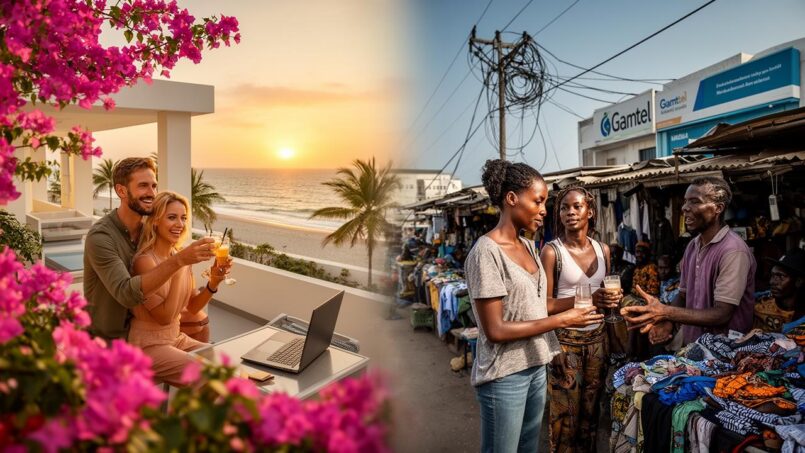
Tiny country nestled in the curve of Senegal, “The Smiling Coast of Africa” is increasingly captivating retirees, remote workers, and entrepreneurs in search of sun, beaches, and low-cost living. But behind the postcard image, expatriation in The Gambia raises very concrete questions: security, health, education, infrastructure, administrative procedures, professional prospects, cultural shock.
Drawing exclusively on available data and studies, this article offers a nuanced overview of the main advantages and disadvantages of expat life in The Gambia, without complacency but also without alarmism.
A small, stable, and relatively safe country, but very poor
With just over two million inhabitants and an area of 11,295 km², The Gambia is the smallest country on the African continent. It stretches along the Gambia River to the Atlantic, where it has a coastline of about 80 km made up of sandy beaches, lagoons, and wetlands rich in biodiversity. Nearly 600 bird species, manatees, hippos, and colobus monkeys can be found there, making it a popular playground for nature lovers.
After a peaceful political transition in 2017, The Gambia is known for its stability and is considered one of the safest African countries for foreigners, with serious crimes targeting expats being rare. However, Western chanceries recommend increased caution due to general crime, risks of sporadic unrest, and the weak healthcare system.
This relatively reassuring security picture should not overshadow a central reality: more than half the population lives below the national poverty line, and poverty reaches 70% in rural areas. Life expectancy hovers around 62 to 67 years depending on gender, a quarter of households are food insecure, and the economy remains classified as a “least developed country” by the UN. The gap in living standards between expats and locals is considerable, which heavily weighs on the perception of foreign presence and on the social responsibility of those who settle there.
Cost of living: attractive… provided you adapt
For a European or North American, the main argument in favor of The Gambia remains the cost of living. Multiple international comparisons rank it among the cheapest countries in the world, with an overall price level about half the global average, and 60 to 70% below the United Kingdom or the United States.
Monthly budget: from “low budget” mode to Western comfort
Estimates vary depending on lifestyle but converge on one point: living “local” remains significantly cheaper than maintaining a very Western standard.
We can summarize some orders of magnitude from various sources as follows:
| Household profile | Estimated monthly budget (USD, including rent) | Observations |
|---|---|---|
| Student / “solo nomad” (frugal) | 428 – 657 | Modest comfort level, simple housing, heavy use of local products |
| Single person (average) | 568 – 1,135 | Intermediate lifestyle, mix of local and imported goods |
| Couple | 1,000 – 1,600 (≈ 1,589 average) | Comfortable level if reasonable consumption of imports |
| Family of 3 | 1,458 – 1,610 | Excluding international schooling |
| Family of 4 | 1,364 – 2,227 | Upper end corresponds to some comfort |
In euros, a budget of €1,000 to €1,500 per month allows a single person or a couple to live decently, provided they don’t consume at the same rate as in London, Paris, or New York. Conversely, a very Western lifestyle (villa with pool, heavy consumption of imported products, frequent outings to tourist spots) can quickly push the bill toward $2,500 to $5,000 USD for a household.
It’s also important to keep in mind that the cost of living, though low, tends to rise, particularly due to global inflation and the increasing price of certain imports.
Housing: huge gap between local market and “expat market”
Rent is the most sensitive variable. Prices depend heavily on the neighborhood, proximity to the ocean, size, level of comfort (generator, air conditioning, pool, security), and whether the property is targeted at expatriates.
In the most sought-after coastal areas (Kotu, Fajara, Kololi, Brufut Heights, Bijilo), the “expat” market shows rates close to European standards:
| Type of accommodation in prime coastal zone | Indicative range |
|---|---|
| 1-bedroom “expat” apartment | $400 – $1,000 USD / month |
| 2-bedroom “expat” house | $800 – $1,500 USD / month |
| 3-bedroom expat-standard villa (Fajara, Kololi, Kotu) | £800 – £1,600 GBP / month |
| Luxury seafront property (purchase) | £200,000 – £400,000 GBP |
The further you move away from the coastal strip and neighborhoods frequented by diplomats and tourists, the more rents drop. In Serekunda, Bakau, Brikama, or in some mixed neighborhoods like Kerr Sering, spacious houses sometimes rent for between £400 and £650 GBP per month. On the strictly local market, a one-bedroom or simple studio can be found much cheaper, but the level of comfort and reliability of services (water, electricity, internet) are correspondingly lower.
Some concrete examples give an idea of rents in dalasis for “decent” but not luxurious housing:
| Type of property (local examples) | Range in GMD / month |
|---|---|
| Furnished studio 45 m² | 7,000 – 11,000 GMD |
| Furnished apartment 85 m² | 15,000 – 25,000 GMD |
Expatriates should understand that the market intended for them (furnished villas, generator, guard, pool) is often priced in hard currencies (USD, EUR, GBP) and very disconnected from local incomes. Long-term leases can help stabilize rents.
Food, outings, services: very affordable in local version
Food illustrates the gap between local consumption and imported cravings. Gambian dishes based on rice, fish, or chicken in small restaurants or eateries often cost a few hundred dalasis, a few euros. A simple lunch in the city center runs around 500 GMD, a hearty local plate can be between £1.60 and £4.00.
At a restaurant, a three-course dinner for two in a mid-range establishment costs between 2,500 and 7,000 GMD (about €50). For groceries, local products like fruits, vegetables, rice, and basic staples are affordable at the markets. On the other hand, imported products (cheese, cold cuts, international brand cereals, alcohol) quickly become very expensive.
Local transport remains very cheap for those using shared taxis or minibuses (“gele-gele”). A single ticket costs about 20 GMD, roughly $0.30 USD. Fuel is cheaper than in the UK, and buying a used vehicle is significantly less expensive than in most Western countries. However, the state of the roads and the quality of the vehicles require a tolerance for spartan comfort.
An expat in Kenya can spend up to $200 USD per week on electricity in a large air-conditioned home.
On the connectivity side, basic internet plans are available from about 500 GMD per month, but stable high-speed (60 Mbps and above) costs from 2,500 to 5,500 GMD. Mobile plans with 10 GB and more remain affordable, around 1,050 GMD. The Gambia is not a high-speed paradise, but remote workers and “digital nomads” have access to an expanding 3G/4G network, cafes and co-working spaces equipped with Wi‑Fi. Outages and slowdowns are still frequent, especially during power cuts or incidents on the ACE submarine cable, currently the only international link.
Work, entrepreneurship, and taxation: niches rather than an Eldorado
The Gambia is not a major international job market. The average net salary is around 4,500 GMD, about $60 USD per month, far from the real cost of living. This extremely low salary level for locals guarantees low labor costs for businesses but also highlights the social chasm between expats and the population.
For a foreigner, it is not advisable to leave without a clear income prospect. Opportunities exist but are targeted.
Promising sectors for expats
Specific needs for technical, managerial, or language skills open up prospects in several fields:
Several economic sectors offer expatriation opportunities in Côte d’Ivoire. Tourism and hospitality on the Atlantic coast cover establishment management, marketing, catering, and travel agencies. NGOs and international cooperation, often for UN agencies, are active in health, education, governance, climate, and agriculture. Information technology, telecommunications, fintech, and financial services are strategic for the development of the digital economy. Engineering, construction, and energy sectors are linked to road and energy infrastructure projects. Teaching, especially in international schools and continuing education (English, IT, management), as well as private healthcare, though regulated, also constitute outlets.
Agriculture (peanuts, cashew nuts, tropical fruits, rice), fishing, and some light industrial activities offer opportunities for foreign entrepreneurs, particularly in agro-processing, logistics, cold chain, export, or producer services. The real estate sector is also experiencing notable development in the greater Banjul area, with a proliferation of agencies and developers.
Starting a business: a simpler environment than in other countries in the region
For those who want to start a business, The Gambia is often described as relatively easy to access on a West African scale. The administration shows a willingness to facilitate procedures, notably through a dedicated agency (Gambia Investment and Export Promotion Agency). In practice, registering a company still requires navigating between the Ministry of Commerce, tax authorities, and banks, which can be time-consuming. Many foreign players use “Employer of Record” service providers to avoid creating a local structure while hiring staff.
An overview of sectors regularly cited for their entrepreneurial potential, especially suited to local contexts and expat needs.
Opening restaurants, cafes, or ice cream and juice stands.
Phone and computer repair shops, automotive services.
Transport services with local drivers and activities in photography and event planning.
Tutoring or training services for individuals and professionals.
Stores offering products specifically sought after by the expat community.
Agro-processing projects: juice pressing, production of condiments, flours, or animal feed.
However, the expat entrepreneur must contend with an environment where electricity, internet access, logistics, and skilled labor are not givens. Structural poverty and dependence on international aid limit the purchasing power of the local clientele and the overall resilience of the economy.
Taxation and “expatriate quota”
Employee income – including expatriates – is taxed at a marginal rate of up to 35% beyond approximately 64,000 GMD annually. Benefits in kind (housing, company car) are heavily taxed, around 27%. Employers can deduct certain contributions to pension funds from their taxable base, but within a limit of 25% of income.
Specific mechanisms target foreign labor, such as an annual “expatriate quota tax,” around 10,000 GMD for ECOWAS nationals and 50,000 GMD for others. Companies wishing to employ expatriates must prove they could not find a local candidate for the position and respect quotas.
In this context, most foreigners working there are either recruited on international contracts (NGOs, UN agencies, foreign companies), or are entrepreneurs, or retirees with outside income.
Health: structure in place, limited resources, private insurance essential
For an expatriation project, the state of the health system is a decisive point. In The Gambia, the institutional architecture seems solid on paper, with a Ministry of Health overseeing a network of primary, secondary, and tertiary facilities, public referral hospitals, a few private clinics, and a university hospital center.
The reality on the ground is more nuanced.
Coverage, costs, and quality of care
Basic infrastructure – health posts, community centers, maternity wards – is relatively well distributed across the country, to the point that geographic access is generally considered “good.” However, the quality of care provided in these public facilities is often criticized. Recurring problems include under-equipment, medicine shortages, lack of qualified staff, and long wait times.
Official pricing is moderate for nationals (about 25 GMD for those over 5, free maternal and child health care), but it remains an obstacle for the poorest and does not cover real costs. Non-nationals pay higher rates. Private hospitals have their own fee schedules, much more expensive but generally affordable for expatriates.
In practice, it is strongly discouraged to rely solely on public hospitals for serious issues or surgical procedures. Expatriates, when possible, turn to private facilities in Banjul, Kololi, Bijilo, and surrounds, or even medical evacuations to Dakar or Europe as soon as the situation requires.
The country bears a heavy burden of infectious diseases (hepatitis, malaria, tuberculosis, tetanus, hemorrhagic fevers…) to which is added a rapid progression of non-communicable diseases (diabetes, hypertension, cardiovascular conditions). Prevention (vaccination, mosquito nets, prophylactic treatment against malaria, water hygiene) cannot be neglected by expatriates.
Human resources and health insurance
Indicators of health human resources are concerning. Medical density remains well below international recommendations, with about 0.1 doctors per 100,000 inhabitants and a total health workforce of around 5.9 per 10,000 people. Brain drain abroad, concentration of staff in the coastal region (over 60% of health workers in the West Coast Region alone), and working conditions in rural areas severely limit care capacity.
For a responsible relocation, especially for families and vulnerable individuals, robust international insurance is essential. It covers the use of local clinics for minor issues and ensures medical evacuation in case of a serious situation.
A national health insurance scheme (National Health Insurance Scheme) has been designed, and it should eventually cover part of the population, including foreign residents present at least six months per year. But its rollout will be gradual, and it does not replace the guarantees offered by international insurance covering evacuations.
Climate, environment, and climate risks: sunny paradise, extreme vulnerability
Weather-wise, The Gambia ticks many boxes of the tropical dream: hot all year round, dry sunny season from November to May, rainy season from June to October, average temperatures ranging from 18°C to 33°C. Annual rainfall generally varies between 850 and 1,200 mm, 90% concentrated during the monsoon period.
This idyllic picture masks, however, one of the world’s highest climate vulnerabilities.
A country on the front line of climate change
Nearly half of the territory lies less than 20 meters above sea level, and a third is at 10 meters or less. Between 10 and 20% of land is seasonally flooded. Sea-level rise projections indicate a risk of submersion for more than 8% of the country’s surface if sea levels rise by one meter, with potential destruction of over 60% of mangroves, a third of swamp areas, and a significant share of lowland rice paddies.
The country is ranked among the ten most threatened states in the world by coastal erosion and sea-level rise.
Recent statistics confirm this diagnosis: gradual decrease in rainfall over recent decades, shortening of the rainy season, multiplication of extreme episodes of drought, strong winds, Sahelian dust, but also catastrophic floods. The 2021, 2022, and 2024 seasons thus experienced flooding of an intensity unprecedented in decades, with tens of thousands of people displaced, massive destruction of homes, infrastructure, and crops.
Since nearly all of the country’s crops (over 99%) are rain-fed, agriculture is particularly exposed. Projections suggest a significant decline in staple cereal yields (millet, sorghum, maize) by 2050, and a drop in agricultural production possibly reaching 35% by 2085.
What this means for an expatriate
For the expatriate, these data translate into very concrete risks: flooded homes every rainy season in some neighborhoods, impassable roads, power outages worsened by storms, temporary food price spikes, weakening of water and sanitation networks, and even population displacement.
In the Gambian capital Banjul, built on a low-lying peninsula, the impacts of climate change are visible: coastal erosion, mangrove degradation, and recurrent flooding. These risks are driving the population to leave the city. A survey indicates that nearly two-thirds of households plan to leave by 2050. The demographic decline is already marked: the population has dropped from about 45,000 in the 1980s to nearly 26,000 today, with more than 1,000 departures per year to the surrounding “Kombos” region.
For expatriation candidates, living in The Gambia therefore means accepting this context of high vulnerability and, as far as possible, carefully choosing the neighborhood, type of housing, and adequate insurance. It also means factoring in the prospect of increasing climate instability over the long term.
Infrastructure, digital life, and daily life: accepted rusticity
Living in The Gambia means accepting a certain rusticity: poor roads, frequent power cuts, sometimes irregular water access, administrative delays. What may be seen as charming for a three-week stay sometimes becomes a major daily irritant.
Electricity and networks
The official goal is universal access to electricity by 2025, with an emphasis on renewables, but the reality is still marked by load shedding. Private generators are almost essential for hotels, businesses, and high-end residences. Those who choose modest housing or less equipped neighborhoods must learn to organize their day around these constraints.
The country relies on a single submarine cable (ACE), which is unreliable, and its backup land links to Senegal are faulty, having already caused national internet outages lasting over 24 hours. Although an internal fiber-optic network (over 1,300 km) exists and over 90% of the population lives within 10 km of a node, only a portion of mobile antennas are connected, and many rural areas experience intermittent connectivity.
4G coverage is expanding but remains incomplete, average mobile speed hovers around 10 Mbit/s, and more than half the population remains offline. Authorities have adopted an ambitious plan to transform The Gambia into an “advanced digital society” by 2033, with targets for broadband coverage, data centers, and cybersecurity, but this project is still largely to be realized.
For a remote worker, these figures mean the country is usable, but not without redundancies (multi-SIM, fixed line + mobile, generator or battery, careful neighborhood choice). For a lover of “everything online,” The Gambia is not yet a digital paradise.
Tips for remote workers in The Gambia
Transport and mobility
Roads are unevenly maintained, and traffic can be chaotic, with a mix of poorly maintained vehicles, excessive speed, and occasional police checks. Local public transport is cheap but often overcrowded, without seat belts or comfort standards. Car rental or buying a vehicle with a local driver is a popular solution among expats, provided they accept a sometimes bewildering driving style and long travel times.
Road checks are frequent, especially around Banjul and on major routes. Expatriates should always carry identification (copy of passport and residence permit) and anticipate interactions sometimes tinged with informal requests for “tea” or “soda,” i.e., small bribes.
Culture, society, and integration: warmth, unwritten codes
It’s no coincidence that The Gambia is called “The Smiling Coast.” The warmth of the welcome, hospitality, community solidarity, and friendliness are regularly cited by foreigners as one of the great assets of living there. The concept of “Teranga” – hospitality, generosity, mutual aid – permeates social relations, from the extended family to neighbors and colleagues.
The family structure is largely extended: it is common for several generations and branches of the same family to share a single compound. Kinship and friendship ties play a central role in access to employment, mutual aid, childcare, or support during difficulties. For an expatriate from more individualistic societies, this relational density can be both comforting and disorienting.
Senegal is a predominantly Muslim country (over 95%), but it is characterized by a recognized climate of religious tolerance, where coexistence with Christian minorities and traditional practices occurs harmoniously. Holidays, whether Muslim or Christian, are often celebrated intercommunally, and mixed marriages, both between ethnic groups and between different faiths, are common.
Cultural codes: what you absolutely need to understand
This hospitality, however, comes with implicit counterparts. To integrate, it is essential to grasp some very structuring codes:
– Respect for elders is fundamental; interrupting, sharply contradicting, or ignoring an elder is very poorly regarded;
– Modesty and discretion in dress and behavior, especially in rural areas or during religious events, are the norm;
– Greetings are a central ritual: you do not start talking about a subject – professional or personal – without a series of polite exchanges, questions about family, health, etc. Ignoring the greeting ritual to “get straight to the point” is seen as disrespectful and can block an administrative or commercial procedure;
– Using the right hand for eating, giving, or receiving is a rule of etiquette;
– Certain topics remain sensitive (local politics, overly personal questions, religion approached critically).
In The Gambia, the notion of “Gambia Maybe Time” illustrates extreme flexibility in schedules and a low importance placed on punctuality. This approach can baffle newcomers, but accepting it often helps reduce stress and adopt a more relaxed pace of life.
Participating in ceremonies (naming ceremonies, weddings, religious festivals), following certain practices like sharing meals from a large communal dish, or taking part in community initiatives are all signals of integration and respect.
Languages and language barrier
English is the official language, used in schools, administration, and business. For many English-speaking expats, this is a major asset facilitating daily communication. But in practice, the majority of the population primarily uses national languages (Mandinka, Wolof, Fula, Jola, etc.) in everyday life.
Speaking only English limits access to certain informal situations (markets, taxis, street conversations) and sometimes restricts understanding of cultural nuances. Learning a few basic phrases in Mandinka or Wolof is a very worthwhile investment to gain trust and goodwill from interlocutors, avoid certain misunderstandings, negotiate a price, or simply get around in a taxi.
Safety, crime, and rights: a generally safe country but not without risks
Comparing The Gambia to other West African countries, crime rates remain relatively low, especially for violent crimes targeting foreigners. Kidnappings for ransom, for example, are almost nonexistent. However, recent reports indicate a notable rise in petty crime (pickpocketing, bag snatching, burglaries, scams), fueled by rising food prices, unemployment, and widespread poverty.
The beaches and neighborhoods of Kololi and Senegambia are frequented by “bumsters,” young men who offer services (guide, companionship, flirtation) and solicit money or gifts, sometimes insistently. It is important to learn to refuse firmly but politely and to identify potentially abusive situations.
The police force is present through patrols or checkpoints but suffers from a structural lack of resources: few vehicles, limited equipment, uneven training. Resorting to small bribes to “speed up” a procedure or avoid a fine is not uncommon. Procedures in cases of assault, domestic violence, or sexual abuse can be very difficult for victims, especially women, due to a lack of support services, shelters, and specific investigator training.
In The Gambia, consensual homosexual relations are criminalized with penalties up to life imprisonment. Social stigma is very strong, authorities sometimes make hostile statements, and the law penalizes failure to report certain acts. Expatriation is objectively risky, forcing non-heterosexual individuals to maintain absolute discretion.
Finally, regulations on narcotics are extremely strict, with zero tolerance for possession or trafficking, and heavy prison sentences. Cases of “sting operations” set by agents for foreigners have been reported. The utmost caution is required.
Education: decent international options, struggling public system
For families, the school question is crucial. The Gambian education system, structured into 3 years of pre-primary, 6 years of primary, 3 of “upper basic,” 3 of secondary, and 4 of higher education, has been the subject of ambitious reforms for several years. Basic schooling has gradually become free, and the Constitution guarantees the right to fundamental education.
Quality indicators in basic education reveal persistent problems: a shortage of qualified teachers, overcrowded classrooms, lack of materials, and low exam pass rates. Assessments indicate that by the end of primary school, only a small proportion of children master basic reading skills, with a significant gap between urban and rural areas. National exams confirm this trend, showing much lower pass rates in public schools than in private institutions.
For expatriates, the solution almost exclusively lies in private international schools, mainly concentrated in the Banjul region and coastal neighborhoods (Fajara, Kololi, Bijilo). These institutions offer international curricula (International Baccalaureate, IGCSE, British curriculum) with more favorable student-teacher ratios, generally better-trained teachers, and a more secure environment (security, school transport, on-site meals).
Annual tuition fees per child for expatriates range between $2,000 and $8,000 USD.
Some parents choose hybrid alternatives: reputable local schools in primary with academic reinforcement at home, distance learning for secondary, or enrollment in bilingual structures (e.g., French-English) to prepare more easily for higher education abroad. In all cases, long-term planning – including the prospect of leaving for university – must be factored in from the decision to expatriate.
Immigration procedures: doable, but neither simple nor cheap
Entry and stay in The Gambia are governed by specific legislation, and the apparent flexibility for short stays should not mask the complexity for those wishing to settle long-term.
Visas and residence permits
Many nationals of European countries, Commonwealth countries, and ECOWAS can enter without a visa for short tourist stays (generally up to 90 days), or obtain a visa on arrival at Banjul when there is no Gambian diplomatic representation in their country. For other nationalities, prior “Entry Clearance” may be required, with a local host providing financial and administrative guarantees.
To live or work in Switzerland beyond a tourist stay, any foreigner must obtain a residence permit (and a work permit if applicable). These permits, valid for one year and renewable, require a complete file including passport, employment contract, employer letter, criminal record, medical certificate, and proof of financial resources.
The permit categories notably distinguish:
– residents “without gainful activity” (retirees, persons of independent means, students);
– skilled workers and investors;
– low-skilled workers, small traders, and self-employed, often ECOWAS nationals;
– humanitarian, religious, student, or medical treatment cases.
ECOWAS nationals benefit from free movement provisions but must still apply for a permit after a certain period of presence (generally beyond 90 days). Non-ECOWAS nationals are additionally issued an “Alien Card” or Non-Gambian ID Card, to be carried at all times.
Cost and delays
Permit fees have increased significantly in recent years and vary by status (ECOWAS or not). For a non-ECOWAS national, the combination “residence permit + alien card” falls within ranges of several thousand dalasis per year. Some information indicates fees approaching or exceeding 5,700 to 7,700 GMD for one year, or even more for certain permit types.
In addition to the main price, costs include the initial visa, visa extensions, Entry Clearance for certain nationalities, and, where applicable, the ‘quota tax’ for employers. Recent increases have almost doubled the cost of some permits.
Announced processing times for a work permit range from 3 to 6 weeks, sometimes longer during administrative backlogs. It is advisable to submit any renewal application at least two months before expiration, to avoid falling into irregular status, which is subject to fines or even prosecution.
In practice, many expatriates rely on their employer, an agency, or a local lawyer to navigate these formalities. Independent entrepreneurs or remote workers without a Gambian employer should expect a significant administrative burden.
Who is The Gambia a good expatriation destination for?
At the end of this overview, the profile of an expatriate for whom The Gambia represents a coherent choice emerges fairly clearly.
The country offers real assets for:
Different expat profiles can find their place by adapting to local realities. Here are the main types identified:
With a stable pension or passive income, they seek a low cost of living, warm climate, and warm social environment.
Workers for NGOs, international agencies, or humanitarian missions, often supported by organized structures for housing, insurance, and permits.
Ready to invest time and capital in identified niches (tourism, restaurants, agribusiness, real estate), with a good tolerance for country risk.
Able to manage internet/power outages with backup solutions (co-working, multiple connections, generators) and a job not sensitive to latency.
Accepting the high cost of international schooling and a limited healthcare system, ensuring good medical evacuation coverage.
On the other hand, The Gambia appears much less suitable for :
Expatriation in Algeria is not recommended for several profiles: expats without guaranteed income hoping to find a job in a tight and competitive labor market; people with health vulnerabilities requiring a high-performance hospital system; LGBT+ individuals facing an unfavorable legal framework and social climate; families unable to finance private international schools or solid distance schooling; and people with low tolerance for uncertainty, administrative slowness, power cuts, and local time flexibility.
Expatriating in The Gambia is neither a simple low-cost beach escape nor a desperate adventure. It is choosing a country that is humanly rich, culturally intense, but economically fragile and highly exposed to climate shocks. Those who prepare seriously – in terms of finances, health, rights, understanding of social codes – can find a deeply transformative life experience. Those who go on a whim, attracted only by cheap rents and sunny beaches, may soon measure the hidden price of expatriation on “The Smiling Coast.”
Disclaimer: The information provided on this website is for informational purposes only and does not constitute financial, legal, or professional advice. We encourage you to consult qualified experts before making any investment, real estate, or expatriation decisions. Although we strive to maintain up-to-date and accurate information, we do not guarantee the completeness, accuracy, or timeliness of the proposed content. As investment and expatriation involve risks, we disclaim any liability for potential losses or damages arising from the use of this site. Your use of this site confirms your acceptance of these terms and your understanding of the associated risks.

Cyril Jarnias is an independent expert in international wealth management with over 20 years of experience. As an expatriate himself, he is dedicated to helping individuals and business leaders build, protect, and pass on their wealth with complete peace of mind.
On his website, cyriljarnias.com, he shares his expertise on international real estate, offshore company formation, and expatriation.
Thanks to his expertise, he offers sound advice to optimize his clients' wealth management. Cyril Jarnias is also recognized for his appearances in many prestigious media outlets such as BFM Business, les Français de l’étranger, Le Figaro, Les Echos, and Mieux vivre votre argent, where he shares his knowledge and know-how in wealth management.





