
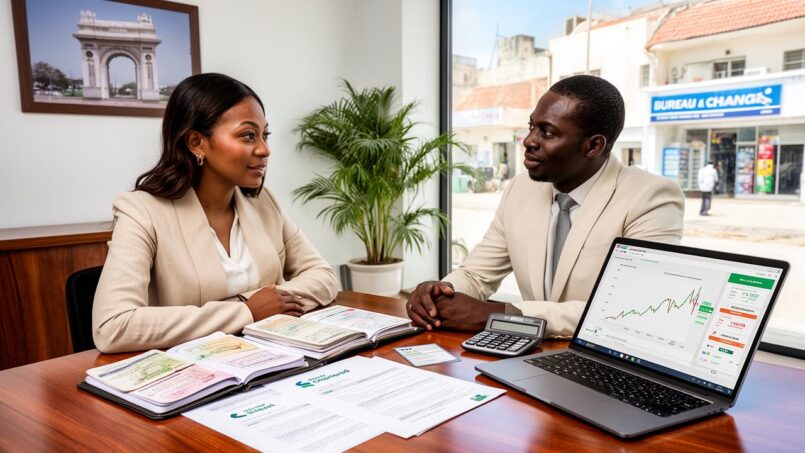
 Published on and written by Cyril Jarnias
Settling in The Gambia involves far more than finding housing or a job. For an expatriate, true stability requires rigorous financial organization: opening accounts, international transfers, choosing between a local bank, an offshore bank, or a digital bank, understanding taxation, and managing currency risk. The Gambian banking system is small but growing, increasingly connected to international networks, and governed by a strengthening regulatory framework. This offers opportunities, but also some pitfalls to avoid.
This practical guide covers key aspects of financial management for expatriates in The Gambia, including opening a bank account, types of available services, methods for sending and receiving money, as well as tips for optimizing taxation and asset protection in compliance with local legislation.
Understanding the Gambian banking landscape as an expatriate
The banking system is supervised by the Central Bank of The Gambia (CBG), based on Ecowas Avenue in Banjul. This institution sets exchange rate policy, regulates commercial banks and foreign exchange bureaus, and ensures sector stability. There are about a dozen licensed commercial banks, mostly controlled by foreign groups, often Nigerian or international.
The official currency is the Gambian dalasi (GMD). However, accounts can be opened in international currencies, primarily U.S. dollars (USD), euros (EUR), and British pounds sterling (GBP), via foreign currency accounts or domiciliary accounts.
It is useful to keep some financial figures in mind to put the environment into context.
| Indicator | Value / Information |
|---|---|
| Currency | Gambian dalasi (GMD) |
| Adult population (15+) | Approximately 1.60 million people |
| Number of commercial banks | Approximately 12 to 13 |
| Share of diaspora remittances in GDP | Approximately 20% |
| Currency used for tax conversion | GMD, at the average rate set by the CBG |
The sector is small but evolving: banks are rolling out more online services, cards, and mobile apps, while the CBG is modernizing the regulatory framework, particularly for foreign exchange bureaus, money transfer operators, and fintech solutions.
For an expatriate, this context has two major implications. First, standard banking fees (account maintenance, small transactions) are generally lower than in highly banked countries like Switzerland. Second, competition remains limited, which keeps certain specific costs (international services, currency exchange, transfers) still relatively high.
Opening a bank account in The Gambia as an expatriate
Opening a local account is essential for an expatriate living, working, or investing in The Gambia. It is the foundation for receiving a salary, paying rent, settling bills (electricity, internet, water), and reducing the cost of cash withdrawals.
Gambian banks generally welcome non-residents and foreigners. Opening an account is described as relatively straightforward, provided you present the right documents and accept a certain amount of paperwork.
Documents typically required from expatriates
Requirements vary from one institution to another, but the same main categories always appear:
To open a bank account in The Gambia, you must provide several mandatory documents: a valid identity document (passport, sometimes supplemented by a residence card or work permit), proof of local address (utility bill, rental contract), and sometimes proof of address in your home country, a tax clearance certificate (Taxpayer Identification Number – TIN) obtained from the Gambia Revenue Authority at a modest cost, recent passport-sized photos, as well as proof of professional status (employment contract, business documents). A bank reference letter may also be required, especially for checking accounts.
For a couple wishing to open a joint account, the bank will additionally require a copy of the marriage certificate and documents for each signatory.
Minimum deposit amounts remain modest for an expatriate: accounts can be opened with a few hundred dalasis, or even zero for some products, although certain foreign currency accounts or investment accounts may require higher thresholds.
Types of accounts useful for an expatriate
An expatriate generally needs to combine several products rather than relying on a single standard account.
A standard GMD checking account allows you to manage daily financial operations, such as receiving local salaries, making payments by card or check, and transferring money to suppliers. It also provides access to banking services like an overdraft facility or consumer loans. Banks typically issue a debit card (Visa, Mastercard, or Verve) linked to the account, usable at ATMs and at merchants equipped with payment terminals.
A GMD savings account serves as a reserve for precautionary cash, with a moderate interest rate but high flexibility. Some banks offer thematic savings products, for example, accounts to finance education, with terms of 5 to 18 years and recommended periodic deposits.
Foreign currency accounts (domiciliary or foreign currency accounts) are central for any expatriate who receives income in foreign currency, receives transfers from abroad, or prepares outgoing transfers. You can hold USD, EUR, or GBP in these accounts, benefit from real-time conversions, and limit losses due to dalasi fluctuations.
For savers with larger amounts, two investment options are available: term deposits and Treasury bills. A term deposit can be taken out for 3, 6, 9, or 12 months, with a minimum amount of about 10,000 GMD, a fixed interest rate, and can be used as collateral for a loan. Treasury bills, on the other hand, require a typical minimum investment of 25,000 GMD for similar durations (3, 6, or 12 months) and can also serve as collateral for credit lines.
The following table illustrates, for indicative purposes, the logic behind a few typical products in Gambian banks:
| Product | Currency(ies) | Minimum amount (indicative) | Term / Use | Key advantage for an expatriate |
|---|---|---|---|---|
| Checking account | GMD | ~500 GMD and up | Daily use | Salaries, payments, withdrawals |
| Savings account | GMD | ~2,000 GMD | Long-term, flexible | Building a reserve in local currency |
| Foreign currency account (domiciliary) | USD, EUR, GBP | 0 to a few hundred units | No fixed term | Receiving international transfers, managing exchange |
| Term deposit | GMD | 10,000 GMD | 3–12 months | Higher interest, possible loan collateral |
| Treasury bills | GMD | 25,000 GMD | 3–12 months | High security, credit support |
Some banks structure specific product lines for the diaspora, with USD, EUR, or GBP accounts, tiered levels (silver, gold, platinum), and fixed-term investment products, sometimes described as “risk-free” in the sense that the capital is guaranteed over the contractual period.
Banks present and profiles useful to expatriates
Expatriates have a fairly wide choice of institutions, ranging from local banks to subsidiaries of pan-African or international groups.
For example:
| Bank | Origin / Particularity | Services useful for expatriates |
|---|---|---|
| Ecobank (Gambia) Ltd | Member of a pan-African group present in 30+ countries | Multi-currency accounts, intra-network transfers |
| Guaranty Trust Bank (Gambia) Ltd | Subsidiary of a Nigerian group active in West Africa | Strong local presence, online services |
| Standard Chartered Bank (Gambia) Ltd | Present for over a century, group based in London | Strong experience with international clients |
| Trust Bank Ltd | Indigenous bank, headquartered in Banjul | Connection to the local economy and diversified clientele |
| Zenith Bank Gambia Ltd | Subsidiary of a Nigerian group | Savings accounts, cards, digital services |
| Agib Bank | Islamic bank | Products compliant with Islamic finance (Mudarabah, Musharakah) |
Most of these banks offer:
– Checking and savings accounts in GMD and foreign currencies.
– Visa or Mastercard debit cards.
– Online and mobile banking services.
– Personal loans, mortgages, business financing.
– Foreign exchange, international trade, and treasury services.
For an expatriate, the choice is often based on: the presence of a parent company in their home country or region, the quality of the online banking platform, the branch network in the areas where they live, and the fee conditions for international transactions.
Taxation and tax residency: what an expatriate needs to know
Living in The Gambia means clearly situating yourself within the local tax system. The central question is tax residency, as it determines the scope of taxation.
An individual is considered a Gambian tax resident if they spend at least 183 days in the country during the tax year, or if their cumulative presence reaches this threshold, or if they own a home in the country. Once a resident, they are taxed on all their worldwide income. Conversely, a non-resident is only taxed on their Gambian-source income.
The Gambian tax system applies progressive income tax, with several brackets. There is no generalized personal allowance, which limits reductions to the taxable base.
Applicable to income up to 18,000 GMD.
Rate applied beyond the first income threshold.
Second progressive tax bracket.
Intermediate rate for higher incomes.
Top bracket, applied beyond a certain income level.
For expatriate employees, an important feature is the Expatriate Payroll Tax (or Quota Tax), payable by the employer for each non-Gambian employee. The annual amount is 40,000 GMD per expatriate employee from outside ECOWAS, and 10,000 GMD for citizens of the West African region. This tax cannot be passed on to the employee; it remains the company’s responsibility.
The Gambia has concluded double taxation agreements with several countries (United Kingdom, Sweden, Norway, Switzerland, Taiwan, France). For expatriates from these countries, these agreements help reduce or avoid double taxation. The Gambia provides a tax credit mechanism: tax paid abroad can be offset against Gambian tax due on the same income, up to the amount of the corresponding Gambian tax.
In practice, managing these complex situations (income in multiple countries, offshore investments, remote work) more than justifies consulting a specialist advisor in cross-border matters. Several international firms specifically target expatriates and can coordinate banking, tax, and wealth management aspects.
Managing everyday payments: cards, cash, mobile
For daily life, expatriates juggle between card payments, cash withdrawals in GMD, and possibly digital wallet usage.
Visa and Mastercard are widely accepted at ATMs and in many formal businesses (supermarkets, hotels, restaurants, car rental agencies, travel agencies). Contactless and chip & PIN payments are possible, including via wallets like Apple Pay or Google Pay when terminals allow it.
However, it remains essential to keep a portion of cash, especially for markets, tips, and small businesses that do not yet accept electronic payments. The card + cash combination is the safest setup.
Be mindful of fees:
Withdrawals using a foreign card in The Gambia often incur double fees: those from the card issuer (about 3% international transaction fee plus withdrawal fees) and a commission from the local bank. Additionally, some hotels or service providers may apply extra charges of up to 5% on credit card payments.
A good practice is to use an international card optimized for travel, with low or no foreign exchange fees, and always pay in local currency (GMD) to avoid markups from “dynamic currency conversion” at the point of sale.
On the Gambian card side, several banks issue GMD debit cards, sometimes usable internationally, linked to deposit accounts. They typically include SMS or email notifications, blocking features, and the chip & PIN standard.
International transfers: sending and receiving money in The Gambia
Money transfers are at the heart of the financial life of expatriates and the diaspora. On one hand, foreigners living in The Gambia receive funds from their home countries or send money for investments and family expenses. On the other hand, Gambian citizens abroad send massive remittances to The Gambia: it is estimated that remittances from expatriates account for about one-fifth of GDP.
Available solutions fall into three main categories: traditional bank transfers, specialized money transfer operators, and digital multi-currency platforms.
Traditional bank transfers
Gambian banks have SWIFT codes and can receive international transfers in foreign currencies, whether to GMD or foreign currency accounts. An expatriate can arrange a transfer from their foreign bank to their Gambian account, provided they supply the SWIFT code and account details.
Traditional bank transfers have two main drawbacks: high cost (fixed fees and exchange rate margins applied) and slow execution, potentially taking several business days. However, they remain the most common solution for business transactions or large amounts.
Money transfer operators
Several well-known international services operate to The Gambia, either directly or through local partners:
| Transfer service | Receiving methods in The Gambia | Particularities |
|---|---|---|
| Western Union | Cash pickup, deposit to account, mobile wallet depending on partnership | Global presence, ID required for pickup |
| Ria | Cash pickup, sometimes bank deposit | Mobile app, short delivery times |
| WorldRemit | Bank account, cash pickup, mobile wallet | 90% of transfers to its Gambian partners are reported to arrive within minutes |
| Xoom (PayPal) | Cash pickup (e.g., Zenith Bank, AGIB, Skye Bank), bank deposit | Integration with PayPal, speed |
| Remitly | Cash pickup at a wide network of banks and bureaus, account deposits | First transaction fee-free offer for new customers, choice between “Express” or “Economy” speed |
| BOSS Money | Cash, bank deposit, sometimes home delivery | Some transactions delivered in minutes, refund guarantee if not delivered |
| APS International | Cash, remote purchase services (Nduga), electricity payments (Cash Power), mobile top-ups | Large payment point network, direct integration with mobile operators |
These players rely on Gambian banks such as Access Bank, AGIB, Bloom Bank, Ecobank, GT Bank, Trust Bank, Zenith Bank, or recognized foreign exchange bureaus. Delivery times are often very short (minutes to a few hours) and fees are more competitive than via a standard interbank transfer, especially for small or medium amounts.
Multi-currency digital platforms and banks
For highly mobile expatriates or remote workers, multi-currency accounts and cards are a powerful tool. They allow you to hold several currencies, get paid in different currencies, and transfer to The Gambia at exchange rates close to the market rate.
These international services allow sending funds to The Gambia via SWIFT transfers to local bank accounts or transfers to cash pickup points.
Global money transfer service allowing funds to be sent to agents in The Gambia for quick cash pickup.
Online transfer platform offering options to send to bank accounts, for cash pickup, or mobile top-up in The Gambia.
– Wise, with a multi-currency account and card allowing you to hold over 40 currencies, conversions at the mid-market rate, and a few free withdrawals per month.
– Revolut, which enables exchange of more than 30 currencies with monthly limits without exchange fees on the standard plan and paid plans to remove those limits.
– Other providers like Monese, N26, or Payoneer, useful especially depending on the expatriate’s main country of residence.
The most effective combination for an expatriate in The Gambia often involves:
1. Using an international bank or fintech to centralize your income and pay your global expenses in multiple countries. 2. Funding a local Gambian account in GMD or foreign currency via transfers or specialized remittances for local needs (rent, school fees, utilities, real estate investments).
Foreign exchange bureaus: a key link for the expatriate
The CBG strictly regulates foreign exchange bureaus, known as “foreign exchange bureaux.” The revised guidelines in 2024 strengthen oversight, particularly regarding anti-money laundering and counter-terrorism financing. Only Gambian nationals can obtain a foreign exchange bureau license, in the form of a limited liability company, with a mandatory deposit of 1 million GMD with the central bank.
For the end user, this regulation translates into: better protection and greater transparency in business practices.
Foreign exchange bureaus must prominently display their license and buying/selling rates. They are required to keep detailed records for each transaction, including the client’s identity, amount, exchange rate, GMD equivalent, and nature of the operation. Certain transactions are prohibited, notably purchasing foreign currency checks above specific amounts and using agents to collect funds.
Foreign exchange bureaus cannot open accounts, lend, or accept demand deposits: their role is strictly limited to the purchase and sale of cash foreign currency. For an expatriate, this means they serve as a point for occasional currency exchange, but not a substitute for a bank account.
The regulation enhances security (less risk of dealing with an informal or unauthorized operator), at the cost of some formalization (presenting an ID, traceability).
Offshore and wealth structuring: advantages and precautions
For high-income expatriates or international entrepreneurs living in The Gambia, opening offshore accounts in other jurisdictions can seem attractive: better asset protection, potential tax optimization, currency diversification, access to developed financial markets.
Offshore accounts are accounts held by Gambian residents in foreign banks, often based in financial centers like the Bahamas, Belize, Cayman Islands, Panama, or Seychelles. These banks typically do not work with their own residents but with non-residents, offering high confidentiality and advanced investment platforms (stocks, bonds, precious metals, etc.).
The main advantages are:
– Asset protection in case of litigation or local instability.
– The ability to benefit from interest rates or investment opportunities unavailable in The Gambia.
– Hedging against dalasi fluctuations through accounts in strong currencies.
– Greater confidentiality, although this is diminishing as international regulations tighten.
However, several limitations and obligations apply:
Opening an offshore account is demanding, requiring extensive documentation (income, residence, banking history) and sometimes high minimum deposits. Fees (management, transfers) and minimum balance thresholds are often higher than in The Gambia. Gambian authorities have access to information about these accounts and use it against tax evasion. Interest or income generated must be declared in The Gambia by tax residents above a certain threshold, even if not taxed in the offshore jurisdiction.
Thus, offshore can be a relevant tool for diversification, provided it remains fully declared and compliant. It is neither a legal way to escape Gambian tax nor a space free from international surveillance.
Growing role of digital banks and neobanks
The typical profile of an expatriate or remote worker in The Gambia is increasingly “digital nomad“: income paid in several countries, frequent stays outside The Gambia, online activities. For these profiles, purely local banks, oriented toward the domestic market, are not always sufficient.
Neobanks and international fintechs provide several missing pieces:
Discover the main services offered by neobanks and modern financial institutions for managing your money abroad without excessive fees.
Hold around forty currencies and get paid locally via dedicated banking details (IBAN for euro, local account details for dollar, pound, etc.).
Benefit from cards with no major foreign exchange fees, with ATM fee reimbursements or favorable limits.
Access integrated budgeting tools, real-time alerts, and detailed spending analysis.
Enjoy a 100% digital opening process, often accessible without residency in the bank’s country.
These tools are particularly suitable for:
– Foreign freelancers who invoice clients in Europe or North America.
– Expatriate employees paid in USD or EUR, who then periodically fund their Gambian account.
– Business owners operating in The Gambia but selling internationally.
The main limitation is that these neobanks are not Gambian players: they do not allow you to fulfill all local obligations (some organizations may require an account with a Gambian bank), and their cards are not always optimized for all ATMs in the country. The optimal strategy therefore often combines:
– One or two global digital solutions for cross-border flows.
– One or two accounts with Gambian banks for local anchoring and compliance.
Regulation, stability, and protection: what the Gambian framework guarantees
The CBG does more than just supervise banks and foreign exchange bureaus. It establishes a set of prudential standards (capital ratios, internal controls, risk management) designed to prevent bank failures and protect depositors. The system is in a phase of strengthening, with recent reforms to better integrate technological risks (mobile banking, fintech) and align The Gambia with international standards in anti-money laundering.
For customers, this means: a better experience and services tailored to their needs.
Financial institutions are subject to rigorous KYC requirements (identity, address, income), enhanced monitoring of currency transfers to combat money laundering and terrorism, and risk sanctions from the CBG, including license suspension, for non-compliance.
Supervision is not limited to traditional banks: foreign exchange bureaus, transfer operators, and financial innovation incubators in enterprise zones are also regulated. The Gambia has, for example, established an Enterprise Zone with a financial incubator, where innovative structures can obtain a provisional banking license limited to operations within that zone. This demonstrates a willingness to experiment with new models while maintaining a control perimeter.
For an expatriate, the challenge is twofold: take advantage of the legal framework to secure your assets, while remaining attentive to the soundness and reputation of the chosen banking institution. It is prudent to inquire about these criteria before opening any account.
– The exact status of the license (fully licensed commercial bank vs. restricted or provisional license).
– Shareholding and the home country of the parent company.
– The quality of governance and financial communication (audited accounts, experienced management committee).
Building a comprehensive financial strategy in The Gambia
Settling in The Gambia is not just about opening a checking account. For an expatriate, especially if planning a stay of several years, it is useful to think of your financial situation as a system organized around several axes.
A first axis is local liquidity: a GMD checking account to cover monthly expenses, with a safety reserve in a local savings account and, if applicable, access to an overdraft or credit facilities.
To manage currency risk, it is advisable to open one or more foreign currency accounts (domiciliary) in a Gambian bank, and combine them with an international multi-currency account. This strategy allows you to easily move funds between different currencies based on your income and expense forecasts, as well as exchange rate fluctuations, particularly between the Gambian dalasi (GMD) and the U.S. dollar (USD) or euro (EUR).
A third axis concerns investments and project preparation: term deposits and Treasury bills in The Gambia for GMD amounts, supplemented by investments abroad via offshore banks or international investment platforms, taking into account Gambian tax obligations and double taxation treaties.
For a safe settlement, it is essential to regularize your residence status, understand the rules for income and capital gains taxation, and correctly declare your income and foreign accounts. The Gambia also offers incentives for expatriate entrepreneurs, such as special investment certificates or export processing zone licenses, which may grant temporary tax exemptions.
By intelligently combining these levers, an expatriate can:
– Reduce overall banking fees.
– Reduce exposure to currency risk.
– Take advantage of local and international return opportunities.
– Remain compliant with Gambian laws and those of their home country.
Conclusion: The Gambia, a human-scale financial platform for expatriates
The Gambia is neither a major financial center nor an overdeveloped banking hub. Its banking system is compact, dominated by a few large players, and still marked by limited financial inclusion for part of the population. Yet, for an expatriate, this smaller scale also has advantages: relatively straightforward account opening procedures, contained standard banking fees, and the possibility of close relationships with your bank.
The real challenges lie at the intersection of three worlds:
An overview of the main banking solutions tailored to the needs of expatriates living in The Gambia, combining local anchoring and global connectivity.
Essential for integrating into the country’s economy, managing daily expenses and local transactions.
Transfers and foreign exchange are crucial for connecting The Gambia to home countries and new financial geographies of expatriates.
Digital platforms and neobanks offering flexibility and speed for a multi-country lifestyle.
Mastering these three dimensions, combined with a solid understanding of taxation and exchange regulations, makes it possible to turn a stay in The Gambia into a financially smooth, secure, and even advantageous experience. The key lies less in choosing a single “best product” than in the coherent architecture of a set of accounts, cards, transfer channels, and investments that truly match each expatriate’s profile and projects.
Disclaimer: The information provided on this website is for informational purposes only and does not constitute financial, legal, or professional advice. We encourage you to consult qualified experts before making any investment, real estate, or expatriation decisions. Although we strive to maintain up-to-date and accurate information, we do not guarantee the completeness, accuracy, or timeliness of the proposed content. As investment and expatriation involve risks, we disclaim any liability for potential losses or damages arising from the use of this site. Your use of this site confirms your acceptance of these terms and your understanding of the associated risks.

Cyril Jarnias is an independent expert in international wealth management with over 20 years of experience. As an expatriate himself, he is dedicated to helping individuals and business leaders build, protect, and pass on their wealth with complete peace of mind.
On his website, cyriljarnias.com, he shares his expertise on international real estate, offshore company formation, and expatriation.
Thanks to his expertise, he offers sound advice to optimize his clients' wealth management. Cyril Jarnias is also recognized for his appearances in many prestigious media outlets such as BFM Business, les Français de l’étranger, Le Figaro, Les Echos, and Mieux vivre votre argent, where he shares his knowledge and know-how in wealth management.





