
 Published on and written by Cyril Jarnias
Obtaining a passport from the country of Tuvalu, whether you were born in the archipelago, abroad, or living outside the territory, involves a series of very specific rules. Between nationality law, administrative procedures, forms, deadlines, and even peculiarities like “investor passports,” the system can seem confusing from the outside. Yet the texts are quite clear once you put them in order.
This guide covers obtaining a passport in Tuvalu: citizenship, procedures for adults and children (new or renewal), costs, reasons for refusal, and the key distinction between passport and citizenship.
Understanding the link between citizenship and passport in Tuvalu
Before even thinking about the passport, you need to understand a key point of Tuvaluan law: the passport is a travel document; it does not create nationality. Only the texts on citizenship determine who is a citizen, and therefore who is entitled to a passport from the country of Tuvalu.
Nationality in Tuvalu is governed by the Constitution of 1986, the Citizenship Ordinance of 1979, and the Citizenship Act. Parliament sets the conditions through a Citizenship Committee and a Registrar.
On the passport side, everything is regulated by the Passports Act (CAP. 24.20), adopted in 1979 and revised in 2022. This text defines what a Tuvaluan passport is, who can issue it, under what conditions it can be refused, suspended, or canceled, and sets the possibility of creating regulations for forms, fees, or managing lost passports.
In practice, this means: to obtain a passport from the country of Tuvalu, you must first be a citizen of Tuvalu (by birth, descent, registration, or naturalization). The passport then comes as proof of that citizenship and as a travel document.
How does one become a citizen of Tuvalu?
Tuvaluan nationality law combines jus soli (birth on the soil) and jus sanguinis (birth to a Tuvaluan parent), but with many restrictions. It is this status that determines the possibility of applying for a passport from the country of Tuvalu.
Citizenship by birth on the territory
According to the most recent texts, any child born within the territory of Tuvalu is, in principle, a citizen. However, several exceptions limit this principle.
If a parent benefits from diplomatic immunity, the child does not receive citizenship by simple birth on the territory. Likewise, a child whose father is a foreign diplomat, or a national of a country at war with Tuvalu, does not acquire citizenship by jus soli. Added to this is an essential constraint: at least one parent must be a citizen of Tuvalu. Mere birth in Tuvalu, to two foreign parents, is not enough to obtain nationality.
Foundlings discovered on the territory are presumed to have been born in Tuvalu. However, the Constitution of 2023 does not go so far as to systematically guarantee protection against statelessness: the foundling must again have at least one citizen parent to be automatically recognized as a citizen by birth. In the absence of a Tuvaluan parent, risks of statelessness remain.
Citizenship by descent (birth abroad)
The logic is more generous when a parent is Tuvaluan. A child born abroad to at least one citizen parent automatically acquires citizenship by jus sanguinis, regardless of the place of birth. This rule applies equally for a citizen father or mother, allowing families in the large diaspora to pass on nationality.
For a child born outside Tuvalu, citizenship alone is not enough: you must first register the birth with a Tuvaluan embassy or consulate, then apply for a citizenship confirmation letter, which is necessary before you can apply for a passport.
Citizenship by registration
Registration targets profiles with a family or historical link to the country, but who do not fit into the categories of standard birth.
Notably, the following may be registered as citizens:
Tuvaluan nationality can be granted to persons adopted by a citizen of Tuvalu (or by a person who would have been a citizen if not deceased), to minor children of a citizen of Tuvalu (or of a person who would have been a citizen), to foreign spouses of Tuvaluan citizens, and to certain persons who, at the time of independence, did not automatically acquire nationality but had a “belonger” status.
The procedure involves a registration form, documentary evidence (birth certificates, marriage certificates, adoption orders, etc.) and payment of fees set by regulations (for example, fees are provided for registration, issuance of the citizenship certificate, or naturalization). The application is processed by the Registrar and the Citizenship Committee.
Once registration is granted, a citizenship certificate is issued. This certificate is a key document for subsequently applying for a passport from the country of Tuvalu.
Naturalization: becoming a citizen after residence
For foreigners with no direct family link to Tuvalu, the entry point is naturalization. This path is demanding.
The Citizenship Act imposes several cumulative criteria:
To be naturalized in Tuvalu, you must be of legal age and legally capable, have ordinarily resided for at least 7 years (5 years for former citizens), have good moral character with no serious convictions, prove financial capacity, manifest the intention to reside permanently, know local laws and customs, not have a permanent contagious disease, and take an oath of allegiance after approval.
The application is filed with the Registrar, who transmits it to the Citizenship Committee. This committee decides based on written or oral evidence (testimonies, certificates, medical attestations, etc.). If the application is accepted, a Certificate of Naturalization (Form 5) is issued. It is from this certificate that the new citizen can apply for a passport from the country of Tuvalu.
Renunciation, dual citizenship, and special status
Tuvalu accepts dual nationality since the late 2000s, even though some passages of the law still mention renouncing another nationality, particularly in the context of naturalization. Recent amendments have, however, relaxed this requirement.
The Act also provides for a measure of protection against statelessness: when a foreign state does not allow renunciation of its nationality or makes it practically impossible, the future Tuvaluan citizen can make a simple declaration of intent to renounce, with a period to formalize this renunciation after acquiring Tuvaluan citizenship.
The citizenship registers must keep the names of all persons who acquire, renounce, resume, or lose nationality, as well as those of citizens who hold another nationality.
Who can apply for a passport from the country of Tuvalu?
Legally, the Passports Act is clear: every citizen of Tuvalu is entitled, upon an application that complies with the rules and subject to paying the fees, to the issuance of a passport. The competent authority is the Department of Immigration, under the authority of the Chief Immigration Officer, based in Vaiaku, Funafuti.
In practice:
Citizens by birth, descent, registration, or naturalization can apply for a passport. A child can be included in a parent’s passport. A spouse can appear in a joint passport, but this practice is becoming obsolete; a non-Tuvaluan wife cannot be included as a citizen.
Stateless persons with a connection to Tuvalu may, exceptionally, be issued a passport limited to a single journey to Tuvalu, which must be surrendered upon arrival. This document confers neither citizenship nor the right to obtain an ordinary passport from the country of Tuvalu.
Finally, a fundamental point: all new passports are issued exclusively from Funafuti. Diplomatic missions (embassies, high commissions, consulates) cannot issue new passports. At most, they can extend an existing validity within the prescribed limit (second five-year period). After ten years, every passport must be renewed, which requires processing in Tuvalu itself.
What does a passport from the country of Tuvalu look like?
The physical characteristics of passports are standardized, and here again, the law and administrative practice are precise.
Types of passports and travel documents
The main documents issued by the Department of Immigration are:
– the ordinary passport (Tuvalu Passport – Regular);
– the diplomatic passport (Tuvalu Diplomatic Passport);
– the Certificate of Identity;
– the Seamen’s Certificate of Nationality and Identity (for seafarers).
Each document has its own format, number of pages, and color. Identity or seaman certificates serve as travel documents in specific cases, but do not replace a standard passport for a citizen wishing to travel abroad.
Features of the ordinary passport
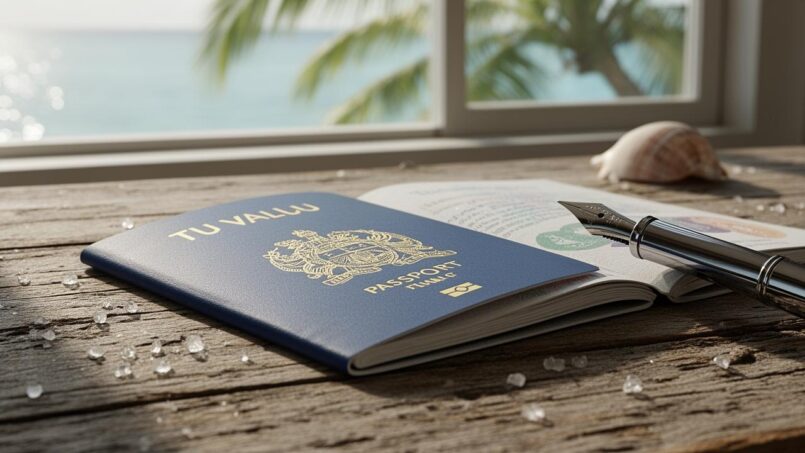
The ordinary passport is sky blue (azure) in color. The cover displays the official seal of Tuvalu centered, stamped in gold. The word “Tuvalu” appears above the seal and the word “Passport” below. Inside, there is an area for the photograph, with fields for Type, Issuing Country Code, Passport Number, Surname, Given Names, Nationality, date and place of birth, dates of issue and validity. Pages are numbered and bear the watermark of the coat of arms and the phrase “Tuvalu Passport.” The standard validity of the ordinary passport is five years from the date of issue, possibly extended once by missions up to a total of ten years, after which a new passport is mandatory.
Diplomatic passport
The diplomatic passport, reserved for holders of official functions and certain dignitaries, is red. The cover features the same seal as the ordinary passport, with “Tuvalu” at the top and “Diplomatic Passport” at the bottom. Its validity is ten years from issuance. Although it provides travel facilities for its holder, it confers no difference in status regarding citizenship: citizenship remains defined by nationality law, not by this document.
Inscribed data and usage
The introductory text of the passport reminds that the Governor-General, on behalf of the Sovereign of Tuvalu, requests foreign authorities to allow the holder to pass freely and to grant assistance and protection if needed. The passport includes a description of the holder (height, eye and hair color, occupation, distinguishing marks), and may mention a spouse or children if included, even though this practice is becoming rarer.
A document like a passport does not guarantee admission to another country, as each sovereign state decides entry conditions. Even a citizen must present a valid passport to enter Tuvalu.
Where and how to submit a passport application in Tuvalu?
Obtaining a passport from the country of Tuvalu follows well-defined paths, which vary slightly depending on whether you are in Tuvalu or abroad, whether it is an adult or a child, a first passport or a renewal.
On Tuvaluan territory: the standard route
In Funafuti, the route is relatively simple. The Immigration Office, located in the government building in Vaiaku, is the main point of entry. Residents of the outer islands must travel to Funafuti to submit an application, or give power of attorney to a relative to collect the form and submit it.
The administration has set up a fairly logical process:
To obtain a passport in Wallis and Futuna, the steps are as follows: 1. Get an application form from the Immigration Office or the Mobility Pathway Hub on Te Auala O Fogafale road; 2. Have a compliant photo taken at Pese Prints or Tokotu Printery; 3. Gather identity and citizenship evidence (long-form birth certificate, citizenship certificate, old passport); 4. Pay the fees at the Treasury (Treasury office in the same building); 5. Submit the form, photo, supporting documents, and payment receipt to the Department of Immigration.
The processing time announced for a standard application is about two weeks. In case of urgency, an express processing is offered with higher priority fees and a reduced timeframe of three working days, provided all documents are complete.
Applying from abroad: role of High Commissions and missions
For citizens residing abroad (New Zealand, Fiji, United States, United Kingdom, India, etc.), the contact point is generally the Tuvalu High Commission or a diplomatic mission. These representations do not issue new passports, but they play a key role in collecting applications, verifying documents, advising on procedures, and, in some cases, extending the validity of an existing passport.
A very common pattern, particularly at the High Commission in Wellington, relies heavily on electronic exchange:
– all required documents (form, digital photo, scan of old passport, proofs of citizenship, signatures on A4 paper, proof of payment) are sent by email to the mission;
– fees are paid by bank transfer to the official account of the High Commission, with the applicant’s name as reference;
– the mission checks that the file is complete, then transmits it to Funafuti for processing;
– once the passport is produced, it is sent to the mission, then to the applicant (by PO box, on-site collection, or postal/courier service depending on the case).
The contact details of the Chief Immigration Officer (phone, fax) also remain a channel for obtaining information or resolving specific issues, but the preferred channel for applications from outside the country remains the competent mission.
Detailed procedures for adults
Adults, defined in practice as persons aged 18 and over, follow a relatively strict protocol to obtain or renew a passport from the country of Tuvalu.
Form and identification
The main form (often referred to as Form 1A) must be filled in by the applicant’s hand, in block capitals for surnames and given names. It includes several sections:
– personal information (name, former names, date and place of birth, occupation, physical characteristics);
– family details (if married woman, husband’s or ex-husband’s full names, place and date of marriage);
– information on citizenship (by birth, descent, naturalization, marriage);
– if applicable, sections to include spouse and children in the same passport.
The form must be signed by the applicant and countersigned by a witness of good repute, such as a Member of Parliament, minister of religion, senior civil servant (grade 5 or above), island president, officer authorized to administer oaths, or a person of equivalent status who knows the applicant personally. This witness also certifies the authenticity of a photograph by writing on the back a phrase such as “I certify that this is a true likeness of Mr./Mrs./Miss…” followed by their signature.
Photos: strict requirements
Photographs must meet precise criteria, whether in Funafuti or via the system set up with Pese Prints. The logic is to ensure a clear and recent image of the face:
– completely white background, no shadows;
– full face view, no hat or head covering;
– no t-shirt or tank top, no jacket or superfluous accessories;
– no visible jewelry (earrings, necklaces, etc.);
– for men, a “Bula” shirt or equivalent is encouraged.
Missions abroad often require a digital photo submission (soft copy), accompanied by a specific payment for physical printing in Funafuti, for example 20 NZD paid into a dedicated Pese Prints account with the holder’s name as reference.
Proof of citizenship and civil status
Required documents vary depending on how citizenship is held:
For citizens born in Tuvalu: birth certificate (long version) or old passport. For those born abroad to a Tuvaluan father: birth certificate, parents’ marriage certificate, and documents of the father. For naturalized persons: certificate of naturalization or citizenship. For wives: marriage certificate and husband’s nationality documents.
In case of name change (other than marriage), documentary proof is mandatory (court order, deed poll, etc.). Documents not in English must be translated and the translation duly authenticated.
Signatures and payment
The system set up with certain missions, like the High Commission in New Zealand, requires additionally providing a blank A4 sheet with at least four signatures of the applicant. This precaution serves to prevent fraud and to have signature specimens for future verification.
Payment is made by transfer to the mission’s official bank account (e.g., “Tuvalu High Commission” starting with 03‑0155…). The applicant’s name must be mentioned as the transfer reference, and the receipt or screenshot must be attached to the digital file.
The fees generally involve two levels: a “normal” rate with a processing time of about 14 working days, and an “urgent” rate offering processing in three working days, with both timeframes starting from receipt of all documents and excluding shipping time for the passport to reach the applicant.
Lost or stolen passport: mandatory reporting
A frequent point of blockage concerns lost or stolen passports. Tuvalu requires that a loss be reported to the police. Without a certificate or police report formally mentioning the loss of the document, the Department of Immigration will refuse to process a new application, even if the original passport had already expired.
For a passport still valid at the time of loss, a financial penalty is added to the base fees. The amounts mentioned in working documents (e.g., a penalty of around 180 NZD or 160 AUD) illustrate the authorities’ desire to discourage negligence and ensure traceability of travel documents.
Specific procedures for children
Passport applications for minors follow the same general logic, but with enhanced requirements regarding parental consent and proof of citizenship.
Form and consent
For a child under 18, a separate form (often called Form 1B) is used. It must be signed by the parent or legal guardian, and accompanied by a separate signed consent letter when the procedure is via a mission abroad. This parental consent is central to preventing international abductions or disagreements between parents.
If the child can write, the administration requires an A4 sheet with at least four signatures. If the child cannot write yet, this condition is not required.
Proof of citizenship of the child
For a child who already holds a Tuvaluan passport, a scanned copy of the biographical page of the old passport is generally sufficient, alongside the birth certificate and parental documents.
For a child born abroad who has never had a passport, the procedure is more burdensome:
To obtain a Tuvaluan passport, you must first register your birth certificate with a Tuvaluan mission. Then, submit an application for citizenship confirmation via a dedicated form, accompanied by payment of the fee (120 NZD). Finally, once the confirmation letter is received, you can submit your passport application.
This double step – citizenship, then passport – explains why applications for children born abroad can take several weeks to several months, especially if they go through an embassy or consulate.
Fees and processing times for children
The fee schedules used by missions, particularly in New Zealand, clearly distinguish between adults and children. For example, available data indicates:
– a “normal” rate for a child of about 70 NZD with a processing time of 14 working days;
– an “urgent” rate around 120 NZD with processing in three working days.
Photo fees remain similar to those for adults (20 NZD paid to a photo provider when the image is supplied digitally and must be printed in Funafuti).
Pitfalls and frequent causes of delay
Tuvaluan authorities identify several recurring causes of blockage or delay in passport applications from the country of Tuvalu.
The most frequent are: communication errors, time management problems, and interpersonal conflicts.
A passport application can be rejected for several reasons: failure to declare a lost or stolen passport, non-compliant photos (non-white background, shadows, inappropriate clothing, accessories), files of persons born abroad without citizenship confirmation, lack of proof of payment or applicant’s name reference on the transfer, and incomplete or unsigned forms.
Missions and the Department of Immigration regularly remind that an incomplete file will not be transmitted to Funafuti for processing until it is regularized.
Citizenship by investment and “investor passports”: what the passport is not
The case of Tuvalu is often cited in debates about “citizenship by investment programs.” The reality is more nuanced. To date, Tuvalu has no active program granting citizenship in exchange for a financial investment. Between 2020 and 2022, the government studied and budgeted for setting up such a scheme, but no specific legislation was enacted.
The Passports Act allowed the Investment Passport Committee to issue a 5-year investor passport, without citizenship, to investors and their families meeting strict conditions and paying high fees, to enter and reside in Tuvalu.
A 2003 investigation by the US immigration service confirmed this distinction: a Tuvaluan passport issued to an investor did not constitute recognition of Tuvaluan citizenship. This mechanism is now considered dormant. For a genuine citizenship-by-investment program to emerge, a fundamental amendment to the Citizenship Act or the adoption of a dedicated law would be required, which is not the case to date.
For applicants for citizenship, the conclusion is clear: you do not become a citizen, and therefore eligible for a passport from the country of Tuvalu, through a simple financial investment. Only the paths provided by the Constitution and the Citizenship Act (birth, descent, registration, naturalization) open this right.
As is often the case in small island states, fee schedules have evolved over time and may vary depending on the authority publishing the information (ministry, diplomatic mission, internal regulations). Nevertheless, certain benchmarks stand out clearly.
Overview of passport fees (missions / High Commission scheme)
The following table summarizes the most consistent data for applications processed via the High Commission (particularly Wellington), in New Zealand dollars:
| Type of application | Applicant | “Normal” fee | Indicative processing time | “Urgent” fee | Indicative processing time |
|---|---|---|---|---|---|
| Passport (new or renewal) | Adult (18+) | 90 NZD | 14 working days | 180 NZD | 3 working days |
| Passport (new or renewal) | Child (<18 years) | 70 NZD | 14 working days | 120 NZD | 3 working days |
| Photo printing (soft copy) | Adult or child | 20 NZD | – | – | – |
| Penalty for lost passport (valid) | Adult or child | ~180 NZD or 160 AUD | – | – | – |
These fees are in addition to any fees for a citizenship procedure (citizenship confirmation by descent, naturalization, registration), which are subject to separate schedules provided for in the citizenship fees regulations.
Overall processing time and channels
Once the complete file is received by the mission or the Department of Immigration, internal processing times are relatively short, especially for “urgent” cases. But the physical delivery of the passport from Funafuti to the applicant, often via New Zealand or Fiji, can add several days or even weeks, especially for postal shipments to remote islands or countries without direct connections.
Reported experiences indicate: significant results in the field of research.
– one to two weeks for applications processed entirely within the country (Funafuti, local residents);
– a few weeks to several months for applications submitted via missions, especially when a preliminary citizenship confirmation step is required.
Passport from the country of Tuvalu and international mobility: an example with Australia
Beyond the ability to travel, the passport from the country of Tuvalu has become a strategic key for certain specific migration schemes. A prime example is the Falepili Mobility Pathway, or “Treaty stream visa,” established with Australia.
This program allows, each year, a contingent of Tuvaluan citizens (up to 280 people, including spouses and children) to obtain permanent residence in Australia. Selection is made by ballot (lottery), based on an online registration.
To register as a primary applicant, you must:
– be a citizen of Tuvalu;
– be at least 18 years old;
– be born in Tuvalu yourself, or have a parent or grandparent born in Tuvalu;
– not have acquired citizenship by investment;
– not be a New Zealand citizen;
– and, crucially, hold a valid passport from the country of Tuvalu.
Without a passport, it is impossible to participate in the ballot. Selected individuals then have a limited period (60 days) to submit a visa application, with additional fees (200 AUD for the primary applicant, 50 AUD per dependent), and remain responsible for funding their medical checks, police certificates, air tickets, etc.
This example illustrates how the passport from the country of Tuvalu is not limited to a simple travel document: it also becomes the key to a range of mobility opportunities, whether for special programs like Falepili, visa procedures for Australia, India, or other countries, or third-country passport procedures (Dutch, British, etc.) requiring proof of residence or status in Tuvalu.
In summary: the general logic of obtaining a passport from the country of Tuvalu
Obtaining the passport from the country of Tuvalu relies on a stable legal and administrative framework, but one that is particularly demanding regarding proof of citizenship and accuracy of documents.
The logic can be summarized as follows:
To obtain a Tuvaluan passport, you must: 1) be a citizen of Tuvalu (by birth, descent, registration, or naturalization); 2) register births abroad with a Tuvaluan mission and obtain a citizenship confirmation letter if necessary; 3) fill out the appropriate form (adult or child) with required witnesses and signatures; 4) provide compliant photos, civil status documents, citizenship certificates, old passports, and certified translations if applicable; 5) pay the fees (normal or urgent, adult or child) indicating your name as the transfer reference; 6) send the documents by email if possible and wait for confirmation of a complete file; 7) in case of loss, file a police report and provide it to the administration.
From there, the issuance of a passport from the country of Tuvalu falls under the authority of the Chief Immigration Officer in Funafuti, supported by a network of diplomatic missions that serve as an interface between citizens in the diaspora and the central administration. For those who master these rules, the system proves rigorous but predictable, with a constant red line: without citizenship, there is no passport. And without accurate documents, no application moves forward.
A heritage project or a question? Contact us now to speak with a wealth management expert.
Disclaimer: The information provided on this website is for informational purposes only and does not constitute financial, legal, or professional advice. We encourage you to consult qualified experts before making any investment, real estate, or expatriation decisions. Although we strive to maintain up-to-date and accurate information, we do not guarantee the completeness, accuracy, or timeliness of the proposed content. As investment and expatriation involve risks, we disclaim any liability for potential losses or damages arising from the use of this site. Your use of this site confirms your acceptance of these terms and your understanding of the associated risks.

Cyril Jarnias is an independent expert in international wealth management with over 20 years of experience. As an expatriate himself, he is dedicated to helping individuals and business leaders build, protect, and pass on their wealth with complete peace of mind.
On his website, cyriljarnias.com, he shares his expertise on international real estate, offshore company formation, and expatriation.
Thanks to his expertise, he offers sound advice to optimize his clients' wealth management. Cyril Jarnias is also recognized for his appearances in many prestigious media outlets such as BFM Business, les Français de l’étranger, Le Figaro, Les Echos, and Mieux vivre votre argent, where he shares his knowledge and know-how in wealth management.





