
 Published on and written by Cyril Jarnias
Expatriating to Tuvalu, this string of nine islands in the heart of the Pacific, has nothing to do with a simple tropical change of scenery. You settle in one of the smallest countries in the world, where barely less than 10,000 people share a tiny territory, and where nearly 60% of the population lives on the capital atoll of Funafuti. It is also a deeply communal, strongly Christian society, structured by ancient Polynesian customs and a system of traditional governance that continues to shape daily life.
Understanding social codes is crucial: gender relations, the role of family and the Church, the authority of customary chiefs, ways of greeting, dressing, participating in festivities, or speaking in public are strong markers. Ignoring them can lead to isolation or serious offenses.
A small, largely patriarchal, and very communal society
Tuvalu is a micro-state, but also a micro-society. With fewer than 10,000 residents estimated in 2024, and 11,000 inhabitants if including the broader figures used in some analyses, almost everyone is connected by kinship, home island, or religious ties. This reinforces the weight of reputation, family obligations, and the neighborly gaze.
The basic social unit is the *kaaiga* (extended family), where several nuclear households share a single plot of land. The *fale* (house/home) is administered by the *pule*, usually the oldest active male, who makes decisions, assigns tasks, manages conflicts, and represents the household at community meetings.
Above the household comes the puikaainga (land group), then the kaaiga in its very broad sense, which mobilizes for major events: weddings, funerals, religious ceremonies, or big celebrations. At the village level, space is divided into potu (neighborhoods) that form feituu, symbolic “sides” responsible for organizing gift exchanges and cooperation.
This social architecture rests on a set of values prominent in political and community discourse: alofa (love, care, generosity), aava (respect), fealofani (living in harmony), fakatalitonugina (trustworthiness), fakatau fesoasoani (mutual aid), and paagatasi (equity, unity). For an expatriate, these terms are not just words but touchstones for reading local behavior.
Society remains largely patriarchal: men are seen as providers and decision-makers, while women mostly handle domestic work, childcare, cooking, cleaning, and caring for the elderly or sick. Despite some loosening of roles, especially in Funafuti, the division of responsibilities remains very pronounced.
Formal employment figures reflect this gap: about 90% of working-age men have a job, compared to 57% of women. When they do work, more than 60% of women report earning less than their husband or partner. They are concentrated in teaching, nursing, and administrative tasks, while men dominate engineering, construction, or technology fields.
The decisive role of chiefs and the Falekaupule
To understand public life in Tuvalu, one must grasp the role of the Falekaupule – both a traditional assembly of elders and a meeting house. Each island has its own Falekaupule, an institution recognized by the Constitution as the “traditional government authority.” The Falekaupule is based on aganu (customs) and works closely with the Kaupule, a kind of elected executive council.
Concretely, the Falekaupule and the Kaupule handle a wide range of local matters:
| Areas of action for Falekaupule/Kaupule | Examples of responsibilities |
|---|---|
| Planning & buildings | Village planning, public constructions |
| Agriculture & forestry | Management of plantations, tree protection |
| Fisheries & lagoon | Fishing rules, closed areas, marine zones |
| Markets & commerce | Regulation of local sales |
| Health & hygiene | Public cleanliness, prevention of certain nuisances |
| Public order & safety | Community regulations, customary sanctions |
| Culture & heritage | Protection of sites, ancient objects, skills |
| Local civil registration | Recording marriages, births, deaths |
Meetings are held in the community building – maneapa or falekaupule – a central village space, often painted white (lase) from burnt coral. This is where debates, celebrations, and welcomes for distinguished visitors take place. The spatial arrangement is codified: elders, chiefs, and religious authorities occupy the positions of honor. Speaking is generally reserved for men over 50 or 60, depending on the island. Young people and often women do not speak or do so very little, out of respect for hierarchy.
For an expatriate, the Falekaupule influences two essential aspects: first, it makes daily decisions (market opening hours, fishing rules, permission for a worship service, organizing a festival) that do not fall solely under the national government; second, its power is enshrined in law, and some customary decisions are validated by the courts to preserve local stability and culture.
The system is not absolute, however: the Constitution affirms the supremacy of the national Parliament for matters of general interest. Judges have thus invalidated customary decisions when they severely infringed on a politician’s political rights or on national principles. But in everyday life, a foreigner is well advised never to underestimate the weight of the Falekaupule, nor that of the Ulu Aliki (paramount chief) and the aliki (sub-chiefs).
Religion: an officially Christian country
The religious dimension is omnipresent. Tuvalu officially presents itself as a “Christian nation,” founded on Christian principles, local culture, and the rule of law. The vast majority of inhabitants belong to Christian churches, with the Church of Tuvalu – Te Ekalesia Kelisiano Tuvalu (EKT) – overwhelmingly dominant.
Estimates vary by source, but all are very high:
| Source / approximate year | Percentage of Christians | Percentage EKT (Church of Tuvalu) | Other religious groups |
|---|---|---|---|
| 2020 database | 95% Christian | Majority not detailed | 3.3% atheist/agnostic, 1.7% Baha’i |
| Earlier report | 91% Protestant | 91% EKT | Minorities: Catholic, Adventist, etc. |
| 2022 census | — | 86% EKT | Other Christian denominations + minorities |
Around this Protestant axis are minorities of Adventists, Catholics, Pentecostals, Baha’is, but also a small Muslim core (Ahmadiyya in particular) and some independent evangelical groups. Most are based in Funafuti.
The EKT pastor influences the spiritual, social, and political spheres in Tuvalu. Customary chiefs, linked to the Church, protect religious cohesion against proselytizing groups. The law requires Falekaupule approval and registration for any new religious group, under penalty of a ban on public meetings.
For an expatriate, several concrete consequences:
Sunday is a sacred day in Tuvalu: life stops, people go to church in formal, modest attire (collared shirt for men, long skirt for women) and spend time with family. Avoid noisy work, loud music, or conspicuous sports activities, especially outside Funafuti. A foreigner (Palagi) is welcome at Sunday worship, even out of respectful curiosity; it facilitates integration. Finally, any new religious initiative (prayer group, meditation) must be approached with caution, as what is ordinary in the West may be perceived as intrusive in Tuvalu.
Language and greeting codes: more than mere formulas
Although English is an official language alongside Tuvaluan, it is not the language of daily life. Outside of government offices, international exchanges, and some urban circles, Te ‘Gana Tuvalu dominates. Making the effort to learn a few words is both a sign of respect and a tool for integration.
Some useful basics:
| English | Tuvaluan |
|---|---|
| Hello / hi | Talofa / Tālofa |
| Hello everyone | Talofa koutou |
| Goodbye (to those leaving) | Tofa / Fano la / Tōfā |
| Goodbye (to those staying) | Nofo la |
| Please | Fakamolemole |
| Thank you | Fakafetai / Fāfetai |
| Excuse me (to get attention) | Tulou |
| I don’t understand | Au e sē malamalama |
| How are you? (singular) | Ea koe? / E ā koe? |
| I’m fine, thank you | Au e lelei, fakafetai / Au e malosi, fakafetai |
The way of greeting also follows an unspoken code. You say “Talofa” upon arrival, shake hands with men, often suffice with a slightly tilted head nod for women, unless some familiarity exists. The cheek kiss, common in Europe, is seen as a foreign, intrusive, or even inappropriate gesture in formal contexts or with strangers.
In this country, where the kaaiga is central, asking about the well-being of parents, spouse, and children is a sign of consideration, not nosiness. Ignoring this aspect can be perceived as coldness.
Finally, politeness also comes through mastering a few religious terms and common wishes, which are ubiquitous: Manuia te aso! (Have a nice day), Manuia te malaga! (Have a good trip), Manuia te pō! (Good night).
Dress codes and relationship to the body: modesty first
In a country where the Church and elders hold sway, the way you dress is far from neutral. The norm, especially in villages and at formal events, is modesty. Shoulders and knees covered, loose fabrics, no deep necklines or tight clothing.
Women often wear long dresses or te bee (lavalava) tied around the waist. When sitting in a meeting hall or at church, they usually cover their legs with the fabric. In some Falekaupule on outer islands, women wearing pants during meetings or ceremonies is still frowned upon.
Men wear the lava lava or sulu with a collared shirt, especially on Sundays and for ceremonies. Women wear the puletasi, and leaf skirts (titi tao, titi kaulama) are reserved for dances and festivities, with a protocol including flower necklaces (fou), bracelets, plant belts, and perfumes.
For an expatriate, the classic mistake is to transpose beachwear into daily attire, including when going to the village or store. Yet, even though the climate is hot and humid, micro-shorts, thin tank tops, or swimsuits worn in town clash with local norms. The simple rule: near homes, at the Falekaupule, at church, or in an institutional setting, dress soberly; light clothing is for the beach or private settings.
Family, hierarchy, and respect: what lies behind a polite “yes”
The key word in social relations is aava – respect. It takes a thousand forms: respect for elders, chiefs, pastors, parents, family obligations, customs, and unspoken rules.
The *pule* (oldest man) holds authority, while women manage daily life without final decision-making power, though urbanization and female employment in Funafuti are changing this dynamic. Children are raised in obedience (*fakalogo*) and collectivism, with tasks like looking after younger siblings and helping the extended family.
Certain relationships are surrounded by very strict taboos. The brother-sister bond is sacralized: the brother owes his tuagaene (sister) extreme protection and deference; it is “forbidden to cause the sister’s tears.” Similarly, opposite-sex cousins (up to the second or third degree) are expected to avoid joking, discussing intimate topics, or even being alone together. These rules aim to prevent any real or symbolic risk of incest.
Maternal uncles (tuaatina), meanwhile, have a special responsibility toward their sister’s children. They are expected to help them without counting the cost in times of need, even at their own expense. These expectations deeply structure the circulation of gifts, services, and money within kinship.
For an expatriate, these codes translate very concretely into interactions: a polite “yes” from a young person may mean “I hear you” rather than “I agree,” because directly contradicting an elder remains difficult. Public criticism of a chief or pastor is hardly acceptable. And directly addressing a young person in front of their parents in a very egalitarian Western tone can cause deep discomfort.
Gift obligations, mutual aid… and financial pressure
Tuvalu operates on a deeply redistributive model. The practice of family and community contributions – often referred to collectively as fakalavelave – permeates economic life. Weddings, funerals, major birthdays, religious ceremonies, fundraising for building or renovating a church, for a village project: every event mobilizes a vast network of relatives and allies.
Gifts (money, food, mats, necklaces, durable goods) create moral credit, not an accounting calculation. Refusing to give is seen as a sign of selfishness or unreliability.
A typical exchange session might take place at a wedding: the bride’s and groom’s families compete to display their koloa (riches) on the village square, offering mats, food, fabrics. Gifts often continue for several days after the ceremony.
For Tuvaluans, social obligations are constitutive of the ‘good life’ and local wealth, measured in land, relationships, and the ability to give, rather than savings. For modest families, especially in the context of urbanization or migration, this dynamic can lead to debt or sacrifice of essential expenses.
An expatriate, if integrated into a host family or community, will quickly be invited to participate, even if only symbolically. They will not be asked to fund everything, but to engage in this cycle of gifts and counter-gifts. Responding, even modestly, is often seen as proof that they respect the faiga te Alofa – the system of shared generosity.
Work, fishing, and the question of gender
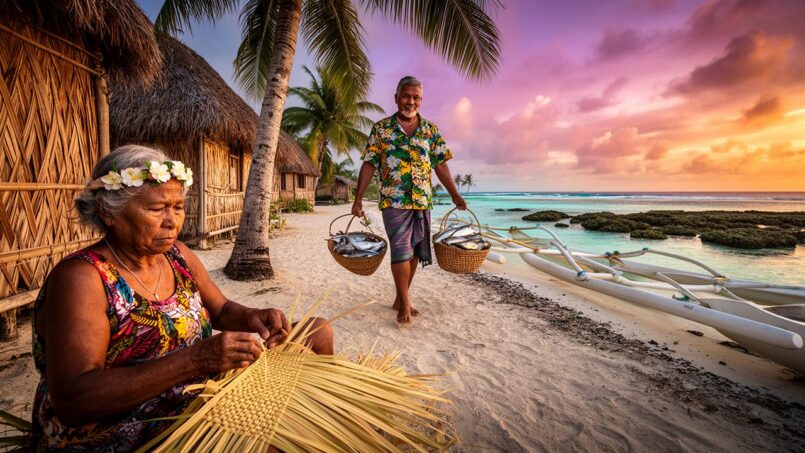
In a country where the economy relies heavily on the sea, fishing is not just an economic activity but a cultural pillar. Men fish in the lagoon, on the reef, or offshore, using various techniques (nets, lines, trolling, bottom fishing, traditional canoes). In many families, the catch is first shared or consumed, before possibly being sold. It is estimated that fish consumption can reach 80 kg per person per year on some islands, among the highest rates in the world.
Women play a key role in shellfish gathering, fish preparation, and handicrafts, but these tasks are often not recognized as economic work. The use of outboard motors and commercial offshore fishing has reinforced men’s position, relegating women’s fishing to a leisure activity.
For an expatriate working in development, fisheries, environment, or local economy projects, this means not underestimating the gender dimension. Resource management decisions are overwhelmingly made by men in the Falekaupule, even though women are strongly affected by shortages, pollution, or overfishing. It is therefore crucial to design approaches that truly include women’s voices, beyond just meetings of elderly men.
The country has adopted Te Paagatasi a Tuvalu, a national gender equity policy aimed at women’s economic empowerment, public participation, and combating gender-based violence, but power inequalities persist in daily practice.
Domestic violence and gender relations: a sensitive but central issue
Beneath the surface of hospitality and apparent gentleness, available data reveal a troubling reality: nearly 44% of women report having experienced violence from an intimate partner. A significant portion of the population, both men and women, still consider certain acts of domestic violence justifiable. However, surveys also show a clear decline in this tolerance, from 70% in 2007 to about 30% in 2020.
In 2014, Tuvalu adopted a law on family protection and domestic violence, along with a national gender policy and campaigns like the annual ’16 Days of Activism’ since 2020. Local organizations such as Fatu Lei (Women for Change) and the Tuvalu National Council of Women offer counseling, training, and support programs.
For an expatriate, it is important to acknowledge these realities without falling into stereotypes. Several points should be kept in mind:
Traditional culture has long pushed women to endure everything in silence to preserve family honor. Local authorities must find a delicate balance between respect for culture and fundamental rights. Western systems cannot be mechanically exported: it is necessary to understand local terms like *fakasauaaga i loto i kaaiga* to refer to family violence, as well as the logic of customary mediation.
If working professionally on these issues, one must be prepared to navigate between state institutions, chief councils, the Church, and women’s associations, while remaining very attentive to issues of confidentiality and victim safety.
The time of ceremonies: Fatele, gifts, and protocol
Tuvaluans love community gatherings: national holidays, welcome and farewell ceremonies, festivals, weddings, funerals, Independence celebrations, Te Aso Faka-Tuvalu (National Day). These moments are punctuated by music, dance, food, and highly precise protocols.
The fatele is at the heart of these celebrations: participatory dance and song that tell stories, celebrate people, islands, and events. Each island has its own style of fatele, its choreography, its costumes. During festivals or inter-island competitions, groups compete on the quality of dance, music, costumes, and also on the scale of generosity.
Welcome ceremonies, for instance when an official delegation arrives on an island, follow a fairly consistent pattern.
1. Arrival of guests, guided by a community representative to the gathering area; 2. Opening prayer, delivered by the pastor or a religious leader; 3. Welcome speech given by the unimwane (oldest man) or an unaine (oldest woman) or a community leader; 4. Presentation of head garlands (te bau or fou) by girls or women to the guests, as a sign of respect; 5. Sequence of dances and songs, often in fatele; 6. Meal or refreshment, where abundance and sharing are central.
A surprising trait for a foreigner: the audience sometimes shows appreciation for dancers by spraying them with perfume or talcum powder. A joyful and affectionate gesture, it is part of local folklore.
After funerals, the family receives food, fabrics, mats, and money. A final feast closes the mourning period and symbolically redistributes a portion of the goods received.
To participate in these moments without causing offense, keep a few principles in mind:
– Arrive on time (or rather, at “local” time, i.e., within a certain window) and dressed respectfully;
– Let elders and local authorities speak first;
– Do not refuse offered food or drink, even if you barely taste it;
– Avoid standing in the front row with a camera without being invited;
– If you wish to contribute (a speech, a song, a small gift), prepare something simple and sincere, and announce it in advance to a responsible person.
Justice, individual rights, and custom: a particular articulation
Another point that may surprise an expatriate used to Western rule-of-law states: the way Tuvalu attempts to reconcile individual rights and collective customs.
Within the Tuvaluan constitutional framework, a Falekaupule restricted preaching by minority churches on its island, on grounds that it could be ‘divisive’ or ‘shocking’ to the community. The court upheld this measure as constitutional, ruling that social peace and cultural cohesion should take precedence.
Conversely, when chiefs attempted to “ban” a member of parliament who did not follow their political directive, the court ruled that they had exceeded their authority and violated the principle of parliamentary supremacy and national balance.
For someone coming to settle and possibly work in law, human rights, or development, it is crucial to grasp this subtle balancing act: the reference to custom is not mere folklore; it is a recognized legal foundation, but it is itself bounded by other constitutional principles.
Climate, migration, and attachment to land
Even if your expatriation project is motivated by a job, a short mission, or Pacific curiosity, you will inevitably come into contact with the grand narrative that runs through Tuvalu today: climate change and the future of the islands.
Local authorities have chosen to make in situ adaptation their priority. The official message is clear: it is not about abandoning the islands, but about securing them, protecting coasts, raising land if necessary, negotiating treaties (such as the Falepili Union Treaty with Australia) that guarantee the country permanent state recognition, even in the event of sea-level rise.
Migration (seafarers, seasonal workers, students) is part of Tuvaluans’ adaptation strategies, bringing in income and skills. However, total exodus is overwhelmingly rejected because the land, ancestral graves, and community are essential to their identity.
For an expatriate, this means that conversation about “leaving,” “climate relocation,” or the implicit suggestion that “you’ll end up being relocated elsewhere anyway” can be hurtful or ill-informed. Conversely, showing interest in how Tuvaluans organize to stay, to preserve their fishing practices, their lands, their Maneapa, is a way to resonate with their priorities.
Working with Tuvaluans: a few attitude keys
Living and working in Tuvalu is not just about knowing a few words of the language or dressing properly. It is also about adopting an adapted relational posture.
Some deeply ingrained cultural markers can help adjust your way of being:
To work effectively in this context, prioritize consensus-building through lengthy discussion and compromise rather than direct confrontation. Respect elders by adopting an attitude of a listening partner, without lecturing. Give centrality to relationships by favoring informal exchanges over a meal, which are essential. Show availability and take care of colleagues during personal hardships—that matters more than technical aspects. Finally, accept the apparent slowness that corresponds to the time needed to transmit information through multiple social relays.
Settling in Tuvalu ultimately means accepting entry into a culture where the person is inseparable from the group, where land and sea are far more than resources, where religion permeates nearly all social life, where men still largely dominate the public sphere but women are beginning to hold important leadership positions in administration and justice.
It is not a small adjustment, but those who take the time to tame these differences discover a society with a remarkable capacity for organizing mutual aid, maintaining bonds despite family dispersion, and defending, in the face of major global challenges, its own conception of dignity and sovereignty.
Observer of society
For the expatriate in preparation, the best compass remains that word found in many songs, prayers, and speeches in Tuvalu: alofa – love, care, concern for others. Understanding it, and especially practicing it within the Tuvaluan framework, may be the biggest cultural difference… and the greatest learning opportunity.
A project or a question about your estate? Contact us now to speak with a wealth management expert.
Disclaimer: The information provided on this website is for informational purposes only and does not constitute financial, legal, or professional advice. We encourage you to consult qualified experts before making any investment, real estate, or expatriation decisions. Although we strive to maintain up-to-date and accurate information, we do not guarantee the completeness, accuracy, or timeliness of the proposed content. As investment and expatriation involve risks, we disclaim any liability for potential losses or damages arising from the use of this site. Your use of this site confirms your acceptance of these terms and your understanding of the associated risks.

Cyril Jarnias is an independent expert in international wealth management with over 20 years of experience. As an expatriate himself, he is dedicated to helping individuals and business leaders build, protect, and pass on their wealth with complete peace of mind.
On his website, cyriljarnias.com, he shares his expertise on international real estate, offshore company formation, and expatriation.
Thanks to his expertise, he offers sound advice to optimize his clients' wealth management. Cyril Jarnias is also recognized for his appearances in many prestigious media outlets such as BFM Business, les Français de l’étranger, Le Figaro, Les Echos, and Mieux vivre votre argent, where he shares his knowledge and know-how in wealth management.





